INTRODUCTION
Spina bifida is a common central nervous system birth defect resulting from failure of the spinal column to close properly during the early stages of embryological development. The most severe and most common form of this malformation is myelomeningocele, which affects as many as 1 child per 1000 live births, despite recent decreases in Western countries attributable to prenatal folate supplementation (Canfield et al., 2005; Shurtleff & Lemire, 1995). Myelomeningocele is characterized by a protrusion of the spinal cord and meninges into a sac externally located above the spinal column.
Children with myelomeningocele display a range of primary brain abnormalities, including the Type II Arnold-Chiari malformation, which involves abnormalities of the hindbrain and posterior fossa; agenesis of the corpus callosum; and other more subtle developmental anomalies, such as heterotopias, polymicrogyria, and disordered lamination (Gilbert et al., 1986). Additionally, hydrocephalus develops in 80 to 90% of all cases, resulting in secondary brain insults: stretching and thinning of white matter tracts, including the corpus callosum and optic tracts; disruption of normal myelination; and thinning of the cortical mantle, especially in posterior regions of the brain (Del Bigio, 1993).
The neuropsychological outcomes associated with myelomeningocele and hydrocephalus have been summarized in several recent reviews (Erickson et al., 2001; Fletcher et al., 2004; Yeates et al., in press). As a group, children with myelomeningocele and hydrocephalus demonstrate deficits in IQ compared to age-matched peers. Performance IQ is often lower than their Verbal IQ, but mainly among Caucasian middle class samples with lower level lesions (Fletcher et al., 2004). Basic linguistic abilities are often intact, but deficits are seen in language pragmatics. Visuoperceptual, visuospatial, and constructional skills are usually poor, and selective memory difficulties are apparent, especially on tasks involving serial learning and spontaneous recall. Performance on measures of attention and executive functions is frequently poor, and corticosensory and motor skills are usually impaired. Academic skills in word recognition and spelling are often intact, but reading comprehension, written expression, and mathematical skills are typically poor.
Children with myelomeningocele and hydrocephalus have also been reported to show particularly marked deficits on tests that require speeded responses. For instance, compared to healthy children, they perform more slowly on measures of handwriting (Zivani et al., 1990), math fact retrieval (Barnes et al., in press), focused attention (Fletcher et al., 1996), and motor speed and dexterity (Grimm, 1976; Prigatano et al., 1983; Zeiner et al., 1985). Unfortunately, previous studies of response speed have relied on tasks that are confounded by other abilities known to be deficient in children with myelomeningocele and shunted hydrocephalus, such as motor skills or arithmetic knowledge.
We are not aware of any previous study using the Paced Auditory Serial Addition Test (PASAT; Sampson, 1956), which purportedly provides a relatively specific measure of working memory and information processing speed. On the PASAT, a series of digits is presented aurally at a controlled pace. The goal is to add each new digit to the digit immediately preceding it. The test involves four trials, each of which occurs at a progressively faster pace. The test is ordinarily scored based on the total number of correct responses at each presentation rate. Although the PASAT draws on multiple cognitive abilities, including general intellectual functioning and mathematical ability (Chronicle & MacGregor, 1998; Sherman et al., 1997; Wills & Leathem, 2004), it has been most strongly correlated with measures of working memory and processing speed (Crawford et al., 1998; Deary et al., 1991). Functional imaging studies have implicated multiple brain regions in PASAT performance, including those involved in auditory perception, speech production, working memory, and attention (Deary et al., 1994; Lockwood et al., 2004).
Concern has been raised regarding the traditional approach to scoring the PASAT. Some individuals cannot follow the task directions, but instead skip test items intermittently, adding every other pair of numbers correctly and thereby circumventing the task's demands on working memory. To account for this possibility, an alternative scoring system has been proposed in which only the number of consecutive correct responses (i.e., dyads) is scored (Fisk & Archibald, 2001). Studies using the dyad scoring system have demonstrated its utility in adults with white matter disease (Fisk & Archibald, 2001; Shucard et al., 2004; Snyder & Cappalleri, 2001; Snyder et al., 2001).
A children's version of the PASAT (CHIPASAT) has been developed that reduces demands on mathematical skills, by ensuring that the sum of any number pair never exceeds 10 (Dyche & Johnson, 1991; Johnson et al., 1988). Performance on the CHIPASAT has been shown in healthy children to be related to age, digit span, and the ability to solve oral arithmetic problems, but not to vocabulary knowledge (Dyche & Johnson, 1991; Johnson et al., 1988). Although the CHIPASAT has shown some sensitivity to attentional disturbance in children (Mendley & Zelko, 1999; Roodenrys et al., 2001), it has not been used in previous research to assess children with specific brain disorders.
The primary goal of the present study was to examine working memory and information processing speed in children with myelomeningocele using the CHIPASAT. Their performance was compared to that of healthy siblings using both traditional and dyadic scoring methods. Children with myelomeningocele were expected to make fewer correct responses and fewer consecutive correct responses (i.e., dyads) than healthy siblings. They also were expected to make more correct but nonconsecutive responses, reflecting a tendency to skip items because of difficulties mastering the working memory demands of the task. The study also sought to examine the relationship between CHIPASAT performance and standardized measures of working memory and processing speed. Their relationship was examined after controlling for general intellectual functioning and math skill. The analyses helped to determine whether the CHIPASAT provides a valid measure of working memory and information processing speed for children.
METHODS
Participants
Participants included 31 children with myelomeningocele and shunted hydrocephalus and 27 healthy siblings, all ranging from 8 to 15 years of age. The children with myelomeningocele had a documented history of hydrocephalus that was shunted shortly after birth, without any other serious neurological complications such as seizures or ventriculitis. They were selected from a data set of 56 children who participated in a larger study of neuropsychological functioning in spina bifida, based on having Full-Scale IQ scores on the Wechsler Intelligence Scale for Children-Third Edition (WISC-III; Wechsler, 1991) greater than 70. The 56 participants in the larger study represented 67% of all eligible children followed by a clinic for children with myelomeningocele located in a large teaching hospital. Study participants did not differ from nonparticipants in age, gender, ethnic status, or parental education.
Siblings were recruited from the families of children with myelomeningocele. They had to be free of any known neurological disorder or significant developmental handicap, based on parent report, and their Full-Scale IQ was greater than 70. Siblings were recruited from 77% of all eligible families. Many children with myelomeningocele did not have siblings or their siblings fell outside the study age range. Among children with myelomeningocele, the presence or absence of a sibling was not related to gender, ethnic status, age at testing, parental education, or Verbal or Performance IQ.
Table 1 presents a summary of demographic characteristics for the children with myelomeningocele and their siblings. The groups did not differ in gender or race, but they did differ in age at testing and Full-Scale IQ, with siblings being older and having higher IQ scores, t = 2.78, p < .01, and t = 8.33, p < .001, respectively.
Demographic characteristics of participants by group

Procedure
As part of a larger study, each child was administered a neuropsychological test battery that included the WISC-III (Wechsler, 1991), selected subtests from the Wechsler Individual Achievement Test (WIAT; Psychological Corporation, 1992), and the CHIPASAT (Dyche & Johnson, 1991; Johnson et al., 1988). The WISC-III Verbal Comprehension Index and Perceptual Organization Index were chosen as measures of general intellectual functioning rather than the Full-Scale IQ, to avoid confounding with measures of working memory and processing speed. The WISC-III Digit Span and Arithmetic subtests were treated as measures of working memory and the Coding subtest as a measure of information processing speed. The WIAT Mathematical Reasoning subtest was selected as a measure of math skill.
Because the original version of the CHIPASAT was recorded using a British speaker, we re-recorded the test with an American speaker. We also modified the instructions to be more understandable to American participants. Participants were provided with training on a practice trial at a rate of 2.8 seconds per digit, to help ensure that they understood the test and could perform it accurately. All children displayed an understanding of the task during the practice trial. After the practice trial, four standard trials were administered at rates of 2.4, 2, 1.6, and 1.2 second per digit. No criterion was used for discontinuation. The test was scored for the total number of correct responses, with a maximum of 60 on each trial. Additionally, the test was scored for the total number of consecutive correct responses (i.e., dyads) and total number of nonconsecutive correct responses. For instance, if a child responded “6, 9, 7, 7, 7” to the following series of digits, 2 4 5 3 4 1 6 2, then they would be credited with 4 total correct responses, including two consecutive correct responses (i.e., adding 2 and 4 and then 4 and 5) and two nonconsecutive correct responses (i.e., skipping the 5 and 3 dyad, adding 3 and 4, skipping the 4 and 1 dyad, and then adding 1 and 6). The last response, “7”, would be scored as an error (i.e., incorrect addition of 6 and 2).
Data Analysis
The performance of the two groups was compared using three multivariate repeated-measures analyses of covariance (ANCOVA). The dependent variables were total number of correct responses per trial, total number of correct dyads per trial, and total number of nonconsecutive correct responses per trial. Age was treated as a covariate in each analysis. Preliminary analyses indicated that no significant interactions existed between group and age for any of the dependent variables, consistent with the assumptions of ANCOVA.
Three hierarchical regression analyses were performed to examine the cognitive abilities influencing CHIPASAT performance. The dependent variables for the analyses were total correct responses on the CHIPASAT averaged across all trials, total correct dyads averaged across trials, and total nonconsecutive correct responses averaged across trials. For each hierarchical regression analysis, the same predictors were entered in the following three steps: (1) age and group membership (myelomeningocele vs. sibling); (2) WIAT Mathematical Reasoning, WISC-III Verbal Comprehension Index, and WISC-III Perceptual Organization Index; and (3) WISC-III Digit Span, Arithmetic, and Coding. Step 2 was intended to determine whether CHIPASAT performance was related to math skill and intellectual functioning after controlling for group differences and age. In turn, step 3 was intended to examine whether more specific measures of working memory and processing speed were related to the CHIPASAT independent of these more general abilities.
RESULTS
Group Comparisons
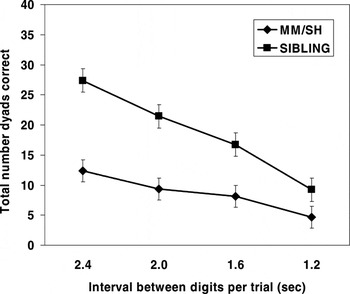
The siblings made more correct responses than children with myelomeningocele on the CHIPASAT, although the magnitude of group differences declined as the rate of presentation increased (see Figure 1). The group main effect was significant, F(1,55) = 13.21, p < .001. The overall group by trial interaction did not reach significance, F(3,53) = 2.53, p < .07, but the linear contrast for the group by trial interaction was significant, F(1,55) = 4.46, p < .05.

Total number correct responses per trial by group, with standard error bars. MM/SH = myelomeningocele and shunted hydrocephalus.
The siblings also had more correct dyads than children with myelomeningocele, with the magnitude of group differences again declining as the rate of presentation increased (see Figure 2). The group main effect was significant, F(1,55) = 14.83, p < .001, as was the group by trial interaction, F(3,53) = 6.26, p < .001.

Total number correct dyads per trial by group, with standard error bars. MM/SH = myelomeningocele and shunted hydrocephalus.
The children with myelomeningocele made more nonconsecutive correct responses than the siblings but only on the slower trials. As shown in Figure 3, the number of nonconsecutive correct responses declined across trials for the children with myelomeningocele, but increased slightly among the siblings. Thus, the group main effect did not reach significance, F(1,55) = 2.82, p < .10, but the group by trial interaction was significant, F(3,53) = 4.85, p < .005.

Total number nonconsecutive correct responses per trial by group, with standard error bars. MM/SH = myelomeningocele and shunted hydrocephalus.
Prediction of Individual Differences
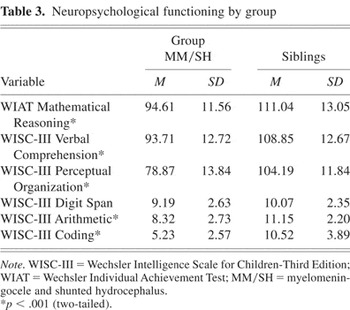
Table 2 presents the pooled within-groups correlations among the independent and dependent variables included in the hierarchical regression analyses, and Table 3 presents group means for the independent variables assessing neuropsychological functioning. Age was correlated significantly with all three dependent variables from the CHIPASAT. Both the WISC-III Arithmetic and Coding subtests had significant positive correlations with CHIPASAT total dyads and total correct responses, and the WISC-III Perceptual Organization index had a significant negative correlation with total nonconsecutive correct responses. The groups differed significantly on all neuropsychological measures other than the WISC-III Digit Span subtest.
Pooled within-groups correlations among measures in regression analyses

Neuropsychological functioning by group

Table 4 summarizes the results of the hierarchical regression analyses themselves. After controlling for age and group membership, general intellectual functioning, and math skills did not collectively account for significant variance in the average number of correct responses on the CHIPASAT, F(3,52) = 1.64, p > .05, although the WIAT Mathematical Reasoning score approached significance as an individual predictor, t = 1.86, p < .07. Measures of working memory and processing speed were significant predictors of the average number of correct responses, collectively accounting for 11% of the variance after taking into account age, group membership, intellectual functioning, and math skills, F(3,49) = 5.68, p < .01. The WISC-III Coding and Arithmetic subtests were both significant individual predictors of the average number correct, both t > 2.17, both p < .05.
Regression analysis with cognitive abilities as predictors of CHIPASAT performance

General intellectual functioning and math skills were significant predictors of the average number of correct dyads, accounting for 7% of the variance, F(3,52) = 3.37, p < .05. The WIAT Mathematical Reasoning score explained unique variance, t = 2.08, p < .05. After taking into account the other predictors, measures of working memory and processing speed also were significant predictors of the number of correct dyads, collectively explaining 8% of the variance, F(3,49) = 4.98, p < .01. The WISC-III Coding subtest accounted for unique variance, t = 3.40, p < .001. Notably, the WIAT Mathematical Reasoning score was no longer a significant predictor after taking into account the working memory and processing speed measures, t = 0.65, p > .05.
General intellectual functioning and math skills collectively predicted the average number of nonconsecutive correct responses, accounting for 12% of the variance, F(3,52) = 2.98, p < .05. None of the individual predictors accounted for unique variance, although the WISC-III Perceptual Organization Index approached significance, t = −1.91, p < .07, with higher scores predicting fewer nonconsecutive correct responses. Measures of working memory and processing speed did not collectively predict the number of nonconsecutive correct responses, F(3,49) = 0.41, p > .05, and none of the individual measures accounted for unique variance. The WISC-III Perceptual Organization Index continued to approach significance as an individual predictor after controlling for working memory and processing speed, t = −1.88, p < .07.
Group differences were less pronounced after taking into account the other cognitive measures. Group differences on total correct responses remained significant after taking into account intellectual functioning and math skills, t = −2.39, p < .05, but not after taking into account working memory and processing speed, t = −0.73, p > .05. Group differences on total dyads and on total nonconsecutive correct responses were no longer significant after controlling for intellectual functioning and math skills, t = −1.06 and t = −0.90, respectively, both p > .05, and also not after taking into account working memory and processing speed, t = 0.58 and t = −1.26, respectively, both p > .05.
DISCUSSION
As predicted, children with myelomeningocele and shunted hydrocephalus performed more poorly than healthy siblings on the CHIPASAT. They made fewer correct responses compared to the siblings, particularly on the slower trials. Notably, their performance of the task also differed qualitatively. They had fewer correct dyads but more nonconsecutive correct responses than the siblings. Indeed, of the correct responses made by children with myelomeningocele, more than half were nonconsecutive, even on the slowest trials. In contrast, the majority of healthy siblings' correct responses occurred in dyads, except on the fastest trial, when they had more difficulty responding as directed. These results indicate that children with myelomeningocele not only perform poorly on the CHIPASAT but also tend to respond in a way that avoids the working memory demands of the task and necessarily limits overall performance. The findings underscore the importance of the dyadic scoring system for the CHIPASAT and suggest that the traditional method of scoring confounds two distinct response styles, including one that circumvents the expected task demands (Fisk & Archibald, 2001).
Of interest, group differences on the CHIPASAT became less pronounced with increasing presentation rates. This finding may appear counterintuitive. More rapid rates of presentation might be expected to engender larger group differences, because of the apparently increased burden on processing speed. However, if the rate of presentation becomes too fast, then the task may become too difficult, even for healthy children, and actually less sensitive to group differences. We suspect this is what happened in this case. Indeed, both groups showed a decline in the total number of correct dyads across trials, although the decline was more rapid among the siblings. In contrast, the siblings actually showed a slight increase in the total number of nonconsecutive correct responses across trials, suggesting that they began to skip items, similar to the children with myelomeningocele. However, skipping test items is not very effective; it does not allow children to compensate for the faster rate of presentation and results in poorer performance. Thus, the children with myelomeningocele showed a decline in the total number of nonconsecutive correct responses at faster rates across trials, and the siblings showed only a slight increase.
An alternative interpretation for the decline in the magnitude of group differences across trials is that it reflects the particular difficulties that children with myelomeningocele have with attention. Previous research using other measures of executive functions has shown that children with shunted hydrocephalus show deficits in focusing attention on the initial parts of tasks but do not show difficulties sustaining attention (Brewer et al., 2001; Fletcher et al., 1996). The decline shown in the magnitude of group differences across trials would be consistent with a deficit in focused but not sustained attention among children with myelomeningocele. However, focused attention and sustained attention are difficult to differentiate on the CHIPASAT, because the trials not only become progressively faster but also shorter in duration, so that time on task and rate of stimulus presentation are confounded.
The regression analyses concerned with the cognitive correlates of CHIPASAT performance provide additional evidence that consecutive and nonconsecutive correct responses are related to different abilities. The number of correct dyads was collectively predicted by measures of working memory and processing speed, as well as mathematical ability, after controlling for age, group membership, and general intellectual functioning. In contrast, nonconsecutive correct responses were not predicted by working memory or processing speed, but were negatively related to general intellectual functioning. These findings suggest that the CHIPASAT likely provides a valid measure of processing speed and working memory, at least when the number of correct dyads is used to assess performance. However, the results also indicate that the CHIPASAT is related to other skills, including general intellectual functioning and arithmetic ability, consistent with previous research indicating the multifactorial nature of the task (Chronicle & MacGregor, 1998; Crawford et al., 1998; Deary et al., 1991; Sherman et al., 1997; Wills & Leathem, 2004).
Collectively, the study results are consistent with previous research indicating that children with myelomeningocele display marked deficits on tests that require speeded responses (Barnes et al., in press; Fletcher et al., 1996; Grimm, 1976; Prigatano et al., 1983; Zeiner et al., 1985; Zivani et al., 1990). The study adds to the existing literature by suggesting that the slowing reflects a deficit in information processing speed and cannot be accounted entirely for by deficits in other abilities, such as math skills, that may have confounded performance on other timed measures. Thus, although children with myelomeningocele characteristically display poor math skills (Erickson et al., 2001; Fletcher et al., 2004; Yeates et al., in press), which could affect their CHIPASAT performance, mathematical ability was not a significant predictor of correct dyads after taking into account processing speed and working memory, whereas processing speed and working memory predicted performance independent of mathematical knowledge. The findings also suggest that working memory is impaired in children with myelomeningocele and shunted hydrocephalus. Working memory has not been a specific focus of previous research in this population, although a recent study did show deficits in working memory among young adults with spina bifida (Iddon et al., 2004). Moreover, working memory has been implicated as an important predictor of reading and arithmetic skills among children with spina bifida (Ayr et al., 2005; Barnes et al., 2002, 2004, in press).
The study is characterized by several limitations. The measures of working memory and processing speed drawn from the WISC-III were less than ideal. The Arithmetic subtest clearly is not a pure measure of working memory, because it also draws on other abilities, including mathematical skills. However, it remained a significant predictor of correct responses on the CHIPASAT even after controlling for mathematical ability as measured by the WIAT Mathematical Reasoning subtest. Moreover, the mathematical skill required to perform the CHIPASAT is quite limited (i.e., being able to add single digits to sums less than 10). Thus, it seems likely that working memory is primarily responsible for the obtained association between the CHIPASAT and the Arithmetic subtest. Similarly, the WISC-III Coding subtest is not a pure measure of processing speed, because it also requires fine-motor skills and may depend on memory processes as well (Lyle & Johnson, 1974). However, the CHIPASAT does not depend on fine-motor skills, so that the Coding subtest's association with CHIPASAT performance likely reflects their shared dependence on processing speed, and possibly working memory. The CHIPASAT itself is clearly confounded by other abilities as well, including mathematical skills. Alternative versions of the PASAT have been devised since the conduct of the current study that do not depend on numerical skills and that may provide a purer measure of working memory and processing speed (Gow & Deary, 2004).
Another potential shortcoming of the study was that the children with myelomeningocele differed significantly from the siblings on both age and IQ. Our data analyses indicated that age accounted for significant variance in performance on the CHIPASAT, so it would have been appropriate to include it as a covariate even if the groups did not differ in age. We realize that analysis of covariance can be problematic when used to control for pre-existing differences between groups and that it would have been desirable for the groups to be equated for age; in this instance, however, the difference in ages is not likely to have arisen because of a causal relationship between group membership and age, so that analysis of covariance is arguably still a valid procedure (Miller & Chapman, 2001). In contrast, we do not believe that controlling or equating for IQ would be desirable. IQ was not used as a covariate in the analysis comparing groups because IQ scores depend in part on the very cognitive skills that are measured by the CHIPASAT, including working memory and processing speed. Controlling for IQ would have removed relevant variance in any group comparisons.
Despite these limitations, the findings may hold several potential clinical implications. To begin with, the results highlight the importance of assessing working memory and processing speed in children with myelomeningocele and shunted hydrocephalus. Deficits in working memory and processing speed are likely to slow their acquisition of reading and arithmetic skills (Ayr et al., 2005; Barnes et al., 2002, 2004, in press), as well as to hamper their academic classroom performance more generally. Children with spina bifida may require suitable accommodations for the slowing that characterizes their performance, such as the provision of untimed tests and reductions in the amount of work expected in a given amount of time. Additionally, the results suggest that the CHIPASAT may provide a valid measure of information processing speed free of the motor demands that are characteristic of many other measures, such as those contained on the WISC-III (Wechsler, 1991). Better norms would be needed, however, to enable its widespread clinical use. Finally, if the test truly is excessively difficult at the faster rates of presentation, then it also may be advisable to consider administering only the slowest trials when using the CHIPASAT clinically, to decrease the time needed to complete the task and increase its appeal to children, who otherwise may find its demands unduly burdensome.
In the future, research is needed to identify the neural substrates of children's performance on the CHIPASAT, and specifically to determine whether the structural brain abnormalities associated with myelomeningocele and hydrocephalus are predictive of poor performance. Previous research of the PASAT using functional neuroimaging has implicated multiple regions, including the cerebellum, which is abnormal in children with myelomeningocele and shunted hydrocephalus (Deary et al., 1994; Lockwood et al., 2004). However, previous studies have only involved adults and so may not apply to children, particularly those with congenital brain disorders, who may show atypical patterns of functional brain organization.
ACKNOWLEDGMENTS
Portions of the research described here were presented at the annual meeting of the International Neuropsychological Society, Toronto, February 2003. The larger project from which the research was derived was supported by a grant to the second author from the Columbus Children's Research Institute.