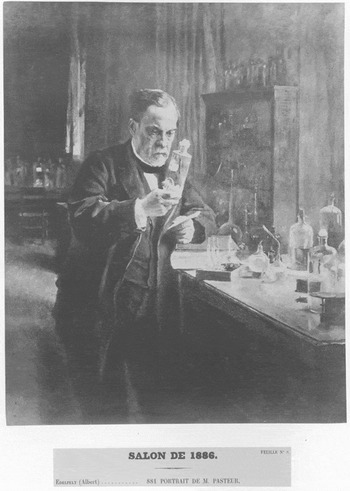
The scene is familiar to all of us: a scientist, brooding over a research object contained in laboratory glassware. This motif has become omnipresent in heroic representations of science since the late nineteenth century.Footnote 1
Portrait de M. Pasteur (Photography, 1886). Source: Archives nationales, Paris.

But such iconic prominence of scientific glass containers has a dark side. As a matter of fact, they play at best an ambiguous role in the history of science: Although recent historical epistemology has convincingly emphasized the significance of materiality in the dynamics of experimental research, the scientific glass vessel, though symbolically established, has remained curiously invisible.Footnote 2 The glittering iconography of laboratory glassware has obstructed from view the material historicity and functionality of these objects in experimental research.Footnote 3 Based on the above, I will re-materialize scientific glassware, which means making visible the materiality that turned glass into a constitutive inner boundary in laboratory environments. The notion of the boundary and material boundary work suggested in this paper does not aim at a discursive, disciplinary, or institutional level,Footnote 4 but quite literally at the physical space of the modern research laboratory.
I will focus on the early history of the standardization of laboratory glassware in the second half of the nineteenth century, more precisely on the standardization of the material and not the form of experimental glass containers such as flasks, test tubes, and petri dishes. The material standardization of glassware will not be addressed as a technical solution to a practical problem nor will it be addressed from the viewpoint of history of technology, but rather as a process of epistemic and material reconfiguration of spatial boundaries in emerging research laboratory environments, i.e. from the viewpoint of a historical material epistemology. This means that on a conceptual level, I approach the history of modern laboratory research from an environmental perspective, focusing on the genealogies not of the epistemic objects but of those enclosed ecologies, architectures, and infrastructures, in which experimental inquiry into nature has settled. Seen from this perspective, the history of glass vessels turns out to be a challenging case study.Footnote 5
The paper starts with an outlook on the development of the container glass industry and technical glass chemistry in mid-nineteenth century. In a second step, I will follow the rise of a new awareness for measurement errors due to the chemical agency of experimental glass vessels in the context of precision research. Third, I will outline the emergence of a whole techno-scientific infrastructure for the improvement of glass container quality in late nineteeth-century Germany that equally involved the needs of glassware consumers, the rise of special glass industry, the establishment of state institutions for material standards, as well as new forms of glass research and development. In the last part of the paper, I will return to the laboratory environment focusing on the implementation of this glass reform especially the reconfiguration of glass boundaries in research.
In the history of modern laboratory research glass containers are typically perceived as ahistorical, quasi-immaterial material objects the properties of which are limited to form, transparency, neutrality, and sometimes annoying fragility. These are without doubt fascinating qualities in their own right (and as such, the raw material of many a fragile scientific anecdote).Footnote 6 But they are also characteristics that nonetheless have not warranted further historical analysis and explanation so far. The common reference to laboratory glassware on book covers and titles is a mere topos,Footnote 7 given the double meaning of the term as a popular object of imagination on the one hand, and as the spatial place in its original Aristotelian sense on the other hand.Footnote 8 So the topos of laboratory glassware could be paraphrased as the idea of an ideal place of the experiment, surgically removed from the actual, complex textures of research environments. But having learned the lesson of the much-evoked material turn in history of science (cf. Pravica Reference Pravica2007), one might indeed suspect that the glass container is not the quasi-immaterial device we imagine it to be. It should rather be materially entangled with experimental research and inseparably embedded into its oikos – which is called laboratory. Thus, shifting our understanding of scientific glassware from topos to oikos, we gain access to the rich history of the formation and the contingent dynamics of these inner material boundaries so constitutive to experimental research. The introduction to a laboratory handbook on microbiology from the early twentieth century illustrates this shift in perspective. The author Ernst Küster writes:
Microscopic as well as macroscopic organisms can be taken out of their natural habitats and transferred to artificial environments in order to be studied scientifically. All kinds of microorganisms can be cultivated under laboratory conditions, which are adapted to their natural habitats and which can be varied deliberately according to the ends of research.
Therefore, we will start our considerations with water, the precondition of all organic development. . . . At this point we will only mention pure water, which cannot be understood without glass, because glass vessels as indispensible containers for water and aqueous solutions alter the contained liquids constantly by successive dissolution of their proper substance. One should not underestimate these unwanted admixtures. It seems reasonable to underestimate the quantity of the soluble substance yielded by the glass and to overestimate the need of the organisms for minerals. But, in reality the amount of potassium and magnesium originating from the glass is sufficient to feed thousands of generations of cells. (Küster Reference Küster1907, 6–7)
In this quotation, the author obviously contradicts the culturally dominant image of laboratory glassware. He rather understands it as a material, spatial, and causal boundary device, as a micro-oikos for laboratory metabolisms. Consequently, this illustrative paragraph leads us to a historiographical as well as epistemological problem: How was it possible that vitreous material layers came to perform their complex epistemic task (the stable causal containment of spatially enclosed phenomena in laboratory contexts) throughout the changes which the experimental sciences have undergone since the scientific revolution? Revisiting the history of the laboratory sciences from this marginal perspective means deconstructing a firmly established cultural motif, the glassware topos. It also means reconstructing the numerous painstaking efforts in science geared towards demarcating the non-self-evident boundaries of the innermost dwelling of experimental research, the glass house of experiment so to say.
In the following, I will focus on the material boundary work that was performed in the second half of the nineteenth century when modern laboratory research emerged. This will be done in order to understand how laboratory glassware turned into a problem for research in the first place and to grasp the ways scientists and other actors, for example in the glass industry, reacted to these situations. To do this, one has to reconstruct the glass theories that were developed in this context, the glass production, testing and standardizing technologies, as well as the entangled substances, practices, institutions and actors (Espahangizi Reference Espahangizi2010).
Glass Culture and Glass Diseases in the Nineteenth Century
When we think of glass culture in the nineteenth century, greenhouses, railway stations, and the so-called Crystal Palace in London instantly come to mind: The glass architecture of the World Exhibition in 1851, when the Empire gathered in London, formed part of an emergent glass vision of modernity (cf. Koppelkamm Reference Koppelkamm1988; Armstrong Reference Armstrong2008; Schivelbusch Reference Schivelbusch1977). The new giant glass constructions provided a powerful imaginative medium for a whole new cultural outlook. At the same time, however, the glass facades in the real world inexorably suffered from chemical corrosion induced by water and other atmospheric substances (Dumas Reference Dumas1832, 610–611; Péligot Reference Péligot1862 and Reference Péligot1877, 54; Benrath Reference Benrath1875). Decades before the urban historian Lewis Mumford came to lament the actual opacity of modern glass architecture due to air pollution, the image of crystal clear translucent glass transcending materiality was already being contradicted by dull, “blind,” and “sweating” surfaces in the real world (Mumford [1938] Reference Mumford1998, 207–208). This tension between lofty glass imaginations and the annoyingly profane material reality seems to be a characteristic inherent to the glass boom that took off in mid-nineteenth-century Europe, in the field of construction and architecture as well as in the household. Drinking glasses, bottles, vases and bowls, too, would rapidly lose their brilliance due to chemical reactions with their immediate environment, such as the surrounding atmosphere or the substances they contained (Dumas Reference Dumas1832, 610–611). These glass diseases as they were called later by the art historian G. E. Pazaurek (Pazaurek Reference Pazaurek1903), got worse with bulk production of glassware: Industrialization increased the output, but lowered the quality of the material compared to traditional glass making at first (Foerster Reference Foerster1911, 135). But the need to improve glass quality, not only in the case of construction glass but also for example for wine bottles,Footnote 9 heavily stimulated the interest of the new so-called technical glass chemistry in the material.
Already in the 1830s, the theoretical and methodological progress of chemistry had made it possible to analyze the substance of different glass products quantitatively, for example with the use of hydrofluoric acid (cf. Rowney Reference Rowney1845; Warington Reference Warington1845; Vogel and Reischauer Reference Vogel and Reischauer1859). The French chemist Jean-Baptiste Dumas for instance, who is famous for his handbook on applied chemistry, had begun to study numerous commercial glass products that were on the market. By this means, he tried to derive the general glass formula, the so-called composition générale (Dumas Reference Dumas1830, 144). There was no coherent glass theory and not even a general consensus over the question whether glass should be understood as a pure chemical compound or a mixture of substances and compounds. But the observable corrosion of ordinary glassware and glass surfaces in general turned out to be a promising starting point for the inquiry into the very nature of this fascinating, but according to Dumas scientifically rather neglected material.Footnote 10
Between the 1830s and 1850s, the new technical glass chemistry was not specifically concerned about laboratory glassware. Brilliance and crystalline transparency were essential properties for the performance of nonscientific glassware, but only secondary to experimental practice. Also, slight corrosion of laboratory glassware and material depositions on their surfaces, an everyday phenomenon for chemists, did not necessarily affect their scientific usability. Until the mid-nineteenth century experimentalists tended to overlook the chemical agency of their glassware, the same way we are used to ignoring the continuous chemical reactions between drinking water and the glass vessels in everyday life today. These physico-chemical micro-processes simply did not affect research: There were neither epistemically relevant effects and consequences tied to them, nor were there any instruments, measuring or observing procedures to exactly quantify and objectify the interactions between glassware and the substances they contained. To put it in other words: There was no epistemic awareness for these kinds of phenomena. However, this indifference of experimental research towards the chemistry of glass surfaces was questioned only when a revolution in experimental research occurred with the establishment of precision measurement around the mid-nineteenth century.
The emergence of a whole new world of experimental research in the nineteenth and early twentieth century has been studied thoroughly by historians of science in the last decades. There has been a focus on the consolidation of new scientific values like exactness and objectivity, on issues of standardization, error analysis, and instrumentation, the development of new institutional forms in research and higher education, and the coming into being of new kinds of scientific objects in the expanding and diversifying landscape of modern experimental cultures.Footnote 11 While drawing on all of these aspects and dimensions, ecological approaches to the history of this “laboratory revolution” try to understand the emergence of new specialized environments of laboratory research (Dierig Reference Dierig2006, 26). Various studies have shown that in order to provide the stability needed for research, this nascent modern oikos of experimental inquiry into nature to some extent had to be encapsulated from the immediate socio-cultural (often urban) environment (cf. Hoffmann and Schickore Reference Hoffmann and Schickore2001; Hoffmann Reference Hoffmann2001; Schmidgen Reference Schmidgen, Schmidgen, Geimer and Dierig2004). Its outer as well as inner boundaries had to be defined. The “well-tempered environment” of laboratory buildings – to use a term coined by the architectural critic Reyner Banham – which were supposed to buffer external acoustic, atmospheric, hygienic, physico-chemical or socio-technical, disturbances, had to be designed carefully. The outcome of this process was a multiply nested research environment – similar to a Russian doll – that reached from the outer shell of the building, the intermediary strata of administration and teaching to the innermost “extreme milieus” of the laboratory buildings, in which research was actually done (Latour Reference Latour, Cunningham and Williams1992, 299; Felsch Reference Felsch, Geisthövel and Koch2005, 30–32). In the late nineteenth and early twentieth century, even within the sanctuaries of experimental research, we witness further stratification and a rigid redefinition of spatio-functional boundaries: Experimental glass containers, in which the objects of research were enclosed and studied, turned from a handcrafted technical object into an epistemically relevant and technologically controlled boundary, forming the envelope of the material nucleus of experimentation. This technological reconfiguration commenced in the 1850s when scientists First discovered that contrary to their traditional expectations, laboratory glassware was all but chemically neutral.
Setting the Scene: Individual Glass Errors in the Laboratory
There had been doubts about the chemical neutrality of laboratory glassware and its possible effects on experiments already in the eighteenth century in the context of a debate on the possible transmutation of water into earth (Eller Reference Eller1746; Pott Reference Pott1756; Marggraf Reference Marggraf1756; Lavoisier Reference Lavoisier1770) and in the context of the discovery of the element fluor (Espahangizi and Orland Reference Espahangizi, Orland, Espahangizi and Orland2014b, 11–13). But it took until the advent of precision measurement and exact experimentation in the nineteenth century, when the chemical interaction of experimental glassware with the contained substances ceased to be a marginal curiosity to experimental practice and natural philosophy. Instead, this interaction turned into a dynamic and integral factor in emerging laboratory research environments.
The first note on glass-induced measurement errors was published in 1853 in a short appendix to the third edition of the famous textbook Quantitative Chemical Analysis edited by the German chemist Carl Remigius Fresenius. Fresenius was working at Justus von Liebig's internationally renowned laboratory in the city of Giessen, when he noticed irregularities while weighing residues in watch-glasses. He concluded: “A lot of strange phenomena that disturb chemical analysis are due to the contamination of the evaporated substance by the material of the vessel, gross errors often originate from this source. Because of its importance, I have made further investigations on this subject” (Fresenius Reference Fresenius1853, 76; cf. also the appendix “Analytische Belege”). Fresenius’ textbook was a huge success, it was circulated widely and with it, the first notes on measuring errors caused by glassware (Poth Reference Poth2006).
The second, maybe even more important reference to this issue was made by the Belgian chemist Jean Stas a couple of years later. In the late 1840s Stas’ teacher, the already mentioned Jean-Baptiste Dumas, had called for a thorough reevaluation of the atomic weights measured in the early nineteenth century. The exact quantification of atomic weights was supposed to provide a solid fundament to future chemistry. Jean Stas adopted his teacher's scrutiny. No measuring error, as minimal as it was, could eventually be tolerated (cf. Schickore Reference Schickore2005). All marginal conditions of experimental settings and measurements had to be controlled accurately, even supposedly unsuspicious glassware. In the introduction to his influential paper on atomic weights published in 1860, Stas stated: “Indeed, I have been observing that the weight of tubes, retorts or flasks made of glass . . . changes significantly. Be it because of the heat, the attack of chemical substances, which we assumed not to have any influence on glass” (Stas Reference Stas1860, 220). With these remarks, and through a second more comprehensive paper in 1865, Jean Stas drew the attention of the scientific community to the chemical agency of experimental glassware (Stas Reference Stas1865; Braun Reference Braun1868). Shortly after, Robert W. Bunsen, professor at the University of Heidelberg, a shooting star of chemistry at that time and Stas’ friend, initiated the first systematical study on the chemical agency of experimental glassware.Footnote 12 The aim of this work, executed by his assistant Adolph Emmerling, was to elicit possible regularities in the chemical interaction between the experimental container and the contained substances of interest and to derive precautionary measures in order to minimize glass errors in laboratory practice (Emmerling Reference Emmerling1869). But beyond such limited practical rules for everyday laboratory life, like boiling the glassware beforehand, using smaller amounts of experimental substances, preferring already used glassware, etc., a more sustainable solution was needed. Jean Stas, who was acquainted with technical glass chemistry due to his teacher Dumas, had come to the following conclusion: In order to re-stabilize the vitreous boundaries of experimental settings, new, specifically modified and adapted glasses had to be designed. That is, new glass types had to be invented.
Half-heartedly supported by the Belgian state, Stas commenced to work on a new glass formula. In order to translate his theoretical paper work and laboratory experience on a possibly ideal glass composition into a workable recipe for glass making, he had to collaborate with a glass manufacturer near Brussels (Stas Reference Stas1865, 217–218). In 1868, he was finally able to present the results of this early cooperation between glass science and the manufacture of glassware in William Crookes’ Chemical News (Stas Reference Stas1868, 1). Jean Stas glasswork indicated the guidelines that the technology of scientific glassware would have to follow in the next decades. The glass composition had to be adapted to the exigencies of precision measurement. However, Stas’ project stayed in fact singular and isolated. No doubt, Stas had generated a glass suitable for his own work and more than that his scrutiny concerning the glass error was praised by his colleagues to be an ideal role model for the ethics of exact research and scientific preciseness (Braun Reference Braun1868, 160, 165). But as an individual experimentalist working in his home laboratory, he had no ambition, no support, and even less infrastructural means to improve the general quality of experimental glassware. In order to understand the limitation of Stas’ efforts to deal with the glassware issue, one has to bear in mind that at the time there was no single laboratory glass on the market, but rather a wide and unclear variety of regional glass products with varying, traditionally secret recipes and therefore mostly unknown chemical compositions. Moreover, there were very different expectations with regard to the uses of glass containers in experimentation: In some contexts, glasses had to be more resistant to acids, in others more resistant to alkaline attacks or to water-induced corrosion, etc. (cf. Newton Reference Newton1985). So on the one hand, there was functional heterogeneity of glass containers. But on the other hand, a certain standardization of the physico-chemical properties of scientific glass containers was essential to guarantee the general comparability of experimental outcome. In order to realize such an extensive project, the reconfiguration of the spatio-functional boundaries marked by laboratory glassware, actors and institutions from different fields, such as science, technology, industry, and politics had to come together. Existent glassware had to be analyzed, glass research had to be coordinated, uses and exigencies of glassware had to be identified, new glass batches had to be developed, standardization procedures and criteria of glass quality had to be determined, and finally, these glasses had to be distributed and brought to modern laboratories. In sum, the efforts of an individual like Jean Stas were heroic but rather insufficient. A large-scale adjustment of scientific glassware would depend on a whole techno-scientific infrastructure (cf. Edwards Reference Edwards, Misa, Brey and Feeberg2003, 188–189). In the following subchapter, I will sketch the emergence of this infrastructure in the second half of the nineteenth century.
Preparing the Ground: The Emergence of Technical Glass Chemistry
The first successful steps towards a collectively organized improvement of glassware were initiated by the industry, more precisely the Prussian Society for the Advancement of Industry, which had prominent members like Werner von Siemens and Hermann Helmholtz. In 1850, this influential interest group promoted the development of industrially applicable technical procedures to test and predict the “weathering” tendency of glass surfaces by offering various prizes “in the most widespread newspapers in Berlin.”Footnote 13 As mentioned earlier, at that time the glass industry was taking off and material quality became an issue in the industrial production of glass products. In spite of the substantial advancements technical chemistry had made since the pioneering work of Jean-Baptiste Dumas, it took until the early 1860s when Rudolf Weber, a technical chemist from Berlin, was finally awarded the silver medal for his contribution to the glass-testing contest of the Prussian Society. Weber's testing procedure encompassed the following steps: First, the glass specimen had to be cleaned thoroughly with alcohol and then put beneath a bell jar filled with vapors of strong nitric acid for 24 hours. In a next step, the glass specimen had to be taken out of the bell jar for another 24 hours so that the condensed acid would evaporate from its surface – the less steamy the glass, the better the quality (Weber Reference Weber1864). Weber's test was quite impractical, but due to the lack of alternatives it came into use within the glass industry in the 1890s. From a scientific viewpoint however, it was deeply unsatisfactory: It depended on a rather subjective assessment of glass quality without quantification and it did not provide any theoretical explanation of the chemical phenomena involved. Having become the Society's glass expert, Weber, too, aimed at more than only providing a quick industrial test for glass surfaces. Like Jean-Baptiste Dumas before, technical glass chemists at that time searched for the formula of a true universal glass (Stein Reference Stein1862, 25), the Normalglas, as the young glass chemist Herman Benrath at Baltic Dorpat University named it (Benrath Reference Benrath1868). With statistical methods generally advancing at this time, Benrath analyzed and compared dozens of glass products on the market, applying Weber's nitric acid test among others, in order to determine the mean value of the chemical composition of all “good glasses” (Benrath Reference Benrath1875, 25–27).
But what was a good glass? What is the meaning of good in this context? For Benrath, this attribute referred to the combined assessment on a set of different attributes: fusibility, processability, hardness, brilliancy, and resistance to chemicals. His Normalglas-formula, which was supported by Rudolf Weber's results, should provide glassware suitable for every purpose (ibid., 34; and Weber Reference Weber1879, 450). In contrast to the functional specificity of Jean Stas’ glassware, Benrath's and Weber's standard glass formula had been derived from statistical “field work” and the formula had to be an ideal all-in-one device, be it for scientific or non-scientific purposes.
But at the same time, the use of glassware in laboratories had diversified and intensified since the mid-nineteenth century.Footnote 14 Therewith, the problem of glass attack turned out to be more complex so that neither the idea of a mean value Normalglas, nor the individual enterprise of a solitary experimentalist like Jean Stas could eventually solve it. Both approaches, i.e. material standardization based on collective efforts as well as functional specificity, converged when around 1880, the needs of scientific research took the lead as the driving force in the quest for better glass containers. The techniques and criteria of laboratory measurement had changed dramatically since the early nineteenth century and so did the exigencies towards the boundaries of experimental settings. The “best” glassware was no longer needed in construction or in households, but in the laboratory. The field in which technical glass chemistry and the needs of modern laboratory research came together was, somewhat unexpectedly, scientific thermometry and not chemical glassware.
Working Together: A Standard Glass for Thermometry
By the 1870s thermometry, more precisely mercury-in-glass thermometry, had become an all-important research technology. Nonetheless, its precision suffered from a severe technological flaw. The zero point of the thermometric scale shifted with every use (Pernet Reference Pernet and Carl1875, 266). In 1874, the astronomer Wilhelm Foerster, one of the most prominent actors in the field of international metrology, a member of the International Bureau of Weights and Measures and head of the Imperial Standards Commission since the founding of the German Reich, put his assistant Leopold Loewenherz in charge of investigating this phenomenon to find a solution (Loewenherz Reference Loewenherz1877; Foerster Reference Foerster1911). Loewenherz, who would later become one of the founders of the influential German Journal for the Study of Scientific Instruments, joined the Prussian Society for the Advancement of Industry, which pushed the solution of this problem by offering yet another 1500 silver coins.Footnote 15 In the next two years, Foerster's assistants found out that the chaotic shifts of the thermometric scale were due to the complex thermal behavior of the glassware, which expanded and contracted in a non-linear way with every heating episode (Thiesen Reference Thiesen1881). This is not the place to go into details of the history of thermometry, the important point would rather be that in the course of these collective efforts to stabilize mercury-in-glass-thermometry, the field of scientific metrology came into contact with the technology of glass chemistry. As a result, a nucleus of cooperation took shape that would be decisive for the improvement of scientific glass containers in the following years. In 1880, Hermann Wiebe, another assistant of Wilhelm Foerster at the German Standards Commission, contacted his former colleague from university, the young technical glass chemist and entrepreneur Otto Schott, who had earned his PhD in 1875 with a thesis on the Theory and Practice of Glass-Making at the University of Jena, and asked him for help.
There is no need to emphasize the great importance of Otto Schott for the history of scientific glassware. Together with his associate, the German physicist Ernst Abbe who had been an assistant to Carl Zeiss, he founded the renowned glassworks in the city of Jena and revolutionized glass technology. But whenever the name Schott is mentioned, historians (of science) usually think of his contribution to the improvement of optical glasses (cf. Jackson Reference Jackson2000). Indeed, at first sight, scientific glassware seems to be a mere by-product of the success of Schott's optical glasses. But in fact, it played an important role in the consolidation of Schott and Abbe's fragile business start-up in the early 1880s (cf. Zschimmer Reference Zschimmer1909; Kühnert Reference Kühnert1946; Kühnert Reference Kühnert1949; Kühnert Reference Kühnert1953; Kühnert Reference Kühnert1957; Bayer et al. Reference Bayer Tilde and Meyer2003). When Wiebe asked him for help, Schott was at first reluctant to being distracted from his work on optical glasses.Footnote 16 But realizing it would make a good case for governmental aid, he finally agreed on cooperating with the Imperial Standards Commission on thermometric glass in 1882.Footnote 17 Not surprisingly, the Prussian state granted the bitterly needed financial support shortly after.
In Schott's laboratory, state-of-the-art glass research and glass making came together in a new way. They did R&D avant la lettre, based on experimental glass melting, systematic variation of batch ingredients, and introduction of chemical elements guided by theoretical knowledge and minutely journalized results. Indeed, between April 1883 and November 1884, Schott was able to develop a glass batch – melt number 16III – which eliminated the zero-point problem by optimizing the ratio of sodium and potassium in glass composition. Schott alone however, like Jean Stas before him, could not have accomplished the necessary distribution of this new glass. His young company would have to compete with the established glassware manufacturers in the forest of Thuringia who were in fact still helping Schott. Schott depended on temporarily hiring skilled workers of the region in order to draw the necessary fine glass tubes (Kobe Reference Kobe2008, 42). Schott did not yet possess the experience, the resources, the necessary commercial network, or a base of customers. Against all odds, his sales were pushed by a governmental decree issued in 1885: Mercury-in-glass-thermometers had to be certified by testing houses led by the Standards Commission, with Schott's new glass as the benchmark.Footnote 18 It was to a great part the authority of the state, combined with entrepreneurial ability, which ensured and enforced the diffusion of the first specific standard glass, the so-called Jenaer Normalthermometerglas in the scientific world.
Getting Serious: New Glasses for New Laboratories
While Schott's sales were increasing rapidly, quintupling from 1885 to 1890, glass-induced measurement errors of all kinds, not only in thermometry, had become ubiquitous in modern laboratory research. In the mid-1880s, glass errors were noted in different branches of analytical chemistry, in gasometry, physics, cathode ray physics, hygienology, and in physical chemistry (Fresenius Reference Fresenius1883; Bohlig Reference Bohlig1884; Warburg Reference Warburg1884; Warburg and Ihmori Reference Warburg and Ihmori1886; Egger Reference Egger1884; Bottomley Reference Bottomley1885; Wartha Reference Wartha1885; Lunge Reference Lunge1885; Kohlrausch Reference Kohlrausch1885; Bunsen Reference Bunsen1883; Bunsen Reference Bunsen1885). Experimentalists had come to the conclusion that “facing the facts . . . one cannot ignore anymore that the material our indispensible chemical instruments are made of does not fulfill the requirements, and that producing a remedy is highly desirable” (Kreusler and Henzold Reference Kreusler and Henzold1884, 40). The German Standard Commission, too, realized that glass errors were far more common than initially thought. Even the use of bubble levels (small glass vessels filled with ether and air that indicate whether a surface is horizontal or not) in astronomy, geodesy, and artillery was affected by the chemical agency of glassware.Footnote 19 Material deposits on their inner surfaces impeded the free movement of the enclosed bubble and made precise surveying extremely difficult. Because of the experiences with mercury thermometers, the culprit for this phenomenon was easily identified: the substance of glassware. But Otto Schott was still working on the thermometric glass and he had no increased affection to deal with these new glassware “calamaties.”Footnote 20
It took until the foundation of the Physikalisch-Technische Reichsanstalt in Berlin, with its own laboratories, for the problem to be studied systematically. This state-funded institute for metrological research, which took up its work in 1887, was closely tied to the Imperial Standard Commission.Footnote 21 Leopold Loewenherz for example, became the director of the technical division of the Reichsanstalt; and Hermann Wiebe, who had initiated the collaboration with Otto Schott, would head the heat and pressure laboratory. Franz Mylius, director of the new chemical laboratory of the Reichsanstalt in Berlin-Charlottenburg, continued the glass cooperation with Schott in place of Wiebe (Engel Reference Engel and Kroker2001; Foerster Reference Foerster1931). In the winter of 1887, Mylius visited the glassworks at Jena for the first time.Footnote 22 Being in correspondence with Schott, Mylius quickly ascertained the reason for the problems with bubble levels. The deposits on the inner surfaces of their small glass chambers were caused by chemical attack not by the ether itself but by the small amount of water dissolved in the ether (Mylius Reference Mylius1888). This finding also matched perfectly with the experience of experimentalists in the 1880s. Much to their surprise, it was the precarious relationship between two supposedly pure and neutral substances, such as glass and water, which turned out to be the most relevant source of measurement errors caused by experimental glassware. Franz Mylius was well aware of this general situation when he and his assistant Fritz Foerster started to focus their research on the interplay of glass and water. More than that, the interaction between these two substances turned out to be the leitmotif, or rather Ariadne's thread, in the quest for standardized glass tests and new glassware.
The Leitmotif of Glass Reform: Hygroscopicity
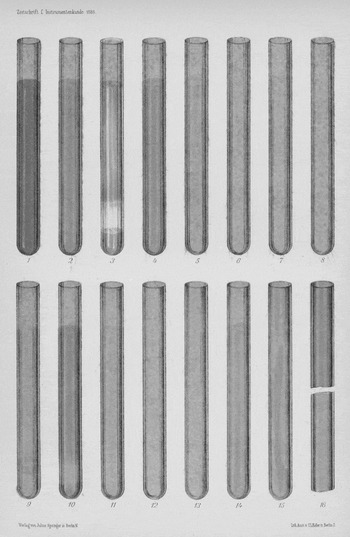
Understanding the interaction of glass and water was a complex task: When Mylius and Foerster started their investigation they did not possess a theoretical model (of what happened when glass surfaces came in contact with water) nor a reliable testing procedure to measure the effects. However, since the early nineteenth century, chemists knew that watery solutions contained in glassware turned basic (cf. for example, Faraday Reference Faraday1830, 47–48). Mylius’ experiences with bubble levels on the one hand and with organic chemistry on the other hand led him to develop a colorimetric testing procedure based on a dye synthesized in the 1870s: iodeosin. When dissolved in an aqueous ether solution, the iodeosin and the alkali would form a red-colored salt that would then precipitate on the attacked glass surfaces. Therefore, color intensity could be taken as a measure of the chemical quality of the glassware. For the first time, the glass testing procedure was expressed in a chemical formula (Mylius Reference Mylius1889, 52).
Glass Testing with Iodine-Eosin. Source: Mylius Reference Mylius1889, 52.

Nonetheless, Otto Schott did not hesitate to utter his critique. Mylius’ test was still purely qualitative, like Rudolf Weber's acid nitric method at use in the glass industry. It literally stuck to the surface without getting to the core of the glass substance.Footnote 23 Challenged by these valid objections, Mylius and Foerster refined their method in the following months and presented a modified quantitative, titrimetric procedure in 1891 (Mylius and Foerster Reference Mylius and Foerster1891). With growing concerns about the neutrality of laboratory glassware and its functioning as an experimental boundary, this turned out to be just in time. Experimentalists were already demanding “not only to differentiate between suitable and non-suitable glasses, but to quantify their solubility in water by exact measuring methods in order to assess their performance . . . numerically” (Pfeiffer Reference Pfeiffer1891, 264). It was the duty of the Reichsanstalt, directed by Hermann Helmholtz, to take these demands seriously (Helmholtz and Loewenhertz Reference Helmholtz and Loewenherz1891). Thus, from the early 1890s, Mylius and his team started to provide a public service for testing scientific glassware that was sent in, based on their iodeosin method, while extending their glass research.
Mylius and Foerster were now able to model the interaction of water and glass as a two-stage process (Foerster Reference Foerster1893): In a first step, water soaked the glass surface dissolving the alkali parts of the glass substance, which was now understood as a mixture of compounds as well as a frozen solution. The dissolved alkali would in a second step leach the remaining glass substance and decompose the silicates. In other words, alkaline attack on glass could be subsumed under this model. The same applied for acid attack, which was actually caused by the aqueous solution, not the acid itself (except for fluoric acid). Backed by this theoretical model, this so-called glass hygroscopicity turned out to be a valid benchmark for assessing the general chemical durability of glasses. Mylius and Foerster could therefore use their iodeosin test in order to assess and compare the general quality of all laboratory glasses sent to the Reichsanstalt.
Improving Glass Quality in Berlin and Jena
Otto Schott was a glass technologist and entrepreneur and he had different objectives from the Reichsanstalt. His plan was not to provide a liable glass test but to design and sell new glassware adapted to the needs of laboratory research. This time however, he had no official order or mandate as in 1882. Nonetheless, his contact with Mylius and the Reichsanstalt encouraged him to carry out this work. Since 1885 Schott had also successfully expanded his network within the German scientific community. So, he was now able to “hear” the demands of the experimentalists without any mediation from the Reichsanstalt. Some scientists even started to consult the “glass doctor” (Kühnert Reference Kühnert1949, 17) on glass issues. Among them were renowned scientists like Friedrich Kohlrausch, author of the famous Guidelines to Practical Physics and second president of the Physikalisch-Technische Reichsanstalt. In 1889, Kohlrausch had noticed that the dissolution of glass introduced a significant error into the measurement of the electrical conductivity of pure water, a fundamental parameter for the nascent discipline of physical chemistry (Kohlrausch Reference Kohlrausch1891). He realized that it made no sense trying to determine the electrical properties of laboratory water without taking into account its interaction with the glass container. During this research on the hygroscopicity and solubility of glass, he repeatedly contacted Schott, asking him for advice and for glass specimens.Footnote 24
To sum up, in the aftermath of his successful collaboration with the Standards Commission on thermometric glassware, Schott had positioned himself strategically in the landscape of scientific research and official metrology.Footnote 25 He knew of the needs and exigencies of laboratory research at first hand and this insider expertise went directly into his efforts to design new adequate glasses for experimentation and precision measurement. Moreover, it also led to his glass research.
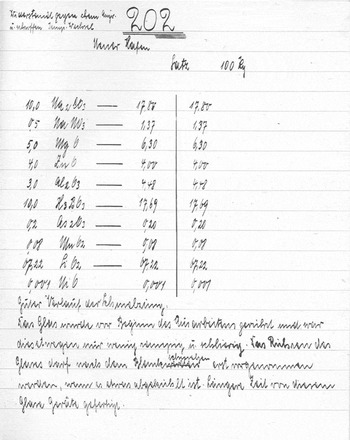
Schott too, had started to study the hygroscopicity of glass surfaces as early as 1889, finding out that glasses based on the melting agent sodium had a lower hygroscopicity than potassium (or mixed) glasses (Schott Reference Schott1889). He also knew that the admixture of glass-forming borosilicates optimized the thermal durability of glassware (Schott Reference Schott1891). Last but not least, analyzing the famous but “unscientific” glasses of his Thuringian neighbors, Schott discovered that their excellent processability was due to a certain amount of aluminum oxide (Schott Reference Schott1887). By optimizing all of these parameters and generally benefitting from his intuition and experience in glass melting, Schott finally succeeded in spring 1892. Glass melt number 202III was the first promising candidate for a new laboratory glass. In his melting journal, we find the following side note: “resistance to chemical attack and abrupt change of temperature.”Footnote 26
When Jean Stas had developed the first modern laboratory glass in the late 1860s, he published its composition in a chemistry journal. Some twenty-five years later the situation had changed completely. A complex infrastructure had come into being which involved various scientific, technical, political, and industrial actors and institutions, which was based on the strong Berlin-Jena axis. Schott's efforts to design new laboratory glasses were embedded in this partly formal, partly informal techno-scientific infrastructure, which carried out the general reform of glassware used in all kinds of laboratories in Germany. The new apparatus glass could now be sent to the Physikalisch-Technische Reichsanstalt in order to be tested, certified and, in a way, promoted.
Otto Schott, Glass Melt 202III (1892). Source: Schott Archive, Jena.

Before Mylius and Foerster would publish the results of their extensive testing of German glassware in 1894, Otto Schott did not miss the opportunity to write his colleagues in Berlin a letter praising the extraordinary quality of his new glass and to ask for its adequate “appreciation” by the Reichsanstalt.Footnote 27Schott & Company, who had already implemented new Siemens furnaces in order to start bulk production, expected this test to boost their sales – and Schott would not be disappointed. Foerster confirmed in public: Glasses from Jena had reached “the limits of what is technically possible” (Foerster Reference Foerster1894, 396).
Schott's glass products outmatched other glasses, but they did so only in general performance. Other glasses turned out to be more adequate to specific uses. The conclusion that Mylius and Foerster drew from their results was far-reaching: Even with the ongoing improvement of general glass quality, there was in principle no ideal universal glass that could possibly supersede all other glasses. In a speech at the fifth International Conference on Applied Chemistry in Berlin, Mylius ultimately buried the hopes of Benrath, Weber, and other technical glass chemists to find a Normalglas:
Sirs! We once imagined a universal glass to be possible, suitable for every purpose. We now know, that there is no such a glass. Quite the contrary, we know that each specific use of glassware has its own ideal standard. We are now witnessing that with every year the specialization of glasses advances . . . . In fact, there is no glass, which resists equally to all kinds of chemicals, and there is no hope to ever find one. (Mylius Reference Mylius1903, 884)
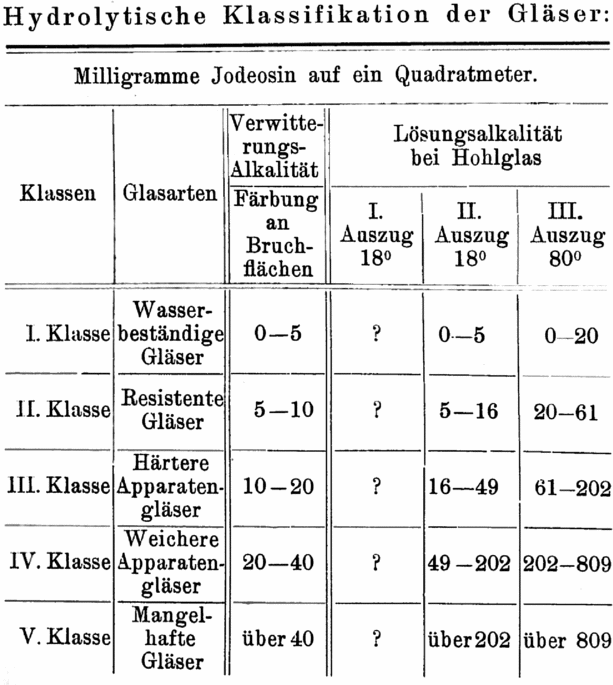
Mylius realized that the wish to homogenize the glass material itself contradicted the ongoing functional differentiation and multiplication of glass types. But what was the alternative? How could glass quality be generally improved and harmonized in order to guarantee the comparability of experiments and measurements in different laboratory settings? Mylius’ answer to that question was: standardizing the glass tests rather than the glass substance. In the course of his ongoing iodeosin tests in the 1890s, he had distilled the first classification system of glass quality, the so-called hydrolytic classes. Not surprisingly though, it was scaled in regard to the properties of Schott's apparatus glass, the so-called Jenaer Geräteglas. Mylius and his team continued to work on this classification system and improve it step by step in first decade of the twentieth century (Mylius Reference Mylius1907, Reference Mylius1910).
We propose a division in five hydrolytic classes of chemical durability for all types of technical silicate-glasses (independent from their percentile composition). . . . the terms water-resistant and resistant glass are already in use for the first and the second class; . . . as well as poor glass for the fifth class. Glass substances belonging to the third and fourth class, which are not apparatus glass, are sufficiently characterized by the numbers. (Mylius Reference Mylius1913, 5)
Mylius’ Hydrolytic Classification of Glass Quality. Source: Mylius Reference Mylius1913, 5.

Mylius’ hydrolytic classification system was the scientific basis and the starting point of the development of specialized industrial norms (Din Denog) on glass quality that started after World War I in Germany in close cooperation with the Reichsanstalt, the German Association for Chemical Apparatus (Dechema), the special glass industry, industrial consumers of chemical glassware and other interest groups. A whole “cosmos of norms” (Vec Reference Vec2006) dealing with scientific, industrial and commercial glass emerged in the 1920s (in Germany) and 1930s (internationally),Footnote 28 and these norms based on glass hygroscopicity continue to be the general reference of glass quality until today.
Implementing New Glass Boundaries in Laboratory Research
In spite of the substantial advances in standardized glass testing and glass development, the glassware reform had by no means come to an end in mid-1890s. It still had to reach the laboratories.
In the case of thermometric glassware, governmental authority had pushed the diffusion of Schott glass in the scientific world. This time there was no decree, no mandatory testing or certifying of experimental glassware. However, the general awareness for the physico-chemical properties and unwanted effects of glassware had increased fundamentally since the 1880s. There was even a certain self-enforcing dynamic, as the ongoing debates on glassware drew the attention of even more disciplines and individual experimentalists. In the course of the collaboration between the German Standards Commission, the Physikalisch-Technische Reichsanstalt and Schott's glassworks, an informal infrastructure arose which had the epistemic, technical and normative authority and reputation to satisfy this demand and to initiate the necessary reform of laboratory glassware. The widespread diffusion of Jenaer Geräteglas into the laboratories is reflected in the sales figures (national and international) in the company's archives (Steiner and Hoff Reference Steiner, Hoff, John and Wahl1995). We can follow the path of the new glasses into the inner core of experimental research also by looking at the scientific output. From the mid-1890s, Schott glasses were mentioned more and more frequently in experimental reports, papers, and textbooks. In 1900, Schott's success as a global player and world market leader on technical glasses culminated in the World exhibition at Paris (Müller Reference Müller and Malkowsky1900).Footnote 29 Nonetheless, the work on the physico-chemical boundaries in the laboratory was by no means limited to a replacement of old glassware by Schott glasses. In spite of their general quality, Schott glasses were neither ideal nor universally suitable for all uses. Hence, other manufacturers of scientific glassware started to revise their glass batches trying to match the new criteria established by the Reichsanstalt in order to satisfy the specific demands of their customers and compete with Schott. From the late 1880s, certified chemical and thermal durability of glassware was a sales pitch. It was the complex interplay of market dynamics, state intervention, and techno-scientific demands that broadly raised the general level of glass quality and the new awareness for glass quality in modern laboratories, spreading from analytical chemistry, to gasometry, physical chemistry cathode ray and X-ray physics, medicine, and – as shown in the quoted handbook at the beginning – into microbiological disciplines like bacteriology and cell physiology (cf. Benecke Reference Benecke1896; Hesse Reference Hesse1904; Campbell-Swinton Reference Campbell-Swinton1907; Sternberg Reference Sternberg1914). This new glass consciousness even influenced commercial packing technology for food, beverage, and pharmaceutical products (Ford Reference Ford1930). Inside the laboratory, the chemical agency of glassware had produced measurement errors. Outside the laboratory, i.e. in the sphere of industrial production and circulation of goods, it turned out to have unhealthy, painful, sometimes even lethal consequences. Glass-packed, water-based pharmaceutical substances like cocaine, strychnine, morphine, etc. for example were heavily altered by glass hygroscopicity (Grübler Reference Grübler1907; Stich and Wulff Reference Stich and Wulff1918). Again, it was the technoscientific reconfiguration of the glass boundaries, i.e. their packing material, which made these substances immutable and therefore mobile. Due to these chemically more inert glass envelopes the enclosed substances could be stored or transported for a longer time without any notable alteration.Footnote 30
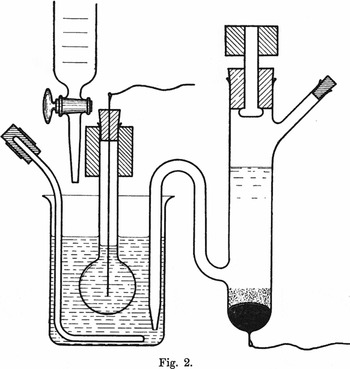
The standardization of the container material glass based on hygrospicity connected the fields of scientific research, technological application and industrial production in a productive way. One striking example for this would be Fritz Haber's work on the so-called glass cell: In 1905 Fritz Haber, famous for his method of ammonia synthesis and less known for his glass studies, had been requested to develop an easy glass-testing method for the bottle industry. Scanning the vast literature on glass-testing since the 1860s, he eventually decided to repurpose the above mentioned findings of Friedrich Kohlrausch: If the dissolution of glass in water increased its electrical conductivity, this effect could be used the other way round as a testing method for glass quality (Haber und Schwenke Reference Haber and Schwenke1904). This finding was his starting point. Being a scientist at heart his aim, however, was not only to measure the effects, but also to understand the processes going on at the phase boundary between glass and water (ibid., appendix). Around 1907 Fritz Haber, who was familiar with the earlier debates on the electrochemistry of cells (cf. Grote Reference Grote2010), realized that the hygroscopicity of glass, as first theorized by Mylius and Foerster, could also serve as a model for the so-called “phase boundary force” (i.e. an electromotive force at the boundary of two electrolytic phases) at semipermeable cell membranes (Haber and Klemensiewicz Reference Haber and Klemensiewicz1909).Footnote 31 The experiment that Haber designed in order to study his cell model was based on two nested laboratory glass vessels: The outer beaker was made of – significantly – Jenaer Geräteglas whereas the inner spheric vessel had to be made of the chemically less resistant old type of Thuringian glass. Here, water-induced corrosion was of course a desired effect. In a sense, a twofold history of glassware as a material boundary of experiment and as a medium of exploring boundaries converges in this experimental design (cf. Espahangizi Reference Espahangizi, Grote, Stadler and Otis2011b): On one hand, Haber's glass cell incorporated the traditional as well as the new, modified laboratory glass types, and on the other hand, the whole setting was meant to be an experimental model for electrochemical processes at semipermeable cellular membranes.
Haber's Glass Cell. Source: Haber and Klemensiewicz Reference Haber and Klemensiewicz1909, 411.

But the importance of the glass cell went far beyond modeling bioelectric potentials. The knowledge of glass hygroscopicity also inspired the design of a measuring instrument that is still in wide use today: the glass electrode. In his experiments, Haber had noted that the “phase boundary force” between the glass and the water increased with the logarithm of the acidity and alkalinity, respectively. In other words, Haber's glass cell was potentially some kind of chemical yardstick for those parameters. In the same year Haber published his results, in 1909, and Søren Sørensen proposed the use of an index that today is known to indicate acidity/alkalinity – not only in research but also in everyday life – as the pH-value (Sørensen Reference Soerensen1909). The glass electrode and its widespread use can be taken as one very illustrative example of a well-known phenomenon in the history of science, that is, the unintended epistemic productivity and unanticipated consequences of certain findings and technical development, in this case of the glassware reform in the modern laboratory. Indeed, the glass electrode turned out to be a valid measuring device for a fundamental quantitative index of (bio-)chemical milieus (Kratz Reference Kratz1950). Moreover, being an all-important device today for pH-measurements in ecology (within the laboratory, as well as in the field), the glass electrode whose history begins with a glass-testing procedure for the bottle industry based on hygroscopicity turns out to be a meaningful emblem for the conceptual shift in the history of scientific glass containers that guides my paper: from topos to oikos.
Outlook: From Topos to Oikos
As mentioned in the opening paragraph, the culturally established image of scientific glassware can be understood as a topos in both of its meanings: It symbolically outlines the ideal place of experiment in (imaginative) vacuo, i.e. a place that is not embodied and embedded in the material conditionalities of real laboratory environments and their historical trajectories. This image obstructs the view of the material historicity of scientific glassware. No one doubts that there has been historical progress in glass making techniques, but what does this tell us about the changing nature of the material itself? A more or less defined set of properties seems to constitute and define this substance, first and foremost translucency. Chemical neutrality, too, is commonly ascribed to the nature of glass, although in a more implicit way. Without doubt, the extraordinary qualities of glass are reasons for the rich cultural history of the substance. But the underlying image of glassware neutrality rendered the actual materiality of this material as something invisible for scientists until the nineteenth century as well as for historians of science today.
In my paper I have dealt with the reconfiguration of glass boundaries during the emergence of a modern laboratory environment in the late nineteenth and early twentieth century. First, I related the development of container glass industry and technical glass chemistry in the mid-nineteenth century. Then I focused on the rise of a new awareness for measurement errors due to the chemical agency of experimental glass vessels in the context of precision research. In a third step, I sketched the emergence of the techno-scientific infrastructure that fostered the improvement and material standardization of scientific glass containers in late nineteenth-century Germany.
The aim of the paper was to “re-materialize” the glass container in the history of science, which means to recover the rich materiality and historicity of its substance in the context of the modern research laboratory.Footnote 32 But what have we learned about the very nature of this material? We have seen that the uses of glassware, the theories on the nature of glass, glass research, glass classifications, glass testing procedures, glass making techniques – all these dimensions of materiality are in constant flux. It is their historical interplay in the first place, which gives meaning to the question “What is glass?” Not surprisingly, it was in the heyday of glass standardization when the nature of glass was again problematized and glass theory advanced fundamentally (Zachariasen Reference Zachariasen1932; Tammann Reference Tammann1933; Morey Reference Morey1936).
From the viewpoint of historical ontology we should understand glass not as a single substance, but as a wide variety of similar substances in a phenomenological continuum, divided by knowledge, practices, and the perception of what people think glass is or what it ought to do. From this perspective, the material genealogy of glass turns out to be essentially intertwined with the development of the specific uses and functions of glassware, in this case of scientific glass containers. Hence, there is no single history of glass, not even of all glass containers. The need of laboratory research, for instance, to settle in the world, to encapsulate and demarcate its experimental milieus in relation to external disturbances, was indelibly imprinted into the materiality of material glass around 1900. New techno-scientific objects were existentially bound to their new vitreous envelopes, and vice versa. With such a shift of perspective, the glass container turns from an iconic placeholder of the experiment, a topos, into a material oikos of research objects in modern laboratory research.