The National Institutes of Health is the United States federal government’s agency for biomedical research. It is made up of 27 institutes and centres that each focus on specific areas of health and research. Created in 1948, the National Heart, Lung, and Blood Institute is the third largest institute. The mission of the National Heart, Lung, and Blood Institute is to provide global leadership for research, training, and education programmes, to promote the prevention and treatment of heart, lung, and blood diseases and sleep disorders, and to enhance the health of all individuals so that they can live longer and more fulfilling lives. The Institute achieves its mission in myriad ways; the most familiar of which is to provide financial support for research endeavours by issuing grants and contracts. Another important method for accomplishing the Institute’s mission is to foster multidisciplinary collaborations and discussions between experts in the field to identify areas of need and high impact.
The National Heart, Lung, and Blood Institute is committed to supporting research in paediatric heart failure. This review describes the National Heart, Lung, and Blood Institute’s past, present, and future efforts to promote a better understanding of paediatric heart failure, with the ultimate goal of improving outcomes.
Scope of the problem
The causes of paediatric heart failure are heterogeneous and include myocardial abnormalities, volume overload, and failing palliated complex CHD. This diversity presents challenges for conducting research and identifying optimal treatment strategies. The burden of paediatric heart failure is significant, and has been increasing over time, with high rates of hospitalisation, morbidity, mortality, and resource utilisation.Reference Andrews, Fenton, Ridout and Burch 1 – Reference Rossano, Goldberg and Mott 5 There is increasing acknowledgment that the development of effective treatment strategies depends on a thorough understanding of the unique pathogenesis of paediatric heart failure rather than an extrapolation of mechanisms and treatments from adult heart failure, and the research supported by the National Heart, Lung, and Blood Institute reflects this important focus.
Landscape of support from the National Heart, Lung, and Blood Institute for paediatric heart failure research
The National Heart, Lung, and Blood Institute has a long track record of supporting research in paediatric heart failure. The Institute’s research programme includes both investigator-initiated grants and Institute initiatives and encompasses the realms of basic science and translational research, clinical trials, and technology development.
Investigator-initiated grants
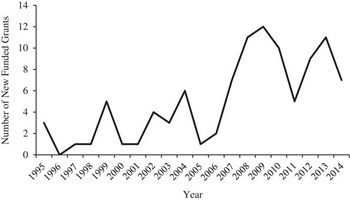
An analysis of the Institute’s portfolio using the National Institutes of Health Research Portfolio Online Reporting Tools 6 with the search terms “pediatric heart failure”, “pediatric cardiomyopathy”, and “pediatric heart transplant” revealed 107 grants funded by the National Heart, Lung, and Blood Institute from 1995 to 2014. Although the duration of each grant varied by funding mechanism, the number of new grants each year ranged from 0 to 12, with an increasing number of new grants per year over time, suggesting increasing interest in the field (Fig 1).
New grants in paediatric heart failure per year.

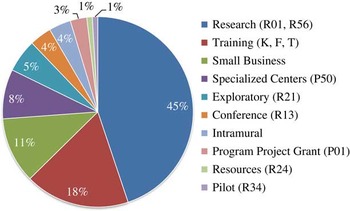
Figure 2 demonstrates the various types of grant mechanisms funded by the Institute to study paediatric heart failure over the past 20 years. The majority of grants were submitted using the traditional R01 research grant mechanism (45%). Junior investigators have shown a strong interest in studying paediatric heart failure, as evidenced by a significant percentage of funded training grants (18%) in this area.
Grant mechanisms for paediatric heart failure.

The topics covered by the 107 funded grants were as heterogeneous as the causes of paediatric heart failure. They included various types of cardiomyopathy, such as hypertrophic, dilated, and left-ventricular non-compaction, as well as cardiomyopathy due to human immunodeficiency virus and genetic syndromes such as muscular dystrophy, Barth, Noonan, and LEOPARD syndromes. Other research topics included myocarditis, single ventricle failure, and transplantation.
The scientific approaches to understand and treat paediatric heart failure were also highly diverse and included β-adrenergic signalling, biomarkers, genetics, induced pluripotent stem cells, micro-ribonucleic acids, cardiomyocytes, therapeutics, tissue engineering, and device development.
The Pediatric Cardiomyopathy Registry is an example of a successful investigator-initiated R01 grant funded by the National Heart, Lung, and Blood Institute for 15 years. From 1994 to 2009, the Institute and the Children’s Cardiomyopathy Foundation provided support for this multi-centre observational study of primary and idiopathic cardiomyopathy in children.Reference Grenier, Osganian and Cox 7 , Reference Wilkinson, Landy and Colan 8 The Registry collected data on >3500 children with cardiomyopathy and provided valuable information about the epidemiology, natural history, and management practices of paediatric cardiomyopathy and heart failure. The Registry contained a retrospective cohort of children from 39 centres in the United States and Canada between 1990 and 1995. It also included a population-based cohort of children from the northeastern and central southwestern regions of the United States diagnosed with cardiomyopathy starting in 1996 at 38 centres. After 2005, ~400 additional children from 11 high-enrolling centres were prospectively enrolled for more detailed data collection and acquisition of a blood specimen and cardiac tissue in a subset. The Pediatric Cardiomyopathy Specimen Repository, which was an adjunct investigator-initiated R01 study funded by the Institute from 2007 to 2010, stored the blood and tissue specimens for the Registry to facilitate phenotypic and genotypic studies. At present, the Institute funds several investigator-initiated R01 grants that leverage the data and bio-specimens from the Pediatric Cardiomyopathy Registry and Specimen Repository to advance the understanding of the paediatric cardiomyopathy population.
Institute initiatives
In addition to maintaining a robust grant portfolio, the National Heart, Lung, and Blood Institute supports several large programmes in the areas of technology development, registry data collection, and clinical trials for paediatric heart failure.
The Institute recognised a critical gap in the availability of circulatory support devices for children under the age of 5 with congenital or acquired cardiovascular disease and circulatory collapse. In response to this gap, it launched the Pediatric Circulatory Support Program from 2005 to 2009. In all, five contracts were awarded for basic and applied research to design novel devices for children from 2 to 25 kg, with the goal of providing reliable circulatory support while minimising the risks of infection, bleeding, and thromboembolism.Reference Baldwin, Borovetz and Duncan 9 During the funding cycle, the contractors recognised that miniaturisation of adult devices would not be sufficient to address the unique needs of the paediatric heart failure population. The contractors also demonstrated unique collaborative progress in developing products that may eventually compete with each other in the marketplace.Reference Baldwin, Borovetz, Duncan, Gartner, Jarvik and Weiss 10
In January of 2010, the Institute launched the next phase of the Pediatric Circulatory Support Program called the Pumps for Kids, Infants, and Neonates (PumpKIN) Program. A total of four contracts were issued to perform the pre-clinical studies and to develop a clinical study necessary to receive Investigational Device Exemptions from the Food and Drug Administration for the novel paediatric circulatory support devices; three of the contractors from the Pediatric Circulatory Support Program were selected to continue their work, and an additional contract was issued to develop a compact extracorporeal membrane oxygenation device.Reference Baldwin, Borovetz, Duncan, Gartner, Jarvik and Weiss 10 At present, one device (the Infant Jarvik®, Jarvik Heart, Inc., New York, USA) has advanced to the stage of further optimisation and development of a clinical study.
Another Institute initiative for paediatric heart failure is PediMACS, the paediatric arm of the Interagency Registry for Mechanically Assisted Circulatory Support (InterMACS). This programme is a novel collaboration between the National Heart, Lung, and Blood Institute, the Food and Drug Administration, clinicians, scientists, and industry. PediMACS is a longitudinal, prospective, multi-centre registry for patients <19 years of age who received Food and Drug Administration-approved mechanical circulatory support devices. Housed at the University of Alabama at Birmingham, PediMACS currently involves 62 sites. Although InterMACS began in 2006 and included some data on children, more robust data collection on both short- and long-term paediatric devices began via PediMACS in September of 2012.Reference Kirklin, Naftel and Pagani 11 , Reference Blume 12
The Pediatric Heart Network is another Institute-funded initiative that supports research in paediatric heart failure. The Network was established in 2001 as an infrastructure to support clinical research for paediatric acquired and congenital heart disease (CHD). At present, it comprises nine main sites, 23 auxiliary sites, and a Data Coordinating Center. The Network has focussed a great deal of effort on characterising the single ventricle population and fills an important knowledge gap in understanding single ventricle heart failure. Based on data from adult heart failure studies suggesting that angiotensin-converting enzyme inhibitor therapy improves ventricular function and outcomes, the Network launched the Infant Single Ventricle trial in 2003. This trial randomised 230 infants with single ventricle anatomy who were <45 days of age to receive either enalapril or placebo. At 14 months, enalapril demonstrated no improvement in somatic growth, ventricular function, and heart failure severity.Reference Hsu, Zak and Mahony 13 These results corroborate the findings of other paediatric heart failure trials that extrapolation of findings from studies on adult heart failure therapies is not an effective approach for some types of paediatric heart failure.
The Network is currently continuing its exploration of single ventricle failure by partnering with industry to design a placebo-controlled trial of a phosphodiesterase-5 inhibitor in adolescents with Fontan physiology. Previous studies have shown that a decline in exercise capacity during adolescence in those with Fontan physiology correlates with symptoms of ventricular dysfunction and subsequent hospitalisations for heart failure.Reference Diller, Giardini and Dimopoulos 14 The trial will examine whether phosphodiesterase-5 inhibition can attenuate the decline in exercise capacity and delay the onset of single ventricle heart failure.
Working groups
The National Heart, Lung, and Blood Institute not only supports research by issuing grants and contracts, but it also fosters discussions with subject-matter experts by convening multidisciplinary Working Group meetings to identify areas of need and to delineate research agendas; two recent Working Groups have particular relevance for paediatric heart failure.
The Institute recognised that treatment strategies for adult heart failure have not demonstrated clinical effectiveness in paediatric heart failure, and that there is a paucity of targeted heart failure therapies for children. Therefore, in April, 2013, the Institute convened a Working Group entitled “New Mechanistic and Therapeutic Targets for Pediatric Heart Failure” to identify promising research targets based on the unique pathogenesis of paediatric heart failure with possible therapeutic potential.
Experts in paediatric and adult cardiology, heart failure, cardiomyopathy, cardiomyocyte proliferation, genomics, paediatric cardiovascular surgery, gene therapy, and imaging outlined a roadmap for paediatric heart failure and recommended the following:
-
∙ Creating new paradigms that acknowledge ventricular interdependence and are personalised for the heterogeneous causes of paediatric heart failure:
-
∙ Developing and expanding registries and databases to include more granular longitudinal data such as genomics and biomarkers.
-
∙ Fostering innovative partnerships between the Institute, regulatory agencies, industry, clinicians, and scientists.
-
∙ Developing relevant models and endpoints for paediatric heart failure, particularly for CHD and single ventricle failure.
-
∙ Focussing research on aspects specific to paediatric heart failure, such as biventricular interactions, mechanical circulatory support, myocardial fibrosis, micro-ribonucleic acids, myocardial regeneration, cytoskeleton, and cardiomyopathy genetics.Reference Burns, Byrne and Gelb 15
The recent era of increasing availability of data from multiple sources such as registries, databases, and electronic health records provides ample opportunities to facilitate and expedite research, quality improvement efforts, and clinical care. The simultaneous trend of decreasing budgets for biomedical research underscores the need for efforts to improve data integration from multiple sources. In response to this need, the Institute convened a Working Group in January, 2015 to explore issues related to data integration in the research, clinical, and quality improvement communities for CHD. The salient issues raised at this Working Group, which will be summarised and published, are also relevant for the paediatric heart failure community. The group recommended creating a vision for data integration, taking steps towards short-term data integration of existing data sources, standardising data, and aligning goals with multiple stakeholder interests – for example, hospital systems, scientists, clinicians, patients, and families. These recommendations should be considered when strategising how to advance the field of paediatric heart failure as well.
Future directions
The National Heart, Lung, and Blood Institute encourages investigators to continue to submit investigator-initiated grant proposals for paediatric heart failure research, focussing on the areas of interest identified by the Pediatric Heart Failure Working Group. The Institute particularly welcomes applications from early stage investigators, who are currently given special consideration by the Institute during peer review and at the time of funding. Proposals for clinical research in paediatric heart failure are also welcomed by the Pediatric Heart Network. Investigators need not be from a Network site to submit a proposal.
Important infrastructure has already been built for the paediatric heart failure research community, such as the Pediatric Cardiomyopathy Registry and Specimen Repository, PediMACS, and other existing databases. The Institute encourages leveraging of such existing structures to develop hypothesis-driven research proposals for submission to the Institute. The currently funded R01 grants using data and specimens from the Pediatric Cardiomyopathy and Specimen Repository are an excellent example of this approach.
The Institute also encourages collaboration between stakeholders such as with industry – as in the Pediatric Heart Network’s upcoming trial of phosphodiesterase-5 inhibition in adolescents with Fontan physiology – and with patients and families – in order to help prioritise research questions and to provide patient-reported outcomes.
The future is bright for research into the unique pathogenesis and management strategies of paediatric heart failure. Building upon a strong, established foundation of research and infrastructure in this area, the National Heart, Lung, and Blood Institute looks forward to the progress to come in improving outcomes for children with heart failure.
Acknowledgement
None.
Financial Support
No external funding sources were used.
Conflicts of Interest
None. The views expressed are those of the author and do not necessarily reflect official National Heart, Lung, and Blood Institute positions.
Ethical Standards
This paper does not involve human subject or animal experimentation.