There is growing international interest in the use of the cognitive enhancing medication D-Cycloserine (DCS) to augment treatment of anxiety in children and adolescents (e.g., Byrne, Farrell, Storch, & Rapee, Reference Byrne, Farrell, Storch and Rapee2014). When ingested prior to exposure therapy, DCS is believed to consolidate fear extinction learning into memory and speed remission from an anxiety disorder (e.g., Norberg, Krystal, & Tolin, Reference Norberg, Krystal and Tolin2008). While still in its developmental stages, the use of DCS and other cognitive enhancing medications by psychologists could represent a significant development in the treatment of child anxiety. In clinical trials, DCS has been prescribed by a medical doctor and then administered by a psychologist prior to exposure sessions. DCS was originally used as antibiotic medication for treatment-resistant tuberculosis in high doses and over prolonged periods (e.g., Norberg et al., Reference Norberg, Krystal and Tolin2008). When used for treating anxiety, DCS is administered acutely, in low doses and it is considered to be very safe (e.g., Byrne et al., Reference Byrne, Farrell, Storch and Rapee2014). Yet regardless of how effective or appropriate DCS is as an adjunctive treatment for an individual child, it will be their parents who decide whether it is acceptable or not. Parent concerns regarding DCS could represent a barrier to treatment for an individual child, as well as an obstacle to the development of this treatment approach. It is therefore important to understand factors that could influence DCS's treatment acceptability before it becomes more widely used.
Treatment acceptability describes an individual's belief that treatment procedures are consistent with their expectations and appropriate for their relevant concerns (e.g., Kazdin, Reference Kazdin1980). There is evidence that treatments with higher acceptability are more sought after and adhered to than treatments with lower acceptability (e.g., Whalen & Henker, Reference Whalen and Henker1991; Kazdin, Reference Kazdin1980). There are a variety of factors that could influence parent preferences and expectancies for certain treatments, which could influence patient engagement, adherence to treatment, and treatment outcomes (e.g., Cross-Calvert & Johnston, Reference Cross-Calvert and Johnston1990). Parents often have concerns regarding the use of psychiatric medications to treat children, and these types of concerns may also influence the acceptability of DCS. While parents have few concerns about medications used to treat childhood physical ailments, they are often more wary of medications used to treat childhood mental disorders (Lazaratou, Anagnostopoulos, Alevizos, Haviara, & Ploumpidis, Reference Lazaratou, Anagnostopoulos, Alevizos, Haviara and Ploumpidis2007; McLeod, Pescosolido, Takeuchi, & White, Reference McLeod, Pescosolido, Takeuchi and White2004; Rappaport & Chubinsky, Reference Rappaport and Chubinsky2000). For example, parents are often concerned about the potential side-effects (Chavira, Stein, Bailey, & Stein, Reference Chavira, Stein, Bailey and Stein2003; Lazaratou et al., Reference Lazaratou, Anagnostopoulos, Alevizos, Haviara and Ploumpidis2007; Monastra, Reference Monastra2005), that the medication will control their child's thoughts (Hatzimanolis & Alevizos, Reference Hatzimanolis and Alevizos1999; Rappaport & Chubinsky, Reference Rappaport and Chubinsky2000), or have concerns regarding a medication's efficacy (McLeod et al., Reference McLeod, Pescosolido, Takeuchi and White2004). Research suggests parents may also be more willing to consent to their child taking psychiatric medications for more severe, interfering or treatment-resistant mental disorders (Hatzimanolis & Alevizos, Reference Hatzimanolis and Alevizos1999; McLeod et al., Reference McLeod, Pescosolido, Takeuchi and White2004). Research also suggests that providing information to parents regarding psychiatric medications can reduce these concerns and increase treatment acceptability (Lazaratou et al., Reference Lazaratou, Anagnostopoulos, Alevizos, Haviara and Ploumpidis2007; Monastra, Reference Monastra2005).
There may be other factors influencing the acceptability of this novel and unfamiliar treatment approach. While medical practitioners would necessarily provide a prescription for the use of DCS for a particular child, parents may be uncomfortable with psychologists using medication to treat their child, as psychologists have traditionally provided psychotherapy rather than pharmacotherapy. A number of studies have reported that parents generally have more favourable attitudes towards the use of psychotherapy rather than psychiatric medication for their child (Brown, Deacon, Abramowitz, Dammann, & Whiteside, Reference Brown, Deacon, Abramowitz, Dammann and Whiteside2007; Lazaratou et al., Reference Lazaratou, Anagnostopoulos, Alevizos, Haviara and Ploumpidis2007; Chavira et al., Reference Chavira, Stein, Bailey and Stein2003; Cross-Calvert & Johnston, Reference Cross-Calvert and Johnston1990; Johnston, Hommersen, & Seipp, Reference Johnston, Hommersen and Seipp2008). For example, behavioural parent training and stimulant medication are both evidence-based interventions for ADHD; however, parents typically report more favourable attitudes to parent-training (e.g., Gage & Wilson, Reference Gage and Wilson2000). It is also well established that anxious children are more likely to have anxious parents (see Rapee, Schniering, & Hudson, Reference Rapee, Schniering and Hudson2009, for a review) and this trait may influence parent willingness to use what may be perceived as a risky and unfamiliar intervention. Finally, demographic variables may influence a parents' willingness to use psychiatric medications. For example, in a large-scale study of paediatric psychotropic prescribing practices, researchers found that at younger ages, boys were more likely than girls to receive psychotropic medications; however, at older ages this relationship was reversed (Hong & Shepherd, Reference Hong and Shepherd1996).
Unlike many psychotropic medications used to treat children, DCS is considered to be a very low-risk intervention, with the potential for adverse effects being described by Storch et al. (Reference Storch, McKay, Reid, Geller, Goodman, Lewin and Murphy2010) as ‘almost negligible’. A possible risk raised by some researchers is that DCS could inadvertently strengthen the fear memory, should fear extinction fail to occur during exposure therapy (e.g., Hofmann, Reference Hofmann2014). To date, researchers have conducted numerous DCS clinical trials in young people, with few reports of side-effects or adverse events in young children (e.g., Byrne, Rapee, Richardson, Mahli, Jones, & Hudson, Reference Byrne, Rapee, Malhi, Richardson, Jones and Hudson2015) through to youths (e.g., Farrell et al., Reference Farrell, Waters, Boschen, Hattingh, McConnell, Milliner and Storch2013). DCS is an antibiotic medication that is used to treat tuberculosis in relatively high doses over longer periods (‘Cycloserine’). Therefore, its use to augment exposure for anxiety is akin to taking a few, very low doses of an antibiotic. Furthermore, in all cases where DCS is used, it would necessarily be prescribed by a medical doctor. Yet parent-related factors may prevent an individual child from receiving this treatment and influence the development of this approach.
In a recent study, Roberts, Farrell, Waters, Oar, and Ollendick (Reference Roberts, Farrell, Waters, Oar and Ollendick2016) compared parent perceptions of treatments for children enrolled in exposure therapy for a specific phobia augmented by either DCS or attention bias modification (novel interventions) versus cognitive behaviour therapy (CBT) and selective serotonin reuptake inhibitors (SSRIs; standard treatments). Overall, parents favoured CBT and psychological over pharmacological treatments. Interestingly, participants enrolled in the DCS trial viewed this intervention more favourably. The authors argued this data suggests favourable attitudes to psychotherapy, as well as the value of educating parents about novel treatments. This study attempts to examine more specific factors influencing parents’ willingness to consent to DCS. Based on research regarding parent attitudes to psychotropics, it is hypothesised that: (1) parents would also have concerns about using DCS to treat their child; (2) they would be more willing to use antibiotics for a physical ailment, such as an infection, than DCS (also an antibiotic) for their child's anxiety; and (3) greater symptom severity will be associated with more willingness to use DCS. Finally, this study explores how specific concerns regarding the drug and demographic variables were associated with willingness to consent.
Method
Participants
Participants comprised a community-based sample of parents who had a child aged over 10 years. Participants were recruited using weblinks (or hyperlinks that redirected to the online survey page) that were inserted in emails, on Facebook, or on mental health websites. Participants were also recruited through advertising flyers and by asking undergraduate psychology students to forward emails with weblinks inserted in them to parents they knew. The final sample comprised 222 parents (n = 41 fathers; n = 181 mothers). The parents reported their mean age as 48.67 years (SD = 9.07). The sample predominantly described their heritage as Anglo-Celtic (n = 162; 72.97%), followed by European or Mediterranean (both n = 14; 6.31%), West Asian or Jewish (both n = 8; 3.60%), and other minorities/no data (n = 16; 7.21%). The sample was composed of parents who had completed postgraduate studies (n = 59; 26.58%), undergraduate studies (n = 72; 32.43%), other post-school training (n = 40; 18.02%), high school (n = 27; 12.16%), or no data provided (n = 24; 10.81%). The sex of the child used in the imaginal methodology was predominantly female (n = 122; 54.95 %). The median income of the 202 families who reported income was $120,000–$140,000 per year (IQR = $80,000–$100,000 and $180,000–$200,000).
Procedures
Participants were asked to complete a 15-minute online survey delivered via Survey Gizmo 3.0. The survey began with basic information about using DCS to augment the treatment of anxiety disorders. The information described DCS as equivalent to taking ‘a few low doses of an antibiotic’ and as being very safe (see Supplementary A for complete information). The study then used an ‘imaginal’ methodology, where parents were asked to remember when their first child was 10 years old and to imagine the child was experiencing an anxiety disorder or infection. Parents were asked to make a series of decisions regarding treatment for this child. They were also asked a series of questions regarding the use of DCS. Parents provided informed consent at the start of the survey and all data was deidentified. The project was approved by Macquarie University's Human Research Ethics Committee.
Survey Design
Vignettes
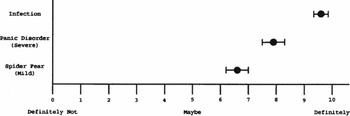
Parents were asked to rate their willingness to allow their child to take medication on an 11-point scale (0 = definitely not; 5 = maybe; 10 = definitely) for three types of imagined ailments: (1) severe/interfering anxiety (2-year duration panic disorder), (2) mild/less-interfering anxiety (3-month duration spider fear), or (3) a 2-week duration infection. The anxiety disorder scenarios were presented first and the order they were presented was randomised. See Supplementary B for vignettes describing each ailment type.
Parent concerns
Parents were also asked to rate on an 11-point scale (0 = definitely not; 5 = maybe; 10 = definitely) concerns (or beliefs) they had about using DCS to treat their child. Parents were asked: (1) ‘I would be concerned DCS could have side-effects’, (2) ‘I would be concerned that DCS could change the way my child thinks and feels’, (3) ‘Psychologists should use medications like DCS to improve their treatments’, and (4) ‘I do think DCS could help my child overcome their anxiety’. The order in which statements were presented was randomised.
Parent trait anxiety
Parents completed the trait section (Form Y-2) of the State-Trait Anxiety Inventory (Spielberger, Reference Spielberger1983) to assess their own levels of trait anxiety. Participants were asked to indicate how much each of 20 statements reflects how they generally feel on a 4-point Likert scale (1 = almost never; 2 = sometimes; 3 = often; 4 = almost always). The STAI (Form-Y) has shown good to have excellent internal consistency, with a Cronbach's alpha = .86–.95 (Spielberger, Reference Spielberger1983) and significant correlations with other trait measures of anxiety in normal populations (Creamer, Foran, & Bell, Reference Creamer, Foran and Bell1995; Spielberger, Reference Spielberger1983).
Written responses
Parents were finally asked to write an open-ended response outlining any thoughts they had regarding the use of DCS to treat anxiety in children.
Analysis
A one-way, within-subjects analysis of variance (ANOVA) was conducted to compare the effects of ailment type on parent willingness to allow their child to take medication for mild anxiety, severe anxiety, and an infection, using a Bonferroni corrected alpha of .017. Descriptive statistics were calculated for parent concerns and trait anxiety. Differences between mothers versus fathers in willingness to consent and individual concerns regarding DCS were calculated using independent samples t tests, with a Bonferroni-corrected alpha of .007. Bivariate correlations were first conducted to examine whether parent concerns, demographic factors, or parental trait anxiety were associated with willingness to use DCS for each anxiety disorder. A multivariate analysis of variance (MANOVA) examined the unique proportion of variance accounted for by each parent concern associated with their willingness to use DCS. For this analysis, parent willingness to use DCS for both mild and severe anxiety was combined into a single dependent variable, and then each dependent variable was examined independently.
For the written responses, an inductive analysis was conducted, in a similar manner to that described by Mertens (Reference Mertens2005). Codes were initially generated by the first author (SPB) to describe content of written responses, and these codes were organised into overarching themes. The frequency of the different codes and themes throughout the responses was reported. The reliability of these codes was examined by the third author (NS) who independently examined the first code that appeared for 25% of all responses. For this analysis, interrater reliability was very high, at kappa = .87, p < .001.
Results
Comparisons Between Ailment Types
Means are presented in Figure 1. There was a significant main effect of ailment type on parents’ willingness to use medication, Wilks’ lambda = 0.487, F(2, 220) = 115.81, p < .001. Bonferroni-controlled follow-up contrasts revealed parents were more likely to use the medication for an infection than severe anxiety, F(1, 217) = 89.19, p < .001, or mild anxiety F(1, 217) = 221.94, p < .001. A further follow-up contrast revealed parents were more likely to use medication for severe anxiety than mild anxiety, F(1, 217) = 82.74, p < .001.
Mean (+2 SEMs) parent willingness to use medication to treat their child.

Preliminary Analysis
The following mean scores were reported when parents were asked to rate on an 11-point scale (0 = definitely not; 5 = maybe; 10 = definitely) whether they were concerned about: (1) side-effects from DCS (M = 7.63, SD = 2.74), (2) DCS changing the way their child thinks (M = 5.86, SD = 3.23), (3) psychologists should use DCS (M = 5.78, SD = 2.74), and (4) believing DCS could help their child (M = 6.95, SD = 2.23). The mean score on the STAI (Form Y-2) was 35.03 (SD = 9.30). Cronbach's alpha for the STAI was .94, indicating the measure had high internal consistency in this sample. There were no differences between mothers or fathers on any concern or willingness variable (all ts ≤ 1.13, all ps ≥ .26), with the exception of ‘DCS would change the way their child thinks and feels’, where fathers were significantly more concerned than mothers (t = 2.24, p = .03); however, this effect was lost when controlling for error rate (Bonferroni-corrected p = .007).
Correlations Between Parent Willingness and Other Variables
Parent willingness to use DCS for mild anxiety (spider fear) showed small to moderate negative correlations with concern about side-effects (r = -.288, p < .001) and concern it could change how their child thinks (r = -.315, p < .001); large positive correlations with belief psychologists should use DCS (r = .501, p < .001) and belief DCS could help their child (r = .598, p < .001); small positive correlation with parent trait anxiety (r = .172, p = .010) and no significant relationship with any demographic variable (all rs ≤ .065, all ps ≥ .334).
Parent willingness to use DCS for severe anxiety (panic disorder) showed a similar pattern of results, with small-to-moderate negative correlations with concern about side-effects (r = -.246, p < .001) and concern it could change how their child thinks (r = -.390, p < .001); large positive correlations with belief psychologists should use DCS (r = .538, p < .001) and belief DCS could help their child (r = .604, p < .001); small positive correlation with parent trait anxiety (r = .224, p < .001); and no significant relationship with any demographic variable (all rs ≤ .109, all ps ≥ .122).
Multivariate Analysis of Variance for Variables Associated With Parent Willingness to Use D-Cycloserine
A MANOVA was conducted to examine variables associated with willingness to use DCS for both the mild and severe anxiety disorders, examining the unique variance from the four parent concerns: side-effects, changing the way the child thinks/feels, whether psychologists should use DCS, and whether they believed DCS could help their child. On examination of the multivariate results, two of the variables were found to be significantly and positively associated with willingness to use DCS: whether parents thought DCS would help their child, Wilks’ lambda = .73, F(2, 216) = 40.14, p < .001, ηp 2 = .27, and whether psychologists should use DCS, Wilks’ lambda = .84, F(2, 216) = 20.33, p < .001, ηp 2 = .16. Changing the way the child thinks/feels was significantly and negatively associated with willingness to use DCS, Wilks’ lambda = .94, F(2, 216) = 6.72, p = .001, ηp 2 = .06. Side-effects was not significantly associated with willingness to use DCS (p = .09). Of these variables, parents’ beliefs that DCS could help their child uniquely accounted for the largest proportion of variance, followed by the belief psychologists should use DCS, concern it could change how their child thinks and feels, and concern about side-effects. The pattern of the multivariate analysis was mirrored by the univariate results, with the exception that changing the way the child thinks/feels was negatively associated with willingness to use medication for the severe anxiety disorder, F(1, 217) = 12.65, p < .001, ηp 2 = .06, but was not significantly associated with use for the mild anxiety disorder (p = .206).
Written Responses
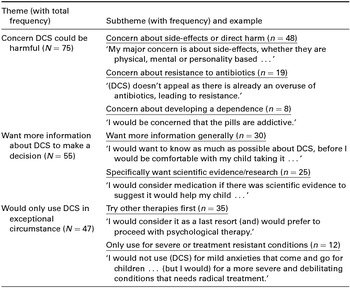
Of the entire sample, 150 (67.57%) participants provided written responses at the end of the survey. See Table 1 for responses categorised by themes and subthemes.
Themes From Inductive Analysis of Written Responses of Parent Attitudes to D-Cycloserine

Discussion
The aim of this study was to examine factors that could influence parental consent to use DCS to treat child anxiety. Overall, results suggest parents would consider using DCS to treat their child; however, in partial support of hypothesis 1, they reported a number of concerns regarding its use. Even when informed that DCS is safe, requires only brief use and has been shown to improve the effects of exposure, parents were concerned about the potential for harm from the medication. For example, they generally believed DCS could control their child's thoughts and feelings and were unsure as to whether psychologists should use it. As hypothesised, parents indicated that they were more willing for their child to take an antibiotic for a mild infection, rather than taking DCS (also an antibiotic) for a severe and debilitating anxiety disorder. These results are consistent with other findings suggesting parents have particular concerns about the use of medications to treat childhood mental disorders (Lazaratou et al., Reference Lazaratou, Anagnostopoulos, Alevizos, Haviara and Ploumpidis2007; Rappaport & Chubinsky, Reference Rappaport and Chubinsky2000). This consistency in response comes despite the fact that DCS is very different from traditional psychotropic medications.
As hypothesised, greater symptom severity was associated with more willingness to use DCS, similar to other studies of parent treatment acceptability (e.g., Lazaratou et al., Reference Lazaratou, Anagnostopoulos, Alevizos, Haviara and Ploumpidis2007). This relationship suggests parents may be less willing to use DCS as a first-line intervention, yet may be more willing to use it for difficult-to-treat disorders. A similar attitude was expressed in the written responses, where parents reported they would only consider DCS augmentation in exceptional circumstances (as a ‘last resort’), after other treatment options had been attempted or if the disorder was sufficiently severe to warrant its use. Despite the varied concerns that parents expressed about DCS, the belief it could help their child was most strongly associated with their willingness to use it. Parents generally reported wanting more information about DCS in order to make a judgement regarding its use. This information could be in the form of expert advice, a second opinion or scientific evidence. An unexpected result was that greater parental trait anxiety was associated with more willingness to use DCS. This may have been a consequence of how the vignettes were presented: they did not give parents the opportunity to have alternate treatment for their child. However, this result suggests that anxious parents may be more willing to try any intervention rather than do nothing.
If DCS is used in clinical practice, clinicians should be mindful that parents always have mixed views regarding the use of any medication. Some concerns about DCS may be due to misconceptions or inflated perceptions of risk. More speculatively, yet consistent with Lazaratou et al. (Reference Lazaratou, Anagnostopoulos, Alevizos, Haviara and Ploumpidis2007), these results suggest providing parents with knowledge about DCS, including information about its acute administration and minimal side-effect profile, may reduce unrealistic concerns and increase its acceptability. For example, Roberts et al. (Reference Roberts, Farrell, Waters, Oar and Ollendick2016) found parents did not view DCS as a favourable intervention relative to psychological treatments; however, once they had been informed of the potential risks and benefits, there was a significant increase in acceptability. In these cases, good information may increase treatment acceptability by: (1) dispelling misconceptions about risks regarding DCS, and (2) highlighting the potential benefits of the intervention for their child. Future research may wish to examine these effects in a clinical population, possibly by measuring how treatment acceptability is influenced by the amount and quality of information given to parents prior to their child receiving treatment.
These results should be viewed in the light of some limitations. First, the hypothetical methodology may not truly and accurately reflect a parents' decision-making process in real life. For example, parent decisions regarding care for their unwell child are typically made during periods of high stress and emotion. Second, this study used a community-based sample that was biased towards being middle-aged, female, of Anglo-Celtic origin, and well educated. These biases may have implications for this study's external validity and may partly account for the lack of correlation between parent willingness to use DCS and demographic variables. Parents in this study did not have the option of having an alternative treatment for their child, possibly increasing their reported willingness to consent to DCS. It should be noted that vignettes could have made clearer that a medical doctor would be prescribing DCS. This omission may have decreased parents’ acceptability of DCS and/or increased their concerns about it. Future studies may wish to examine how a child's prior history of anxiety treatment affects acceptability, as there is evidence that this could influence parents' willingness to allow their child to take medications (e.g., Brown et al., Reference Brown, Deacon, Abramowitz, Dammann and Whiteside2007; Deacon & Abramovitz, Reference Deacon and Abramowitz2005). Finally, while we detected no systematic differences between mothers and fathers in DCS concerns or willingness to consent, future studies may wish to examine how parent gender influences treatment acceptability.
The promising result from this study is that many parents would consider using DCS to treat their child; however, it should also be noted many were unsure and most had concerns. Parents reported particular concerns regarding the potential for harm or side-effects from the drug and were more willing to consider DCS if their child's anxiety was severe and/or other approaches had failed. The belief that DCS could be beneficial to their child could override concerns parents have about its use. There are obvious differences between DCS and traditional psychotropic medications; however, considering DCS is such a low-risk intervention, these results may reflect a general wariness regarding the use of medications to treat childhood mental disorders. Providing parents with good information regarding DCS may reduce these concerns.
Acknowledgments
This research was supported by Australian Research Council grant DP1095162 to Professor Rapee (the second author). The authors have no conflicts of interest to disclose.
Supplementary material
To view supplementary material for this article, please visit https://doi.org/10.1017/bec.2017.5