Dilated cardiomyopathy is the most common cause of cardiac failure, and the most frequent indication for cardiac transplantation, in children and adolescents.Reference Boucek, Edwards, Keck, Trulock, Taylor and Hertz1 In adults, familial disease accounts for between one-quarter and half of cases with mutations described in genes encoding cytoskeletal, nuclear envelope, and most recently, cardiac sarcomeric proteins.Reference Kamisago, Sharma and DePalma2, Reference Mogensen, Murphy and Shaw3 Familial disease in childhood is thought to be less important, the majority of cases being attributed to myocarditis.Reference Calabrese, Rigo and Milanesi4
In 2004, a novel mutation in the gene encoding cardiac Troponin C (TNNC1) was identified in a family with dilated cardiomyopathy.Reference Mogensen, Murphy and Shaw3 Here, we present a subsequent case of dilated cardiomyopathy in occurring in a child from the same family. This has important implications for genetic counselling of families harbouring such mutations, and the screening of families of children presenting with dilated cardiomyopathy.
Case report
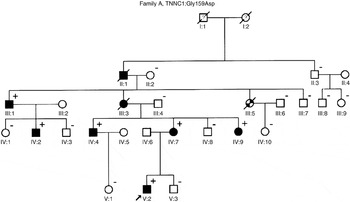
A previous accountReference Mogensen, Murphy and Shaw3 has been given concerning the family in which the missense mutation in TNNC1, resulting in a substitution of aspartic acid for glycine at position 159, or Gly159Asp for short, was initially identified. The 3 year old son of the sister of the proband of this family (see Fig. 1) was admitted to his local hospital with a 3-day history of vomiting and reduced urinary output. He had been unwell for the previous 3 months, with progressive lethargy, dyspnoea, and cough. The chest radiograph showed an increased cardiothoracic ratio, along with pulmonary oedema. An episode of self-terminating tachyarrhythmia, at 210 beats per minute, was detected on the monitor, but not captured on a 12-lead electrocardiogram. He was commenced on diuretics, and transferred to the regional Paediatric Intensive Care Unit.
The pedigree of the involved family. Squares: male family members; circles: female family members; symbols with slash: deceased individuals; open symbols: unaffected individuals; solid symbols: individuals affected by dilated cardiomyopathy; checkered symbols: individuals who died suddenly; plus signs: presence of mutation; minus signs: absence of mutation; arrow: individual described in this report.

Echocardiography demonstrated a normally connected heart, with biventricular dilatation, left ventricular end-diastolic dimension being 54 millimetres, with end-systolic dimension of 50 millimetres, and poor biventricular systolic function, the left ventricular ejection fraction being measured at 20%. There was global left ventricular hypokinesis, and severe mitral regurgitation. Coronary arterial anatomy was normal, with antegrade diastolic flow seen on colour Doppler. A 12-lead electrocardiogram showed sinus rhythm with increased left ventricular voltages, anterior Q waves, inverted T waves inferiorly, and evidence of bi-atrial enlargement.
Despite inotropic support, he experienced two respiratory arrests with bradycardia requiring resuscitation, and was therefore intubated and transferred to Great Ormond Street Hospital for extra-corporeal membrane oxygenation and assessment for transplantation. He received 17 days of veno-arterial extra-corporeal membrane oxygenation as a bridge to transplant, with two unsuccessful attempts at weaning. He underwent successful orthotopic heart transplantation on 10th February, 2005, and at last review 7 months after transplantation remains very well and active, with no episodes of rejection detected clinically or on endomyocardial biopsy.
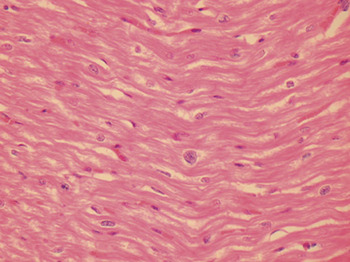
Mutation analysis was carried out on genomic deoxyribonucleic acid extracted from a peripheral blood sample taken from the patient during his admission. This confirmed the presence of the mutation previously identified in the family. Histological analysis of the explanted heart demonstrated non-specific patchy fibrosis, particularly in the subendocardium. There was no evidence of myocytic disarray or hypertrophy, and no vacuolation or inflammation was seen (Fig. 2).
A section of left ventricular myocardium from the explanted heart. There are a few elongated myofibres, some containing enlarged nuclei, in keeping with dilated cardiomyopathy. There is no fibrosis, inflammation or necrosis. Elsewhere there was moderate endocardial fibroelastosis.

Discussion
To the best of our knowledge, this is the first report of dilated cardiomyopathy caused by a mutation in the cardiac Troponin C gene presenting in childhood. Dilated cardiomyopathy is a disorder of the cardiac muscle characterised by left ventricular dilation and impaired systolic function. Children with dilated cardiomyopathy may present with symptoms and signs of pulmonary congestion, failure to thrive, and low cardiac output. Arrhythmia, thromboembolic disease, and sudden cardiac death are not infrequent complications. In infants and children, myocarditis is thought to be the commonest cause of left ventricular dilation and heart failure.Reference Calabrese, Rigo and Milanesi4 Other causes of childhood dilated cardiomyopathy are rare, and include nutritional deficiencies, neuromuscular, and metabolic disorders. In adults and adolescents, up to half of cases are believed to be familial, with predominantly autosomal dominant inheritance.Reference Mogensen, Murphy and Shaw3 Genes implicated in the pathogenesis of familial dilated cardiomyopathy encode cytoskeletal, nuclear envelope, and sarcomeric contractile proteins.Reference Mogensen, Murphy and Shaw3 The role of mutations in these genes in the childhood form of the disease remains unknown.
Cardiac Troponin C has been identified recently as a disease-causing gene in dilated cardiomyopathy.Reference Mogensen, Murphy and Shaw3 In the described family, expression of the disease was severe, with several family members experiencing premature cardiac death or transplantation. The age at diagnosis in this family ranged from 20 years to 62 years. Of note, the later generations presented at younger ages, with a mean age of 25 years in the fourth generation as opposed to 39 years in the third generation, and 62 years in the second (Fig. 1).Reference Mogensen, Murphy and Shaw3 This could imply genetic anticipation. The finding of severe cardiac failure requiring transplantation in this three-year-old member of the same family provides further evidence of the severity of the expression of the clinical disease associated with TNNC1 mutations.
Mutations in other sarcomere protein genes, namely Troponin T and β-myosin heavy chain, have been reported to be associated with disease of early onset, including infantile cardiomyopathy and sudden death, and fetal left ventricular dilation.Reference Kamisago, Sharma and DePalma2 These findings suggest that mutations of the sarcomeric protein genes may be an important cause of dilated cardiomyopathy in the young, but large studies involving populations will be required to determine the prevalence of such mutations in children with dilated cardiomyopathy.
It has been suggested that analysis of mutations in the Troponin complex genes in adults with dilated cardiomyopathy may provide the opportunity for early detection of individuals at high risk of complications, and improved management and survival.Reference Mogensen, Murphy and Shaw3 This may be the same in children, but there are ethical issues to consider regarding genetic screening in children. It is important that informed consent is always obtained from the parents. In particular, issues relating to the autonomy of the patient, confidentiality, and psychosocial harm, including loss of self-esteem, stigmatisation or discrimination, and guilt, should have been raised. Unlike the situation where predictive testing is carried out in childhood for diseases with onset during adult life, however, or where there is no effective treatment, such as Huntington disease, familial dilated cardiomyopathy can present in children, medical treatment and transplantation is readily available, and early detection has the potential to improve outcome. In adults, data suggests that medical treatment of asymptomatic patients with familial dilated cardiomyopathy may improve their prognosis.Reference Waagstein, Hjalmarson and Swedberg5 Although prospective studies of medication for cardiac failure have not been published in children, it is not unreasonable to assume that this may also apply to them. It is possible that earlier identification of the patient in this report, such as might have been achieved with predictive genetic testing, may have prevented the catastrophic collapse that resulted in the requirement for extra-corporeal membrane oxygenation prior to transplantation, and may have allowed for medical management at a pre-symptomatic stage, thereby delaying cardiac transplantation.
As far as we know, this is the first report of dilated cardiomyopathy in childhood caused by a mutation in the cardiac Troponin C gene. Future studies to define the frequency of such mutations in children with dilated cardiomyopathy are warranted before recommendations can be made for routine screening of the sarcomeric protein genes in the setting of dilated cardiomyopathy.
Acknowledgements
We are indebted to Dr Petros Syrris, for carrying out the genetic analysis. We also thank the family involved for consenting to the publication of this report; and Dr Michael Ashworth for providing and interpreting the histopathological slide. Dr Kaski is supported by British Heart Foundation Junior Research Fellowship FS/05/036.