Introduction
Almost ten years ago, the CANE was developed in the United Kingdom for the assessment of needs in the elderly population (Reynolds et al., Reference Reynolds2000; Orrell and Hancock, Reference Orrell and Hancock2004). Following the person-centered approach, the CANE allows the assessment of met and unmet physical-, psychological-, and environment-related needs of older people from different angles including the perspectives of patients, carers, and healthcare professionals. Possible applications of the CANE are diverse and range from private and clinical to research settings. Currently, the CANE is available in 16 languages (for more information, please also visit http://www.ucl.ac.uk/cane). In Germany, the development and establishment of a German version of the CANE is currently pending. Although the German version of the CANE was initially introduced by Dech and Machleidt (Reference Dech, Machleidt, Orrell and Hancock2004), it was not further evaluated or established in the German-speaking countries. Recently, the psychometric quality of the German version of the CANE was investigated in the study of Stein et al. (Reference Stein, Luppa, König and Riedel-Heller2014). However, the results of this study also showed that the currently available German version of the CANE would substantially benefit from a formal and content-related verification and adaptation as well as an evaluation of the content validity. Content validity considers whether an instrument adequately represents all relevant aspects and facets of a given construct (Bannigan and Watson, Reference Bannigan and Watson2009). The investigation of the content validity of the CANE is necessary in order to account for differences between the British and the German healthcare system. Furthermore, the current demographic and social developments in our society will lead to a significant increase of treatment and healthcare needs in the future, particularly in the elderly population. Thus, the planning of healthcare and healthcare services for the older population requires an adapted and up-to-date multidimensional, systematic, and comprehensive assessment of the needs of older people.
Thus, the aim of this study was the (1) evaluation of distribution and frequency of met and unmet needs in the German elderly population, (2) evaluation of frequency and relevance of needs in the German elderly population and collection of improvement suggestions from the experts’ point of view, and (3) discussion of these findings in multidisciplinary consensus conferences and integration in the adapted German version of the CANE.
Methods
In order to evaluate the content validity and to improve the German version of the CANE, we followed a three-stage approach based on the group Delphi method (Schulz and Renn, Reference Schulz and Renn2009).
Patients’ point of view: evaluation of relevance and frequency of met and unmet needs in the German elderly population
In the first step, 474 general practitioner (GP) patients aged 75 years and older were assessed regarding individual met and unmet needs by using the German version of the CANE including 24 domains of needs in four care categories environmental needs, physical needs, psychological needs, and social needs (Reynolds et al., Reference Reynolds2000; Orrell and Hancock, Reference Orrell and Hancock2004; van der Ploeg et al., Reference van der Ploeg, Bax, Boorsma, Nijpels and van Hout2013). In our study, the two carer-related needs sections (carer's need for information, carer's psychological distress) were not included. Participants were recruited via GPs in the city of Leipzig, Germany. All participants gave written informed consent. The study was approved by the local ethics committee. More details of the study are given by Stein et al. (Reference Stein, Luppa, König and Riedel-Heller2014).
Descriptive statistics were used to analyze the relevance and frequency of met and unmet needs as assessed via the German version of the CANE in the study sample. Across all the CANE sections and care categories, ranks were computed according to the relevance and frequency of met and unmet needs with 1 being the highest rank (high relevance and frequency) and 24 being the lowest rank (low relevance and frequency).
Experts’ point of view: evaluation of relevance and frequency of met and unmet needs in the experts’ survey
The research team of this study developed an expert questionnaire including rating and ranking scales in order to evaluate the presently available German version of the CANE from an experts’ point of view. The conception and construction of the expert questionnaire was based on theoretical foundations of empirical social research (Schulz and Renn, Reference Schulz and Renn2009). In the questionnaire, experts were asked to examine the German version of the CANE followed by the invitation to rate the relevance and frequency of met and unmet needs of older people as assessed by the German version of the CANE. Furthermore, experts were asked about missing or unnecessary need sections in the CANE. In this context, the evaluation of the need sections in the CANE was based on established criteria for prioritization in medical healthcare including frequency, relevance, and redundancy (Hoppe, Reference Hoppe2010). An open answering format was included in order to assess further suggestions or ideas that would improve the CANE. Furthermore, the questionnaire included the socio-demographic variables age, gender, and education/occupation. The sample of the expert survey (n = 19) included three groups: professionals and experts (n = 7) as well as user representatives (senior citizens, n = 6) and carer representatives (caring relatives, n = 6). The expert group included representatives from the geriatric care sector, counseling centers for older people, research staff and academic specialists in geriatric medicine. The sample was recruited via the existing university scientific network and collaborators such as the advisory board of seniors of the city of Leipzig and the co-operational network of the cities of Rostock, Hamburg, Berlin, and Munich. This means that our institute and the research team is part of a broad scientific network of researchers and project partners from other universities as well as medical professionals that co-operate in our numerous studies. Moreover, we have been supported by the local advisory board of the seniors of the city of Leipzig to enter into an intensive dialogue and exchange of experience. The members of the senior advisory board work as a politically and ideologically independent committee on a voluntary basis. Their aim is to improve the living conditions of the elderly and support those people working in the geriatric care system. They represent the interests of seniors in an even greater focus beyond the borders of the city of Leipzig. All participants gave written informed consent. The study was approved by the local ethics committee. Again, ranks were computed according to the relevance and frequency of needs with 1 being the highest rank (high relevance and frequency) and 24 being the lowest rank (low relevance and frequency) across all the CANE sections and care categories.
Multidisciplinary consensus conference: discussion and integration of the findings in an adapted version of the CANE
The members of the consensus conference consisted of 15 experts in the field including psychiatrists, psychologists, sociologists, and nutritionists. The aim of the consensus conference was to discuss and to integrate the findings based on the members’ experiences in the fields of geriatric research, healthcare and living conditions of the elderly population. The results of the first two stages (patients’ and experts’ surveys) were circulated to the participants of the multidisciplinary consensus conference and mean values of ranks were determined across all the CANE sections and care categories that were included.
Results
Patients’ view: evaluation of relevance and frequency of met and unmet needs in the German elderly population
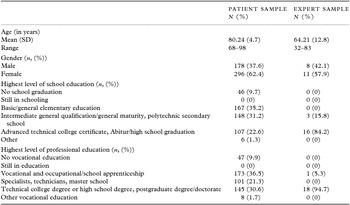
In Table 1, the socio-demographic characteristics of the patient sample (N = 474) are displayed. Mean age of patients was 80.2 years. Two-thirds of the patients were women. Most of the patients had basic elementary education (35.2%) or intermediate general qualification (31.2%).
Socio-demographic characteristics of the sample of the patients (n = 474) and the experts (n = 19)

Notes. SD = standard deviation.
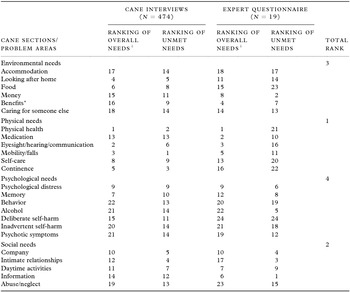
Table 2 provides a summary of the priorities (ranks) of overall met and unmet needs as reported by GP patients who were interviewed via the CANE. With regard to overall needs, physical health, eyesight/hearing/communication, medication, mobility/falls, looking after home, benefits, and continence were the five highest ranked CANE sections in GP patients. With regard to unmet needs, the five highest ranked CANE sections were mobility/falls, physical health, continence, intimate relationships, and company.
Ranking of overall and unmet needs as reported by patients and according to the expert ratings

Notes. +Overall needs included met and unmet needs; *Pensions and other financial support; Ranking: 1 = highest rank, 24 = lowest rank.
Experts’ point of view: evaluation of relevance and frequency of met and unmet needs in the experts’ survey
In Table 1, the socio-demographic characteristics of the expert sample (N = 19) are displayed. Mean age of the experts was 64.2 years and over the half of the sample (57.9%) were female. Most of the experts (84.2%) had a high educational level.
Table 2 provides a summary of the priorities (ranks) of overall met and unmet needs as evaluated by the experts. Similar to the findings in the patient sample, experts rated physical health, eyesight/hearing/communication, medication, mobility/falls, looking after home, benefits, and continence as the five highest overall CANE sections. With regard to unmet needs, contrary to the patient sample, the five highest ranked CANE sections were information, money, intimate relationships, company, and alcohol.
The further evaluation of the instrument comprised formal and content-related aspects of the CANE. In general, the experts recommended to (1) simplify the formulations, (2) to avoid foreign words, (3) to shorten the sentences, (4) to specify and to refine the questions, (5) to leave more space for comments, and (6) to provide an interview guideline.
Furthermore, experts were asked to rate if there are missing or unnecessary sections in the CANE. The experts stated that the need sections “dental health/condition of dentures,” “disability,” “pain,” and “handling of new media” should be added to the CANE. Furthermore, the experts suggested introducing an extra section for “falls” as it seems to be an extremely relevant topic in the elderly. The experts also suggested extending several CANE sections: “food” should be extended by “drinking,” “psychotic symptoms” by “delirium,” “alcohol” by “addiction” including not only alcohol but also tobacco, medication, and other drugs. Last but not least, the CANE section “daytime activities” should also include “participation in culture” according to the experts. With regard to negligible sections in the CANE, the experts believed that “deliberate self-harm” and “inadvertent self-harm” may be considered redundant. Moreover, the experts suggested to separate the two carer-related sections (carer's need for information and carer's psychological distress) from the CANE.
Multidisciplinary consensus conference: discussion and integration of the findings in an adapted version of the CANE
Table 2 shows the final rankings of relevance of met and unmet needs as the result of the multidisciplinary consensus conference (right column). With regard to overall needs, physical health, medication, eyesight/hearing/communication, mobility/falls, self-care, and continence were the highest ranked CANE sections. The second highest ranked CANE sections were company, intimate relationships, daytime activities, information and abuse/neglect. The CANE sections accommodation, looking after home, food, money, benefits, and caring for someone else were ranked third-highest. The lowest priorities with regard to overall needs were given to the CANE sections psychological distress, memory, behavior, alcohol, deliberate self-harm, inadvertent self-harm, and psychotic symptoms. With regard to unmet needs, the priorities were slightly different: the highest ranked CANE sections were company, intimate relationships, daytime activities, information, and abuse/neglect, followed by physical health, medication, eyesight/hearing/communication, mobility/falls, self-care, and continence. Further ranking of CANE sections with regard to unmet needs were given in a similar pattern as outlined above. Altogether, the highest ranked care category was physical needs (physical health, medication, eyesight/hearing/communication, mobility/falls, self-care, and continence), followed by social needs (company, intimate relationships, daytime activities, information, and abuse/neglect). The care category of environmental needs was in third and the care category of psychological needs in fourth place (Table 2, right column).
As a further result of the multidisciplinary consensus conference, the following modifications of the CANE have been made. With regard to the layout of the questionnaire, we added a brief introduction and definition of need as well as an example how to rate met and unmet needs. Every CANE section was modified with regard the given examples – all examples have been revised and moved to the new developed interview guideline. We simplified the formulations in order to improve the coherence and the readability of the text. This step also included to simplify (foreign) words and to shorten the sentences. Furthermore, we specified and refined the initial questions in every CANE section. We also added spacious comment fields to every CANE section to enable the collection of important information and patient data. In order to improve the user-friendliness, an interview guideline was provided. Finally, two forms of the CANE were developed: one form for the self-assessment and one form for the external assessment of patients including carers, medical staff, or other raters.
Furthermore, the CANE was modified with regard to missing sections in the CANE and overall contents. So, the CANE has been extended based on expert recommendations to include “dental health/condition of dentures,” “disability,” and “pain” in the need section of physical health/physical status. Furthermore, the CANE sections “food” and “psychotic symptoms” have been extended based on expert recommendations to include “drinking/drinking status” and “delirium,” respectively. The CANE section “alcohol” has been modified into “abuse and addiction” including not only alcohol but also tobacco, medication, and other drugs. The CANE section “daytime activities” was extended by the aspects “handling of new media” and “participation in culture.” Moreover, we introduced the new CANE section “falls.” With regard to CANE sections rated as negligible, no modifications have been done. Although the experts believed that the CANE sections “deliberate self-harm” and “inadvertent self-harm” are redundant, the members of the consensus conference decided that these sections are important and should be maintained in the CANE. Analogous, the two carer-related sections (carer's need for information and carer's psychological distress) were kept in the CANE. Two versions have been developed: one self-assessment version (patient) in direct speech and one external assessment version (carer, staff, external rater) in indirect speech.
Discussion
The aim of this study was to evaluate and to adapt the currently available German version of the CANE based on a staged process including a user survey of 474 older individuals (face-to-face CANE interviews), an expert survey (n = 19), and a multidisciplinary consensus conference involving professionals in the field of the aging population, geriatrics, and gerontology.
As a main result, unmet physical needs including physical health, medication, eyesight/hearing/communication, mobility/falls, self-care, and continence were found to have top priority closely followed by social needs (company, intimate relationships, daytime activities, information, and abuse/neglect). This is broadly consistent with the findings of two other studies evaluating common unmet needs in the older population in the United Kingdom. According to these studies, most unmet needs occurred in the sections physical health, senses (vision and hearing), physical ability (mobility and falls), and incontinence (Walters et al., Reference Walters, Iliffe, Tai and Orrell2000; Iliffe et al., Reference Iliffe, Lenihan, Orrell, Walters, Drennan and Tai2004). Psychological needs were the lowest ranked care category. This might be surprising when one considers the high prevalence of mental disorders such as depression and dementia in the elderly population (Luppa et al., Reference Luppa2012; Prince et al., Reference Prince, Bryce, Albanese, Wimo, Ribeiro and Ferri2013). One could assume that the results may be biased due to non-reporting. For example, critical or personal themes may not be reported in a face-to-face CANE interview. Accordingly, there is substantial evidence that mental disorders may not only be masked in the elderly population but also unreported for different reasons such as stigmatization (Preville et al., Reference Preville2009; Byers et al., Reference Byers, Arean and Yaffe2012). Even if the implementation of different angles and methods in this study was expected to reduce potential bias, these circumstances may have significantly influenced the results.
The outcome of this study has been a comprehensive revision and necessary improvement of the German version of the CANE including the perspectives of older primary care patients, experts and specialists for the aging population. In this study, content-related validity of the German CANE was assessed incorporating these different angles. As a result of the staged content-related assessment procedure in this study, the CANE was extended by several aspects, for example, “drinking status,” “dental health,” “disability,” “delirium,” and “pain” as these aspects represent common issues in the elderly population that should be systematically recorded and considered when assessing needs (Lüttje et al., Reference Lüttje, Varwig, Teigel and Gilhaus2011; Vermeulen et al., Reference Vermeulen, Neyens, van Rossum, Spreeuwenberg and de Witte2011; Rabbo et al., Reference Rabbo, Mitov, Gebhart and Pospiech2012; Inouye et al., Reference Inouye, Westendorp and Saczynski2014). The extension of the CANE section “alcohol” by other substances such as tobacco, medication, and other drugs ensures the broad coverage of the section “substance abuse and addiction” in the CANE. According to a recent review by Taylor and colleagues, geriatric substance abuse represents a growing problem in the elderly and includes both licit and illicit substances (Taylor and Grossberg, Reference Taylor and Grossberg2012). Furthermore, research shows an increasing internet and email use among the elderly in the course of the rise in technology utilization (Kiel, Reference Kiel2005). Therefore, the CANE section “daytime activities” was extended by the aspect “handling of new media.” Additionally, the CANE section mobility/falls was divided into two separate sections. In the literature, falls were found to be the most relevant with regard to mortality. For example, Spaniolas et al. showed that falls were strongly associated with increased mortality in elderly patients, especially in patients older than 70 years (Spaniolas et al., Reference Spaniolas, Cheng, Gestring, Sangosanya, Stassen and Bankey2010). In general, falls represent a serious problem in the elderly, and the severity of fall-related complications rises steadily after the age of 65 years (Al Tehewy et al., Reference Al Tehewy, Amin and Nassar2014). Facing the significant association between falls and a higher burden of injury, morbidity and mortality in the elderly, effective fall prevention strategies are becoming increasingly important (Gelbard et al., Reference Gelbard2014). To take account for these circumstances, we established a separate “falls” section in the CANE for the assessment of met and unmet needs with regard to falls. On the other hand, no changes have been made with regard to the sections “deliberate self-harm” and “inadvertent self-harm” as well as the two carer-related sections (carer's need for information and carer's psychological distress) due to the importance of these sections (Böttche et al., Reference Böttche, Klasen and Knaevelsrud2013; Glover and Srinivasan, Reference Glover and Srinivasan2013; van der Ploeg et al., Reference van der Ploeg, Bax, Boorsma, Nijpels and van Hout2013).
The German version of the CANE has also been substantially improved due to an in-depth revision of the layout. Spacious commentary fields were added in order to collect all the relevant information on the patient. Furthermore, the results of all the CANE sections can be compiled in a circle at the end of the questionnaire for a better overview of the individual needs status across all the CANE sections. On this basis, it should be possible to derive a specific intervention plan for every patient. Therefore, in the adapted CANE, extra pages were designed and supplemented in order to provide a synopsis of all results. This new feature in the German version of the CANE may substantially contribute to a tailored care planning. The development of the two versions for self-assessment and external assessment should facilitate the application of the CANE. The fully revised and adapted German versions of the CANE are available from the authors upon request.
The strength of this study is the usage of a mixed methodological approach based on the group Delphi method including user involvement and professional disciplines. The group Delphi method as the modified form of the Delphi method was found to be particularly suitable for the determination of expert judgments on issues of future research, forecasting, policy development, and priority setting as well as to solve very specific problems such as the development of questionnaires (Häder, Reference Häder2009). As pointed out in a former study, the combination of different methods may enhance the validity of the results and reduce bias (Iliffe et al., Reference Iliffe, Lenihan, Orrell, Walters, Drennan and Tai2004). The patient sample consisted of primary care patients. This fact is an advantage of this study, as the primary care setting is most relevant for prevention strategies since for the majority of older individuals their most important healthcare provider is the GP (Linden et al., Reference Linden, Gilberg, Horgas and Steinhagen-Thiessen1996). Moreover, it has been shown that involving service users in healthcare research may substantially improve translation of research findings into clinical practice (Domecq et al., Reference Domecq2014). The involvement of older primary care patients in the methodological triangulation of this study was of direct relevance for the results and therefore increased the content validity of the German version of the CANE. The results of this study may serve as a basis for the development of a short version of the German CANE focusing on sections of high needs (Walters et al., Reference Walters, Iliffe, Tai and Orrell2000). Limitations of the study were that carer-related needs (carer's need for information, carer's psychological distress) were not included in the face-to-face CANE interviews. Therefore, it was not possible to evaluate and contrast them in the ranking process. Further studies are needed to investigate the nature and impact of carer-related needs as assessed by the CANE. A recent review showed that family caregivers of frail and older people often suffer from stress and unmet needs for support and services (Mast, Reference Mast2013). In particular, the caregiver burden among dementia patient caregivers was associated with a negative impact on caregiver health and well-being for both the caregiver and the patient (Etters et al., Reference Etters, Goodall and Harrison2008). In contrast, it was found that caregivers often tend to postpone or decline accessible and affordable services such as respite, which may also lead to early nursing home placement for patients. Thus, the assessment of carer-related unmet needs plays a central role for the development of interventions for frail older adults and their caregivers (Mast, Reference Mast2013). Second, the patient sample was recruited from a single study site in Germany which may limit the generalizability of the results. However, the fact that the expert sample was recruited from different cities all over Germany should minimize potential bias. Nevertheless, further evaluation of the CANE based on a larger sample is needed to support our findings.
In summary, this study supports the claim that the German version of the CANE is a practical instrument of high content validity that can be used to examine met and unmet needs in the elderly population. The results of this study represent an important starting point for further studies using the German version of the CANE. In the future, further evaluation of the reliability (e.g. inter-rater reliability) and validity (including criterion and construct validity) of the instrument is warranted to support our findings. More studies are necessary to evaluate the CANE with regard to applicability and practicability in different settings and patient samples. In this context, the preparation of a handbook for the German version of the CANE for the assessment of needs in the elderly population would be desirable. In our study, the conventional paper and pencil version of the CANE has been revised. On this basis, the development of an electronic or computerized version of the CANE could be the subject of further work. Altogether, the provision of the German version of the CANE allowing individual needs assessment in older individuals presents a valuable contribution to healthcare and health services research.
Conflict of interest
None.
Description of authors’ roles
J. Stein, M. Luppa, and S. G. Riedel-Heller formulated the research questions. M. Luppa, H.-H. König, and S. G. Riedel-Heller assisted with writing the paper. J. Stein was responsible for carrying out the statistical analyses and wrote the paper.
Acknowledgments
This study was funded by the German Federal Ministry of Education and Research (grant number: 01GY1155A) and by the German Research Foundation (Deutsche Forschungsgemeinschaft) (STE 2235/1-1).