Atherosclerosis represents a disease that begins in childhood, and low-density lipoprotein cholesterol levels play a pivotal role in its pathogenesis and evolution. Familial hypercholesterolaemia is an inherited condition that results in life-long high low-density lipoprotein cholesterol levels. The elevated low-density lipoprotein cholesterol levels are due to a number of potential genetic defects. Foremost among these is an autosomal dominant defect in the low-density lipoprotein receptor, resulting in reduced low-density lipoprotein clearance. Even in the heterozygous form, the consequences of familial hypercholesterolaemia are significantly increased risk of morbidity and mortality from coronary heart disease, particularly in early mid-life.Reference Goldstein and Brown 1 – Reference Marks, Thorogood, Neil and Humphries 9
The need for intensive drug therapy in children with familial hypercholesterolaemia has been strongly accepted by all authorities.Reference McCrindle, Urbina and Dennison 10 – Reference Braamskamp, Wijburg and Wiegman 16 Bile acid sequestrants have long been considered the drug of choice in children.Reference Tonstad, Knudtzon, Sivertsen, Refsum and Ose 17 , Reference Glueck, Tsang, Fallat and Mellies 18 However, statin therapy is currently recommended as first-line treatment, and should be commenced by the age of 10 years, although some advise waiting until menarche in girls.Reference Justo 13 – Reference Braamskamp, Wijburg and Wiegman 16 Over the last two decades, statins have been studied extensively in small groups of children with heterozygous familial hypercholesterolaemia, demonstrating that they are efficacious, well tolerated, and safe in the short term.Reference Lambert, Lupien and Gagné 19 – Reference Avis, Hutten and Gagne 28 Nevertheless, there are concerns regarding the initiation at young ages and long-term efficacy and safety.Reference Justo 13 , Reference Braamskamp, Wijburg and Wiegman 16 , Reference McCrindle 29
This study explores a three-decade-long experience of treatment and follow-up of children and adolescents with heterozygous familial hypercholesterolaemia, the long-term use of statins, the achieved low-density lipoprotein cholesterol levels, and the effect on cardiovascular risk.
Patients and methods
The charts of 89 children and adolescents – 18 years of age or younger at first visit – of ∼1000 heterozygous familial hypercholesterolaemia patients treated at the Cholesterol Treatment Center, Cincinnati, Ohio, United States of America, between 1974 and 2008, were reviewed.
Familial hypercholesterolaemia was defined as low-density lipoprotein cholesterol level above the 90th percentile in individuals with a family history of familial hypercholesterolaemia, defined according the Simon Broome Registry. 8
The following data were recorded for each patient: gender; age at diagnosis; lipid levels on diet only, on each lipid-lowering medication, and at the most recent visit under treatment; age when medications and statins were started; and length of follow-up. Symptomatic cardiovascular events, including revascularisation procedures during treatment at the centre, were also recorded – events were recorded in years, for example two events occurring in the same year were counted as one event.
The routine lipid analyses – total cholesterol, high-density lipoprotein cholesterol, triglycerides, and calculated low-density lipoprotein cholesterol by the Fredrickson formula – were assayed in a Centers for Disease Control-National Heart, Lung and Blood Institute Part III standardised laboratory that maintained Part III standardisation using calibrators either supplied by the Centers for Disease Control or extensively assayed and assigned target values by Centers for Disease Control lipid standardisation branch.Reference Hainline, Karon, Winn and Gill 30 The laboratory focused on long-term clinical trials, while extensive quality efficiency was maintained and showed minimal drift over the 30 years of the study.
Statistical analysis
Demographic characteristics are presented with the mean and standard deviation for quantitative variables and with the count and per cent for categorical variables. The mean and the standard deviation are provided for the summary of lipid parameters – total cholesterol, low-density lipoprotein cholesterol, high-density lipoprotein cholesterol, and triglycerides – for the initial on-diet-only levels and for the most recent under-treatment levels. The per cent change from the initial on-diet-only levels to the most recent under-treatment levels was calculated. A simple t-test was performed to test the significance of the per cent change between these two levels.
Results
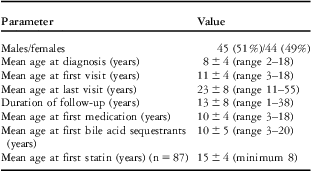
Of the 89 patients in the study group, 45 (51%) were male. The mean age at diagnosis was 8 ± 4 years (range 2–18 years). Additional demographic characteristics are shown in Table 1. There were no significant differences in demographics between genders – data not shown. The mean follow-up period was 13 ± 8 years (range 1–38 years).
Demographic parameters of the study group (n = 89).

Table 2 shows on-diet-only and most recent lipid levels during treatment and the per cent change. Serum total cholesterol and low-density lipoprotein cholesterol levels on diet alone were reduced by 33% (p < 0.0001) and 43% (p < 0.0001), respectively, at the most recent follow-up visit on treatment. There were no significant differences between genders at baseline or on treatment, or any fluctuations of low-density lipoprotein cholesterol and total cholesterol levels – data not shown. The low-density lipoprotein cholesterol levels on treatment were <130 mg/dl in 39% of the patients, <100 mg/dl in 18%, and <70 mg/dl in 4%.
Lipid levels (mg/dl).

Patients began medical treatment at a mean age of 10 ± 4 years. Resins were started at the age of 10 ± 5 years, and statins at an average of 15 ± 4 – minimum 8 years; first quartile 13 years (Table 1).
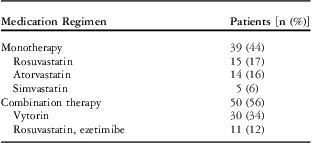
At the most recent visit, nearly half (44%) of the 89 patients were treated with statin monotherapy, mainly rosuvastatin or atorvastatin, and 56% with combination therapy, mainly vytorin or rosuvastain/ezetimibe (Table 3). At that time, 15 patients – nine male and six female patients – were >30 years of age. None of the patients in the study group, including these 15, developed symptomatic cardiovascular events or required a revascularisation procedure.
Medications on most recent follow-up visit (the most common, >5%).

Despite the long-term use of statins with or without combination therapy, none of the patients developed any severe adverse reactions such as liver failure, rhabdomyolysis, evidence of pathology in growth or hormonal status, or had any other complaints. Except for non-compliance, interruptions to therapy were not recorded.
Discussion
This patient record review strongly suggests that the natural history of heterozygous familial hypercholesterolaemia among children and adolescents has changed during the last three decades. Although familial hypercholesterolaemia is not yet curable, it can be treated effectively and safely to reduce the risk of atherosclerosis and cardiovascular events. The mean low-density lipoprotein cholesterol level was reduced by 43%, and none of the 15 patients above 30 years of age (60% male) at the most recent visit developed symptomatic cardiovascular disease or needed a revascularisation procedure. In comparison, historical data reveal that the cumulative probability of non-fatal or fatal coronary heart disease by age 40 in men with familial hypercholesterolaemia was 16% – one in six.Reference Stone, Levy, Fredrickson and Verter 4
Bile acid sequestrants have long been considered the drug of choice for children. When added to diet, resins cause a 15% reduction in low-density lipoprotein cholesterol levels in only half to two-thirds of patients. Most withdrawals from studies were related to their unpalatability.Reference Tonstad, Knudtzon, Sivertsen, Refsum and Ose 17 , Reference Glueck, Tsang, Fallat and Mellies 18
Currently, it is well accepted that statin monotherapy should be used in children at high risk for coronary heart disease.Reference Justo 13 – Reference Braamskamp, Wijburg and Wiegman 16 All available statins have been studied in children and adolescents and were found to be effective, well tolerated, and safe in the short term. However, the studies were small, lacked a control group, or had a short follow-up period of a few weeks to 2 years.Reference Lambert, Lupien and Gagné 19 – Reference Avis, Hutten and Gagne 28 , Reference Arambepola, Farmer, Perera and Neil 31 – Reference Rodenburg, Vissers and Trip 33
On the basis of these findings, it is recommended that in general statins should be started at 8–10 years of age, although some advise waiting after onset of menses in girls. The desired low-density lipoprotein cholesterol target levels are <130 mg/dl.Reference Justo 13 – Reference Braamskamp, Wijburg and Wiegman 16 Our study results revealed that the mean age of first statin use was 15 ± 4 years – minimum 8 years – and that the recommended target low-density lipoprotein cholesterol level was reached by 39% of patients, whereas 18% achieved a low-density lipoprotein cholesterol level < 110 mg/dl.
Statins were reported to affect the pathogenesis of the atherosclerotic processes in children and adolescents with familial hypercholesterolaemia. In a 2-year, single-arm study, fluvastatin (80 mg/day) resulted in fractional, but insignificant, decreases in the carotid arterial wall thickness and stiffness compared with baseline.Reference Van der Graaf, Nierman and Firth 24 In another 2-year, placebo-controlled study, pravastatin 20–40 mg/day caused a significant decrease in carotid intima media thickness.Reference Wiegman, Hutten and de Groot 34 Further treatment and follow-up of all children revealed that age at statin initiation was an independent predictor of carotid intima media thickness. The authors concluded that early initiation of statin treatment delayed the progression of carotid intima media thickness and might be beneficial in preventing atherosclerosis in adolescents and young adults.Reference Rodenburg, Vissers and Wiegman 35 Early statin treatment might also have contributed to the low baseline carotid intima media thickness levels (0.69 mm) found in the ENHANCE study and to the fact that the objective of demonstrating additional low-density lipoprotein cholesterol lowering by adding ezetimibe to high-dose statins to be more effective on carotid intima media thickness than statins alone was not achieved.Reference Kastelein, Akdim and Stroes 36 , Reference Stein 37 A significant improvement in endothelial dysfunction towards normal levels was reported after 28 weeks and even after 1 month of simvastatin treatment in children and adolescents with familial hypercholesterolaemia.Reference de Jongh, Lilien and op't Roodt 38 , Reference Ferreira, Bertolami and Santos 39
Statin treatment for children and adolescents is associated with great concern regarding long-term effect, mainly growth and hormonal status. A survey among physicians in 169 lipid clinics revealed that in boys aged 10–15 years 65% of physicians were prepared to treat with bile acid sequestrants, but only 23% with statins. There was a greater reluctance to treat girls of the same age (52% and 12%, respectively).Reference Greene and Durrington 40 The efficacy and tolerability of pravastatin therapy in real-life setting was demonstrated to be similar to that in randomised controlled studies in 185 children, who were followed up for a mean duration of 2 years 2 months.Reference Carreau, Girardet and Bruckert 41 Two other placebo-controlled studies evaluated the probable adverse effects of lovastatin on adolescent familial hypercholesterolaemia patients. In the first, lovastatin 10–40 mg/day was administered to 63 boys 10–17 years old for 48 weeks. There was no effect on sexual maturation assessed by Tanner staging and testicular volume, either on serum hormone levels or biochemical parameters of nutrition.Reference Stein, Illingworth and Kwiterovich 20 The second study included 35 girls post menarche aged 10–17 years, who were treated with lovastatin 20–40 mg/day for 24 weeks. There were no clinically significant alterations in anthropomorphic measurements, hormone levels, or menstrual cycle length.Reference Clauss, Holmes and Hopkins 21
Statin therapy in combination with ezetimibe is recommended for aggressive reduction of low-density lipoprotein cholesterol levels in adult patients with heterozygous familial hypercholesterolaemia.Reference Hamilton-Craig, Kostner, Colquhoun and Woodhouses 42 However, only a small number of short-term studies have investigated their efficacy and tolerability among children with familial hypercholesterolaemia. Ezetimibe as monotherapy had been reported to lower significantly and safely total cholesterol and low-density lipoprotein cholesterol levels;Reference Clauss, Wai, Kavey and Kuehl 43 , Reference Yeste, Chacon and Clemente 44 however, co-administration of ezetimibe with simvastatin for 53 weeks was also reported to provide safe and tolerable higher low-density lipoprotein cholesterol level reduction compared with simvastatin alone in 248 male and female patients, 10–17 years of age.Reference van der Graaf, Cuffie-Jackson and Vissers 45 More than half of our patients were treated by combination regimens, most of which included ezetimibe, demonstrating their long-term effectiveness and tolerance.
Our study results provide a long-term follow-up (13 ± 8 years) on the efficacy and safety of lipid-lowering treatment, mainly statins, in children and adolescents with familial hypercholesterolaemia. Nonetheless, it is mainly limited by its retrospective design and lack of a comparison group. Furthermore, there was no systematic evaluation for coronary or carotid atherosclerosis, and only symptomatic events or revascularisation procedures could be evaluated. Nevertheless, patients in this study were also included in the ENHANCE study, where low baseline carotid intima media thickness levels were reported at enrolment.Reference Kastelein, Akdim and Stroes 36
In conclusion, long-term statin-based therapy provides the opportunity to achieve substantial reduction in low-density lipoprotein cholesterol levels in the majority of children and adolescents with heterozygous familial hypercholesterolaemia and to decrease their cardiovascular risk significantly.
Acknowledgements
None.
Financial Support
This research received no specific grant from any funding agency, commercial or not-for-profit sectors.
Conflicts of Interest
None.
Ethical Standards
None.