Introduction
Although Otis Redding wrote and recorded ‘Respect’ in 1965, Aretha Franklin stakes a claim of ownership by re-authoring the song in her famous 1967 recording. Her version features striking changes to the melodic content, vocal delivery, lyrics and form. Listeners have ascribed a variety of meanings to Franklin's recording, ranging from female sexual empowerment to racial equality, which are shaped in part by the musical and lyrical changes she makes in her version and by her emergent cultural position as the Queen of Soul. ‘Respect’ became Franklin's signature song, the one most readily identified as hers marking her creativity and innovation. Both versions of ‘Respect’ illustrate how gender as a socially constructed concept does cultural work through performance and is integral to the meanings audiences ascribe to the recordings, and Franklin's version shows how creative and significant re-authoring of musical and lyrical content results in a new sonic experience that can be clearly related to the cultural work the song performs. Multiple social movements claimed Franklin's ‘Respect’ as their anthem, and her version more generally functioned as a song of triumph and empowerment for those who have been marginalised.
The first half of this essay will pursue a number of key points. First, it will illustrate the most significant musical and lyrical changes Franklin makes in her version of ‘Respect’ through musical transcription and analysis. Second, it will argue that her re-authoring is so extensive that it grants her status as owner of the song. Finally, it will draw a parallel between the changes she makes to the song and the rhetorical practices identified by Henry Louis Gates, Jr. in his theorising of black literary texts. In the second half, the essay will examine the critical reception of Franklin's gendered re-authoring of ‘Respect’, explore its complex relationship with feminism, and attempt to tease out the multiple meanings and cultural import audiences have ascribed to the recording. Discussion of this last area will draw upon multiple disciplines: musicology, black literary criticism, cultural studies, black feminist thought and popular journalism.
Franklin as author
Franklin re-authors ‘Respect’ to such a degree that the song becomes hers. Although one critic disagrees, most people ascribe ownership of ‘Respect’ to Franklin, not Redding.Footnote 1 Even Redding himself acknowledged that Franklin took the song from him in her 1967 recording. Freeman describes Redding's commentary before he performed ‘Respect’ at the Monterey International Pop Festival in June 1967 just after Franklin's version had been released:
‘This is just another one of mine’, Otis said. ‘This is a song that a girl took away from me, a good friend of mine’. He laughed as he said it, as if he recognised the irony of kidding someone else about stealing ‘Respect’. ‘This girl, she just took this song. But I'm still gonna do it anyway.’ (Freeman Reference Freeman2001, p. 183)
Simon Frith, Rob Bowman and George Plasketes have discussed the transference of ownership from songwriter to recording artist as a result of musical appropriation, particularly in cases when listeners ascribe ownership as a value to individuals who have not written a song, but perform it in a manner so compelling that audiences strongly associate it with the cover artist rather than the songwriter (Frith Reference Frith1996, pp. 200–201; Bowman Reference Bowman and Moore2003, p. 105; Plasketes Reference Plasketes and Plasketes2010, p. 31). This phenomenon is not uncommon, especially considering the roots of American popular music through the Tin Pan Alley tradition in which performing artists became famous for singing songs written by others.
In her re-authoring, Franklin revises the song's melodic content, including its scale-degree structure, pitch collection and rhythmic properties; presents a powerful and elastic vocal delivery; and adds new musical material and lyrics, which impact the song's form and meanings. The differences are so extensive that Matt Dobkin (Reference Dobkin2004) describes Franklin's version as ‘radically, almost unrecognisably different from Redding's original’ (Dobkin Reference Dobkin2004, p. 165). The extent of new creation in her version goes beyond what is typical in most covers or arrangements of popular songs of the era, placing it closer to the category of ‘composition’ or ‘variants’ rather than ‘arrangements or covers’, according to Richard Middleton's (Reference Middleton1990, pp. 139–40) model for classifying songs based on their degree of appropriation. Likewise, Kurt Mosser (Reference Mosser2008) classifies Franklin's ‘Respect’ as a ‘major interpretation’, which ‘refashion[s] the base song into a song so distinct that it virtually functions as an independent creation, and can even become identified as the paradigmatic version of the base song’.
Melodic structure
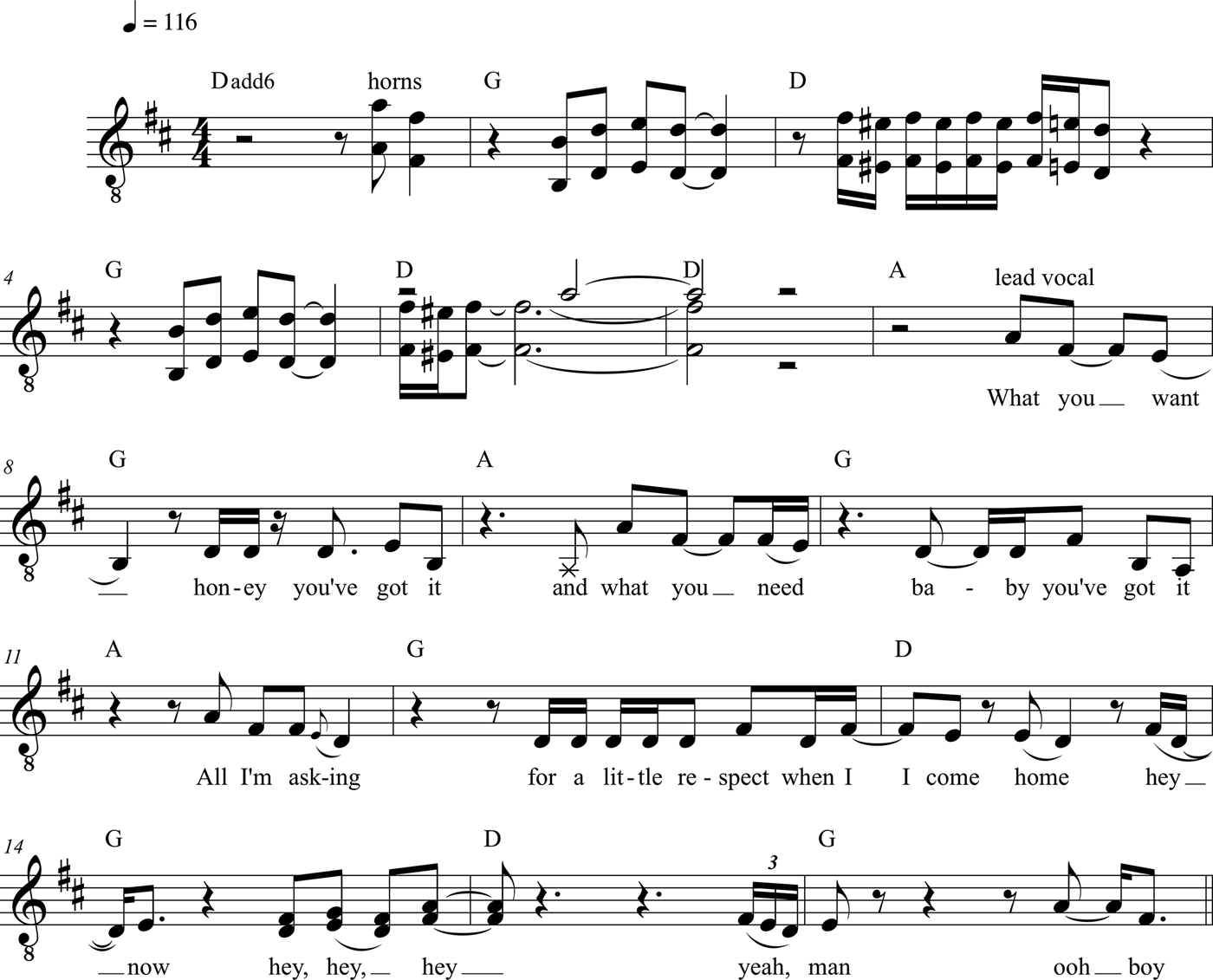
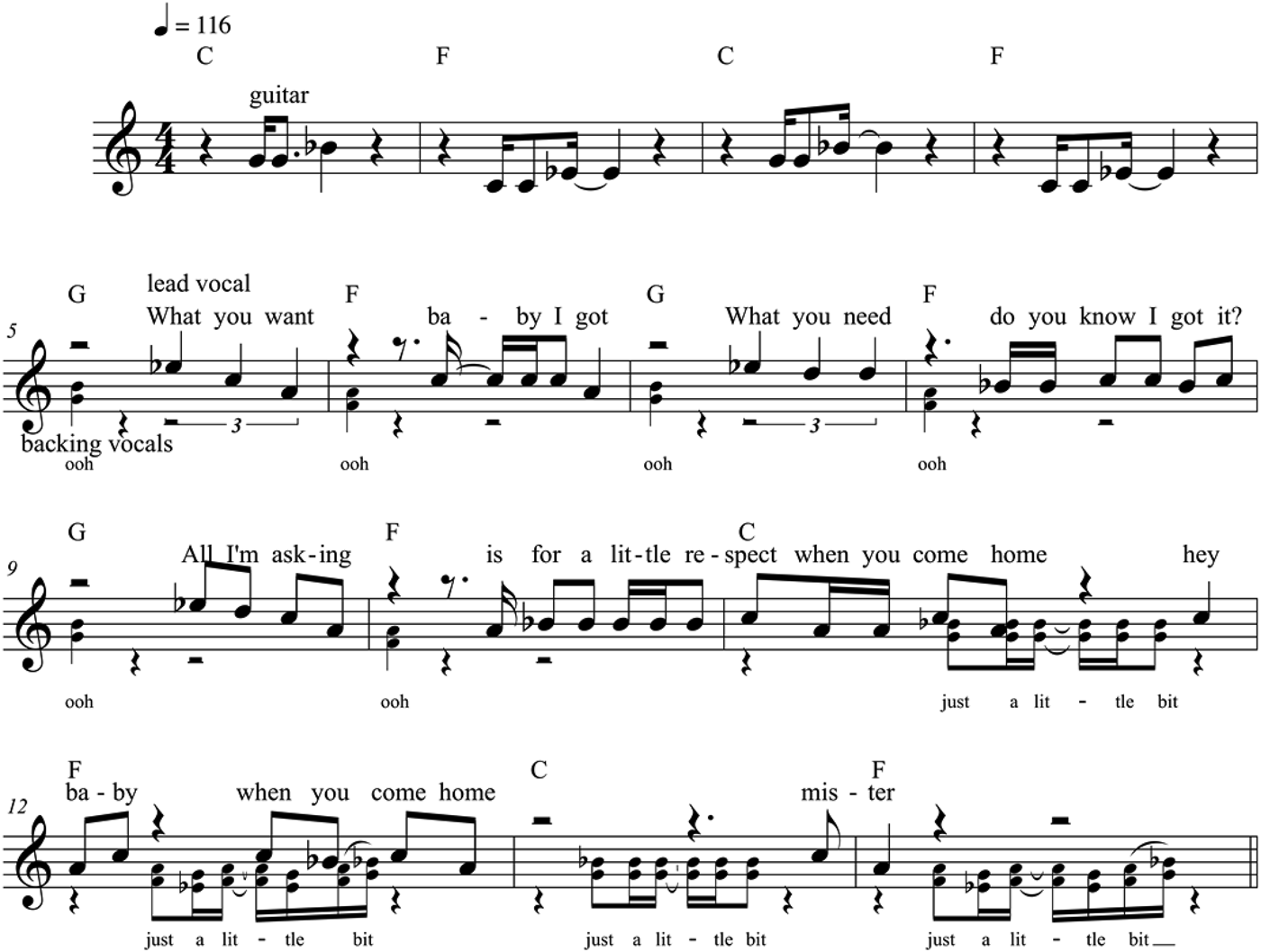
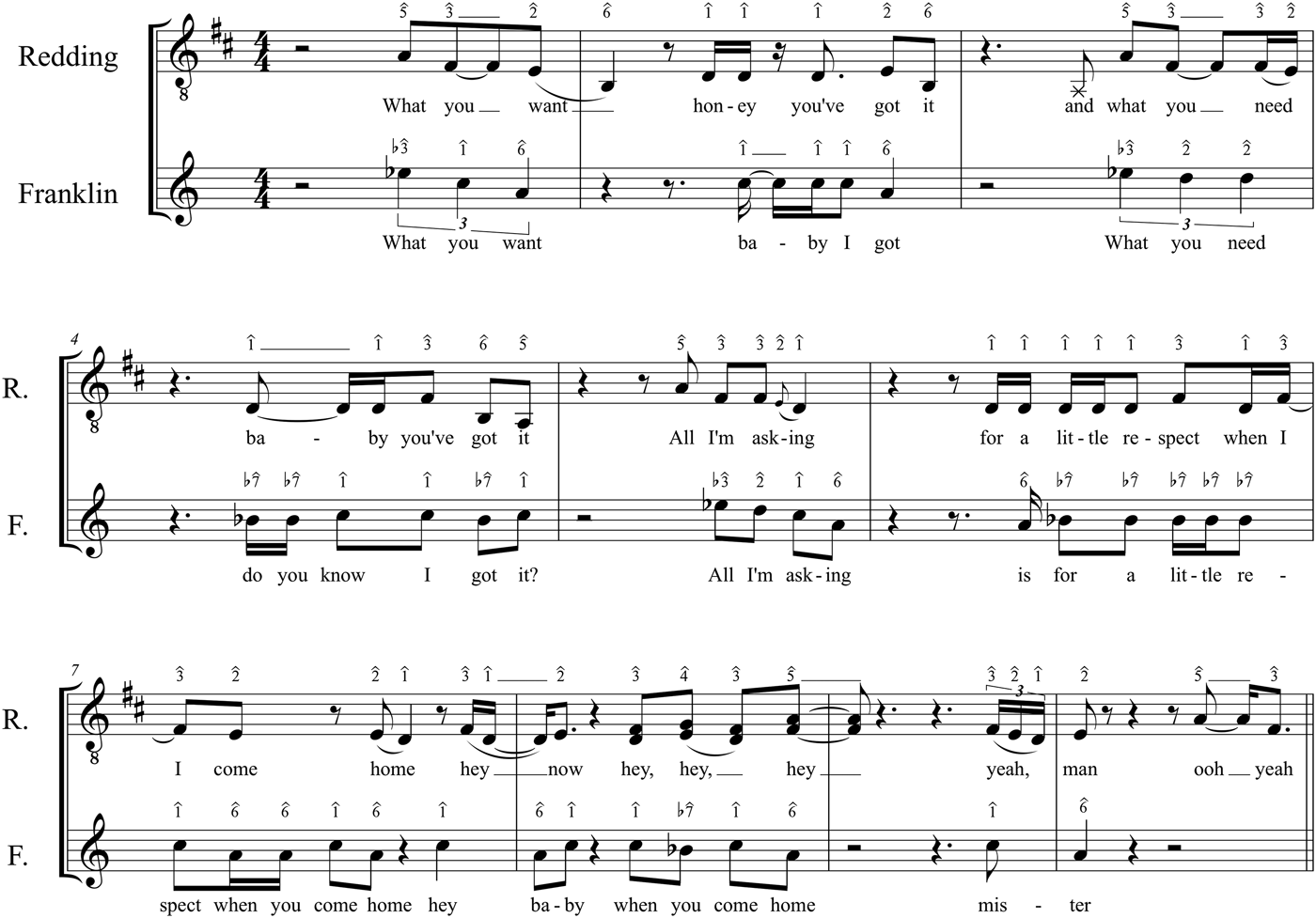
Significant changes to melodic structure make Franklin's ‘Respect’ different from Redding's. Franklin uses blue notes more emphatically than Redding, her blue notes are generally lowered further than Redding's and, in fact, the entire melodic structure is different. Transcriptions of the introduction, first verse and refrain of both versions (shown in Example 1 and Example 2) illustrate some of the most obvious differences in melodic structure. The transcriptions are intended to be a rough account of the melodic content, with the caveat that some pitches are blue notes, residing in between true tempered scale degrees, in both versions. For example, scale degree 3 in Redding's recording resides in between F-natural and F-sharp, particularly in bar 11 on ‘asking’, bar 15 on ‘yeah’, and parallel passages in the subsequent verses. Since his mediant scale degree sounds higher than Franklin's, which is more squarely centred on the lowered form of the mediant (E-flat rather than E-natural), by comparison, I have notated scale degree 3 in Redding's version as F-sharp rather than F-natural.
Redding, ‘Respect’, introduction, first verse and refrain.

Franklin, ‘Respect’, introduction, first verse and refrain.
The overall key – as played by the rhythm section – of Franklin's version is C major, yet the lead vocal melody draws upon the C minor pentatonic collection because of Franklin's extensive emphasis on lowered scale degree 3 (E-flat) and lowered scale degree 7 (B-flat) as blue notes.Footnote 2 These marked scale degrees are foreshadowed in the lead guitar melody in the introduction before Franklin's voice enters on E-flat. Her entrance on E-flat is also emphasised as the first and highest note of the passage, which functions as a primary marker of melodic difference between the two versions. Although Redding uses some blue notes, his use is not as extensive as Franklin's, and his vocal part relies mostly on the major pentatonic collection, mostly a subset of the diatonic collection of the rhythm section, which plays in D major. Example 3 compares the basic scale-degree structure of both versions. Although they share some of the same core structural pitches, Franklin's structure deviates from Redding's increasingly as the melodic structure of the first verse and refrain unfolds in bars 5–10. Franklin extensively reconceives the melody of ‘Respect’, which is a critical aspect of her re-authoring of the song.
Comparison of lead vocal parts, first verse and refrain.
Another marked difference between the recordings involves the nature of syncopation in the delivery of melodic content. Both recordings use syncopation, which is commonplace in many popular genres, but in Redding's version, vocals and horns use syncopation at the level of the eighth note, whereas Franklin's backing vocals and the guitar feature syncopation at the level of the 16th note. Furthermore, in general the horns in Redding's version use less syncopation than the accompanimental instruments in Franklin's version. To illustrate, compare Redding's version in Example 1, bars 2 and 4 (horns), bars 7, 9 and 13 (lead vocal) and bars 14–15 (vocals on ‘hey, hey, hey’) with Franklin's version in Example 2, bars 1–4 (guitar) and bars 11–14 (backing vocals).
Henry Louis Gates, Jr. (Reference Gates1988) offers the concept of ‘rewriting the speakerly’ as a black literary device that results from intertextual play between two works as part of a larger trope of Signifyin(g), which he defines as ‘repetition and revision, or repetition with a signal difference’ and argues that ‘whatever is black about black American literature is to be found in this identifiable black Signifyin(g) difference’ (Gates Reference Gates1988, p. xxiv). Scholars have applied this concept to musical genres as well.Footnote 3 Franklin's revision of melodic structure, along with significant changes to vocal delivery and lyrics, exemplifies the kind of intertextual play Gates describes. Furthermore Franklin's revision serves as a ‘motivated’ rewriting, which Gates describes as a parody or ‘close reading’ intended to comment upon the original source, if we understand Franklin's emphasis on lowered 3 to be a musical outdoing or one-upping as it functions as a heightened blue note and marker of primacy in the melodic structure, in contrast to Redding's more unassuming pentatonic structure (Gates Reference Gates1988, p. xxvi). This outdoing around the use of blue notes might be understood to highlight a critical dimension in Franklin's version in that Gates contrasts ‘motivated’ rewritings with ‘unmotivated’ rewritings with the latter lacking a consciously critical element within the act of Signifyin(g) in the sense of a pastiche.
Vocal delivery
Perhaps the most compelling aspect of Franklin and Redding's respective recordings concerns how the voice is used, especially with regard to vocal quality and phrasing. Michael Coyle (Reference Coyle, Beebe, Fullbrook and Saunders2002) emphasises the importance of vocal delivery in cover songs:
In an age where singers become ‘artists’ as much by their songwriting ability as their delivery, numerous performers […] have nevertheless made their reputations by reinventing familiar songs: they project their identity precisely by singing songs associated with another voice or style. Since the consolidation of rock and roll, the ‘cover song’ has established itself as a way for performers to signify difference, much as the presentation of ‘standards’ serves jazz musicians. (Coyle Reference Coyle, Beebe, Fullbrook and Saunders2002, p. 134)
Furthermore, Carys Wyn Jones (Reference Jones and Tate2005) argues that vocal delivery relates to constructions of authenticity in popular music; she writes, ‘The voice is especially important, as the instrument of most direct expression, and it must carry signifiers of authenticity in order to be accepted as sincere’ (Jones Reference Jones and Tate2005, p. 41). In addition, she argues, ‘Similar to the need for a voice to be unique is the demand for originality often bound up with notions of authenticity. Each song should be an expression of a singular self’ (Jones Reference Jones and Tate2005, p. 42). In terms of timbre and general delivery style, Franklin and Redding possess readily identifiable and seemingly singular voices, different from each other in a number of ways (such as grain, degree of rasp and clarity, range, use and frequency of melismas, and so forth).
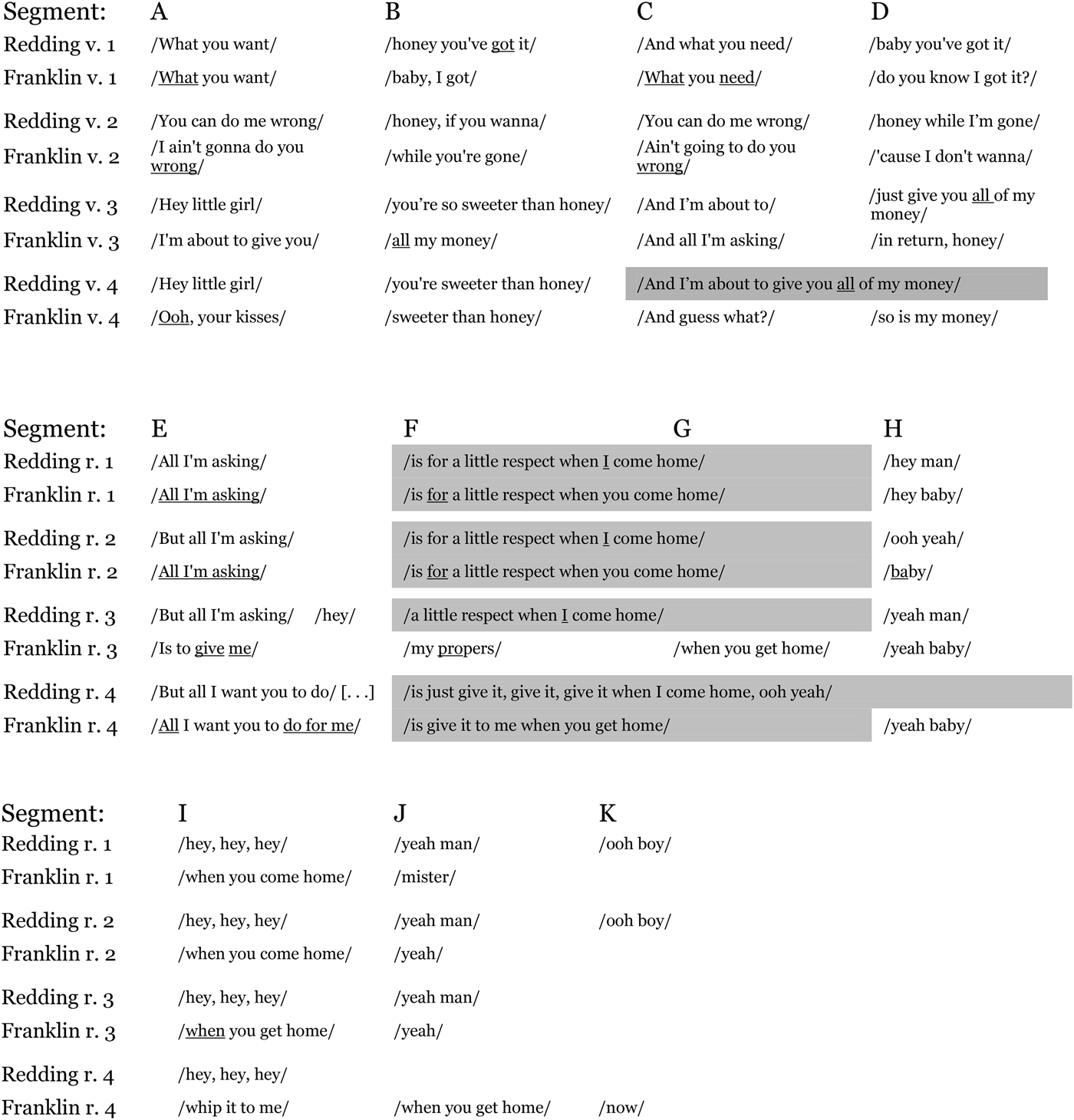
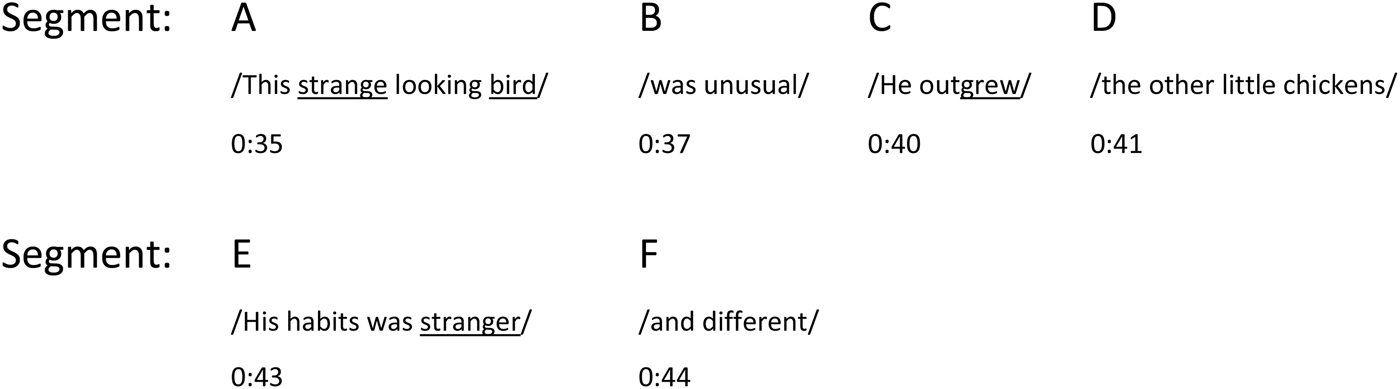
That said, much of Redding and Franklin's styles of phrasing are similar: both use short, declamatory fragments and a mostly consistent pattern of delivery. Figure 1 parses the lyrics Redding and Franklin sing into segments based on where each singer takes a breath or pause in the delivery of the vocal line. In the verses (segments A–D), Redding's phrasing parses the first two verses similarly into four short segments of roughly equal duration. However, in the fourth verse, Redding departs from this structure and instead combines segments C and D into one larger segment. All combined segments are shaded in Figure 1. Franklin parses each line of all four verses into four discrete segments in a manner similar to Redding's treatment of the first three verses.
Comparison of phrasing.
In the refrains (shown as segments E–K in Figure 1), Redding always connects segments F and G, and in the fourth refrain he connects F–H. Franklin similarly connects F and G in all of the refrains except for the third, which departs from the pattern of phrasing established in the previous refrains. In general, the overall pattern of phrasing in both recordings interacts with the lyrics in the following manner:
Segments F and G lead up to the primary message, which is the demand for respect, and all of the shorter segments lead up to this demand. The segments following F and G punctuate the primary message with affirmative interjections, such as ‘yeah baby’ and ‘yeah man’ in both versions.
Both singers use a playful elasticity in their delivery, and each artist emphasises different syllables, which characterises their phrasing as distinct from one another. Franklin uses what I call ‘syllabic elasticity’ – the contrast between syllables receiving relatively longer duration (agogic accent) and louder attack (dynamic accent) and fewer accentuated syllables – more extensively than Redding. Figure 1 underlines emphasised syllables, such as ‘got’ (at 0:16), ‘I’ (at 0:24, 0:45 and 1:05) and ‘all’ (at 1:00 and 1:24) in Redding's recording, which contrast with a greater number of emphasised syllables in Franklin's – ‘what’ (at 0:09), ‘what you need’ (at 0:13–0:15), ‘all I'm asking’ (at 0:18 and 0:39), ‘for’ (at 0:20 and 0:41), ‘wrong’ (at 0:31 and 0:36), ‘all’ (at 0:53), ‘give me’ (at 1:00), ‘prop’ (at 1:01), ‘when’ (at 1:06), ‘ooh’ (at 1:28) and ‘all … do for me’ (at 1:37–1:39). Franklin's syllabic elasticity functions as part of a larger discursive strategy, akin to what Gates (Reference Gates1988) describes as ‘talking texts’, which is ‘a black form of intertextuality’ where ‘black texts “talk” to other black texts’ (Gates Reference Gates1988, p. xxiii). A greater number of Franklin's phrases feature more marked emphasis at beginnings, such as in segments A and C in verses 1, 2 and 4. Franklin's single departure from this trend occurs in the third verse, where ‘all’ in segment B is marked by a drawn out delivery that mimics Redding's delivery on the same word in segment D of the same verse. This connection between the two versions is highlighted by the departure from Franklin's pattern of emphasis and draws attention to dialogue and play with the content and delivery in Redding's version. While Redding projects a protagonist who assumes a male role within a heterosexual relationship, Franklin portrays a female protagonist who responds to the character that Redding has created. The lyrics (having to do with money) and syllabic elasticity of the third verse in particular allow Franklin to portray her character as financially independent, in contrast to the addressee of Redding's version, who is assumed to be financially dependent.
David Nathan (Reference Nathan1999) argues that the style of phrasing Franklin heard in sermons by her father, Reverend Clarence LaVaughn Franklin, probably influenced phrasing in her own singing style (Nathan Reference Nathan1999, p. 74). Although there are dozens of extant recordings of his sermons, one particularly compelling example – ‘The eagle stirreth her nest’ (JVB 61/63) – demonstrates syllabic elasticity and an emergent phrasing technique that is remarkably similar to the segmented phrasing style in Aretha's ‘Respect’. Over the course of this six-and-a-half minute excerpt, the elder Franklin begins with impassioned speech that gives way to emotive singing gestures. At around 0:35, his phrasing evolves into short, emphasised declamatory segments featuring syllables that are more drawn out with agogic and dynamic accents that alternate rapidly with short, less accentuated segments. Figure 2 summarises a brief excerpt from this sermon where this pattern of phrasing first emerges. The technique is similar to the alternation of Aretha's more emphasised A and C segments, which alternate with less accentuated ones (B and D) in most of the verses of ‘Respect’. The Reverend's style of phrasing continues throughout the excerpt and evolves into a sermon melody in the D minor pentatonic scale. Throughout the recording, the congregation punctuates the Reverend's phrasing with energetic interjections in a call-and-response style. Similarly, the backing vocals in Franklin's ‘Respect’ prominently articulate the downbeat and her phrasing in a way that is reminiscent of the call-and-response punctuations in her father's sermons.
Phrasing in C.L. Franklin's ‘The eagle stirreth her nest’, 0:35–0:45.
New (added) material
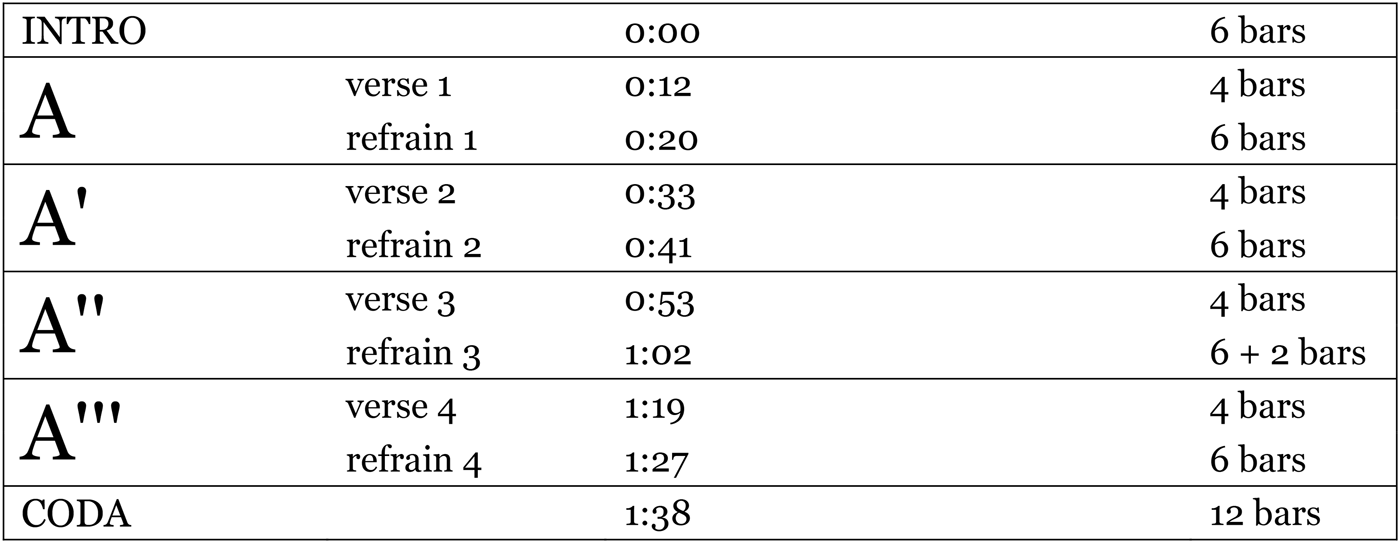
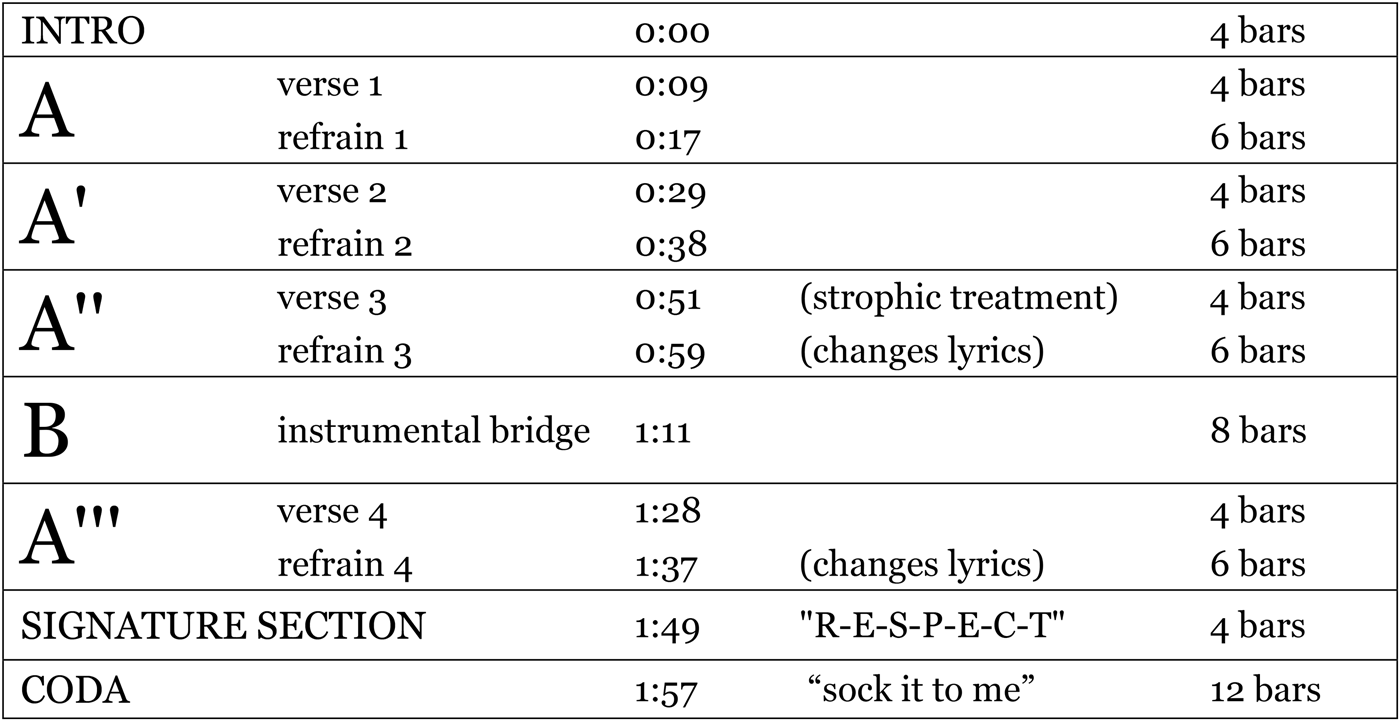
Differences in formal design because of added material contribute significantly to Franklin's re-authoring of the song. Figure 3 and Figure 4 summarise the form of Redding and Franklin's versions, respectively. The most noticeable additions to Franklin's version are: (1) the instrumental bridge, which R&B historians conclude was borrowed from Sam and Dave's ‘When something is wrong with my baby’ (Kellom Reference Kellom1989, p. 12; Marsh Reference Marsh1992, p. 29), and (2) the famous ‘R-E-S-P-E-C-T’ hook, Franklin's ‘signature section’. The formal additions in Franklin's version transform the standard symmetrical strophic design of Redding's original into a more expansive design.
Formal design of Redding's ‘Respect’.
Formal design of Franklin's ‘Respect’.
The lyrics of the signature section (‘R-E-S-P-E-C-T, find out what it means to me’), lasting a mere eight seconds, reveal that the protagonists portrayed by Franklin and Redding may understand the concept of respect differently. The musical energy peaks in this passage, and the section contrasts with the rest of the song. Franklin's vocal delivery is declamatory and limited in terms of pitch content (hovering around B-flat and C primarily), and it is highlighted by an abrupt change in texture where the instruments articulate only the downbeats while Franklin sings, drawing attention to her voice and lyrics. The texture is restored at 1:57 as the song concludes with a lively call-and-response between Aretha and her sisters, Carolyn and Erma Franklin, who sing backing vocals.
The backing vocals create a spirit of call-and-response throughout Franklin's recording, which is not present in Redding's. Patricia Hill Collins (Reference Collins1990) characterises call-and-response as an expression of ‘the ethic of caring’, which she describes as ‘the value placed on individual expressiveness, the appropriateness of emotions, and the capacity for empathy’ and argues is an important part of African American women's epistemology (Collins Reference Collins1990, p. 216). Furthermore, the call-and-response backing vocals connote dialogue among girlfriends or sisters (quite literally, in this case). Drawing upon ‘the idea of the girlfriend’ described by Kevin Everod Quashie (Reference Quashie2004) as ‘an oscillating identificatory process between self and other, a Black feminist idiom of subjecthood’ (Quashie Reference Quashie2004, p. 1), the backing vocals articulate Aretha's main points and offer support and confidence. The call-and-response dialogue reaches its culmination in the coda, where every line that Aretha sings is punctuated by a response from her sisters.
Franklin's version features new and altered lyrics, many of which are made possible by backing vocals performed by Franklin's sisters. For example, they repeat ‘just a little bit’ in the refrains and its variation ‘just a’ in the third refrain, and they punctuate the downbeats with ‘oohs’ in the verses. The ‘sock it to me’ line, which appears near the end of the song at 1:57, has generated much discussion among scholars and critics. Franklin describes its origins:
I heard Otis Redding doing ‘Respect’. I was living in Detroit at the time. My sister Carolyn […] worked with me in the background and on a lot of different songs. She and I had picked up a local cliché: ‘Sock it to me’. We incorporated it into the re-recording of ‘Respect’. That line really became major across the country. I had no idea that it would go that far. (Quoted in Christian Reference Christian2010, p. 55)
Buzzy Jackson (Reference Jackson2005, p. 173) describes the line as ‘catchy, feisty, and pleasingly raunchy’. Dobkin (Reference Dobkin2004, p. 169) characterises it as ‘a sexual demand’. Russell Gersten (Reference Gersten, DeCurtis, Henke and George-Warren1992, p. 335) similarly contrasts the ‘sweet and coy’ girl groups of the 1960s with the ‘strong and fierce, and ferociously sexual’ Franklin sisters. Steven Feld offers a less simplistic interpretation of the line and highlights its ambiguity: ‘The juxtaposition of “R-E-S-P-E-C-T / Find out what it means to me” with the chorus singing “Sock it to me” intensifies the effect. Does “Sock it to me” mean fuck me or fuck off?’ (Keil and Feld Reference Keil and Feld1994, p. 220). Ascribing only meanings that excessively sexualise the singers of this song, as many authors have done, is problematic because they too easily and dangerously become fodder for negative racial stereotyping. bell hooks (Reference hooks1992) argues that ‘sexual interpretations of the song seemed far removed from the way it was heard and celebrated in black communities’ and says, ‘“Respect” was heard by many black folks, especially black women, as a song challenging black male sexism and female victimisation while evoking notions of mutual care and support’ (hooks Reference hooks1992, p. 69). hooks situates Franklin's black female identity in direct opposition to ‘the representation of wild animalistic sexuality’, which closely resembles Jackson, Dobson and Gersten's interpretations of this line. Ann Powers (Reference Powers and O'Dair1997) similarly suggests that many of Franklin's songs cultivate multiple layers of meaning – ‘on the surface, concerned […] with love’, but on other levels, they transcend pleas for personal sexual liberation and become demands for freedom from all kinds of oppression (Powers Reference Powers and O'Dair1997, p. 93).
Furthermore, if we take into account the song's relationship to a broader cultural context, references to sex can be seen not only as signifiers of personal sexual liberation, but also as signifiers of freedom for oppressed people on a larger scale. Angela Y. Davis (Reference Davis1998) points out, ‘While sexual metaphors abound in [earlier pop songs from the 1930s], the female characters are clearly in control of their sexuality in ways that exploit neither their partners nor themselves’ (Davis Reference Davis1998, pp. 14–15). Coming out of the tradition of blues singing in which Bessie Smith and her contemporaries took part several decades before Franklin recorded ‘Respect’, the agency with which she and her sisters make such sexual references in this recording is inextricably linked to the references themselves. Thus, the ‘sock-it-to-me’ line marks Franklin's agency, not only as an empowering sexual metaphor in line with aspects of the African American blues tradition, but also as evidence of her own authorship. Or to address this last point a little differently, such authorial gestures are a key factor in the reading of Franklin's version as authentic, with authorship and authenticity being tightly bound to notions of artistic freedom and control (Keightley Reference Keightley, Frith, Straw and Street2001, p. 134).
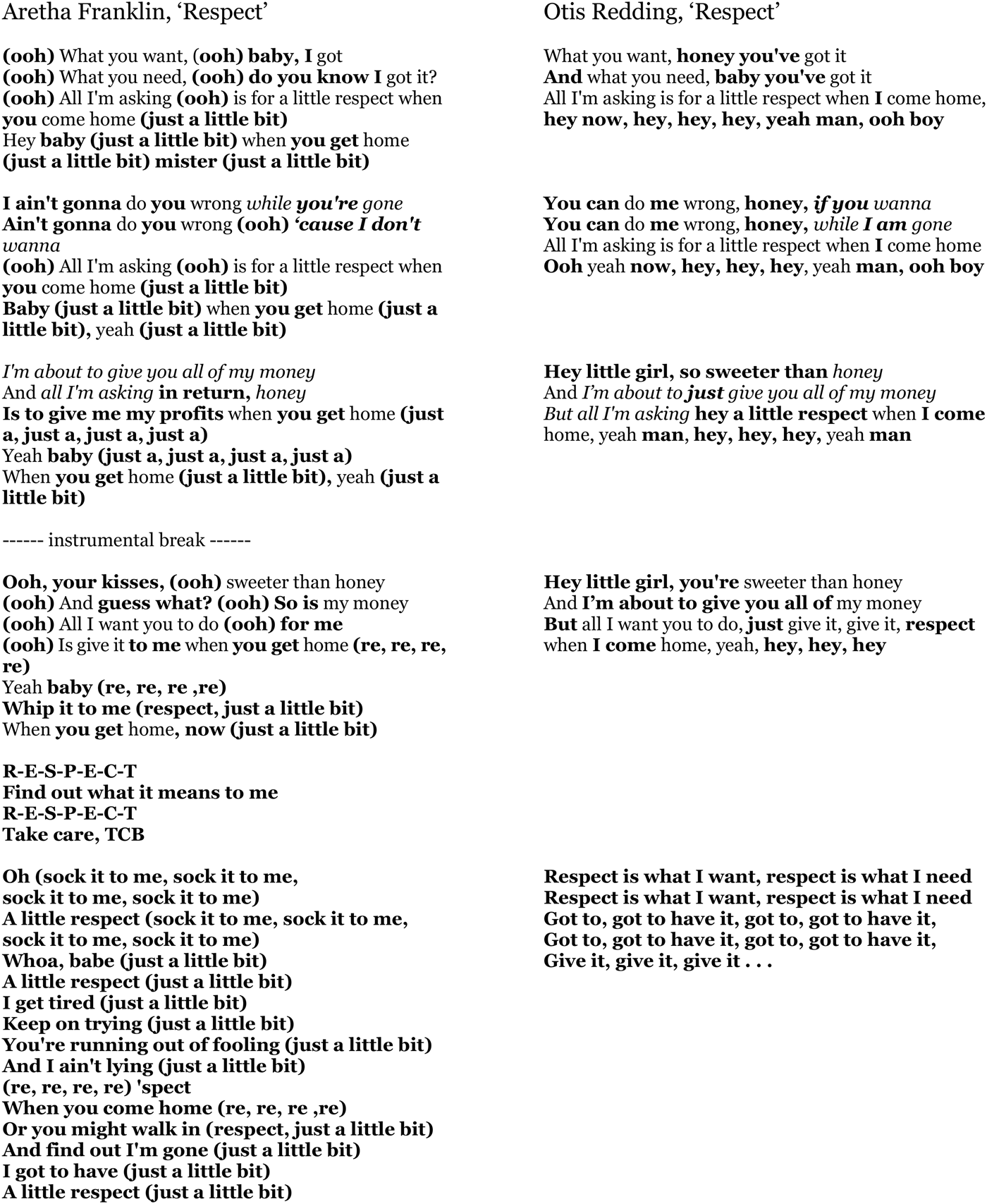
Other changes in the lyrics occur throughout the recording and appear in boldface in Figure 5. Italicised portions indicate passages that correspond to one another, but on different lines rather than in parallel positions. Even a cursory glance at Figure 5 shows that Franklin has rewritten the lyrics extensively. Many of these changes suggest a dialogic interpretation – as though Franklin is speaking in response to Redding.Footnote 4 In this way, it may be understood as an answer song, which features changes to the lyrics that respond to the original version.
Comparison of lyrics in both versions.
Gates's concept of the ‘Signifyin(g) Monkey’ as a black rhetorical trope may allow us to more deeply understand the dialogue that emerges between Redding and Franklin's respective versions. Within black literary traditions, Gates (Reference Gates1988, p. xxiii) identifies repetition ‘with difference’, which ‘manifests itself in specific language use’. In his application of the concept to black musical practices, Samuel A. Floyd (Reference Floyd1995, p. 95) describes Signifyin(g) as ‘a way of saying one thing and meaning another; it is a reinterpretation, a metaphor for the revision of previous texts and figures’. Aspects of Signifyin(g) are at play between both versions of ‘Respect’, since Franklin's recording manipulates the content of Redding's original in the manner of a trope to comment upon it, and from which new meanings arise.
In our exploration of syllabic elasticity we have seen how the recordings function as ‘talking texts’, which goes beyond identifying Franklin's ‘Respect’ as a simple answer song and further captures the dialogic functions that emerge from the interaction of the recordings and also its rootedness in a specifically black intertextual practice (Gates Reference Gates1988, p. xxvi). Changes made to the lyrics also contribute to interpreting the song pair as ‘talking texts’. For example, in the second verse explicit dialogue and two distinct characters emerge. Here Redding sings: ‘You can do me wrong, honey, if you wanna. But only do me wrong, honey, while I am gone.’ Franklin responds: ‘I ain't gonna do you wrong while you're gone; ain't gonna do you wrong ’cause I don't wanna.' With this dialogue, the song shifts from the perspective of a male protagonist in Redding's version to a female protagonist in Franklin's version who now also demands respect. Franklin invokes an additional layer of agency through this lyrical re-authoring by stating emphatically that the reason she is faithful is because she chooses to, and not because it is expected of her. Gendered differences significantly facilitate Signifyin(g) as the recordings function as ‘talking texts’.
In addition, Gates' trope of motivated ‘rewriting the speakerly’, identified earlier with regard to melodic structure, is also at play with the significant changes in vocal delivery and lyrical content, which create Franklin's gendered performance and facilitate these black tropes of repetition and difference. The protagonist in Franklin's re-authoring of the lyrics is a woman who is faithful (with lyrics ‘I ain't gonna do you wrong while you're gone; ain't gonna do you wrong ’cause I don't wanna'), financially independent (‘Ooh, your kisses, sweeter than honey. And guess what? So is my money’), and unafraid to make demands (‘Whip it to me’; ‘a little respect … when you come home, or you might walk in and find out I'm gone’). Franklin's lyrics – an integral part of her gendered re-authoring – consciously challenge Redding, participate in a motivated rewriting of his song, and facilitate these marked changes in the subject position of the song's protagonist and the resulting dialogue that ensues between her version and Redding's.
Finally, call-and-response operates as rhetorical device on two different levels in Franklin's ‘Respect’. Within the song, localised call-and-response is apparent in Franklin's singing, which functions as a series of calls and is echoed by responses in the backing vocals. But on another level, the recording as a whole responds and challenges Redding's original, and thus can be seen as participating in a larger dialogic, intertextual call-and-response.
Authorship and authenticity
Recognising that authenticity is a contingent, ascribed, socially constructed and mediated value and understanding that what constitutes an authentic performance is entirely variable upon an artist's particular time and location, cultural context, genre conventions and listener expectations, it may be useful to understand constructions of authenticity in Franklin's ‘Respect’ as part of the meanings audiences have ascribed to her recording as well as the cultural work it performed. Many listeners have ascribed authenticity to Franklin's singing, as she participates in the soul tradition that values vocal virtuosity, and at the same time creates distance between herself and Redding through her re-authoring of ‘Respect’ to make artistic space for her success.
Plasketes (Reference Plasketes and Plasketes2010, p. 27) writes, ‘The imitation intrinsic in the act of covering in music, even with the honorable intent of homage from a discipline, is incongruent with authenticity’. However, if audiences perceive a performance of a cover song to be real, honest, genuine, serious and/or relevant, they may also ascribe authenticity to the performance. Gabriel Solis (Reference Solis2010, p. 20) argues that, however paradoxically, cover songs are a significant means by which performers establish ‘personal authenticity’. Similarly, Johan Fornäs (Reference Fornäs, Straw, Johnson, Sullivan and Friedlander1995, p. 107) writes, ‘Covers and quotations can be a superficial masquerade, but they are also a way to reflexively position oneself in certain historical contexts’. In addition, David Headlam (Reference Headlam, Marvin and Hermann1995, p. 328) argues that, in the case of Led Zeppelin, the band can rightfully claim ownership of songs that use pre-existing musical material they did not author, even songs that are considered hallmarks of their output, because they feature a set of style traits unique to Led Zeppelin. The same can be said for Franklin except that she goes beyond adding her own distinctive style traits, and entirely rewrites the melodic structure of the song and adds her own new material, too.
Furthermore, compelling performances of cover songs can significantly shape artists' personas. Michael Awkward (Reference Awkward2007, p. 20) understands ‘song covers as mechanisms through which talented singers construct and reflect their still evolving artistic and social identities’. Furthermore, Coyle (Reference Coyle, Beebe, Fullbrook and Saunders2002, p. 134) argues that, since the idea of what a cover song is has changed remarkably through the past six decades (prior to Elvis, most covers were ‘hijacked hits’), after Elvis, cover songs became a way artists shaped their identities. The most successful constructions of such identities become markers of authenticity when articulated in a way that listeners perceive as honest and genuine.
Hans Weisethaunet and Ulf Lindberg (Reference Weisethaunet and Lindberg2010, p. 465) argue that authenticity is ‘sometimes verbalised in terms like “integrity”, “honesty”, “sincerity”, “credibility”, “genuineness”, and “truthfulness”’. These characteristics align with many of the values associated with Keir Keightley's (Reference Keightley, Frith, Straw and Street2001) concept of ‘romantic authenticity’, which emphasises sincerity, honesty, originality and lyrical expressiveness as markers of authenticity (Keightley Reference Keightley, Frith, Straw and Street2001, p. 137), which some listeners have associated with Franklin's manner of singing. Weisethaunet and Lindberg (Reference Weisethaunet and Lindberg2010, p. 470) explain that in the context of ‘folkloric authenticity’, listeners value the idea of ‘truth’, which implies ‘that music expressed more than the individuality of the performer: it was taken to represent the sentiment of the social oppression of a whole group of people’. This is the aspect that especially lends authenticity to Franklin's ‘Respect’ for so many listeners – that she projects truth in her singing, representing the oppression of multiple disenfranchised groups.
Related to a type of authenticity described by Lawrence Grossberg (Reference Grossberg, Frith, Goodwin and Grossberg1993, p. 202) as ‘often linked with dance and black music, [which] locates authenticity in the construction of a rhythmic and sexual body’ and ‘constructs a fantasy of the tortured individual struggling to transcend the conditions of their inadequacy’, Weisethaunet and Lindberg's concept of ‘body authenticity’ may also be relevant to constructions of authenticity ascribed to Franklin's ‘Respect’: this category involves the idea that body and physical presence, as opposed to something more cerebral, are connected to ‘natural’ expression (acknowledging that the concept of ‘natural’ is a social fabrication) and aspects central to authentic performance, as well as having a rhythmic component that lends danceability to the music (Weisethaunet and Lindberg Reference Weisethaunet and Lindberg2010, p. 475). The authors write, ‘Peter Guralnick interprets these musical innovations in relation to “the southern dream of freedom”; with its clear roots in gospel music, soul combines the gospel “truth” and its longing for freedom with everyday danceable experiences’ (Weisethaunet and Lindberg Reference Weisethaunet and Lindberg2010, p. 475). The problem with this type of thinking about authenticity is that it tends to align with racialised essentialism, implying that black music is somehow more inherently physical, more primitive or more natural than other musics (and therefore more authentic). White people in many contexts have ascribed such ideas to black music.Footnote 5 Such constructions are problematic in at least two ways: First, they pigeonhole artists along racial lines, inhibiting artists and the range of personas they might wish to portray; and second, they inaccurately portray authenticity – as it is linked with racial identities – as an inherent, fixed and unchanging property.
Allan Moore (Reference Moore2002, p. 210) argues it is more useful to determine who is authenticated through a particular performance than whether or not a performance is authentic in and of itself. To this end, he describes three different ways authenticity may be ascribed based on narrative points of view: first, third and second person authenticity. According to Moore, first person authenticity occurs when the performer convinces his or her audience that the performance is pure, has integrity, is honest and does not ‘sell out’ (Moore Reference Moore2002, pp. 211–14). This type of authenticity may be located in the reception of Franklin's ‘Respect’, as many fans and critics viewed Franklin as being true to herself, projecting an image of being a strong black woman, and singing genuinely from the heart. In their discussion of a June 1968 Times article titled ‘Queen of soul’, authors Vron Ware and Les Back (Reference Ware and Back2002, p. 249) confirm, ‘Aretha was heralded as the embodiment of racial authenticity’. Journalist Phyl Garland (Reference Garland and Brackett2009) similarly describes the authenticity that many listeners ascribe to Franklin: ‘For some artists, the “soul” sound might be a mere artifice, but for Aretha Franklin, it is an element deeply imbedded in herself. She has never learned how to be pretentious enough to build a false image and deeply identifies with people on all levels who hear her music’ (Garland Reference Garland and Brackett2009, p. 206).
Moore (Reference Moore2002, p. 218) describes third person authenticity as the result of a performer successfully representing or emulating the work of someone else, usually highly regarded, as part of an established performance tradition. Brought up as a gospel singer, Franklin follows in both gospel and soul traditions and by continuing these traditions she exemplifies third person authenticity. Collins (Reference Collins1990) situates Franklin within the Black women's blues tradition and its role in ‘Afrocentric feminist epistemology’; she writes, ‘The Black women's blues tradition's history of personal expressiveness heals this either/or dichotomous rift separating emotion and intellect. […] Without emotion, Aretha Franklin's (1967) cry for “respect” would be virtually meaningless’ (Collins Reference Collins1990, pp. 215–16). Franklin's artistry grew out of several musical traditions – gospel, blues and R&B – and thus is seen by many listeners as exemplifying third person authenticity as described by Moore.
Moore's (Reference Moore2002, p. 220) final category – second person authenticity – occurs when a performer validates the experiences and truths for the individual members of his or her audience. This type of authenticity allows for artists (who may or may not be truthful to their own personal experiences, or in other words, who may or may not project also first person authenticity) perform in such a way that their songs can mean different things to different audiences, speaking to many people in some meaningful way. Franklin's recording of ‘Respect’ resonated with several different overlapping audiences in profound ways. For many women, this song became an anthem for feminism, with Franklin's celebration of female independence and freedom, intolerance of mistreatment by men, and sexual empowerment by taking control of female sexuality. For many African Americans, this song became an anthem for the Civil Rights Movement. Two years after the release of Franklin's ‘Respect’, Garland named the song the ‘new black social anthem’ and said, ‘[Franklin] spoke to everyone. The way she interpreted it – we couldn't hear it enough’ (quoted in Dobkin Reference Dobkin2004, p. 189). Nathan (Reference Nathan1999) reminds us of the historical and cultural context of the release of Franklin's ‘Respect’ in the late 1960s; he writes, ‘It is almost impossible in hindsight to recreate the kind of impact Aretha had on the world in 1967. It is almost like you just had to be there’ (Nathan Reference Nathan1999, p. 79).
In sum, the musical changes, performativity and high level of musicianship in Franklin's ‘Respect’, as well as the construction of Franklin's artistic persona as reflected in the popular press, connote values of invention (that is, creating something new from something pre-existing), truthfulness, sincerity and relevance for many listeners who ascribe authenticity to her performance from all three narrative points of view as described by Moore.
‘Respect’ and its cultural work
Franklin's ‘Respect’ exploits the potential that gendered performance and vocal delivery have to elicit new meanings. In a discussion of gender-shifting cover songs, Dai Griffiths (Reference Griffiths, Hesmondhalgh and Negus2002, p. 52) asserts that male and female voices are ‘recognisably different’ in sound, and further identifies a ‘tendency for the sense of subject position, addresser and addressee, to change, with sexuality introducing a further variable’. Once listeners who are familiar with Redding's version identify Franklin's voice as female in her recording, the possibility for gendered dialogue emerges, as well as a shift of the singer's subject position from male to female.
In addition, Griffiths argues that changes (or lack thereof) in pronouns impact a gender-shifting cover song's meanings (Griffiths Reference Griffiths, Hesmondhalgh and Negus2002, p. 53). Franklin's ‘Respect’ does not keep the original pronouns intact, and instead inverts all instances of ‘you’ to ‘me’ or ‘I’, reinforcing a sense of dialogue between the cover version and original through the trope of talking texts. Since neither version uses third person (gendered) pronouns, gender is implied primarily through performance and perceived gender roles. Performance connotes gender, as listeners perceive a human voice and assign its embodied quality to either a man or woman. Given the cultural/historical context of heteronormativity and male hegemony in 1960s America in which both versions reside, perceived gender roles are implied and reinforced through lyrics, such as ‘when you come home/when I come home’ which suggests that the person who ‘comes home’ is the man, and the person who is already at home is the woman and thus maps the dichotomy of public/private onto gender as male/female.
Even though on the surface the lyrics of both recordings seem to reinforce traditional gender roles, perhaps putting Franklin's version at odds with more progressive feminist ideals, on a larger level her recording is informed by earlier gospel and blues traditions of making the personal political, something that resonated with feminist movements at the time the recording was released. Although the idea of the ‘personal is political’ was a tenet of the white-dominated women's movement, which did not resonate with many black women in the 1960s, Davis (Reference Davis1998, p. 55) writes that ‘it is possible to detect ways in which the sharing of personal relationships in blues culture prefigured consciousness-raising and its insights about the social construction of individual experience’. Similarly, Powers (Reference Powers and O'Dair1997, p. 95) argues that ‘gospel created a space where the personal could be political’ and situates Franklin within this tradition. Davis (Reference Davis1998, p. 91) argues that lyrics which directly deal with sexuality within early 20th-century blues place that which had been the domain of the private sphere into the public sphere, where sexuality ‘is represented as shared experience that is socially produced’. Following in this tradition, Franklin, whether intentional or not, indeed succeeded in making the personal political by treating a subject matter ostensibly confined to the private domestic sphere (that is, one that deals with negotiating roles within a romantic relationship), at least on the surface, which consequently transferred to the larger public realm as social liberation movements adopted the song as their anthem.
In her autobiography, Franklin (Reference Franklin and Ritz1999) discusses the significance audiences have ascribed to ‘Respect’:
So many people identified with and related to ‘Respect’. It was the need of a nation, the need of the average man and woman in the street, the businessman, the mother, the fireman, the teacher – everyone wanted respect. It was also one of the battle cries of the Civil Rights Movement. The song took on monumental significance. It became the ‘Respect’ women expected from men and men expected from women, the inherent right of all human beings. (Franklin Reference Franklin and Ritz1999, p. 112)
Franklin's recording became different things to different people, and critics disagree on the song's meaning. Some interpret Franklin's version as overtly sexual and Redding's less so. On more than one occasion, Jerry Wexler, Atlantic Records executive and Franklin's friend, describes her ‘Respect’ as a demand for ‘sexual attention of the highest order’ (Bego Reference Bego1989, pp. 88–9; Wexler and Ritz Reference Wexler and Ritz1993, p. 213; Dobkin Reference Dobkin2004, p. 183). Dobkin (Reference Dobkin2004, pp. 164–5) characterises Redding's version as ‘a fairly straightforward appeal from man to woman that she show him sufficient appreciation for bringing home the bacon as it were. It's clear-cut, a song without subtext’. Others understand Redding's plea for respect as a euphemism for sex. Peter Guralnick (Reference Guralnick1986, p. 332) writes, ‘The song itself was transformed from a demand for conjugal rights into a soaring cry of freedom; where Otis sang specifically of domestic and social proprieties, Aretha staked out a claim for the ecstatic transcendence of the imagination, no less’. Jackson (Reference Jackson2005, p. 173) similarly asserts that Franklin reversed the ‘man's frustrated complaint against his woman’ and in so doing, ‘the song became the personal war whoop for anyone who had ever felt wronged’.
Several aspects of Redding's version point toward equating respect with sex, such as the repetition of lyrics ‘give it’ in the last verse and closing material (the referent of ‘it’ is ambiguous), as well as ‘do me wrong’ in the second verse, which implies adultery. In addition, Redding's recording, like many R&B songs in the 1960s, comes out of a tradition beginning in the 1950s that John Covach (Reference Covach2009) describes as a series of songs recorded by black musicians that feature thinly veiled references to sex, often in the form of a double entendre; some examples include Big Joe Turner's ‘Shake, rattle, and roll’ (1954), Big Mama Thornton's ‘Hound dog’ (1952) and Hank Ballard and the Midnighters' ‘Work with me, Annie’ (1954) (Covach Reference Covach2009, pp. 53, 77–8). Coming out of this context, respect may be understood as a euphemism for sex in Redding's version.
Although some of Redding's original language is kept intact, Franklin's added lyrics and signature section, ‘R-E-S-P-E-C-T, Find out what it means to me’, declare that she and Redding may understand respect differently as each singer portrays it. For many listeners, Franklin's ‘Respect’ transcends sexual innuendo and instead becomes something more meaningful, especially politically. Garland writes in her 1967 Ebony article:
Aretha's version of the Otis Redding composition Respect stands, week after week, at the head of JET Magazine's Soul Brothers Top 20 Tunes poll and is considered by far more than a few of those ‘brothers’ to be ‘the new Negro national anthem’. (Garland Reference Garland and Brackett2009, p. 204)
Surprised that her recording became such an integral part of the Civil Rights Movement, Franklin says, ‘Some were saying that in my voice they heard the sound of confidence and self-assurance; they heard a proud history of a people who had been struggling for centuries’ (quoted in Abbey Reference Abbey2001, p. 66).
Other audiences hear Franklin's ‘Respect’ as a celebration of female independence and sexual empowerment. Even Wexler admits that her version became ‘a global anthem’ for ‘feminist rights, a feminist stance with sexual overtones’ (quoted in Mitchell Reference Mitchell2003, pp. 19–34). It is not at all surprising that Franklin's recording could become politically meaningful in all of these ways. We can situate Franklin as coming out of the blues tradition carried on by Gertrude ‘Ma’ Rainey and Bessie Smith, active several decades before Franklin, who performed blues music ‘as a means of social protest’ (Davis Reference Davis1998, pp. 92–4). That Franklin's ‘Respect’ resonated with so many different people, who ascribe different meanings to the song, attests to its power and the command of Franklin's artistry in her re-authoring of the song.
Empowerment
Dobkin (Reference Dobkin2004, p. 13) identifies sex as the key to effectiveness in Franklin's singing, especially on I Never Loved a Man the Way I Love You, the album on which ‘Respect’ appeared. He describes this album as one ‘largely about female sexual desire, a subject previously owned by the blues women of the early part of the century’. Davis (Reference Davis1998, p. 4) explains that early blues singers paved the way for ‘openly addressing both female and male sexuality’ in a way that ‘was specifically African-American’. Furthermore, Davis asserts ‘that women's blues provided a cultural space for community-building among working-class black women, and that it was a space in which the coercions of bourgeois notions of sexual purity and “true womanhood” were absent’ (Davis Reference Davis1998, p. 44). Franklin was steeped in this mode of expression as soul music in the 1960s grew out of the blues traditions of earlier decades. We learn from Davis that sexuality came to mean much more to black communities in the years after slavery was abolished; in her words, ‘the blues registered sexuality as a tangible expression of freedom’ (Davis Reference Davis1998, p. 8). Meanings ascribed to Franklin's ‘Respect’ reveal that the song adopts an identity that is not only about sexuality, but also about empowerment and ultimately freedom. In an Essence article published in 1995, Evelyn White recalls the feeling of empowerment upon hearing Franklin's ‘Respect’:
Twelve years old when it was released, I remember feeling a sense of triumphant elation whenever I heard Aretha belt out ‘Respect’. ‘Here's a sister who ain't taking no mess’, I'd think to myself as Aretha wailed. Her impassioned, soulful licks and sly innuendos about sexual pleasure made me feel good about myself, both as a Black American and as a young girl about to discover sex. (White Reference White1995, p. 298)
White also describes how Franklin's music allowed her to see the female role models in her life – her mother and her mother's friends – ‘as Black women with lives outside of cooking, cleaning and taking care of husbands and kids. […] I realised they had feelings, opinions and interests in matters outside their homes’ (White Reference White1995, p. 299).
At first, it may seem irreconcilable that Franklin participates within a patriarchal genre that affirms traditional gender roles while her recording has come to represent feminism of the late 1960s. This ostensible contradiction may make more sense through examining some of the feminist aspects of black female blues of the 1920s and 1930s. Davis (Reference Davis1998) explains, ‘A female narrator in a women's blues song who represents herself as entirely subservient to male desire might simultaneously express autonomous desire and a refusal to allow her mistreating lover to drive her to psychic despair’ (Davis Reference Davis1998, p. xv). Similarly, Franklin adopts the male-dominated discourse of soul music (as well as its adherence to traditional gender roles where the woman is relegated to the domestic realm and the man participates in the public realm) to subvert meaning and appropriates the genre to give voice to several feminist ideas, including sexual empowerment and self-reliance. Understanding Redding as a figure who represents a dominant voice within this genre in the 1960s, Franklin speaks within this (his) language as a means of empowerment. She must speak within the dominant discourse in order to be heard and to critique it (Keil and Feld Reference Keil and Feld1994, p. 219).
Furthermore, Franklin empowers her listeners by giving a voice to those who have been victims, silenced or marginalised within the dominant discourse. By speaking truths of and for her listeners, Franklin authenticates her performance in the sense of Moore's (Reference Moore2002, p. 220) second person authenticity. Lynn Norment (Reference Norment1998, p. 90) characterises Franklin's ‘Respect’ as ‘a personal and collective anthem not only for Aretha Franklin but for everybody living in the shadows, for abused and undervalued sisters as well as undervalued brothers, for women and men of all races who wanted, needed, had to have respect’. Franklin's envoicing of respect through her re-authoring of the song and the second person authenticity listeners ascribe to it facilitated its role as an anthem to multiple social liberation movements.
Feminism and ‘Respect’
Widespread (scholarly and non-academic) rhetoric freely associates feminism with Franklin's ‘Respect’. Writers have varying views on what feminism is, which has contributed to the song's complex relationship with feminism. Some of this discourse is problematic because it makes essentialist assumptions that are difficult to substantiate with any reputable academic feminist writings. To illustrate, Dobkin (Reference Dobkin2004) makes a general claim that ‘Respect’ is at once a feminist anthem and also overtly sexual.Footnote 6 This is not an unreasonable claim, yet how Dobkin reconciles his view remains problematic. He writes:
What makes Aretha's music so compelling to female listeners is that she assumes the perennial role of woman who aims to please her man – and turns that struggle into art, paying tribute to an old-fashioned gender system in which women are caregivers. She embraces this ordinary position, and with her extraordinary vocalism makes it honorable. Aretha loves men and has always viewed housewifehood as a desirable, rewarding way of life. She sees herself as a domestic creature and, musically, finds power in that position. As a result, the Aretha Franklin who emerges on I Never Loved a Man is an extremely modern, progressive kind of feminist, one who doesn't reject traditional womanly roles but sees the gratification that can be derived from them and celebrates those conventional yet satisfying possibilities. (Dobkin Reference Dobkin2004, pp. 81–2)
And later in his monograph, Dobkin describes Franklin as
embod[ying] two almost paradoxical extremes of femaleness: the shy girlish woman who lives to please her man, and the powerful, strong-willed woman who demands R-E-S-P-E-C-T. These are extremes that virtually all women identify with at various points (what woman hasn't variously thought of herself as ultrafeminine, designed to delight her partner, and yet a proud, complex, self-reliant, calls-it-as-she-sees-it person?). (Dobkin Reference Dobkin2004, pp. 196–7)
I quote Dobkin at length because his discourse illustrates a problematic understanding of Franklin as feminist. The idea of ‘the perennial role of woman who aims to please her man’ is not aligned with feminist values. Dobkin also makes the mistake of essentialist stereotyping, implying that all women are somehow hard-wired ‘to delight [their] partners’ as part of an ‘ultrafeminine’ desire. It is inconceivable that Dobkin's ‘feminism’ is ‘modern’ or in any sense ‘progressive’. In fact, the radical feminism of the late 1960s criticised this kind of sexism that in Ellen Willis's words, ‘had distorted a so-called sexual revolution that envisioned women's sexual freedom mainly as women's right-cum-obligation to have sex on men's often exploitative terms’ (Echols Reference Echols and Willis1989, p. xii). Much of Dobkin's discourse draws upon inaccurate and oppressive stereotypes of the black woman as mother, as caretaker, as housewife, when female, black expressions of strength have been tools of necessity for survival of the spirit, as opposed to some inherent matriarchal value that all women share (Davis Reference Davis1983, pp. 27–31).
In spite of the heterogeneity within the radical feminism movement just taking shape in fall of 1967, we may identify two core ideas emerging within some strands of the movement that may have influenced Franklin at least indirectly and that her ‘Respect’ may seem to capture. First, Franklin's ‘Respect’ emphasises female sexual empowerment, which relates to the idea of advocating for sexuality as a source of pleasure for women, as some radical feminists at the time were known to do (Echols Reference Echols and Willis1989, p. 14). Second, radical feminists were firmly opposed to male hegemony (Echols Reference Echols and Willis1989, p. 5), which relates to re-authored passages that assert female agency, such as notions of financial independence (‘and guess what? So is my money’), commands (‘find out what it means’, ‘whip it to me’ and ‘sock it to me’), and the ability to stay or leave freely (‘or you might walk in … and find out I'm gone’).
What may further complicate the relationship of Franklin's ‘Respect’ to feminism in general is that the liberal and radical feminist movements of the 1960s have been criticised as movements limited to and for middle- and upper-class white women. Elizabeth V. Spelman and others have argued that these white feminist movements do not represent the interests and perspectives of all women, especially women of colour and the working class (Davis Reference Davis1983, pp. 222–44; hooks Reference hooks1984; Spelman Reference Spelman1988). The irony here lies in the idea that these predominantly white movements that adopted Franklin's recording as their anthem may have ignored the interests most significant to Franklin herself, as a black woman. However, Franklin's ‘Respect’ not only served as an anthem for those who already occupy a space of privilege, but also as, in Suzanne E. Smith's (Reference Smith1999, p. 212) words, ‘an anthem of the dispossessed’.
Because Franklin's ‘Respect’ became an anthem for multiple social liberation movements, we may understand it as embracing Deborah King's (Reference King1988) concept of ‘multiple jeopardy’, which ‘refers not only to several, simultaneous oppressions but to the multiplicative relationships among them as well’, and she argues that the effect of multiple oppressions is more than merely additive (King, Reference King1988, p. 47).Footnote 7 Like King, hooks (Reference hooks1984) argues that feminism needs to account for ‘the diversity of women's social and political reality’ by taking seriously ‘the inter-relatedness of sex, race, and class oppression’ (hooks Reference hooks1984, pp. 14, 25). Franklin's ‘Respect’ speaks to different people because it embodies this diversity and the intersection of inseparable categories of gender, race, class and culture. Furthermore, the persona that Franklin projects in her re-authoring of ‘Respect’ is an identity that faces multiple jeopardy, in contrast to the persona projected by Redding. This may explain in part why Franklin's ‘Respect’ became a song of liberation for multiple social movements when Redding's did not.
hooks (Reference hooks1984) describes the relation of sexism to racism:
Sexism has always been a political stance mediating racial domination, enabling white men and black men to share a common sensibility about sex roles and the importance of male domination. Clearly both groups have equated freedom with manhood, and manhood with the right of men to have indiscriminate access to the bodies of women. (hooks Reference hooks1984, p. 59)
Franklin confronts these politics head on. By projecting a protagonist who is strong, financially independent, perhaps demanding and sexually in control, she makes a statement that disallows any man, white or black, access to her female body without her permission. Franklin's statement is particularly significant given the history of sexual abuse and rape that countless black women endured at the hands of white men during slavery in the United States (Davis Reference Davis1983, pp. 3–29).
Collins (Reference Collins1990) relates the kind of respect that Franklin commands with ‘a distinctive Black feminist politic’, which includes respect for self and for others, as well as independence and self-reliance (economic and otherwise) (Collins Reference Collins1990, pp. 108–10). The spirit of this recording – in contrast to the domination hooks describes – makes it an ideal feminist anthem, if we understand feminism to strive not just for gender equality, but also liberation against racial and class oppression. The song becomes a conduit for resistance precisely because it does not draw any lines (explicitly or implicitly) between different oppressed groups as many liberation movements have. Although it may not have been Franklin's intention to create a meta-anthem against oppression, she follows hooks' (Reference hooks1990) description of what it takes to resist ‘politics of domination, to eradicating sexism and racism’, which is a person who ‘understands the importance of not promoting an either/or competition between the oppressive systems’ (hooks Reference hooks1984, p. 64). Finally, Franklin's status as a black woman, as a victim of domestic abuse,Footnote 8 and as a participant in a genre that has functioned as a discursive space for the working class – all of which situate her identity in multiple jeopardy – facilitates her ability to stand against multiple forms of oppression in her re-authoring of ‘Respect’.
Conclusion
Musical analysis and transcription reveal Franklin's re-authoring techniques, which relate to rhetorical strategies of motivated rewriting, talking texts and call-and-response and invite listeners to ascribe new meanings to ‘Respect’. Historically, the recording functioned as an anthem for multiple social movements of the late 1960s. It also speaks dialogically with Redding's version as an answer song that gives agency to a female perspective – one that demands respect, meaning not only regard for one's self and others, but also independence, sexual empowerment and freedom. Franklin's recording becomes a powerful response to Redding's original version, speaking within its own language of soul music, which appealed to many listeners.
Franklin re-authors ‘Respect’ to such an extent that ownership transfers from songwriter Redding to Franklin. This argument does not devalue Redding's version, which achieved more than a modicum of success upon its release. Franklin's version, however, transforms Redding's to such an extent that she can claim authorship of the song. Furthermore, her re-authoring facilitated the widespread success of the song and its vital association with larger cultural and political meanings.
Any cover song possesses the potential for re-authoring, which may effect a transference of ownership from original songwriter or artist to the cover artist, thereby generating cultural meanings beyond the source if significant changes to its melodic and/or lyrical content are made. Aspects that impact a cover song's propensity for inviting new meanings include changes in melodic content (in the case of Franklin's ‘Respect’ this holds true in the areas of scale-degree structure, contour, pitch collection and rhythm), vocal delivery (including timbre/quality, phrasing and degree of syllabic elasticity), and addition of new musical and lyrical content, which also impacts form. Of these, voice and lyrics are the primary markers of gendered difference, which is an essential aspect of any gender-shifting cover song. In Franklin's ‘Respect’ we have seen one powerful example of how the process of re-authoring a song can have important consequences for the personal, cultural and political work it performs.
Acknowledgements
The author would like to thank the following individuals for their invaluable help on this essay: Lori Burns, Laurie Finke, and members of the editorial board of Popular Music, including Allan Moore, Dai Griffiths, and the anonymous reviewers of this article.
Permission was secured for the use of ‘Respect’, which is copyright Hal Leonard.