1. Introduction
The Santa Gertrudis Formation crops out in the Sierra de Mojoroto, Eastern Cordillera of Salta province and represents lower Palaeozoic successions in the region. The geology of this area was described by Harrington (Reference Harrington1938, Reference Harrington, Harrington and Leanza1957), Ruiz Huidobro & González Bonorino (Reference Ruiz Huidobro and González Bonorino1953), Ruiz Huidobro (Reference Ruiz Huidobro1955, Reference Ruiz Huidobro1968, Reference Ruiz Huidobro1975), Moya (Reference Moya, Bahlburg, Breitkreuz and Giese1988, Reference Moya1998), Hong & Moya (Reference Hong and Moya1993), Malanca (Reference Malanca1996), Moya et al. (Reference Moya, Malanca, Monteros and Cuerda1994) and Waisfeld (Reference Waisfeld1996), among others.
The first mention of conodonts from the Santa Gertrudis Formation is due to Monaldi & Monaldi (Reference Monaldi and Monaldi1978), followed by Sarmiento & Rao (Reference Sarmiento and Rao1987) and Albanesi & Rao (Reference Albanesi and Rao1996). Lately, Moya et al. (Reference Moya, Monteros, Malanca, Albanesi, Moya, Ortega, Monteros, Malanca, Albanesi, Buatois and Zeballos2003) and Albanesi et al. (Reference Albanesi, Monaldi, Ortega and Trotter2007) have contributed to the knowledge on conodont biostratigraphy. Carlorosi et al. (Reference Carlorosi, Heredia, Sarmiento and Moya2011) exposed several controversies regarding the conodont content of this unit, mentioning the presence of Baltoniodus triangularis (Lindström) and proposing a possible reworking of the conodont association.
This contribution deals with the taxonomic analysis of the conodont assemblage recovered from the Santa Gertrudis Formation, presenting new species of the genus Baltoniodus and proposing innovative considerations of the biostratigraphy and correlation of the Santa Gertrudis Formation.
2. Stratigraphy
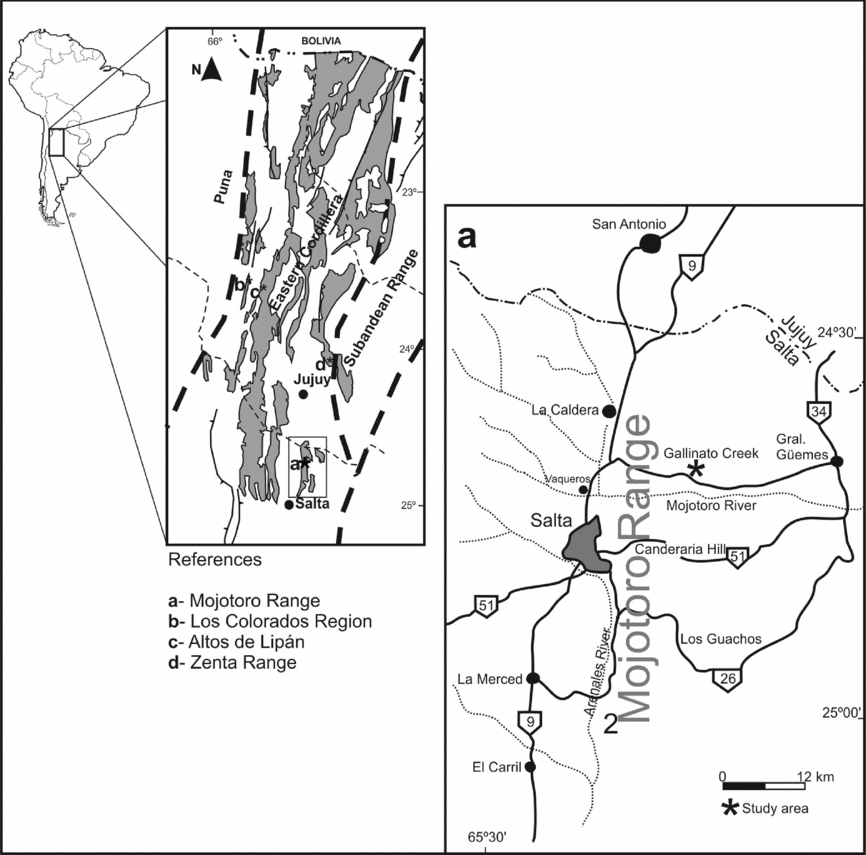
The Eastern Cordillera geological province (Fig. 1) located in northwestern Argentina (Salta and Jujuy provinces) displays a remarkable lower Paleozoic stratigraphy. The Santa Gertrudis Formation is one of the classical Ordovician units of the Eastern Cordillera; it crops out at the Gallinato and Santa Gertrudis creeks, 14 km north of Salta City (Fig. 1). It was defined by Harrington (in Harrington & Leanza, Reference Harrington and Leanza1957) and comprises dark grey shale with abundant intercalations of greenish-grey shaly sandstone and dark grey marl, and a few interspersed beds of dark bluish-grey limestone of 70 m thickness. This limestone yields Hoekaspis schlagintweiti Harrington & Leanza, Synhomalonotus kobayashii Harrington & Leanza, large undeterminable asaphids, cephalopods and bivalves. Harrington (in Harrington & Leanza, Reference Harrington and Leanza1957) has indicated a Llanvirnian age for this unit.
Location map showing the Eastern Cordillera geological province in NW Argentina: (a) area of study and (b–d) areas with similar associations of conodonts previously studied. (a) Santa Gertrudis Formation, Mojotoro Range; (b)Alto del Condor Formation, Los Colorados Region; (c) Altos de Lipán and (d) Zenta Range.

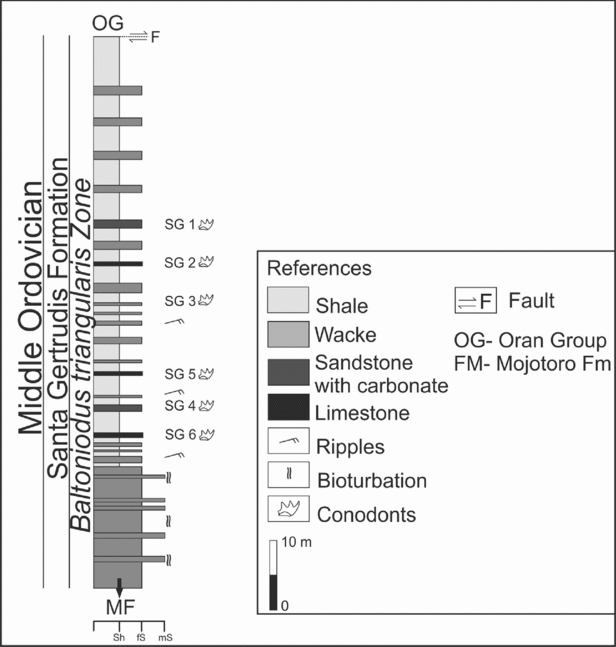
Moya et al. (Reference Moya, Monteros, Malanca, Albanesi, Moya, Ortega, Monteros, Malanca, Albanesi, Buatois and Zeballos2003) described the Santa Gertrudis Formation as composed of fine–medium slightly micaceous wacke and dark-greenish grey silt, with ripple cross-lamination and weak stratification. This formation was interpreted by Carlorosi et al. (Reference Carlorosi, Heredia, Sarmiento and Moya2011) as comprising intensive burrowed quartz wacke and grey siltstone alternating with limestone. The entire unit reaches 80 m thickness in the Gallinato Creek, where the Santa Gertrudis Formation is best exposed. This unit paraconformably overlies the Lower Ordovician Mojotoro Formation and its top is covered in modern deposits (Fig. 2). The fossiliferous levels are immediately above the wacke beds. The fossil record comprises trilobites (Harrington, Reference Harrington, Harrington and Leanza1957; Monaldi & Monaldi, Reference Monaldi and Monaldi1978; Monaldi, Reference Monaldi1982), bivalves (Sánchez, Reference Sánchez1986), brachiopods (Benedetto, Reference Benedetto1999) and conodonts.
Stratigraphical section of the Santa Gertrudis Formation, Mojotoro Range, Salta Province.

3. Methodology
Six samples were collected randomly; some of them correspond to dark grey limestone beds, while other samples were collected from limestone with bioclastic accumulations (brachiopods) (Fig. 2). The samples were processed in the laboratory using standard methods of formic acid (Stone, Reference Stone and Austin1987). The conodonts are housed at the Instituto Superior de Correlación Geológica (INSUGEO; CONICET, Universidad Nacional de Tucumán), in the Collection Lillo-microvertebrates/Conodonts (CML-C) under the code MLC–C (7000-10000).
4. Conodonts
A total of 3000 conodonts were obtained from the type area of the Santa Gertrudis Formation (SGF). The faunal diversity is relatively poor, but almost all identified species are biostratigraphically significant. Most of the recovered specimens exhibit excellent state of preservation, with different growth stages (juvenile, adult and mature) of each species recovered. The Color Alteration Index corresponds to 1.5–2 of the Epstein, Epstein & Harris (Reference Epstein, Epstein and Harris1977) table.
Key conodont species were photographed with a scanning electron microscope in the National Centre of Electronic Microscopy, Complutense University of Madrid, Spain and in the SEM laboratory of CCT, Mendoza (Argentina).
The taxonomic and taphonomic analysis of these recovered conodont assemblages were carried out. The taphonomic aspect revealed that the conodonts from SGF are not reworked (as proposed by Carlorosi et al. Reference Carlorosi, Heredia, Sarmiento and Moya2011) because the preservation is excellent; they are not broken or cracked and fractures with padding are not evident. Taking into account certain taphonomic processes such as disarticulation and transportation that act on conodont apparatus, we can rebuilt the apparatuses from individual elements that are disjointed; each element, mainly the balognathiid P elements, consists of crown and basal fillings (or basal body) which, during the disarticulation of the apparatus, were detached from each other (basal filling–crown). The recovered specimens are only composed of basal filling or basal filling with parts of crown. Another taphonomic detail to note is the presence of all the elements (P, M and S) that constituted the conodontal apparatus of recovered species with more abundance, refuting any suggestion that segregation and therefore displacement has occurred.
Finally, a little evidence of dissolution is observed in the aboral margin of the basal cavity and in a few denticles; furthermore, there are no distortion effects present such as changes in side and form or alteration in the texture.
5. Systematic palaeontology
The conventional notation system was used in the descriptions of taxa (Sweet Reference Sweet and Robison1981, Reference Sweet1988) which defines the spatial positions M, S and P, from the anterior extremity to the posterior of the multielemental apparatus. Corresponding subpositions of the symmetry were also considered, and do not necessarily reflect location within the oral cavity of the conodont animal.
Five conodont species have been selected for description and illustration: Baltoniodus triangularis, B. cooperi sp. nov., Erraticodon patu Cooper, Periodon aff. P. flabellum (Lindström) and Trapezognathus quadrangulum Lindström. We also mention the occurrence of Gothodus sp. and Drepanoistodus sp.
Class Conodonta Pander, Reference Pander1856 Order Prioniodontida Dzik, Reference Dzik1976 Superfamily Prioniodontacea Bassler, Reference Bassler1925 Family Balognathidae Hass, Reference Hass1959 Genus Baltoniodus Lindström, Reference Lindström1971
Original diagnosis (Lindström, Reference Lindström1971): The multielemental genus Baltoniodus Lindström (Reference Lindström1971) has a septimembrate apparatus. The elements are pectiniform, pastinate, alate, tertiopedate, bipennate, quadriramate and geniculate and occupied the P (Pa and Pb), S (Sa, Sb, Sc and Sd) and M position, respectively.
Type specie Prioniodus navis Lindström, Reference Lindström1955
Baltoniodus cooperi sp. nov.
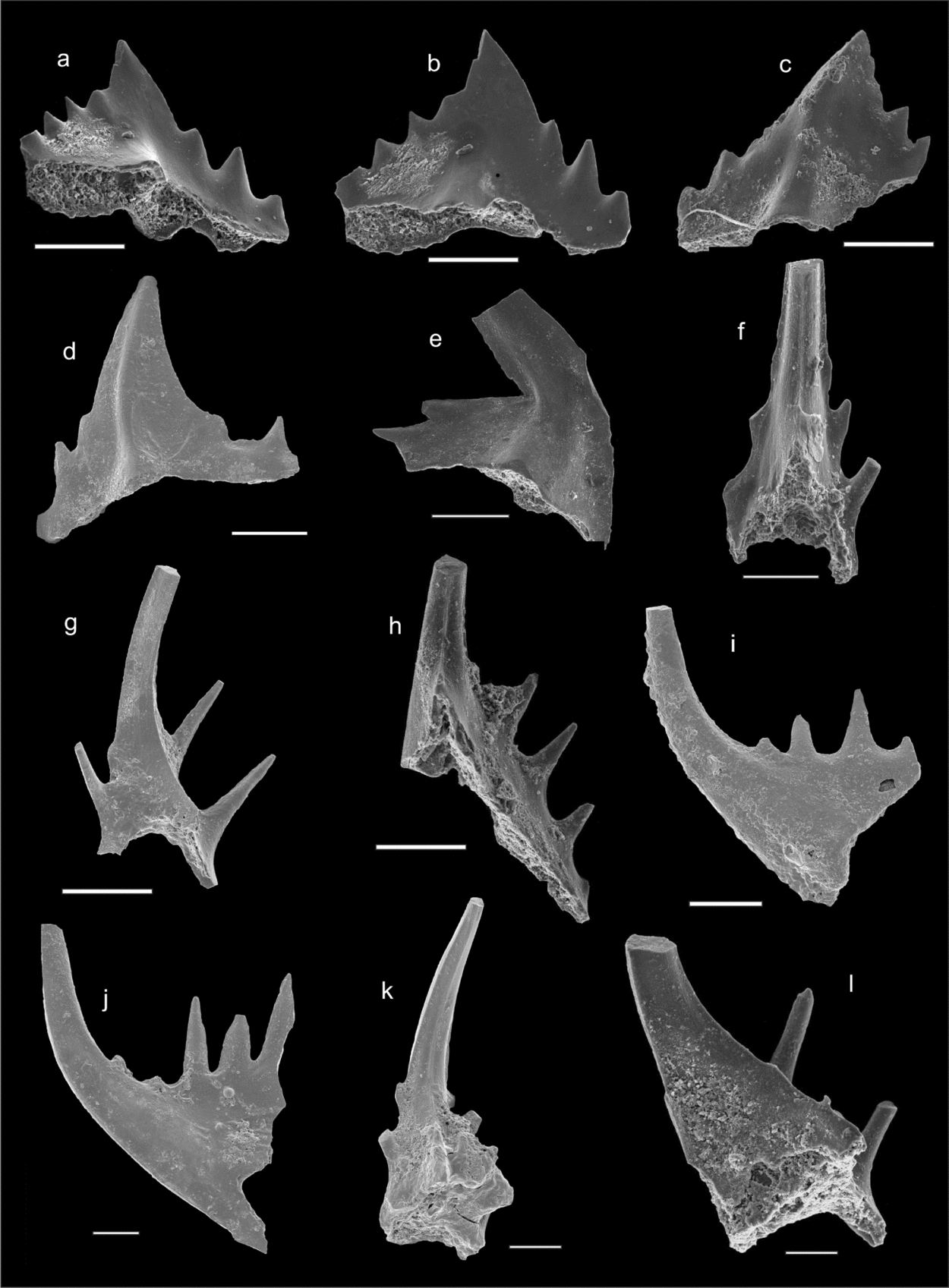
Figure 3a–m
1981. Baltoniodus navis, Cooper, p. 160, pl. 29, figs 9–10, pl. 30, fig. 2.
1994. Baltoniodus navis (sensu Cooper), Albanesi & Vaccari, p. 133, pl. 2, figs 1–13 (not 4, 12)
2003. Plectodina n. sp. A Moya et al., p. 64, fig. 12, 3.
Plate of scanning electron microscope microphotographs. The bar indicates 0.1 mm. Baltoniodus cooperi sp. nov. Elements recovered from de Santa Gertrudis Formation in the Mojotoro Range, Salta Province. (a–d) P elements. (a–c) Pa element, aboral, postero-lateral and anterior views, sample SG2, CML-C 7101(1). (d) Pb element, anterior view, sample SG2, CML-C 7102(1). (e) M element, postero-lateral view, Sample SG5, CML-C 7102(1). (f, g, l) Sa elements, posterior and postero-lateral views, sample SG5, CML-C 7103(1-3). (h) Sb element, posterior view, sample SG5, CML-C 7104(1). (i, j) Sc elements, lateral views, sample SG5, CML-C 7105(1-2). (k) Sd element, postero-lateral view, sample SG5, CML-C 7106(1).

2007. Plectodina n. sp. Albanesi et al., p. 12, text-fig. 3Q.
Derivation of name: in honour of Dr Barry J. Cooper, an Australian geologist who originally recognized and described these elements.
Diagnosis: This species is characterized by a marked change in the indentations of the elements. In the case of the P elements these denticles are of triangular shape, fusiform and pointy; in the case of the M and S elements denticles are long, thin and rod-like.
Type locality: Gallinato Creek, Mojotoro Range, Salta province, Argentina.
Type stratum: Sampled level SG5 from the Santa Gertrudis Formation, approximately 50 m from the base of the section. Collection Lillo-Microvertebrates/Conodonts (CML-C) (J. Carlorosi, collector).
Holotype: Pa element, CML-C 7100 (1) (Fig. 3a).
Paratypes: Pa elements, CML-C 7100 (2–39); Pb elements, CML-C 7101 (1–45); M elements, CML-C 7102 (1–8); Sa elements, CML-C 7103 (1–14); Sb elements, CML-C 7104 (1–15); Sc elements, CML-C 7105 (1–19); Sd elements, CML-C 7106 (1–39).
Description: The Pa element is pastinate. This element is characterized by its lateral compressed form with sharp flanks in the short cusp. The cusp has a triangular shape in a cross-section view with a shark tooth-like appearance. From the flanks two long processes develop, the lateral and the posterior both denticulate, the anterior face of the cusp is concave and ends in a short anterior process without denticles. From the posterior process and close to the junction of this with the cusp a small lobe develops whose location represents right and left forms. The denticles present on the processes are small and triangular in shape. The denticles on the posterior process begin on the cusp and the first denticle marks the development of the lobe. The basal cavity is elongated and deep; below, the cusp is sub-rounded to oval in shape, corresponding to the anterior process and the lobe. The basal sheath linking processes is wide and wavy.
Pb element: pastinate with three processes. The cusp is similar to those of the Pa elements. It is triangular in shape in a cross-section view with sharp sides from which two processes develop, the shortest lateral and the longest posterior. From the middle part of the cusp, a marked rib extends along the anterior process. The three processes carry small triangular denticles; the first denticle of the lateral and posterior processes arise about half-way along the cusp. The basal cavity is deep and extends to the processes; the basal sheath connects the processes but is less developed than that of the Pa element.
The M element is a modified geniculate laterally compressed with sharp edges. The cusp is erect to procline. The anterior margin of the cusp extends in a short anterior extension directed downwards. The margin of the posterior process carries large rod-like denticles. The basal sheath connects the posterior and the anterior ribs and a flare is observed in a lateral view. The basal cavity is deep.
Sa element: alate element. It has a long and thin proclined cusp with three strong ribs that extend beyond the cusp and form three processes, two lateral and one posterior; the lateral processes carries long denticles which are directly perpendicular to the cusp, almost forming an 90° angle. The basal cavity is deep and extends into the processes.
Sd element: tertiopedate element. The cusp is slightly proclined with sub-rounded cross-section; a strong rib on the inner side of the cusp gives rise to a posterior process. Two lateral processes are continued from the cusp below the basal cavity, and present a different angle which grants an asymmetry to the element. Denticles are long and rod-like, a main feature of this new species. The basal cavity is deep and runs into the processes.
Sc element: bipennate element. The cusp is long with the external flank curved. The anterior process extends beyond the basal cavity and is directed to the posterior side, this process ended in a keel; the inner flank is flat and extends in a posterior process that carries 4–5 wide and long denticles. The basal sheath connects the two processes and presents an undulation near the anterior process. The basal cavity is deep.
Sd element: quadriramate element. It has a long proclined cusp, four processes are developed and their position are two latero-anterior and two latero-posterior. The denticles in most of the samples are broken, but these are long and rod-like shape. The basal cavity is deep. The basal sheath connecting the four processes gives a quadrangular shape to the base.
Remarks: This species is here considered as belonging to the Balognathidae family. The strong relation with B. triangularis is supported by the presence of main characters that define the family and the genus proposed by Hass (Reference Hass1959) and Lindström (Reference Lindström1971), such as a septimembrate apparatus, microstructure with lateral lamination, robust pectiniform P elements and delicate geniculate M and ramiform S elements. The transition series remains the patron of the S elements of the genera Trapezognathus Lindström and Baltoniodus Lindström.
Cooper (Reference Cooper1981) assigned this species to Baltoniodus navis, and at that time the description was supported only by few elements from the Horn Valley Siltstone, Amadeus Basin, Australia. The former author compared this species with Baltoniodus navis Lindström from Baltica, but the illustrated elements shows strong differences from the Baltoniodus navis redescribed by Stouge & Bagnoli (Reference Stouge and Bagnoli1990). Later, Albanesi & Vaccari (Reference Albanesi and Vaccari1994) recorded it in the Suri Fomation (Famatinian Range). These authors described the complete apparatus but they proposed a different M element compared with that figured by Cooper (Reference Cooper1981). In this contribution we define this Baltoniodus navis (sensu Cooper) as a new species, recognizing the diagnostic characters that defined it.
Furthermore, in those samples taken from this section, the conodont species Baltoniodus cooperi sp. nov. is well represented in number of elements with juvenile, adult and mature forms, suggesting that this species was well adapted to the environment.
Provenance: Santa Gertrudis Formation, Mojotoro Range, Salta Province. Beds SG1 to SG6.
Age: The occurrence of Baltoniodus triangularis (Lindström) in the same samples indicates for Baltoniodus cooperi sp. nov. a Middle Ordovician age (early Dapingian).
Distribution: Northwestern Argentina, Famatinian Belt (Albanesi & Vaccari, Reference Albanesi and Vaccari1994) and Amadeus Basin, Australia (Cooper, Reference Cooper1981). The co-occurrence of Baltoniodus cooperi sp. nov. and Erraticodon patu indicates a strong relation with the Australian conodont Province.
Baltoniodus triangularis (Lindström, Reference Lindström1955)
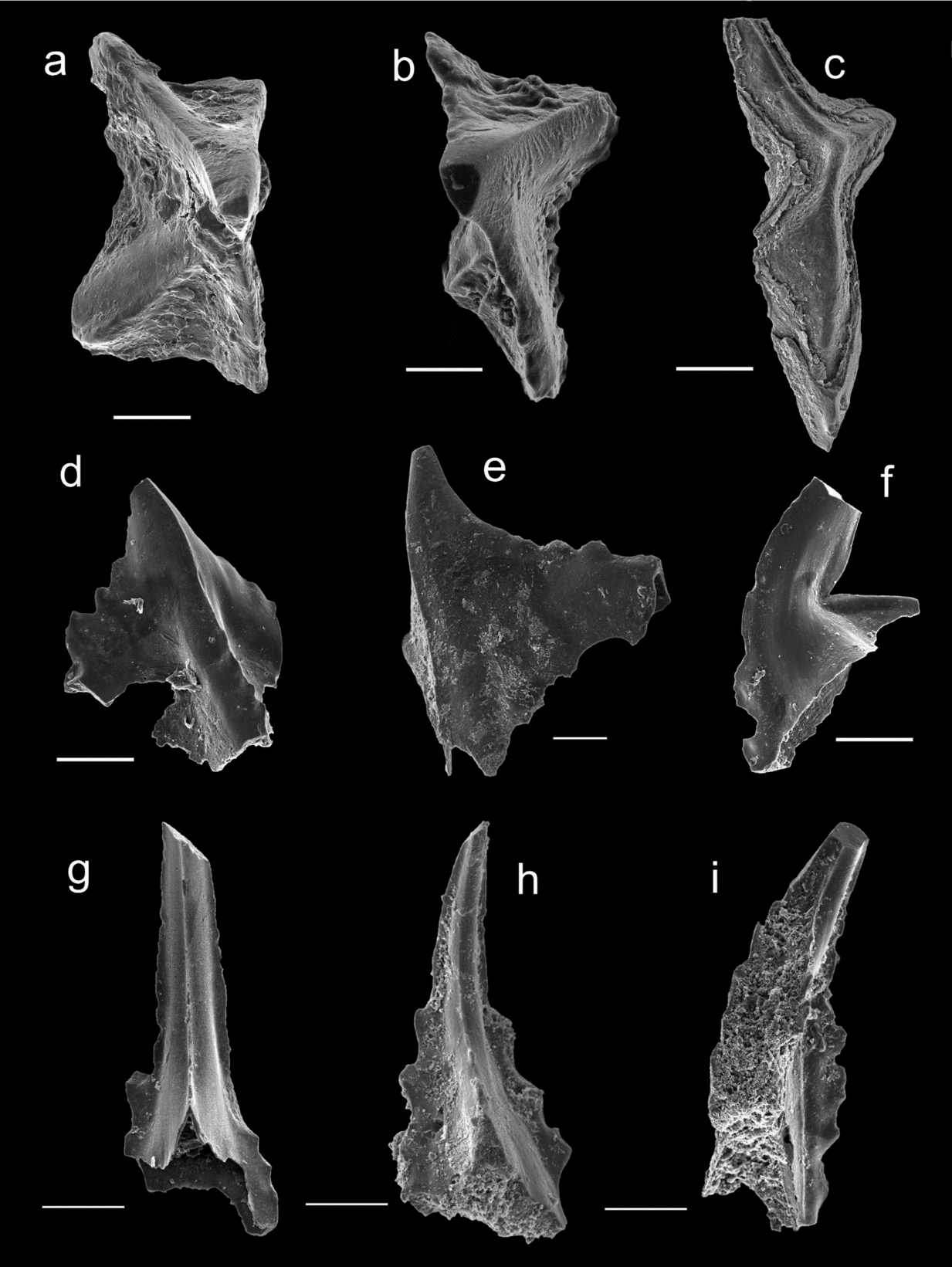
Figure 4a–i
1955 Prioniodus triangularis Lindström, pp. 591, pl. 5, figs 45–46.
Plate of scanning electron microscope microphotographs. The bar indicates 0.1 mm. Baltoniodus triangularis (Lindström). Elements recovered from de Santa Gertrudis Formation in the Mojotoro Range, Salta Province. (a–e) P elements. (a–c) Pa elements, upper views, samples SG4, 5, CML-C 7008(1-3). (d, e) Pb elements, latero-anterior and latero-posterior views, samples SG2, 3, CML-C 7009(1-2). (f) M element, lateral view, sample SG4, CML-C 7010(1). (g) Sa element, posterior view, sample SG6, CML-C 7011(1). (h) Sb element, postero-lateral view, sample SG2, CML-C 7012(1). (i) Sd element, lateral view, sample SG2, CML-C 7013(1).

1971 Baltoniodus triangularis (Lindström), Lindström, p. 55, pl. 1, fig. 12.
1974 Prioniodus navis Lindström, Wamel, pp. 89–90, pl. 12, figs 2, 3?
1994 Baltoniodus triangularis (Lindström), Löfgren, fig. 8: 28–29.
1994 Trapezognathus argentinensis Rao, Hünicken & Ortega, p. 73, lám. III, figs 2, 8, 10, 12, lam. VII, fig. 7.
1997 Baltoniodus? triangularis (Lindström), Bagnoli & Stouge, pp. 137–138, pl. 3, figs 1–12.
1998 Baltoniodus triangularis (Lindström), Albanesi, p. 159, pl. 2, fig. 12.
2003 Baltoniodus sp. A Zhen et al., p. 182, pl. 11, fig. S.
2005 Baltoniodus triangularis (Lindström), Wang et al., fig. 4.
2009 Baltoniodus triangularis (Lindström), Bergström & Löfgren, p. 7, pl. 4, figs a–ac.
2009 Baltoniodus triangularis (Lindström), Wang et al., p. 104, fig. 9, 1–5, 7–11.
2010 Baltoniodus triangularis (Lindström), Li et al., pp. 117, 118, pl. II, figs 1–15.
2013 Baltoniodus triangularis (Lindstöm), Carlorosi, Heredia & Aceñolaza, pp. 2, fig. 3, A–I.
2013 Trapezognathus? argentinensis Rao et al., Voldman et al., pp. 126, 127, fig. 2, n16–18.
2016 Zentagnathus primitivus Voldman et al., Voldman et al., fig. 6, G, H.
Original diagnosis (Lindström, Reference Lindström1955): The apparatus of Baltoniodus triangularis is septimembrate, composed for well-defined pastinate P elements, geniculate M element and transitional series of the S elements. All the elements have denticles, a deep basal cavity and a large basal sheath.
Remarks: Baltoniodus triangularis was described for the first time from northwestern Argentina (Los Colorados section, Alto del Cóndor Formation) by Carlorosi, Heredia & Aceñolaza (Reference Carlorosi, Heredia and Aceñolaza2013). Detailed observations made on the recovered P elements of Baltoniodus triangularis from this region and those from the Gallinato section (SGF) allow us to propose subtle but identifiable differences between these apparatuses. Based on these differences, we propose the recognition of early and late forms of B. triangularis both from the Alto del Cóndor Formation (ACF) and Santa Getrudis Formation (SGF). This interpretation allows us to recognize different time intervals in the B. triangularis Zone. A brief list of differences follows.
Pa elements
Cusp: Elements from ACF show cusps round and straight and the costae are less prominent than those present in specimens from SGF.
Processes: There is a difference in length between the anterior and lateral processes of both forms, and the relation of the angles between them is also different. Additionally, there are differences in the length of the posterior process and its relation with the angles of the anterior processes. The connection of the lobe with the posterior process occurs at different distance from the cusp.
Basal sheath and general shape of the basal cavity: Specimens present different development in both cases, and the shape of the basal cavity is more compressed in the Pa elements from SGF.
Pb elements
Cusp: this is rounded with a slight posterior tilt in the Pa elements from the ACF; it is more pronounced than those SGF elements where the cusp is thinner with concave front edge and a medial well-marked rib where the anterior process rises.
Processes: the primitive (ACF) Pb elements demonstrate a relationship between the angles of the anterior, lateral and posterior processes different from those of SGF in terms of the direction towards its point of origin.
Basal sheath: the specimens of SGF have a less-developed basal sheath compared with those of ACF.
The denticles of the P elements recovered from the SGF are larger compared to those from ACF. They also seem to be further apart.
It must be noted that morphological differences between S and M elements (comparing early and advanced forms) were not observed.
Material: Pa elements, CML-C 7008 (1–7); Pb elements, CML-C 7009 (1–12); M elements, CML-C 7010 (1–5); Sa elements, CML-C 7011 (1–25); Sb elements, CML-C 7012 (1–49); Sc elements, CML-C 7013 (1–63); Sd elements, CML-C 7014 (1–24).
Age: This key species is recorded in the early Dapingian (Middle Ordovician) in the Santa Gertrudis Formation.
Distribution: Los Colorados Section, northwestern Argentina. Baltoscandia (Bagnoli & Stouge, Reference Bagnoli and Stouge1997; Bergström & Löfgren, Reference Bergström and Löfgren2009) and South China (Wang et al. Reference Wang, Stouge, Chen, Li, Wang, Finney, Zeng, Zhou, Chen and Erdtmann2009).
Provenance: Santa Gertrudis Formation, Mojotoro Range, Salta Province. Beds SG1 to SG6.
Genus Trapezognathus Lindström, Reference Lindström1955
Type species: Trapezognathus quadrangulum Lindström, Reference Lindström1955
Figure 5a–l
1955 Prioniodus triangularis Lindström, pp. 591, 592 (partim), pl. 5, fig. 45 (only).
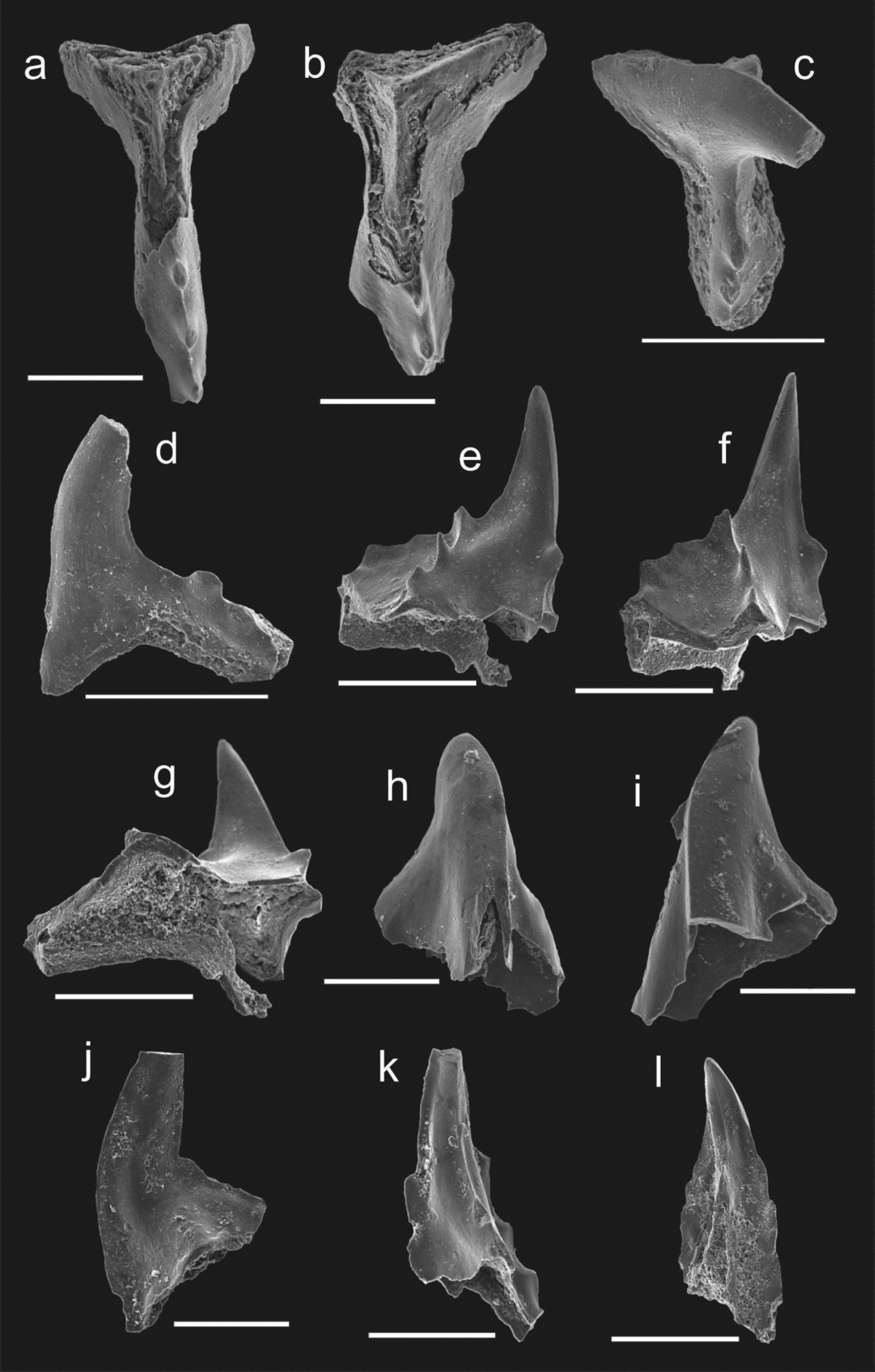
(a–l) Plate of scanning electron microscope microphotograph. The bar indicates 0.1 mm. Trapezognathus quadrangulum Lindström. Elements recovered from de Santa Gertrudis Formation in the Mojotoro Range, Salta Province. (a–i) P elements. (a–g) Pa elements, upper, lateral and basal views, samples SG2, 5 CML-C 7015(1-4). (h, i) Pb elements, latero-anterior and lateral views, sample SG5, CML-C 7016(1-2). (j) M element, lateral view, sample SG5, CML-C 7017(1). (k) Sb element, postero-lateral view, sample SG2, CML-C 7019(1). (l) Sd element, postero-lateral view, sample SG5, CML-C 7021(1).

1955 Prioniodus navis Lindström, pp. 590, 591 (partim), pl. 5, figs 31, 32 (only).
1955 Trapezognathus quadrangulum Lindström, p. 598 (partim), pl. 5, figs 38, 39 (only).
1974 Prioniodus navis Lindström, Wamel, pp. 89, 90, pl. 8, figs 10, 11.
1977 Baltoniodus triangularis (Lindström), Lindström, in Ziegler, pp. 81–82 (partim), Baltoniodus, pl. 2, figs ?8, ?9, 10, 11.
1978 Prioniodus (Baltoniodus) triangularis Lindström, Löfgren, pp. 81, 82, pl. 12, figs 1–7.
1990 Trapezognathus quadrangulum Lindström, Stouge & Bagnoli, pp. 26, 27, pl. 10, figs 1–5, 7–10.
1994 Trapezognathus argentinensis Rao & Hünicken, Rao et al., p. 73, lám. III, figs 9a–c, 11a, lám. VII, figs 1, 3, 5.
1994 Baltoniodus navis (sensu Cooper), Albanesi & Vaccari, p. 133, pl. 2, fig. 4.
1995 Lenodus? sp. A, Löfgren, fig. 9 j–n.
1997 Trapezognathus quadrangulum Lindström, Bagnoli & Stouge, p. 160, pl. 8, figs 1–8.
2001 Trapezognathus quadrangulum Lindström, Viira et al., fig. 6c–f.
2003 Baltoniodus sp. A, Zhen et al., p. 182, fig. 11V.
2003 Icriodella n. sp. A., Moya et al., p. 64, pl. 12, figs 13, 15.
2013 Baltoniodus cf. triangularis Lindström, Voldman et al., p. 126, pl. 2, fig. 6.
Original diagnosis (Stouge & Bagnoli, Reference Stouge and Bagnoli1990): The Trapezognathus Lindström apparatus is septimembrate, with pectiniform P elements, geniculate M elements and a complete series of S elements (alate, tertiopedate, bipennate, quadriramate). P elements are adenticulate to weakly denticulate. M element is adenticulate to denticulate and the cusp forms an angle about 90° with the upper margin of the base. S elements are stubby, with a base higher than the cusp, weakly denticulate to denticulate. All elements are albid and have a deep basal cavity and large basal sheath.
Description: The material recovered from Santa Gertrudis Formation was previously described by Carlorosi & Heredia (Reference Carlorosi and Heredia2013), who illustrated only Pb elements. New Pa elements were recovered from this unit and are described here. It is important to highlight that the recovered material shows different evolutionary stages, where the transition from basal morphology of the Pa elements of Trapezognathus quadrangulum s.l. to advanced forms with features that link it with the genus Lenodus, corroborating the lineage proposed by Löfgren & Zhang (Reference Löfgren and Zhang2003), is visible. In addition it should be noted that all these different morphologies were found coexisting in the same place and at the same time.
Pa element: Pastiniscaphate element. The illustrated material in Figure 5a, b represents Pa elements that correspond to a typical form of the species. It is possible to recognize two degrees of development – (a) a primitive form and (b) an advanced form – which is differentiable due to the development of the lobe. Vestiges of the crown attached to the basal body can also be distinguished. Three processes are developed from the cusp: the anterior, posterior and lateral. The anterior process is longer than the lateral, and they are related by an angle of c. 60°; the lateral process carries hints of denticles near the cusp. The posterior process is the longest of the three and is developed almost straight from the cusp; its terminal portion is curved backwards. This posterior process also has an adenticulated lobe. The distal part of the posterior process carried sub-rounded denticles. The general shape of the element differs from those previously illustrated; the shape in this case is more elongated and compressed (Fig. 5a, b).
Figure 5c, d represents the next evolutionary step. The complete Pa element with the preservation of the crown is shown for the first time. The evolutionary trend is to laterally compress the general shape and grow in height. The cusp is high and directed towards the back with a marked turn towards the inner side of the element; the anterior and posterior edges of the cusp are sharp; its cross-section is triangular; and the base of the cusp is wide and exhibits the longitudinal striations characteristic of the Balognathidae family. From the cusp, the anterior and posterior processes are developed and are almost of the same length (the lateral being a little longer). The posterior process is fragmented but is the longest of the three, this process carries sub-rounded denticles of central position. The basal cavity is deep; a small basal sheath links the processes.
The last specimen illustrated (Fig. 5e–g) represents a major evolutionary step compared with the previous Pa elements figured; it is possible to observe the diagnostic features of Pa elements of Trapezognathus quadrangulum, as well as morphological characters that show an evolutionary trend towards Lenodus genus that appears in the basal Darriwilian. The cusp is high and posteriorly pointed with sharp edges. Three ribs indicate the origin of the anterior, lateral and posterior processes; all processes carried sharp denticles similar to the shape of the cusp. The posterior process is the longest and develops a denticulate lobe that arise from the first denticle of the posterior process. This character is one that is present in the descendant Lenodus. The basal cavity is deep and wide and extends through the processes and the lobe; a narrowing in the middle of the element is evident.
Remarks: T. quadrangulum was recorded from the Baltoniodus navis Zone to the L. antivariabilis Subzone in South China and Baltica. Löfgren & Zhang (Reference Löfgren and Zhang2003) proposed that the stratigraphic record of T. quadrangulum is short, being restricted to zones and subzones of the Arenig (British Series). Carlorosi, Heredia & Aceñolaza (Reference Carlorosi, Heredia and Aceñolaza2013) mentioned the co-ocurrence of Trapezognathus quadrangulum and Baltoniodus triangularis in the Los Colorados section (Alto del Condor Formation), representing the oldest record of T. quadrangulum worldwide. The presence of this species in the Santa Gertrudis Formation confirms this datum and allows a continuous record of T. quadrangulatum since the beginning of the B. triangularis Zone (Basal Dapingian) to be determined.
Material: Pa elements, CML-C 7015 (1–4); Pb elements, CML-C 7016 (1–8); M elements, CML-C 7017 (1–4); Sa elements, CML-C 7018 (1–16); Sb elements, CML-C 7019 (1–15); Sc elements, CML-C 7020 (1–22); Sd elements, CML-C 7021 (1–20).
Age: Middle Ordovician age (early Dapingian).
Distribution: Los Colorados Section and Altos de Lipán, northwestern Argentina, Baltoscandia (Stouge & Bagnoli, Reference Stouge and Bagnoli1990; Bergström & Löfgren, Reference Bergström and Löfgren2009).
Provenance: Santa Gertrudis Formation, Mojotoro Range, Salta Province. Beds SG3 and SG5.
Family Periodontidae Lindström, Reference Lindström1971
Genus Periodon Hadding, Reference Hadding1913
Type Species: Periodon aculeatus Hadding, Reference Hadding1913
Periodon aff. P. flabellum (Lindström, Reference Lindström1955)
Figure 6a–e
1997 Periodon sp. A, Bagnoli & Stouge, p. 151, pl. 6, figs 8, 12–15.
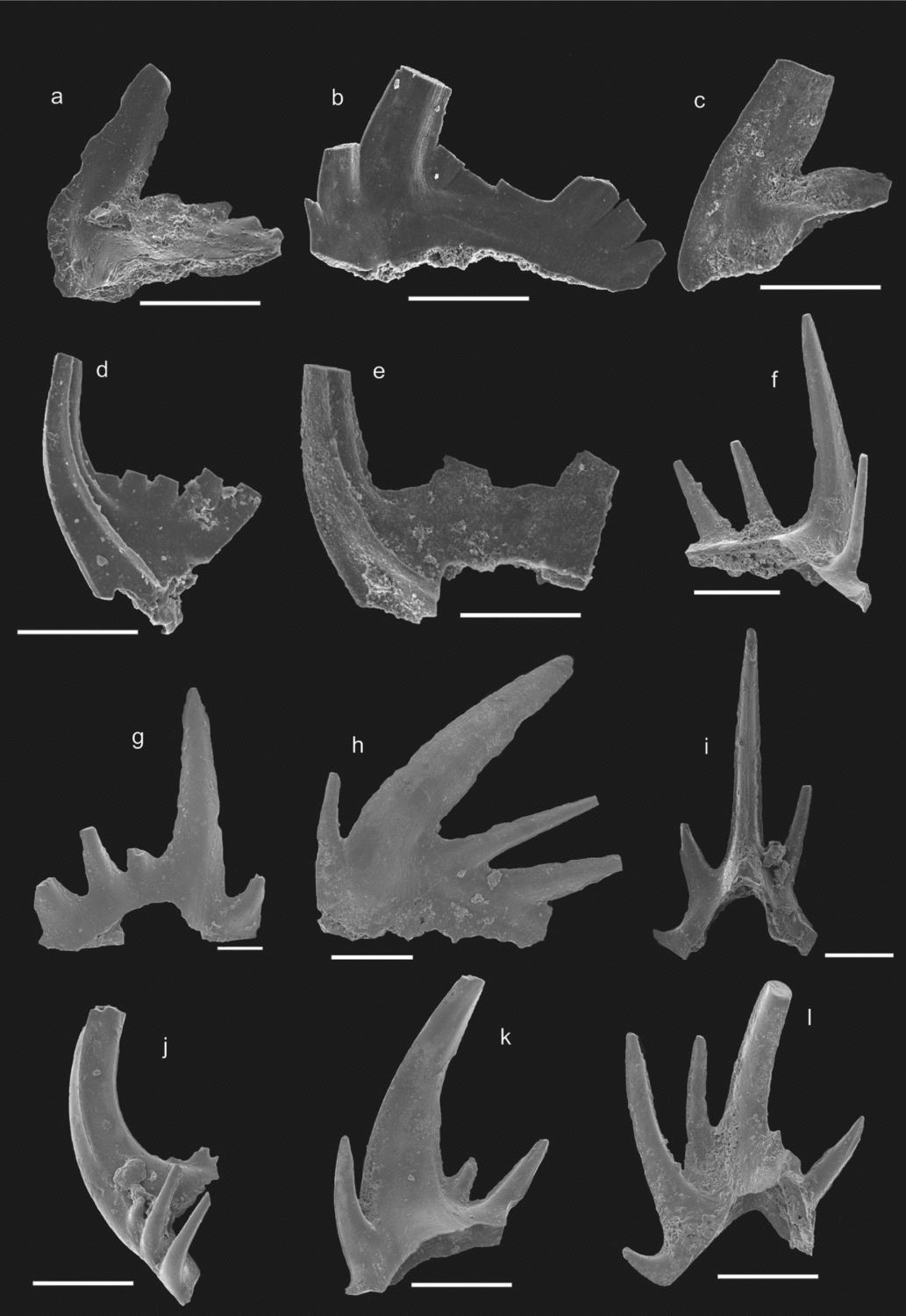
Plate of scanning electron microscope microphotograph. The bar indicates 0.1 mm. Elements of the apparatus of Periodon aff. P. flabellum Lindström and Erraticodon patu Cooper, recovered from de Santa Gertrudis Formation in the Mojotoro Range, Salta Province. (a–e) Periodon aff. P. flabellum Lindström. (a) Pb element, lateral view, CML-C 7023(1). (b) Pa element, postero-lateral view, CML-C 7022(1). (c) M element, lateral view, CML-C 7024(1). (d) Sc element, lateral view, CML-C 7027(1). (e) Sd element, lateral view, CML-C 7028(1). (f, l) Erraticodon patu Cooper. (f, g) P elements. (f) Pa element, posterior view, sample SG3, CML-C 7001(1). (g) Pb elements, anterior view, Sample SG5, CML-C 7002(1). (h) M element, lateral view, sample SG5, CML-C 7003(1). (i) Sa element, posterior view, sample SG3, CML-C 7004(1). (j) Sb element, lateral view, sample SG2, CML-C 7005(1). (k) Sc element, lateral view, sample SG5, CML-C 7006(1); (l) Sd element, postero- lateral view, sample SG5, CML-C 7007(1).

Original diagnosis (Stouge & Bagnoli, Reference Stouge and Bagnoli1988): The genus Periodon has a septimembrate apparatus comprising Pa, Pb, M, Sa, Sb, Sc and Sd.
Comments of the original diagnosis: Following Stouge (Reference Stouge2012), this species evolved from Periodon flabellum (Lindström) and is characterized by the development of a denticulated anterior process on the anterior margin. P. cf. P. flabellum has one small denticle on the anterior process. P. aff. P. flabellum has two denticles on the anterior process, one short and the other long. In our collection the latter species is present.
Description: Pa element: Bipennate element. The reclined cusp is long and laterally compressed with flat margins from which two processes originate; the anterior one is short and carries two denticles, one of which is long and rectangular while the second seems to be an aberrant small denticle. The posterior process is long and carries six denticles; the first two are over the cusp and are more reduced in size than the remaining, the next three are large and rectangular and the sixth is small. All the denticles in the posterior process are directed backwards. The basal cavity is thin and continues to the processes.
M element: Geniculate element laterally compressed. The cusp is reclined, long and thin. Their margins are sharp; the anterior margin of the cusp extends beyond the base forming a keel. The angle between the posterior margin of the cusp and the top margin of the base is c. 60°. The posterior margin of the base continues in a short extension; the margin of the oral cavity has an undulation, and in this region the oral cavity widens and expands and prolong towards the sides of the element. We have not recovered any element with denticles in the anterior margin of the base.
Sc element: Dolobrate element. The cusp is long and slightly reclined; the external face of the cusp is concave with sharp margins. A well-marked rib runs along the cusp and the base. From the posterior margin of the cusp a posterior denticulated process arises that carries five denticles: three small between the cusp and the two major distal denticles. The process and the denticles are directed backwards.
Sd element: Tertiopedate element. Has a long cusp nearly straight, with three ribs well-marked which extend beyond the base and form three processes: one very small adenticulated anterior, the adenticulated lateral and the larger posterior. The angle between the cusp and the posterior processes is almost 90°. The posterior process has evidence of four denticles located between the cusp and the last small denticle, which is the largest.
Remarks: This species is recorded in northwestern Argentina and Gondwana for the first time. Only a few elements were recovered from the SGF, and their description was based on the evolutionary scheme presented by Stouge (Reference Stouge2012). According to this author, its FAD occurs in the basal Dapingian and the LAD occurs in the upper Dapingian, coincidently with the recovered conodont association. On the other hand, some elements from this collection coincide with those described as Periodon sp. A. by Bagnoli & Stouge (Reference Bagnoli and Stouge1997). The presence of this last species is also mentioned by Wang et al. (Reference Wang, Stouge, Chen, Li, Wang, Finney, Zeng, Zhou, Chen and Erdtmann2009) in the Baltoniodus triangularis Zone as it occurs in the Santa Gertrudis Formation.
Material: Pa elements CML-C 7022(1–3), Pb elements CML-C 7023(1–3), M elements CML-C 7024(1–2), Sc elements CML-C 7027(1–5), Sd elements CML-C 7028(1–6).
Age: Baltoniodus triangularis Zone, Middle Ordovician age (early Dapingian).
Distribution: Baltoscandia (Bagnoli & Stouge, Reference Bagnoli and Stouge1997), western Newfoundland (Stouge, Reference Stouge2012) and Central and South China (Wang et al. Reference Wang, Stouge, Chen, Li, Wang, Finney, Zeng, Zhou, Chen and Erdtmann2009; Wu et al. Reference Wu, Stouge, Li and Wang2010).
Provenance: Santa Gertrudis Formation, Mojotoro Range, Salta Province. Beds SG1 to SG6.
Order Prioniodinida Sweet, Reference Sweet1988
Family Chirognathidae Branson & Mehl, Reference Branson, Mehl, Shimer and Shrock1944
Erraticodon Dzik, Reference Dzik1978
Type species Erraticodon balticus Dzik, Reference Dzik1978
Erraticodon patu Cooper, Reference Cooper1981
Figure 6f–l
1981 Erraticodon patu Cooper, p. 166, pl. 32, figs 1–6, 8.
1987 Erismodus quadridactylus (Stauffer), Sarmiento & Rao, p. 90–91, pl. 1, figs 2–4, 7, 9, 12; pl. 2, figs 1–6.
1994 Erraticodon patu Cooper, Albanesi & Vaccari, p. 137, pl. 1, figs 11–16.
2003 Erraticodon cf. gratus (Moskalenko, 1977), Moya et al., p. 64, pl. 12, figs 6, 7, 9.
2003 Erismodus typus Branson & Mehl, Moya et al., p. 64, pl. 12, figs 8, 11.
2007 Erraticodon balticus Dzik, Albanesi et al., p. 46, text-fig. 3A–D.
2010 Erismodus cf. quadridactylus (Stauffer), Aceñolaza, Carlorosi & Heredia, p. 168, pl. 4, fig. a.
2012 Erraticodon patu Cooper, Carlorosi (J. M. T. Carlorosi, unpub. PhD thesis, Universidad Nacional de Tucumán, 2012), p. 112–116, pls 2, 3, 27 (A, F), 28 (D).
2013 Erraticodon patu Cooper, Heredia et al., p. 23 pl. 5, figs A–I.
2014 Erraticodon patu Cooper, Carlorosi, Heredia & Sarmiento, p. S2–9, fig. 1.
Remarks: According to Zhen, Percival & Webby (Reference Zhen, Percival and Webby2003) the apparatus of this species is constituted by ramiforms digyrate P, makellate M, alate Sa, bipennate Sb and Sc and tertiopedate Sd elements. This species was previously mentioned and described from Los Colorados section (northwestern Argentina) by Heredia et al. (Reference Heredia, Carlorosi, Mestre and Soria2013); the elements recovered in the SGF present the same features as those from Los Colorados. The elements are robust and all the ontogenetic stages are well represented. Erraticodon patu is very abundant compared with the other recovered species, indicating that it was well adapted to the environment.
The finding of Erraticodon patu in this section is of particular biostratigraphic interest since this species has been mentioned in different areas of geological provinces of Eastern Cordillera (Los Colorados Region, Altos de Lipan and Zenta Range), Famatina and Precordillera.
Material: Pa elements CML-C 7001(1–11), Pb elements CML-C 7002(1–3), M elements CML-C 7003(1–11), Sa elements CML-C 7004(1–24), Sb elements CML-C 7005(1–28), Sc elements CML-C 7006(1–25), Sd elements CML-C 7007(1–22).
Age: Heredia et al. (Reference Heredia, Carlorosi, Mestre and Soria2013) suggest that the global record of E. patu ranges from late Early Ordovician to early Middle Ordovician. The record of this species in the Santa Gertrudis Formation confirms this proposal.
Provenance: Santa Gertrudis Formation, Mojotoro Range, Salta Province. Beds SG1 to SG6.
6. Biostratigraphic implications
Since the discovery of conodonts in the Santa Gertrudis Formation, its age has been controversial. The conodont association recovered from this unit was studied by many authors, who assigned different genus and species into the assemblage composition and consequently different ages for it. The first conodont fauna was recovered by Monaldi & Monaldi (Reference Monaldi and Monaldi1978), identifying an association composed of Oistodus, Sagittodontus, Polycaulodus and Panderodus; these conodonts and the macro fossils recovered suggested dissimilar ages for this formation. Later, Sarmiento & Rao (Reference Sarmiento and Rao1987) described and illustrated Erismodus quadridactylus (Stauffer) proposing an Ordovician s.l. age for these strata.
Moya et al. (Reference Moya, Monteros, Malanca, Albanesi, Moya, Ortega, Monteros, Malanca, Albanesi, Buatois and Zeballos2003) mentioned the conodont species Erismodus quadridactylus (Stauffer), Bryantodina aff. B. typicalis Stauffer, Plectodina n. sp. A, Erraticodon cf. E. gratus (Moskalenko), Erismodus typus Branson & Mehl, Icriodella n. sp. A, Polycaulodus sp. and Semiacontiodus sp., and proposed a Llanvirnian – early Caradoc age (Darriwilian Sandbian) for this formation.
A review of the Santa Gertrudis conodont fauna was carried out by Carlorosi et al. (Reference Carlorosi, Heredia, Sarmiento and Moya2011) who agreed with Moya et al. (Reference Moya, Monteros, Malanca, Albanesi, Moya, Ortega, Monteros, Malanca, Albanesi, Buatois and Zeballos2003) at that time, recognizing the conodont Erismodus quadridactylus but also the appearance for the first time of Baltoniodus triangularis and Trapezognathus quadrangulum. This conodont association was interpreted as reworked and we proposed a Darriwilian–Sandbian age for these outcrops.
Albanesi & Aldridge (Reference Albanesi and Aldridge2013) reiterated a list of conodont species such as Erismodus, Erraticodon, Plectodina and Semiacontiodus, introducing new genera that were not described or illustrated. These authors proposed a Late Ordovician age for the Santa Gertrudis Formation.
A review of previous taxonomic analysis and a new conodont collection from this formation allow us to propose a new biostratigraphic interpretation for it. First, it must be noted that Erismodus quadridactylus was not recorded in the conodont association; those misinterpreted elements correspond to Erraticodon patu.
The conodont species Erraticodon patu Cooper ranges in Gondwana from the uppermost Floian (Oepikodus evae Zone) to lower Dapingian (Baltoniodus triangularis – Baltoniodus navis zones) as proposed by Heredia et al. (Reference Heredia, Carlorosi, Mestre and Soria2013). This species is also present in Los Colorados Region (Carlorosi, Heredia & Aceñolaza, Reference Carlorosi, Heredia and Aceñolaza2013), Famatinian Range (Albanesi & Vaccari, Reference Albanesi and Vaccari1994), and the Precordillera (Heredia et al. Reference Heredia, Carlorosi, Mestre and Soria2013), linking these regions.
We also introduce Baltoniodus cooperi nov. sp. which was already recorded as B. navis (sensu Cooper) in the Famatian Belt (Suri Formation) by Albanesi & Vaccari (Reference Albanesi and Vaccari1994). This finding suggests that these outcrops, although in two separate basins (Suri and Santa Gertrudis formations), are close in age.
The presence of Baltoniodus triangularis is of great importance. This key conodont represents the guide species for the lowest Middle Ordovician (Dapingian) (Wang et al. Reference Wang, Stouge, Chen, Li, Wang, Finney, Zeng, Zhou, Chen and Erdtmann2009; Li et al. Reference Li, Stouge, Chen, Wang, Wang and Zen2010; Carlorosi, Heredia & Aceñolaza, Reference Carlorosi, Heredia and Aceñolaza2013). This species was described for the first time in northwestern Argentina from the Alto del Cóndor Formation (J. M. T. Carlorosi, unpub. PhD thesis, Universidad Nacional de Tucumán, 2012; Carlorosi, Reference Carlorosi2013; Heredia et al. Reference Heredia, Carlorosi, Mestre and Soria2013) and from the Santa Gertrudis Formation (Carlorosi et al. Reference Carlorosi, Heredia, Sarmiento and Moya2011 and this contribution).
The taxonomic analysis indicates that those elements of B. triangularis recovered from the SGF present slight morphological differences that we interpreted as advanced forms compared with those from the Los Colorados region.
Also, several Pa elements of Baltoniodus cooperi nov. sp. exhibit characters that were considered as transitional between B. triangularis and this new species. This consideration allows us to interpret the Santa Gertrudis Formation as being stratigraphically younger than other Dapingian formations from northwestern Argentina (e.g. Alto del Cóndor Formation in Los Colorados region).
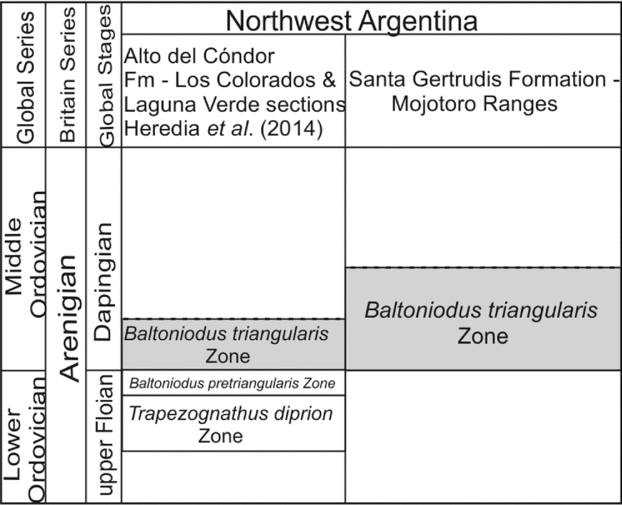
The recovered conodont association from Los Colorados is composed of Baltoniodus triangularis, Baltoniodus pretriangularis nov. sp. (Heredia, Carlorosi & Sarmiento, Reference Heredia, Carlorosi and Sarmiento2014); Erraticodon patu, Gothodus costulatus Lindström, Trapezognathus diprion (Lindström) and Trapezognathus quadrangulum, among others. This association represents the basal part of the Dapingian stage due to the presence of B. pretriangularis and T. diprion. Further, the presence of primitive characters in the Pa elements of B. triangularis and T. quadrangulum compared with those Pa elements of the same species recovered in the Santa Gertrudis Formation confirm this proposal. The conodont association recovered allows us to make an accurate correlation between different regions of northwestern Argentina (Fig. 7).
Biostratigraphic chart showing the conodont biozones, with an accurate correlation between different regions of northwestern Argentina.

The conodont diversity from the Santa Gertrudis Formation is low; there are only eight different species. Several species such as Baltoniodus triangularis, T. quadrangulum and Periodon aff. P. flabellum allow the link to Baltoscandia and China to be confirmed. Bergström & Lögfren (2009) presented a list of shared conodont species from Baltica and Huanghuanchan (China). They mentioned, among others, Baltoniodus triangularis, Microzarkodina flabellum (Lindström), Periodon flabellum, Gothodus costulatus, Drepanoistodus forceps (Lindström) and Trapezognathus diprion. On the other hand, Baltoniodus cooperi nov. sp. and Erraticodon patu indicate a strong connection to Australia.
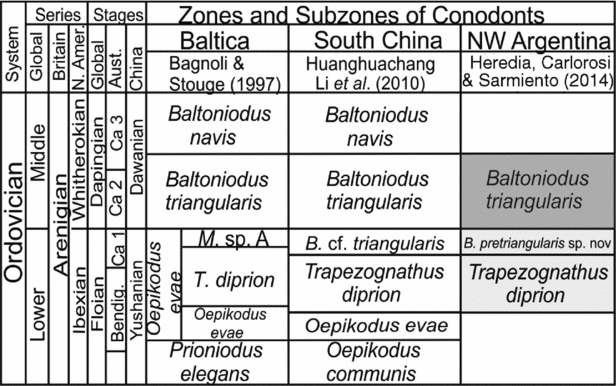
It is important to note that the finding of Periodon aff. P. flabellum is mentioned for the first time in deposits from northwestern Argentina; this species is typical from Baltoscandia and suggests an early–middle Dapingian age in agreement with the vertical distribution of B. triangularis (Bergström & Löfgren, Reference Bergström and Löfgren2009) (Fig. 8).
Lower–Middle Ordovician biostratigraphical chart comparing conodont biozones from Baltica, South China and northwestern Argentina.

7. Conclusions
The classical Argentinean Ordovician succession, the SGF, is finally interpreted in its age. The presence of the index conodont Baltoniodus triangularis indicates lower Dapingian (Middle Ordovician). We have compared morphologically the oldest forms of this species from the Alto del Cóndor Formation with those recovered from the SGF, concluding that these Pa elements suggested advanced forms as well as the Pa forms of Trapezognathus quadrangulum. The conodont composition supports the proposal of an early Dapingian age for the SGF, but not the earliest due to the presence of Periodon aff. P. flabellum. Regarding provincialism, this region could be interpreted as a transitional zone due to its strong affinities with two different faunal provinces. On one hand the presence of B. triangularis, T. quadrangulum and Periodon aff. P. flabellum supports strong affinities with Baltoscandia and South China, while the record of E. patu and B. cooperi nov. sp. links this region with the Australian faunal province.
Acknowledgements
This studied was funded by an external postdoctoral grant from the Argentine Research Council (CONICET) and completed at the Complutense University of Madrid. The authors are grateful to the National Center of Electronic Microscopy, Complutense University of Madrid, Spain and the SEM laboratory of CCT, Mendoza for the SEM microphotography.