I. INTRODUCTION
Covalent functionalization of graphene and carbon nanotubes by several routes has been reported. Reference Subrahmanyam, Ghosh, Gomathi, Govindaraj and Rao1–Reference Pramoda, Kumar and Rao6 Covalent functionalization bestows novel properties on these materials. Recently, surface-functionalized 2D transition metal dichalcogenides have emerged as potential candidates for biosensing applications due to their tunable optoelectronic characteristics. Reference Li and Wong7,Reference Kalantar-zadeh and Ou8 Covalent functionalization of nanosheets of metallic 1T-forms of MoS2 and MoSe2 has been carried out recently giving rise to major changes in the attributes of these 2D materials. Reference Vishnoi, Sampath, Waghmare and Rao9–Reference Knirsch, Berner, Nerl, Cucinotta, Gholamvand, McEvoy, Wang, Abramovic, Vecera, Halik, Sanvito, Duesberg, Nicolosi, Hauke, Hirsch, Coleman and Backes11 In the procedures used, the basal plane defects as well as the sites at the edges of the nanosheets of MoS2 get functionalized by their reaction with organic halides. In the case of MoS2 and MoSe2 nanosheets, the 1T-metallic form generated by lithium intercalation and exfoliation enables electron transfer to organic halides causing the formation of covalent C–S or C–Se bonds. In view of the success of this method of functionalization in the case of MoS2 and MoSe2, we have extended the studies to the dichalcogenides of tungsten, WS2, WSe2, and WTe2. In these studies, we have used organic halides to functionalize both metallic and insulating phases of layered tungsten chalcogenides, the latter by using the Pd(0) catalyst to facilitate the formation of the carbon–chalcogen (S, Se, and Te) bonds. The reagents used for functionalization are substituted iodobenzenes as well as pyrene and coumarin halides with fluorescing properties. The use of para-substituted benzenes has afforded a study of the effect of electron withdrawing and donating power of the benzene substituents in functionalization. Gallium chalcogenides, GaS and GaSe, which are insulators could be functionalized by the use of Pd(0) catalyst by the reaction with organic halides. The present study demonstrates that reaction of organic iodides and bromides can be used as a general method to functionalize 2D metal chalcogenides as well other chalcogenide structures.
II. EXPERIMENTAL
A. Materials
WS2 (99.8% metal basis) and WSe2 (99.9% metal basis) powder from Alfa Aesar (Ward Hill, Massachusetts) were purchased for the study. n-BuLi (1.6 M) solution in hexane was obtained from Avra Synthesis (Hyderabad, India). Iodobenzene (Spectrochem, Mumbai, India), 4-nitroiodobenzene (TCI) and 4-iodoanisole (Sigma-Aldrich, St. Louis, Missouri), 1-(bromoacetyl)pyrene (Sigma-Aldrich, Bangalore, India) and 3-acetyl-6-bromocoumarin (TCI, Tokyo, Japan) were also from commercial sources. We have used deionized water for the exfoliation of Li-intercalated WS2 and WSe2. Hexane, dried over sodium wire, was used for washing off the excess n-BuLi added in the Li-intercalation reaction of the WS2 and WSe2 reactions. WTe2 was prepared by the reaction of the elements in a sealed tube. Reference Ali, Xiong, Flynn, Tao, Gibson, Schoop, Liang, Haldolaarachchige, Hirschberger, Ong and Cava12 The GaS and GaSe prepared by the chemical vapor transport method were used for the studies. N,N-Dimethyl formamide (DMF) and 1-methyl-2-pyrrolidinone (NMP) were purchased from Spectrochem (Mumbai, India).
B. Characterization
Transmission electron microscopy (TEM) images were collected with a JEOL-3010 (JEOL, Tokyo, Japan) and a FEI-TITANTM (FEI, Eindhoven, the Netherlands) microscope. Scanning electron microscopy (SEM) images were collected with a FEI Nova NanoSEM 600 instrument (FEI, Eindhoven, the Netherlands). Energy dispersive spectroscopy (EDS) and elemental mapping analysis were carried out with an EDAX Genesis instrument (Ametek, EDAX Inc., Mahwah, New Jersey) attached to the SEM instrument. X-Ray photoelectron spectra (XPS) were recorded with an Omicron Nanotechnology spectrometer (Omicron, Limburger Strasse, Germany) using Al Kα (1486.6 eV) X-ray source. Raman spectra were recorded with a Horiba JobinYvon LabRam HR 800 Spectrometer (HORIBA France, Longjumeau, France) at ∼20 mW using an Ar laser (514.5 nm). Thermogravimetric analysis (TGA) was done using a PerkinElmer thermogravimetric analyzer (Pyris 1 TGA PerkinElmer, Shelton, Connecticut) under a continuous flow of nitrogen gas (40 mL/min) at a heating rate of 3 °C/min till 800 °C. Fourier transform-infrared (FT-IR) spectra were recorded with a Bruker IFS 66v/S spectrometer (Bruker Optics GmbH, Karlsruhe, Germany). Absorption and photoluminescence (PL) spectra were recorded with a PerkinElmer UV/VIS/NIR spectrometer (Lambda 750, PerkinElmer, Llantrisant, United Kingdom) and a PerkinElmer fluorescence spectrometer (LS 55, PerkinElmer, Llantrisant, United Kingdom), respectively. UV-visible and PL samples were placed in the quartz cuvettes of 1.0 cm path length.
For measurements of PL spectra, 0.5 mg/mL of the functionalized samples were dispersed in spectroscopy grade N-methyl-2-pyrrolidone, and the absorption spectra were obtained using a pair of quartz cuvettes with 1.0 cm path length. The PL spectra of the functionalized WS2 and WSe2 were recorded on Horiba JobinYvon spectrometer (iHR 320, HORIBA, Edison, New Jersey).
C. 1T-WS2, WSe2, and WTe2 nanosheets and their functionalization
Bulk WS2 (300 mg) and n-BuLi (3.0 mL, 1.6 M in hexane) were taken into a Schlenk flask and heated at 100 °C for 72 h under a nitrogen atmosphere. After cooling to room temperature, the black precipitate was filtered under nitrogen and washed thoroughly with dry hexane to remove excess n-BuLi. The Li-intercalated black product was transferred to a round-bottomed flask containing 300 mL of deionized and degassed cold water. The aqueous dispersion was sonicated for 1 h to facilitate exfoliation. The resulting aqueous dispersion was first centrifuged at 5000 rpm (two cycles of 10 min each) and then at 8000 rpm (two cycles of 10 min each) to remove nonexfoliated bulk material as sediments. The supernatants, containing exfoliated 1T-WS2, were collected and used for the functionalization with organic halides. The reaction of bulk WSe2 with n-BuLi was carried out at 70 °C. All other conditions were same as that for bulk WS2. The functionalization of 1T-WS2 and WSe2 was carried following the protocol described elsewhere. Reference Vishnoi, Sampath, Waghmare and Rao9
50 mg WTe2 was probe (2 h, 4 s on/off pulse) sonicated in 10 mL of dry and degassed DMF. The DMF dispersion of WTe2 was transferred to a 50 mL Schlenk flask under a nitrogen atmosphere. To this iodobenzene (116 mg), Pd(PPh3)4 (11.6 mg; 2 mol%), K2CO3 (1.4 mg; 2 mol%) were added. The mixture was then heated at 120 °C for 24 h under a nitrogen atmosphere. After cooling to room temperature, the black product was repeatedly washed with ethanol and dried in air for 6 h. The same protocol was followed for the reaction of WTe2 with 1-(bromoacetyl)pyrene.
D. Functionalization of GaS and GaSe
The experiments were conducted in dry and degassed spectroscopy grade DMF. In a vessel, 5.0 mg GaS/GaSe was probe sonicated in 10 mL DMF for 2 h by using Sonics Vibra Cell™ VCX 750Ultrasonic processor (Sonics & Materials, Inc., Newton Connecticut), operating at 40% of the amplitude with 4 s on/4 s off pulses. In a nitrogen atmosphere, various samples of 1-(bromoacetyl)pyrene (0.2 mM), Pd(PPh3)4 (0.1 mg) and K2CO3 (0.1 mg) with increasing concentrations of GaS were prepared in DMF (3 mL). The samples were bath sonicated for 2 h under a nitrogen atmosphere. The absorption spectra were recorded for these samples in a quartz cuvette of 1.0 cm path length. In a similar way, the samples of 1-(bromoacetyl)pyrene with GaSe were prepared. The samples were diluted to 0.25 µM concentration of 1-(bromoacetyl)pyrene. The PL spectra were recorded at an excitation wave length of 360 nm.
III. RESULTS & DISCUSSION
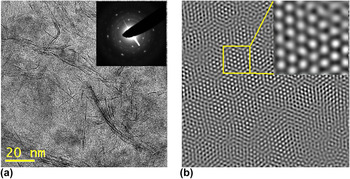
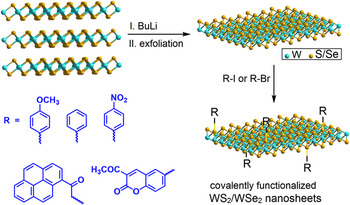
Nanosheets of the 1T-WS2 and 1T-WSe2 obtained by Li-intercalation of the bulk material followed by exfoliation in aqueous medium were examined by TEM (Fig. 1). Covalent functionalization of the 1T-WS2 and 1T-WSe2 nanosheets was achieved by reaction with various para-substituted iodobenzenes as shown in Scheme 1. To study the effects of electron-withdrawing or -donating nature of the para-substituent in the benzene ring on the functionalization reaction, we have chosen three para-substituted iodobenzenes R–C6H4–I with R = OCH3, H or NO2. Exfoliated 1T-WS2 and 1T-WSe2 possess negative charges on the sulfur or selenium atoms and it can, therefore, substitute iodide in iodobenzene through nucleophilic substitution. Reference Voiry, Goswami, Kappera, Silva Cecilia de Carvalho Castro, Kaplan, Fujita, Chen, Asefa and Chhowalla10,Reference He, Xu, Chen, Liu, Habib, Liu, Wang, Haleem, Xiang, Wu, Khalil, Fang, Niu and Song13 We obtained a black precipitate upon the addition of DMF solutions of iodobenzenes to the aqueous dispersion of the as-prepared 1T-WS2 or WSe2. The precipitate was separated and washed thoroughly with water and ethanol and dried in air. The functionalized WS2 and WSe2 sheets were characterized by Raman spectroscopy, FT-IR spectroscopy, X-ray photoelectron spectroscopy, and thermogravimetry.
TEM micrographs of 1T-WS2 (a) low-resolution image, inset: SAED and (b) high-resolution image.

Schematic presentation of covalent functionalization of 1T-WS2 and 1T-WSe2 nanosheets with organic halides.

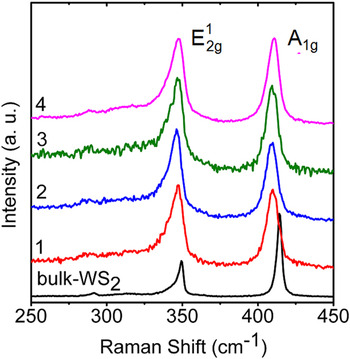
Figure 2 shows Raman spectra of the functionalized WS2 products and pristine WS2. In the Raman spectra, we observe intense bands due to the in-plane phonon mode,
 ${\rm{E}}_{{\rm{2g}}}^{\rm{1}}$
and the out-of-plane phonon mode, A1g, around 350 and 417 cm−1, respectively. The bands correspond to the 2H-phase of the functionalized compounds, indicating the transformation of 1T-phase to the 2H-phase.
Reference Vishnoi, Sampath, Waghmare and Rao9,Reference Voiry, Goswami, Kappera, Silva Cecilia de Carvalho Castro, Kaplan, Fujita, Chen, Asefa and Chhowalla10
We observe mode softening as well as broadening of both the bands to a significant extent.
Reference Voiry, Goswami, Kappera, Silva Cecilia de Carvalho Castro, Kaplan, Fujita, Chen, Asefa and Chhowalla10,Reference Knirsch, Berner, Nerl, Cucinotta, Gholamvand, McEvoy, Wang, Abramovic, Vecera, Halik, Sanvito, Duesberg, Nicolosi, Hauke, Hirsch, Coleman and Backes11
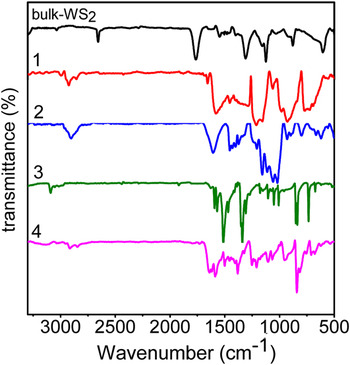
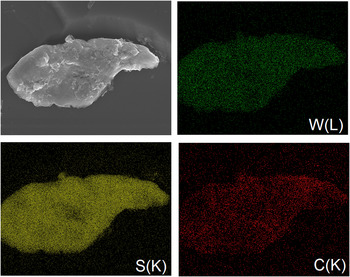
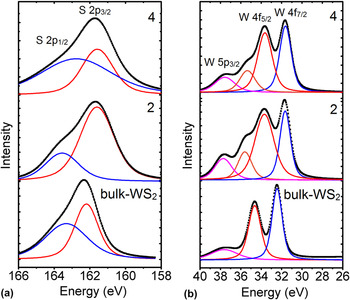
Fig. 3 shows FT-IR spectra of the functionalized and the pristine WS2 samples. The IR band due to the covalent C–S bond is clearly observed at 700, 698, and 680 cm−1 in the spectra of WS2 functionalized with para-methoxyiodobenzene (1), iodobenzene (2), and para-nitroiodobenzene, (3) respectively. The C=C stretching bands of the benzene rings lie in the range of 1600–1350 cm−1, indicating that the benzene moieties are attached to the WS2 sheets through C–S bonds. The absence of the C–S vibration band in the IR spectrum of pristine WS2 further suggests the occurrence of covalent functionalization. Elemental maps were recorded to determine the distribution of the W, S, and C elements in the sample drop-casted on a piece of aluminum foil (Figs. 4, S1 and S2). The elemental composition and the chemical environment of the W and S atoms of the functionalized samples were examined by X-ray photoelectron spectroscopy (XPS). We observe signals due to the elements present in the functionalized samples. Core level S 2p and W 4f spectra of WS2 functionalized with benzene (Fig. 5) show a prominent S 2p signal of the functionalized sample which is also broadened compared to that of the pristine WS2. We have observed similar broadening in the case of the W 4f
5/2 and W 4f
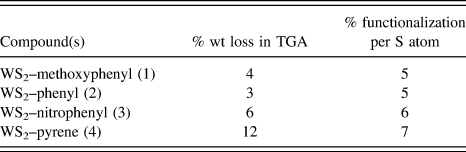
7/2 signals caused by covalent functionalization. The absence of the I 3d signal in the functionalized WS2 reveals the absence of the unreacted iodobenzene. A prominent peak of 400 eV corresponding to N 1s in the XPS of nitrobenzene functionalized WS2 has been observed. C 1s signal has been seen at ∼285 eV. The degree of functionalization has been determined by TGA by heating the samples till 800 °C in a nitrogen atmosphere (Fig. S4; Supplementary Material).
Raman spectra of WS2–methoxyphenyl (1), WS2–phenyl (2), WS2–nitrophenyl (3), and WS2–pyrene (4). The Raman spectrum of bulk WS2 is also given.

FT-IR spectra of WS2–methoxyphenyl (1), WS2–phenyl (2), WS2–nitrophenyl (3), and WS2–pyrene (4). The FT-IR spectrum of bulk WS2 is also given.

SEM-EDS elemental maps of WS2–phenyl (2).

Core-level (a) S 2p, and (b) W 4f XP spectra of WS2–phenyl (2) and WS2–pyrene (4).

The efficiency of functionalization of WS2 increases with increasing electron-withdrawing power of the para-substituent in the case of the substituted iodobenzenes. The degree of functionalization follows the trend OCH3 ∼ H < NO2. Table I summarizes the degree of functionalization determined by TGA. An electron withdrawing para-substituent such as the nitro group favors functionalization, just as in the case of MoS2. Reference Vishnoi, Sampath, Waghmare and Rao9
The degree of functionalization of WS2 nanosheets by para-substituted benzenes and pyrene.

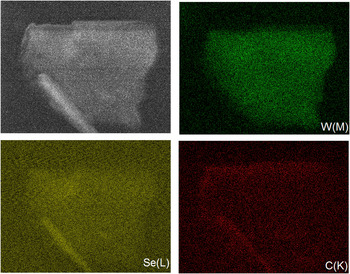
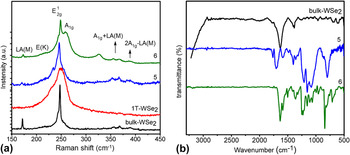
After the successful functionalization of WS2, we carried out the reaction of chemically exfoliated 1T-WSe2 with iodobenzene. 1T-WSe2 was prepared by reacting n-BuLi with bulk 2H-WSe2 followed by exfoliation in water. Figure 6 shows the elemental distribution maps of W, Se, and C in WSe2 functionalized with benzene. Figure 7(a) shows the Raman spectrum of the functionalized WSe2 functionalized with benzene sample. The Raman spectrum does not reveal the intense and sharp in-plane phonon mode
 ${\rm{E}}_{2{\rm{g}}}^1$
and the out-of-plane phonon mode A1g characteristic of 2H-WSe2 in the range of 240–260 cm−1.
Reference Ma, Liu, Zhang, Chen, Fathi, Shen, Abbas, Ge, Mecklenburg and Zhou14
Instead, we observed a weak and broad signal in this region, indicating the presence of 2H-phase in the exfoliated 1T-phase. Upon adding DMF solution of iodobenzene to the aqueous dispersion of WSe2, we obtained a black precipitate. The product was washed and characterized by TGA, FT-IR spectroscopy, Raman spectroscopy, and elemental mapping. Intense
 ${\rm{E}}_{2{\rm{g}}}^1$
and A1g bands as well other weak bands A1g + LA(M) and 2A1g + LA(M) in the 350–400 cm−1 region can be seen in the spectrum.
Reference Zhaoqiang, Tanmei, Jiandomg, Yi, Jiarui and Guowei15
This reveals the presence of the 2H-phase of WSe2 in functionalized sample. We also observed softening and broadening of the A1g band.
Reference Georgakilas4
In the FT-IR spectrum of WSe2 functionalized with a phenyl group [Fig. 7(b)], the vibrational band due to the C–Se bond is observed at 622 cm−1, suggesting that the benzene ring is attached to the Se atoms of WSe2 nanosheets. The bands due to C–C stretching of benzene rings have been observed in the range of 1630–1320 cm−1.
SEM-EDS elemental maps of WSe2–phenyl (5).

(a) Raman spectra of WSe2–phenyl (5) and WSe2–pyrene (6) (λex = 514.5 nm) and (b) FT-IR spectra of WSe2–phenyl (5) and WSe2–pyrene (6). Raman and FT-IR spectra of bulk WSe2 are also given.

The optical properties of the functionalized WS2 and WSe2 were examined (electronic absorption spectra of NMP dispersions given as Figs. S9 and S10; Supplementary Material). The UV-visible spectrum of 2H-WS2 shows bands at 633, 525, 460, and 415 nm, corresponding to the exciton bands A, B, C, and D, respectively. Reference Atkin, Daeneke, Wang, Carey, Berean, Clark, Ou, Trinchi, Cole and Kalantar-zadeh16 These bands are not observed in 1T-WS2. As expected, we do not observe these bands in the spectra of the functionalized WS2 compounds. The UV-visible spectrum of bulk WSe2 shows excitonic bands in the range of 500–900 nm which are suppressed in both 1T-WSe2 and functionalized WSe2. Reference Dong, Li, Feng, Zhang, Zhang, Chang, Fan, Zhang and Wang17
We have carried out the reaction of 1T-WS2 with the fluorescing organic dyes, 1-(bromoacetyl)pyrene and 3-acetyl-6-bromocoumarin (Scheme 1). The black precipitate of WS2 functionalized with 1-(bromoacetyl)pyrene was washed thoroughly with water, DMF, and ethanol and dried in air. The degree of functionalization of WS2-pyrene was found to be ∼12% per S atom (Table I and Fig. S4 Supplementary Material). Both the
 ${\rm{E}}_{2{\rm{g}}}^1$
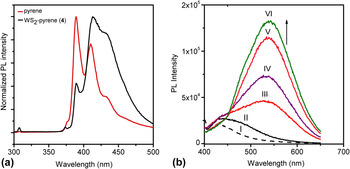
and A1g bands in the Raman spectrum of WS2–pyrene (Fig. 2) show softening as well as broadening as in the case of WS2 functionalized with benzenes. The WS2–pyrene product exhibits a PL band at 425 nm due to the pyrene group attached to the sheet [Fig. 8(a)]. The PL band of WS2–pyrene shows a red shift compared to that of the parent fluorophore. The product of the reaction of 1T-WS2 with 1-acetyl-6-bromocoumarin was analyzed by absorption spectra (Fig. S12; Supplementary Material). 1-Acetyl-6-bromocoumarin shows a PL band around 480 nm which upon addition of an aqueous dispersion of 1T-WS2 shows a red shift [Fig. 8(b)]. The PL intensity of 3-acetyl-6-bromocoumarin shows enhancement upon progressive addition of an aqueous dispersion of 1T-WS2. This observation clearly indicates increasing functionalization between WS2 and the fluorophore.
(a) PL spectra of 1-(bromoacetyl)pyrene and WS2–pyrene (6) in NMP dispersion (λex = 280 nm) and (b) PL spectra of 3-acetyl-6-bromocoumarin (II; 40 μM in NMP–water mixture; 8/2: v/v) with increasing concentration of aqueous dispersion of as prepared 1T-WS2 (I) (λex = 365 nm). The added concentrations of 1T-WS2 are 15 (III), 30 (IV), 45 (V), and 60 μM (VI), respectively.

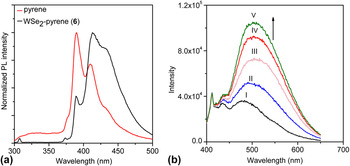
The reaction of 1T-WSe2 sheets with 1-(bromoacetyl)pyrene gave a black product which could be precipitated by the addition of diethyl ether. The WSe2–pyrene adduct exhibits a PL band at around 425 nm [Fig. 9(a)] as in the case of WS2–pyrene upon excitation at 265 nm. The reaction of 3-acetyl-6-bromocoumarin with 1T-WSe2 yielded a fluorescing product with an emission band centered at 505 nm. As it was observed in the case of WS2–coumarin, the fluorescence intensity of WSe2–coumarin enhances with the progressive addition of aqueous 1T-WSe2 dispersion [Fig. 9(b)].
(a) PL spectra of WSe2–pyrene (6) in NMP suspension (0.1 mg/mL) (λex = 280 nm) and (b) PL spectra of 3-acetyl-6-bromocoumarin (I; 40 µM in NMP–water mixture 8/2: v/v) with increasing concentration of aqueous dispersion of as prepared 1T-WSe2 (λex = 365 nm). The added concentrations of 1T-WSe2 are 0.2 (II), 0.4 (III), 0.6 (IV), and 0.8 (V) µM.

We have functionalized 2H-WTe2 with iodobenzene and 1-(bromoacetyl)pyrene in the presence of Pd(0) catalyst in dry DMF under a nitrogen atmosphere. The functionalized products are characterized by Field Emission-Scanning Electron Microscope (FE-SEM), Raman spectroscopy, FT-IR spectroscopy, and TGA. TGA indicates nearly 15–20 wt% loading of the organic functional groups (Fig. S14; Supplementary Material). The Raman spectrum of bulk WTe2 (Fig. S15; Supplementary Material) shows five distinct phonon peaks around 110, 115, 132, 162, and 210 cm−1. Reference Jana, Singh, Late, Rajamathi, Biswas, Felser, Waghmare and Rao18 These bands show marked shifts and broadening in the WTe2 functionalized with benzene and pyrene. The scanning electron microscopyenergy dispersive X-ray spectroscopy (SEM-EDS) mapping of WTe2 functionalized with benzene suggests the presence of W, Te, and C elements. This study shows that tellurides can also be functionalized by iodobenzene just as the sulfides and the selenides.
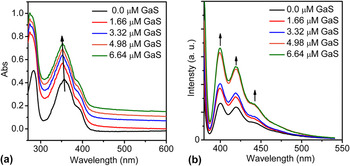
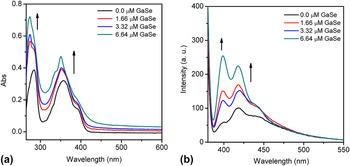
We have carried out absorption and PL spectral titration experiments of 1-(bromoacetyl)pyrene with 2D GaS in DMF to investigate the interaction of GaS with pyrene. The absorption spectra of 1-(bromoacetyl)pyrene recorded with the increasing concentration of GaS are provided in Fig. 10(a) which shows the typical pyrene absorption bands at 280, 355, and 395 nm. Upon progressive addition of the DMF dispersion of GaS, the absorbance shows a marked increase as well as a slight blue-shift of the bands with a more pronounced change in the high energy band. 1-(bromoacetyl)pyrene shows the PL characteristic of pyrene, Reference Ramakrishna Matte, Subrahmanyam, Venkata Rao, George and Rao19 the intensity of which increases markedly with increasing the concentration of GaS as shown in Fig. 10(b). We carried out the titration of the pyrene dye with 2D sheets of GaSe as well (Fig. 11). The intensities of absorption as well as PL bands increase with progressive additions of DMF dispersion of GaSe showing a definitive interaction. These results suggest that GaS and GaSe sheets are functionalized by the organic bromide reagents.
(a) UV-visible and (b) PL spectra of 1-(bromoacetyl)pyrene with increasing concentration of GaS.

(a) UV-visible and (b) PL spectra of 1-(bromoacetyl)pyrene with increasing concentration of GaSe.

IV. CONCLUSION
Reaction of 2D metal chalcogenides with organic iodides and bromides appears to provide a general method of functionalizing 2D chalcogenides, independent of whether they are metallic or insulating. Furthermore, all the three chalcogenides of tungsten are functionalized by forming C–chalcogen (S, Se, or Te) bonds. The only requirement in the case of insulating chalcogenides is the use of the Pd(0) catalyst. The present study prompts us to believe that this method can be extended to other structures of metal chalcogenides including nanoparticles and quantum dots. Preliminary studies indicate that this may indeed be possible. Our method of functionalization may be applicable for functionalizing biocompatible 2D materials with functional groups specific to bio targets.
Supplementary Material
To view supplementary material for this article, please visit https://doi.org/10.1557/jmr.2017.224.
ACKNOWLEDGMENT
S.M. and S.R. thank JNCASR for financial support and research facilities. P.V. thanks the DST Nano Mission for a postdoctoral fellowship.