INTRODUCTION
Scientific research and pedagogy have been politicized since the development of science, and economic and religious interests have influenced which branches of inquiry will be supported or repressed. Yet, science is often perceived by mass publics more through its applications to everyday life through technology than through discoveries of new knowledge. Often, religious and political interests are opposed to scientific discovery in itself, particularly if it takes a form that violates religious dogma or is costly to the state and has limited apparent practical application. From a religious view, humans may be perceived as vain, prideful, and trying to outdo God if they seek knowledge which they believe is forbidden (Stark Reference Stark1963). Many fundamentalist religious groups actively oppose scientific pedagogy in areas where science infringes on religious explanations or where science supports findings that contradict religious dogma (Ellison and Musick Reference Ellison and Musick1995; Jelen and Lockett Reference Jelen and Lockett2014; Moore Reference Moore2001; Plutzer and Berkman, Reference Plutzer and Berkman2008; Berkman, Pacheco, and Plutzer Reference Berkman, Sandell Pacheco and Plutzer2008). Studies consistently demonstrate that scientists are significantly less religious than the general public (Ecklund and Scheitel Reference Ecklund and Scheitle2007; Gross and Simmons Reference Gross and Simmons2009; Larson and Witham Reference Larson and Witham1998; Lemert Reference Lemert1979; Leuba Reference Leuba1921), and sectarian Protestants and people holding fundamentalist beliefs in the Bible are substantially more opposed to scientific pedagogy, less trustful of science, and less informed about science (Ellison and Musick Reference Ellison and Musick1995; Deckman Reference Deckman2002; Reference Deckman2004; Sherkat Reference Sherkat2011).
Political movements are also often concerned about the propriety of scientific inquiry, and the social and economic implications and consequences of scientific applications in technology. Pro-industry political movements tend to amplify the benefits of applying science to new technologies across many realms, from medicine and drugs, to hydraulic fracturing, nuclear power, military technology, or genetically modified food products. In contrast, many liberal political movements have tended to support the regulation of the use of science to develop technologies which might harm the environment, generate negative economic externalities for others, waste public resources, or enable the mass killing of humans. Recently, Gauchat (Reference Gauchat2012) argued that the politicization of science has largely been restricted to church-going political conservatives, who have increasingly viewed science in a negative light. However, Gauchat (Reference Gauchat2012) does not explore several potentially important political and religious factors on confidence in science; particularly, the potential impact of Republican Party identification, sectarian Protestant identification, and fundamentalist versus secular beliefs about the Bible.
In this article, I analyze General Social Survey (GSS) data from 1974–2012 to examine trends in the predictors of confidence in science as a social institution. I estimate a series of ordinal logistic regression models across each of the four decades of the GSS, and compare these estimates using heterogeneous choice models (Mood Reference Mood2010; Williams Reference Williams2009). Next, I estimate multiple-group ordinal structural equation models to examine how the connections between religion, politics, and confidence and science have shifted over the four decades. These analyses show that the relationship between religious and political attachments and confidence in science is complicated over time, and that the redefining of political conservatism in terms of religious causes and Christian fundamentalism is partly responsible for growing hostility towards science among political conservatives and Republicans.
RELIGION, SCIENCE, AND POLITICS AS INTERSECTING SOCIAL FIELDS
Religion, science, and politics are abstractions used to encapsulate social institutions with definitive characteristics, yet which are also connected to one another in the broader social field. Following Bourdieu (Reference Bourdieu1991a; Reference Bourdieu1991b; Reference Bourdieu1993), we can think of social fields as being constituted by cultural capital that rewards dominant actors within a relatively autonomous arena of cultural production, and interested actors in these fields contest over the resources constituting the actual and symbolic aspects of cultural capital. Cultural capital can be both virtual and actual (Sewell Reference Sewell1992), consisting of rules, ideas, and understandings, as well as buildings, laboratories, endowments, and offices. Within any field there is considerable competition over control of cultural capital and the artifacts it produces and reproduces, and as in all competitions there are winners — established scientific organizations, dominant religious groups, and major political parties — and losers — pseudoscientific movements, heretical sects, and fringe political movements.
Bourdieu (Reference Bourdieu1991a, 7, emphasis in the original) argued that there are two types of capital in the scientific field, “First is the capital of strictly scientific authority, which rests upon the recognition granted by the peer competitors for the competency attested to by specific successes…Second, there is the capital of social authority in matters of science, partly independent of the strictly scientific authority (more so as the field is less autonomous) which rests upon delegation from an institution, most often the educational system.” Cultural capital in the scientific field defines “the boundary between authentic knowledge and false science, between true and false problems, true and false objects of science, legitimate methods or solutions and those that are absurd….(Bourdieu Reference Bourdieu1991a, 8).”
In the case of science, religion, and politics as intersecting cultural fields, competition for the capital of social authority within each field is often orthogonal to capital for social authority in the other fields. Powerful actors in the religious field transpose their understandings of religious narratives to impugn scientific motives, ends, and findings. And, of course, the social authority of a scientist or scientific organization can be called into question if individuals or organizations grant social authority to religious narratives or institutions (Coyne Reference Coyne2012; Reference Coyne2015). Similarly, religious social authority may be discounted in the political field, and ordained religious officials and people with formal religious training are generally considered ill-suited for political office, and the political power of religious groups is often viewed with suspicion by those who hold sway over the political field. Political actors rightly fear that religious authority could stifle economic and political innovation, as has been shown using both US data on patents and cross-national data on beliefs about innovation (Bénabou, Ticchi, and Vindigni Reference Bénabou, Ticchi and Vindigni2015a; Reference Bénabou, Ticchi and Vindigni2015b). Indeed, the mix of political authority with religious authority can also denigrate cultural capital in the religious field; religious leaders may profane their religious authority by playing politics. And, scholars have persuasively argued that the politicization of religion reduces religious capital by spurring defection (Hout and Fischer Reference Hout and Fischer2002; Reference Hout and Fischer2014; Sherkat Reference Sherkat2014). Finally, political social authority is viewed with distrust in the scientific field, as institutions and individuals with strong political commitments and connections are deemed a corrupting influence that can undermine scientific authority (Wang Reference Wang1999; Jamieson Reference Jamieson2014).
CONTEXTUALIZING CONFIDENCE IN SCIENCE IN THE UNITED STATES
Public opinion about science is an assessment of interpretations regarding scientific cultural capital. Most people are not scientists, and they sit on the sidelines of the scientific field. Most Americans interact with the scientific field only through basic pedagogy, which for most comes in primary or secondary education, or as part of required coursework in post-secondary education. Beyond the educational setting, most Americans are only informed about scientific advances by the general media, and as a consequence, Americans lag behind other developed nations in their level of scientific literacy (Baldi et al. Reference Baldi, Jin, Skemer, Green, Herget and Xie2008; Bybee Reference Bybee2008; Bybee, McCrae, and Laurie Reference Bybee, McCrae and Laurie2009; Cromley Reference Cromley2009). Given the public's minimal connections to the scientific field, schemata from other cultural fields will have a considerable influence on Americans' confidence in the field of science. How Americans view science will be influenced heavily by their perceptions of their experiences with scientific pedagogy, and by when and how science intersects with public issues like education, public policy, government funding of science, and scientific technology applied to public concerns like energy, environmental safety, medicine, and the military (Pion and Lipsey Reference Pion and Lipsey1981)
The “space race” mixed science into the geopolitical conflict of the Cold War, feeding the intrusion of politics into science that began with the development of superweapons like the atomic bomb and the application of nuclear power for ships and submarines (Wang Reference Wang1999; McLauchlan and Hooks Reference McLauchlan and Hooks1995). In the late 1960s and early 1970s, the United States put enormous resources into the science and technologies of space travel and exploration, all of these efforts were expressly political, funded by the state, and directly or indirectly connected to potential military applications for satellite surveillance and the perfection of long range nuclear missiles (Hooks and McLauchlan Reference Hooks and McLauchlan1992; McLauchlan and Hooks Reference McLauchlan and Hooks1995).
The equation of science with the cold war space race and with militarism suggests that particular types of political cultural capital will have confidence in these applications of science, while other types of political capital will be critical of science. Particularly, we should expect that during the Cold War political conservatives and Republicans should be quite favorable toward science — since science was being used to push back communism and provide lucrative technical advances that spilled over into the domestic economy (particularly the rise of computers). Indeed, even religious conservatives may warm to a scientific field that kept them safe from godless communism. And, the negative environmental potential for scientific and nuclear technologies is often deemphasized in sectarian and fundamentalist religious communities, who often view environmentalism as “earth worship” and believe, like Reagan Interior secretary James Watt, that God will fix environmental damage (Sherkat and Ellison Reference Sherkat and Ellison2007).
In contrast, liberals saw scientific militarism as a scourge that promoted a bloated military industrial complex and threatened the very existence of the planet. Indeed, even within the scientific community the dangers of the nexus of the military and space complex were acknowledged, and there was considerable conflict over hitching scientific authority to the goals and aims of the military industrial complex (Wang Reference Wang1999). Catastrophic events like the nuclear disasters at Three Mile Island (1979) and Chernobyl (1983), as well as the Challenger space shuttle disaster (1986) also shook many Americans’ confidence in science (McLauchlan and Hooks Reference McLauchlan and Hooks1995), perhaps especially for those on the left who were already skeptical about the propriety of nuclear energy or the value of a militaristic space program. Outside of the scientific community, liberal criticism of science was all the rage by the mid-1990s with the ascendance of post-modernist critiques of science. Yet, postmodernism's strident rejection of science began to backfire in the late 1990s, and liberal backlash against postmodernist overreach was further fueled by scientific advances in AIDS and HIV research, as well as the growing importance of scientific research for exposing environmental problems like climate change. Liberal scientists began to push back against anti-scientific orientations on the left, and post-modernist critiques of science became something of a joke (Sokal Reference Sokal2008; Sokal and Bricmont Reference Sokal and Bricmont1998).
The fall of the Soviet Empire and the conversion of China to a mixed capitalist economy also meant the equation of science with militarism began to decline in the early 1990s. The space program became increasingly international, particularly with cooperation between Russia and the United States to operate the International Space Station (which became operational in 1998), the culmination of cooperation that began with the joint US-Soviet Apollo-Soyuz project in 1975. It was increasingly apparent that the main goal of the space program was no longer for military purposes, and that satellite technologies spurred by the space program were enabling myriad applications for non-military purposes. The rise of modern computing, cell phone technologies, and the development of successful treatments for HIV and other devastating illnesses transformed what science meant in the eyes of the mass public.
While the end of the Cold War gave political liberals a reason to have increased confidence in science, the march of progress in fields like evolutionary biology and theoretical physics clashed with the fundamentalist religious beliefs held by sectarian Protestants. Conservative Christians’ longstanding concerns about secularized scientific pedagogy led to a flourishing of fundamentalist schools, a vibrant home schooling movement, and in many areas where conservative Christians dominate public school teachers also reflect the antiscientific views of their communities (Berkman and Plutzer Reference Berkman and Plutzer2010; Reference Berkman and Plutzer2011; Deckman Reference Deckman2002; Reference Deckman2004; Kunzman Reference Kunzman2009; Peshkin Reference Alan1986; Plutzer and Berkman Reference Plutzer and Berkman2008; Rose Reference Rose Susan1988; Sikkink Reference Sikkink1999). Alongside these developments, prominent scientists with considerable scientific and social authority within the scientific field began to directly confront religiously-inspired antiscientific movements, starting perhaps with evolutionary biologist Richard Dawkins’ (Reference Dawkins1986) detailed criticism of intelligent design. Within the field of science, there was increasingly no room for the social authority of religion, and in the 2000s many scientists began to openly combat the intrusion of religion into the scientific field (Coyne Reference Coyne2012; Reference Coyne2015; Dawkins Reference Dawkins2006; Dennett Reference Dennett2006; Harris Reference Harris2004; Stenger Reference Stenger2010).
Beginning in the late 1970s, sectarian and fundamentalist religious individuals and institutions began to militate politically for a host of concerns, including the reintroduction of religious doctrines in education and science. The considerable overlaps between religious and political social fields made conservative religion a powerful ally for conservative political movements and regimes. Indeed, religiously inspired social conservatism came to redefine what it meant to be conservative, and starting in the 1980s Americans increasingly identified conservatism with positions on social issues like sexuality, abortion, opposition to evolution, and support for school prayer (Miller and Hoffmann Reference Miller and Hoffmann1999). This was a considerable departure from earlier periods when conservatism was defined more in terms of libertarian stances on social issues, and laissez faire economic policies. Indeed, over the course of the last four decades, this has also affected political party alignments, as sectarian Christians and fundamentalists increasingly came to identify with the Republican Party, while social liberals left the Republicans (McDaniel and Ellison Reference McDaniel and Ellison2008; Sherkat Reference Sherkat2014).
The 1990s also saw the development of a scientific consensus that was equally threatening to secular and religious conservatives — the overwhelming evidence that humans were causing climate change primarily through the use of fossil fuels. For economic conservatives, including most Republicans, this was seen as a radical environmentalist agenda concocted by politicized scientists who were opposed to the free market. For religious conservatives, this was more evidence that scientific materialism trumped the revelations of their Gods and promoted earth-worship. Indeed, Richard Cizik, a senior director of the National Association of Evangelicals, was sharply criticized after suggesting that Christians should be worried about climate change and active in seeking its mitigation (Banks Reference Banks2007). Both variants of conservatives were emboldened by liberal Southern Baptist and Democratic Vice President Al Gore's (Reference Gore1992) book Earth in the Balance: Ecology and the Human Spirit and subsequent documentary (2006) presenting the seriousness of the problem of climate change and environmental damage.
By 2000, fundamentalist Christian orientations and sectarian Protestant religious identifications had become closely connected to political conservatism and Republican Party identification. Indeed, the anti-scientific orientations of Republican Party members became so intense that journalists wrote of a “Republican war on science” (Mooney Reference Mooney2006). Yet, journalistic accounts failed to discern whether religious factors were largely responsible for the anti-scientific drift in the Republican Party. Indeed, this is suggested by recent statements from Congressman Paul Broun, a Republican from Georgia, who was the highest ranking member of the U.S. House Science Committee, saying “God's word is true. I've come to understand that. All that stuff I was taught about evolution and embryology and the big bang theory, all that is lies straight from the pit of Hell…You see, there are a lot of scientific data that I've found out as a scientist that actually show that this is really a young Earth. I don't believe that the earth's but about 9,000 years old. I believe it was created in six days as we know them. That's what the Bible says” (http://www.theguardian.com/world/video/2012/oct/07/republican-congressman-dismisses-evolution-video). Similarly, Oklahoma Republican Senator James Inhofe (Reference Inhofe2012) amplifies that his denial of global warming is based on his fundamentalist Christian beliefs in his book The Greatest Hoax: How the Global Warming Conspiracy Threatens Your Future. While many Republicans opposed to climate science may base their antipathy on economic interests in conflict with the scientific consensus, the politicization of science by Republicans is also strongly rooted in Christian fundamentalism which is institutionally concentrated in sectarian Protestant denominations.
The changing historical context over the last four decades brings with it several expectations regarding how religion and politics will influence Americans’ views about science, and how political and religious fields intersect differently across historical periods. First, in the 1970s and 1980s, the association between science and militarism should make political conservatives less opposed to science, and political liberals more circumspect in their confidence in science. The threat of Godless communism also should quell some of the opposition to science among sectarian Protestants and fundamentalists, but those with no religious identification and mainline Protestants may view science as potentially leading to global destruction during the 1970s and 1980s. Further, since the Republican Party strongly supported scientific militarism, Republicans should be quite bullish on science until the growth of scientific environmentalism in the 1990s and 2000s. What should also be evident in the analyses is that the indirect effects of religious and political factors will shift over the four decades — sectarian Protestantism and fundamentalist beliefs should become more strongly associated with political conservatism, and with Republican identification.
DATA AND MEASURES
Data from the General Social Survey (GSS) from 1974–2012 were analyzed to examine Americans confidence in science. I estimate models across decades (1970s, 1980s, 1990s, and 2000s), and also examine separate models for the periods where indicators of biblical fundamentalism are available (1980s, 1990s, and 2000s). Notably, my focus on decades differs somewhat from the analytic strategy employed by Gauchat (Reference Gauchat2012), who examined periods based on the presidential terms (post-Reagan, and W. Bush), and interacted these periods with political factors, and political factors with year of the study. Instead, I divide the analyses into periods, and examine how political and religious factors have varying impacts in the decades. Notably, while some of these results mirror those of Gauchat (Reference Gauchat2012), there are important differences.
DEPENDENT VARIABLE: CONFIDENCE IN SCIENCE
Since 1974, the GSS asked respondents, “I am going to name some institutions in this country. As far as the people running these institutions are concerned, would you say you have (1) a great deal of confidence, (2) only some confidence, or (3) hardly any confidence at all in them [the Scientific Community]?” While Gauchat (Reference Gauchat2012) dichotomized this variable on “a great deal of confidence,” I reverse code and analyze this as an ordinal item.
Political Factors
I examine two political items, (1) liberal-conservative ideological identification, and (2) party identification. Political ideological identification is an ordinal item running from (1) extremely liberal to (7) extremely conservative. Because Republican Party identification has been singled out as antithetical to science in the journalistic literature (Mooney Reference Mooney2006), I use a dummy indicator for Republican identification.
Religious Factors
Three key religious factors are examined, religious identification, beliefs about the Bible, and religious participation. Following Sherkat (Reference Sherkat2011), religious identifications are grouped into (1) Mainline Protestants; (2) Sectarian Protestants; (3) Catholics; (4) Non-Christians; and (5) No religious identification. Beliefs about the Bible are analyzed across three groups, (a) “The Bible is the actual word of God and should be taken literally, word for word;” (b) “The Bible is the inspired word of God, but not everything in it should be taken literally;” and (c) “The Bible is an ancient book of fables, legends, history, and moral precepts recorded by men.” Dummy indicators for fundamentalism (word of God) and secular beliefs (fables) are used in the ordinal logistic regression analyses, while the structural equation models use a binary indicator for biblical inerrancy.
CONTROL VARIABLES
Multivariate models are estimated using controls for age, gender (female = 1), race (African American compared to all others), education (in years), family income, southern residence, and rural residence.
Figure 1 presents the trend in confidence in science across the four decades and by some key religious and political indicators. Notably, overall levels of confidence in science are remarkably stable across the decades, declining only slightly from 44% in the 1970s to 42% in the 2000s. In contrast, several of the religious and political indicators show volatility over time. Sectarian Protestants and fundamentalists are the least confident in science, and their confidence declines after the 1980s— decreasing from 36% to about 30% in the 2000s. In contrast, confidence in science is high among people who reject religious identification, and it increases substantially from 47% in the 1990s to 52% in the 2000s. Secular beliefs about the Bible are associated with the highest levels of confidence in science in all three decades where that measure is available. However, confidence in science among those who hold secular beliefs diminishes from 54% in the 1980s to 50% in the 1990s, before rebounding to 55% in the 2000s. This seems in concert with historical context of the liberal “science wars” of the 1990s.
Religious and political factors and confidence in science.

Republicans are quite positive about science, and around 49% expressed confidence in science in the 1970s and 1980s, though this drops to 45% in the 1990s. Indeed, only in the 2000s do we see Republicans having the same level of confidence as other respondents. Respondents who identify as extremely conservative are only slightly less optimistic about science than the average respondent in the 1970s, but confidence wanes to 37% in the 1980s and falls to about 31% in the 1990s and 2000s. In contrast, respondents who were extremely liberal in their ideological identification were quite confident in science in the 1970s and 1980s, at nearly 49%. By the 1990s, extremely liberal respondents had less enthusiasm (45%) and it continued to wane to 42% in the 2000s — bringing them even with the average respondent.
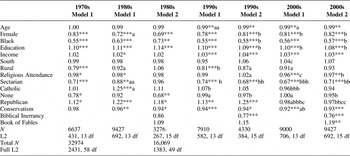
Multivariate models are needed to sort out the relative impact of political and religious factors, and to see if these may be accounted for by other demographic controls such as ethnicity, gender, and educational attainment. In order to compare the relative impact of these factors across decades, Table 1 presents a heterogeneous ordinal logistic regression model predicting confidence in science across four decades in Model 1. Because the GSS did not tap beliefs about the Bible in the 1970s, Model 2 of Table 1 examines models from the 1980s,1990s, and 2000s.
Exponentiated heterogeneous ordinal logistic regression estimates for confidence in science across decades

*p < 0.05, two tailed. **p < 0.01, two tailed. ***p < 0.001, two tailed.
“a” difference from 1970s p < 0.05, “aa” difference from 1970s p < 0.01 two-tailed, “aaa” difference from 1970s p < 0.001, two-tailed.
“b” difference from 1980s p < 0.05 two-tailed, “bb” difference from 1980s p < 0.01 two-tailed, “bbb” difference from 1980s p < 0.001, two-tailed.
“c” difference from 1990s p < 0.05 two-tailed, “cc” difference from 1990s p < 0.01 two-tailed, “ccc” difference from 1990s p < 0.001, two-tailed.
In the 1970s, conservative ideological identification has no significant impact on confidence in science net of other factors, and Republican political identification has a significant positive impact on the odds of having greater confidence in science. In the 1980s, the net impact of political conservatism becomes more negative and significant, and this continues into the 1990s and 2000s. Indeed, the net impact of ideological conservatism on confidence in science is significantly more negative in the 2000s than in the 1970s or 1980s. It should be remembered that what I am calling “conservatism” is an ordinal measure, and these results could just as well be interpreted as a positive impact of liberal ideological identification on confidence in science.
In the Reagan era 1980s, Republican confidence increases (though not significantly), and being a Republican increases the odds of greater confidence in science by 22% after controlling for other factors. Republican confidence drops relative to non-Republicans in the 1990s, but Republicans remain significantly more confident in science than other Americans in the 1990s. In the 2000s, the estimates show no significant difference between Republicans and other respondents, which is a significant change in the effect of party identification compared to all previous decades, and particularly the Reagan era 1980s.
Sectarian religious identification significantly and substantially decreases confidence in science in every decade when judged against the mostly mainline Protestant comparison category. In line with expectations, sectarian Protestant pessimism about science improves somewhat in the Reagan era, when the effect of being a sectarian is significantly less negative than in the other three decades. In the 1990s, sectarian confidence in science declines relative to mainline Protestants, and this decline continues in the 2000s (though the effect of sectarian identification is not significantly different across the 1970s, 1990s, and 2000s).
Catholics also chart an interesting nonlinear pattern of confidence across the decades. Net of other factors, Catholics are not significantly different from mainline Protestants in the 1970s; however, in the 1980s Catholics are significantly more confident in science than mainliners, and this is a significant change in the effect. After the 1990s, with the increasing salience of scientific atheism, and the rise of controversies over stem-cell research, Catholic confidence waned substantially and they were not significantly different from mainline Protestants.
Respondents who reject religious identification are significantly more skeptical of science in the 1970s, in line with expectations. Having no religious identification reduces the odds of higher confidence in science by 22% relative to mainline Protestants — making them roughly as skeptical as sectarian Protestants. In the 1980s and 1990s, non-identifiers are not significantly different from mainline Protestants, and in the 1990s and 2000s the relative effect of rejecting identification is significantly less negative than it was in the 1970s.
Religious attendance significantly decreases the odds of greater confidence in science in the 1970s, 1980s, and 2000s. However, in the 1990s church attendance does not significantly decrease trust in science. Indeed, it appears that the increasing hostility between religion and science in the 2000s makes church attendance significantly more important for lowering trust in science, in line with Gauchat's (Reference Gauchat2012) findings.
In Table 1, many of the control variables have substantial effects on confidence in science. Over time, age has come to have a significant negative impact on confidence in science, and it appears that the “science wars” along with the contemporary political debates about climate change may be undermining the confidence of older Americans. Women are significantly less confident in science than men in all four decades net of other factors, and the Reagan “star wars” era which also saw several technological disasters was a significant low point in women's confidence in science. African Americans also have significantly lower levels of confidence than other Americans net of other factors. Educational attainment significantly increases trust in science in all four decades. Americans from rural areas were less confidence in science in the 1970s, but were not significantly different from other Americans in the Reagan era — a significant improvement in trust. Rural distrust of science was again evident in the 1990s; however, in the 2000s, rural residents were no different from other Americans. It is possible that the findings of climate science are more salient to people who live in rural areas.
Model 2 in Table 1 presents estimates of the effects of covariates on the odds of having greater trust in science in the three decades for which there are indicators of beliefs in the Bible. Even after controls for beliefs about the Bible and other factors, conservative ideological identification has a strong negative estimated effect on the odds of having greater trust in science, and the estimates are quite close to what was found in Model 1. However, controls for Bible beliefs eliminate the significance of the difference in the 2000 effect compared to its effect in the 1980s and 1990s. Hence, it appears that the reason why “conservatism” was substantially more negative in 2000 is because conservatism has increasingly become associated with religious beliefs. As in Model 1, the estimates from Model 2 show that Republicans are significantly more trusting of science than others in the 1980s and 1990s. But, Republicans are no more trusting in the 2000s — a significant shift. The decreased enthusiasm about science among Republicans does not appear to be simply a function of fundamentalist Christians drifting to the Republican Party.
Controls for beliefs about the Bible eliminate the significance of the difference between sectarian and mainline Protestants found in the 1980s, and Bible beliefs also explain the significance of the effect of religious participation found in Model 1. Indeed, in the Reagan era, with its promise of nuclear energy and the defeat of godless communism through military science there were only limited negative effects of religious factors — though non-identifiers are significantly more negative than mainline Protestants. Shifting the comparison category to biblical inerrancy shows that believing the Bible is a book of fables significantly increases the odds of greater trust in science by 27% in the 1980s.
In the 1990s and 2000s, Model 2 shows that religious factors become more important for predicting confidence in science, and sectarian Protestants are significantly more negative than mainline Protestants even after controls for Bible beliefs and other factors. Non-identifiers hold roughly the same levels of confidence as mainline Protestants in the 1990s and 2000s, which is a significant increase in trust compared to mainline Protestants in the 1980s. Bible beliefs become more salient for predicting trust in science in the 1990s and 2000s, and fundamentalists are found to be significantly less confident in science in the 1990s compared to respondents who believe the Bible contains some human error. Net of other factors, people holding secular beliefs in the Bible are substantially more trusting of science than fundamentalists in the 1990s. Indeed, in the 2000s the odds of trust are significantly higher for respondents with secular beliefs compared to those who believe the Bible was inspired by God. Notably, in the 2000s church attendance lowers the odds of trust in science, which is a significant departure from its effect in the 1990s.
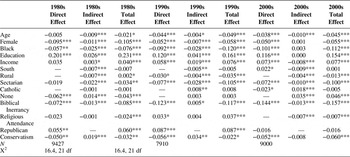
Examining the impact of political and religious factors on confidence in science over times is informative, however the single equation models presented in Table 1 cannot disentangle the relationships among these overlapping cultural fields. Table 2 presents direct, indirect, and total standardized effect estimates on confidence in science from a multi-group structural equation model (Hayduk Reference Hayduk1988). Table 2 explores these relationships estimated from a five-equation model specifying that religious beliefs influence religious participation, political identification, and party alignment. Religious participation is predicted to influence political identification and party identification, and political identification predicts Republican Party alignment. Again, since Bible beliefs are only measured since 1980, the models are estimated across the three decades.
Multi-group ordinal structural equation model of confidence in science: standardized direct, indirect, and total effects

*p < 0.05, two tailed. **p < 0.01, two tailed. ***p < 0.001, two tailed.
The estimates from the structural equation models echo the findings presented in Table 1, and Table 2 shows that net of other relationships, the total effect of political conservatism on trust in science grows more negative because of decreasing confidence in science among Republicans. In the 1980s and 1990s, the negative direct effect of political conservatism was offset somewhat by a significant positive indirect effect created by Republican confidence in science. However, in the 2000s, Republicans were not significantly different from other Americans, and the indirect effect for political conservatism becomes negative and insignificant.
The estimates in Table 3 also show the growing importance of biblical fundamentalism for undermining confidence in science. Indeed, the negative direct effect of biblical fundamentalism on confidence in science doubles between 1980 and 2000. Interestingly, in the 1990s, a positive estimated direct effect for church attendance on confidence in science yields a small but significant positive indirect effect for biblical inerrancy, though the total effect is more negative in the 1990s than in the 1980s. Net of other relationships, in the 1980s the direct effect of sectarian Protestant identification is not significantly different from mainline Protestantism; however, biblical fundamentalism generates significant negative indirect and total effects for sectarian identification. In the Reagan era, people who hold no religious identification were significantly less trusting of science in the direct effects, though this is offset by a significant positive indirect effect on confidence in science (the sources of which will be explored further in Table 3). In the 1990s, sectarian Protestants become more negative in both direct effects and indirect effects, while non-identifiers are no different from mainline Protestants after the close of the Reagan era and the end of the Cold War. Religious attendance has a significant negative total estimated effect on confidence in science in the 1980s, but a positive direct and total effect in the 1990s. Net of other factors, there is a very small negative indirect and total effect of church attendance on trust in science in the 2000s.
Standardized direct effects of selected covariates on political and religious factors across decades

*p < 0.05, two tailed. **p < 0.01, two tailed. ***p < 0.001, two tailed.
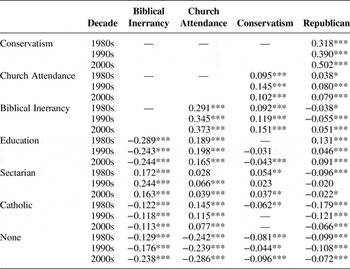
Table 3 presents the direct effects of political and religious factors on each other from the model estimated in Table 2, and these estimates show how interrelationships among political and religious cultural fields shifted across the three decades. For brevity, only estimates for political and religious factors are presented, though all covariates presented in Table 2 were included in the models yielding these estimates. First, the relationship between political ideological identification and Republican Party identification became stronger between the 1980s and 2000s, as liberals and moderates became less likely to identify as Republican while conservatives became more likely to claim Republican identification. Religious factors also become more predictive of Republican identification, with church attendance becoming more positively predictive and biblical fundamentalism shifting from having a negative significant effect on Republican identification in the 2000s. Sectarian Protestants also became more similar to mainline Protestants in their party identification, which is remarkable since mainline Protestants are the traditional base of the Republican Party. Catholics also show an increasing affinity for the Republican Party over the three decades, though they remain significantly less Republican than Mainline Protestants in the 2000s. Those who reject religious identification are significantly less likely to be Republicans compared to mainline Protestants, though this difference appears to have decreased slightly in the 2000s. Some of these denominational differences are probably a function of mainline Protestants gradually abandoning the Republican Party in the 2000s.
Political conservatism is increasingly wedded to fundamentalist religious beliefs, and biblical inerrancy became more predictive of conservative ideological identification across the three decades. This finding conforms with research showing that political conservatism and liberalism are increasingly interpreted through the lens of social issues strongly associated with religion — such as abortion, LGBT rights, and women's equality (Miller and Hoffmann Reference Miller and Hoffmann1999). In contrast, Table 3 shows that church attendance is somewhat more closely associated with conservatism in the 1990s than in the 1980s or 2000s, though in all decades there is a significant positive effect of church attendance on conservative ideological identification. Sectarian Protestants are significantly more conservative than mainline Protestants in the 1980s and 2000s, but net of other factors there is no difference in the 1990s. Catholics are substantially more liberal than mainline Protestants in the 1980s, but they do not differ significantly in the 1990s and 2000s and that coefficient was constrained to 0. Respondents with no religious identification are estimated to be significantly more liberal in their political ideological identification than mainline Protestants in all decades, though the difference was less substantial in the 1990s than in the 1980s and 2000s. Notably, the 1990s was a period where the threat of the religious right appeared to have declined (Bruce Reference Bruce1988; Green et al. Reference Green, Guth, Schmidt and Kellstedt1996), and this may have made religious non-identifiers less averse to a more conservative ideological identification.
Fundamentalism is a prime motivator of church attendance, and is rooted in commitments to sectarian Protestant denominations, where the fundamentalist embrace of biblical inerrancy is substantially and significantly higher than other religious groups. Catholics and respondents with no religious identification are significantly less attracted to fundamentalism when compared to mainline Protestants. As other research has shown (Hout and Greeley Reference Hout and Greeley1987; Sherkat Reference Sherkat2014), Catholic religious participation has waned compared to other groups over time, though they remain significantly more active in the 2000s when compared to mainline Protestants, and more than match the participatory levels of sectarian Protestants.
DISCUSSION AND CONCLUSIONS
Science is a cultural institution that most people interact with fleetingly, usually mediated by other cultural institutions like education and journalism, or through the distant applications of science to technology and medicine. Because most of the public are disconnected from science, public opinion about science is heavily influenced by other cultural institutions that provide perspectives for evaluating scientific authority. The cultural fields of politics and religion intersect with the field of science and both of these cultural institutions provide overlapping lenses through which the public views science. Political and religious filters are products of political and religious resources, and these are sustained and interpreted through schemata that are transposable across all three cultural fields. The dynamics of public opinion are channeled by the intersection of historical events with the cultural fields, and historical factors change how institutions like science are viewed depending on one's position in the political and religious field.
In the United States, political institutions are strongly linked to science because public resources are used to fund scientific endeavors and pedagogy, and political actors expect that these investments will pay off by fueling a strong economy, protecting the public health from natural and environmental hazards, and yielding fearsome military technologies. The political field is highly contested in the United States, with two major parties controlling most of the political resources. Generally, the Republican Party is a conservative party, and people who embrace conservative understandings tend to identify Republican. However, the meaning of conservatism and liberalism shifts over the course of the last four decades (Miller and Hoffmann Reference Miller and Hoffmann1999). Previous examinations of confidence in science focus on liberal to conservative ideological identification in the political field, while ignoring connections to organized political parties. This has led to a misunderstanding of the historical relationship between party identification, political ideology, and confidence in science. There is no support for the idea that there is a “Republican war on science.” Instead, self-identified Republicans were more confident in science than other Americans in three of the four decades observed, and no different in the latest decade. Given that American's views of science were heavily influenced by the space program, nuclear energy and weapons, medical advances, and industry-friendly technologies, it is not surprising that people who identify with the pro-business, anti-communist/pro-military Republican Party expressed more confidence in science. Still, Republican exuberance about science declined significantly in the 21st century, as scientific research became more associated with liberal causes than pro-business initiatives.
This research has also shown that political ideological identification was unrelated to confidence in science in the 1970s, and that conservative opposition to science and liberal support for science grew across the four decades. On the conservative side of the coin, this research suggests that the meaning of conservatism shifted over the decades to become more focused on social issues like gender, sexuality, and patriarchal family values — driven increasingly by religious conservatism emanating from sectarian Protestantism and fundamentalist Christian beliefs. For liberals, anti-scientific orientations lingering from the cold war era eroded as science and scientists came to be seen as allies combating AIDS/HIV, climate change, and environmental degradation. Science was no longer seen as a tool of the military industrial complex.
Sectarian Protestant opposition to modern science has been longstanding in the United States, rooted in the conflict between scientific discoveries in biology and theoretical physics and fundamentalist Christian interpretations of the origins of life and the universe (Lienesch Reference Lienesch2007; Berkman and Plutzer Reference Berkman and Plutzer2010). This research has shown that religious participation is less important for influencing skepticism about science than is identification with sectarian Protestant denominations and embracing fundamentalist beliefs about the Bible. Indeed, this research has shown that sectarian Protestants and those with fundamentalist beliefs about the Bible are increasingly drawn to the Republican Party, which explains some of the decline in Republican confidence. Fundamentalism is also increasingly linked to more conservative political ideological identifications. The United States is becoming more secular, and an increasing fraction of the population reject religious identification and hold secular beliefs about the Bible (Sherkat Reference Sherkat2014), and these secular individuals have distinctive perspectives on science. While the “nones” were more skeptical about science in the 1970s when compared to mainline Protestants, the end of the Cold War saw them embrace confidence in science. Indeed, the anti-scientific orientation linked to religion may well have been a factor that pushed people to reject religious identification.
The political mobilization of sectarian Protestants and fundamentalist Christians has increasingly impacted political support for science and scientific pedagogy. Pushback from scientists against religious opposition has become increasingly direct, evidenced not only by the new atheist movement, but also the growing popularity of secular figures like Neil DeGrasse Tyson and Bill Nye. Social scientific research shows that concerns about scientific pedagogy and scientific innovation are well-founded. At the individual level, fundamentalist beliefs and sectarian religious identifications have been shown to diminish educational attainment, hinder verbal ability, reduce scientific literacy, and decrease earnings and wealth (Darnell and Sherkat Reference Darnell and Sherkat1997; Fitzgerald and Glass Reference Fitzgerald and Glass2008; Keister Reference Keister2003; Reference Keister2008; Keister and Sherkat Reference Keister and Sherkat2014; Sherkat Reference Sherkat2010; Reference Sherkat2011; Reference Sherkat2014). At a more macro-level, these religious commitments have also been shown to decrease economic innovation both cross nationally, and across regions in the United States (Bénabou, Ticchi, and Vindigni Reference Bénabou, Ticchi and Vindigni2015a; Reference Bénabou, Ticchi and Vindigni2015b). It is likely that the political mobilization of sectarian and fundamentalist religious groups is hindering not only scientific education in the United States, but is also having a negative impact on scientific progress.