INTRODUCTION
The historic isolation of many Pacific island marine communities generally provides these with greater protection from direct anthropogenic impacts compared to coastal communities. However, many of these island ecosystems such as Johnston and Wake Atolls, and Howland and Baker Islands were drastically altered during World War II due to military construction work (Maragos et al., Reference Maragos, Friedlander, Godwin, Musburger, Tsuda, Flint, Pantos, Ayotte, Sala, Sandin, McTee, Siciliano, Obura, Riegl and Dodge2008a). Both the alteration of habitats and the inadvertent and intentional transport of terrestrial and marine non-indigenous propagules began the transition of these habitats away from their pristine state.
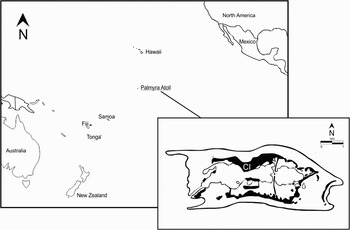
Palmyra Atoll (Figure 1) in the US Line Islands is part of the Pacific Remote Island Areas (PRIAs) Marine National Monument created in 2008 and is administered by the US Fish and Wildlife Service of the US Department of Interior. The reefs surrounding Palmyra are richly diverse with high coral biodiversity (Williams et al., Reference Williams, Maragos and Davy2008) and large numbers of apex predators, providing one of the last remaining baselines for a ‘near pristine’ reef system (Sandin et al., Reference Sandin, Smith, DeMartini, Dinsdale, Donner, Friedlander, Konotchick, Malay, Maragos, Obura, Pantos, Paulay, Richie, Rohwer, Schroeder, Walsh, Jackson, Knowlton and Sala2008b). This atoll is a suitable site for studying historical alteration as it was developed into a military installation in the early 1940s, with upwards of 6000 servicemen stationed there during World War II (Dawson, Reference Dawson1959). Prior to development by the military, Palmyra was an undisturbed atoll with numerous small islets forming a perimeter around three distinct lagoons (Dawson, Reference Dawson1959). The military drastically altered the atoll by using dredged material from the lagoon to build up the islets, and create airstrips and connecting causeways. The causeways formed a perimeter road around the lagoons bisecting the eastern and central sections, essentially creating a fourth lagoon at the west end of the atoll and drastically altering the circulation patterns within the interior of the atoll (Dawson, Reference Dawson1959; Maragos, Reference Maragos1993; Maragos et al., Reference Maragos, Friedlander, Godwin, Musburger, Tsuda, Flint, Pantos, Ayotte, Sala, Sandin, McTee, Siciliano, Obura, Riegl and Dodge2008a, Reference Maragos, Miller, Gove, DeMartini, Friedlander, Godwin, Musburger, Timmers, Tsuda, Vroom, Flint, Lundblad, Weiss, Ayotte, Sala, Sandin, McTee, Wass, Siciliano, Brainard, Obura, Ferguson, Mundy, Riegl and Dodgeb; Collen et al., Reference Collen, Garton and Gardner2009). In addition, a navigation channel was excavated in the south-western end of the atoll to allow ships to enter the lagoon (Dawson, Reference Dawson1959). Therefore, the recent history of Palmyra Atoll is one of severe habitat alteration and potential exposure to terrestrial and marine non-indigenous species through anthropogenic transport mechanisms.
Location of Palmyra Atoll within the Central Pacific Ocean. CI, Cooper Island.

Dredging characteristically reduces habitat complexity and availability (Auster, Reference Auster1998; Auster & Langton, Reference Auster and Langton1998) heavily impacting the macrobenthos (Rosenberg, Reference Rosenberg1977; Wassenberg et al., Reference Wassenberg, Dews and Cook2002), changing species composition, diversity and richness (Jones, Reference Jones1992; Wassenberg et al., Reference Wassenberg, Dews and Cook2002; Hiddink et al., Reference Hiddink, Jennings, Kaiser, Queiros, Duplisea and Piet2006). The dredging across the lagoons may initially have left non-indigenous species unchallenged due to the removal of the native biota as well as inadvertently creating conditions more suitable for introduced species over the recipient biota (Vitousek et al., Reference Vitousek, Dantonio, Loope, Rejmanek and Westbrooks1997).
The terrestrial non-indigenous species at Palmyra have been documented extensively (Dawson, Reference Dawson1959; Flint, Reference Flint1992), but no non-indigenous marine species, which may threaten the reefs, have yet been described. Here we present details of the recently reported non-indigenous species at Palmyra Atoll. To date, one macroalgae species and four marine invertebrates have been documented as non-indigenous to this remote atoll and include a red alga, two sponges, a hydroid and a bryozoan.
MATERIALS AND METHODS
Initial surveys for marine non-indigenous species began in 2002 through to 2009 under the auspices of inventory and monitoring activities conducted at Palmyra Atoll by the US Department of Commerce, National Oceanic and Atmospheric Administration (NOAA), Pacific Islands Fisheries Science Center and Coral Reef Ecosystem Division (CRED) (Godwin, Reference Godwin2002). These surveys examined both natural coral reef habitat and altered habitats in the lagoon including sea walls, docks and dredge spoil areas. Additional surveys began in 2008 by researchers from Victoria University of Wellington, New Zealand and the Scripps Institution of Oceanography associated with the Palmyra Atoll Research Consortium (PARC).
Surveys
The surveys for non-indigenous species at Palmyra Atoll were conducted by three institutes with independent objectives and therefore different, but appropriate, sampling methods were used for each.
ALGAE
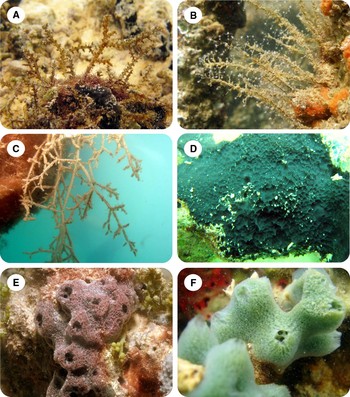
An initial qualitative survey of Acanthophora spicifera (Børgesen, Reference Børgesen1910) (see Figure 2) was conducted at a number of sites in 2002 and again in 2008 (as part of a lagoon restoration experiment). Regular annual quantitative monitoring takes place using 10 × 1 m2 quadrats along each of 2 × 25 m transect lines. Photographs of the benthos are taken and species abundance and composition are determined using image analysis software Photogrid© v1.0 (Bird, Reference Bird2003). During 2008 a number of sites spanning from the western to eastern lagoons at 1–5 m depth were also surveyed.
Photographs of identified non-indigenous species at Palmyra Atoll. (A) Acanthophora spicifera; (B) Pennaria disticha; (C) Zoobotryon verticillatum; (D) Gelliodes fibrosa; (E) Haliclona (Sigmadocia) caerulea purple morph; (F) Haliclona (Sigmadocia) caerulea blue morph.

NON-SPONGE INVERTEBRATES
The CRED surveys were conducted using two 25 × 2 m belt transects at each site. Suspected non-indigenous species were sampled and preserved for later taxonomic analysis.
SPONGES
Surveys for the non-indigenous sponges were conducted in 2008 across all four lagoons at twelve sites using 10 × 1 m2 quadrats subdivided into 20 cm2 squares at depths of 6–8 m. Within each square, per species, we counted numbers of individuals, estimated the percentage area cover of both sponges and hard substratum and adjusted all data to the percentage of available substrate.
RESULTS AND DISCUSSION
Acanthophora spicifera
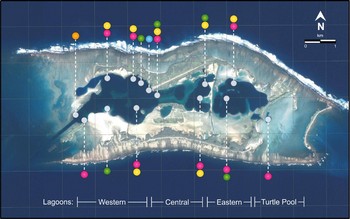
The red alga Acanthophora spicifera is currently the only known non-indigenous seaweed species present in the waters surrounding Palmyra Atoll. During surveys conducted in 2002, A. spicifera was not found around the atoll despite sampling a large number of sites including both lagoon and reef habitats (Godwin, Reference Godwin2002). However, in 2008 specimens of the alga were found conspicuously attached to several of the mooring buoys anchored in the western lagoon near Cooper Island (see Figure 1), the current location of the field station. After this initial discovery, qualitative surveys were conducted around the lagoon and samples were found at the locations shown in Figure 3. Acanthophora spicifera is native to the western and south Pacific, the Indian Ocean and the Caribbean, but is a known invader in the Hawaiian Islands (Guiry & Guiry, Reference Guiry and Guiry2010).
Locations of non-indigenous species found across the lagoons at Palmyra Atoll.  Acanthophora spicifera;
 Pennaria disticha;
 Zoobotryon verticillatum;
 Haliclona (Sigmadocia) caerulea; and
 Gelliodes fibrosa.

Acanthophora spicifera was originally introduced to the Hawaiian Islands in the 1950s via hull fouling on a barge that was brought from Guam to Oahu (Doty, Reference Doty1961; Russell, Reference Russell1992). This species has now spread throughout all of the main Hawaiian Islands and has most likely been transported via hull fouling of small vessels (Smith et al., Reference Smith, Hunter and Smith2002). Privately owned yachts are allowed entrance to Palmyra's lagoons for short periods of time with special permission and permitting through the USFWS. Therefore, it is likely that A. spicifera was transported on the hull of a yacht or small vessel from Hawaii to Palmyra sometime between 2002 and 2008. It likely first established on a mooring near Cooper Island and either through sexual reproduction or asexual fragmentation spread throughout much of the shallow water habitats (>1 m, <10 m) in the lagoon. While A. spicifera is a red alga its coloration can be highly variable ranging from purple to brown and even yellow. The alga attaches to the substrate with a single holdfast and the upright portion of the thallus has an alternate branching pattern. All of the main branches are covered with short thick spines that radiate sporadically off of the algal thallus. On Palmyra this alga is primarily found on limestone flats or rubble zones spanning in depth from 1–5 m. There are currently no data indicating the ecological impacts (if any) of this algal invader on the already highly degraded lagoon ecosystem of Palmyra, but observational evidence suggests that numerous green sea turtles found on the atoll are consuming it (E. Sterling, personal communications). Specimens of fertile female plants were collected in July 2010 suggesting that A. spicifera is now reproducing sexually, which may help facilitate its spread around the atoll. To date this alga has not been found on the outer reef habitats, but future survey efforts should pay special attention to this and other algal invaders as they have the potential to alter the coral and coralline algal dominated fore reef and reef terrace habitats (Sandin et al., Reference Sandin, Smith, DeMartini, Dinsdale, Donner, Friedlander, Konotchick, Malay, Maragos, Obura, Paulay, Richie, Rohwer, Schroeder, Walsh, Jackson, Knowlton and Sala2008a). Documentation of the spread and ecology of A. spicifera around Palmyra Atoll could be very useful for understanding the invasion ecology of this species in other locations. Finally, if any management or control strategy is going to be developed for A. spicifera on Palmyra a targeted monitoring programme should be established.
Pennaria disticha (hydroid) and Zoobotryon verticillatum (bryozoan)
The hydroid Pennaria disticha (Goldfuss, Reference Goldfuss1820) and the bryozoan Zoobotryon verticillatum (Della Chiaje, 1822) (see Figure 2) are the two recorded non-sponge invertebrate introductions to Palmyra Atoll.
Pennaria disticha, also known as the Christmas tree hydroid, is native to the western Atlantic and has now established within the western lagoon of Palmyra (see Figure 3). This species has become cosmopolitan in tropical and warm temperate seas and is a common sessile organism in harbours, natural lagoons and embayments. It has also been documented at remote coral reef habitats in the Hawaiian Archipelago (Godwin, Reference Godwin2006). Pennaria disticha has been observed to be an aggressive competitor for space in both man-made and natural habitats in the Hawaiian Archipelago (Godwin, personal observation). This behaviour has proved to be unpredictable with this species and could be associated with variations in environmental factors, which has been shown to be the case for hydroids in other locations (Boero, Reference Boero1984).
Zoobotryon verticillatum is a stoloniferous bryozoan forming translucent colonies on hard substrates in bays and harbours. The colonies can form streaming masses and tangled mats that have been confused with macroalgae (Coleman, Reference Coleman1999). This species is found in many tropical and warm temperate waters around the world and has an uncertain home range (Carlton & Eldredge, Reference Carlton and Eldredge2009). Zoobotryon verticillatum is considered high risk by management agencies in the United States based on documented economic and ecological impacts (Nagy, Reference Nagy2006; Williams, Reference Williams2007). Its presence was first recorded at Palmyra Atoll in 2008, at which time it was forming large bushy aggregations at a long-term monitoring site established by CRED in 2002 within the main navigation channel (see Figure 3). These concentrated aggregations have the potential to overgrow coral communities if they spread to fore reef locations and create habitat changes in the shallow subtidal areas of the lagoon. Pederson & Peterson (Reference Pederson and Peterson2002) showed that stoloniferous bryozoans create an ephemeral habitat in shallow subtidal zones that can cause shifts in species assemblages.
The distributions of P. disticha and Z. verticillatum can be attributed to their ability to foul boat hulls, which is well-documented in remote tropical ecosystems, such as the Hawaiian Archipelago (Godwin, Reference Godwin2003; Godwin et al., Reference Godwin, Eldredge and Gaut2004) and the Azores (Amat & Tempera, Reference Amat and Tempera2009). Palmyra Atoll receives maritime vessel traffic in the form of commercial re-supply vessels from Hawaii and sporadic visits from sailing yachts that have frequented ports in the tropical Pacific. Therefore, identifying the source populations for P. disticha and Z. verticillatum found at Palmyra Atoll would be difficult.
Haliclona (Sigmadocia) caerulea and Gelliodes fibrosa
The two non-indigenous sponge species in the lagoons at Palmyra Atoll (see Figure 3), are the Demosponges Haliclona (Sigmadocia) caerulea (Hechtel, Reference Hechtel1965), and Gelliodes fibrosa (Wilson, Reference Wilson1925) (see Figure 2) from the order Haplosclerida. Both species are found around the main Hawaiian Islands (De Felice et al., Reference De Felice, Eldredge, Carlton, Eldredge and Smith2001; Coles et al., Reference Coles, Kandel, Reath, Longenecker and Eldredge2006) usually in shallow water embayments, harbours and disturbed habitats, all with restricted water flow (De Felice et al., Reference De Felice, Eldredge, Carlton, Eldredge and Smith2001).
Haliclona caerulea (family Chalinidae), commonly known as the ‘Blue Caribbean sponge’ originates from the Caribbean Sea where it is found on rocks, dock pilings and mangrove roots (Hechtel, Reference Hechtel1965; Cubit & Williams, Reference Cubit and Williams1983; Wulff, Reference Wulff1997; De Weerdt, Reference De Weerdt2000). Haliclona caerulea is pale blue with a beige interior and is soft and easy to tear. Interestingly, the majority of individuals at Palmyra are found in association with the red branching coralline alga Jania adherens. The alga rarely protrudes from the sponge tissue and provides skeletal structuring and rigidity (Carballo & Avila, Reference Carballo and Avila2004). This mutualistic relationship also exists in individuals from the Pacific Coast of Panama (Wulff, Reference Wulff1997) and Mexico (Carballo & Avila, Reference Carballo and Avila2004), and changes the colour of the sponge from its characteristic pale blue to purple, making the sponge brittle, but still easy to tear. The purple forms retain some blue tissue, normally at the base of the sponge aiding in the identification of this species. Haliclona caerulea develops into thickly encrusting or massive forms approximately 40 cm in diameter and 2–15 cm in height. The oscules (0.5–1.5 cm diameter) are on top of thickly walled irregular volcano-like protrusions (1–5 cm in height). The megascleres are bent oxeas (170–230 µm), and the microscleres are C-shaped sigmas (25 µm) (De Felice et al., Reference De Felice, Eldredge, Carlton, Eldredge and Smith2001). The sigmas are common throughout the blue tissue, but less common in the purple forms (Hechtel, Reference Hechtel1965).
Gelliodes fibrosa is characterized by its dark grey, blue/black appearance, and tissue, which is fibrous, hard to tear, and if repeatedly squeezed turns beige. It forms thick encrusting mats or branches with a smooth to conulose surface and regular extruding fibres. The oscules, usually found on the flatter encrusting individuals, indent before forming the opening. The megascleres are curved oxeas (160–180 µm) and the microscleres are sigmas (15 µm). Gelliodes fibrosa was originally described from the Philippines and was introduced to Hawaii in the 1990s and has now also been documented in Guam (De Felice et al., Reference De Felice, Eldredge, Carlton, Eldredge and Smith2001).
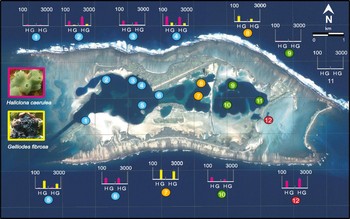
Spatial distribution patterns of H. caerulea indicate higher densities at sites across the northern edge of the western lagoon, the centre of the eastern lagoon and the eastern edge of Turtle Pool (see Figure 4). Gelliodes fibrosa was primarily located on the southern edge of the western lagoon, and the central lagoon. The abundance of both species was lower in the eastern lagoon, but interestingly H. caerulea also had high abundance in the far east of Turtle Pool. The reduction in sponge densities from the west to east lagoons may relate to the reproductive strategies of the sponges. Sponges can either fragment over short distances and/or produce larvae. The larvae are predominantly anchiplanic, remaining in the water column for only minutes to days, thus having limited dispersal capability (Maldonado, Reference Maldonado2006). Increased densities of H. caerulea in the far eastern Turtle Pool suggests that sponge distribution patterns across Palmyra may not be limited by dispersal capabilities, but also influenced by environmental conditions across the lagoons.
Sponge densities (right hand side of graph), and area cover (cm2) (left hand side of graph) of Haliclona (Sigmadocia) caerulea (H)  and Gelliodes fibrosa (G)
 10 × 1 m2 quadrats at each of the 12 sites across the Western
 (1–6), Central
 (7–8), Eastern
 (9–11) and Turtle Pool
 (12) lagoons at Palmyra Atoll.

It is most likely that H. caerulea and G. fibrosa were introduced to Palmyra from Hawaii, via fouling on ships and yachts (Godwin, Reference Godwin2003) or other structures (e.g. barges), as Hawaii has always been the predominant shipping connection to Palmyra (Dawson, Reference Dawson1959). Neither De Laubenfels (Reference De Laubenfels1950) or Bergquist (Reference Bergquist1967) recorded either species during their respective sponge surveys in Hawaii, therefore they are considered to be recent introductions.
The ecological impacts of H. caerulea and G. fibrosa at Palmyra are currently unknown; however, potential impacts include spatial competition with native fauna and a possible threat to corals (De Felice et al., Reference De Felice, Eldredge, Carlton, Eldredge and Smith2001). Sponges are also highly efficient suspension feeders, pumping up to 24,000 l of water a day (kg−1 of sponge) (Vogel, Reference Vogel1977) and removing carbon resources, such as plankton, as well as oxygen and nitrogen from the water column (Reiswig, Reference Reiswig1971, Reference Reiswig1974). The vast quantity of water sponges pump each day means that in high densities they can significantly impact surrounding pelagic ecosystems (Bell, Reference Bell2008), even potentially controlling phytoplankton levels (Peterson et al., Reference Peterson, Chester, Jochem and Fourqurean2006).
CONCLUSIONS
The modifications to the lagoons at Palmyra during World War II have likely created an environment with reduced water quality and lower circulation now better suited to fouling communities. The presence of these non-indigenous species at such a remote atoll is most likely attributable to man-made transport mechanisms in the form of vessels arriving from harbours and coastal areas such as Hawaii where all five species are also listed as non-indigenous. Future monitoring to assess the invasive potential of all the non-indigenous species established at Palmyra is important to ensure their impacts on the lagoon and adjacent reefs are limited and not progressive.
ACKNOWLEDGEMENTS
We are greatly indebted to the staff of The Nature Conservancy (TNC), the United States Fish and Wildlife service (USFWS) and the institutes involved in the Palmyra Atoll Research Consortium (PARC) for providing access to the refuge and logistical support, without which this work would not have been possible. Thanks need also to be given to National Oceanic and Atmospheric Administration (NOAA), Pacific Islands Fisheries Science Center–Coral Reef Ecosystem Division, NOAA RV ‘Oscar Elton Sette’ and NOAA RV ‘Hiialakai’. We are also very grateful to Air New Zealand, the Centre for Marine Environmental and Economic Research (CMEER), the Centre for Biodiversity and Restoration Ecology (CBRE), Victoria University of Wellington and Scott and Karin Wilson for generously providing funding. This work was conducted under the USFWS special use permits: 12533-08004, 12521-02009, 12521-08005 and 12533-08015.