Introduction
This paper is an attempt to explain the frequently observed inconsistent or paradoxical combination, among the less educated members of society, of a leftist position with regard to equality and redistribution, and a rightist position with regard to authoritarianism, ethnocentrism and other democratic citizenship values. First, we very briefly summarize the literature with regard to the emergence of the two left/right dimensions, and specify the way in which we conceive of and measure the so-called ‘new’ dimension. Then we propose an explanation for the apparent inconsistency of the position of the less educated, and submit it to an empirical test.
Emergence or re-emergence of a new alignment
From the late 1960s onwards many authors diagnosed the decline of class-based voting (Goldthorpe et al., Reference Goldthorpe, Lockwood, Bechhofer and Platt1969; Gallie, Reference Gallie1978; Inglehart, Reference Inglehart1984; Dalton, Reference Dalton1988; Minkenberg and Inglehart, Reference Minkenberg and Inglehart1989; Minkenberg, Reference Minkenberg1992). Some saw this as part of a more encompassing destructuration of the ‘old politics’ (Gibbins, Reference Gibbins1989: 18; Reimer, Reference Reimer1989: 123; Hellemans, Reference Hellemans1990: 271).Footnote 1 Others diagnosed the emergence of a new alignment (Evans and Heath, Reference Evans and Heath1995; Elchardus, Reference Elchardus1996; Evans et al., Reference Evans, Heath and Lalljee1996; Stubager, Reference Stubager2008, Reference Stubager2009) distinct from the ‘old’ left/right or socio-economic one that was centered around issues of equality, allocation, and the role of the stateFootnote 2. Stubager (Reference Stubager2008, Reference Stubager2009) distinguishes two core elements of the new alignment: the extent to which people are attached to social hierarchy (a dimension strongly related to authoritarianism) and the extent to which they tolerate non-conformity. Authoritarianism, which has often been taken as a proxy measure of the new alignment, has been shown to be strongly related to a great number of attitudes that can also influence electoral behavior: such as ethical conservatism (Middendorp, Reference Middendorp1978, Reference Middendorp1979; Stenner, Reference Stenner2005: Ch. 6; De Koster and Van der Waal, Reference De Koster and Van der Waal2007), a preference for punitive criminal justice (Stack, Reference Stack2003; Benjamin, Reference Benjamin2006), feelings of insecurity (Stenner, Reference Stenner2005), skepticism with regard to the welfare state (Derks, Reference Derks2004; Jaeger, Reference Jaeger2006), populism (Derks, Reference Derks2006), nationalism (Arwine and Mayer, Reference Arwine and Mayer2008), and ethnocentrism (Scheepers et al., Reference Scheepers, Billiet and De Witte1995).Footnote 3
That clustering of strongly related attitudes is important because the concept of an alignment suggests that various attitudes, interests, and conceptions cluster into an ideology or a world view. This is implicitly recognized by authors who label the new dimension as a libertarian vs. authoritarian attitude, but operationalize it on the basis of items that refer to a broader range of attitudes including ethnocentrism, a tough stand on law and order, the degree of tolerance of public protest (see, for instance, Evans and Heath, Reference Evans and Heath1995; Stubager, Reference Stubager2008, Reference Stubager2009). Another argument in favor of identifying a meaningful cluster of attitudes is the observation that the new right wing parties did not appeal to a single issue (ethnocentrism), but to a cluster of issues (Hainsworth, Reference Hainsworth1992).
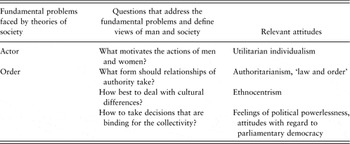
The challenge in identifying the new alignment consists in uncovering a stable configuration of attitudes and ways of thinking that can be considered as expressing (in a rudimentary form) a worldview. The search for such an alignment was undertaken along two tracks (Elchardus, Reference Elchardus1994a, Reference Elchardusb, Reference Elchardus1996; Elchardus and Pelleriaux, Reference Elchardus and Pelleriaux1998). First, inductively, by looking at the issues the ‘new’ parties of the 1980s and 1990s – the greens and the extreme right – put on the political agenda (that search relied heavily on, among others, Minkenberg and Inglehart, Reference Minkenberg and Inglehart1989; Schmitt, Reference Schmitt1989; Ignazi and Ysmal, Reference Ignazi and Ysmal1992; Minkenberg, Reference Minkenberg1992). That led to a selection of the attitudes that were relevant to determine positions on issues such as growing diversity, the fear of crime, the call for law and order, the critique of putatively corrupt politics, the environment, the alleged loss of values and norms…. A second, deductive, selection criterion was derived from the theoretical logic of sociological theories as described by Alexander (Reference Alexander1982: 64–126).Footnote 4 The starting point is Alexander's thesis that every sociological theory, and by implication, any cognitively coherent view of man and society, has to solve two problems: the actor problem and the order problem. The first concerns the view of what motivates human action, the second turns around the explanations of order. Using this scheme, a number of the attitudes that were identified as typical for the electorates of the new parties can be viewed as answers to the fundamental questions raised by those problems. These were used as the attitudes that composed the new alignment.
Table 1 describes how the attitudes are related to the problems of actor and order and to the questions addressing those problems. In order to be able to speak of a new alignment, those attitudes should be strongly interrelated. That is indeed the case, both in samples of the adult population (Elchardus, Reference Elchardus1996; Elchardus and Pelleriaux, Reference Elchardus and Pelleriaux1998) and in samples of young people (Elchardus et al., Reference Elchardus1999; Pelleriaux, Reference Pelleriaux2001). Derks’ (Reference Derks2006) finding that the different attitudes remain interrelated after controlling for the influence of socio-economic conditions, suggests that their interrelations are partly cognitive and emotional.
Attitudes salient for the new political dimension and the problems of action and order

Qualitative research has moreover shown that respondents do combine different attitudes into a coherent narrative structure (Elchardus et al., Reference Elchardus, Glorieux, Derks and Pelleriaux1996) that shows marked similarities with the ways of thinking about man and society that inspired fascist ideology. It shows affinities with social Darwinism and, more generally, with what Sorokin (Reference Sorokin1928: 309–356) has described as the sociological versions of the idea of the struggle for existence. Central to those ways of thinking is the idea that life is a struggle, oriented by the pursuit of self-interest. In applications of that idea, the struggle often pits ‘us’ against ‘them’, for instance, our own people against foreigners. That struggle should, according to this discourse, not be tempered by (pampering) social security provisions, precisely because it is good (militarily, economically, and/or genetically) that the strongest should win. Us and them, locked in conflict, are often, but not always, defined in terms of a racial, cultural, or national identity.
The name ‘new’ alignment does not do justice to the long pedigree of these ideas. We are rather confronted with the reemergence of a way of thinking and speaking that belongs to the tradition of the Counter-Enlightenment and has been a stable part of modern European political culture since the 18th century (Sternhell, Reference Sternhell2006). It is precisely this cultural continuity that increases the likelihood such an alignment of conceptions will stabilize, determine people's view of man and society, and eventually give rise to a full-blown stable cleavage. In order to avoid tedious repetition we shall also refer to the old dimension or alignment as egalitarianism and to the new one as the conflict discourse.
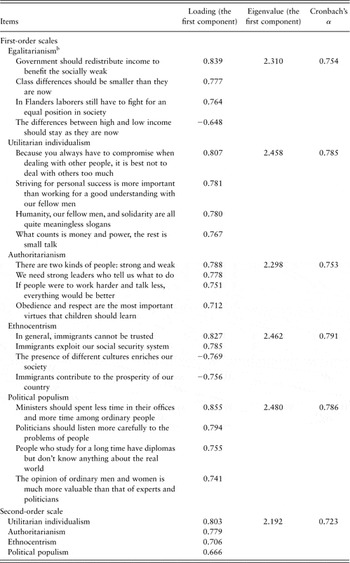
The two dimensions are operationalized in a way similar to Evans and Heath (Reference Evans and Heath1995) and Stubager (Reference Stubager2008, Reference Stubager2009) and in line with our theoretical arguments, using Likert items that could be rated on a 5-point scale. The old dimension is measured as a principal component based on four items (see Table 2). The new alignment is a meta-scale based on 16 items grouped into four scales of fout itels each. The four separate scales are estimated on the basis of principal component analysis. The new alignment is estimated as a second-order scale based on those four scales. In the analyses we use factor scores for both dimensions. Higher scores on the old alignment indicate a rightist position, rejecting state intervention to promote equality. Higher scores on the new dimension reflect a leaning towards authoritarianism, utilitarian individualism (social Darwinism), ethnocentrism, and populism.
Technical details of the attitude scales measuring egalitarianism and the conflict discourse in Flanders (principal component analysis; N = 2148)Footnote a

a Missing value imputation was applied for respondents who had a valid answer on the majority of items of a scale.
b In order to be theoretically consistent (see text) we prefer higher values on this scale to reflect an economic ‘rightist’ position. Therefore, we rescaled this variable by multiplying it by −1.
The existence of a double left/right dimension is now defended and empirically illustrated by many researchers (Middendorp, Reference Middendorp1978, Reference Middendorp1979; Flanagan, Reference Flanagan1979, Reference Flanagan1987; Fleishman, Reference Fleishman1988; Topf, Reference Topf1989: 70; Grunberg and Schweisguth, Reference Grunberg and Schweisguth1990; Elchardus, Reference Elchardus1994a; Kriesi, Reference Kriesi1998; Kriesi et al., Reference Kriesi, Grande, Lachat, Dolezal, Bornschier and Frey2008; Treier and Hillygus, Reference Treier and Hillygus2009). The analysis of elections in Flanders between 1991 and 2003 clearly illustrate the relevance of the two dimensions, and the observations are in line with findings on other countries (see online Appendix). In the four elections considered, the green party (Agalev) and the extreme right wing party (Vlaams Blok, now Vlaams Belang) occupy the extreme and opposite positions on the new dimension.Footnote 5 These two electorates can however hardly be distinguished from each other in terms of the old, socio-economic dimension. On the latter the extreme positions are, predictably, occupied by the voters of the (pro-free-market) liberal party on the one hand and the electorate of the socialist party on the other. These electorates in turn hardly differ with regard to the new dimension.
Left/right dimensions, old and new
Research has repeatedly shown that the correlation between the two dimensions is complex and varies with the level of education (Bishop, Reference Bishop1976; Carmines and Stimson, Reference Carmines and Stimson1982; Evans and Heath, Reference Evans and Heath1995; Elchardus and Pelleriaux, Reference Elchardus and Pelleriaux1998; Achterberg and Houtman, Reference Achterberg and Houtman2009). The less educated appear to take an inconsistent position, combining a desire for more equality and redistribution with support for social Darwinism, intolerance, and authoritarianism. No such seemingly contradictory position is observed among the more highly educated.
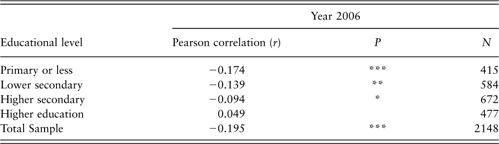
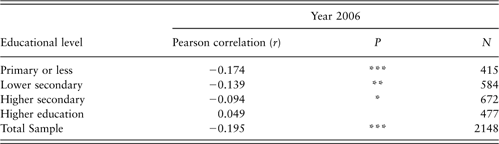
In the data used in this analysis, using a purely random sample of 4487 inhabitants of Belgium, aged 19–81 years, the same phenomenon is observed. The data used were gathered in 2006 by way of a mail questionnaire sent out to 9300 people. The response rate was 48.3% (technical details are provided in Elchardus and Smits (2006)). In order to work with a homogeneous native sample, the analyses pertain only to Dutch-speaking respondents who had Belgian nationality at birth, whose father or mother was not of foreign origin and who were not Muslim. This was the case for 2479 respondents. When four levels of education are distinguished, the correlation increases from −0.17 for the lowest level to −0.14 and −0.09 for the next two levels, and to +0.05 for people who pursued higher education (see Table 3). This counterintuitive finding has been explained in three different ways.
Bivariate relationship between egalitarianismFootnote a and the conflict discourse according to the level of education in Flanders (N = 2148)
a In order to be theoretically consistent (see text) we prefer higher values on this scale to reflect an economic ‘rightist’ position. Therefore, we rescaled this variable by multiplying it by −1.
***P < 0.001; **P < 0.010; *P < 0.050.
Note: Test interaction between education and old alignment on new alignment (generalized linear model); P-value was 0.000.
Acquiescence
The first explanation proposes that the relationship between the old and the new alignment is different for less and more educated people, because the former react differently to likert-type questions in surveys. They are supposed to be more prone to ‘acquiescense’ – a tendency to agree with attitudinal questions even when they hold opposite attitudes (Marsh, Reference Marsh1996). The effects are particularly disturbing when using unbalanced attitude scales, composed of items that are all formulated in the same direction (Krosnick, Reference Krosnick1999). For this type of scale a position in favor of the items cannot be distinguished from acquiescence. In balanced scales the effect does not disappear but its impact is lessened. Evans and Heath (Reference Evans and Heath1995) compared the performance of different balanced and unbalanced Likert scales of the old and new alignment, and found that the difference in correlation by educational levels almost disappeared when using balanced scales. This would imply that there is in fact not much inconsistency and that the paradox is in large part due to a methodological problem.
That conclusion is not entirely convincing. First, we compared the performance of balanced and unbalanced scales for the data used to test our final models. We re-estimated the correlations with more limited but perfectly balanced scales: an egalitarianism scale that contained only two opposite-worded items and an ethnocentrism scale that contained four opposite-worded items. Furthermore, we used summations scales instead of factor scales. In that situation acquiescence, if relevant in our data, would play its full role. However, the results indicate that the use of balanced scales has a negligible impact on the results. The correlations between the dimensions for the different levels of education now became: −0.15, −0.11, 0.06, and 0.10. Second, and more important, the difference in association between the two dimensions was not only observed with correlation data based on survey questions, but also in qualitative research. In depth interviews with less educated people revealed a longing for more equality, combined with an hostility and intolerance towards immigrants, a lack of trust in fellow men, a sense of powerlessness, skepticism with regard to parliamentary democracy, and a call for law and order, in short a combination of a leftist position on the old and a rightist position on the new alignment (Elchardus et al., Reference Elchardus, Glorieux, Derks and Pelleriaux1996).
Inconsistent thinking
Another explanation, directly derived from the work of Converse (Reference Converse1964), proposes to view the different correlations as a consequence of differences in political competence. Several authors suggest that the thinking of the less educated is less consistent than that of the more highly educated (Converse, Reference Converse1964; Middendorp, Reference Middendorp1978: 60, 251, Reference Middendorp1979: 138), or that the less educated are less aware of the logical connections between egalitarianism and the rejection of social Darwinism or of the affinities between market fundamentalism and social Darwinism. Empirical evidence offers only limited support for this explanation. Achterberg and Houtman (Reference Achterberg and Houtman2009) constructed a measure for political competence and used it to explain the differences in correlation structure between egalitarianism and authoritarianism. They found only (very) limited support for the political competence thesis and concluded that a more substantive theoretical explanation is called for.
Substantive explanations
Robert Lane (Reference Lane1973: 100) was one of the first to suggest a fundamentally different approach to apparent inconsistency. The central idea underlying his approach is that an apparently illogical combination of different attitudes can turn out to be meaningful and logical once one uncovers the grounds for those positions. One such explanation was offered by Lipset (Reference Lipset1959) in signaling working class authoritarianism. This was inspired by the psychoanalytically based research tradition that considered authoritarianism as a form of mental deficiency (i.e. ‘fear of freedom’) that expresses itself in the search for certainty and in negative attitudes towards out groups (see also Middendorp, Reference Middendorp1978, Reference Middendorp1979; Stenner, Reference Stenner2005). For Lipset, the leftist position of the working class on the old alignment is inspired by self-interest, while the rightist position with regard to authoritarianism is produced by the cultural context constituted by an authoritarian upbringing, a low level of education, and a working environment that allows for little self-direction.Footnote 6
It is this kind of explanation, framed in terms of economic interest and cultural deficits, that inspired the interpretation of the old alignment as an ‘economic’ dimension and the new alignment as a ‘cultural’ one, so that positions on the first are seen as economically inspired (expressed in ‘economic voting’), while positions on the latter are culturally inspired (expressed in ‘cultural voting’; e.g. Houtman, Reference Houtman2003a, Reference Houtmanb).Footnote 7
Achterberg and Houtman (Reference Achterberg and Houtman2009) propose a somewhat related, yet different approach. They propose that anomie explains the paradoxical relationship between egalitarianism and authoritarianism. They consider anomie as a consequence or reflection of cultural insecurity, induced by detraditionalization and modernization, and as prevalent among the ‘losers of modernity’, often the less well-educated members of society. They show that the interaction effect between education and egalitarianism with regard to authoritarianism disappears as soon as one takes the effect of anomie into account. Their empirical evidence supports their claim that the latter accounts for the paradoxical relationship, but their argument suffers from a methodological and theoretical problem.
The first concerns the anomie scale which, in Srole's (Reference Srole1956) version, upon which Achterberg and Houtman rely, is to some extent tautologically related to the new alignment or at least to some of its components. Srole (Reference Srole1956: 713) measures anomie on the basis of five items, which he sees as representing five different components of ‘social malintegration’. Several of those components refer to elements of the new alignment such as social Darwinism, utilitarian individualismFootnote 8, and anti-political and populist attitudes.Footnote 9
Second, and theoretically, Achterberg and Houtman (Reference Achterberg and Houtman2009; see also Houtman et al., Reference Houtman, Achterberg and Derks2008: 7) make an a priori distinction between economic and cultural insecurity, while it seems more plausible to assume that people experience insecurity and vulnerability as a consequence of many possible causes (threat of unemployment, inability to deal with Information and Communication Technologies (ICT), old age, ill health, neighborhood deterioration, perceived incivility…). Put differently, there is no a priori reason to assume that anomie is caused by cultural rather than economic insecurity.
The thesis we will defend and test is that the paradoxical relationship between egalitarianism and the new alignment (the conflict discourse) should be explained without making an a priori distinction between economic and cultural insecurity or vulnerability, and without recourse to a concept like anomie whose operationalization is tautologically related to the new dimension.Footnote 10
Coping with vulnerability
Many of the conditions indicating vulnerability are (strongly) related to levels of education that have become an important allocator of life chances in contemporary society. A common challenge posed in these various situations is the necessity of coping with the experience of being vulnerable. It has, in a manner of speaking, to be processed in order to maintain self-respect. This proposition is closely related to a recent specification of social identity theory (Hogg, Reference Hogg2000, Reference Hogg2005; Abrams and Hogg, Reference Abrams and Hogg2004; Hogg et al., Reference Hogg, Hohmann and Rivera2008) that considers the reduction of uncertainty as an important motivation. The coping strategy used to deal with one's vulnerable position should not be considered as a purely psychological process. It takes place in a specific social and cultural setting in which vulnerable persons are challenged to discursively explain their vulnerability and justify the way they react to it (Boltanski and Thévenot, Reference Boltanski and Thévenot1991). That is likely to take on a narrative form, simply because this is a very familiar, very persuasive cognitive structure (Bonilla-Silva and Embrick, Reference Bonilla-Silva and Embrick2004; Tilly, Reference Tilly2006). Such processing is moreover not a personal matter, but is performed through socially constructed strategies that circulate in the form of stories.Footnote 11 The processing of vulnerability is a collective undertaking based on the production of narratives that frame the vulnerability in a specific way. This approach is indebted to theories concerning the social construction of identity (Harré Reference Harré1989) and to Goffman's (Reference Goffman1974) notion of the frame. In-depth interviews conducted with 49 persons revealed three stories vulnerable people used to explain and cope with their vulnerability (Elchardus, Reference Elchardus2009). The stories dealt with ‘strangers’, but also revealed more general worries. Three recurrent scripts could be identified: (1) stories highlighting the heavy involvement of ‘strangers’ in criminal activities, (2) pinpointing the heavy involvement of strangers in social fraud, and (3) stories indicating that the vulnerable people felt relatively deprived compared to the ‘strangers’. Those stories perform three functions. First, they focus: they diagnose the origin of the vulnerability and the threat (victimization by crime, social security benefits not going to the people who really deserve them, being relatively deprived). Second, the narratives create a scapegoat: they render a group responsible for the vulnerability as it was interpreted in the stories. This distancing from others drives people to join groups (Hogg, Reference Hogg2000: 224); yet, it does not seem necessary to really specify the own group beyond descriptors such as ‘people like us’ or ‘normal people’ which the respondents often used to refer to themselves, while the others remained a vague ‘them’, the ‘strangers’, the ‘foreigners’, sometimes joined by ‘the politicians’ accused of siding with ‘them’.
Third, the narratives justify both the feelings of vulnerability and the negative feelings with regard to the ‘others’ and ‘strangers’, which, in the logic of the stories, are not prejudices but legitimate reactions to a real threat. Not only did vulnerable people tell these stories, but research on a representative sample of the population showed that vulnerable people had high feelings of insecurity, were convinced that many people committed social fraud, and felt relatively deprived (De Groof and Elchardus, Reference De Groof and Elchardus2009). In trying to cope with their vulnerability, they accept a view of the world in which they are unjustly deprived, social fraud is widespread and crime is rampant.
Following is the summary of our argument:
• People with low levels of education and elementary skills have a high probability of being vulnerable in contemporary knowledge-based economies.
• Vulnerable people, in search of dignity and self-respect, are likely to attach more importance to equality and to wish for more equality than non-vulnerable people.
• Therefore, they are more likely to be frustrated in their quest for equality, which will increase their need to cope with their vulnerability.
• They will, therefore, be likely to use some narrative that explain vulnerability and assigns responsibility in order to cope with their vulnerability and frustrations.
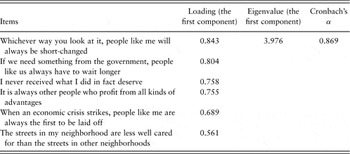
Of the three stories encountered among vulnerable people in the qualitative research – fear of social fraud, fear of crime and relative deprivation – the latter seems to be the most relevant as a reaction to vulnerability and a frustrated longing for (more) equality. The concept of relative deprivation was introduced by Stouffer et al. (Reference Stouffer, Suchman, DeVinney, Star and Williams1949) and later refined (Runciman, Reference Runciman1966; Vanneman and Pettigrew, Reference Vanneman and Pettigrew1972; Grant and Brown, Reference Grant and Brown1995). The six-item scale we use to measure relative deprivation does not specify a group with which people compare themselves (Walker and Smith, Reference Walker and Smith2002), but rather suggests comparisons between the respondents and generalized others (see Table 4). Higher scores on the deprivation scale indicate stronger feelings of deprivation.
Measurement information about the scale tapping feelings of relative deprivation in Flanders (principal components: N = 2142)

aMissing value imputation was applied for respondents who had a valid answer on the majority of items of a scale.
Lest our argument be misunderstood, we do not explain the behavior of vulnerable people on the basis of deprivation theory proper, but rather as a consequence of a coping strategy that presents relative deprivation as an injustice, and a violation of norms of equality for which a group of others/strangers is blamed. The experience of relative deprivation is seen as a consequence of vulnerability and as a trigger for the coping strategy. The coping strategy is likely not only to pinpoint a group of responsible others, but also to blame ‘the establishment’ and ‘politics’ for privileging these others and for tolerating and covering up the injustice. All these elements create strong affinities between the coping strategy and a rightist position on the conflict discourse. They create a disposition to view the world as a place where social-Darwinist rules apply, where values like equality are not operational, where out groups are unjustly privileged, and where the political establishment is a willing party to this injustice. This translates into the attitudes forming the core of the new dimension: utilitarian individualism, ethnocentrism, authoritarianism, populism. Therefore, we expect that taking feelings of relative deprivation into account will explain the apparent inconsistency among the less educated.
Testing the hypotheses
The hypotheses are tested in two steps. First, we look at the influence of education and other socio-economic conditions on the positions of the old (egalitarianism) and new (discourse of conflict) dimension, and on the scale measuring relative deprivation. Next, we verify whether taking into account feelings of relative deprivation can account for the seemingly inconsistent relationship between the two alignments among the less educated or, in operational terms, for the interaction effect between education and the dimensions.
Before turning to these tests, we briefly describe the operationalization of the explanatory variables. For people who left school, the level of education was measured as the highest diploma or certificate attained. For respondents still at school, their current grades, or level of education were considered as the highest diploma obtained. For both groups, educational levels are coded in four categories: primary education or less, lower secondary education, higher secondary education, and higher (post-secondary) education.
Income was measured as the average monthly, disposable family income. A 9-point scale was used (categories: <€600; €600–999; €1000–1499; €1500–1999; €2000–2499; €2500–3749; €3750–4999; €5000–5249; >€6000). As the relationship between this variable and the dependent variables turned out to be linear, we use the standardized version of this income scale as a continuous variable in the models presented.
To measure occupation a slightly modified version of the well-known Erikson-Goldthorpe (EGP) classification scheme was used, which distinguishes between skilled workers, unskilled workers, employees, higher employees, other wage earners, small businessmen (including the small group (n = 25) of farmers), professionals, and, finally, people who do not work (including students).
With respect to the current employment status we distinguish between people who work, people who are unemployed, and people who don't work for reasons other than unemployment (such as retirement, sick or maternity leave, study, or a career break). In addition, age and gender are entered as control variables in all models. We also tested whether there were significant interaction effects between these variables and any of the other explanatory variables. This turned out not to be the case.
Socially structuring the feelings of relative deprivation
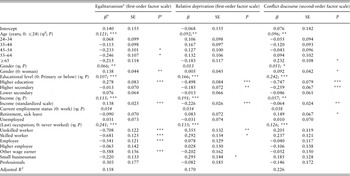
Crucial to our argument is the idea that vulnerability can have different origins and cannot therefore a priori be classified as a consequence of either economic or cultural insecurity. We therefore look at the sociodemographic determinants of egalitarianism, the conflict discourse, and feelings of relative deprivation. Table 5 presents two different parameters.Footnote 12 The partial etas (which can be read as betas) reflect the global (net) association between the independent and the dependent variables. They allow for a general comparison of the importance of the variables included in the model. That comparison gives us an idea of the degree of social anchoring of the different attitudes. The b-coefficients in the table are the unstandardized regression coefficients and can be used to assess differences between categories of the same variables or differences with the reference category in the case of nominal or ordinal variables.
Multiple regression analysis on three socio-political attitudes in Flanders (N = 2097)

aIn order to be theoretically consistent (see text) we prefer higher values on this scale to reflect an economic ‘rightist’ position. Therefore, we rescaled this variable by multiplying it by −1.
bUnstandardized regression coefficients.
cSignificance levels: ***P < 0.001; **P < 0.010; *P < 0.050.
dPartial η estimated with a univariate general linear model.
In line with what most authors observe, positions on the conflict discourse are – in terms of the model presented here – very strongly determined by the level of education and also, but much less strongly, by occupation. Income plays a small role, and age, gender, and employment status a negligible one. The higher the level of education attained, the higher the probability the conflict discourse is rejected. The position taken on the old dimension, expressing a longing for equality, is also influenced, albeit much less strongly, by the level of education. The effect of income is slightly stronger than that of education and the strongest effect is that of occupation. Blue-collar workers and low level white-collar workers express a preference for more equality and differ significantly in that respect from small business men, professionals, and higher-level white-collar workers. The determinants of the position taken on the old dimension appear to point to the role of the meanings and values carried by class ideology, emphasizing the link between occupational and financial positions on the one hand, and an egalitarian social project on the other.
Feelings of relative deprivation are influenced by level of education and occupation (see Table 5). The most important determinant, given the specification of our model, is income. Observed feelings of deprivation are quite strongly related to income, suggesting that money acts as a measure of recognition. While education seems to play a dominant role in determining the position of the new dimension and occupation does the same for the old dimension, feelings of relative deprivation appear to be influenced, in almost equal measure, by financial considerations, education, and occupational status. Since such feelings are, as expected, very strongly related to positions on the conflict discourse (r = 0.55) feelings of deprivation create a relationship between income and occupation on the one hand, and the new dimension on the other, illustrating the danger of considering the conflict discourse as exclusively cultural and the old one as economic. Labeling the alignments ‘economic’ and ‘cultural’ carries the risk of confusing the mental processes that produce an attitude (which are always cultural), with the conditions under which certain mental processes are more or less likely to occur.
Explaining a seemingly inconsistent ideology by feelings of relative deprivation
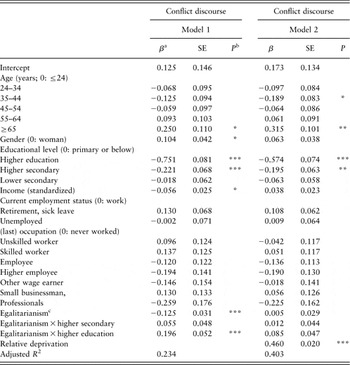
In Table 6 the relationship between the two dimensions is investigated using the conflict discourse as the dependent variable. This does not of course imply any causal ordering between the two alignments, but is a way to verify (1) whether there is indeed a significant interaction effect between education and egalitarianism with regard to the position on the conflict discourse, and (2) whether that effect disappears when feelings of relative deprivation are taken into account. As a matter of fact, a very similar analysis could also be performed using the new alignment as the independent variable and the old alignment as the dependent variable. This analysis builds upon the findings presented in Table 5. Model 1 (in Table 6) adds the old dimension (egalitarianism) and the interaction term between that dimension and the level of education. The significance of the interaction effect confirms the finding frequently reported in the literature, also presented in Table 3. Model 2 adds the feelings of relative deprivation. This variable completely explains the effect of egalitarianism and the interaction between level of education and egalitarianism. It has a very strong effect and increases the R 2 from 23% to 40%. Feelings of relative deprivation account for both the relationship between the two dimensions and for the apparent difference in that relationship according to the level of education.
Multiple regression analysis on the conflict discourse (N = 2097)

aUnstandardized regression coefficients.
bSignificance levels: ***P < 0.001; **P < 0.010; *P < 0.050.
cIn order to be theoretically consistent (see text) we prefer higher values on this scale to reflect an economic ‘rightist’ position. Therefore, we rescaled this variable by multiplying it by −1.
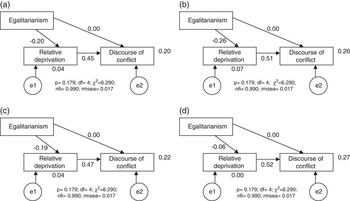
A similar analysis can be carried out using structural equation models. These have the advantage of allowing for a simple visual presentation of the complex relationships. Figure 1 presents the results of a multiple group comparison with educational level as the grouping variable and in which the association between egalitarianism and the conflict discourse is placed as equal to zero for all educational levels.Footnote 13 Into this analysis we fit the same model for the four educational categories. These models allow us to decompose the correlation structure between the three attitudes within each educational group.Footnote 14
Structural models for the relationship between egalitarianism and the conflict discourse and feelings of relative deprivation (multiple group comparison by level of education).

The models fit the data very well. The effects of relative deprivation on the new alignment are very high, as expected, and nearly the same for the four educational levels distinguished (they vary from 0.45 to 0.52). The strength of the effects of egalitarianism on relative deprivation varies by the level of education. It is quite strong for educational levels up to higher secondary school (0.20 or 0.26), but drops to 0.06 for people with a diploma of post-secondary schooling. This indicates that among the less educated the longing for equality leads to feelings of relative deprivation. From the analysis presented in Table 5 we know that this is partly due (for about 50%) to the relationship between education, income, and occupation. It is obvious that other aspects and covariates of education and causes of feelings of vulnerability also play a role. It is noteworthy that only people with a post-secondary degree escape these feelings. The effects of education and egalitarianism on feelings of relative deprivation, together with the effects of relative deprivation on the position on the new alignment, create a spurious negative relationship between the old and new dimensions – the paradoxical combination of egalitarianism and social Darwinism – among the less educated.
Summary, conclusions, and discussion
In this paper we measured the new left/right alignment as a meta-scale on the basis of different attitude scales that measure both the degree of acceptance and rejection of a discourse or view of society – the conflict discourse – that shows strong affinities with the social Darwinist, ethnocentric, authoritarian, and populist discourses, typical of the Counter-Enlightenment and endemic to Western culture since the 18th century (Sternhell, Reference Sternhell2006). Early signs of the (re)emergence of this alignment of attitudes created the expectation that it would replace the ‘old’ left/right alignment that expressed attitudes with regard to equality, state intervention, and the self-regulating market. Very soon that view gave way to the now dominant thesis that two left/right alignments jointly structure the electoral space.
On these two dimensions the less educated take a seemingly inconsistent position, combining a longing for more equality and a favorable stand with regard to state intervention, with a preference for social Darwinism, ethnocentrism, authoritarianism, and populism.
That paradox has been explained in various ways. The most interesting of which are the substantive explanations that advance our understanding of how and why people take certain ideological stands (Lipset, Reference Lipset1959; Lane, Reference Lane1973). Working in this tradition Achterberg and Houtman (Reference Achterberg and Houtman2009) have shown that taking into account anomie can explain the paradox. Our position differs in three ways from theirs. First, we think that the new alignment should be addressed as such and not piecemeal via its different components such as ethnocentrism, authoritarianism, social Darwinism, or populism. Significant alignments have to be able to capture views of man and society that are sufficiently encompassing and complex to be able to structure stable conflict lines. Second, we think that in Achterberg and Houtman's empirical analysis anomie is measured in a way that induces an artificial or tautological relationship with social Darwinism, utilitarian individualism, and anti-democratic or populist attitudes. Third, they make an a priori distinction between economic and cultural sources of insecurity and impute anomie, which can be regarded as an awareness of vulnerability, entirely to cultural causes.
We propose to view vulnerability or insecurity as a state that can be induced by many causes, but that has, regardless of its specific causes, to be coped with. Dealing with such a condition entails three things: pinpointing a cause for the feelings, identifying someone responsible for that cause, and linking that responsibility to an injustice, so that one can claim the status of victim and account for or legitimate negative attitudes with regard to those people held responsible for the injustice. Of the various narrative strategies identified that fulfill those functions, we focused on relative deprivation as a trigger and form of coping strategy.
The way in which relative deprivation operates as a coping strategy creates, among the less educated, a reasonably strong relationship between the old and new alignments. People with elementary skills and low levels of education are more likely to feel relatively deprived compared with others in society, and this is due at least in part to the relationship between low levels of education and low levels of income. Moreover, the feelings of relative deprivation are stronger when aspirations for equality are higher or, put differently, the position on the old alignment is more to the left. These two mechanisms lead to a strong relationship, an effect, of egalitarianism on feelings of relative deprivation among the less educated. That effect declines with the level of education and all but disappears among people with post-secondary education. Among the latter, a leftist position with regard to equality is not related to feelings of relative deprivation because the aspiration for equality is not, or much less frequently, frustrated.
Feelings of relative deprivation lead to a rightist position on the conflict discourse; they increase the likelihood that a person will opt for an authoritarian, ethnocentric, social-Darwinist outlook on society. The effects of relative deprivation are the same at the different levels of education (while, of course, the number of people that feel relatively deprived declines sharply as the level of education increases). The theory proposed here suggests that feelings of relative deprivation lead to a rightist position on the new alignment because coping with such feelings and with the vulnerability that causes them make it seem plausible to look at society in Social-Darwinist terms, make it attractive to target immigrants as unduly privileged ‘strangers’, to reject the political elites that are held responsible for that situation, and to put hope and faith in an authoritarian solution for a situation perceived as unjust but maintained by political representatives and the political elite.
When these explanations are taken into account, it can be observed that feelings of relative deprivation completely explain the seemingly inconsistent ideological positions of the less educated. After controlling for the effects of relative deprivation, the old and new alignments – egalitarianism and the conflict discourse – are completely independent of each other at all levels of education. They are in fact dimensions that orthogonally structure the political space. This creates a complex playing field for political parties. Tensions between parties, but also and particularly within parties, and between segments of the electorate, are indeed likely to be very high under such conditions (Lachat and Dolezal, Reference Lachat and Dolezal2008: 241). This is particularly so for parties emphasizing equality and addressing the vulnerable with socio-economic solutions.
At the heart of the cultural mechanism at work in creating a seemingly contradictory position among the less educated is the longing for equality. This now leads vulnerable people to a rightist position on the new alignment. In that sense, the mechanism uncovered in this analysis reveals a tension at the heart of egalitarianism, and a major problem for socialist and social democratic parties.