The first World Health Organization (WHO) Global Patient Safety Challenge, Clean Care is Safer Care, was launched in October 2005 with focus on improving hand hygiene compliance in healthcare facilities.1 Hand hygiene was selected because it is an effective, low-cost practice to prevent the transmission of multidrug-resistant microorganisms and to reduce healthcare-associated infections.Reference Pittet and Donaldson2 Hand hygiene compliance generally is low.3 Given that it is a behavior-driven action, promotion should be peer centeredReference Larson, Early, Cloonan, Sugrue and Parides4Reference Whitby, McLaws, Slater, Tong and Johnson5 and multimodal.Reference Pittet, Hugonnet and Harbarth6–Reference Zingg, Holmes and Dettenkofer10 This approach includes the empowerment of role models, opinion leaders, and champions.Reference Calhoun11–Reference Greenhalgh, Robert, Macfarlane, Bate and Kyriakidou14 However, team spirit is equally important to drive behavior change because feedback of hand hygiene compliance, even if provided on a daily basis, is effective only in settings with strong social cohesion.Reference Kwok, Harris and McLaws15
According to the diffusion of innovation theory, readiness for implementation is a function of the duration between the exposure to an innovation and the decision to adopt it within a social system.Reference Rogers16 The innovation, or the new idea, is introduced by innovators who may or may not be part of the social system. Early adopters then set the stage for subsequent adoption by the social system. Usually, they are well-respected peers and are better integrated in the social system than the innovators. They are ‘role models’ because their behavior is not perceived as being too far ahead of the average. They decrease uncertainty toward the new idea and make it acceptable by conveying passively a subjective evaluation via their wide interpersonal communication network.Reference Rogers16
Organizations are settings where leadership and hierarchical structures are important determinants of functioning. Leadership is not always a natural process, delivered by well-respected role models, but is more often a top-down managerial approach. The aim of this study was to test 2 principles in work teams on hand hygiene compliance: (1) facilitating hand hygiene by peer-identified change agents (PICAs) in which peers, acting as early adopters, facilitate hand hygiene improvement and sustainability by role modeling; and (2) improving hand hygiene by management-selected change-agents (MSCAs) who are expected to carry out top-down leadership. We hypothesized that hand hygiene promotion by PICAs would outperform hand hygiene promotion by MSCAs.
Methods
Setting
This study was conducted in Sarawak, Malaysia, in collaboration with the WHO Collaborating Centre on Patient Safety at the University of Geneva Hospitals (HUG), Switzerland, the University of New South Wales Sydney (UNSW Sydney), Australia, and the Malaysian Ministry of Health. Malaysia is an upper-middle-income economy in Southeast Asia.17 Sarawak is a state in Borneo with a population of 2.8 million in 2018.18 At the Sarawak General Hospital (SGH), 2 wards (1 male ward and 1 female ward) were selected in the Department of Internal Medicine because the head of this department was receptive to projects related to improving hand hygiene.19, Reference Lloyd20 Delivered care and workload were similar in both wards. The numbers of patient days in the male and female wards during the intervention period were 2,242 days and 2,348 days, respectively. Each ward had 42 official beds but would take up to 8 additional patients if necessary. The nurse-to-physician ratios were 69:6 and 64:5 in the male and female wards, respectively. There was no staff overlap between these 2 wards. Almost one-third of the nurses in the male ward were male (19 of 69), but only 1 nurse in the female ward was male (1 of 64). Also, 5 and 3 male doctors were assigned to the male and female wards, respectively.
Malaysia pledged commitment to the WHO first Global Patient Safety Challenge “Clean Care is Safer Care” in 2006. The Ministry of Health Malaysia has adopted the WHO multimodal strategy for hand hygiene7 in 2009, and since 2011, it has used the WHO Hand Hygiene Self-Assessment Framework (HHSAF)21–Reference Kilpatrick, Tartari and Gayet-Ageron24 to measure the provision of resources on hand hygiene in its public healthcare facilities. For SGH, the total HHSAF scores in 2011, 2013, 2015, and 2017 were 445, 465, 470, and 472.5,Reference Lee, Suraya and Zingg25 respectively, which translates to an ‘advanced hand hygiene level.’21, Reference Lee, Suraya and Zingg25 The total HHSAF leadership scores in 2013, 2015, and 2017 were 18, 20, and 17,Reference Lee, Suraya and Zingg25 respectively; they indicate high-level leadership support for hand hygiene promotion.21, Reference Lee, Suraya and Zingg25
Timeline
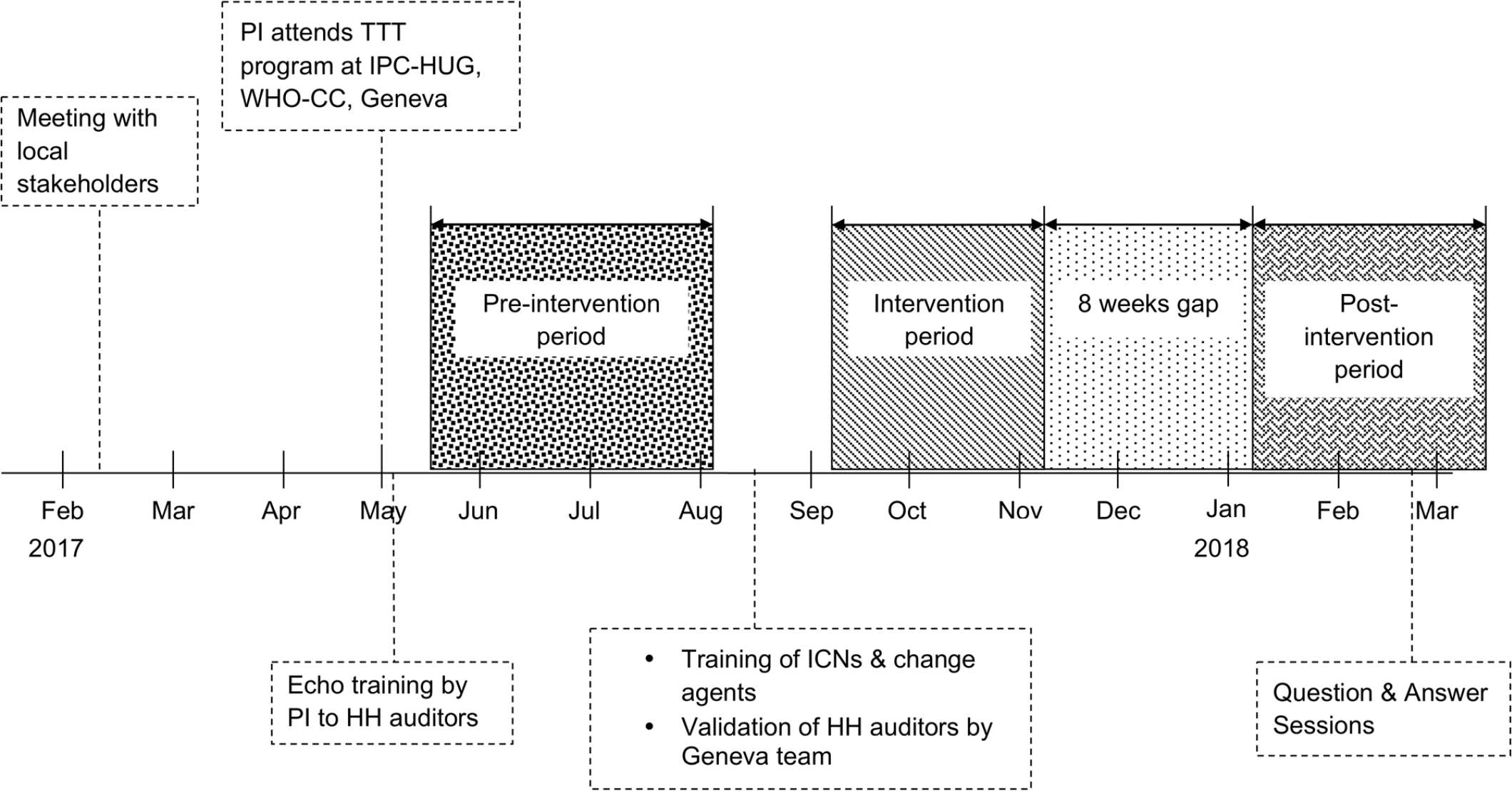
Figure 1 summarizes the timeline of the project. In February 2017, hospital administration, the head of the medical department, the infectious disease physician, infection control nurses, and hospital and ward matrons were engaged in the project. The preintervention period started in May 2017, followed by the intervention period in September 2017 and the postintervention period in January 2018. The preintervention, intervention, and postintervention periods had 48, 51, and 56 study days (weekdays and weekends), respectively (school and public holidays were excluded). A hand hygiene training workshop with validation of the hand hygiene auditors was organized prior to the preintervention period.
Project outline. Role of change agents on hand hygiene, Sarawak General Hospital, Malaysia. Note. HH, hand hygiene; IPC-HUG, Infection Control Program at University of Geneva Hospitals; ICN, infection prevention and control nurse; PI, primary investigator; TTT, train-the-trainers workshop; WHO-CC, World Health Organization Collaborating Centre on Patient Safety.

Interventions
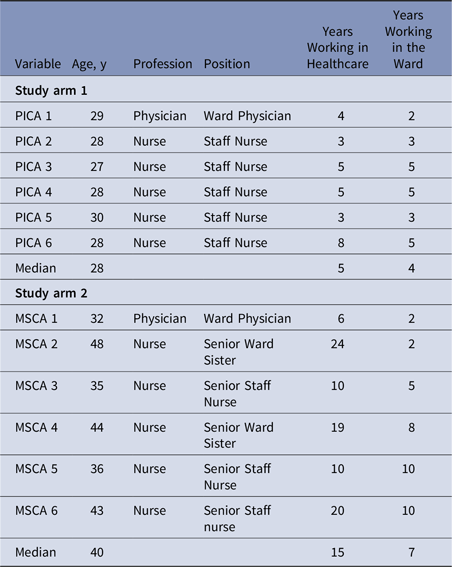
Before the preintervention period, staff from both wards anonymously nominated and ranked 10 peers to become their change agents for hand hygiene promotion. The wards were then randomly allocated either to PICAs (study arm 1) or MSCAs (study arm 2) by flipping a coin. During the preintervention period, the nurse unit manager and the head of the medical department selected change agents from the ward allocated to MSCAs. To conceal the wards from knowing their allocation to one or the other intervention, no information about randomization was provided. Ward staff, PICAs, and MSCAs were told that they were selected by senior management. In total, 6 change agents, 5 nurses, and 1 doctor were selected for each study arm based on the nurse-to-physician ratio to ensure that at least 1 change agent would be present on any study day. In addition to nomination by peers and selection by management, change agents had to have worked in the ward for at least 6 months, were not planned to leave the ward until the end of the study, and did not have skin intolerance to the use of alcohol-based hand rub. On average, MSCAs were 12 years older than the PICAs, and their work experience was 3 times longer (Table 1).
Demographics of Peer-Identified and Management-Selected Change Agents – Role of Change Agents on Hand Hygiene, Sarawak General Hospital, Malaysia

Note. MSCA, management-selected change agent; PICA. peer-identified change agent.
Responsibilities of change agents
During the pre- and postintervention periods, PICAs and MSCAs worked on their regular schedules with no active intervention. During the intervention period, PICAs and MSCAs were told to give feedback to their peers on hand hygiene, to actively encourage them to perform hand hygiene at the WHO Five Moments,Reference Sax, Allegranzi, Uçkay, Larson, Boyce and Pittet26, 27 and to overtly correct, educate, and congratulate them on proper hand hygiene practices. These instructions were given in the first week of the intervention period, when PICAs and MSCAs were randomly paired with an infection control nurse or the principal investigator (PI). The PI then followed up with the PICAs and MSCAs once a week via voice calls to remind them of their responsibilities and to receive feedback regarding their experiences.
Outcome measures
The primary outcome was hand hygiene compliance, measured by direct hand hygiene observation using the WHO hand hygiene observation forms.28 A minimum of 1 but no more than 2 observation sessions per day were performed in each study arm and during all 3 study periods. They were scheduled by applying online randomization.29 Each session lasted no longer than 30 minutes, allowing the observation of 12–15 hand hygiene opportunities. The nurse-to-physician ratio of observed staff was 3:1.Reference Azim, Juergens and McLaws30 Secondary outcomes included (1) knowledge on hand hygiene using the WHO “Hand Hygiene Knowledge Questionnaire for Health-Care Workers”;31 (2) reports from ward tours by the PI; and (3) qualitative summaries from question and answer sessions organized in the postintervention period in both study arms. Knowledge questionnaires were performed once in the preintervention period and 3 times during the intervention period (additional training was offered for staff scoring below 100%). Results of the question and answer sessions are summarized in a separate paper.Reference Lee, McLaws, Ong, Amir Husin, Chua, Wong, Pittet and Zingg32
Training and validation
Data on hand hygiene were collected by 9 infection control nurse auditors of SGH and the PI. The PICAs, MSCAs, and the nurse auditors knew each other, and together, they attended a local hand hygiene train-the-trainers program in Kuching, Sarawak, organized by the infection control program of HUG (IPC-HUG) team. All auditors were validated using 2 videos and 2 written scenarios. Interrater reliability among all 9 observers was calculated using the Fleiss κ test against the gold standard answers provided by IPC-HUG.Reference Landis and Koch33 The PI was trained and validated at IPC-HUG in Geneva.
Data entry and analysis
On weekdays, data were entered at 1.00 pm of the audit day to a Microsoft Excel spreadsheet on designated computers, located in the clinical research center of the SGH. For weekends, data entry was performed on the next working day. Data entry was verified by an auditor against the “WHO Hand Hygiene Observation-Basic Compliance Calculation” form.31 Hand hygiene compliance was calculated in accordance with the WHO hand hygiene observation method.31 Hand hygiene compliance was calculated if a minimum of 12 observed hand hygiene opportunities per day were achieved.19 For median and mean hand hygiene compliance calculations, 1 day equaled 1 data point.Reference Provost and Murray34–Reference Wheeler and Chambers36 The Wilcoxon rank-sum test was used to calculate mean differences of hand hygiene compliance within study arms (preintervention to intervention; preintervention to postintervention), and between study arms (intervention and postintervention periods). Statistical analysis was performed using Stata version 14.0 software (StataCorp, College Station, TX).
Ethical approval
The study was approved by the Medical Research and Ethics Committee of the Malaysian Ministry of Health (Reference: (7) KKM/NIHSEC/P16-971 for NMRR-16-763-30060 (IIR)).
Results
Hand hygiene
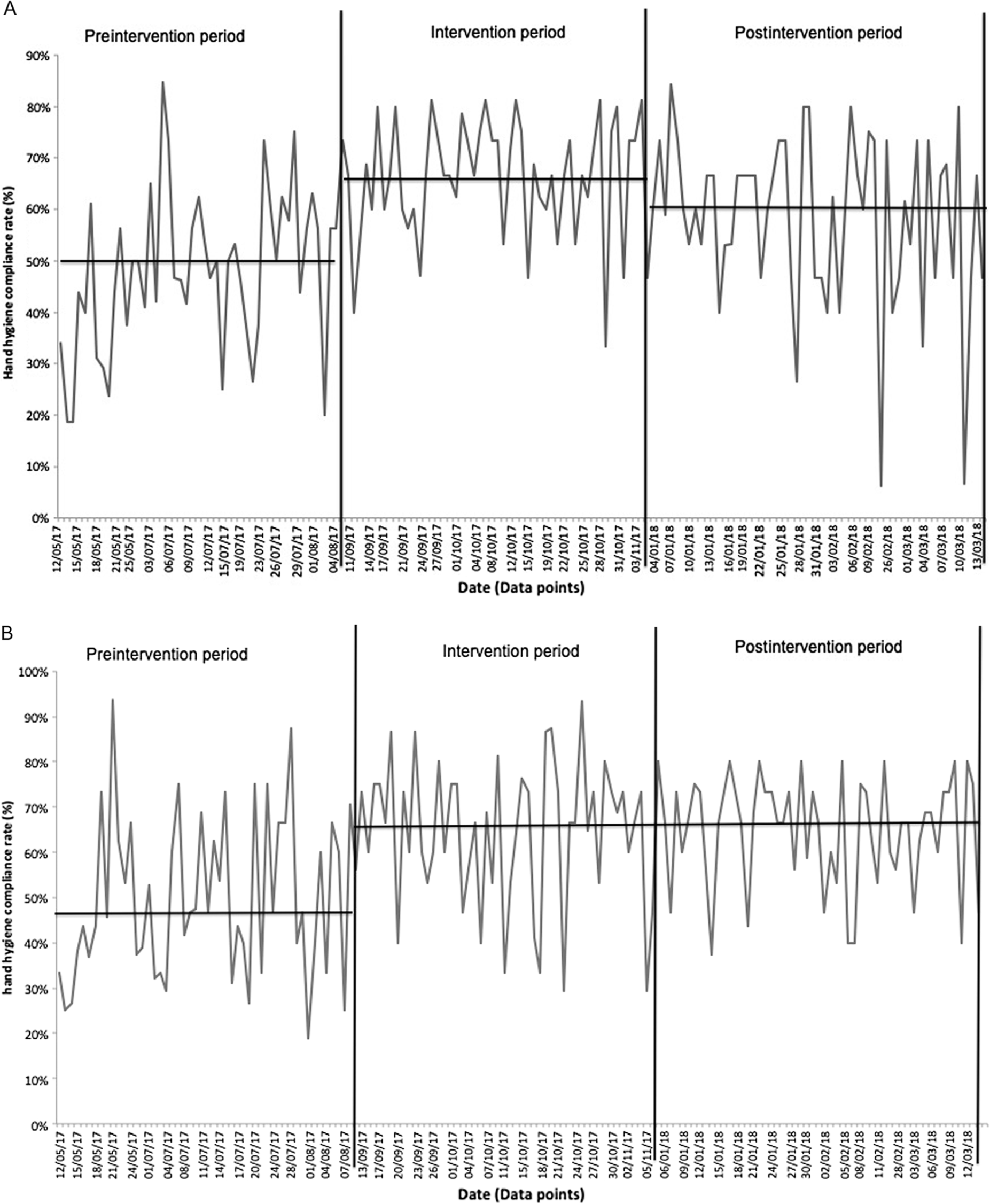
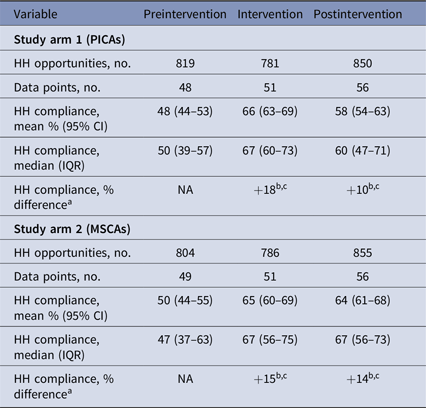
The interrater reliability estimates (κ) among the 9 auditors against 2 video sessions was 0.8 (substantial agreement), and the mean proportion of correct interpretations of written scenarios was 69.0% (±14.9). The number of observed hand hygiene opportunities in the preintervention, intervention, and postintervention periods were 819, 781, and 850 in study arm 1 and 804, 786, and 855 in study arm 2, respectively. Figure 2 summarizes daily hand hygiene compliance during the 3 study periods and for both study arms. Table 2 summarizes mean and median hand hygiene compliance during the 3 study periods and for both study arms. Hand hygiene compliance improved significantly by 10% or more between the preintervention and intervention periods (P < .001) and between the preintervention and postintervention periods (P < .001) in both study arms. Hand hygiene compliance did not significantly differ between the 2 study arms, neither during the intervention (P = .40) nor during the postintervention period (P = .27).
Hand hygiene compliance per study period and intervention arm. Role of change agents on hand hygiene, Sarawak General Hospital, Malaysia. Note. 2A: Arm 1 (peer-identified change agents); 2B: Arm 2 (management-selected change agents).

Hand Hygiene, Stratified by Study Period and Intervention Arm—Role of Change Agents on Hand Hygiene, Sarawak General Hospital, Malaysia

Note. CI, confidence interval; HH, hand hygiene; IQR, interquartile range; MSCAs: management-selected change agents; PICAs, peer-identified change agents.
a Mean % difference from preintervention period.
b Significant difference from preintervention period.
c Nonsignificant difference between arms.
Hand hygiene knowledge assessment
The average scores of the first hand hygiene knowledge assessment were 60% and 63% in study arm 1 and study arm 2, respectively. No healthcare worker scored 100%. The average scores of the second, third, and fourth assessments were 78%, 88%, 98% in study arm 1 and 79%, 93%, 93% in study arm 2, respectively. The average scores of the fifth assessment were 99% in both study arms. This assessment was only performed by staff who did not score 100% in the fourth assessment (29 of 132, 22.0%).
Ward tours
Interactions between change agents and peers
Peer-identified change agents in study arm 1 did not overtly correct or educate ward staff on hand hygiene practices. They expressed reluctance to remind their peers on hand hygiene compliance. Still, they were observed doing it in a friendly way. Management-selected change agents in study arm 2 performed almost daily spot checks on hand hygiene compliance and other patient safety actions. They overtly corrected staff with stern warnings for inappropriate hand hygiene practices, even in the presence of patients. In case of noncompliance, staff were advised to submit an official letter to management explaining missed hand hygiene actions if reasons for noncompliance were not perceived acceptable by the MSCAs. Both PICAs and MSCAs performed hand hygiene correctly when observed by the PI.
Interactions between peers
In study arm 1, staff felt obliged to improve hand hygiene compliance because they did not want to disappoint the efforts taken by the PICAs. In study arm 2, the staff felt pressured to comply with hand hygiene to obtain good overall performance appraisal results from their assessors. They perceived it as having strong social cohesion, aimed to reduced cognitive dissonance arising from the roles and efforts taken by MSCAs.
Discussion
The Five Elements of the WHO Multimodal Hand Hygiene promotion strategy7 were adopted by SGH, with availability of alcohol-based hand rub at the point of care in 2009. The HHSAF survey attested SGH an ‘advanced hand hygiene level’ with high-level leadership support since 2011. Taking into account such hospital investment in hand hygiene, it is not surprising that both strategies of hand hygiene promotion resulted in improving hand hygiene compliance. However, unlike our initial hypothesis, hand hygiene promotion by PICAs did not outperform hand hygiene promotion by MSCAs. Although change agents in both wards were role models by correctly applying hand hygiene, their strategies of encouraging or making peers to improve hand hygiene were very different.
Peer-identified change agents, or democratically selected change agents, did not perceive their role as being a leader, mainly because they were not given a formal leadership position. They were hesitant to correct poor behavior of their peers, but they were positive role models and champions, and they tried to be an example.Reference Calhoun11, Reference Damschroder, Banaszak-Holl, Kowalski, Forman, Saint and Krein13, Reference Greenhalgh, Robert, Macfarlane, Bate and Kyriakidou14, 37 In this sense, their behavior is much in line with the diffusion of innovation theory,Reference Rogers16 in which the PICAs act as early adopters. Indeed, they had a positive attitude toward the benefit of hand hygiene. Their popularity combined with a rather humble attitude created complicity in the work team who did not want to disappoint the efforts of their change agents.Reference Valente and Pumpuang12
The MSCAs had a completely different attitude. They perceived themselves as leaders and their role as being obliged to improve hand hygiene in the ward as a directive management strategy. Their authoritative top-down attitude, which may have been perceived as intimidating by staff, created pressure on the team to comply with their expectations, which fostered social cohesion within the work team. In his theory of cognitive dissonance, Leon Festinger (1957) proposed that to mentally function in the real world, human beings strive for internal psychological consistency.Reference Festinger38 To reduce mental discomfort, an inner drive holding attitudes and behavior in harmony with seniors emerges to avoid cognitive dissonance, leading to the formation of a socially cohesive work team.
This study has limitations. First, the study periods may have been too short to demonstrate sustainability, and differences of hand hygiene compliance between the 2 study arms in the long term. Even though top-down attitudes may be effective in the short term, the dynamics (as described by the diffusion of innovation theory) may unfold their effects in the long term. Thus, the similar achievements of hand hygiene compliance in the 2 study arms do not refute our initial hypothesis of PICAs being more effective on hand hygiene promotion in the long term. Second, direct hand hygiene observation, although considered the gold standard in hand hygiene compliance surveillance, may have created a surveillance effect, or Hawthorne effect.Reference McCambridge, Witton and Elbourne39 This effect may have been even more pronounced in the work team allocated to MSCAs due to their desire to align behavior with expectations from superiors and auditors being perceived as authorities.Reference Chen, Vander Weg, Hofmann and Reisinger40 Third, the proportion of female nurses was lower on the ward allocated to PICAs. Gender-dependent hand hygiene compliance in favor of female professionals may have limited the potential of hand hygiene improvement that could have been expected for this ward.19 However, both baseline and intervention compliances between the 2 teams were similar. Lastly, generalizability of our study findings requires further testing in other populations, considering the fact that attitudes and strategies of PICAs and MSCAs in hand hygiene promotion may be perceived differently in cultural backgrounds other than Malaysian.
In conclusion, both PICAs and MSCAs effectively changed behavior of staff toward improved hand hygiene. Although the attitude of PICAs and MSCAs in terms of leadership, perception of their task, and their mode of action were very different, or even opposed, the effect on hand hygiene compliance in both wards was similar. Peer-identified change agents acted as early adopters and created complicity among their peers. However, this effect was not superior to the authoritative attitude of the MSCAs in our setting. More in-depth analyses are required to interpret the different attitudes identified in this study.
Acknowledgments
We thank the hand hygiene trainers of IPC-HUG for the organization of the local train-the-trainers workshop, and the Malaysian Ministry of Health for their continuous commitment in enhancing patient safety. In particular, we thank the following colleagues for advice, support, and contribution to this study: Norjannah Abas, Catherine Valarie Alek, Elizabeth Awang, Nordiah Awang Jalil, Sugiwati Boret, Aldrick Bungan, En Sze Chan, Aaron Chiew, Zin Hing Chin, Manjan Dagang, Dayang Diun, Amilita Esseary, Alan Fong, Ni’mat Hamadan, Fatin Amalina Ibrahim, Kandong Jarop, Rufina Shantie Jep, Isma Iskandar Juperi, Ren Jye Kim, Molly Kudin, Kamarudin Lajim, Sie Ngo Lau, Marilyn Libin, Monica Martin, Zaidah Mat, Glorita Philip, Sheila Ivy Rasidin, Ellisa Reba, Whel Rosen, Suria Sayid Adris, Esah Serman, Irip Ubai, Mary William Ago, Suria Zaini. Finally, we thank the Director General of Health (Malaysia) for allowing this publication.
Financial support
This work was supported by the Infection Control Programme and WHO Collaborating Centre on Patient Safety (SPCI/WCC), University of Geneva Hospitals and Faculty of Medicine, Geneva, Switzerland; hand hygiene research activities at the SPCI/WCC are also supported by the Swiss National Science Foundation (grant no. 32003B_163262).
Conflicts of interest
All authors report no conflicts of interest relevant to this article.