Introduction
Antipsychotic medications (AP) are commonly used in the management of children with autistic spectrum disorders (ASD). A small number of studies have demonstrated therapeutic benefits for APs in ASD, particularly in association with parent training programmes (Aman et al. Reference Aman, Arnold, McDougle, Vitiello, Scahill, Davies, McCracken, Tierney, Nash, Posey, Chuang, Martin, Shah, Gonzalez, Swiezy, Ritz, Koenig, McGough, Ghuman and Linsay2005; Scahill et al. Reference Scahill, McDougle, Aman, Johnson, Handen, Bearss, Dziura, Butter, Swiezy, Arnold, Stigler, Sukhodolsky, Lecavalier, Pozdol, Nikolov, Hollway, Korzekwa, Gavaletz, Kohn, Koenig, Grinnon, Mulick, Yu and Vitiello2012). On this basis, the US Food and Drug Administration has approved two APs for management of ‘irritability’ in ASD, namely risperidone and aripiprazole, which are now among the most commonly prescribed APs in ASD (Aman et al. Reference Aman, Arnold, McDougle, Vitiello, Scahill, Davies, McCracken, Tierney, Nash, Posey, Chuang, Martin, Shah, Gonzalez, Swiezy, Ritz, Koenig, McGough, Ghuman and Linsay2005). Community surveys of prescribing practices in the ASD population have shown that common clinical reasons for AP prescribing include challenging and aggressive behaviour, self-injurious behaviour and affective instability (Oswald & Sonenklar, Reference Oswald and Sonenklar2007).
However, notwithstanding some therapeutic benefits significant side effects are associated with the use of APs, for example, metabolic syndrome [with core features of abdominal (central) obesity, elevated blood pressure, elevated fasting plasma glucose, high serum triglycerides and low high-density lipoprotein levels], extrapyramidal side effects and hyperprolactinaemia (Marken et al. Reference Marken, Haykal and Fisher1992; Leucht et al. Reference Leucht, Pitschel-Walz, Abraham and Kissling1999; Yumru, 2007; Bak et al. Reference Bak, Franken, Janssen, van Os and Drunker2014).
Prolactin is a natural hormone that is secreted by the lactotroph cells in the anterior pituitary gland. It stimulates breast enlargement during pregnancy and lactation, whereas reducing libido and fertility, which may have evolutionary, or survival significance (Rosenbloom, Reference Rosenbloom2010). Prolactin secretion is disinhibited by atypical and typical APs impacting on dopaminergic activity in the infundibular neurones. Serotonergic effects of APs are also reported to cause prolactin secretion through antagonism of the 5 HT1 [5-HT: serotonin (5-hydroxytryptamine)] and 5 HT2 receptors. Prolactin inhibits the release of gonadotropin-releasing hormone from the hypothalamus, which in turn disturbs the balance of luteinising hormone and follicular-stimulating hormone. This in turn leads to low levels of estrogens in women and testosterone in men, gonadal hypofunction and associated loss of libido and infertility. Increased prolactin is also associated with decreased bone density, increased propensity to fractures, rare associations such as increased rates in pituitary tumours (Szarfman et al. Reference Szarfman, Tonning, Levine and Doraiswamy2006) and cancers in later life (Berinder et al. Reference Berinder, Olaf Akre, Granath and Hulting2011). Patients with elevated levels of prolactin may, however, be asymptomatic. In adults, there have been significant concerns raised on the effects of hyperprolactinaemia on bone density. In adults on APs, long-term studies have shown a possible risk for decreased bone density (Szarfman et al. Reference Szarfman, Tonning, Levine and Doraiswamy2006); however, research data are limited on the long-term risk of asymptomatic children and adolescents and the exact risk remains uncertain. Calarge et al. (Reference Calarge, Zimmerman, Xie, Kuperman and Schlechte2010) studied the effects of risperidone and selective serotonin reuptake inhibitors (SSRIs) on bone mineral density on boys aged 7–17, and found preliminary evidence that risperidone-induced hyperprolactinaemia and SSRIs might, independently, hinder bone mineralisation in boys, preventing a child from reaching his genetically determined peak bone mass. Despite the concerns of decreased bone density on children and adolescents, prescribed APs or prolactin-inducing medication data are limited in this area and the consensus on monitoring of the risk with bone density scan remains uncertain.
Normal levels of prolactin are usually <500 mIU/l for women and <450 mIU/l for men. Levels >500 mIU/l indicate hyperprolactinaemia; however values can vary from one laboratory to another. When total prolactin exceeds the upper reference limit, testing for the presence of macroprolactin is essential. Macroprolactin is a non-bioactive prolactin isoform usually composed of a prolactin monomer and immunoglobulin G molecule and is considered to be inactive, whereas mononeric prolactin is said to be bioactive and responsible for the symptoms of hyperprolactnaemia (Vaishya et al. Reference Yumru, Savas, Kurt, Cemal Kaya, Selek, Savas, Timucin Oral and Atagun2010). If after screening for macropolatin the mononeric prolactin is still elevated then hyperprolactinaemia is present even though macroprolactin has been detected.
Based on the associated side effects of APs, the National Institute for Health and Care Excellence (NICE) (National Collaborating Centre for Mental Health, 2013) has guidelines for the use and monitoring of children and young people prescribed AP (National Collaborating Centre for Mental Health, 2013). These include the recommendation to evaluate serum prolactin levels at baseline in children and adolescents commencing on AP, again at 12 weeks and six monthly thereafter. Adequate monitoring of prolactin in the context of antipsychotic prescribing will therefore not mask an elevated level associated with an underlying pituitary tumour. Ali & Khemka (Reference Ali and Khemka2008) in their review paper in United States reviewed literature on children and adolescents on long-term risperidone and made recommendations for monitoring and managing of risperidone-induced hyperprolactinaemia giving the potential risks. In addition, in the United Kingdom, several National Health Service (NHS) Trusts have developed guidelines for the management of antipsychotic-induced hyperprolactinaemia giving the potential long-term effects of hyperprolactinaemia (Sussex Partnership NHS Trust, Tee Esk Wear NHS Trust and Northamptonshire Health Care NHS Trust and Oxford Health NHS Foundation Trust). However, most of these guidelines are targeted at adults and are not specific to children and adolescents. We are not aware of any existing guidelines in Ireland for the management of hyperprolactinaemia associated with AP prescribing in children and adolescents. The Oxford NHS Foundation Trust guideline makes some reference to children and adolescents and recommends the following guidelines for monitoring: (1) before commencing any APs known to cause hyperprolactinaemia take a baseline prolactin; if the antipsychotic is not known to cause increased prolactin no need for baseline prolactin; (2) repeat prolactin after 3 months on a stable dose of APs known to increase prolactin; if prolactin is normal there is no need for further monitoring unless there has been a dose increase or symptoms indicate a need; (3) recheck prolactin after three months after every dose increase; (4) if a patient is being prescribed an antipsychotic medication that is known to cause hyperprolactinaemia, you should check for symptoms of hyperprolactinaemia and if there are no symptoms prolactin levels should be repeated at the patients next routine physical check. If symptoms are present repeat prolactin level evaluation as soon as possible. The guideline defined raised prolactin as levels >375 mIU/l for men and >620 mIU/l for women. Recommendation by the Oxford NHS Trust for managing raised prolactin include the following: (1) If prolactin levels are raised consider repeating prolactin level evaluation under ideal conditions – that is, in the morning one hour after waking and before eating. (2) If prolactin levels are <3000 mIU/l and the patient is asymptomatic, the medication can be continued and you should continue to monitor for symptoms of hyperprolactinaemia. Recheck only if indicated by symptoms. If symptomatic consider dose reduction or consider switching to an antipsychotic with lower potential to elevate prolactin. (3) If prolactin levels are >3000 mIU/l and the baseline prolactin levels were normal, If so, it is drug induced hyperperprolactinaemia and there may not be a need to refer to endocrinology. Consider dose reduction and repeat if symptomatic or switching APs. In children and adolescent, if it is unwarranted to switch to prolactin sparing APs refer to endocrinology for further investigation and adivse. The Maudsley Prescribing Guidelines (Taylor et al. 2012) also has guidelines for monitoring and management of AP-induced hyperprolactinaemia: (1) if prolactin concentration is between 530 and 2120 mIU/l there is a need for retest; (2) if prolactin levels are >3180 mIU/l there is a need for referral for tests to rule out a medical cause. Treatment recommendation include (1) for patients with symptomatic hyperprolactinaemia a switch to a non-prolactin elevating antipsychotic is the first choice; (2) alternative is to add aripiprazol to existing treatment; (3) for patients who need to remain on prolactin elevating antipsychotics a dopamine against may be effective.
Beechpark Services is a specialist Health Service Executive (HSE) service in the Dublin North East and Dublin Mid-Leinster regions providing disability services for children and adolescents with ASD. Children and adolescents attending the service typically have normal intelligence quotient (IQ) or mild intellectual disabilities. The psychiatry team within the service assesses and manages the occurrence of comorbid psychiatric disorders and challenging behaviours in association with the multidisciplinary team. A number of young people attending the service are prescribed APs for the management of irritability. However, there is currently no written policy for the monitoring and management of hyperprolactinaemia secondary to AP prescribing. Consequently, we undertook an audit of case records of all patients prescribed APs in April 2013 and again in December 2013. The aim of the audit cycle was as follows.
Aims
-
1. To determine the number of patients in the service prescribed APs.
-
2. To determine current practice with respect to prolactin monitoring.
-
3. To examine how many patients on antipsychotics had elevated prolactin levels and the actions taken.
-
4. To make recommendations for improvements in monitoring and management practices.
-
5. To complete the audit cycle to determine if recommended changes had been implemented.
-
6. To compare the above information with international best practice guidelines.
-
7. To make recommendations based on these guidelines and develop a guideline for the management of hyperprolactinaemia in children on antipsychotics.
Method
In phase one (April 2013) and phase two (December 2013) of the audit cycle, a chart review of patients prescribed APs was undertaken. Data collected include the age, gender, and duration of use of APs, AP dose, baseline prolactin levels (if available), and prolactin at 12 weeks and whether any prolactin level had been obtained in the last 6 months. In addition, we noted the documentation of any abnormality found (bioactive prolactin levels >500 mIU/l indicated hyperprolactinaemia) and the action taken. In phase two of the audit cycle the charts reviewed in April 2013 were re-reviewed and additional charts of patients commenced on APs in the intervening period. Data were anonymised and stored on password-encrypted computers.
Results
Summary of findings from phase one (April 2013)
There were a total of 109 patients attending the psychiatry team in the Beecpark Service at phase one of the audit cycle (92 males and 17 females). A total of 14 patients (12.84%) were on APs of which 13 were male and one female (Table 1). The age range was 7–19 years and mean age 11.57 years. Three (21.4%) were prescribed aripiprazole (with a dose range of 3–5 mg and mean dose of 4.3 mg) and 11 (78.6%) risperidone (with a dose range of 0.125–2.5 mg and mean dose of 0.87 mg). Range of duration of use of APs was from 1 month to 65 months and mean duration of use of APs was 1 year and 5 months.
Patient gender and antipsychotic medications prescribed

Phase one: prolactin monitoring at baseline
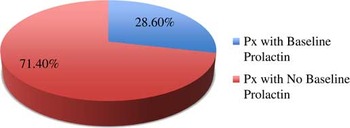
Four (28.6%) had baseline prolactin and 10 (71.4%) did not (Fig. 1 and Table 2). None of the patients had repeat prolactin levels 3 months following commencement of APs as recommended by NICE.
Monitoring at baseline.

Prolactin monitoring at baseline

AP, antipsychotic medications.
Phase one: prolactin monitoring at follow-up (6 months)
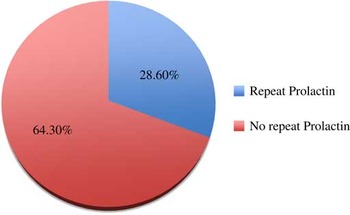
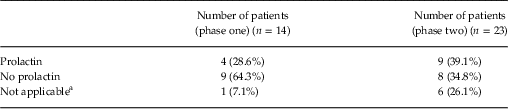
Four patients (28.6%) had repeat prolactin levels within 6 months of commencing on therapy and nine (64.3%) did not (Fig. 2 and Table 3). One patient had commenced APs less than 6 months previously. Three of the four (75%) patients who had levels checked had elevated prolactin (range between 517−1081 mIU/l), whereas the other patients were within the normal range. Prolactin measured was the bioactive isomer. Normal range set by the laboratory used for bioactive prolactin was 75–381 mIU/l for females and 63–245 mIU/l for males. However, normal values vary from laboratory to laboratory. None of the patients with elevated prolactin had any action documented (Table 4). Following phase one of the audit, the results and recommendation for improvement were disseminated through email to clinicians in the service. Recommendations were made based on review of the NICE guidelines, Maudsley guidelines, Oxford NHS Trust guidelines and review paper by Ali & Khemka (Reference Ali and Khemka2008) on monitoring and managing hyperprolactinaemia.
Monitoring at 6 months.

Repeat serum prolactin at 6 months

a Six monthly prolactin levels were not applicable, as these patients had commenced antipsychotic medications within the last 6 months.
Action taken on patients with elevated prolactin levels

Summary of findings from phase two (December 2013)
At phase two of the audit, there were 105 patients being seen by the psychiatric team; 89 males and 16 female. In total, 23 patients were on APs at phase two of the audit cycle (Table 1). A total of 10 patients were included from the first audit. Four patients from phase one were either discharged or discontinued APs. Reason for discharges include referral to another service and patient had turned 18, and reasons for discontinuation included side effects from medication, that is, weight gain and poor response. An additional six patients were identified who were on medication at the time of the first audit but were overlooked and seven were new patients who had commenced APs in the intervening period. Of the seven new patients six had commenced APs within the last 6 months and one had commenced 8 months earlier. The age range in phase two was 7–17 years and mean age was 11.08 years. Range of duration of use APs 2 weeks to 70 months Mean duration of use of antipsychotics was 21.08 months (1 year 9 months) for all patients. Two patients were on aripiprazole with a dose range of 0.75–10 mg and mean dose of 5.375 mg and 21 were on risperidone with a doses ranging from 0.25 mg to 3 mg and mean dose of 1.2 mg.
Phase two: prolactin monitoring at baseline
In phase two, we looked at the seven new patients who were commenced on APs after phase one of the audit. Of these four out of seven (57%) had serum prolactin at baseline indicating significant improvement in the level of monitoring. In phase one, we found that four out of 14 (28.6%) patients had baseline levels and this had improved significantly at phase two.
Where prolactin levels were not conducted there was no recorded reason in the clinical notes. It was also noted that none of these patients had repeat levels conducted at 3 months as per the NICE guidelines, indicating possible difficulties tolerating phlebotomy.
Phase two: prolactin monitoring at follow-up (6 months)
At phase two of the audit cycle 17 of the 23 patients on APs were due for six monthly repeat prolactin levels. Levels were checked in nine patients (52.9%) compared with four out of 13 patients (30.8%) at phase one (Table 3) indicating some improvement in the level of monitoring.
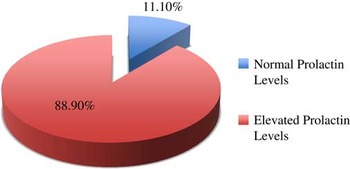
Eight out of nine patients (see Fig. 3) who had repeat prolactin levels checked in phase two had elevated levels with a range from 481 to 3015 mIU/l and mean value of 1021.63 mIU/l). Seven out of the eight patients with elevated levels were prescribed risperidone and one aripiprazole. Of note is that the patient prescribed aripiprazole had recently been switched from risperidone due to weight gain.
Prolactin levels following repeat monitoring at 6 months.

Action taken with respect to elevated prolactin levels
In phase two, no symptoms of hyperprolactinaemia were documented in the notes for those patients with elevated levels and no action was documented in seven (88.9%) out of the eight patients. One (12.5%) patient had repeat prolactin levels and a dose reduction documented. Table 4 summarises the findings in phase one and two of the audit cycle.
Discussion
This audit was conducted on patients with ASD attending a specialist service who were prescribed AP medication for the management of challenging and aggressive behaviour, a common and widely prescribed medication in this group of patients. The purpose of the audit was to determine practice in relation to the monitoring and management of hyperprolactinaemia in these patients secondary to medication. The audit indicated that risperidone is the most commonly prescribed AP to patients attending the service who were referred to psychiatry. As highlighted above, risperidone is an atypical AP that is most likely to be associated with hyperprolactinaemia (Bostwick et al. 2009; Torre & Falorni, Reference Torre and Falorni2007). As phase one of the audit baseline blood monitoring of prolactin levels doubled by phase two, indicating significant improvement with 28.6% in phase one versus 57.1% at phase two. Baseline monitoring was probably not as high as expected possibly because of difficulties collecting blood from this cohort of patients, however, there was no documentation in files in the new cases reviewed as to why baseline monitoring of prolactin was not done. Some patients are commenced on antipsychotics urgently due to concerns of risk and hence a possible reason why baseline monitoring may not be completed.
None of the patients had repeats prolactin levels checked at 3 months as recommended by NICE, however, a number had levels at 6 months and therefore 6-month repeat evaluations were included here. In phase one, 30.8% of patients scheduled for repeat levels actually had these investigations completed. In phase two, this increased to 52.9% indicating a good improvement in repeat prolactin testing, although the number of patients was relatively small. In one of the cases reviewed, there was documented evidence that the child had difficulties tolerating phlebotomy, hence the lack of repeat blood investigations. There was no documentation in the clinical notes to clarify why blood investigations had not been completed in the other cases. It was therefore not possible to evaluate the commonest reasons for this. Clinical experience would suggest that difficulties tolerating phlebotomy in these patients may be a factor. This might be a more significant issue with non-verbal patients. In this audit we did not record the clinical characteristics of the patients, which could indicate whether this is a greater problem for this group. Many children with ASD have severe difficulties tolerating medical investigations and frequently require a general anaesthetic to conduct investigations such as Magnetic Resonance Imaging (MRI) or dental treatment. However, it is important to weigh up the relative benefits versus risks of a general anaesthetic and in general this is not administered for phlebotomy alone. It would also be beneficial to make recommendations for clear documentation in case files as to the exact reasons why investigation are not carried out.
Of the patients tested in phase two who had six monthly repeat prolactin, 88.9% (eight) showed significantly high levels of prolactin in keeping with the evidence that antipsychotics, particularly risperidone can cause hyperprolactinaemia (Torre & Falorni, Reference Torre and Falorni2007). In terms of the action taken on those with elevated prolactin only one patient in phase two, compared with none in phase one had action taken to manage the abnormality. In this case, this involved dose reduction and monitoring for symptoms of hyperprolactinaemia. This may be due to the absence of clear guidelines with respect to the management of elevated serum prolactin within the service indicating a need for clear written guidelines based on best practice. One consideration is whether clinicians regard that in the long-term hyperprolactinaemia secondary to antipsychotics can potentially have a negative impact on bone density as shown in some studies (Takahashi et al. Reference Takahashi, Uchida, John, Hirano, Watanabe, Mimura, Correll and Kishimoto2013). It is also our experience since this audit was completed that some females patients may develop oligomenorrhea as a consequence of hyperprolactinaemia, this was the case in one female patient with AP-induced hyperprolactinaemia. Oligomenorrhea is known to be associated with increased risk of osteoporosis (Bargiota et al. Reference Bargiota, Bonotis, Messinis and Angelopoulos2013). This is a side effect that may be under-reported in this population by caregivers.
In conducting this audit we identified a number of features of our patient charts, at the time, which could contribute to under-recording of some of this information. The chart did not contain a separate section for filing blood results. Moreover, systematic recording of information including the date of blood investigations, reasons why phlebotomy cannot be completed and side-effect monitoring was not completed in this patient group. Such monitoring would support improved practice in this area and indeed more broadly in relation to the monitoring of all medications prescribed.
Recommendation
-
∙ In keeping with NICE guidelines for management of children and young persons on antipsychotics, all child and adolescent patients prescribed antipsychotics for the first time should have prolactin at baseline, after 3 months and six monthly thereafter.
-
∙ Clear documentation of prolactin levels on case file and the development of forms for chart to systematically record date of blood monitoring, abnormal results, symptom monitoring and reasons why blood monitoring is not conducted.
-
∙ The following guidelines for the service have been adapted for the management of hyperprolactinaemia in children and adolescents prescribed AP:
-
1. If the bioactive prolactin is noted to be elevated (>530 mIU/l) with no clinical symptoms, repeat in 8 weeks without altering medication, the hyperprolactinaemia is expected to resolve and diminish (Ali & Khemka, Reference Ali and Khemka2008).
-
2. If elevated with symptoms (i.e. Amenorrhoea, galactorrhea, gynaecomastia), consider tapering medication and switching to a prolactin sparing antipsychotic [i.e. Aripiprazole, quetiapine and clozapine (Ali & Khemka, Reference Ali and Khemka2008; Bargiota et al. Reference Bargiota, Bonotis, Messinis and Angelopoulos2013)].
-
3. If prolactin is >3000 mIU/l or is persistently elevated above the normal upper limit (>500 mIU/l) despite switching to prolactin sparing antipsychotic or discontinuing the medication, consider obtaining an MRI of the sella turcica to rule out a pituitary adenoma or parasellar tumour (Ali & Khemka, Reference Ali and Khemka2008).
-
∙ Seek advice from consultant paediatric endocrinologist regarding the development of a management protocol and whether monitoring of bone density in children and adolescents with persistent hyperprolactinaemia is recommended.
Conclusion
This audit was associated with significant improvement in prolactin monitoring practice at baseline marginal improvement at six monthly repeat. Three monthly prolactin recording did not occur in either phase one or two; the reason for this was not determined. Although one patient had repeat prolactin and action taken due to hyperprolactinaemia at phase two, it is clear that the majority of patients did not. Methodological limitation of this audit such as the small sample size and heterogeneity of time of exposure to the antipsychotic make it difficult to interpret clinical findings of prolactin elevation in charts reviewed, which may not be representative of most clinical population of children and adolescents prescribed APs. Monitoring and management of hyperprolactinaemia in children on antipsychotics still requires further improvement, such as systematic recording and the development of a policy on the management of hyperprolactinaemia, in consultation with a paediatric endocrinologist.
Acknowledgements
The authors are very grateful to the peer reviewers for their helpful suggestions and comments.
Conflicts of Interest
None.
Ethical Standards
The authors assert that all procedures contributing to this work comply with the ethical standards of the relevant national and institutional committee on human experimentation with the Helsinki Declaration of 1975, as revised in 2008. The authors assert that ethical approval for publication of this audit was not required by their local REC.
Financial Support
This work received no specific grant from any funding agency, commercial or not for profit sectors.