Introduction
It is well known that many insects, especially, nocturnal moths, often fly toward an artificial light source, or rest around the light source at night. Level of the phototactic behavior to the light source in same insect species can be influenced by several factors, such as wavelength, intensity, exposure time, and direction of the light source and so on (Antignus, Reference Antignus2000; Jing & Lei, Reference Jing and Lei2004; Liao et al., Reference Liao, Shi, Liu, Du, Ma, Zhou and Deng2017). Several studies were conducted to evaluate phototactic behaviors of insect to different wavelengths of light sources. In the previous studies, some lepidopteran adult moths, such as the Indian meal moth (Plodia interpunctella), the oriental fruit moth (Grapholita molesta), the tobacco cutworm (Spodoptera litura) and the diamondback moth (Plutella xylostella), have relatively stronger phototactic behavior to a light source of green wavelength compared to the other wavelength lights, including ultraviolet, visual and infrared wavelengths (Cho & Lee, Reference Cho and Lee2012; Yang et al., Reference Yang, Kim and Lee2012; Sun et al., Reference Sun, Tian, Zhang, Zhao, Zhang and Ma2014; Park & Lee, Reference Park and Lee2016). There are various hypotheses made by researchers on phototactic behavior of insects, such as the light interference (Robinson & Robinson, Reference Robinson and Robinson1950), the light orientation (Baker & Sadovy, Reference Baker and Sadovy1978; Atkins, Reference Atkins1980), and the light biological antenna (Callahan, Reference Callahan1965a, Reference Callahanb). However, it is still unclear why many insects fly into an artificial light of special wavelength (Sang et al., Reference Sang, Zhu and Lei2016; Gao et al., Reference Gao, Li, Li, Lei and Huang2017).
The oriental armyworm, Mythimna (or Leucania) separata is an important crop pest in East-Asian countries, causing serious economic losses (Sharma et al., Reference Sharma, Sullivan and Bhatnagar2002; Zhao et al., Reference Zhao, Sandhu, Ouyang and Ge2016; Lihuang et al., Reference Lihuang, Zhang, Kim, Huang and Lei2017). Outbreak of the insect pests traditionally is controlled and managed by chemical synthetic pesticides, but this method is becoming increasingly difficult due to the ecosystem pollution and the insect pest's pesticide resistance by excess usage of the chemical pesticides (Jiang et al., Reference Jiang, Luo, Zhang, Sappington and Hu2011; Lihuang et al., Reference Lihuang, Zhang, Kim, Huang and Lei2017; Kim et al., Reference Kim, Song, Li, Huang and Lei2018a). Recently, considerable interest has been increased in a pest control technology that utilizes a light trap equipped with light-emitting diodes (LEDs) emitting a specific wavelength as a ‘green pest control technology’ without using pesticides (Shimoda & Honda, Reference Shimoda and Honda2013; Brehm, Reference Brehm2017; Park & Lee, Reference Park and Lee2017). Therefore, the studies on the biological characteristics of phototactic insects under an illumination condition of specific wavelength light that attracts them are helpful for elucidating a nature of phototactic behavior in insect, and for estimating a prospect of using traps equipped with the light source that emits this wavelength.
In the light and dark components of the daily cycle, the environments where the ratio of light period and dark period is changed by artificial means and the illumination environments base on different wavelength light sources during a dark period of daily photoperiod can affect the biological characteristics of insects living in these environments (Saunders, Reference Saunders2013; Zhang, Reference Zhang2018). For example, pupae of the cotton bollworm, Helicoverpa armigera, rearing under the condition where the light period is 11 h in daily photoperiod evoked greater intensity of diapause than longer light period groups (Chen et al., Reference Chen, Xia, Fu, Wu and Xue2014). In the case of the swallowtail, Sericinus montelus, prolonging of light period in daily photoperiod resulted in a negative effect on diapause of the insect pupae (Wang et al., Reference Wang, Yang, Zhou, Xu and Lei2010). Some studies have proved that UV light illumination induces a negative effect on several biological characteristics in M. separata and H. armigera (Zhang et al., Reference Zhang, Meng, Wang, Zhu and Lei2011; Ali et al., Reference Ali, Rashid, Huang and Lei2016). Our previous study has already confirmed that green (520 nm) LED light results in a significantly high phototactic behavior in M. separata adult moths compared to the other wavelength LED lights (Kim et al., Reference Kim, Song, Li, Huang and Lei2018a). The present study aimed to evaluate the effect of the green (520 nm) LED light illumination on several biological characteristics of M. separata, including development, longevity and reproduction in different developmental stages of P generation and F1 generation.
Materials and methods
Insect rearing
Experiment insects were reared at the temperature 25 ± 2°C, with 65 ± 10% relative humidity (RH) under a photoperiod of LD 14 h:10 h in the insect rearing room of Hubei Insect Resources Utilization and Sustainable Pest Management Key Laboratory, College of Plant Science and Technology, Huazhong Agricultural University, Wuhan, China. M. separata larvae used in the study were fed on an artificial diet as described by Be (Reference Be1981). The adult moths were fed on 10% honey solution. During the insect rearing period, all insects were maintained with no exposure to any chemical.
Experimental groups of P generation and F1 generation
Experimental insects reared under a normal rearing condition (LD 14 h:10 h) were used for the experiments, and were expressed as P generation. Fifty 1-day-old eggs laid by M. separata females were selected as a treatment and transferred to a plastic cup (height 5 cm; diameter 3.5 cm). The first-instar larvae of the P generation were collected and placed in a transparent plastic container (height 6 cm; diameter 20 cm), and treatment included 50 the larvae. Fifty 1-day-old pupae of the P generation were selected as a treatment, and transferred to a transparent plastic container (height 5 cm; diameter 15 cm). Fifteen male–female adult pairs of the P generation were used in a treatment, and each pair was placed in a transparent plastic cup (height 12 cm; diameter 6 cm).
Insects from eggs laid by females of the P generation were called as F1 generation. Insect numbers of a treatment in the different development stages of the F1 generation were the same as those of the P generation as explained above. Each treatment was repeated in triplicate. All experiments were maintained under the temperature and relative humidity of the normal rearing condition.
Light treatment
During survival duration of the insect, experimental groups of different development stages in P generation were exposed to a white light (420–650 nm; 1000 lux; 196.7 ± 4 µW cm−2) for 14 h (05:00 to 19:00) as a light period of the photoperiod, and then exposed to a green LED light (520 ± 3 nm; 200–250 lux; 29.8 ± 2 µW cm−2) for different exposure time periods (0, 2, 4, 6, 8 and 10 h) in a dark period (19:00 to 05: 00) of the daily photoperiod. The light treatments for different exposure time periods in the P generation were conducted from one development stage to the next development stage. Meanwhile, F1 generation M. separata which is the next generation of P generation adults treated with green LED light for different exposure time periods was reared from egg stage to adult's death under the normal rearing condition (LD 14 h: 10 h). During the survival durations of P generation and F1 generation M. separata, several biological characteristics were recorded daily. The green LED lights (5 W), used as the light source in light traps for monitoring or controlling insect pest moths, were employed in the experiment, and were purchased from Shenzhen New Photoelectric Technology Co., Ltd., China.
Biological characteristics at the different developmental stages
In egg stage groups, all data of P generation were recorded during the breeding duration from 1-day-old eggs of P generation females to their hatch under green light illumination conditions according to different exposure time periods, and all data of F1 generation were recorded during the breeding duration from 1-day-old eggs of the F1 generation based on different exposure time groups until their hatch under the normal breeding condition. Egg period indicates the average duration from 1-day-old eggs to their hatch, and the hatch rate is the average percentage of hatched eggs.
In larva stage groups, all data of P generation were recorded during the rearing duration from the P generation first-instar larvae to their pupation under green light illumination conditions, and the results of F1 generation were recorded during the rearing period from the first-instar larvae of F1 generation until their pupation under the normal breeding condition. Developmental period expresses the average duration from the first-instar larvae until their pupation. Survival rate indicates the average percentage of the sixth-instar larvae (before pupation) developed from the first-instar larvae. The sixth-instar larva period represents the average duration from the sixth-instar larvae to the pupation. Pupation rate shows the average percentage of the pupae developed from the sixth-instar larvae.
In pupa stage groups, all data of P generation were recorded during the rearing duration from 1-day-old pupae until their eclosion under green light illumination conditions, and all results of F1 generation were produced during the rearing duration from the 1-day-old pupae of F1 generation until their eclosion under the normal breeding condition. Pupa period indicates the average duration from 1-day-old pupae to their eclosion, and emergence rate shows the average percentage of adults emerged from the pupae.
For adult stage groups, M. separata pupae were assorted by sex based on the morphological characteristic of the abdominal terminal segment and kept separately until eclosion. At the first day after eclosion, a virgin male and female were paired and placed in a transparent plastic cup (height 12 cm; diameter 6 cm). The upper side of the cup was closed with a net cover, a special paper as the oviposition substrate was used, and the paper was replaced every day. A number of eggs laid by the females during oviposition duration, and survival of males and females were observed every day until they died. All results of P generation were recorded during the rearing duration after pairing of 1-day-old female and male until their death under green light illumination conditions, and data of F1 generation were recorded during rearing duration after pairing of 1-day-old female and male of F1 generation until their death under the normal breeding condition. Fecundity indicates the average amount of all eggs laid by a female during her survival. Oviposition quantity per day represents the average amount of eggs laid by each female during a day. Pre-oviposition period represents the average duration after pairing to first oviposition of the female. Oviposition period shows the average duration from first oviposition until her last oviposition.
Statistical analysis
IBM SPSS Statistical 18.0 (SPSS Inc., Chicago, IL, USA) software was used for statistical analyses. Experimental results were analyzed by the one-way analysis of variance (ANOVA) and means were compared by using Tukey's HSD test (P < 0.05). Additionally, significant differences between males and females in the adults (in fig. 1a, b) were analyzed using the independent sample t-test. Values represented as the mean values ± SE.
Effect of green illumination on longevity of M. separata adults. (a) P generation; (b) F1 generation. The value of each bar indicates a mean of the replicate experiments (n = 3) and the error bar indicates the SE. Different letters above each bar show significant differences according to the Tukey's HSD test (P < 0.05; capital letters and lowercase letters represent significant differences in males and females, respectively). Different signs above each line denote significant differences between the male and the female according to the independent sample t-test (#P < 0.1; *P < 0.05; **P < 0.01).

Results
Influence of green light illumination on different developmental stages of M. separata
Influence on the eggs
Effect of the green light on P generation M. separata eggs was evaluated (table 1). When M. separata eggs were exposed to the green light illumination for 10 h per day, an egg period was significantly prolonged compared with the control (0 h) (F = 4.138; df = 5, 12; P = 0.038), but no significant differences between other exposure time periods and the control were found. Additionally, significant decreases in hatch rate were recorded at 6, 8 and 10 h groups, respectively, when compared to the control (F = 5.942; df = 5, 12; P = 0.005), but these groups did not significantly differ from 2 and 4 h.
Effect of green light illumination on hatch of M. separata eggs.

Each value in the table expresses a mean and SE of the replicate experiments (n = 3). Different letters within a column represents a significant difference by Tukey's test (P < 0.05).
Average egg periods of F1 generation eggs produced by M. separata adult females, which were exposed to the green light illumination for different exposure time periods per day, were significantly changed only in 10 h groups (F = 7.819; df = 5, 12; P = 0.002), when compared with the control, but no significant difference in the other groups was recorded (table 1). Additionally, significant decrease in the hatch rate of the F1 generation eggs was appeared in 6, 8 and 10 h groups when compared to the control (F = 6.294; df = 5, 12; P = 0.004), whereas, no other groups were significantly changed.
Influence on the larvae
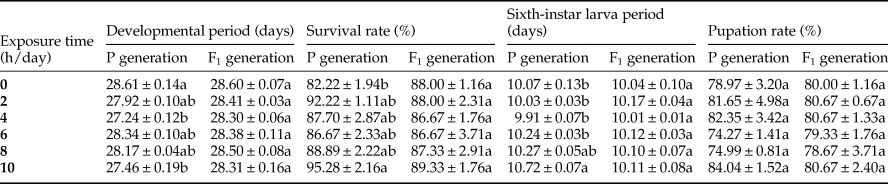
In P generation groups, the developmental period of M. separata larvae was significantly shortened at 4 and 10 h groups, respectively, compared to the control (0 h) (F = 4.539; df = 5, 12; P = 0.015), but the other groups were not significantly changed compared with the control (table 2). Additionally, when compared to the control (0 h), a significant increase in the larval survival rate appeared only in 10 h group (F = 2.794; df = 5, 12; P = 0.050), but no there was observed in the other groups. Meanwhile, the sixth-instar larva period in 10 h group was significantly longer compared with the control and the other groups except for 8 h group (F = 9.147; df = 5, 12; P = 0.001), and significant difference in pupation rate was not appeared in all the groups and the control.
Effect of green light illumination on M. separata larvae.

Each value in the table expresses a mean and SE of the replicate experiments (n = 3). Different letters within a column represents a significant difference by Tukey's test (P < 0.05).
Data indicated that green light illumination had no significant effects on the F1 M. separata larvae (table 2). In all the groups, larval developmental periods (F = 1.524; df = 5, 12; P = 0.254) and larval survival rates (F = 0.175; df = 5, 12; P = 0.967) of the F1 generation reared under normal condition were not significantly changed as compared to the control. Additionally, the sixth-instar larva periods (F = 1.358; df = 5, 12; P = 0.306) and pupation rates (F = 0.163; df = 5, 12; P = 0.972) in all the groups also were not significantly different from the control.
Influence on the pupae
In P generation groups, pupa period in 10 h group was significantly shortened as compared to the control (F = 3.612; df = 5, 12; P = 0.032), but there was not a significant difference between the other groups and the control. Additionally, a significant increase in emergence rate was obtained only in 10 h group as compared to other groups and the control (F = 3.289; df = 5, 12; P = 0.050) (table 3).
Effect of green light illumination on M. separata pupae.

Each value in the table expresses a mean and SE of the replicate experiments (n = 3). Different letters within a column represents a significant difference by Tukey's test (P < 0.05).
Our results showed the non-significant effect of the green light illumination on the F1 pupa periods (F = 3.029; df = 5, 12; P = 0.051) and emergence rates (F = 0.557; df = 5, 12; P = 0.731) in all groups compared to the control (table 3).
Influence on the adults
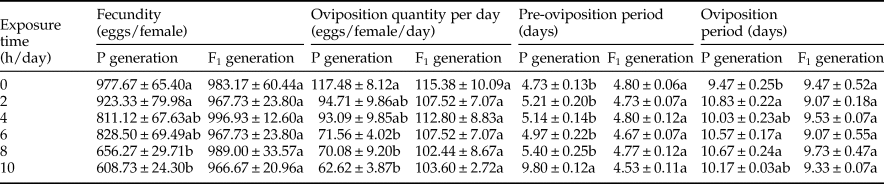
In P generation groups, a significant decrease in fecundity per female was recorded for 8 and 10 h, respectively, when compared to the control (F = 5.844; df = 5, 12; P = 0.006), but there was no significant change between the control and the other groups (table 4). Additionally, a significant decrease in oviposition quantity per day of the female appeared in 6, 8 and 10 h group, respectively, when compared to the control (F = 4.475; df = 5, 12; P = 0.016), but no these groups had a significant difference compared with 2 and 4 h groups. Meanwhile, a pre-oviposition period in 10 h group was significantly prolonged among all the groups (F = 76.651; df = 5, 12; P = 0.001) (table 4). Oviposition periods in 2, 6 and 8 h groups were significantly lengthened as compared to the control (F = 4.288; df = 5, 12; P = 0.018), but there was no significant change as compared to the other groups.
Effect of green light illumination on reproduction of M. separata females.

Each value in the table expresses a mean and SE of the replicate experiments (n = 3). Different letters within a column represents a significant difference by Tukey's test (P < 0.05).
No significant changes in fecundity per the F1 generation female were found in all the groups compared with the control (F = 0.1557; df = 5, 12; P = 0.974), additionally, oviposition quantity per day per the F1 female in all groups were not significantly different from the control (F = 0.614; df = 5, 12; P = 0.692) (table 4). Meanwhile, pre-oviposition periods (F = 1.425; df = 5, 12; P = 0.284) and oviposition periods (F = 0.515; df = 5, 12; P = 0.760) in all groups were not significantly decreased or increased compared with the control.
When M. separata adults were exposed to the green light illumination for 10 h during the dark period per day, survival times in both the males and females were significantly lengthened compared with all the groups. Survival times of 8 and 6 h groups in the male moths were significantly prolonged when compared to the control (F = 29.546; df = 5, 12; P = 0.000), but those of the 2 and 4 h group was not significantly changed (fig. 1a). Additionally, when compared to the control, survival times of the 6 and 8 h group in the female moths were significantly prolonged (F = 22.7716; df = 5, 12; P = 0.000), but no significant changes in 2 and 4 h groups were recorded. Meanwhile, significant differences in survival times between the male and female moths appeared in all the groups, 2 h (t = −2.639; df = 4; P = 0.050), 4 h (t = −2.836; df = 4; P = 0.047), 6 h (t = −3.269; df = 4; P = 0.031), 8 h (t = −5.433; df = 4; P = 0.006), 10 h (t = −6.475; df = 4; P = 0.003) group and the control (t = −4.000; df = 4; P = 0.016), respectively.
No significant changes in longevities of the F1 generation adults were neither observed in all of the male groups (F = 0.402; df = 5, 12; P = 0.839) and the female groups (F = 1.063; df = 5, 12; P = 0.427) (fig. 1b). However, marginally significant differences in longevities between the F1 males and the F1 females were observed in the 2 h (t = 2.489; df = 4; P = 0.068) and 6 h (t = −2.384; df = 4; P = 0.076) groups, additionally, the control (t = 7.543; df = 4; P = 0.002) and the other groups (4 h: t = 12.027; df = 4; P = 0.001; 8 h: t = 14.697; df = 4; P = 0.001; 10 h: t = 5.041; df = 4; P = 0.007) had extremely significant differences in longevities between the F1 males and the F1 females.
Discussion
Nocturnal insects, including, nocturnal moths, are attracted to an artificial light source at night, because they have phototactic character (Cloyd et al., Reference Cloyd, Dickinson, Larson and Marley2007; Shimoda & Honda, Reference Shimoda and Honda2013). At night, an illumination environment of an artificial light emitting in the light source of light traps can influence biological characteristics of insects, because of confusing biological rhythms of insect, such as photoperiodism (Saunders, Reference Saunders2013). However, the changing level of biological characteristics of insect varies according to different light sources (Zhang, Reference Zhang2018).
Ali et al. (Reference Ali, Rashid, Huang and Lei2016) reported that when different development stages of M. separata were exposed to ultraviolet light (UV-A) for different exposure periods, survival rates of the larvae were gradually reduced as UV-A radiation exposure time increased, and adult emergence of the pupae exposed to UV-A for longer periods were significantly reduced. Moreover, when different developmental stages of H. armigera were exposure to UV-A radiation, similar results were found (Zhang et al., Reference Zhang, Meng, Wang, Zhu and Lei2011). Meanwhile, hatch rates of G. molesta eggs and P. xylostella eggs exposed to green (520 nm) LED light illumination for 12 h during a dark period, were significantly declined compared with the control (Wang, Reference Wang2010; Yun, Reference Yun2011).
Our results showed that when different developmental stages of M. separata were exposed to green LED light illumination for longer exposure time period; there was a positive influence on the development of M. separata larvae and pupae. In the egg stage, hatch rates were declined, and egg periods were prolonged compared to the control level. In M. separata larvae stage, developmental periods were shortened, and survival rates were increased, and the sixth-instar larva periods were prolonged, but there were no significant differences in a pupation rate, when compared with the control. In M. separata pupae of the longest exposure period, a pupa period was shortened, and an emergence rate was increased, when compared with the control. These findings suggest that the biological characteristics of M. separata may be influenced by an exposure time of the green light illumination.
When adults of M. separata were exposed to UV-A light irradiation, fecundities per the female in longer exposure time groups were significantly increased, but those of the longest time group sharply reduced, additionally, longevities of the females and the males were shortened with extending UV-A irradiation exposure period (Ali et al., Reference Ali, Rashid, Huang and Lei2016). Similar results in H. armigera reported by Zhang et al. (Reference Zhang, Meng, Wang, Zhu and Lei2011). Meanwhile, when G. molesta adults exposed to the green light for different time periods (0, 2, 4, 8 h) in dark period, fecundities of G. molesta females were declined as exposure period increased, and longevities in G. molesta adults had no significant changes (Fang, Reference Fang2015). When P. xylostella adults were exposed to green light illumination for 12 h during the total dark period, fecundity per the female was reduced, and oviposition period was shortened, as compared to the control (Wang, Reference Wang2010).
All reproduction-related parameters of M. separata adults exposed to the green light illumination were considerably influenced by the green light illumination. Fecundity and oviposition quantity per day of the female decreased with extending exposure time periods. Both of pre-oviposition period and oviposition period of the females were prolonged than the control level. Meanwhile, longevities of the adults exposed to green light illumination were prolonged as exposure time period extended, and longevities of the males significantly were longer than those of the females. An artificial light environment at night (or dark period) can disrupt the mating of male and female in insects (Fang, Reference Fang2015; Geffen et al., Reference Geffen, Eck, Boer, Grunsven, Salis, Berendse and Veenendaal2015; Qiu et al., Reference Qiu, Xie, Li-Ping, Qin, Zhang, Wang, Xu and Tu2016). Thus, the reproduction-related parameters in the M. separata adults exposed to green light illumination may be reduced.
When F1 generation of M. separata was reared under a normal condition, biological characteristics of all developmental stages except for egg were not different from the control level. These results were similar to the reports of Zhang et al. (Reference Zhang, Meng, Wang, Zhu and Lei2011) and Ali et al. (Reference Ali, Rashid, Huang and Lei2016). These findings showed that after the parental generation adults of M. separata were exposed to the green light, the biological characteristics of their next generations are normal. Some studies had proposed that reciprocal change of oviposition amount and longevity in the insects living in light stress environment is because of reproductive compensation effect. It means that if oviposition amount of an insect increases, longevity of this insect reduces, or vice versa, which may be related to the level of juvenile hormones in the insect (Zhang, Reference Zhang2010; Sang et al., Reference Sang, Zhu and Lei2016). Based on these references, the decrease of fecundity and the prolonging of longevity in the M. separata adults exposed to green light illumination may be related to the change of juvenile hormones in the insect body.
In addition, our experiments are associated with the length of light period (or dark period) in daily photoperiod. Some previous studies have reported that the biological characteristics of different developmental stages in some insects can be changed by a photoperiod of different ratio (Goehring & Oberhauser, Reference Goehring and Oberhauser2002; Chaisuekul & Riley, Reference Chaisuekul and Riley2005; Chen et al., Reference Chen, Xia, Fu, Wu and Xue2014). In Spodoptera exigua, an extending of a light period (used a normal white light during the light period) led to the decrease of developmental period and survival rate of the larvae, emergence rate of the pupae, and longevity and fecundity of the adults (Xu et al., Reference Xu, Wang and Guan2002). When M. separata were bred under different photoperiod conditions, developmental period of the larvae in all the groups was not significantly differed from the control (LD 12 h:12 h), the pre-oviposition period of the females was significantly shortened, and the fecundity in the females was no increased along with extending a light period in photoperiod (Cao et al., Reference Cao, Li and Hu1997). However, these findings conflict with our results, suggesting that the effect of normal white light on the biological characteristics of M. separata differs from that of a specific wavelength light.
Meanwhile, some researchers have suggested that when insects are exposed to UV irradiation, biological characteristics of these insects can be changed, because of damaging cells or DNAs of the body by reactive oxygen species (ROS) produced by UV irradiation (Zhang et al., Reference Zhang, Meng, Wang, Zhu and Lei2011; Ali et al., Reference Ali, Rashid, Huang and Lei2016). However, in an animal body, green light illumination results in an antioxidant role on cells subjected to lethal doses of UV, in addition to, and has a protective role on DNAs denatured by UV light (Comorosan et al., Reference Comorosan, Kappel, Constantinescu, Gheorghe, Ionescu, Pîrvu, Cinca and Cristache2009). The green light illumination could result in weak oxidative stress in M. separata moths, and the moths under this light could restore the damage caused by this light stress (Kim et al., Reference Kim, Yun, Sin, Huang, Huang and Lei2018b). Zhang et al. (Reference Zhang, Wang, Lin, Denlinger and Xu2017) proposed that the artificial boosts of ROS can extend the life span of insects by using components of the insulin-signaling pathway, therefore, the physiological level of ROS can promote diapause, and prolong life span in the H. armigera pupae. Meanwhile, when Drosophila melanogaster pupae are subjected to light irradiation of different wavelengths, including UV wavelength, visual wavelength and infrared wavelength, the green light irradiation among all the groups resulted in the highest survival rate, moreover, it induced to a higher survival rate than different photoperiod groups (Hori et al., Reference Hori, Shibuya, Sato and Saito2014).
Because of these reasons, the biological characteristics of different development stages of M. separata under green light condition may be positively changed, unlike UV irradiation condition. Perhaps, M. separata adult moths may have a strong phototactic behavior to green light for promoting their fitness. However, this hypothesis needs to be validated in the future. Meanwhile, our results propose that light traps equipped with green LED light should be used for a short period when M. separata adult moths outbreak.
Conclusions
The present study evaluated the influence of green (520 nm) LED light illumination and exposing time length on biological characteristics of different developmental stages in M. separata. When different developmental stages of M. separata were exposed to the green light for longer times, parameters of those biological characteristics were considerably altered compared with the control, which was related to a length of exposure period of the green light. Meanwhile, biological characteristics of F1 generation M. separata under the normal breeding condition were not different from the control in all the developmental stages except for eggs. These findings suggest that the green light illumination environment at night (or dark period) has a positive effect on the development and longevity in M. separata.
Acknowledgements
We thank Mr Ali Hassan for language modification. This study was funded by the National Key Research and Development Program of China (2017YFD0200906), the National Natural Science Foundation of China (31871958), and National Department Public Benefit (Agriculture) Research Foundation (201403031).
Conflict of interest
All authors declare that they have no conflicts of interest.