Title of show: BR-Trans
Name of theatre company: N/A
Director: Jezebel de Carli
Playwright and performer: Silvero Pereira
Lighting design: Silvero Pereira
Keyboard: Rodrigo Apolinário
Venue, city and date of performance reviewed: Festival Trema!, Teatro Hermilo Borba Filho, Recife, April 2015
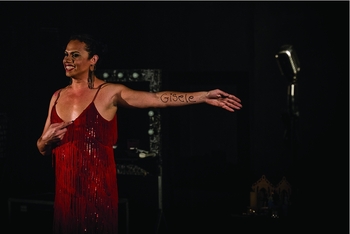
BR-Trans. Photographer: Caique Cunha.

Since 2002, when he created the monologue Uma flor de dama (A Lady's Flower) based on a short story by Caio Fernando Abreu, Silvero (Pereira) has developed the (character) Gisele, a travesti, resulting from his investigation within the theatre collective As Travestidas, in the state of Ceará.Footnote 2 Like a patchwork quilt of real and remembered situations that he experienced during his research in the south of Brazil in 2012, BR-Trans changes Silvero into a body marked by Gisele and by many other ‘girls’ encountered on the journey.
The performance is essentially a chronicle. Written by Pereira, the play casts him simultaneously as narrator and actor, alternating between first- and third-person narration. As listener and observer, the actor transforms onstage into the different transsexuals with whom he lived. The text, based on real events, is projected in the theatre as a personal release. When faced with pain, the audience assumes the role of accomplice, but they are also spectators when shows by travestis appear onstage.Footnote 3
This documentary theatre manages to be relevant and critical, casting light on the life and pain of a part of society that lives with constant exclusion and rejection. On the other hand, although the play carefully selects stories and moves through images and memories, it does not probe deeply into the psychology of the characters; it merely floats above them. Nonetheless, it is a performance of accusation, to be added to current debates surrounding the absurd violence suffered by Brazil's transsexuals.Footnote 4
Silvero executes the staging in the same way that he created the narrative. To stitch together all of the stories and situations encountered in BR-Trans, the directing by Jezebel de Carli opts for a staging produced by the actor. He creates the lighting, the sound design (at several points accompanied by keyboardist Rodrigo Apolinário) and acts as the stage manager. The use of projection in the set design adds to the painful stories, at some points discordant, at others harmonizing with the scene.
The world of trans and travestis is conveyed in the performance by the actor's language, creating tools that touch us through broad gestures and verbal glances. Possessed of an impeccable and precise interpretation, becoming the voice of the first-person narrator of the stories, Silvero presents us with powerful scenes, such as the restrained and emotional reading of a mother's letter to one of the travestis who talks of longing and of the family's difficulties, while never ceasing to reflect on the exclusions and prejudices experienced inside that house. In another scene, the expressive and deep theatricality of the girl who sings ‘Geni e o zepelim’ (Geni and the Zeppelin) sums up her life in an interpretation in which the actor alternates between a bass and treble voice, as a clear metaphor for the ambiguity present in transsexuality and in his relationship with Gisele.Footnote 5