


Introduction
Firms adapt to institutional environments. They can also help produce them. A university seeking to retain its graduates needs employers nearby; a manufacturer recruiting engineers needs a town where their families will want to live, with schools, services, and opportunities whose provision requires cooperation beyond the firm’s own workforce. When those arrangements are missing or inadequate, an organization with the means to act may help build them. This paper calls that activity corporate statecraft.
At national scale, firms encounter legal and institutional orders whose authorship is widely distributed. At regional scale, the work of particular organizations becomes visible. Stanford leased its inalienable land to technology firms under covenants governing tenancy and use. The Cummins Engine Foundation offered to pay architects’ fees for Columbus’s schools under a selection procedure the school board agreed to adopt. In both cases, an organization pursuing its own purposes created arrangements that others could use. Firm interests reached beyond firm boundaries.
Coase’s account of administrative coordination supplies the starting point. A firm brings resources under direction to organize production; establishing land-use rules, civic infrastructure, or arrangements for regional cooperation also requires the participation of people it cannot direct. The firm accepts reduced control in exchange for extended coordination. The question is how it acquires the means and commitment to do so and what kind of order follows.
Four American episodes ground the inquiry: Terman’s Stanford, Miller’s Cummins, the Allegheny Conference’s Pittsburgh, and Jacob Long’s American Woolen. They encompass a university, manufacturers, a foundation, and a corporate coalition, working with public authorities and facing different deficits. Their histories range from arrangements sustained across decades to an unfinished effort to rebuild a manufacturing community.
The political question follows from what these organizations produce. Internal firm governance already allocates authority, resources, and opportunities (Anderson, Reference Anderson2017; Ferreras, Reference Ferreras2017). Corporate statecraft brings that capacity into arrangements affecting residents and independent organizations, including people with no contractual relationship to the producer. The terms on which they participate, and the authority they can exercise over those terms, belong to the political nature of the firm.
Corporate statecraft: theoretical foundations
Coase made the organization of production a question of governance. Where using the price system is costly, an entrepreneur can coordinate activities through administrative direction; the firm’s distinguishing mark is ‘the supersession of the price mechanism’ (Coase, Reference Coase1937: 389). His later discussion of stock and produce exchanges took the inquiry outward: by supplying premises, rules, and procedures to independent traders, exchanges produce the institutions of a market whose transactions they organize without bringing the traders’ businesses under their own administration (Coase, Reference Coase1992: 718). Private organizations can produce conditions for coordination beyond their own operations. Corporate statecraft extends that inquiry to the scale of a place.
The distinction between institutional environment and institutional arrangement gives this extension its object (Davis and North, Reference Davis and North1971; North, Reference North1990). In Williamson’s four-level framework, formal rules constitute the environment at Level 2, while the arrangements governing transactions occupy Level 3. He also recognizes upward feedbacks, which his analysis chooses to ‘mainly neglect’ (Williamson, Reference Williamson2000: 596–598). A covenant that becomes a municipal land-use rule makes such a feedback visible: an arrangement devised for particular transactions helps constitute the terms of subsequent transactions. The question moves from how organizations govern exchanges to how they produce conditions under which others exchange.
Langlois connects those conditions to the changing scope of the firm. Dynamic transaction costs include ‘the costs of not having the capabilities you need when you need them’ (Langlois, Reference Langlois1992: 99). In his account of the vanishing hand, activities brought under corporate administration when markets could not supply the required capabilities become available for external coordination as specialized providers and the institutions supporting their exchanges develop around them (Langlois, Reference Langlois2003). Market development changes the scope of the firm. For an organization whose aims depend on that development, building the supports outside itself can become an alternative to waiting for them: Stanford could organize advanced education and hold land while relying on independent employers to make both part of a local industrial community. The university gained from what remained outside its control.
Independent organizations can sustain demanding cooperation without coming under common ownership. Holmström and Roberts (Reference Holmström and Roberts1998) show that ownership is one of several instruments through which organizations address problems of coordination, knowledge, and incentives. In the collaborations studied by Helper et al., (Reference Helper, MacDuffie and Sabel2000) and Gilson et al., (Reference Gilson, Sabel and Scott2009), firms exchange information about their capacities and monitor work in progress, learning enough about one another to sustain joint production while retaining separate ownership of the resources they contribute. That same ability to cooperate can support the production of shared infrastructure, property-use rules, or procedures for collective decisions. A hybrid arrangement may be the instrument. Corporate statecraft concerns the institutional conditions it produces for a wider set of actors.
North’s organizations participate in changing their institutional environment, guided in part by beliefs about how the world works (North, Reference North1990, Reference North2005). Organizational institutionalism likewise brings environmental constraint and purposive agency into the same inquiry (Battilana et al., Reference Battilana, Leca and Boxenbaum2009; DiMaggio, Reference DiMaggio and Zucker1988; Powell and DiMaggio, Reference Powell and DiMaggio1991). The production of a regional order is one form that agency can take. At this scale, the influence that Hall and Soskice (Reference Hall, Soskice, Hall and Soskice2001) expressly allow to large firms becomes traceable through a covenant, a funding rule, or a coalition whose terms show which resources the organization commits and which powers it must share with others.Footnote 1 The work can begin within an established institutional field, as it did in Columbus, or supply supports for an emerging industry. Its distinctiveness lies in the organizational means committed to the task.
A firm is an organization coordinating productive resources through administrative direction; the comparison applies that Coasean definition to private organizations with different purposes and legal forms. Stanford is a university; Cummins is a manufacturer acting partly through a separate foundation; the Allegheny Conference is a corporate coalition; American Woolen is a proprietor-led manufacturer. Each possesses assets, decision rights, administrative capacity, and continuity, while its legal form determines what it can own, require, and sustain. The mechanism is shared; the authority through which each organization acts remains specific to it.
The organizational boundary marks the reach of its own administrative decision rights. A lease binds a tenant to terms of use while leaving the tenant in command of its business. A conditional grant can shape a school’s design while leaving the school board’s public powers intact. Beyond its hierarchy, an organization coordinates through contracts, agreed rules, and cooperation with public authorities. Other actors retain powers of their own.
The resulting institutional environment comprises locally operative rules and arrangements sustaining shared capabilities: property-use covenants, public-building standards, infrastructure, educational provision, and procedures for collective decisions. Their reach matters. Training employees supplies a firm’s operations; a coalition in which independent educators and employers govern provision establishes terms beyond any one value chain. The pattern of rules, authority, and access constitutes an institutional order. Institutional production purposively creates an identifiable part of it. Other actors can extend an instrument’s uses as the regional economy develops.
Corporate statecraft is the purposive production of a place’s institutional order by a private organization.Footnote 2 It differs from lobbying because the organization commits its own resources and instruments to making an arrangement, while lobbying seeks decisions from public rule-makers. Regulatory capture directs public decisions toward particular interests (Peltzman, Reference Peltzman1976; Stigler, Reference Stigler1971); statecraft identifies the work of producing an arrangement, whose distributional effects remain open to examination. Corporate political activity encompasses efforts to influence public policy (Hillman et al., Reference Hillman, Keim and Schuler2004). A coalition can lobby, capture, and produce within the same history; the distinction concerns what it does in each instance. Environmental, social, and governance commitments may motivate institutional production; their presence alone establishes neither what was built nor who governs it. Research on private authority shows how standards and rules govern beyond the state (Bartley, Reference Bartley2018; Büthe and Mattli, Reference Büthe and Mattli2011; Cutler, Reference Cutler2003). Corporate statecraft connects those powers to the resources, purposes, and territorial commitments of the producing organization.Footnote 3
A manufacturer recruiting engineers may need schools its hierarchy cannot provide. Its future gives it a reason to help produce arrangements that benefit others. Shared benefits encourage participation while also creating the collective-action difficulties Olson (Reference Olson1965) identified. A producer must have enough at stake to begin and enough capacity to secure the cooperation on which provision depends. When the resulting arrangements determine participation, authority, and the distribution of costs and benefits, their production is political.
Method
Inference and comparison
Abduction develops an explanation for an observation that existing accounts leave puzzling. In philosophy of science, it is commonly described as inference to the best explanation: a hypothesis deserves consideration because, if true, it would make the observation intelligible. Its warrant depends on comparison with the evidence and with alternative explanations. In qualitative inquiry, this means moving between empirical material and theoretical concepts, allowing an encounter with the record to change the question brought to it (Dubois and Gadde, Reference Dubois and Gadde2002; Timmermans and Tavory, Reference Timmermans and Tavory2012).
Coase’s American journey illustrates this way of working. During his travelling-scholarship year, he studied the vertical and lateral integration of American industry and asked why administrative coordination existed alongside the price mechanism. By the summer of 1932, he had arrived at the proposition that using the price system has costs. He presented it in a lecture that year; The Nature of the Firm followed in 1937 (Coase, Reference Coase1992). The concepts guiding the present inquiry similarly direct attention to organizational action while leaving its relationships open to discovery. They are sensitizing concepts in Blumer’s (Reference Blumer1954) sense. The cases come before the comparative framework, and the generalization proceeds from cases to theory (Eisenhardt, Reference Eisenhardt1989; Yin, Reference Yin2018).
The inquiry therefore takes an episode of institutional production by an identifiable organization as its unit of analysis. Reconstructing an episode means identifying what was missing, the means available to an organization, and the decision to commit to them and then examining how other actors accepted, resisted, or revised the arrangement and what happens when the initiator leaves. A region’s prosperity brings additional causes into the account. The dated production of a covenant or coalition can be established with greater precision than its contribution to growth, and the explanation must preserve that difference (Small, Reference Small2009).
Comparison requires variation: the four episodes were selected for differences in organizational form, institutional deficit, period, and maturity, using a diverse-case design (Seawright and Gerring, Reference Seawright and Gerring2008). Stanford sought local supports for an emerging technology economy. Columbus had an established civic order whose educational and cultural provision fell short of a manufacturer’s recruitment needs. The Conference initially confronted fragmented coordination of Pittsburgh’s environmental improvement and redevelopment; steel’s later collapse tested the durability of the industrial order. Stafford Springs combines the loss of skills and suppliers with a development commission unable to function consistently. These histories permit comparison of different tasks, including the creation of new arrangements and the restoration of existing ones.
Stanford and Columbus permit reconstruction across leadership transitions. Pittsburgh permits comparison within one region between company provision, a corporate coalition, endowed foundations, and rules persisting in law. Stafford permits observation while the wider project is still unsettled. The variation concerns both how arrangements begin and how far their functions have become independent of the people who began them.
Across these differences, the American setting supplies a common national context. Its liberal political economy gives firms substantial responsibility for securing complementary capabilities (Hall and Soskice, Reference Hall, Soskice, Hall and Soskice2001). Within that setting, state and local institutions, federal policy, and historical conditions vary. Public participation enters every case through particular resources and powers: federal research patronage, public schools, municipal redevelopment, or state finance and local appointment. The comparison examines how private organizational action works through those relationships. Other capitalist democracies offer different employer organizations, public capacities, and restrictions on private authority; their effects belong to the comparative programme this inquiry opens.
Evidence, attribution, and commitment
The evidence for each episode includes the instruments and decisions through which an arrangement was made. A covenant records both a property transaction and a decision about the activities permitted on the land; a conditional grant records an expenditure and the procedure another institution must accept to obtain it. When a school board refuses an offer or a zoning proposal goes to a vote, the decision makes the reach of private initiative visible alongside the powers others retain, allowing legal instruments and business decisions to be read together as evidence of institutional production. Their terms establish powers and obligations; participants’ accounts explain the purposes for which those powers were used.
Accounts explain purposes, traces record commitments, and sequences connect them to subsequent decisions; together they supply process evidence (Beach and Pedersen, Reference Beach and Pedersen2013). Columbus rests principally on published institutional histories and participants’ statements reproduced in Bower and Norris (Reference Bower and Norris2014) and Cruikshank and Sicilia (Reference Cruikshank and Sicilia1997). Stanford adds addresses, manuscripts, and the lands zoning campaign record consulted in the Frederick E. Terman Papers.Footnote 4 Pittsburgh and Stafford Springs add interviews conducted in Reference Lécuyer2025 and 2026 with corporate, civic, and foundation principals. Observation at American Woolen informs the mill narrative; Stafford’s ordinance and development commission minutes record the town’s institutional activity. The source lists identify these materials. Retrospective testimony gives access to participants’ reasoning, while contemporaneous records show the terms and sequence of decisions. Where an account of influence exceeds an office’s formal powers, the distinction remains part of the explanation.
Reading these sources together makes attribution specific to the instrument. Stanford’s covenants preceded municipal zoning, but voters and public authorities determined whether the proposed rules would acquire public force. In Stafford, buying the mill, receiving state support, and taking a public appointment conferred different powers at different dates. The same principle distinguishes related activities outside the four cases. Route 128 developed through many contributions, including Massachusetts Institute of Technology’s research contracts and American Research and Development’s venture capital; particular interventions can be examined without attributing the regional order to a single designer. The Bay Area Council’s campaign for transit helped secure a system constituted and operated by public authorities. Berlin’s account of Silicon Valley’s trade association and consortium likewise traces federal petitions, trade proceedings, and defence authorization; the proposed joint manufacturing operation was abandoned as almost certainly unlawful (Berlin, Reference Berlin2005: 260, 267, 281–282, 285). Advocacy for institutional order, its contractual organization, and its production by public authorities can occur within the same history.
State authorship and unplanned accretion are assessed through those decisions. Public finance may enable a privately devised arrangement, while legislation may constitute one advocated by business; identifying who set its operative terms, contributed resources, and retained authority over its use makes the division of work visible. Chronology establishes which act came first, while a claim that public support was dispensable would require further evidence. Agglomeration can also extend an initiative’s reach as new firms and workers arrive. That growth supplies context for the arrangement’s regional significance; evidence of the initiator’s purpose must come from its own decisions and records.
Attribution also requires an organizational commitment through which individual agency becomes traceable. Terman could act through university offices, land, and educational programmes; Miller through ownership, company resources, and a foundation. The school board’s refusal and the education coalition’s redesign show how other principals limited corporate direction. Foundations with separate assets show how a commitment can survive the person who made it. In Pittsburgh, the Conference’s changing membership and partnerships reveal organizational continuity alongside substantial change in the postwar bargain among corporations, city government, and the steel union. At American Woolen, the relationship between Long’s initiative, the company’s resources, and his public appointment is still taking shape.
Deficits, capability, and outcomes
The resulting sequence permits deficit and capability to be assessed before the outcome. Evidence of a deficit includes a lost skills pipeline, a documented gap in collective services, or a body unable to perform its assigned coordinating function. The question is which shared arrangement is required and whether an existing provider can supply it within a useful period. Price or quality dissatisfaction alone supplies no answer. Capability, in turn, is assessed through the assets, expertise, decision rights, and finance available for that task. An organization’s later achievement cannot establish retrospectively that it possessed all the means beforehand. This separation makes an unsuccessful initiative analytically useful: it can reveal a task for which resources existed in the region but could not be organized.
The four principal cases concern initiatives in which at least part of the intended arrangement was established. Terman’s New Jersey project supplies a documented failure to establish the intended arrangement. In 1966, he proposed a graduate institute financed by, and linked to, the region’s corporate laboratories. Scientific talent was abundant, but research remained enclosed in competing firms; Esso, Mobil, and Merck declined to participate. The proposed institute began in rented premises, without an asset base comparable to Stanford’s, while Princeton preferred a landlord’s role to the developmental one envisaged for it. The intended university–industry arrangement did not materialize (Leslie and Kargon, Reference Leslie and Kargon1996: 443–451).
Terman’s work in Asia involved different organizational arrangements. The Korean state endowed the institute designed with his participation and established its position through a special law (Korea Advanced Institute of Science, 1971: 6–7; Leslie and Kargon, Reference Leslie and Kargon1996: 461–465). He presented his model in Taiwan in 1968; the state’s later Hsinchu science park endured a long initial period before returning engineers helped accelerate its development (Saxenian and Hsu, Reference Saxenian and Hsu2001: 905, 908; Terman, Reference Terman1968). A region can possess abundant resources, while an organization within it remains unable to assemble the means its project requires. Public authority, incentives, finance, and commitment also differ across these settings, so their contrast cannot isolate capability as a single cause.
Failure after an initiative begins raises a further question. Columbus’s first education coalition was rejected and redesigned; Pittsburgh’s redevelopment supplied public improvements with selective benefits; American Woolen’s wider institutional projects remain unfinished. Establishment, continuity, and prosperity are distinct outcomes. Industry structure, timing, federal support, resources, the severity of deindustrialization, and selective outmigration all enter the Stanford–Pittsburgh comparison alongside orientation. The within-case sequences support judgments about particular acts, participation, and continuity. Estimating the frequency of statecraft, or the independent effect of openness on regional prosperity, requires a wider set of successful and unsuccessful attempts. The framework specifies relationships that such a comparison can examine.
Four stories
Terman’s Stanford
Stanford’s Founding Grant of 1885 prohibited the sale of its endowment lands. The university owned roughly 8000 acres, much of it the former Palo Alto Stock Farm, whose use would connect its finances to the development of the surrounding region (Gillmor, Reference Gillmor2004).
Frederick Terman wanted Stanford’s graduates to be able to stay in California. Through the 1930s, he had watched them leave for radio and electronics firms in the East. ‘The best students that came out of my laboratory at Stanford were forced to go East if they were to obtain jobs commensurate with their qualifications’, he recalled (Terman, Reference Terman1974). Keeping them would require employers, advanced training, and connections between the university’s research and the industries that could use it. Terman set out to build those connections.
He returned to Stanford in 1946 after directing Harvard’s wartime Radio Research Laboratory, where more than 800 people had worked on countermeasures to German radar, an experience that had taught him how to organize and finance a large technical enterprise. Now dean of engineering, and from 1955 provost, he could apply that experience through university offices with authority over appointments, programmes, and resources. Federal research spending was expanding what universities could undertake.
In 1951, needing operating income from land it could not sell, Stanford established what became the Industrial Park and began leasing parcels to technology firms, retaining ownership and using covenants to govern tenancy and the uses to which the land could be put. Varian Associates signed the first 99-year lease that year and moved in by 1953. Hewlett-Packard and Lockheed followed (Gillmor, Reference Gillmor2004). Federal contracts gave firms reasons to expand, while Stanford’s leases gave their expansion a location and continuing terms. An inherited restriction on sale became a means of organizing the university’s relationship with industry.
Proximity created an opportunity for interaction. Terman’s ‘community of technical scholars’ joined a university strong in engineering and science to surrounding research companies through formal and informal relationships (Terman, Reference Terman1974). The Honors Cooperative Program let engineers at those firms pursue Stanford degrees while working, connecting continuing education to employment in the region (Gillmor, Reference Gillmor2004). Faculty policy supported the same purpose. Terman concentrated resources in fields such as microwave electronics and solid-state physics, building ‘steeples of excellence’ that attracted firms in need of those capabilities; the firms employed the university’s graduates and sent working engineers back through the cooperative programme (Terman, Reference Termann.d.). Each investment increased the usefulness of the others.
Competing firms could participate in this community, and engineers could change employers or start businesses of their own. For Stanford, that mobility helped sustain the larger labour market on which its ability to retain graduates and attract faculty depended. A graduate who left one employer could remain in the region. The university gained from opportunities it did not control. Openness served the organizational purpose for which Terman had built the arrangements.
Residents brought a different interest to the same land. In the late 1950s, Palo Alto homeowners opposed the park’s proposed expansion toward the foothills, and the rezoning it required went to the electorate in November 1960. Stanford retained political consultants, supported a citizens’ committee, and sent a university mailer to the city’s households. Voters approved the proposal (Stanford Lands Zoning Issue file, 1958; O’Mara, Reference O’Mara2005: 137–138). Standards first expressed in private covenants acquired public force through municipal zoning. In 1969, the Committee for Green Foothills sued Stanford and Palo Alto over development near Coyote Hill; the litigation led to a settlement protecting the hill as open space for decades (Kaufman, Reference Kaufman2024). Entry into the research community had been relatively open; authority over the land remained a matter of political contest.
By 1990, the region held about 267,000 technology jobs, against roughly 150,000 around Massachusetts’s Route 128 (Saxenian, Reference Saxenian1996). Federal patronage, engineering communities, and independent entrepreneurs contributed to that development alongside Stanford.Footnote 5 Terman himself told a business audience in 1974 that ‘this development was not triggered by Stanford Research Institute, Stanford Industrial Park, Stanford University, or even by F. E. Terman’ (Terman, Reference Terman1974). His university’s contribution can be specified without assigning it authorship of an entire region: it established tenure and use of land, access to advanced teaching, and continuing connections between research and employment. Those arrangements survived his death in 1982. The community had acquired purposes and participants beyond its initiator.
Miller’s Cummins
In Columbus, Indiana, in 1919, a mechanic who had never finished high school persuaded the town’s leading banker to finance his diesel engine. Clessie Cummins brought mechanical ingenuity to the venture; William G. Irwin supplied its 50,000 dollars of initial capital. The money backed an experimental undertaking whose commercial viability was still to be established. Irwin gave Cummins time to develop it before the company could pay its way. The Irwin-Miller family continued financing the business through repeated losses and the Depression, until it earned its first profit in 1937. Nearly two decades of patient capital gave the engines time to become a business (Cruikshank and Sicilia, Reference Cruikshank and Sicilia1997). The same ownership would give the business time to invest in its town.
J. Irwin Miller joined Cummins in 1934 after studying at Yale and Oxford. A manufacturer with international ambitions had to recruit skilled people to a small Indiana community, and a job offer could answer only part of what they would ask about living there. Schools, libraries, and civic life mattered to engineers and their families. Miller made their improvement part of the company’s strategy, using the resources and long-horizon family ownership allowed.
On 16 December 1957, the president of the school board read Miller’s offer to his trustees. The Cummins Engine Foundation would pay architects’ fees for future school buildings, provided that the board requested assistance, selected a different architect for each building from a list of six architects of national standing, and retained the chosen architect for any additions. A jury of three senior architects later prescreened the list. The board approved unanimously (Cruikshank and Sicilia, Reference Cruikshank and Sicilia1997: 181). Public authorities would build and operate the schools; the foundation would finance design under a selection procedure of its own.
The programme spread to fire stations and libraries, bringing work by Eero Saarinen, I.M. Pei, Robert Venturi, Richard Meier, Cesar Pelli, and Harry Weese. Columbus became known as ‘the Athens of the prairie’ (Cruikshank and Sicilia, Reference Cruikshank and Sicilia1997: 320).Footnote 6 Behind the buildings stood a recurring commitment: from the 1950s, Cummins allocated 5% of pretax profits to charitable causes, the maximum share then deductible under the tax code. In the 1970s, only Cummins and Dayton Hudson among Fortune 500 companies gave at that rate (Cruikshank and Sicilia, Reference Cruikshank and Sicilia1997: 4, 320). Continuing finance allowed the selection procedure to shape successive public projects.
The board’s right to ask also left it free to refuse. In 1974, it declined the foundation’s architects, preferring, in one member’s words, to ‘just once try a building on our own’ (Cruikshank and Sicilia, Reference Cruikshank and Sicilia1997: 323). Miller accepted the decision. His later account was direct: ‘We waited to be asked’ (Cruikshank and Sicilia, Reference Cruikshank and Sicilia1997: 236). The foundation could make a demanding offer; it could not make the town accept.
The education coalition made the cost of overlooking that distinction explicit. In the mid-1990s, business leaders convened a Community Education Coalition to align local education with the economy’s needs. Educators rejected the arrangement. It ‘was seen as businesspeople telling educators what to do without listening to the educators’ voices’, one recalled (Bower and Norris, Reference Bower and Norris2014). When the coalition was refounded in 1999, superintendents, chancellors, the mayor, and concerned citizens entered alongside business as principals, giving the educators whose cooperation the undertaking required a part in deciding what it would do and how it would work. By 2010, five of its 25 board members were or had been Cummins people. Cummins gained coordination by sharing control.Footnote 7
The company could still bargain from its economic position. In 2010, it made an engine-line expansion in nearby Seymour conditional on improvements to schools and redirected part of the state’s incentives into seed money for an education coalition (Bower and Norris, Reference Bower and Norris2014). The expansion, the public support, and the coalition served connected purposes, but each required a different decision. Cummins could choose where to invest. Sustained educational provision required the state and educators to act with it.
Miller died in 2004. The architecture programme and coalition continued, and Cummins remains headquartered in Columbus. The buildings retained their use without further direction from Miller; further architectural commissions still required the foundation’s finance. The coalition had acquired an organization and governing participants of its own. These are different forms of continuity within the same history. Cummins’s commercial growth accounts for much of the town’s employment and income. The 1957 offer, the board’s refusal, and the coalition’s redesign show how the company also helped create rules through which a manufacturer and a community could act together.
The Allegheny Conference’s Pittsburgh
The Allegheny Conference began with smoke, flooding, and a fragmented capacity to address them. ‘This was the most polluted place on the planet’, Bill Flanagan says of the Pittsburgh that prompted its business leaders to organize (Flanagan and Heuck, Reference Flanagan and Heuck2025). Wartime planning led to the Conference’s incorporation in 1944, giving previously dispersed civic efforts a continuing organization (Allegheny Conference on Community Development, n.d.).Footnote 8 Richard King Mellon, whose family holdings extended across Western Pennsylvania’s leading enterprises, and David Lawrence, the city’s postwar Democratic mayor, became the principals of the resulting coalition.
Membership was by invitation. The original by-laws required each member corporation to be represented by its chief executive or president in person, bringing together people able to commit the firms’ resources (Madison, Reference Madison, Frischmann, Madison and Sanfilippo2023). Representation was attached to an office, giving the undertaking a continuing link to corporate decision-making beyond the tenure of any individual executive. Mellon and Lawrence’s partnership joined this private capacity to municipal authority. The programme became known as the Renaissance. The Conference could agree on priorities and mobilize resources; elected government supplied the public powers the projects required.
David Roger, president of the Hillman Foundation, describes ‘Richard King Mellon working with Mayor Lawrence to put together what was really a public–private partnership before anybody called it that’ (Roger and Gonzalez, Reference Roger and Gonzalez2025). Madison’s (Reference Madison, Frischmann, Madison and Sanfilippo2023) account examines in that vocabulary an arrangement already being practiced in the 1940s. The by-laws and ordinances record its governing work as it took shape.
Smoke-control ordinances improved the air, flood-control works protected the river valleys, and redevelopment transformed the Golden Triangle, downtown Pittsburgh’s business district between the Allegheny and Monongahela rivers. The United Steelworkers joined the corporations and city government in a postwar settlement and placed their headquarters in Gateway Center. Benefits reached beyond the corporate membership, while membership and agenda-setting remained concentrated in the boardrooms. Critical histories trace investment in some sectors, spaces, and people at the expense of others (Vitale, Reference Vitale2015). The partnership was ‘not of all, but of some’ (Deitrick and Briem, Reference Deitrick and Briem2021: 200), operating within a city whose established Democratic dominance also shaped the possibilities for political competition.
Steel’s collapse put this settlement under a strain its founders had not faced. From 1980 into the early 1990s, about 300,000 people left the metropolitan area. Douglas Heuck describes many as ‘the risk-takers’; seniority rules dismissed younger workers first, reinforcing the demographic sorting. Flanagan calls the aftermath ‘the decade of denial’, when the region waited for mills that would not reopen (Flanagan and Heuck, Reference Flanagan and Heuck2025). The speed of closure and the departure of younger workers made the search for a successor economy harder.
The difficulty had an earlier industrial basis. Chinitz (Reference Chinitz1961) showed how a region dominated by a few oligopolistic employers generated fewer entrepreneurs and less receptive capital than one organized around smaller, competitive firms. Pittsburgh could assemble great financial resources and coordinate established companies while remaining poorly equipped to generate new ones. The Conference’s capability and the region’s entrepreneurial capability were different. Their separation helps explain why effective coordination of incumbent wealth could coexist with a difficult economic transition.
Company withdrawal also exposed the dependence of particular services. In some communities, Flanagan recalls, ‘the municipal water system was operated by the steel mill, or the electrical plant was operated by the steel mill’ (Flanagan and Heuck, Reference Flanagan and Heuck2025). When industrial operations ended, the support for those services went with them. Municipal boundaries endured: Allegheny County’s 130 municipalities include communities incorporated around plants to preserve local control. The law kept those divisions in place after the industrial activity that had helped produce them declined.
Endowed foundations preserved a different inheritance. Mellon, Carnegie, Heinz, and Hillman wealth had been vested in bodies with assets and charters of their own. They sustained cultural institutions, supported computer science at Carnegie Mellon, and helped redevelop Hazelwood. In 2021, the Richard King Mellon Foundation committed major grants to robotics and biomanufacturing (Gilman, Reference Gilman2025; Richard King Mellon Foundation, 2021a, 2021b; Roger and Gonzalez, Reference Roger and Gonzalez2025). The resources had acquired an organizational life beyond the firms and individuals from which they came.
The Conference continued too, developing new partnerships and regional initiatives after the steel crisis (Allegheny Conference on Community Development, n.d.). Its changing role belonged to a wider weakening of the locally rooted corporate elite (Mizruchi, Reference Mizruchi2013). Pittsburgh’s technology leaders describe an economy in which more than 200 robotics and artificial-intelligence companies and substantial university research coexist with shortages of patient capital and broad coordination, leaving the work of connecting these resources to sustained regional development unfinished (Pittsburgh Robotics Network, 2025).
The institutions that endured also brought new questions of distribution. By 2021, roughly a fifth of city property was privately owned but tax-exempt. Successive mayors pursued litigation or voluntary contributions without securing a durable fiscal settlement (Allegheny County Controller and City of Pittsburgh Controller, 2022; PublicSource, 2022, 2023). Foundations could retain the capacity to invest while the city struggled to settle how its institutional anchors should contribute to public services. Durability did not settle accountability.
Within one regional history, endowed resources survived their original owners, a coalition adapted, company-supported services lost their base, and municipal divisions persisted in law. The location of resources and authority helps explain those different outcomes. The Renaissance’s selective benefits also reflected choices about who could set priorities. Pittsburgh’s later economic difficulties arose through those institutional arrangements together with an industrial and demographic transformation no local coalition could command.
Long’s American Woolen
Outside the Warren Mills, the smell of lanolin reaches the parking lot. Inside, at the headwaters of the Willimantic River, wool has been turned into cloth since 1853. Jacob Long bought the mill in 2014, committing essentially everything his family had to the venture. ‘It’s not just a business project – it’s become a life mission’, he says (Long, Reference Long2025–Reference Long2026). The operation had belonged to Loro Piana before LVMH acquired an 80% stake in the Italian company in July 2013. The previous owner’s withdrawal left one of the country’s few integrated woolen mills without a continuing place in its strategy (Kurutz, Reference Kurutz2025).
The machinery survived. The workforce and supplier network needed rebuilding. ‘There isn’t any pipeline’, Long says. ‘We are the pipeline. When it comes to woolen textiles, we’re basically rebuilding an industry that had vanished in this region’ (Long, Reference Long2025–Reference Long2026). Apprentices begin with one machine and develop specialization as they learn. This restores the mill’s ability to produce; restoring a regional labour market would also require skills to reproduce and circulate among independent employers.
Long envisages a corridor of boutique manufacturers across Connecticut, Massachusetts, and New York, cutting outerwear, denim, and knitwear from regionally produced cloth. He has discussed it with the U.S. Small Business Administration, the federal agency supporting small businesses. The missing capacity is tangible: in 2023, roughly 78% of the mill’s cloth was being sent to China for sewing because regional cutting and stitching capacity had disappeared (Stafford Free Press, 2023). A sewer-capacity constraint, with expansion estimated at 15–17 million dollars, also limits what Stafford can accommodate (Stafford EDC Minutes 2023). The mill’s commercial prospects reach into problems of regional supply and public infrastructure.
Stafford already had a body charged with economic development. Established in 2004, its commission has nine members appointed by the selectmen, an annually designated chair, and advisory powers of research, recommendation, and coordination (Town of Stafford Ordinance 1–7). By 2024, meetings repeatedly failed for lack of a quorum. Only one member attended a May 2025 revival meeting (Alfano, Reference Alfano2025; Stafford Free Press, 2025a). The selectmen filled vacancies and appointed Long chair after nobody else sought the role (Stafford Free Press, 2025b). The commission then joined the state’s Main Street programme, sought restoration of its budget, coordinated with Planning and Zoning, and established working subcommittees (Stafford EDC Minutes 2025a, 2025b, 2025c).
As chair, Long exercises public powers that are advisory, annual, and revocable. The mill’s property, contracts, training, and investment remain private organizational resources. His initiative connects them to the commission’s work, while authority over that work belongs to a public body. Public participation also preceded the appointment: Connecticut supplied a job-creation loan and matching grant in 2014, following his commitment to the mill (Stafford Free Press, 2025b). The venture has developed through private investment and public support from its beginning.
Long is trying to build a firm and restore the conditions for an industry. Buying the mill and training employees establish the firm’s productive capacity; a supplier corridor would give independent producers a continuing part in a regional arrangement. The move toward corporate statecraft lies in committing organizational resources to that wider undertaking. Its realization remains partial. The mill has reopened, apprentices learn, and the public commission has resumed activity; the proposed supplier network and durable regional order remain projects. Their future still depends heavily on Long, and his public appointment gives him no private authority over the town. Stafford Springs makes visible the distance between an entrepreneur’s commitment and an institutional order able to continue beyond him. The transfer from a departing conglomerate to an arriving proprietor turned the same mill into the base of a renewed commitment to Stafford Springs.
The corporate statecraft framework
A shared institutional deficit becomes an organizational undertaking when a producer can mobilize the means to address it and has reason to commit them. The four histories connect that undertaking to institutional deficit, organizational capability, activation, and embeddedness by design. The arrangements that follow vary in their instruments, access, and distribution of authority. Their continuity depends on where the work of sustaining them resides.
A vacuum is a graded deficit in the arrangements required for a specified activity. Its degree depends on the breadth and depth of the shortfall: how many essential arrangements are missing, how inadequately existing ones function, and whether another provider can supply a remedy within the relevant horizon. Other conditions equal, a training pipeline with insufficient capacity presents a smaller deficit than its disappearance. Absence, thinness, failure, and abandonment describe histories and contents of deficit, rather than four levels of severity. A town can possess a legally constituted development commission and still lack functioning coordination. The threshold is reached when addressing the shortfall requires creating or rebuilding a shared arrangement. A preference for cheaper inputs or more favourable rules is insufficient.
Organizational capability connects a task to the means available for performing it. Penrose (Reference Penrose1959) distinguishes resources from the services an organization can obtain from them. Stanford’s land could support an industrial park because the university could lease it and organize complementary education. Capability therefore combines task-specific knowledge, authority to deploy resources, finance, and the ability to sustain the undertaking. A threshold is relational in this practical sense: the organization must assemble the combination the particular deficit requires. A more severe deficit increases the need for production while also increasing what the producer must supply. Abundant resources somewhere in a region may still leave the undertaking beyond an organization’s reach.Footnote 9
Activation is the decision to apply that capability to an institutional purpose beyond the organization’s hierarchy. Selznick’s (Reference Selznick1996) account of value-infusion explains how organizations acquire purposes exceeding their immediate technical tasks. Those purposes enter the world through commitments: Stanford’s park arrangements, the foundation’s funding rule, a continuing coalition. Stanford held its restricted land long before Terman put it to industrial use. Long’s mill purchase similarly supplied a base for action; internal training alone supplies the firm’s own operations. Activation toward statecraft occurs when organizational resources are committed to an arrangement for independent users.
Commitment also changes the producer’s relationship to place. Streeck’s (Reference Streeck, Hollingsworth and Boyer1997) beneficial constraints show how limits on short-term choice can support productive capacities. What if an organization chooses to bind its future more closely to its community? Granovetter (Reference Granovetter1985) makes the social relations within which economic action occurs central to its explanation. Embeddedness by design identifies an organization’s deliberate adoption or reinforcement of commitments within those relations. Terman inherited Stanford’s prohibition on land sales; the university’s long leases extended its obligations under that constraint. Patient ownership and continuing community investment can likewise make future returns depend on a place’s development. The organization gives others a reason to expect it to remain involved.
That expectation requires more than local size or expenditure already sunk. A past loss cannot make staying preferable to leaving. Credibility rests on prospective benefits tied to place, obligations to others, and value that withdrawal would sacrifice. Asset redeployability, ownership, contracts, and continuing investment make these commitments observable before their outcome. They vary in strength: Stanford’s inalienable land imposed a different constraint from Pittsburgh corporations’ voluntary involvement, and Cummins’s commitment never made relocation legally impossible. The investments also serve productive purposes; raising withdrawal costs need not be their sole aim.
Williamson’s (Reference Williamson1983) hostage metaphor describes a promise backed by a pledge that a counterparty can retain after defection. Commitment to place can create a comparable incentive when withdrawal would sacrifice the producer’s future benefits from local assets and relationships. The resulting order can endure beyond that commitment: resources may be vested in autonomous bodies, and rules may continue to bind after the producer leaves. These arrangements sustain institutional functions through resources and authority committed during production; withdrawal entails no corresponding forfeiture of a pledge to a counterparty.
The deficit helps explain the instrument: tenancy rules organize access, shared programmes supply capabilities, and coalitions sustain cooperation. Open and closed orientations describe who can enter and who can influence decisions. Open orientation broadens access or shares voice; closed orientation restricts them to selected participants. The two dimensions can differ within one undertaking: Stanford welcomed competing firms while residents contested its control of land. Encoding identifies where continuing functions reside: the producer, an autonomous organization, an enforceable rule, or a public body. An endowment can sustain action; a legally constituted commission can remain inactive without members or resources.
Olson’s (Reference Olson1965) privileged-group logic explains how concentrated stakes can sustain provision when a member gains enough to bear its costs despite free-riding. Pittsburgh’s leading corporations shared regional interests, and the Conference’s by-laws placed their executives in charge. Restricted membership connected contribution to control of the agenda. In Columbus, educators rejected the first Community Education Coalition; its 1999 refounding admitted them as principals alongside business. Cummins could help finance the undertaking, while educators gained authority over its direction. Sharing control made cooperation possible.
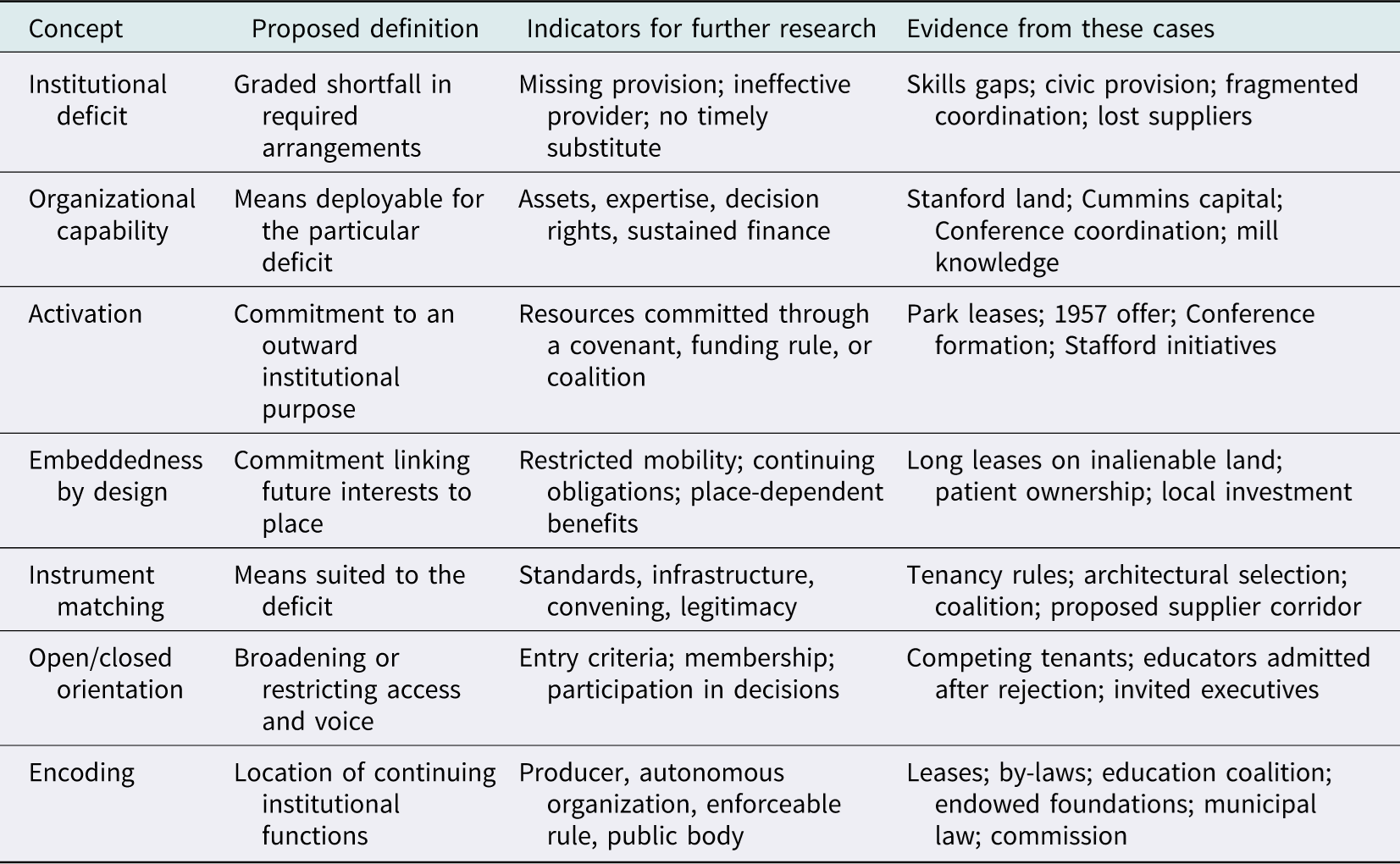
The comparison proposes relationships for further investigation (see Table 1). Production should be more likely where a consequential deficit meets deployable capability, outward activation, and durable interests in place; its instruments should track the deficit. Continuity should strengthen when resources and authority survive the initiator. Open orientation may help by giving other actors a stake in sustaining the arrangement, while limiting the producer’s discretion. Wider comparison can establish when that exchange supports durability.
Corporate statecraft: proposed concepts and their empirical grounding

Table 1. Long description
A table with six rows and five columns. The columns are labeled Concept, Proposed definition, Indicators for further research, and Evidence from these cases. The rows are labeled Institutional deficit, Organizational capability, Activation, Embeddedness by design, Instrument matching, Open/closed orientation, and Encoding. Row 1: Institutional deficit, Graded shortfall in required arrangements, Missing provision; ineffective provider; no timely substitute, Skills gaps; civic provision; fragmented coordination; lost suppliers. Row 2: Organizational capability, Means deployable for the particular deficit, Assets, expertise, decision rights, sustained finance, Stanford land; Cummins capital; Conference coordination; mill knowledge. Row 3: Activation, Commitment to an outward institutional purpose, Resources committed through a covenant, funding rule, or coalition, Park leases; 1957 offer; Conference formation; Stafford initiatives. Row 4: Embeddedness by design, Commitment linking future interests to place, Restricted mobility; continuing obligations; place-dependent benefits, Long leases on inalienable land; patient ownership; local investment. Row 5: Instrument matching, Means suited to the deficit, Standards, infrastructure, convening, legitimacy, Tenancy rules; architectural selection; coalition; proposed supplier corridor. Row 6: Open/closed orientation, Broadening or restricting access and voice, Entry criteria; membership; participation in decisions, Competing tenants; educators admitted after rejection; invited executives. Row 7: Encoding, Location of continuing institutional functions, Producer, autonomous organization, enforceable rule, public body, Leases; by-laws; education coalition; endowed foundations; municipal law; commission.
Note: Definitions and indicators are proposed research tools; case evidence grounds their construction and does not independently test them.
The political nature of the firm
A firm that helps determine who may enter a labour market, how a school is designed, or which industries a town can sustain participates in governing a place. A decision that begins with recruitment, research, or the survival of a mill can establish opportunities and obligations for people who work elsewhere, run other organizations, or simply live in the community whose arrangements the producer has helped to determine. The organizational purpose can be private; the function is political.
Governing a firm already involves power over others. Chassagnon’s (Reference Chassagnon2014) account makes power relations constitutive of the firm, while the workplace polity examined by Ferreras (Reference Ferreras2017) brings their democratic justification into view. Anderson’s (Reference Anderson2017) private government identifies the authority employment places in employers’ hands. The accountability question these accounts pose becomes wider when organizational capacity is applied to the environment in which independent actors operate. People can be governed by an arrangement without being employed by its producer.
The legal constitution of corporate authority, emphasized by Ciepley (Reference Ciepley2013) and Robé (Reference Robé2011), helps explain how that is possible. Property gives an organization powers over access and use; contracts establish obligations across its boundary. Through a lease, a university can govern the activities permitted in a district while its tenants retain control of their businesses; through conditional finance, a foundation can make an architectural standard effective while public authorities continue to own and operate the schools. Each instrument gives the producer a specific power while leaving other actors with decision rights of their own.
Societal constitutionalism asks how governing powers in social formations beyond the state acquire constitutional limits. Teubner’s (Reference Teubner, Blokker and Thornhill2017) inquiry includes enterprises, universities, and functional regimes; Golia and Teubner (Reference Golia and Teubner2021) distinguish the possibility of constitutionalization from an automatic constitutional status for every private order. Corporate statecraft brings the question to the arrangements an organization produces for a place. The relevant authority may be distributed among a firm, a foundation, a coalition, and public bodies. Their legal differences matter, as the debate in this journal also makes clear: Deakin et al., (Reference Deakin, Gindis and Hodgson2021) define firms as legally constituted business entities and distinguish the multinational enterprise from the separately incorporated firms through which it acts. A shared capacity to coordinate leaves those differences intact.
The firm can therefore be an internally governed polity and a constituent of an external order. Constituent capacity means helping establish the arrangements through which economic life proceeds, without acquiring sovereign legislative power. Williamson’s (Reference Williamson2000) upward feedback from organizational governance to the institutional environment captures the movement between levels. North et al., (Reference North, Wallis and Weingast2009) place access to organizations at the centre of social orders. Organizations able to mobilize resources can use that standing to establish access and cooperation for others. The terms they choose become part of the order those others inhabit.
A state-centred account identifies an overlapping political activity. Weber defines politics through the effort to share or influence the distribution of power within or between states; the state is distinguished by its claim to the legitimate use of physical force within a territory (Weber, Reference Weber, Gerth and Mills1946 [Reference Weber, Gerth and Mills1919]: 77–78). Private actors can participate in that contest without themselves possessing coercive power. Stanford’s zoning campaign and the Conference’s partnership with municipal government plainly did so. The constitutive account developed here also reaches the rules made through private instruments, whose wider effects can precede or proceed without a contest for public office.
Poggi’s distinction among economic, normative, and political power clarifies how the resources meet (Poggi, Reference Poggi1990: 8, 22–23). Wealth can finance a programme; standing can induce others to join it; public authority can give a proposed arrangement force beyond the parties who devised it. Stanford’s covenants depended on enforceable property and contract rights, and their extension through zoning required a public decision. The Conference’s plans needed municipal powers. Long’s commission authority comes directly from public appointment, while the mill supplies private resources and a reason for him to undertake civic work. These arrangements join private initiative to public powers whose holders retain authority over their use.
Other actors can change the terms of that connection. Columbus’s educators rejected the first coalition and entered its successor with powers of their own. A school board declined Miller’s architects. Palo Alto residents fought Stanford’s plans through elections and litigation. Each encounter required a producer to confront the limits of what it could obtain from others. Selznick’s account of cooptation explains why admitting those actors into leadership can secure their cooperation while changing the undertaking they join, since ‘the groups to which adaptation has been made constrain the field of choice available to the organization’ (Selznick, Reference Selznick1948: 34–35). Their participation can also share responsibility without sharing power. Decision rights establish which kind of accommodation has occurred.
Corporate statecraft’s orientation is political because entry and voice allocate different opportunities. Engineers could join Stanford’s technical community without acquiring authority over university land. Pittsburgh residents benefited from cleaner air while the Conference’s members retained concentrated agenda-setting power. The United Steelworkers’ participation broadened the coalition without making every affected constituency a principal. By contrast, the redesign in Columbus gave educators a role in governing the undertaking itself. A producer may secure cooperation by sharing authority over what it builds. The cost is a smaller field of unilateral choice.
Authorization likewise attaches to particular decisions. Palo Alto’s electorate approved zoning; school boards accepted or declined the foundation’s offer; Stafford’s selectmen appointed a commission chair. These acts supplied consent or public authorization for specific instruments. They conferred no general mandate on the private initiator to determine the region’s institutional order. People could continue to bear costs without an effective voice, even where an arrangement improved collective provision. Dahl’s (Reference Dahl1985: 54–55) question about the democratic justification of private government therefore applies to the institutional producer as well as the employer. Effective provision and democratic authority require separate judgments.
The political nature of the firm becomes visible in this relationship between organizational purpose and the terms established for others. A university needs a technical community, a manufacturer needs an attractive home town, and a mill needs other producers with whom it can work. Pursuing those purposes can lead each to build arrangements on which a wider population depends. Corporate statecraft reveals how coordinating capacity becomes a source of order and why extending that capacity also raises questions of authority, participation, and accountability.
Conclusion
Firms adapt to institutional environments, and the relationship also runs outward. The four American histories show private organizations committing resources to arrangements beyond their own operations: leases and educational programmes, conditional grants, coalitions, and efforts to restore a manufacturing community. Their ability to act depends on the deficit they confront, the capability they can mobilize, and the commitments connecting their future to the place. American Woolen leaves the passage from initiative to durable order open to observation.
The varieties of corporate statecraft follow from differences in those conditions. Other capitalist democracies provide different public capacities, employer organizations, and constraints on private authority (Hall and Soskice, Reference Hall, Soskice, Hall and Soskice2001). Comparing them, including unsuccessful initiatives and institutional breakdowns, can establish which relationships extend beyond the American setting. Multinational enterprises bring mobility and differences among jurisdictions into the inquiry. Their governing power operates across national orders without a single world government, making the constitutional questions emphasized by Robé (Reference Robé2020) especially consequential. The separate legal entities through which they act remain part of the explanation (Deakin et al., Reference Deakin, Gindis and Hodgson2021).
A firm may need institutions it cannot command. Helping produce them requires it to cooperate with independent actors, accept limits on its control, and establish terms through instruments whose effects reach beyond their immediate parties. The firm is a source of governance as well as a structure for it. Corporate statecraft makes its political nature visible in the terms it establishes for others.
Acknowledgements
For comments on earlier drafts, I thank Charles F. Sabel, Peter A. Hall, Mark Granovetter, Robert J. Jackson Jr., and Ben Armstrong. Earlier versions were presented at the Consortium on the American Political Economy (CAPE) Spring 2026 workshop, where I benefited from Mark Mizruchi’s careful and substantive engagement with the paper as discussant, and at the 2026 conferences of the Society for Institutional and Organizational Economics (SIOE) and the World Interdisciplinary Network for Institutional Research (WINIR); I thank participants at these events. I am grateful to Carlotta Borruto and Bill Peduto for their support of the field research, and to Guido Calabresi for his encouragement. All errors are my own.

 Open access

