





Introduction
Ivermectin is a commonly used anthelmintic that has been in use for over 40 years in veterinary medicine for the control of both endo- and ectoparasites. In pigs, ivermectin is labelled for the treatment of several gastrointestinal nematodes (e.g. Ascaris suum, Hyostrongylus rubidus, Oesophagostomum spp., Strongyloides ransomi), lungworms (Metastrongylus spp.), lice (Haematopinus suis) and mange mites (Sarcoptes scabiei var. suis) (Sulik et al., Reference Sulik, Antoszczak, Huczyński and Steverding2023). These common parasites impact pig production through a variety of mechanisms, including nutrient malabsorption, loss of appetite, anaemia, diarrhoea, immune suppression and secondary infections, and rarely, death (Greve, Reference Greve, Zimmerman, Karriker, Ramirez, Schwartz and Stevenson2012). In addition to the negative impacts on animal health and welfare, infection/infestation with these parasites often results in economic losses due to impairment of feed conversion ratios and reduced growth rates, or in some cases, organ condemnation at the time of slaughter (Greve, Reference Greve, Zimmerman, Karriker, Ramirez, Schwartz and Stevenson2012). Although these parasites are typically well-managed in intensive pig production systems found in high-income countries, they are still a significant burden to smallholder farmers in low- and middle-income countries that raise pigs in extensive and free-ranging systems.
In addition to its long history of use in animals, ivermectin has been used in humans as part of control programmes for onchocerciasis, lymphatic filariasis and soil-transmitted helminths and is labelled for treatment of lice and scabies infestations (Sulik et al., Reference Sulik, Antoszczak, Huczyński and Steverding2023). More recently, it has been under investigation for its potential use as a vector control tool in the fight against malaria (de Souza et al., Reference de Souza, Thomas, Bradley, Leyrat, Boakye and Okebe2021; Ruiz-Castillo et al., Reference Ruiz-Castillo, Imputiua, Xie, Elobolobo, Nicolas, Montaña, Jamisse, Munguambe, Materrula, Casellas, Deng, Marathe, Rabinovich, Saute, Chaccour and Sacoor2023). When ingested as part of a blood meal, ivermectin has mosquitocidal effects on Anopheles spp. And, therefore, has the potential to reduce mosquito populations when delivered rapidly as part of a mass drug administration (MDA) campaign (Billingsley et al., Reference Billingsley, Binka, Chaccour, Foy, Gold, Gonzalez-Silva, Jacobson, Jagoe, Jones, Kachur, Kobylinski, Last, Lavery, Mabey, Mboera, Mbogo, Mendez-Lopez, Rabinovich, Rees, Richards, Rist, Rockwood, Ruiz-Castillo, Sattabongkot, Saute, Slater, Steer, Xia and Zulliger2020). Given that malaria vectors often demonstrate partial zoophagic behaviour (i.e. take blood meals from animal hosts), ivermectin MDA (iMDA) that simultaneously covers humans and peri-domestic livestock has the potential to further reduce Anopheles spp. populations by covering a greater number of potential blood meal sources (Ruiz-Castillo et al., Reference Ruiz-Castillo, Rist, Rabinovich and Chaccour2022).
The Broad One Health Endectocide-based Malaria Intervention in Africa (BOHEMIA) project implemented clinical trials in Mopeia district, Mozambique, in 2022, and Kwale county, Kenya, in 2023, to determine the effectiveness of iMDA for reducing residual malaria transmission (Chaccour et al., Reference Chaccour, Casellas, Hammann, Ruiz-Castillo, Nicolas, Montaña, Mael, Selvaraj, Duthaler, Mrema, Kakolwa, Lyimo, Okumu, Marathe, Schürch, Elobolobo, Sacoor, Saute, Xia, Jones, Rist, Maia and Rabinovich2023). In Kenya, iMDA was used only in humans, whereas in Mozambique iMDA was delivered to humans and pigs. Pigs were selected as the primary target animal in Mopeia, as they have been documented as a major source of blood meals for malaria vectors in the area (Temu et al., Reference Temu, Coleman, Abilio and Kleinschmidt2012), and keeping them close to houses has been associated with an increased risk of malaria infection (Temu et al., Reference Temu, Coleman, Abilio and Kleinschmidt2012). In addition to measuring the efficacy of iMDA on malaria incidence, data were also collected to capture the potential economic and health impacts of iMDA in pigs, recognizing that potential benefits to pig production could bring added value to the implementation of a novel malaria vector control tool.
Unfortunately, the results of the trial in Mozambique did not meet implementation goals due to operational challenges including low coverage, displaced populations and delayed start of drug distribution (Chaccour et al., Reference Chaccour, Nicolas, Martinho, Mundaca, Elobolobo, Ruiz-Castillo, Houana, Montaña, Mbanze, Casellas, Macucha, Mael, Soares, Kiuru, Sanz Gutierrez, Imputiua, Constantino, Vegove, Cole, Leslie Sam, Ribes, Mutepa, Brew, Munguambe, Stanulovic, Xerinda, Materula, Gorski, Wanjiku, Furnival-Adams, Túnez, Sam, Collins, Xia, Hammann, Rudd, Rist, Jones, Maia, Candrinho, Rabinovich and Saute2025b); however, the trial in Kenya resulted in a 26% lower incidence of malaria infection in the iMDA clusters as compared to the control, suggesting that with strong coverage and timely delivery, iMDA could be a cost-effective tool in the fight against malaria (Chaccour et al., Reference Chaccour, Maia, Kariuki, Ruiz-Castillo, Wanjiku, Kasiwa, Brazeal, Casellas, Ngama, Onyango, Elobolobo, Kazungu, Mael, Wangari, Nuru, Otuko, Sanz, Ringera, Matano, Rabinovich, Ribes, Brew, Gorski, Nicolas, Stanulovic, Omondi, Furnival-Adams, Túnez, Mbarak, Vegove, Yaa, Mramba, Kibet, Nyambura, Rotich, Wanjiru, Vura, Wanjiku, Sam, Collins, Xia, Hammann, Saúte, Rudd, Rist, Jones, Mwangangi and Rabinovich2025a; Xie et al., Reference Xie, Otuko, Marathe, Gutierrez, Kariuki, Musyoka, Yaa, Mbarak, Omondi, Kasiwa, Rabinovich, Maia, Chaccour, Deng and Rist2026).
This study presents the results of the pig health and production sub-study of BOHEMIA, which evaluates ivermectin’s efficacy and impact on gastrointestinal nematode burden, daily weight gain and economic outcomes in treated pigs over a 5-month study period. While the primary iMDA trial in Mozambique did not achieve its intended implementation targets, the data generated from this sub-study provide important insights into the animal health and production effects of ivermectin when delivered under real-world field conditions as part of a public health intervention. Importantly, this setting represents a natural experiment in which ivermectin delivery was not optimized for pig health, but rather implemented to achieve a malaria control objective, allowing evaluation of secondary livestock benefits under realistic smallholder conditions. We hypothesized that ivermectin delivered through MDA would result in measurable reductions in gastrointestinal parasite burden, with follow-on improvements in animal growth and economic outcomes for pig-owning households.
By documenting production and economic outcomes alongside parasitological measures, this study addresses an important evidence gap, as very few studies in sub-Saharan Africa link ivermectin use with production-based or economic outcomes under field conditions or within integrated One Health interventions (Rist et al., Reference Rist, Zheng and Maghak2025). Together, these results contribute to a more comprehensive evidence base and help inform the design, feasibility and potential added value of future integrated iMDA strategies that include livestock as complementary targets.
Materials and methods
Study site
This study was conducted in Mopeia district, which is located in the Zambezia province in Mozambique. The district receives an average annual rainfall ranging from 600 to 900 mm between November and March, with an average annual temperature of 26.5°C (Famine Early Warning Systems Network, 2010). Agriculture is the main economic activity, and goats and pigs are the predominant livestock. Similar to most districts in Mozambique, pigs are managed in extensive production systems characterized by small herds that are allowed to roam free during the day and scavenge for food (Chilundo et al., Reference Chilundo, Mukaratirwa, Pondja, Afonso, Alfredo, Chato and Johansen2020). Based on a 2021 demographic survey of the district, 7.4% of households owned pigs, with an average of 3–4 pigs per household. Further demographic details from the 2021 survey are described in Ruiz-Castillo et al. (Reference Ruiz-Castillo, Imputiua, Xie, Elobolobo, Nicolas, Montaña, Jamisse, Munguambe, Materrula, Casellas, Deng, Marathe, Rabinovich, Saute, Chaccour and Sacoor2023).
Study design
BOHEMIA clinical trial
This study used data collected as part of the larger BOHEMIA cluster-randomized trial conducted in the Mopeia district from March to September 2022 (Chaccour et al., Reference Chaccour, Nicolas, Martinho, Mundaca, Elobolobo, Ruiz-Castillo, Houana, Montaña, Mbanze, Casellas, Macucha, Mael, Soares, Kiuru, Sanz Gutierrez, Imputiua, Constantino, Vegove, Cole, Leslie Sam, Ribes, Mutepa, Brew, Munguambe, Stanulovic, Xerinda, Materula, Gorski, Wanjiku, Furnival-Adams, Túnez, Sam, Collins, Xia, Hammann, Rudd, Rist, Jones, Maia, Candrinho, Rabinovich and Saute2025b). The trial included 3 arms: (1) Human and livestock (H + L) arm, where ivermectin was delivered to humans, pigs and a small number of cattle; (2) Human (H) arm, where ivermectin was delivered to humans only and (3) Control (C) arm. Initially, 159 clusters were created using criteria defined by the approved protocol. However, massive floods in the south of the district caused by the tropical cyclone Gombe forced reduction and re-randomization of clusters. Finally, 102 clusters were included in the main study, and each arm contained 34 clusters.
All eligible pigs in the H + L arm were given ivermectin subcutaneously using a 1% injectable solution dosed at 300 mcg/kg, once a month for 3 months, concurrent with delivery of oral ivermectin to humans. Weights were estimated using circumferential measurements of the thorax in centimetres using a zoometric tape designed to provide a weight estimate in kilograms. Field assistants then used a weight chart to deliver the appropriate volume of ivermectin. Pigs were considered eligible at each intervention timepoint if they were 6 weeks of age or older, the owner did not plan to slaughter them within the next 30 days, they had not received ivermectin within the past 3 weeks and the owner reported they would sleep within the cluster borders for the following week.
Study population
A random sample of 180 pig-owning households in the H and H + L arms (90 households per arm) was generated using data collected in 2022 from study households, prior to the start of the clinical trial. From these selected households, 35 juvenile (6–20 weeks of age) and 35 adult pigs (>40 weeks of age) were randomly selected in both the H + L and H arms. For the purposes of this study, selected households and pigs from the H + L are considered the treatment group, whereas households and pigs selected from the H arm serve as the control group (pigs did not receive ivermectin). Sample size determination is described in the Supplementary Materials. The head-of-household or their substitute provided consent for their household to participate in the study. Participation involved longitudinal survey data collection, and fecal sampling and biometrics on pigs owned by the household.
Household questionnaires
A baseline household questionnaire was delivered to pig-owning households enrolled in the study at the beginning of the clinical trial (V0), simultaneously with delivery of the first treatment/control visit. The baseline survey captured basic household demographic information and wealth indicators, detailed information on pig ownership, pig health, management strategies and their associated costs, and the monetary value of pigs owned, sold and lost to disease, injury and theft over the previous 12 months. At each of the following 5 monthly visits (V1–V5), follow-up questionnaires were completed by households, capturing the same information based on the previous 4-week time period.
Pig sampling
Pig sampling included collection of fecal samples and body measurements to estimate weight over a 5-month period. Fresh fecal samples were collected from the rectum of pigs on a monthly basis for the first 3 months of the study (V0–V2), and then again at 5 months (V5). For pigs in the treatment group, fecal samples were collected immediately prior to or within 1 h of the administration of ivermectin, and additional fecal samples were collected 2 weeks post-administration in V0 to assess ivermectin efficacy. Fecal samples were placed in cooler boxes immediately after collection, then taken to the laboratory at the end of the day, where they were stored under refrigeration (4°C). All samples were analysed within 48 h of receipt at the laboratory.
Heart girth and body length were measured on the 70 selected juvenile pigs (6–20 weeks of age) twice a month in months 1–3, and then monthly in months 4–5 of the study. Measurements were taken using a flexible zoometric tape and recorded in centimetres. Figure S1 (Suppl. Materials) provides additional detail on the timing of the sampling process.
Data analysis
Survey data analysis
Descriptive and comparative analyses were conducted to assess differences between treatment and control households. Appropriate non-parametric tests were used for continuous outcomes and exact tests for count data, with significance set at P ≤ 0.05. Monetary values were reported in Mozambican meticals (MZN) and converted to US dollars (USD) at the 2022 exchange rate of 0.015 USD to 1 MZN.
Fecal sample analysis
A fecal egg count (FEC) was performed for each fecal sample collected using the McMaster’s FEC test (Roepstorff and Nansen, Reference Roepstorff and Nansen1998), which requires observation and quantification of parasite eggs under a compound microscope and is used to estimate the number of helminth eggs per gram (EPG) of feces. This method does not allow identification of Strongyle eggs to the species level; therefore, 2 broad categories of strongyle eggs were counted: (1) ‘strongyles’, most likely representing nematodes such as Hyostrongylus rubidus and Oesophagostomum spp., among others; and (2) ‘strongyles – larval’, most likely representing Strongyloides ransomi or Metastrongylus spp. that pass in feces as larvated eggs. Eggs of Ascaris suum can be easily identified microscopically and were therefore counted as their own category.
Baseline parasite prevalence and EPG were estimated using samples from all pigs collected at V0. The treatment and control groups were then compared over the course of the study using methods to account for the non-independence of repeated fecal samples collected longitudinally from the same pigs. The differences in prevalence between the treated and control groups were evaluated using generalized estimating equations (GEEs). A Poisson GEE model with a log link function implemented in the R package geepack using a Poisson model with a log link function, an exchangeable within-group correlation structure, and robust standard errors were utilized to address overdispersion in the data. To determine differences in mean EPG values between treatment and control groups, a negative binomial mixed-effects model was fit using glmmTMB, incorporating pig ID as a random effect. Additionally, the effects of pig age (juvenile vs adult) and visit number on both prevalence and EPG were assessed by including these variables as fixed effects in the GEE and mixed-effects models. The statistical significance threshold was set at P ≤ 0.05 for both models.
For pigs in the treatment group, FEC reduction (FECR) was evaluated using the pre- and 2-week post-ivermectin treatment samples collected in the first month of the study (Kaplan et al., Reference Kaplan, Denwood, Nielsen, Thamsborg, Torgerson, Gilleard, Dobson, Vercruysse and Levecke2023). Pig samples were excluded from the analysis if the post-treatment sample was taken outside of a 14–17-day follow-up period or if one of the samples was missing. The FECR was estimated using a Bayesian hierarchical model with individual efficacy as described by Wang et al. (Reference Wang, Torgerson, Kaplan, George and Furrer2018) using the R package eggCounts v2.4 (Wang and Torgerson, Reference Wang and Torgerson2018). The model provides an estimate of the confidence that the FECR in a population is below 95%, which indicates some level of resistance to ivermectin in the parasite population.
Average daily weight gain
Heart girth and length measurements were used to estimate pig weights using Schaeffer’s formula (Wangchuk et al., Reference Wangchuk, Wangdi and Mindu2017):
 \begin{align*}
{\text{Estimated weight }}\left( {{\text{lbs}}} \right)& = \left[ {\text{heart girth }}\left( {{\text{inches}}} \right)\right.\\
&\quad \times{\text{heart girth }}\left( {{\text{inches}}} \right)\\ &\quad \times\left.{\text{length }}\left( {{\text{inches}}} \right) \right]{\text{/400}}\end{align*}
Pig weights were used to estimate the average daily gain (ADG), or the average amount of weight in pounds an animal gains each day during the study period. Missing values and outliers in pig weights were managed using imputation methods, including mean imputation and forward imputation, depending on the availability of neighbouring data points. Samples were excluded if they had fewer than 4 measurements or exhibited negative or highly irregular values. Wilcoxon rank-sum test was used to compare ADG between treated and control groups, accounting for non-normality of the data. All statistical analyses in the study were performed using R software version 4.3.2. The statistical significance threshold was set at P ≤ 0.05.
Results
Final sample size – households
A total of 77 pig-owning households were enrolled at the first visit (V0) across the 2 study arms. The total number of pig-owning households included at each timepoint over the study period is reported in Table S1 (Suppl. Materials). The number of households initially enrolled at V0 is significantly lower than the expected 90 households per arm, which we attribute to rapid changes in pig ownership. Just prior to the start of the study, the field team received reports of mortality events in adult pigs caused by an unknown illness and also a loss of pigs due to flooding in several study clusters.
Final sample size – pigs
For the treatment group, a total of 39 adult pigs and 68 juvenile pigs were enrolled at V0, and 40 adult and 43 juvenile pigs were enrolled for the control group. The total number of pigs sampled at each visit is reported in Table S2 (Suppl. Materials).
Impact of iMDA on pig ownership, management and health
Table S3 provides details on characteristics of pig husbandry practices at baseline (V0). Among most households (n = 52, 68%), scavenging, grazing or tethering practices were used to feed pigs, and only 8% (n = 6) and 5% (n = 4) of households reported providing vaccines or using anthelmintic medications in their pigs, respectively. Table S4 summarizes pig ownership, gains and losses reported at baseline for the prior year. Differences between household-level indicators of pig ownership, acquisitions, disease losses and sales were evaluated over time between groups (Tables S5–S6), with treatment households reporting higher rates of pig acquisition during follow-up than control households (1.81 vs 1.34 pigs gained per household-month; P = 0.012), particularly through acquisition of sows and growers. However, reductions in parasite burden did not translate into detectable differences in mortality, sale rates, slaughter rates or sale prices over the 5-month study period.
Impact of iMDA on susceptible parasites and ADG
Figure 1 shows the prevalence of infection and EPG for A. suum, strongyles and strongyles-larval in the treatment and control groups at each sample collection visit. At baseline, there were no statistical differences between prevalence values or EPG for any parasite group, and no differences between prevalence or EPG between juvenile or adult pigs (Table S7).
Prevalence of infection and eggs per gram of feces (EPG) for A. suum, strongyles and strongyles-larval in the treatment and control groups at each sample collection visit.

Figure 1 Long description
Six graphs comparing prevalence and eggs per gram (EPG) for A. suum, strongyles and strongyles-larval across treatment and control groups over different visits. The top row shows bar graphs for prevalence and the bottom row shows box plots for EPG. Top row: 1. Ascaris suum: The x-axis is labeled visit with categories V0, V1, V2, V5. The y-axis is labeled Prevalence ranging from 0.00 to 1.00. Bars represent treatment and control groups, showing a decrease in prevalence over visits. 2. Strongyles: The x-axis is labeled visit with categories V0, V1, V2, V5. The y-axis is labeled Prevalence ranging from 0.00 to 1.00. Bars indicate higher prevalence in the control group at V0, decreasing over time. 3. Strongyles larval: The x-axis is labeled visit with categories V0, V1, V2, V5. The y-axis is labeled Prevalence ranging from 0.00 to 1.00. Bars show fluctuations with a notable increase in the control group at V5. Bottom row: 1. Ascaris suum: The x-axis is labeled visit with categories V0, V1, V2, V5. The y-axis is labeled EPG ranging from 0 to 800. Box plots show individual data points, with higher EPG in the control group at V1. 2. Strongyles: The x-axis is labeled visit with categories V0, V1, V2, V5. The y-axis is labeled EPG ranging from 0 to 5000. Box plots indicate higher variability in the control group, especially at V0. 3. Strongyles larval: The x-axis is labeled visit with categories V0, V1, V2, V5. The y-axis is labeled EPG ranging from 0 to 800. Box plots show higher EPG in the control group at V5. The graphs use different colors to distinguish between treatment and control groups, with individual observations overlaid on the box plots. The top row focuses on prevalence, while the bottom row highlights intensity through EPG measurements.
Over the 5-month study period, treated pigs exhibited a 10.1% reduction in the prevalence of strongyle parasite eggs (95% CI: 3.3–16.5%; P = 0.004) and a 20.2% reduction for strongyle-larval eggs (95% CI: 7.1–31.4%; P = 0.004) when adjusting for the effect of age status and visit as compared to untreated pigs (Table 1). No significant difference was seen in the prevalence of A. suum between treatment and control groups. Additionally, there was no difference in prevalence between juvenile and adult pigs for any of the 3 parasite categories, when adjusting for treatment status and visit.
Poisson GEE model results for prevalence of infection (V0–V5)

Table 1 Long description
Poisson GEE results are listed as RR with columns for 2.50%, 97.50%, and P-value, reported separately for Ascaris suum, Strongyles, and Strongyles-larval across rows for (Intercept), Treatment (ivermectin), Juvenile, V1, V2, and V5. For Ascaris suum, RR values are 0.497 for (Intercept), 0.962 for Treatment (ivermectin), 1.03 for Juvenile, 1.141 for V1, 0.862 for V2, and 0.946 for V5, with 2.50% to 97.50% ranges of 0.409 to 0.604, 0.814 to 1.136, 0.872 to 1.216, 0.942 to 1.381, 0.671 to 1.106, and 0.756 to 1.185, and P-values 0.0000, 0.6440, 0.7310, 0.1780, 0.2420, and 0.6300. For Strongyles, RR values are 0.989 for (Intercept), 0.899 for Treatment (ivermectin), 1.032 for Juvenile, 0.786 for V1, 0.748 for V2, and 0.833 for V5, with 2.50% to 97.50% ranges of 0.926 to 1.055, 0.836 to 0.967, 0.956 to 1.113, 0.715 to 0.864, 0.672 to 0.833, and 0.755 to 0.92, and P-values 0.7275, 0.0041, 0.4239, 0.0000, 0.0000, and 0.0003. For Strongyles-larval, RR values are 0.77 for (Intercept), 0.798 for Treatment (ivermectin), 1.078 for Juvenile, 0.716 for V1, 0.463 for V2, and 0.663 for V5, with 2.50% to 97.50% ranges of 0.668 to 0.888, 0.686 to 0.929, 0.922 to 1.259, 0.602 to 0.853, 0.364 to 0.59, and 0.534 to 0.822, and P-values 0.0003, 0.0035, 0.3469, 0.0002, 0.0000, and 0.0002.
When comparing the number of EPG among infected pigs treated with ivermectin to the control, the treatment group exhibited a 26.7% (95% CI: 8.1–35.0%; P = 0.004) reduction in EPG values for A. suum, a 36.1% (95% CI: 16.3–51.2%; P = 0.001) reduction for strongyles and a 33.0% (95% CI: 2.7–39.1%; P = 0.029) reduction in strongyles-larval EPG, when adjusting for age status and visit (Table 2). Similar to the findings with prevalence, there was no difference in EPG for adults or juvenile pigs in A. suum or strongyle eggs, but for strongyles-larval, EPG values for juvenile pigs were 33.8% higher (95% CI: 6.05–68.9%; P = 0.0141) when adjusting for treatment status and visit.
Mixed-effects model results for EPG values V0–V5

Table 2 Long description
Mixed-effects model results are reported as RR with 2.50% and 97.50% columns and a P-value column, for three outcomes: Ascaris suum, Strongyles, and Strongyles larval, each labeled EPG. For Ascaris suum, rows list (Intercept) RR 129.012 with 2.50% 106.898 and 97.50% 155.7, P-value 0.0000; Treatment, ivermectin RR 0.773 with 0.650 to 0.919, P-value 0.0035; Juvenile RR 1.165 with 0.978 to 1.389, P-value 0.0880; V1 RR 1.807 with 1.489 to 2.193, P-value 0.0000; V2 RR 1.051 with 0.849 to 1.301, P-value 0.6488; and V5 RR 1.128 with 0.901 to 1.412, P-value 0.2920. For Strongyles, (Intercept) RR 365.608 with 276.337 to 483.717, P-value 0.0000; Treatment, ivermectin RR 0.639 with 0.488 to 0.837, P-value 0.0011; Juvenile RR 1.073 with 0.82 to 1.404, P-value 0.6089; V1 RR 0.609 with 0.472 to 0.786, P-value 0.0001; V2 RR 0.676 with 0.518 to 0.882, P-value 0.0039; and V5 RR 1.063 with 0.795 to 1.421, P-value 0.6820. For Strongyles larval, (Intercept) RR 123.559 with 97.771 to 156.149, P-value 0.0000; Treatment, ivermectin RR 0.77 with 0.609 to 0.973, P-value 0.0285; Juvenile RR 1.338 with 1.06 to 1.689, P-value 0.0141; V1 RR 0.684 with 0.54 to 0.867, P-value 0.0017; V2 RR 0.441 with 0.333 to 0.584, P-value 0.0000; and V5 RR 0.733 with 0.554 to 0.971, P-value 0.0305.
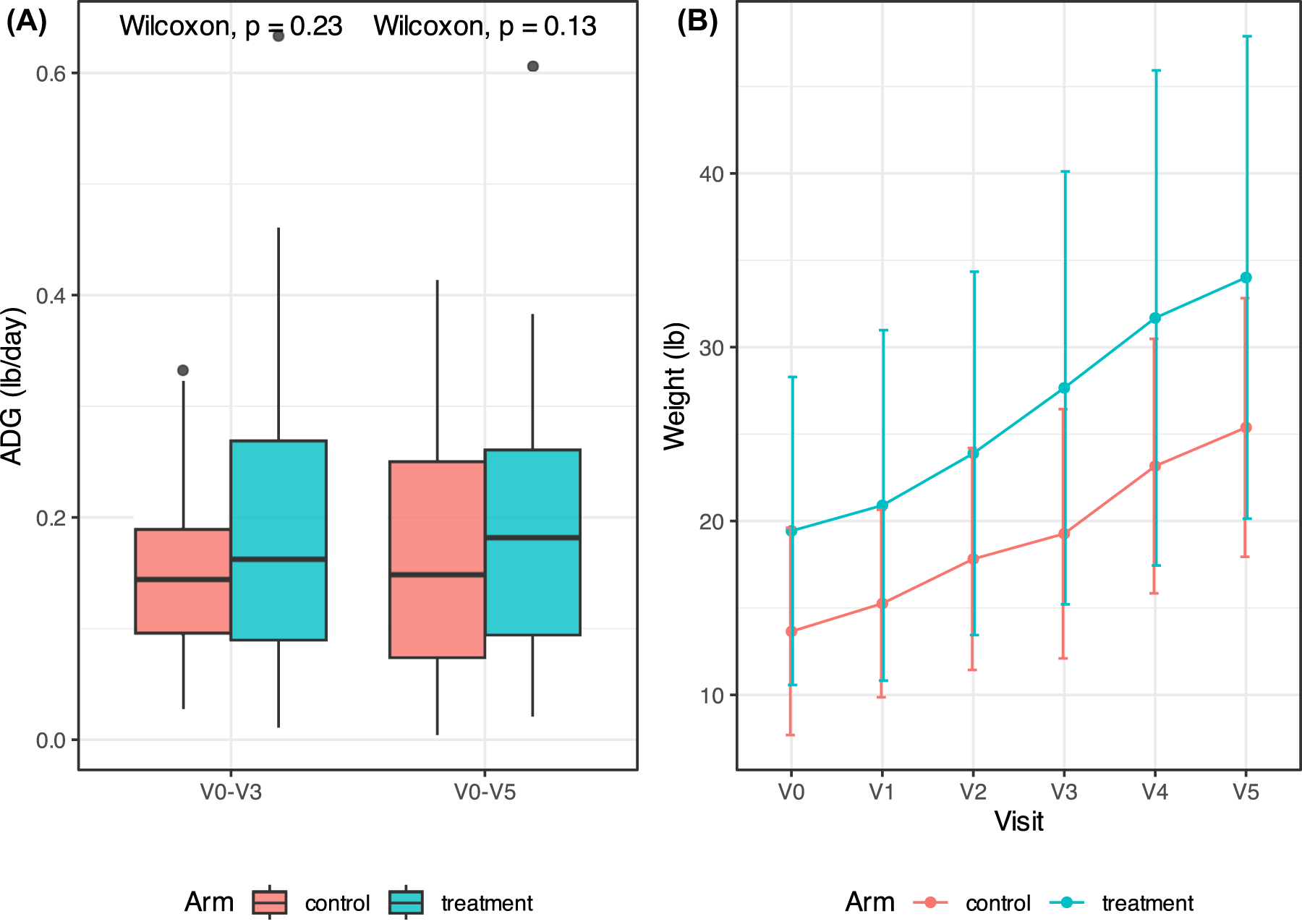
Weight estimates were used to calculate and compare ADG between the groups. The mean ADG (V0–V5) in juvenile pigs in the control group was 0.156 lb/day (SD = 0.096), which was 0.037 lb/day lower than the ADG of juvenile pigs in the treatment group (AGD = 0.193 lb/day; SD = 0.114); however, the difference was not significant (P = 0.134) (Figure 2).
Comparison of average daily gain (pounds per day) from (A) time V0–V3 and V0–V5; and (B) comparison of average weights at each timepoint in the study V0–V5. Estimates were calculated using data from 36 juvenile pigs in the treatment group and 48 juvenile pigs in the control group.

Figure 2 Long description
A showing a box plot with two grouped categories on the horizontal axis labeled V0 dash V3 and V0 dash V5. The vertical axis label is ADG left parenthesis lb slash day right parenthesis, with tick labels 0.0, 0.2, 0.4, 0.6. Text at the top reads Wilcoxon, p equals 0.23 above the V0 dash V3 group and Wilcoxon, p equals 0.13 above the V0 dash V5 group. A legend below reads Arm with two entries, control and treatment. Each group contains two box plots, one for control and one for treatment, with whiskers and individual outlier points. B showing a line graph with the horizontal axis label Visit and tick labels V0, V1, V2, V3, V4, V5. The vertical axis label is Weight left parenthesis lb right parenthesis, with tick labels 10, 20, 30, 40. Two lines are plotted with point markers and vertical error bars at each visit. A legend below reads Arm with two entries, control and treatment. The plotted points rise across visits for both lines.
Fecal egg reduction count and anthelmintic resistance
Samples from 65 of the 100 pigs in the treatment group were able to be used for the FERCT. The median FERC was 0.727 (95% CI: 0.498–0.904) for A. suum, 0.596 (95% CI: 0.443–0.758) for strongyles and 0.618 (95% CI: 0.418–0.802) for strongyles-larval (Table 3). The probability that the FERC fell below the 95% threshold was >99% in all 3 parasite groups, demonstrating reduced apparent efficacy.
Bayesian hierarchical models with individual efficacy

Table 3 Long description
Columns report Median, 0.025, 0.975, and Probability FERC less than 0.950 for three outcomes measured in EPG. For A. suum EPG, FECR has median 0.727 with 0.025 at 0.498 and 0.975 at 0.904, and Probability FERC less than 0.950 is 99.55 percent. A. suum mean EPG untreated has median 66.470 with 0.025 at 51.085 and 0.975 at 86.968, and mean EPG treated has median 17.967 with 0.025 at 6.039 and 0.975 at 35.497. For Strongyles EPG, FECR has median 0.596 with 0.025 at 0.443 and 0.975 at 0.758, and Probability FERC less than 0.950 is 100.00 percent. Strongyles mean EPG untreated has median 311.498 with 0.025 at 241.622 and 0.975 at 411.473, and mean EPG treated has median 124.666 with 0.025 at 71.350 and 0.975 at 193.121. For Strongyles larval EPG, FECR has median 0.618 with 0.025 at 0.418 and 0.975 at 0.802, and Probability FERC less than 0.950 is 100.00 percent. Strongyles larval mean EPG untreated has median 89.092 with 0.025 at 68.818 and 0.975 at 118.393, and mean EPG treated has median 33.870 with 0.025 at 17.304 and 0.975 at 55.300.
Discussion
Despite measurable reductions in parasite burden associated with ivermectin treatment, no significant improvements in growth or economic outcomes were observed, highlighting the limited effectiveness of pharmacological parasite control when delivered through iMDA under high-transmission smallholder conditions. Information collected from pig-owning households in Mopeia characterizes the area as practicing small-scale pig production with minimal preventive veterinary care or advanced management practices, such as nutritional supplementation or controlled breeding for genetic improvements. During the day, most pigs scavenge for food and drink from open surface water sources, returning to sleep near the house at night (Table S3).
Our results indicate that endoparasite prevalence and intensity of infection are high in pigs of all ages in the Mopeia district, which is similar to that reported in other districts in Mozambique (Matos et al., Reference Matos, Sitoe, Afonso, Banze, Baptista, Dias, Rodrigues, Atanásio, Nhamusso, Penrith and Willingham Iii2011), and by other studies in sub-Saharan Africa (Nissen et al., Reference Nissen, Poulsen, Nejsum, Olsen, Roepstorff, Rubaire-Akiiki and Thamsborg2011; Maganga et al., Reference Maganga, Kombila, Boundenga, Cyr, Kinga, Obame-Nkoghe, Tchoffo, Gbati and Awah-Ndukum2019). Interestingly, there was no difference in prevalence or intensity of infection (i.e. EPG) between adult and juvenile pigs for most parasite groups, with the exception of higher strongyle-larval EPG values in juveniles. Although many studies report higher gastrointestinal nematode burdens in younger animals due to the gradual development of acquired immunity with age (Nansen and Roepstorff, Reference Nansen and Roepstorff1999), age-infection relationships are known to vary across parasite species, host populations and transmission settings. Similar heterogeneity in macroparasite age-infection patterns has been described in both theoretical and empirical studies, suggesting that different parasite species may exhibit distinct epidemiological relationships with host age (Wilson et al., Reference Wilson, Bjørnstad, Dobson, Merler, Poglayen, Randolph, Read and Skorping2002). In addition, the relatively broad age categories used in the present study may have reduced our ability to detect finer-scale age-related differences in infection dynamics. Furthermore, under conditions of continuous exposure and heavy environmental contamination, differences between juvenile and adult animals may become less apparent because both age groups experience persistent reinfection pressure. In this study, poor nutrition, limited environmental hygiene and free-range scavenging behaviour likely contributed to intense and sustained exposure to infective stages, resulting in high parasite burdens across all age classes. Taken together, these findings support a system-level explanation in which poor nutrition and scavenging behaviour contribute to high environmental contamination, ongoing reinfection and diminished effectiveness of periodic anthelmintic treatment.
The 3-monthly ivermectin treatments significantly reduced the prevalence of strongyles and strongyles-larval, but it was a modest reduction (10–20%) that remained insufficient to substantially alter transmission dynamics over the 5-month time period. Similarly, although intensity of infection (EPG) was significantly lower among infected animals in the ivermectin treatment group across all 3 parasite groups, it was only ∼20–35% lower overall relative to the control group. These differences are smaller than would be expected under conditions of optimal efficacy, suggesting that ongoing exposure and reinfection likely dampened treatment effects between dosing intervals. For example, 2 studies from Nigeria and Tanzania found ivermectin to be over 95% effective in treating strongyles and A. suum in pigs with a single dose (Mkupasi et al., Reference Mkupasi, Ngowi, Sikasunge, Leifsson and Johansen2013; Idika et al., Reference Idika, Nwauzoije, Uju, Ugwuoke and Ezeokonkwo2017).
Although the difference in ADG in the treated group was higher than that of the control group, it was not significant. Given the prevalence and EPG results, this is not surprising, as even though some pigs benefitted from ivermectin, at the population level, the prevalence and intensity of infection were still relatively high within the treated group. Of note, the ADG in both the treatment and control groups were much lower than the expected ADG = 0.286 lb/day, which was previously documented for smallholder pigs in Kenya (Carter et al., Reference Carter, Dewey and Mutua2013). This provides further evidence of the particularly poor health status of pigs in this area. In addition, it is possible that the lower ADG and greater standard deviation in this particular population would require a larger sample size to detect a significant difference.
There are several possible explanations for the moderate impact of the 3 ivermectin treatments on pig intestinal parasitism and growth. One explanation explored in this study is the presence of ivermectin-resistant parasite populations. FECRT results demonstrated less than 90% reduction for all parasite groups, indicating reduced apparent efficacy under field conditions. However, FECRT results alone do not confirm the presence of anthelmintic resistance, particularly in systems characterized by intense transmission and rapid reinfection. Although reduced efficacy can be consistent with emerging resistance, the interpretation of FECRT results must be considered within the broader epidemiological and operational context of the study. Multiple lines of contextual evidence indicate that true anthelmintic resistance is less likely than epidemiological and operational explanations. Given that this population of pigs receives almost no veterinary intervention and very few owners report giving preventatives or medications, it is unlikely that this population has been exposed to ivermectin in a way that would promote the broad development of ivermectin resistance among all categories of parasites. Furthermore, limited animal movement and lack of regional reports of resistance in similar systems support this interpretation. District veterinarians also confirmed that there were no veterinary pharmacies in the district from which pig-owners would be able to purchase ivermectin easily.
Rather, it is likely that there was a combination of other factors that explain our results. The study was implemented during the wet/rainy season, and there had been recent flooding in many areas. The favourable environment together with poor animal health and scavenging behaviours almost certainly led to continuous exposure to large numbers of infectious eggs throughout the trial period. Monthly dosing of ivermectin in these conditions may not achieve the effect seen under more controlled scenarios. Additionally, we must consider the possibility of underdosing of ivermectin by study field staff or incorrect identification of pigs for sampling or weight measuring over the longitudinal study. To reduce these errors, the field team that was delivering ivermectin to pigs and the team that was responsible for longitudinal pig sampling were trained and managed by a veterinarian hired as part of the study team. It is possible that errors occurred occasionally, but it is unlikely they were systematic given the level of training and oversight.
This study was part of a larger study investigating the effects of iMDA in humans, and humans and pigs as a novel vector control tool for malaria. Therefore, the study described here was not designed to study the effect of ivermectin delivery for pig health, but rather to capture any secondary health and productivity effects that might come from the delivery of ivermectin in pigs to achieve a human health outcome. This distinction is critical, as interventions optimized for parasite control in livestock typically include coordinated strategies such as improved sanitation, environmental management and nutritional support to prevent reinfection. These environmental management strategies are not a common practice in the area of study, and their implementation was not a part of the iMDA intervention. However, the literature shows that education programmes targeted at smallholders can improve basic pig husbandry and nutrition practices (Chilundo et al., Reference Chilundo, Mukaratirwa, Pondja, Afonso, Alfredo, Chato and Johansen2020). These findings underscore the need for integrated One Health approaches, in which pharmacological interventions such as iMDA are coupled with improvements in animal management, environmental sanitation and access to veterinary services to achieve meaningful benefits across both human and animal health domains.
In summary, our results suggest that iMDA in pigs using the labelled dose and frequency for malaria control purposes alone is unlikely to be sufficient for improving pig health in environments that are highly contaminated during rainy seasons, where the population isn’t trained in basic pig management practices, and access to veterinary care is limited. Under these conditions, the impact of ivermectin is constrained by continuous reinfection and underlying host health limitations, resulting in modest parasitological improvements without corresponding production gains. If iMDA in pigs, or other livestock species, is successful in reducing malaria, a true One Health approach going forward would be to deliver ivermectin to animals alongside the proper environmental sanitation programmes and other management programmes including nutrition and other veterinary care.
Supplementary material
The supplementary material for this article can be found at https://doi.org/10.1017/S0031182026102662.
Data availability statement
The datasets generated and/or analysed during the current study are available from the corresponding author upon reasonable request.
Acknowledgements
We thank the trial participants and our field worker team for their outstanding commitment to this work.
Author contributions
A.A., C.R., M.S. and V.M. contributed to the conceptualization of the study. Methodology was developed by A.A., C.R., K.X., M.S., V.M., R.F., C.C., A.S.G., R.R.B. and I.L. Formal analysis was conducted by A.A., K.X. and C.R. Investigation was carried out by A.A., M.S., R.F., A.S.G. and V.M. Resources were provided by P.N., H.M., J.M., M.S., R.F., A.S.G. and F.S., while data curation was performed by E.E., P.R.C. and A.X. The original draft of the manuscript was prepared by A.A., C.R., K.X., R.R.B. and I.L. All authors contributed to the review and editing of the manuscript and reviewed and approved the final version. Supervision was provided by C.R., A.S.G., M.S., V.M., R.R.B. and I.L. Project administration was led by C.R., C.C., R.R., F.S. and I.L., who also acquired funding for the project.
Financial support
This work was funded and supported by Unitaid under the BOHEMIA grant. We acknowledge support from the Spanish Ministry of Science, Innovation and Universities through the ‘Centro de Excelencia Severo Ochoa 2019-2023’ Program (CEX2018-000806-S), and support from the Generalitat de Catalunya through the CERCA Program. We also acknowledge the Servico Distrital das Actividades Economicas of the district of Mopeia (SDAE – Mopeia, Mozambique) for their support of the protocol implementation. And finally, CISM is supported by the Government of Mozambique.
Competing interests
The authors have no relevant financial or non-financial interests to disclose.
Ethical standards
This study was approved by the Comité Institucional de Bioética para do CISM (CISM-010-2021).




 Open access

