Introduction
Chondrichthyans from the Late Cretaceous of Isla Marambio have been known since the early 20th century. Woodward (Reference Woodward1906) indicated the presence of large vertebral centra, doubtfully assigned to Ptychodus Agassiz, 1835, but Welton & Zinsmeister (Reference Welton and Zinsmeister1980) expressed doubt that they belonged to this taxon. Other reports of cartilaginous fishes from the Late Cretaceous of Isla Marambio indicate the presence of the genus Isurus Rafinesque, 1810 (Grande & Eastman Reference Grande and Eastman1986), later reassigned to Sphenodus Agassiz, 1843 by Richter & Ward (Reference Richter and Ward1991), and Notidanodon dentatus Woodward, 1886 (Cione & Medina Reference Cione and Medina1987, Grande & Chatterjee Reference Grande and Chatterjee1987). In addition, sand-tiger sharks of the genus Odontaspis Agassiz, 1838 and cf. Odontaspis sp. were reported from the Maastricthtian of Isla Marambio (Martin & Crame Reference Martin and Crame2006). Further records in Campanian beds of the James Ross Island indicate the presence of the genera Scapanorhynchus Woodward, 1889 and Paraorthacodus Glückman, 1957, as well as a chronostratigraphic extension for Chlamydoselachus thompsoni Richter & Ward, Reference Richter and Ward1991. Also, endemic synechodontiform sharks referred to Paraorthacodus antarcticus Klug et al., Reference Klug, Kriwet, Lirio and Nuñez2008 have been identified from the same locality (Klug et al. Reference Klug, Kriwet, Lirio and Nuñez2008).
Callorhynchid fishes (Holocephali, Chimaeriformes) are an early branch of the chimaeriforms (Didier Reference Didier2004), and are characterized by having crushing tooth plates with well developed, robust tritorial pads (Stahl Reference Stahl1999, Stahl & Chatterjee Reference Stahl and Chatterjee1999) which are hypermineralized in some taxa and therefore considered as a diagnostic feature. In this group, the mandibular apparatus is comprised of six dental pieces, which are paired mandibular, palatine and vomerine plates, and together with dorsal spines, they are the most frequently found body parts of the group. The first reference to fossil holocephalans in Isla Marambio is from Grande & Eastman (Reference Grande and Eastman1986), who described a palatine and mandibular plates tentatively referred to the genus Ischyodus Egerton, 1843, from levels of La Meseta Formation, assigned by these authors to the late Eocene–early Oligocene. These same specimens were later identified as Ischyodus dolloi Leriche, 1905, and constrained to the late Eocene of the La Meseta Formation (Ward & Grande Reference Ward and Grande1991). Additionally, the latter authors described a new species, Chimaera seymourensis Ward & Grande, Reference Ward and Grande1991, from the same unit. The first Late Cretaceous callorhynchid recovered from Isla Marambio belong to a new species, Chimaera zangerli Stahl & Chatterjee, Reference Stahl and Chatterjee1999, from the Maastricthian López de Bertodano Formation, after extended to the Campanian of the James Ross Island (Kriwet et al. Reference Kriwet, Lirio, Nuñez, Puceat and Lécuyer2006). Later, Stahl & Chatterjee (Reference Stahl and Chatterjee2002) also recognized the presence of I. dolloi in the López de Bertodano Formation. The first occurrence of the genus Callorhinchus Laćepède, 1798 in Antarctica is known by a new species, Callorhinchus stahli Kriwet & Gaździcki, Reference Kriwet and Gaździcki2003, from the late Ypresian (Telm 2 stratigraphic unit sensu Sadler Reference Sadler1988) of the La Meseta Formation. Finally, Martin & Crame (Reference Martin and Crame2006) reported the first occurrence of the genus Callorhinchus in Maastrichtian beds of Isla Marambio.
The present paper describes a new callorhynchid fish from the uppermost Cretaceous of Isla Marambio. The material was collected in January of 2011 during fieldwork of the Chilean expedition supported by the Antarctic Ring Project (Anillo de Ciencia Antártica ACT-105, 2010–11, Conicyt - Chile). The particular configuration of the preserved tritors allows identification of a new species among callorhynchids, adding to the known diversity of holocephalans in higher latitudes of the Weddellian Biogeographic Province (sensu Zinsmeister Reference Zinsmeister1979) during the end of the Cretaceous.
Locality and geological setting
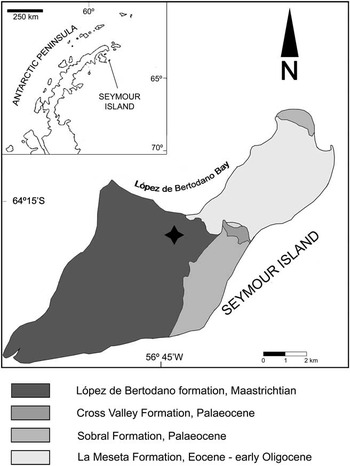
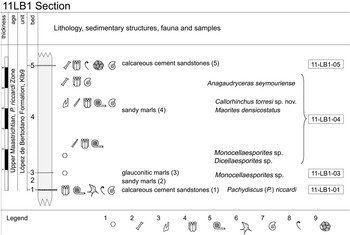
The samples were collected from Isla Marambio (Fig. 1), in the north-eastern part of the Antarctic Peninsula. This island, together with Vega, James Ross and Snow islands contains the most representative outcrops of sedimentary rocks of the James Ross Basin, deposited during the Late Cretaceous–Palaeogene. All collected material from Isla Marambio was found in upper levels of the López de Bertodano Formation. Based on Macellari (Reference Macellari1988), the studied locality (64°16′11.4′′S, 56°44′30.6′′W) is included in the middle part of the Klb9 unit. The recovered specimens were found associated and had been slightly transported over the recent soil by snow and mud slides, and were found with additional scattered samples. Fossil-bearing levels comprise fine-to-medium sandstones intercalated with sandy siltstones. Erosion has exposed abundant concretionary nodules containing vertebrate and invertebrate remains. The hosting cross section reaches c. 30 m and is formed by a succession of sandy marls with thin intercalations of fine-to-medium carbonate cemented sandstone, and a thin glauconitic marl bed near to the base of the section (namely, 11LB1 section, following our field notation, Fig. 2). Our stratigraphic section is equivalent to the middle part of the Klb9 unit of Macellari (Reference Macellari1988). The succession includes frequent, associated remains of elasmosaurid plesiosaurs and mosasaurs, together with scarce and fragmentary neoselachian teeth and osteichthyan vertebrae. Fossil invertebrates are mostly represented by lytoceratids, kossmaticeratids and pachydiscid ammonoids (e.g. Anagaudryceras seymourense Macellari, 1986, Maorites densicostatus Killian & Reboul, 1909, Pachydiscus riccardi Macellari, 1986), gastropods, serpulids, and bryozoans. In addition, two rock samples in the stratigraphic section contain some palinomorphs. The biostratigraphic framework is done by the mentioned ammonoids especially P. riccardi which constrain the age of Callorhinchus torresi sp. nov. to the P. riccardi Zone of Macellari (Reference Macellari1988), at the late Maastrichtian. Additional scattered dental plates of the studied taxon were collected in the same area, but their respective stratigraphic provenance could not be rigorously determined due to transport by erosion.
Schematic map of Isla Marambio (Seymour Island), showing the main geologic units. The asterisk indicates the type locality where the studied material was recovered.

Stratigraphic section of the upper López de Bertodano Formation (Klb9, sensu Macellari Reference Macellari1988) on Isla Marambio (Seymour Island). Legend: 1) palynomorphs, 2) vertebrates remains, 3) Callorhinchus torresi sp. nov., 4) bryozoans, 5) annelids, 6) gastropods, 7) ammonites, 8) bivalves, and 9) little bivalve agglomerate.

Materials and methods
The nomenclature used follows Kriwet & Gaździcki (Reference Kriwet and Gaździcki2003). The material was collected in a small valley filled by recent mud at the bottom, with fresh outcrops of sedimentary rocks exposed on the flanks. Two plates (left mandibular and incomplete right palatine) were found directly on top of the sandstone outcrop and near the uppermost part of this valley, indicating minimal transport from the original fossil-bearing level. A third plate (right mandibular) was recovered about 1 m downwards. Additionally, this plate is anatomically complementary and similar in size to the other two plates. Despite this, it cannot be confidently determined that all the material belongs to the same individual because of slight differences in the wearing patterns, and the position of the tritors. Additional scattered plates were collected in the same area. For taxonomic determination, three main criteria were considered:
1) Synapomorphies. Following Didier (Reference Didier1995), important synapomorphies can be recognized in dental plates of holocephalans related to the shape and size of plates, and particularly, the morphology of tritors, their relative position, and their number. These criteria are useful for determining genera and species in well-preserved samples and are valid for extant and fossil specimens.
2) Ontogenetic stage. The continuous growth of dental plates in chimaeriforms can cause differences in tritor shape and position. In mandibular plates, the growth of the basal surface can cause a thickening of the portion between the symphysis and the anterior inner tritor, while the median and outer tritors become progressively separated. Concerning the collected samples, these are very similar in size, but have very conservative shapes and distribution of the tritors, especially on mandibular plates. In the recovered palatines, these are slightly different in size, but also similar in shape to the median tritor, markedly bifid in the anterior portion. The similar sizes and shapes of all recovered plates suggest that these belonged to individuals of similar ontogenetic stages.
3) Wear pattern. The apical surface is most worn, followed by the occlusal surfaces. Because of this, the anterior margin of mandibulars and palatines could appear to be variable in shape. The occlusal surfaces can display slight variations in the shape of each tritor as a consequence of the abrasive contact between mandibular, palatine and vomerine plates. Despite these considerations, apical surfaces and median tritors of all recovered mandibular plates are very similar in shape. The same seems to apply to the palatines, but since they are incomplete, these cannot be fully compared.
Institutional abbreviations
SGO.PV = Museo Nacional de Historia Natural, Santiago, Chile; DJ = Collection of Palaeontology, British Antarctic Survey, Cambridge.
Systematic palaeontology
CHONDRICHTHYES Huxley, 1880
HOLOCEPHALI Bonaparte, Reference Bonaparte1832
CHIMAERIFORMES Obruchev, 1953
Family CALLORHYNCHIDAE Garman, 1901
Subfamily CALLORHYNCHINAE Stahl, Reference Stahl1999
Genus CALLORHINCHUS Laćepède, 1798
Type species. Callorhinchus callorhynchus (L. 1758), extant taxon from the Southern Hemisphere.
Diagnosis: As for the genus (Kriwet & Gaździcki Reference Kriwet and Gaździcki2003), considering only dental plates; mandibular tooth plate with a single central hypermineralized pad restricted to the distal part of the coronal surface, flanked by narrow tritors on the symphyseal and/or labial edges. Middle tritor of palatine tooth is bifid towards the labial margin, with the symphysial branch being the longest. Vomerine tooth plate quadrilateral with single middle tritorial pad.
Distribution: Albian and Cenomanian of Russia (Nessov & Averianov Reference Nessov and Averianov1996); Cenomanian of New Zealand (Newton Reference Newton1876); Santonian of Russia (Averianov Reference Averianov1997); Maastrichtian of central Chile (Suárez et al. Reference Suárez, Quinzio, Fritis and Bonilla2003); Maastrichtian and Eocene of Isla Marambio (Kriwet & Gaździcki Reference Kriwet and Gaździcki2003, Martin & Crame Reference Martin and Crame2006); Thanetian and Ypresian of England (Gurr Reference Gurr1962, Ward Reference Ward1973); Miocene of Argentine Patagonia (Woodward & White Reference Woodward and White1930); Miocene-Pliocene of central and northern Chile (Suárez et al. Reference Suárez, Encinas and Ward2004, Reference Suárez, Lamilla and Marquardt2006), New Zealand (McKee in Stahl Reference Stahl1999), and Peru (Muizon & DeVries Reference Muizon and DeVries1985); Recent, widespread on Southern Hemisphere (Stahl Reference Stahl1999).
Callorhinchus torresi sp. nov.
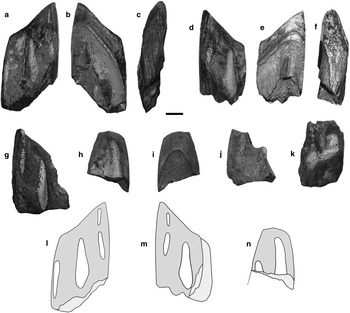
(Fig. 3a–n)
SGO.PV.22011. Callorhinchus torresi sp. nov. Holotype: a. left mandibular in occlusal view, b. ventral view, and c. symphysial view. SGO.PV.22012. Paratypes. SGO.PV.22012a: d. right mandibular in occlusal view, e. ventral view, and f. symphysial view. SGO.PV.22012b: g. right mandibular in occlusal view. SGO.PV.22012c: h. right palatine plate in occlusal view, and i. dorsal view. SGO.PV.22012d: j. isolated, incomplete left palatine, and k. isolated, incomplete right palatine. Schematic occlusal outlines of the most informative plates. l. SGO.PV.22011, the holotype. m. SGO.PV.22012a, right mandibular. n. SGO.PV.22012c, right palatine. Scale bar equals 10 mm.

Holotype: SGO.PV.22011 (Fig. 3a, b, c & l), an almost complete left mandibular.
Paratypes: SGO.PV.22012a, b (Fig. 3b–k, m & n), two incomplete right mandibular plates; SGO.PV.22012c, one anterior portion of a right palatine; SGO.PV.22012d, one incomplete left palatine; SGO.PV.22012e, and one concretionary nodule containing one partial right palatine.
Referred material: DJ.1020.2-F. Callorhinchus sp. left palatine. López de Bertodano Formation (Klb9), latest Maastrichtian (Martin & Crame Reference Martin and Crame2006).
Type locality: Small valley about 1500 m south of the López de Bertodano Bay, Isla Marambio, Antarctica.
Type horizon: López de Bertodano Formation, P. riccardi Zone, Klb9 sensu Macellari (Reference Macellari1988), late Maastrichtian.
Type strata: Bed 11LB1-4, 11LB1 Section (Fig. 2), López de Bertodano Formation.
Derivation of name: The specific name honours Dr Teresa Torres (Universidad de Chile), director of the present research project, for more than twenty years of contribution to Antarctic palaeobotany, and her continuous support to new generations of Chilean palaeontologists, including some of the authors.
Diagnosis: Callorhinchus torresi can be distinguished among other species of the genus by the following unique characters: estimated adult size with large plates, having mandibulars with rhomboidal outline; slender median tritors extended in axial direction, slightly thickened in their posterior inner margin; anterior inner tritor reduced and located in apical position; slender posterior inner tritor, covering about one third of the symphysial margin and anteriorly extended immediately posterior to the vomerine facet; slender external tritor, broader in its anterior portion and covering about half of the post-occlusal margin; no accessory tritors present; palatine plates with prominent, bifid anterior tritor, with a clearly larger symphysial branch and deep embayment between the two branches.
Discussion
In summary, there are five known taxa of callorhynchids from Isla Marambio: a) Chimaera zangerli, Maastricthtian of López de Bertodano Formation (Stahl & Chatterjee Reference Stahl and Chatterjee1999); b) Callorhinchus stahli, early Eocene (late Ypresian) of the La Meseta Formation (Kriwet & Gaździcki Reference Kriwet and Gaździcki2003); c) Ischyodus dolloi, Maastrichtian of the López de Bertodano and late Eocene of the La Meseta formations (Ward & Grande Reference Ward and Grande1991); d) Chimaera seymourensis, from the late Eocene of La Meseta Formation (Ward & Grande Reference Ward and Grande1991); and e) Callorhinchus sp. from the Maastricthtian of the López de Bertodano Formation (Martin & Crame Reference Martin and Crame2006).
Considering the similar size and shape of all the plates studied here (Table I), these probably are from adult or sub-adult individuals. The external tritor can be observed only in the holotype, being the only mandibular collected preserving the outer margin, where this structure occurs. The posterior margin of all the recovered palatines is poorly preserved and is best observed in the right palatine SGO.PV.22012d, having a posterior margin that is relatively straight and diagonally disposed. Despite the lack of better-preserved plates, the observed outlines of median tritors in mandibular plates and those of anterior inner tritors in palatines are different from all known callorhynchids.
Measurements of the preserved tritors in each studied plate, over the occlusal surface, taken with Vernier caliper (± 0.5 mm). Partial measurements available for incomplete tritors are indicated by *, non applicable by #, and missing data is indicated by —. All results are expressed in mm.

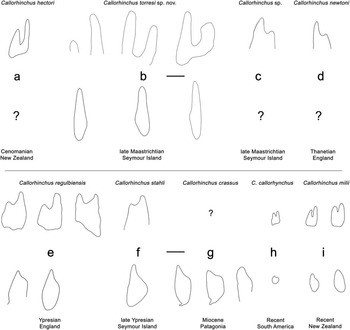
When comparing the specimens of C. torresi sp. nov. with known fossil and extant species of the genus (Fig. 4), in known Cretaceous species the palatines tend to show a deep embayment between both branches of the anterior inner tritor, that progressively became shallower and smaller from Cenomanian to Maastrichtian representatives, as observed in recent species. Apart from C. torresi, there are no records of mandibular plates of any Cretaceous species of the genus. Thus, C. torresi provides the only Cretaceous reference to discuss the evolution of this anatomical element. Palaeogene records include two species from the Eocene with preserved mandibulars, C. regulbiensis Gurr, Reference Gurr1962, and C. stahli. Both have a posterior portion of the medial tritor that is broader than in C. torresi, while the apical projection of the anterior portion is reduced compared to C. torresi. The same situation is observed in the Miocene species C. crassus Woodward & White, Reference Woodward and White1930, and it is particularly evident in the extant species C. milii Bory de Saint-Vincent, 1823 and C. callorhynchus both with very reduced tritors and relatively small dental plates.
Schematic outlines of palatine and mandibular tritors of known species of the genus Callorhinchus. Upper row displays general tritor shape in palatine plates, while the lower row displays the shape of median tritors for each taxon indicated. a. d. e. f. g. h. and i. Taken and modified from Kriwet & Gaździcki (Reference Kriwet and Gaździcki2003, figs 7 & 8). b. This study. c. Modified from Martin & Crame (Reference Martin and Crame2006, fig. 3). h. Modified from Kriwet & Gaździcki (Reference Kriwet and Gaździcki2003, fig. 8) and Suárez et al. (Reference Suárez, Lamilla and Marquardt2004, fig. 2). Scale bar equals 10 mm.

Records in other localities of the Weddellian Biogeographic Province
Late Cretaceous holocephalans have been reported in south-western South America since the 19th century. Philippi (Reference Philippi1887, plate 55, fig. 5) described a dental plate from the Late Cretaceous of the Quiriquina Island, central Chile, tentatively referred by this author to the genus Chimaera L. 1758. The material is a mandibular plate figured with its anterior portion downwards. Nevertheless, it is possible to see a descending lamina in the symphysial margin and the absence of hypermineralized tritors, suggesting a closer affinity with the genus Edaphodon Buckland, 1838. Several other taxa were later mentioned from Late Cretaceous units of central Chile. Suárez et al. (Reference Suárez, Quinzio, Fritis and Bonilla2003) figured a vomerine plate referred to the genus Edaphodon, from early Maastrichtian beds exposed in Algarrobo (120 km west of Santiago), and mentioned the presence of the genus Chimaera in the same levels. Additionally, these authors indicated the presence of the genus Callorhinchus in late Maastrichtian beds of the Quiriquina Island. The genus Ischyodus was reported from late Eocene–early Oligocene beds of southernmost Chile (Le Roux et al. Reference Le Roux, Puratich, Mourgues, Oyarzún, Otero, Torres and Hervé2010), and is still unreported in older units along the south-western margin of South America. The genus Callorhinchus was also reported from three different Chilean units with an Eocene–early Pliocene range (Suárez et al. Reference Suárez, Encinas and Ward2004, Reference Suárez, Lamilla and Marquardt2006, Le Roux et al. Reference Le Roux, Puratich, Mourgues, Oyarzún, Otero, Torres and Hervé2010) and also in the Miocene of the Argentinian Patagonia (Woodward & White Reference Woodward and White1930, Kriwet & Gaździcki Reference Kriwet and Gaździcki2003). This genus is extant in waters of southern South America.
The genus Edaphodon was reported from Campanian–Danian levels of Chatham Islands, New Zealand with the endemic species Edaphodon kawai Consoli, 2006. All these reports indicate that chimaeriform fishes were widespread and abundant in the Weddellian Biogeographic Province during the Late Cretaceous–Palaeogene.
Chimaeriform fishes have proven to be a persistent group subsequent to the Cretaceous–Paleogene event, having common genera with widespread distribution in the Weddellian Biogeographic Province and several endemic species from Antarctica and New Zealand. Like other marine vertebrates, chimaeriforms were later affected by major tectonic and oceanographic changes such as the opening of the South Tasman Rise and the deepening of the Drake Passage, with the subsequent establishment of deep seaways (Lawver & Gahagan Reference Lawver and Gahagan2003), along with important climatic changes leading to gradual Antarctic cooling, which reduced the diversity of chondrichthyans in higher latitudes of the Southern Hemisphere at the Eocene-Oligocene boundary (Cione et al. Reference Cione, Reguero and Hospitaleche2007). Callorhynchids were constrained to lower latitudes during the Neogene being especially abundant in the Miocene–Pliocene of northern Chile (Suárez et al. Reference Suárez, Lamilla and Marquardt2004). Since the Miocene, the establishment of the Humboldt Current influenced the distribution of callorhynchids, which today is exclusively restricted to shallow waters of the Southern Hemisphere (Stahl & Chatterjee Reference Stahl and Chatterjee2002).
Conclusions
Callorhinchus torresi sp. nov. is the third fossil record of this genus from Isla Marambio, the second occurrence from Late Cretaceous levels of this locality, and the first species of chimaeriform fish identified in the late Maastrichtian of the López de Bertodano Formation. The studied material allows us to discount morphological variation due to different ontogenetic states, while the unique outlines of mandibular median tritors, and palatine anterior inner tritors, allows us to distinguish it from all known fossil and extant species of the genus. The studied material adds to the record of Callorhinchus during the Cretaceous, suggesting an evolutionary trend in the lineage leading to modern representatives, from slender median tritors extended anteriorly in mandibular plates to a broader posterior portion of the medial tritor with a reduced anterior apical projection in more recent species. Callorhinchus torresi also shows that, as in other Cretaceous species, there is a deep embayment between branches of the anterior inner tritors in the palatines, confirming the notion that the smaller and shallower embayment of more recent species has evolved from this condition.
Acknowledgements
This study was supported by the Antarctic Ring Project (Anillo de Ciencia Antártica ACT-105, 2010–2011, Conicyt - Chile). R.E. Yury-Yáñez was funded by a master's degree CONICYT-Chile scholarship from the Programa de Formación de Capital Humano Avanzado. Special thanks to the Armada de Chile and the crew of the Icebreaker ship, AP Almirante Óscar Viel, for the professional logistics and goodwill that made this field campaign possible. Dr J. Kriwet, Dr J. Eastman and Dr V. Gallo da Silva are especially acknowledged for reviewing the manuscript, providing comments that helped improve it.