Introduction
”When I got to the worst point [of dyspnea], I was getting really worried and that’s when I called my son. And by the time he got there, I was pacing back and forth… By the time I did get [to the emergency room], I was working myself up and I had so much anxiety and I was in pretty bad shape. I was breathing really hard, and I was wore out… but I did it to myself, I think, over the worrying and the anxiety … thinking one more big breath would help but it makes it worse. So I finally figured that out. You can cause it yourself; you can cause it real easy… I didn’t want to go asleep because I was afraid I wouldn’t wake up.”
Shortness of breath, or dyspnea, is a common, distressing, and debilitating symptom for more than 80% of patients with lung cancer (LC) at diagnosis and will subsequently become the presenting symptom for one-third of emergency room visits (Greer et al. Reference Greer, Pirl and Jackson2014; Mayer et al. Reference Mayer, Travers and Wyss2011; Walling et al. Reference Walling, Weeks and Kahn2015). Dyspnea is the subjective experience of breathing discomfort consisting of sensations related to breathlessness (Parshall et al. Reference Parshall, Schwartzstein and Adams2012). Neurophysiological research has demonstrated the relationship between the perception of dyspnea with corticolimbic areas involved with the awareness of perceived threats and pain (Parshall et al. Reference Parshall, Schwartzstein and Adams2012), but this focus has yet to result in effective pharmacological treatments (Ben-Aharon et al. Reference Ben-Aharon, Gafter-Gvili and Leibovici2012; Mayer et al. Reference Mayer, Travers and Wyss2011). Opioids, the most studied treatment for dyspnea, do not have long-term efficacy (Feliciano et al. Reference Feliciano, Waldfogel and Sharma2021; Lorenz et al. Reference Lorenz, Lynn and Dy2008), and their side effects (e.g., respiratory depression) and risk for addiction limit their use (Currow et al. Reference Currow, McDonald and Oaten2011). Acknowledging these limitations, the American Thoracic Society (ATS) recommended research on the interactions among psychological, behavioral, social, and environmental factors contributing to dyspnea (Parshall et al. Reference Parshall, Schwartzstein and Adams2012). A cognitive–behavioral model offers a comprehensive approach, but its application in LC has not been comprehensively characterized.
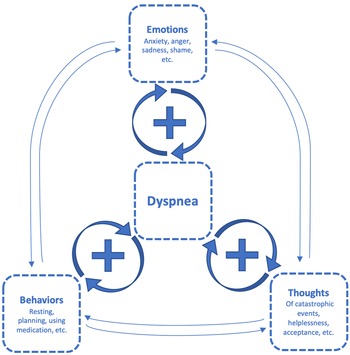
Conceptualizing patients’ responses to dyspnea, a cognitive–behavioral model is proposed and describes how thoughts and behaviors can influence physical and emotional states (see Figure 1). Considering prior models of dyspnea in lung diseases (Smoller et al. Reference Smoller, Pollack and Otto1996; Spathis et al. Reference Spathis, Booth and Moffat2017), this conceptualization presents thoughts, emotions, and behaviors as antecedents and consequences of dyspnea. For example, a patient with LC may experience dyspnea and related physical sensations (e.g., chest pain) during physical exertion (e.g., climbing stairs). This could lead to catastrophic thoughts about dyspnea, such as “I’m going to die unless I get more air.” Emotions (e.g., anxiety) may accompany uncomfortable physical symptoms. This subsequently drives a behavioral response to reduce discomfort, e.g., resting on the stairs—providing immediate relief, thereby reinforcing this behavior, and increasing the likelihood of continual avoidance from activities eliciting dyspnea. Ultimately, continued physical inactivity can result in deconditioning and worsened dyspnea. These unpleasant thoughts, emotions, and behavioral reactions can interact to create a positive feedback loop, intensifying dyspnea.
A cognitive–behavioral model for dyspnea.

There is suggestive evidence that cognitive–behavioral interventions can improve dyspnea, but these have focused on behavioral treatments such as breathing retraining and relaxation exercises (Greer et al. Reference Greer, MacDonald and Vaughn2015; Norweg and Collins Reference Norweg and Collins2013). The model suggests that other elements, particularly cognitive, may be important as relevant targets for treatment (Simon et al. Reference Simon, Weiss and Kradin2006). Catastrophic thinking (i.e., assuming the worst will happen) can be unhelpful and may contribute to behavioral dysfunction. For example, individuals believing that their dyspnea is life-threatening may significantly reduce their usual activities or hobbies. This response can be maladaptive when dyspnea is more likely to be a normal experience from physical exertion. Fortunately, effective interventions such as exposure-based therapies target catastrophic cognitions (Barrera et al. Reference Barrera, Grubbs and Kunik2014). When a catastrophic thought-limiting functioning is identified, exposure therapy can promote tolerance of dyspnea. Intentional, repeated exposures to dyspnea (e.g., walking) can provide corrective information on the thought and opportunities to learn that dyspnea can be an aversive yet normal, tolerable experience that they might not learn when avoiding activity (Pompoli et al. Reference Pompoli, Furukawa and Efthimiou2018).
However, the current poor characterization of dyspnea-related thoughts and other constructs of the cognitive–behavioral model in patients with LC limits the potential of cognitive–behavioral therapies like exposures. Qualitative research can further describe these constructs and potentially provide new directions for treatment design. Previous qualitative research has narrowly focused on some aspects but without sufficient elaboration in these patients (Bailey Reference Bailey2004; Henoch et al. Reference Henoch, Bergman and Danielson2008a; Lai et al. Reference Lai, Chan and Lopez2007; Molassiotis et al. Reference Molassiotis, Lowe and Blackhall2011; O’Driscoll et al. Reference O’Driscoll, Corner and Bailey1999; Stowe and Wagland Reference Stowe and Wagland2018). For example, studies identified constructs similar to the model (e.g., avoidant behaviors and catastrophic thoughts) but did not examine how these constructs relate to each other. Comprehensive qualitative data specific to the model’s constructs are needed. This study aims to qualitatively examine the role of the cognitive–behavioral model as an antecedent and consequence of dyspnea in patients with LC. These data would be an important first step toward developing comprehensive treatments to address the emotional, cognitive, and behavioral aspects that worsen dyspnea and impair patients’ adaptive coping.
Methods
Study design
This is a single-group, cross-sectional study with self-report measures and semi-structured interviews. The self-reported measures used helped validate the sample’s level of breathlessness.
Participants
Inclusion criteria included current LC diagnosis, receiving care from Ohio State University Comprehensive Cancer Center Thoracic Oncology Clinic, and current dyspnea (scoring ≥1 on the ATS Dyspnea Questionnaire). Exclusion criteria included prior history of any other cancer except for basal cell or squamous cell skin cancer, the presence of other serious comorbidities that would interfere with study participation, and a life expectancy of <2 months. Patient enrollment continued until data saturation was achieved as determined by the investigators.
Procedures
A convenience sample was sought from September to November of 2019. Patients with LC and medical record documented dyspnea were identified, approached, and consented during in-person oncology appointments. Following consent, study personnel administered self-report measures followed by an interview. A review of electronic medical records collected medical and cancer history information. This study followed the Consolidated Criteria for Reporting Qualitative Research (COREQ) (Tong et al. Reference Tong, Sainsbury and Craig2007). The Ohio State University Institutional Review Board approved this study.
Interviews
Semi-structured interviews were conducted and recorded by two trained personnel. Interviews assessed patients’ cognitive–behavioral experience of their dyspnea. Questions were adapted from prior qualitative studies of dyspnea (Henoch et al. Reference Henoch, Bergman and Danielson2008a) and were open-ended and framed by the cognitive–behavioral model (e.g., “Do you have any thoughts when your shortness of breath occurs?” to assess cognitions). Interviewers asked follow-up questions to obtain further detail as needed. The average interview duration was 24.9 ± 7.5 minutes (range: 14–39 minutes).
Measures
Dyspnea and lung cancer symptoms
Three self-reported measures of dyspnea were used: (1) The ATS Dyspnea Questionnaire is a commonly used 5-item self-report measure on the presence of dyspnea across various levels of exertion (e.g., “do you ever have to stop when walking at your own pace on the level”) (Ferris Reference Ferris1978). Items were summed with scores ranging from 0 to 5, with higher scores indicating greater dyspnea severity. (2) The Visual Analogue Scales for Dyspnea (VAS-D) assessed the degree of distress caused by dyspnea (Aitken Reference Aitken1969) and has been used in LC (Henoch et al. Reference Henoch, Bergman and Gustafsson2008b). Patients marked a response from “no distress” to “extreme distress” related to dyspnea on a 100-mm line. Scores were calculated by measuring from the 0 mm line to their mark with responses ranging from 0 to 100. (3) The dyspnea item on the Lung Cancer Symptom Scale (LCSS) assessed the frequency of dyspnea and subsequent functional impairment (Hollen and Gralla Reference Hollen and Gralla1996; Hollen et al. Reference Hollen, Gralla and Kris1993). A numerical score from 100 (none) to 0 (severe) is given based on LCSS scoring criteria (e.g., 0 = “nearly constant; disrupts any normal activities”). The European Organization for Research and Treatment of Cancer (EORTC) QLQ-LC13 assessed the frequency of common symptoms of LC (e.g., coughing and dyspnea) and treatment side effects (e.g., neuropathy and dysphagia) (Bergman et al. Reference Bergman, Aaronson and Ahmedzai1994; Nicklasson and Bergman Reference Nicklasson and Bergman2007).
Qualitative analysis
Two investigators trained in qualitative research coded the data using ATLAS.ti 8 software. Codes were generated using a grounded theory approach to identify codes inductively (Saldaña Reference Saldaña2021). Investigators first coded data independently and focused on the meaning of participants’ language using both in vivo coding (coding of verbatim phrases) and process coding (coding of action words). Next, focused coding further categorized and refined new codes based on their conceptual fit within existing themes, and axial coding minimized redundancy within categories. Investigators discussed the coding to resolve discrepancies. After the last round of coding, investigators randomly selected one-third of interviews (n = 5) to calculate the inter-rater reliability of the finalized codebook. Cohen’s κ measured inter-rater reliability adjusted for the probability of chance agreement (Cohen Reference Cohen1960). Inter-rater reliability showed high agreement across coders (κ = 0.90). Finally, investigators reviewed the codes to inform the themes of the interviews and identified quotes that best represented the various themes.
Results
Patient characteristics
Patients (N = 15) were predominantly male (73%), white (93%), married (60%), and retired (40%). All patients had advanced LC, with either Stage IIIA (27%) or IV (60%) non–small cell LC or extensive stage small cell LC (13%). All patients were receiving active treatment for their LC, with most receiving immunotherapy alone (87%). Patient characteristics are summarized in Table 1.
Patient demographics and disease characteristics (N = 15)

HS = high school, NSCLC = non–small cell lung cancer, SCLC = small cell lung cancer
* Mean ± standard deviation
Self-reported dyspnea and lung cancer symptoms
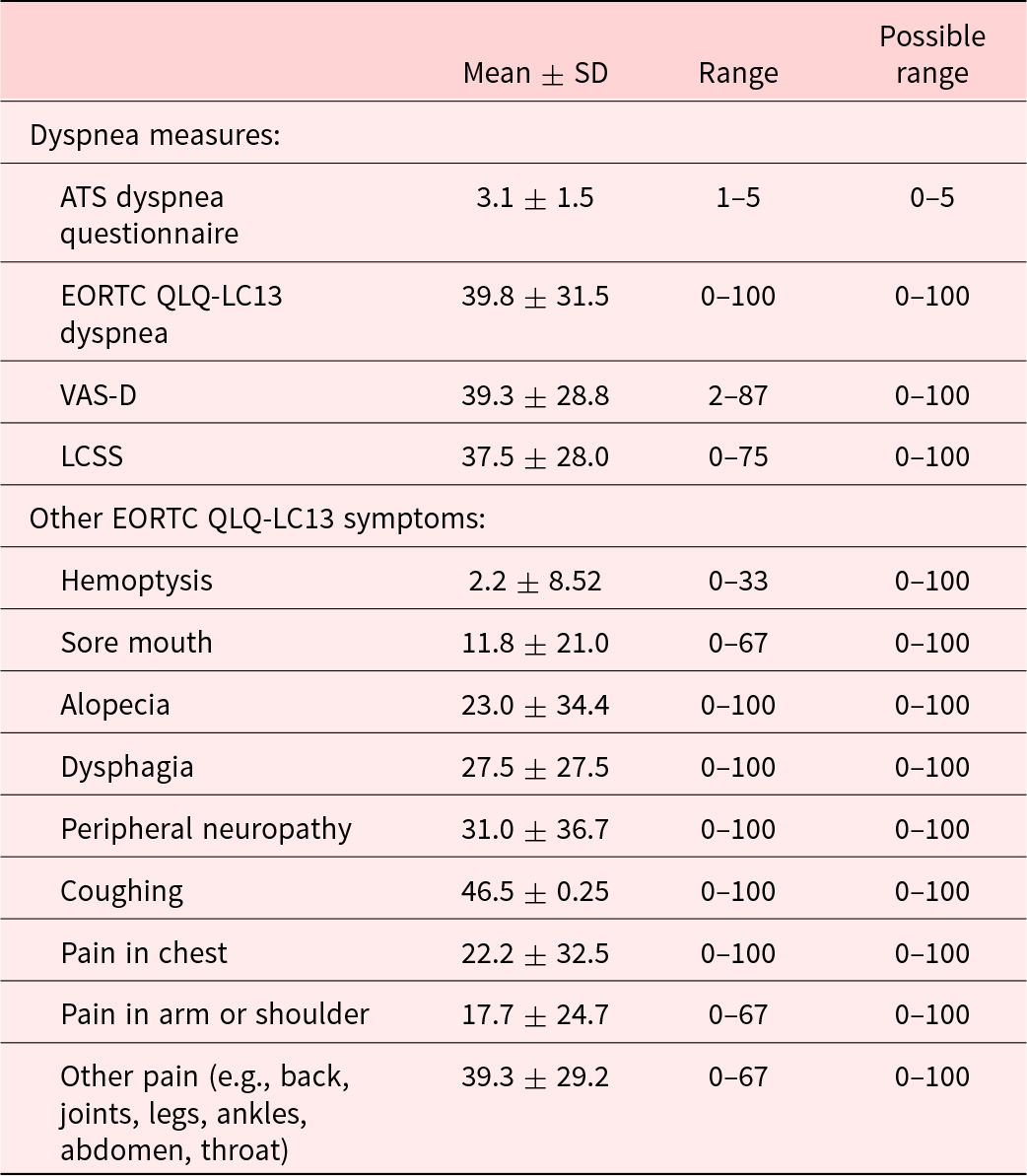
The sample reported significant dyspnea—confirming the appropriateness of the sample for study. Patients reported moderate levels of dyspnea, with the average patient reporting dyspnea to occur when walking at a normal pace (ATS dyspnea M = 3.1 ± 1.5), interfere with their ability to conduct usual activity (LCSS M = 37.5 ± 28.0), and cause moderate dyspnea-related distress (VAS-D M=39.3±28.8). On the EORTC QLQ-LC13, six patients (40%; M = 15.4 ± 21.2) reported dyspnea at rest and patients experienced “quite a bit” of dyspnea while walking (M = 46.4 ± 27.7) and taking stairs (M = 57.6 ± 29.6). Excluding dyspnea, the most frequently reported symptoms were coughing, dysphagia, and peripheral neuropathy (Table 2).
Self-reported dyspnea and lung cancer-related symptoms

ATS = The American Thoracic Society; EORTC QLQ-LC13 = The European Organization for Research and Treatment of Cancer Quality of Life Questionnaire Lung Cancer 13; VAS-D = The Visual Analogue Scales for Dyspnea (measured in mm); LCSS = Lung Cancer Symptom Scale.
Qualitative data
Description of the physical sensations of dyspnea
Patients described tightness in the chest and throat, tingling sensations in the chest, and chest pain. Other respiratory symptoms included coughing and wheezing when gasping for air. Accompanying dyspnea was fatigue/weakness, dizziness, headaches, heart palpitations, and sweating.
Limitations related to dyspnea
Theme: physical limitations
Patients described reducing their activities from premorbid activity levels. Some noted a sudden change in their physical limitations, with one patient describing, “I always used to take things fast; I can’t do that anymore. I don’t have the capacity … you’re not the person that you used to be and all of a sudden, boom, this hit me fast.” Others described dyspnea to limit mobility and activities of daily living, including driving, grocery shopping, and household chores. Although these limitations disrupted their ability to work, especially in physically intensive occupations (e.g., farming), this was not the case in all. Moreover, patients described disruptions to participating in recreational activities and hobbies. These avocational disruptions also disrupted their sense of identity—one patient noted, “I don’t fish. I don’t do a lot of things that I like to do … It’s not me, you know what I mean, it’s not me.”
Theme: social limitations
Dyspnea-related limitations additionally limited access to social support. Patients reported being unable to “keep up” with loved ones during premorbid activities such as walks. One patient described frustrations with being unable to spend time with family indoors due to dyspnea: “When I walk to my dad’s house or my nephew’s … I can’t stay in there because I’m coughing so damn much, but it doesn’t affect anybody else … if they were all outside, I could socialize with them, but I can’t in my dad’s house…”
Cognitive–behavioral responses to dyspnea
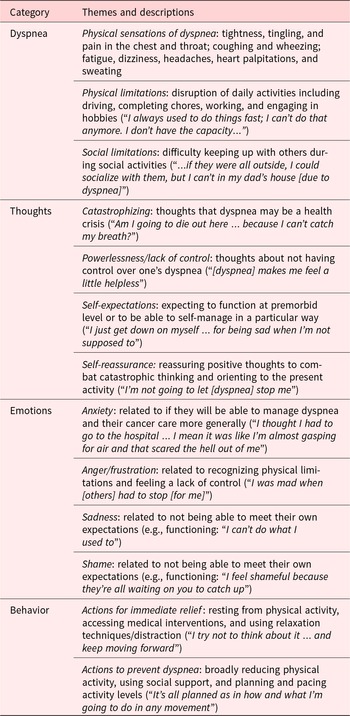
See Table 3 for a summary of themes.
Summary of themes fitting the cognitive–behavioral model of dyspnea in lung cancer

Thoughts
Theme: catastrophizing
Patients commonly expressed concerns about their health and getting enough oxygen during dyspnea. One acknowledged being concerned with any “abnormal” physical sensation (e.g., chest pain) in fear it signaled a health crisis. Indeed, thoughts about dyspnea being a medical emergency were reflected in one patient asking, “Am I going to die out here … because I can’t catch my breath?” These thoughts can also affect daily functioning including sleep as one individual stated, “[…] there’s a lot of things running through your head … am I going to get enough oxygen? Some people don’t get enough oxygen and pass out, well, that could lead to death and if you’re sleeping, you don’t know.”
Theme: powerlessness/lack of control
Coinciding with catastrophizing were beliefs of having no control over one’s dyspnea. Patients stated that dyspnea “makes me feel a little helpless.”
Theme: self-expectations
Some patients set high expectations to function while breathless. Patients described wanting to return to their premorbid functioning: “I get frustrated because … I just came downstairs; I shouldn’t feel like I need to sit down.” Others noted expectations of their emotional response to dyspnea with patients describing that “I can’t get upset or depressed” or “I just get down on myself … for being sad when I’m not supposed to.”
Theme: self-reassurance
Patients described several ways that they would reassure themselves when distressed. Some focused on the positive—one patient stated, “I feel like I’ve been very lucky about how it’s not as bad as some people could have.” Others acknowledged the aversiveness and frequency of dyspnea while noting that dyspnea is not necessarily a sign of an emergency: “Just because you’re having trouble breathing doesn’t mean it’s a [sure] sign that you can’t breathe, you’re gonna die … I’m not going to let it stop me.” Challenging dyspnea-related catastrophic thinking helped this patient reorient to engaging in his usual activities.
Emotions
Theme: anxiety
Patients frequently experienced anxiety related to their dyspnea and cancer treatments. Often, these anxious moments—including anxiety related to one’s cancer care—exacerbated dyspnea. Some patients believed that their anxiety could be the predominant contributor to dyspnea, stating “I was breathing really hard, and I wore out … but I did it to myself, I think, because of the worrying and anxiety … you can cause it yourself.”
Theme: anger/frustration
Patients reported anger and frustration related to physical limitations and thoughts of having limited control over their health. Many reported their desire to be active but explained that they were “mad when [others] had to stop [for me]” and can get “pretty exhausted, which led to frustration.” Patients described anger in the context of self-efficacy, with one patient stating, “I get mad because … I can’t control [dyspnea].”
Theme: sadness
Some reported feeling sad when breathless. Patients noted that “frequently staying inside” and not being able to “do what [I] used to” made them feel sad.
Theme: shame
Patients described feelings of shame when reflecting on their dyspnea’s effect on others. When going on a walk with family, one patient felt “shameful because they’re all waiting on you to catch up.” When discussing dyspnea, a patient reported that “I blame myself … because I smoked,” which made her feel “shame, a lot of shame.” Additionally, another patient noted feeling embarrassed “when others had to do things for [me].”
Behaviors
Theme: actions for immediate relief
Patients reported several strategies to relieve dyspnea. Most described slowing down or stopping physical exertion thought to be worsening dyspnea to rest. The extent to which dyspnea interfered with their activity varied with resting times ranging from a couple of minutes to over an hour. Patients also described coping behaviors like taking deep breaths, stretching, and drinking water to self-soothe. Using distraction was common—one patient stated, “I just try to think about something else, I realize it’s [dyspnea’s] happening and I just try to brush it off and try not to think about it … and keep moving forward.” Others listened to music and used other relaxation techniques to relieve dyspnea.
Patients used medications and/or medical equipment to manage dyspnea. This included short- and long-acting inhalers or adjusting supplementary oxygen flow. A minority used a finger pulse oximeter to check their blood oxygen levels while monitoring dyspnea and the time it took to subside. Patients noted seeking urgent medical attention in fear of their dyspnea signifying a medical crisis.
Theme: actions to prevent dyspnea
Most reduced physical activity (e.g., limiting walking and stairs) to prevent or reduce dyspnea. Activity pacing helped maximize activity during the day without physically taxing themselves beyond their limit. However, patients reported dissatisfaction with its cost for efficiency. One patient described, “It’s all planned as in how and what I’m going to do in any movement … [dyspnea] does kind of rule my life when you kind of have to micromanage everything. I have to do a lot of thinking around what I’m able to do in a given time.” Others also ask for help from family and friends for functional and emotional support for dyspnea.
Interactions between cognitive–behavioral responses contributing to dyspnea
As described, the emotions, cognitions, and behavioral constructs identified in the model have overlapping elements. This reflected the strong interrelation between the constructs identified by patients. For example, behavioral responses to dyspnea focused on relieving dyspnea, which included alleviating the cognitive–behavioral contributors to dyspnea (e.g., stopping physical activity [behavior], distracting from dyspnea [thought], relaxation techniques [emotions]). Patients also often described thoughts alongside emotions. Not meeting lofty expectations of oneself went along with anger “…when [others] had to stop [for me]”, shame “when others had to do things for [me]”, and sadness when patients cannot “do what [I] used to.” Illustrating the relationship between catastrophic thoughts and anxiety to affect dyspnea, a patient described: “When you’re thinking about your next chemotherapy, or your next CAT scan, or whatever it is, then you get a little anxious, and then the anxiety exacerbates the shortness of breath.”
Other contributors to dyspnea
Patients offered contributors outside the cognitive–behavioral model. These included physiological (e.g., tumors pressing against airways) and environmental contributors (e.g., heat and humidity). Additionally, a minority of patients reported no clear pattern of timing or precipitant for dyspnea.
Discussion
This qualitative data supported the cognitive–behavioral model of dyspnea—providing a deeper clinical understanding of dyspnea in patients with advanced LC and direction for identifying potential interventions. Self-report measures validated patients’ dyspnea and associated limitations and distress reported in interviews. Patients identified cognitive (e.g., catastrophizing), emotional (e.g., anxiety), and behavioral responses (e.g., avoidance of physical exertion) to dyspnea. They acknowledged that these responses could work together to contribute to worsened dyspnea.
Most patients noted anxiety and anger related to their dyspnea and, to a lesser degree, sadness. These results support correlative studies between dyspnea and anxiety in LC (Shin et al. Reference Shin, Kosiba and Traeger2014) and, more generally, negative affective states (Von Leupoldt et al. Reference Von Leupoldt, Mertz and Kegat2006). Relaxation techniques such as progressive muscle relaxation (PMR), which teaches patients to monitor and release muscle tension for relaxation, may help as it improves anxiety and the side effects of chemotherapy in patients with cancer (Pelekasis et al. Reference Pelekasis, Matsouka and Koumarianou2017). In advanced LC, a pilot study of a single 20-minute session of PMR demonstrated trending improvements in dyspnea (Arrato et al. Reference Arrato, Lo and Grogan2022), and a randomized controlled trial of PMR combined with symptom management education improved dyspnea (Chan et al. Reference Chan, Richardson and Richardson2011). In cases where patients do not want to engage in PMR due to preference or PMR is aversive (e.g., causing pain/cramps), other relaxation techniques, such as diaphragmatic breathing or guided imagery, may be beneficial for stress management (Greer et al. Reference Greer, MacDonald and Vaughn2015). As thoughts, behaviors, and emotions interact to affect dyspnea, patients may benefit by identifying a treatment strategy that works best for their presenting problem or from a multimodal approach that incorporates several relevant cognitive–behavioral interventions.
Potentially maladaptive thoughts (e.g., catastrophic thoughts) related to dyspnea were common. Most patients reported thoughts of dying or not getting enough air. Although the frequency of these thoughts was unclear during the interviews, these data corresponds with dyspnea being a common reason for an emergency room visit in LC (Gorham et al. Reference Gorham, Ameye and Berghmans2013; Whitney et al. Reference Whitney, Bell and Tancredi2017). Seeking urgent medical care is necessary only when dyspnea indicates a serious health condition (e.g., chronic obstructive pulmonary disease exacerbation). This uncertainty of threat exacerbates dyspnea as seen from experimental (Jiang and He Reference Jiang and He2012) and qualitative data (Bailey Reference Bailey2004) in those with other lung diseases. This complicates patients’ decisions on how best to respond to dyspnea and emphasizes the benefit of teaching patients the signs of these situations, such as sudden and persistent dyspnea (Berliner et al. Reference Berliner, Schneider and Welte2016).
Individuals with frequent maladaptive thoughts related to dyspnea may benefit by challenging these thoughts (Lehto Reference Lehto2017). Continually exposing patients to situations where these thoughts occur could provide corrective information (Barrera et al. Reference Barrera, Grubbs and Kunik2014). Given the frequency of thoughts about not getting enough air, patients may benefit from repeated exposure to dyspnea (i.e., interoceptive exposure) while monitoring their oxygen level. A simple, inexpensive monitoring device, such as a finger pulse oximeter, would provide real-time, objective oxygen saturation and heart rate data. Oximetry is a poor measure of dyspnea (Parshall et al. Reference Parshall, Schwartzstein and Adams2012), but the exercise could reassure that dyspnea is not always a sign of low oxygen or needing urgent care—helping patients better understand their dyspnea. With additional coaching, this knowledge can empower patients to engage in activity while knowing when to appropriately implement coping strategies for dyspnea (e.g., short rests, pursed-lip breathing) and when to seek urgent care. However, the limitations of oximeter’s accuracy, which vary based on manufacturer and skin tone, are important considerations with their use (Lipnick et al. Reference Lipnick, Feiner and Au2016; Shi et al. Reference Shi, Goodall and Dumville2022).
Patients’ behavioral responses to manage their dyspnea involved avoiding dyspnea, either through reducing activity contributing to dyspnea or distraction from the dyspnea’s discomfort. Patients also described slowing their breath similar to pursed-lip breathing, commonly used in pulmonary rehabilitation to help patients relieve dyspnea (Collins et al. Reference Collins, Langbein and Fehr2001). Patients noted their behavioral strategies to help, but the degree to which these strategies are helpful is dependent on the actual threat dyspnea poses (i.e., normative vs. sign of a serious medical condition) and patients’ goals (i.e., short-term relief vs. long-term benefit) (Aldao Reference Aldao2013). For instance, resting and reducing activity can improve discomfort in the short term, but prolonged inactivity can lead to physical deconditioning and more severe dyspnea (Ward et al. Reference Ward, Waterman and Baird2012). Additionally, avoiding physical activity can inadvertently strengthen maladaptive thoughts by limiting learning opportunities to manage dyspnea while active—undermining an individual’s belief in their ability to cope with dyspnea. Indeed, data in early-stage LC show physical activity improves dyspnea, physical conditioning, and quality of life (Bade et al. Reference Bade, Thomas and Scott2015). Hence, the importance of balancing the short-term relief of rest and the long-term benefits of activity through patient education or experience to find an optimal activity pace. The reported behavioral response varied. While some patients balanced their rest/activity with strategies to relieve dyspnea (e.g., inhalers and breathing exercises), others may have risked potential physical deconditioning through prolonged physical inactivity by prioritizing short-term relief of dyspnea.
The proposed model is an important advance in conceptualizing the cognitive–behavioral factors related to dyspnea. Advancing Smoller et al.’s cognitive–behavioral model (Reference Smoller, Pollack and Otto1996), our cognitive model extends its relevance to those with LC and emphasizes the role of the behavioral response and physical inactivity in maintaining dyspnea. Our model also considers a breadth of emotional experiences and subsequent cognitive–behavioral responses beyond an anxiety response emphasized in Spathis et al.’s Breathing, Thinking, Functioning model (Reference Spathis, Booth and Moffat2017). Although dyspnea can serve as a reminder of a terminal disease in patients with LC, we speculate that many of their responses to dyspnea could be similar to those in patients with other diseases where dyspnea is common (e.g., chronic obstructive pulmonary disease, advanced cancer, and heart failure). Additionally, individual differences noted in prior models are useful to consider and help partly explain the range in responses to dyspnea noted in the interviews. For example, psychological factors like anxiety sensitivity (i.e., the fear of anxiety-related sensations like dyspnea) or biological factors affecting interception (i.e., the perception of the physiological condition of the body) could intensify the dyspnea experience through amplifying the cognitive–behavioral relationship of dyspnea depicted in Figure 1 (Simon et al. Reference Simon, Weiss and Kradin2006; Suksasilp and Garfinkel Reference Suksasilp and Garfinkel2022).
The context of the study is discussed. These interviews were part of an effort to identify and develop a psychological intervention for dyspnea. Patients were willing to discuss their experience and expressed interest in additional support for dyspnea despite reporting other symptom burdens (see Table 2). The sample was primarily Midwestern, White men with advanced LC receiving immunotherapy, limiting generalizability to patients with early-stage LC residing elsewhere. Judgment of the adequacy sample size is based on sufficiency in detecting effects. This sample size might be considered small; however, it was large enough for responses to become repetitive with additional interviews and no new themes emerging. Additionally, not all endorsed cognitive, behavioral, or emotional responses to dyspnea. For example, patients described social and environmental factors affecting or consequential to dyspnea. A biopsychosocial approach that considers these other factors could help complement the cognitive–behavioral understanding of dyspnea (Parshall et al. Reference Parshall, Schwartzstein and Adams2012).
In summary, the cognitive–behavioral model is an important conceptual advance. These data provided clinical understandings of the dyspnea experience and directions for identifying interventions. Interviews with patients with LC provided evidence for the utility of a cognitive–behavioral conceptualization. The data provided a new and comprehensive qualitative understanding of the emotional, behavioral, and cognitive responses and contributors to dyspnea. These data offered insight into potential interventions to target cognitive–behavioral contributors to dyspnea (e.g., interoceptive exposure to target catastrophic thoughts of not getting enough air when breathless). Future work can characterize the relationship between cognitive–behavioral factors with dyspnea to confirm the model. If proven useful, a cognitive–behavioral model can further be specified and used to guide new therapies for dyspnea.
Acknowledgments
Special thanks to the patients and staff at the Ohio State University Comprehensive Cancer Center Thoracic Oncology Clinic.
Competing interests
The authors have no relevant financial or nonfinancial interests to disclose.
Ethical approval
This study was performed in line with the principles of the Declaration of Helsinki. Approval was granted by the Ethics Committee of the Ohio State University (Date: 8/28/2019/No: 2019C0129).