Implications
The main objective of this 3-year experiment was to compare the effects of a high- and a very low- (zero-concentrate) feeding level on the different stages of the reproductive process, within the dairy Holstein breed and the dual-purpose Normande breed. These original results provide information on the large adaptability of dairy cows’ reproduction to opposite feeding strategies. Feeding strategies with converse effects on milk yield and body condition score also have converse effects on reproductive stages and lead to similar final reproductive performance, owing to compensations between stages. This study also provides new elements of answer to the question ‘which cow fits which system?’.
Introduction
In western France, feeding systems predominantly contain maize silage and grass in variable amounts and forms (grazed, silage and hay). In a context of reducing costs, a shift to low-input compact calving grass-based dairy systems may be expected in these regions, as seen in Ireland or New Zealand. In such systems, the ability of the cow to reproduce is crucial. The feeding strategy, which can be very restrictive, must therefore not compromise the reproductive process. Discrepancies exist concerning the effects of feeding level on reproduction. In a previous experiment, reducing the feeding level over lactation decreased milk yield (MY) and increased body condition (BC) loss, remarkably improved oestrus detection signs (Cutullic et al., Reference Cutullic, Delaby, Causeur, Michel and Disenhaus2009b) and had no significant effect on conception rates at inseminations and on final pregnancy rates (Delaby et al., Reference Delaby, Faverdin, Michel, Disenhaus and Peyraud2009). In that study, the positive effects of a low MY may have overcome the negative effects of a large BC loss and a low body condition score (BCS) on reproduction. This study aimed to compare the effects of a high and a very low (zero-concentrate) feeding level on the different stages of the reproductive process through milk progesterone (P4) monitoring, within the dairy Holstein breed and the dual-purpose Normande breed. Owing to our previous works, we hypothesised that feeding level would have converse effects at the different stages of the reproductive process and that, in terms of reproductive performance, the Normande breed would be better suited for the low-feeding level system than the Holstein one.
Material and methods
Experimental design
From 2006 to 2008, a feeding system × breed experiment was conducted on the INRA farm in Le Pin-au-Haras (48.44°N, 0.09°E). Each year, the trial involved 36 Normande dual purpose cows and 36 Holstein dairy cows, equally distributed within two winter compact calving systems. At the beginning of the experiment, systems were balanced for parity, calving date, previous lactation milk yield, milk yield/milk fat content/milk protein content genetic indexes, BCS, body weight (BW) and previous rank of successful insemination. Cows remained in their feeding group until culling (not pregnant, severe health problem or death). Replacement primiparous cows were balanced for genetic indexes, BCS, BW and rank of successful insemination.
The experimental design is shown in Figure 1. The two feeding systems were grass-based systems. The high one allows high MY for a grass-based system and limits BC loss. The low one, without any concentrate, limits MY and triggers large BC loss.
Experimental design of the feeding system × breed experiment conducted in the INRA experimental farm Le Pin-au-Haras, comparing a high-feeding level system to a low-feeding level system, in Holstein dairy breed and Normande dual-purpose breed. MS, A, C, GS and HL: maize silage, dehydrated alfalfa pellets, concentrate, grass silage and haylage. Salt and mineral are included in the concentrate of high-fed cows and additionally fed to low-fed cows. GS*: during the dry period, cows are fed ad libitum with grass silage only. Hatched period: if grass offer is insufficient, cows receive additional MS (high) or GS (low) feeding (up to 8 kg/day), mostly in the high group which has a 1.7 lower maximal grazing area.

Sampling, analyses and BC scoring
The cows were milked twice daily at 0630 h and 1600 h. Individual milk yields were recorded by flow meters (Metatron, Westfalia, Germany). Three times a week, both a.m. and p.m. individual milk samples were collected and assayed for fat and protein content with an infrared analyser (MilkoScan™, Foss Electric, Denmark). From calving to 5 weeks after the end of the breeding period, morning milk samples were collected on Monday, Wednesday and Friday, stored at −18°C until assayed for progesterone by commercial ELISA kits (years 2006 to 2007: Ovucheck Milk, Biovet, Canada; year 2008: Milk Progesterone ELISA, Ridgeway Science Ltd., England). The between-assay percentage coefficients of variation for ELISA were 14%, 14% and 10%, respectively, for a sample of 5 ng/ml. ED50 were 3.3, 1.4 and 4.4 ng/ml, respectively. Each cow was assayed on a single plate, from calving to either 2 weeks after the insemination leading to pregnancy (pregnant at 70 days post-insemination) or alternatively to 5 weeks after the end of the breeding period. Within each assay (year), two thresholds were defined to distinguish (i) the baseline P4 level from the luteal phase level (threshold 1) and (ii) a low luteal phase level from a high luteal phase level (threshold 2). Threshold 1 was defined according to Petersson et al. (Reference Petersson, Gustafsson, Strandberg and Berglund2006). In short, for observed oestri, the day following oestrus was considered as the ovulation day. Across cows, threshold 1 was fixed so that 95% of P4 values of the ovulation days are under threshold 1. Thresholds 1 were 1.25, 0.77 and 1.49 ng/ml, respectively, for years 2006, 2007 and 2008. Thresholds 2 corresponded to the first quartile value of the points above threshold 1, and were 3.91, 2.21 and 4.74 ng/ml, respectively. Each P4 value was qualified as follows: negative < threshold 1 ⩽ intermediate < threshold 2 ⩽ positive.
Caudal vein blood samples were taken at 20 and 60 days in milk and at first insemination to assay non-esterified fatty acids (NEFA) and glucose plasma concentrations by enzymatic colorimetry (Kone Instruments Corporation, Espoo, Finland).
BCS was evaluated monthly, always by the same two experienced assessors. It was scaled from 0 to 5, from extremely thin to extremely fat, with increments of 0.25 point (Bazin et al., Reference Bazin, Augeard, Carteau, Champion, Chilliard, Cuylle, Disenhaus, Durand, Espinasse, Gascoin, Godineau, Jouanne, Ollivier and Remond1984). BW at calving was evaluated on 2 days of the first week post partum (PP).
Determination and qualification of luteal activity
The increase in P4 value was considered to be due to corpus luteum activity if at least two consecutive values were not negative and at least one positive. For the first cycles only, two intermediate values were sufficient. Luteolysis was identified when previously non-negative P4 became negative, defining the switch from the luteal to the inter-luteal phase. Owing to the threshold 1 quantile definition (see above), 16 inter-luteal phases (1.2%) were additionally identified by visual inspection of profiles without any negative sample (a few cows had a high P4 baseline level).
The next step was physiological interval computation, relying on luteal phase boundaries. Within a determined luteal phase, t1 was set as the first day with a non-negative P4 value and t2 was set as the last one (using daily linear interpolation between the negative value and the intermediate or positive value). Inter-ovulatory interval (ioi), luteal phase length (lut) and inter-luteal interval (ili) were determined as follows: ioin = t1n + 1 − t1n, lutn = t2n − t1n, ilin = t1n + 1 − t2n. Consequently, ioin = lutn + ilin.
Commencement of luteal activity (C-LA) is the interval from calving to t11. The luteal phase following the n-th ovulation was considered to be a prolonged luteal phase (PLP) if lutn > 25 days. The n-th ovulation was considered to be delayed if ilin − 1 > 12 days.
PP progesterone profiles were classified as normal, PLP profile (if at least one PLP was observed), delayed (if C-LA >50 days), interruption (if at least one ovulation of rank ⩾2 was delayed) or disordered (if luteal activity appeared irregular but without any of the previously indicated abnormalities).
Oestrus detection and related variables computation
During the whole breeding season and the four previous weeks, experienced staff observed the cows at least five times a day (0620 h, 1000 h, 1330 h, 1550 h and 2100 h) during quiet periods for at least 10 min. In the barn (deep straw, grooved concrete floor alley along the feeding table) and at grazing, the two feeding groups were physically separated. Oestrus signs and interacting cows were noted down on a standardised oestrus-detection-card documenting oestrus-specific behaviour, that is, standing to be mounted and mounting head-side on, proceptive signs such as mounting, sniffing or licking the vulva of another cow, chin resting and caressing, and general signs such as restless or MY fall due to oestrous activity (Kerbrat and Disenhaus, Reference Kerbrat and Disenhaus2004). An oestrus detection aid was used in 2007 and 2008 (Kamar Heat Mount Detector, KAMAR Inc., Steamboat Springs, CO, USA). For analyses, oestri were classified as standing (specific behaviours) v. other signs. Oestrous behaviours were linked with P4 profiles (i) to qualify oestri as ‘true’ or ‘false’ (not matching with an ovulation period), (ii) to point out undetected ovulations (ovulation detection rate), (iii) to ensure that interacting cows that were not considered in oestrus by the observers were really not in oestrus (missed oestri). For each undetected ovulation, an expected date of oestrus was calculated. For each ovulation, we considered that there was another cow in oestrus, if there was at least one other cow either in true oestrus on the same or previous day, or oestrus-missed on the same day. We considered that there was another cow in the ovulation period, if there was at least one other cow in detected or expected oestrus on the same or previous day.
Breeding and health management
During the breeding period, artificial inseminations (AI) were performed systematically on spontaneous oestri after 42 days in milk. By combining P4 assays and ultrasonography at 40 and 70 days after insemination, AI results were classified in four categories: non-fertilisation or early embryo mortality (negative P4 before 25 days after AI), late embryo mortality (positive P4 at 25 days, negative before 50 days), foetal death or abortion (ultrasonography positive twice or P4 high more than 50 days and ultrasonography positive once) and recalving (adapted from Humblot, Reference Humblot2001). Results were studied at the first and second inseminations performed on 263 true oestri (35 false oestri were omitted).
All the major health problems were recorded throughout lactation with a focus on reproduction troubles (calving difficulties, caesarean, retained placenta, metritis…). In case of caesarean, retained placenta or abnormal involution, prostaglandins analogue injections (cloprostenol, Estrumate®, Shering-Plough, France) were performed. Severe metritis (purulent and foul-smelling vaginal discharge) was treated with an intrauterine infusion (Metrijet®, Intervet, France) and cloprostenol injection. Anoestrous cows received no specific treatment.
Statistical analyses
Analyses were performed using R statistical software (R Development Core Team, 2009). Means are expressed as least-squared means, unless otherwise stated.
Milk-yield performance and BC evolution
For the 203 lactations, the effects of the feeding levels on MY, milk fat and protein content, BCS and BC change from calving, BW, plasma NEFA and glucose concentrations were investigated by variance and variance-covariance analysis (lm procedure). The models included the effects of breed, feeding level, parity (1st, 2nd, ⩾3rd lactation), year, all first-order interactions with feeding level, plus breed × parity and breed × parity × feeding level interactions, and the genetic index, centred within the breed, for MY, milk fat and milk protein contents as a covariate for MY, milk fat and milk protein contents, respectively.
Feeding level and breed effects on reproductive variables
Commencement of luteal activity was analysed using the same model frame as previously described, without covariate. A genital health problem at/following calving (yes/no) effect was additionally tested as a factor nested within the breed. χ 2 test and Fisher’s exact test were used to assess the effect of a discrete variable on a discrete output variable (e.g. ovulation detection) in observed data. Logistic regressions (glm procedure) were additionally used, starting from the same model as previously described (including genital health problem and its interaction with the breed) and then simplifying the model by a stepwise backward-forward Akaike criterion-based selection (step procedure). In view of their possible influence, additional variables were tested for oestrus detection (pasture access, yes/no; occurrence during the breeding period and the four previous weeks when oestrus detection is maximum: yes/no; presence of another cow in oestrus: yes/no; presence of another cow in ovulation period: yes/no) and for AI result (days in milk <50 days).
Results
Uncoupling between MY and BC: the lowest producing group lost more BC
Two hundred and three lactations were analysed (77, 58 and 68, respectively, in 1st, 2nd and ⩾3rd lactation).
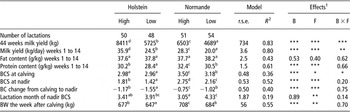
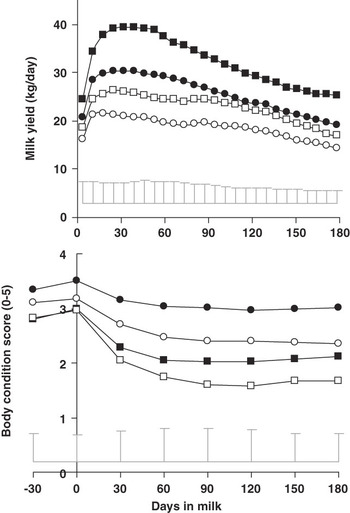
The feeding effect was original. Cows in the low group lost more BC than those in the high group (−1.28 v. −0.96 unit from calving to nadir BCS, P < 0.001), faster (−0.97 v. −0.70 unit from calving to 60 days PP, P < 0.001) and for a longer period (4.1 v. 3.2 months from calving to nadir BCS, P = 0.001), although they produced much less milk (22.3 v. 32.1 kg/day over 14 weeks, 26.5 v. 36.8 kg/day at peak MY, 5207 v. 7457 kg over 44 weeks; P < 0.001; Table 1, Figure 2). The feeding level had similar effects on BC change in Holstein and Normande cows, but had a greater effect on MY in Holstein cows. Over 44 weeks, the MY difference between the high group and the low group was about +2700 kg in Holstein cows v. +1800 kg in Normande cows (breed × feeding interaction P = 0.003). Milk fat contents were similar between groups over the 14 first weeks, but protein content was lower in low-fed cows (29.4 v. 31.3 g/kg, P < 0.001). At 20 and 60 days in milk, low-fed and high-fed cows had similar plasma NEFA concentrations, but low-fed cows had much lower glucose concentrations than high-fed ones (P < 0.001, P = 0.002; Table 2).
Adjusted milk yields, milk contents, BCS (0 to 5 scale) and BW the week after calving for Holstein and Normande cows fed an either high- or low-feeding level diet during lactation

BCS = body condition score; BC = body condition; BW = body weight.
1Effects of breed (B), feeding level (F), breed cross feeding level interaction (B × F).
a,b,c,d Values with different superscript letters are significantly different (P < 0.05).
***, **, *, +P < 0.001, 0.01, 0.05, 0.10.
Adjusted milk yields and body condition scores over the first 180 days of lactation in Holstein (▪, □) and Normande (●, ○) cows submitted to an either high (▪, ●) or low (□, ○) feeding level diet during lactation (n = 203). ⊤: residual standard errors of the models.

Adjusted NEFA and glucose plasma concentrations at 20 and 60 days in milk for Holstein and Normande cows fed a either high- or low-feeding level diet during lactation (n = 201 and 202, respectively)

NEFA = non-esterified fatty acids.
1Effects of breed (B), feeding level (F), breed cross feeding level interaction (B × F).
a,b Values with different superscript letters are significantly different (P < 0.05).
***, **, *, +P < 0.001, 0.01, 0.05, 0.10.
The breed effect on these parameters was as expected. The Normande cows produced less milk, were heavier after calving, lost less BC after calving and had higher BCS than Holstein cows throughout lactation (P < 0.001; Table 1, Figure 2). Milk fat content was similar between breeds over the first 14 weeks, but milk protein content was higher in Normande cows (P < 0.001). Normande cows had lower NEFA concentrations than Holstein ones at 20 days in milk (P = 0.013) and tended to have lower glucose concentrations at 60 days in milk (P = 0.089).
Genital health problems at calving were as frequent in the high group as in the low group (P = 0.70), but were more frequent in Holstein cows than in Normande ones (28% v. 13%, P = 0.019).
PP ovarian activity was not affected by the feeding level
Description of cyclicity abnormalities
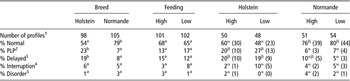
Two hundred and three progesterone profiles were analysed. The distribution of profile types according to breed and feeding level is shown in Table 3. The delayed profile concerned 13% of cows. Among these cows, the C-LA first quartile, median and third quartile values were 60, 69 and 88 days PP, ranging from 51 to more than 200 days PP. The PLP profile concerned 15% of cows. Two-thirds of prolonged luteal phases occurred at first ovulation (n = 24) but they could occur at the second (8), third (2) or even fourth ovulation (1). Five cows had prolonged luteal phases at both the first and second ovulation: two Normande cows that encountered severe metritis and received prostaglandin analogue injection and three Holstein cows without any observed genital health disorder. This abnormality occurred early in the PP period with first quartile, median and third quartile calving-associated oestrus intervals of 16, 20 and 47 days PP, respectively (range 10 to 104). The interruption profile concerned 5% of cows. Half of the delayed ovulations of rank ⩾2 concerned the expected second ovulation (n = 6) but could concern the third (2), fourth (3) or even eighth ovulation (1). On average, this abnormality occurred at 109 ± 36 days PP (range 47 to 149, the expected date of oestrus being considered as luteolysis date +2 days).
Observed percentages of normal progesterone profiles and of profiles with abnormalities for Holstein and Normande cows fed an either high- or low-feeding level diet during lactation (n = 203). The numbers of each type of profile are given into parentheses

PLP = prolonged luteal phase.
1The sum of normal profiles and abnormalities listed below does not correspond to the effective since some abnormal profiles had two types of abnormalities.
2At least one prolonged luteal phase (luteal phase length >25 days).
3Delayed first ovulation (commencement of luteal activity >50 days after calving).
4At least one ovulation of rank ⩾2 delayed (inter-luteal phase length >12 days).
5Irregular luteal activity without previously reported abnormalities.
a,bPercentages per breed or per feeding group without common latin letters are significantly different (P < 0.05).
α,βPercentages per breed × feeding group without common greek letters tend to be different (P < 0.10).
Only five progesterone profiles out of 203 had two kinds of abnormalities. One of the PLP-classified profiles was also delayed classified (C-LA = 53 days PP, ⩽43 for others). Three of the PLP-classified profiles were also interruption classified (one delayed ovulation immediately followed the prolonged luteal phase). One of the delayed classified profiles was also interruption classified.
Commencement of luteal activity was not affected by the feeding level
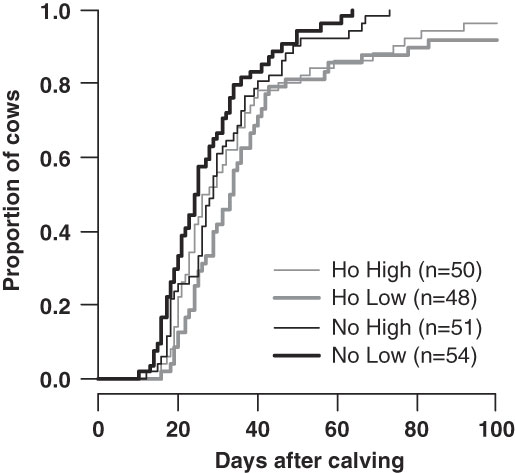
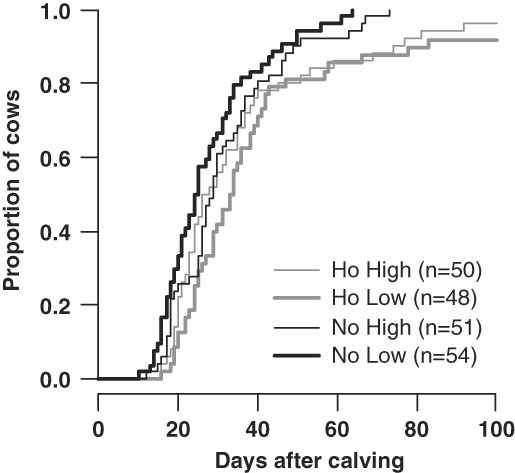
It averaged 35.2 ± 25.9 days (arithmetic mean ± s.d.). Loge(C-LA) averaged 3.41 ± 0.50, that is, 30.3 days (geometric mean). There were 57% and 87% of cows, which had resumed luteal activity before 30 and 50 days, respectively, after calving (Figure 3). Feeding level had no significant effect on loge(C-LA) (P = 0.95). There was a significant breed × feeding interaction (P = 0.041) on C-LA in Holstein and Normande cows: 31.3 v. 35.8 days in Holstein breed (high v. low, P = 0.17) and 28.9 v. 25.1 days in Normande breed (high v. low, P = 0.13; model R 2 = 0.15, model r.s.e. = 0.48 on loge-scale). Overall, Normande cows resumed luteal activity earlier than Holstein cows (27.0 v. 33.5 days, P = 0.002). Very late resumptions in Holstein cows partly account for this difference: six Holstein cows did not resume luteal activity within 100 days PP (3%; four low, two high). Genital health problem delayed commencement of luteal activity by 10 days in Holstein cows (42.5 v. 32.7 days, P = 0.004) but had no effect in Normande cows (P = 0.63).
Cumulative proportions of Holstein (H) and Normande (N) cows fed an either high- or low-feeding level diet during lactation having their luteal activity resumed.
Progesterone profile categories were not affected by the feeding level
Only the breed had an obvious effect on the profile categories (Table 3), owing to significantly more PLP and delayed profiles in Holstein cows (23% v. 7% and 19% v. 8%, P < 0.001 and P = 0.014). Holstein cows had 25% less normal profiles than Normande ones (54% v. 79%, P < 0.001). The worst results were observed for Holstein low-fed cows with only 48% of normal profiles, the best ones for Normande low-fed cows with 80% of normal profiles. There were few interruption profiles, but it concerned eight profiles out of 102 in low-fed cows v. 3 out of 101 in high-fed ones (P = 0.13).
Genital health problem had no significant effect on progesterone profile categories in Holstein cows (P > 0.11). Conversely, Normande cows that encountered genital health problem at/following calving had less normal profiles (36% v. 86%, P < 0.001), more PLP profiles (29 v. 3%, P = 0.006) and more delayed profiles (21 v. 6%, P = 0.07).
More ovulations were detected and standing behaviour was more frequently observed in low-fed cows
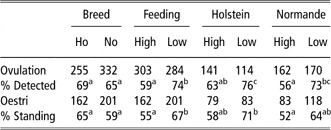
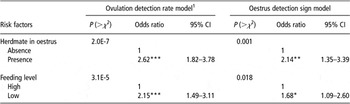
Sixty-seven percent of ovulations of rank ⩾2 (n = 587, corresponding to 199 lactations) were detected and 61% of detections relied on standing behaviour. Ovulations were more frequently detected in the low group than in the high group (74% v. 59%, P < 0.001) and detections relied more frequently on standing behaviour (67% v. 55%, P = 0.025). These differences were observed in both breeds (Table 4). In logistic regression models used to explain the detection rate and the detection by standing behaviour rather than by other signs, the presence of at least one other cow in oestrus was the major risk factor, followed by the feeding level (Table 5). Breed, parity, pasture access and genital health problem had no significant effect in these models (P > 0.11). The presence of another cow in ovulation period had a lower effect than the presence of another cow in oestrus (results are not shown). Out of the 196 undetected ovulations of rank ⩾2, the ‘undetected’ cow was nevertheless observed to interact with an oestrus-considered herdmate in only 17 cases (9%). These cases were neither affected by the feeding level nor by the breed (P > 0.7).
Observed percentages of detected ovulations of rank ⩾2 and of oestri detected by standing behaviour in Holstein and Normande cows fed an either high- or low-feeding level diet during lactation

Ho = Holstein; No = Normande.
a,b,cPercentages per breed, per feeding group or per breed × feeding group without common letters are significantly different (P < 0.05).
Odds ratios and 95% CI for the two binomial logistic regression models used to explain the detection of ovulations of ranks ⩾2 (n = 587 ovulations, ovulation detection rate model) and the incidence of standing behaviour (n = 363 described oestri, oestrus detection sign model) of Holstein and Normande cows fed an either high- or low-feeding level diet during lactation (decrease in the residual deviance, P = 1.5 E-10 and P = 3.7 E-4)

1To avoid observation biases, model also accounted for year (2006 v. 2007 to 2008, as heat mount detectors were not used in 2006) and breeding observation period (ovulation during the breeding period and the four previous weeks v. before).
***, **, *, + Odds ratio is different from 1 (P < 0.001, 0.01, 0.05, 0.10).
Only 13% of the 201 first ovulations were detected and 42% of detections relied on standing behaviour. Once accounted for, the presence of another cow in oestrus, breed, parity, feeding level, genital health problem and pasture access had no significant effect (P > 0.12). When at least one other cow was in oestrus, 25% were detected v. 6% when there was no herdmate in oestrus (P < 0.001).
Ten percent of the 441 oestrus-considered behavioural events were false oestri. They were neither affected by the feeding level nor by the breed (P > 0.49).
Feeding level had converse effects on fertility estimators in Holstein cows
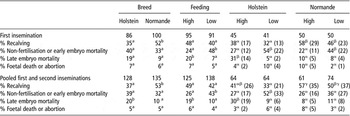
The following section describes results for the pooled first and second inseminations (n = 263; results are very similar to the first insemination, see Table 6).
Observed percentages of recalving, of non-fertilisation or early embryo mortality, of late embryo mortality and of foetal death or abortion following inseminations of ranks 1 and 2 performed on true oestri in Holstein and Normande cows fed an either high- or low-feeding level diet during lactation. The numbers of each type of insemination result are given into parentheses

a,bPercentages per breed or per feeding group without common latin letters are significantly different (P < 0.05).
α,β,γPercentages per breed × feeding group without common greek letters tend to be different (P < 0.10).
Recalving rates did not differ between feeding groups (P = 0.27). However, in the Holstein breed, low-fed cows encountered more non-fertilisations or early embryo mortalities than high-fed ones (52% v. 27%, P = 0.004) but high-fed cows suffered from more late embryo mortalities than low-fed ones (30% v. 9%, P = 0.004). In the Normande breed, these differences were not significant (P = 0.20 and P = 0.61).
Normande cows had higher recalving rates than Holstein ones, owing to less late embryo mortalities in the high-feeding group and owing to less non-fertilisations or early embryo mortalities in the low-feeding group (Table 6).
Using logistic regressions to test recalving v. not recalving, the final model included only breed and calving-AI interval <50 days: being a Normande cow multiplied the odds of recalving by 1.9 (P = 0.009) and an early PP insemination divided it by 2.8 (P = 0.024).
Feeding level had no significant effect on final pregnancy rate but low-fed cows got pregnant earlier in the Normande breed
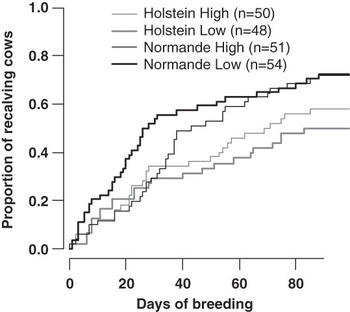
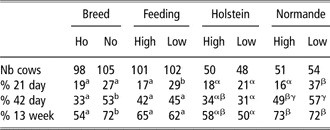
In the following section, a cow was considered pregnant if she recalved. In Holstein cows, feeding level had no significant effect on the proportion of pregnant cows over breeding time (considered either from the start of breeding period or from 42 days in milk; Figure 4; Table 7). In Normande cows, more cows were pregnant within 21 days in the low group than in the high group (37 v. 16%, P = 0.013). This difference was narrowed down as days in breeding increased. Finally, only breed affected the pregnancy rate by the end of the 13-week breeding period: 72% of Normande cows were pregnant v. 54% of Holstein cows (P = 0.007).
Cumulative proportions of cows successfully inseminated over breeding time (from either the start of the breeding period or 42 days after calving), in Holstein and Normande cows fed an either high- or low-feeding level diet during lactation.

Observed percentages of cows successfully inseminated within 21 and 42 days of breeding time (either start of the breeding period or ⩾42 days after calving) and by the end of the breeding period (13 weeks), in Holstein and Normande cows fed an either high- or low-feeding level diet during lactation. Successful insemination is defined as the cow subsequently re-calving

HO=Holstein; NO=Normande.
a,bPercentages per breed or per feeding group without common latin letters are significantly different (P < 0.05).
α,β,γPercentages per breed × feeding group, without common greek letters tend to be different (P < 0.10).
Discussion
The same feeding level can have both positive and negative effects on reproduction
Owing to the reportedly negative effects of energy deficit and subsequent BC loss and low BCS on ovarian activity (Butler et al., Reference Butler, Everett and Coppock1981), oestrous behaviour (Schopper and Claus, Reference Schopper and Claus1990), fertility and overall reproductive performance (Suriyasathaporn et al., Reference Suriyasathaporn, Nielen, Dieleman, Brand, Noordhuizen-Stassen and Schukken1998; Roche et al., Reference Roche, Macdonald, Burke, Lee and Berry2007), we could expect a dramatic effect on reproductive performance of the low feeding level triggering large BC loss and low BCS over lactation. However, the low feeding strategy achieved similar final pregnancy rate. This is in accordance with many studies comparing feeding levels in compact calving systems (Fulkerson et al., Reference Fulkerson, Wilkins, Dobos, Hough, Goddard and Davison2001; Kennedy et al., Reference Kennedy, Dillon, O’Sullivan, Buckley and Rath2003; Horan et al., Reference Horan, Mee, Rath, O’Connor and Dillon2004; Macdonald et al., Reference Macdonald, Penno, Lancaster and Roche2008; Pedernera et al., Reference Pedernera, Garcia, Horagadoga, Barchia and Fulkerson2008; Coleman et al., Reference Coleman, Pierce, Berry, Brennan and Horan2009; Delaby et al., Reference Delaby, Faverdin, Michel, Disenhaus and Peyraud2009), although none of these studies generated the opposite differences that we observed in both MY (Δ = 2200 kg over 44 weeks) and BC loss (Δ = 0.32 on a 0 to 5 scale). On the one hand, low-fed cows may suffer from a greater BC loss and poorer BC score, but on the other hand, they may benefit from a lower MY level.
The similar final reproductive performance can be explained by ‘compensations’ between different stages, in the sense that a particular depressed reproductive stage can be associated with an improved previous or subsequent reproductive stage, balancing the final reproductive outcome. Although ovarian activity appeared to be little affected by feeding treatment, low-fed cows had an improved ovulation detection rate but depressed fertilisation or early embryo survival (and less late embryo mortality, in Holstein cows). This is a major result of this study: the same feeding level can have both positive and negative effects on reproduction.
The feeding level had little effect on commencement of luteal activity and progesterone profile categories
This result is consistent with other recent studies (Horan et al., Reference Horan, Mee, O’Connor, Rath and Dillon2005; Pedernera et al., Reference Pedernera, Garcia, Horagadoga, Barchia and Fulkerson2008; Windig et al., Reference Windig, Beerda and Veerkamp2008). The differences in BCS and BC change observed between feeding groups in the 1st month of lactation may not be large enough to significantly alter ovarian activity (Butler et al., Reference Butler, Everett and Coppock1981), since increasing nutritive input promotes MY but narrowly improves energy balance in the 1st weeks of lactation (Faverdin et al., Reference Faverdin, Delaby and Delagarde2007). However, replications are required to confirm and detail our results, especially for primiparous cows, whose ovarian activity may be more feeding level sensitive. In New Zealand grazing dairy cows, Burke and Roche (Reference Burke and Roche2007) suggested that the pre-partum feeding level, which altered BCS at calving, had more influence on resumption of luteal activity than did the post-calving diet. In our study, pre-partum feeding diet was the same between groups, BCS at calving did not differ in the Holstein breed and was higher for high-fed cows in the Normande breed (without affecting resumption of luteal activity). Taken together, these results underline the need for a better understanding of the respective effects of the level and of the dynamic of body lipid reserves (and their interaction) on the ovarian activity of dairy cows (Friggens et al., Reference Friggens, Disenhaus and Petit2010).
The feeding level had a strong effect on the oestrus
The high-feeding level decreased the ovulation detection rate, and if detected, it decreased detections by standing behaviour. We observed this effect in our previous work (Cutullic et al., Reference Cutullic, Delaby, Causeur, Michel and Disenhaus2009b): in both breeds, we observed less detections by clear behavioural signs in the high-feeding level group than in the low one, both in winter (total mixed ration) and at grazing (crossover design). In descriptive studies, possibly confounding MY and energy balance effects, high MY was linked to reduced oestrus duration or walking activity (Lopez et al., Reference Lopez, Satter and Wiltbank2004; López-Gatius et al., Reference López-Gatius, Santolaria, Mundet and Yániz2005). In our studies, owing to the converse effects of feeding treatment on MY and BC, we suggest that high MY per se has a deleterious effect that is not mediated through the BC status or dynamic. This result is consistent with the described relationship between milk yield, dry matter intake, liver blood flow and consequent clearance of sexual steroid hormones (Sangsritavong et al., Reference Sangsritavong, Combs, Sartori, Armentano and Wiltbank2002). However, if assumed to be the only effect, the dry matter hypothesis is inconsistent with the lack of breed effect in this study, since Holstein cows have higher dry matter intakes than Normande cows in grass-based feeding systems (Dillon et al., Reference Dillon, Buckley, O’Connor, Hegarty and Rath2003). Physiological investigations are required to explain this. A preliminary study suggested an enhanced oestradiol ovarian synthesis in low-fed cows (Cutullic et al., Reference Cutullic, Benhaim, Barbey, Mitre, Carreau and Disenhaus2009a). The fact that Normande cows had a higher percentage of normal ovarian cycles but not a higher ovulation detection rate is intriguing. Observation biases are unlikely, since false oestri and undetected interacting cows were equally distributed among the breeds and among the feeding groups.
The feeding level had no significant effect on the recalving rate at the first and second inseminations
These results are consistent with many recent studies that failed to improve fertility by increasing the feeding level (Fulkerson et al., Reference Fulkerson, Wilkins, Dobos, Hough, Goddard and Davison2001; Ferris et al., Reference Ferris, Gordon, Patterson and Murphy2003; Kennedy et al., Reference Kennedy, Dillon, O’Sullivan, Buckley and Rath2003; Horan et al., Reference Horan, Mee, O’Connor, Rath and Dillon2005; Pedernera et al., Reference Pedernera, Garcia, Horagadoga, Barchia and Fulkerson2008; Delaby et al., Reference Delaby, Faverdin, Michel, Disenhaus and Peyraud2009). However, the low-feeding level increased non-fertilisation or early embryo mortalities (+17% at the pooled first and second inseminations), especially in Holstein cows (+25%). Early embryo mortalities may be due to the poor oocyte quality (Humblot et al., Reference Humblot, Fréret and Ponsart2009), or low glucose availability and poor uterine fluid composition during the blastocyst expansion and elongation stages (Morris and Diskin, Reference Morris and Diskin2008). Large BC loss and low BCS may be responsible for these failures. Conversely, in Holstein cows, the high-feeding level appeared to compromise late embryo development. Two major hypotheses can be retained. First, there is a gradual mortality process and mortality occurs earlier in the low group than in the high one. Second, high MY and/or high BCS specifically alter later stages of embryo development as suggested by Grimard et al. (Reference Grimard, Fréret, Chevallier, Pinto, Ponsart and Humblot2006). Some embryos may also suffer from over-exposure to insulin in the high group (Adamiak et al., Reference Adamiak, Mackie, Watt, Webb and Sinclair2005). Investigations on progesteronemia would be required (Morris and Diskin, Reference Morris and Diskin2008). Indeed, in regard to P4 clearance rate, the high feeding level group should be disfavoured owing to higher dry matter intake (Sangsritavong et al., Reference Sangsritavong, Combs, Sartori, Armentano and Wiltbank2002) but favoured owing to decreased hepathocytes P4 catabolism for insulinergic diets (Lemley et al., Reference Lemley, Vonnahme, Krause and Wilson2009).
Normande cows had a much better ovarian activity, fertility and overall reproductive performance
As expected, breed had a major effect on final reproductive performance (Delaby et al., Reference Delaby, Faverdin, Michel, Disenhaus and Peyraud2009). More Normande cows were pregnant by the end of the breeding period (+18%). This is explained by a much better underlying ovarian activity and a higher fertility, but not by an improved ovulation detection rate. Normande cows had 79% of normal progesterone profiles, as observed in other higher fertility breeds such as Norwegian Red or Swedish Red and White (∼75%; Petersson et al., Reference Petersson, Gustafsson, Strandberg and Berglund2006; Garmo et al., Reference Garmo, Martin, Thuen, Havrevoll, Steinshamn, Prestlokken, Randby, Eknaes, Waldmann and Reksen2009). Holstein cows had only 54% of normal profiles, consistent with recent literature in this breed (Royal et al., Reference Royal, Darwash, Flint, Webb, Woolliams and Lamming2000; McCoy et al., Reference McCoy, Lennox, Mayne, McCaughey, Edgar, Catney, Verner, Mackey and Gordon2006). In our study, Normande cows resumed luteal activity 6 days earlier (geometric means) than Holstein cows; this breed difference is large compared to other studies in dairy cows (Horan et al., Reference Horan, Mee, O’Connor, Rath and Dillon2005; Petersson et al., Reference Petersson, Gustafsson, Strandberg and Berglund2006). PLP profiles were scarce in Normande cows (7%), as observed in Swedish Red and White (6%; Petersson et al., Reference Petersson, Gustafsson, Strandberg and Berglund2006), Norwegian Red (10%; Garmo et al., Reference Garmo, Martin, Thuen, Havrevoll, Steinshamn, Prestlokken, Randby, Eknaes, Waldmann and Reksen2009), Swedish Holstein cows (11%; Petersson et al., Reference Petersson, Gustafsson, Strandberg and Berglund2006) and also Friesian cows three decades ago (13%; Royal et al., Reference Royal, Darwash, Flint, Webb, Woolliams and Lamming2000). Conversely, 23% of Holstein cows had at least one PLP as classically observed nowadays (Royal et al., Reference Royal, Darwash, Flint, Webb, Woolliams and Lamming2000; McCoy et al., Reference McCoy, Lennox, Mayne, McCaughey, Edgar, Catney, Verner, Mackey and Gordon2006). This confirms the Holstein-specific increase in prolonged luteal phases (Royal et al., Reference Royal, Darwash, Flint, Webb, Woolliams and Lamming2000). Severe genital health problems at calving, possibly disrupting the normal pulsatile pattern of prostaglandins F2α secretion, explained PLP profiles in Normande cows but not in Holstein cows. Other mechanisms related to body lipid mobilisation may be involved in lengthening luteal phases (Villa-Godoy et al., Reference Villa-Godoy, Hughes, Emery, Stanisiewski and Fogwell1990).
Recalving rates following the first and second inseminations are consistent with French results in both Holstein and Normande breeds, with a well-established 10% to 15% advantage for Normande cows (Barbat et al., Reference Barbat, Druet, Bonaiti, Guillaume, Colleau and Boichard2005). This seems to be mainly explained by 10% less late embryo mortalities in Normande cows, in agreement with a French survey (Michel et al., Reference Michel, Ponsart, Fréret and Humblot2003). In the high group, non-fertilisation and early embryo mortalities were as frequent in Normande cows as in Holstein cows (∼26%), but many Holstein cows failed to recalve owing to 22% more late embryo mortalities.
Whether the overall better reproductive performance of the Normande breed can be explained by a different partitioning of available energy or whether there is a specific breed effect cannot be ascertained in this study. Holstein cows produced more milk, lost more BC, and had a greater MY response to the increase in feeding level than the dual-purpose Normande cows. Thus they partition more energy to the mammary gland, as previously shown (Delaby et al., Reference Delaby, Faverdin, Michel, Disenhaus and Peyraud2009). The first adaptation of dairy cows submitted to a low-feeding level is to reduce milk yield, and then to compensate residual energy deficit by BC loss (Friggens et al., Reference Friggens, Emmans, Kyriazakis, Oldham and Lewis1998; Delaby et al., Reference Delaby, Faverdin, Michel, Disenhaus and Peyraud2009). The Normande breed appears to be well adapted to low-feeding levels, since low-fed Normande cows reduce MY sufficiently, compromising neither cyclicity nor fertility and having better oestrus expression.
Conclusion: taking the overall reproductive process into account and possible converse effects
In conclusion, final reproductive performance seems to be mainly affected by the reproductive potential of the cow, and Normande cows appear to be more suitable with compact calving systems. For very short breeding periods (6 weeks), a low-feeding level appears to be more suitable for Normande cows, as they do not compromise any reproductive stage. In Holstein cows, the low-feeding level did not lead to reproductive failure, as expected from the literature, since compensations occur at various stages of the reproductive process. In order to build sustainable dairy strategies, we have to get rid of our ‘one-way’ way of thinking: some reproductive stages may suffer from high milk yield, other stages from low BCS.
Acknowledgements
The authors thank the staff of the INRA experimental farm Le Pin au Haras, especially Yves Carbonnier, Loïc Leloup, René Dernaucourt, Nicolas Desramé, Guillaume Michel, Ségolène Leurent and Marion Pavec for the time spent in sampling, observing animals, recording and organising data. Jacques Portanguen and Clara Lambard are also acknowledged for their large implication in progesterone assays. This work received financial support from the Basse-Normandie regional council.