1. Introduction
A reader can obtain information about more than one letter at a glance, an important ability for reading (Rayner, Reference Rayner1998). Given the lateral dominance of the left hemisphere of the brain for processing linear contours (Klingberg, Reference Klingberg2013), it might be easier to derive contour information about letters or letter-like forms from the visual field to the right than to the left because the field to the right is directly related to the left occipital-temporal area. As a result of familiarization with the reading direction, skilled readers of a right-to-left language may have developed a leftward asymmetry, as suggested by Jordan and colleagues (Jordan et al., Reference Jordan, Almabruk, Gadalla, McGowan, White, Abedipour and Paterson2014; Paterson, McGowan, White, Malik, Abedipour, & Jordan, Reference Paterson, McGowan, White, Malik, Abedipour and Jordan2014). Such being the case, we might expect a difference between Dutch and Hebrew readers: In Dutch – reading from left to right – parafoveal processing may be wider to the right and in Hebrew to the left. In the current study we focus on preferences of prereaders. Since reading skills emerge long before children become conventional readers, it is conceivable that even for prereaders the parafoveal processing of letters may be biased by reading direction. Or does lateral dominance of the left hemisphere of the brain for processing linear contours make it easier to process letter forms when they are projected in the right parafoveal field? The experiment was replicated for parafoveal processing of letter-like contours. Because, in contrast to letter forms of the dominant orthography, for unfamiliar letter-like forms there are no reasons to expect alternative factors like reading direction to affect processing.
1.1. parafoveal processing during reading
Only four to five letters around a fixation point (the foveal area) are seen with 100% acuity. Letters further removed from the fixation point are seen with decreasing acuity. In a seminal study of eye movements in reading, Rayner and colleagues (McConkie & Rayner, Reference McConkie and Rayner1975; Rayner & Bertera, Reference Rayner and Bertera1979) tested the width of the area from which a reader can obtain information at a glance. The moving window technique, or moving mask technique, enabled the researchers to control how much print was visible to the reader at each fixation. The print was legible only within an experimenter-defined area (window) around the reader’s fixation point, while outside this area the print was illegible. Each time the eyes moved forward, a new limited area of print became visible, while the previous area was no longer legible. If the reading rate remained the same, whether the window was present or not, we could assume that the perceptual span equals the region from which the reader can obtain information at a glance. With the moving window technique, Rayner (Reference Rayner1986) examined the size and the direction of the so-called ‘perceptual span’ in second-, fourth-, and sixth-grade English children, as well as English adult readers. He reported for beginning readers (at the beginning of grade 2) a perceptual span of 11–12 letters to the right, which is only slightly different from the perceptual span of adult readers, i.e., 14–15 letters to the right (Rayner, Reference Rayner1998). In line with the smaller span, beginning readers fixate 191 times per 100 words, compared to 94 times for adult readers, a reduction of more than 50% (Rayner, Reference Rayner1998).
Häikiö and colleagues (Häikiö, Bertram, Hyönä, & Niemi, Reference Häikiö, Bertram, Hyönä and Niemi2009) tested the width of the perceptual span with a similar technique, but presented, instead of illegible text, non-words outside the window. The non-words looked similar to existing words (e.g., ‘kono’ instead of ‘here’), rather than meaningless letter sequences (e.g., ‘xxxx’ instead of ‘here’), as in the research conducted by Rayner and colleagues. Häikiö and colleagues (2009) reported a span that was somewhat smaller than the span reported by Rayner (Reference Rayner1998), probably because nonwords negatively affected reading rate. Häikiö et al. (Reference Häikiö, Bertram, Hyönä and Niemi2009) found a span of five letters to the right for second-graders and nine letters for adults. Interestingly, the perceptual span of faster readers exceeded that of slower readers, and this applied to both second-graders and adults.
In the current study we designed a new task, different from the one used by McConkie and Rayner (Reference McConkie and Rayner1975) and Häikiö et al. (Reference Häikiö, Bertram, Hyönä and Niemi2009), to test prereaders’ preferences for parafoveal processing of letters at various distances. Unlike the previous studies, we presented two letters, one in the center of the screen and one to the right or to the left at a distance of four or six letters (subtended 7.58 or 11.31 degrees, respectively). This procedure enabled us to test the left or right preferences of prereaders, and which parafoveal distance is appropriate to correctly identify letter shapes in the stage preceding conventional reading.
1.2. reading direction and parafoveal processing
The hypothesis that reading direction as a characteristic of the orthography explains the asymmetric partition of readers’ perceptual span was based on seminal studies by Heron (Reference Heron1957) and Mishkin and Forgays (Reference Mishkin and Forgays1952). The outcomes were much later confirmed by Pollatsek and colleagues (Pollatsek, Bolozky, Well, & Rayner, Reference Pollatsek, Bolozky, Well and Rayner1981), and recently by Jordan and colleagues (Jordan et al., Reference Jordan, Almabruk, Gadalla, McGowan, White, Abedipour and Paterson2014) but contradicted by Faust, Kravetz, and Babkoff (Reference Faust, Kravetz and Babkoff1993). Pollatsek and colleagues found that Israeli adults’ reading of Hebrew text slowed down when letters to the left were masked. Similarly, reading the same content in English slowed down when letters to the right were masked.
In the same vein, Jordan and colleagues (2014) tested the perceptual span in Arabic text, which is read from right to left, with the moving window technique (Rayner, Reference Rayner1985). They demonstrated that for readers skilled in both Arabic and English, reading rate in Arabic was optimal with a window that enabled a parafoveal span to the left, whereas reading English their reading rate was optimal with a window to the right. However, not all studies support a preference to the left for right-to-left languages. Projecting Hebrew words and nonwords in the right or left visual field, Faust et al. (Reference Faust, Kravetz and Babkoff1993) found highly significant, right visual field superiority. It should be noticed, though, that these researchers, unlike the above-mentioned studies, used a word recognition instead of a text reading task. Reading direction may affect word recognition to a lesser extent than reading text. Letters in the fovea may be the main source of information when reading words, but reading text other cues in the parafovea are also important, like punctuation marks, length of words, and blanks. Furthermore, when solving a lexical decision task (word or nonword) as presented by Faust et al. (Reference Faust, Kravetz and Babkoff1993), it is vital to have access to information about word forms. If this information is processed in the left occipital-temporal area (Word Form Area) as is suggested by Dehaene and Cohen (Reference Dehaene and Cohen2011), this may explain Faust et al.’s (Reference Faust, Kravetz and Babkoff1993) result that words in the right visual field were recognized faster and more accurately processed.
Even when the perceptual span of expert readers is biased towards the direction from which most useful information can be expected (Greene, Pollatsek, Masserang, Ju Lee, & Rayner, Reference Greene, Pollatsek, Masserang, Ju Lee and Rayner2010; Jordan at al., 2014; Paterson et al., Reference Paterson, McGowan, White, Malik, Abedipour and Jordan2014), parafoveal processing of beginning readers is expected to be less biased. However, even though prereaders spend only a small amount of time looking at print in storybooks (Evans & Saint-Aubin, Reference Evans and Saint-Aubin2005), children in this early stage may, as a result of book-reading experiences and name writing, be familiar with the reading direction of their language (Clay, Reference Clay1979) and show an asymmetry in the same direction as expert readers. So far, no studies have tested whether, in line with their most familiar orthography, the parafoveal span of Hebrew prereaders may be asymmetric to the left and that of Dutch readers to the right. We tested whether prereaders have a preference for letters presented in the right or left visual field, according to the dominant reading direction in their language (e.g., Pollatsek et al., Reference Pollatsek, Bolozky, Well and Rayner1981).
1.3. reading direction and the optimal viewing position (OVP) in words
According to a study by Aghababian and Nazir (Reference Aghababian and Nazir2000), word recognition after one year of reading instruction varies as a function of fixation point within words, and reading performance is optimal when a spot is fixated to the left of the word center, perhaps because this enables recognition of a maximum number of letters. An asymmetric parafoveal span influences the Optimal Viewing Position – the optimal fixation point in a word. In languages read from left to right, the OVP is somewhat to the left of the word’s center (Nazir, Heller, & Sussmann, Reference Nazir, Heller and Sussmann1992; O’Regan & Jacobs, Reference O’Regan and Jacobs1992; Vitu, O’Regan, & Mittau, 1990). Studies attempting to find a reverse position of the OVP, that is, somewhat to the right of the word’s center for languages read from right to left – like the Semitic languages Hebrew and Arabic – have to take into account complicating factors such as the morphological structure of Semitic languages (Levin, Ravid, & Rapaport, Reference Levin, Ravid and Rapaport2001). Distinguishing between three factors affecting the asymmetry of the OVP (namely, hemispheric specialization, reading direction, and lexical constraint), Farid and Grainger (Reference Farid and Grainger1996) showed that, for Arabic, the OVP is most dependent on the morphological structure of the words. The prefixed words showed a distinct leftwards asymmetry whereas the suffixed words showed a rightwards asymmetry. Hence, a failure to show an OVP somewhat to the left of the middle of a word for Hebrew readers (Deutsch & Rayner, Reference Deutsch and Rayner1999), may be caused by the morphological structure of this language.
There is, however, evidence that, for emergent readers, the first letter might be an important cue for word recognition (Rayner, White, Johnson, & Liversedge, Reference Rayner, White, Johnson and Liversedge2006). Young children particularly pay attention to the first letter of words (Biemiller, Reference Biemiller1970; Ehri, Reference Ehri2005; Marchbanks & Levin, Reference Marchbanks and Levin1965; Savage, Stuart, & Hill, Reference Savage, Stuart and Hill2001). This would mean that Hebrew children, looking at a series of letters, may fixate the first letter appearing to the right, but Dutch children the first letter appearing to the left. This preference for the first letter in words may also influence the outcomes of the parafoveal task in the current study. In this task, two letters appear simultaneously on screen, one in the center and the second to the left or right at a distance of four or six letters. When the parafoveal letter is projected to the left, Dutch children looking for the first letter of a series of letters may pay more attention to the letter to the left and thus score higher on the parafoveal letter or, when the parafoveal letter is projected to the right, on the center letter. The reverse may occur in the Hebrew group.
1.4. this study
In response to the reading direction of their language, prereaders in Semitic languages may develop a parafoveal span to the left, whereas prereaders in Romance languages may develop a parafoveal span to the right. On the other hand, all prereaders may profit more from a parafoveal span to the right because contours of forms are stored in the left hemisphere of the brain (Dehaene & Cohen, Reference Dehaene and Cohen2011). When the reading direction goes from left to right, as in Dutch, both the storage of linear contours in the left hemisphere (Klingberg, Reference Klingberg2013) and the reading direction favors a perceptual span to the right, and may make it easier for prereaders to detect visual information projected at the right side of a fixation. By contrast, when a language is read from right to left, like Hebrew, it may be easier for prereaders to detect information at the left side of a fixation, favoring a perceptual span to the left side. Yet contour information may be easier processed when presented in the right visual field, thus favoring, for Hebrew children, a perceptual span to the right. Unlike letters, letter-like forms may be affected by brain dominance of the left hemisphere and less by culture. For Hebrew as well as Dutch children, it may be easier to detect contour information (Klingberg, Reference Klingberg2013) about letter-like forms at the right side of a fixation profiting from a perceptual span to the right.
In the current study, the parafoveal span for letters and letter-like forms is tested by projecting two letters or two letter-like forms simultaneously on screen, one in the center and one at various distances from the fixation point. We projected only one letter in the parafovea to eliminate non-visual influence, such as memory capacity. We asked children to fixate the center letter and used an eye-tracker to control whether they indeed fixated the center letter. Children selected the projected letters/forms from a set of six letters/forms. Form recognition was preferred to letter naming, as letter recognition may develop preceding letter naming (Both-de Vries & Bus, Reference Both-de Vries and Bus2014). It was hypothesized that: (i) prereaders, Hebrew as well as Dutch, are able to detect letters and letter-like forms in the parafovea; (ii) the farther the letters/letter-like forms are removed from the fovea, the more often children will fail to recognize letters/forms correctly; (iii) despite a different reading direction, Dutch as well as Hebrew children may recognize more letter forms to the right of a fixation than to the left, according to the lateral dominance of the left hemisphere of the brain for letters; (iv) if contour information is stored in the left hemisphere of the brain, similar effects may be expected for letter-like contours, especially when they become familiar; and (v) a preference for the first letter of a word may result in different ways of dividing attention over two letters. Dutch children may consequently more often fail to recognize the center letter correctly when the parafoveal letter is projected to the left because they focus on the ‘first’ letter of a string, while the pattern may be the opposite in the Hebrew group. When Hebrew children preferably pay attention to the letter on the right in a string they may, likewise, more often fail to recognize the center letter when the parafoveal letter is projected to the right. For letter-like forms this behavior was not expected.
2. Method
2.1. participants
A total of 100 children participated in this study, 55 Dutch living in the Netherlands (40.15% girls) and 45 Israeli living in Israel (37.78% girls). One Dutch girl dropped out due to illness. Dutch children (mean age 5;3.15, SD = 6.15), were recruited from two schools (N = 13 and N = 41). The children were from middle socioeconomic status families with Dutch as their first language. Israeli children (mean age 5;6.21; SD = 6.15) from middle to high socioeconomic status families with Hebrew as their first language were recruited from three daycare centers. All children had normal or corrected-to-normal vision. All parents gave written informed consent for their child’s participation in the study.
2.2. design
A cross-sectional correlational design was carried out comparing Dutch and Israeli children’s perceptual span for letters and letter-like forms. Letters and forms were the same size. Distance between the center letter and the parafoveal letter was as wide as four letters or six letters of the same size as the letters used in the center and the parafovea, subtending 7.58 and 11.31 degrees, respectively. The distance between the center form and the parafoveal form varied likewise. The parafoveal letters and letter-like forms were projected at the left or right side of the central letter, thus creating four conditions for both letters and letter-like forms: left-4, left-6, right-4, right-6. The two letters, in the center and parafoveally, were projected simultaneously.
2.3. procedure
During four sessions a trained research assistant instructed the child and a coordinator of the research project operated the eye-tracker and controlled the order of tasks. Sessions took place in a spare room outside the classroom. Both perceptual span tasks were spread over sessions 1–3.
2.4. measures
2.4.1. Perceptual span of letters
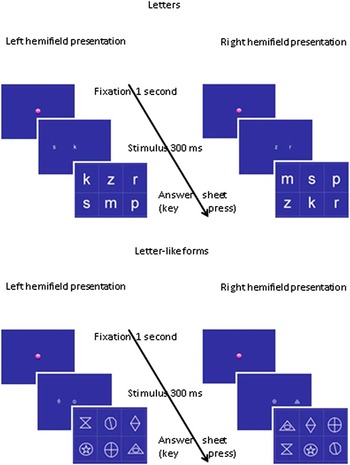
After a smiley appearing in the center of the screen for 1000 ms, two letters appeared simultaneously for 300 ms, one letter in the center and one in the left visual field (LVF) or to the right (RVF). The distance between the center and the parafoveal letter equaled four or six letters (subtending 7.58 and 11.31 degrees, respectively). Letters were printed in Tahoma 54, in white on a dark blue background. To test the children’s perceptual span, after the letters had disappeared, the children were asked to select the two letters out of six letters (see Figure 1). They were not asked to indicate which letter they saw in the center or parafoveally. For both languages we selected letters that differed greatly in form. For the Dutch sample the letters r m s z p k were used and for the Hebrew sample: ל ת ר ב ש א. For each condition (LVF-4, LVF-6, RVF-4, and RVF-6) we selected ten combinations of letters and positions (center or parafovea). The forty trials with two letters were presented in a random order. It was coded how many center and parafoveal letters were correct and how often both letters. Eye-movement data were registered while solving the task to check whether children had looked at the center letter. An item was coded as missing if children did not attend at all to the screen or initial fixations were not at the center of the screen. On average, participants missed 2.30 out of forty trials (SD = 2.72). Because of the missing data we calculated percentages correct.
Schematic displays of the trials. The left panel shows a trial where the parafoveal letter (on top) or letter-like form (below) was presented to the left visual field. The right panel shows an example of a right visual field trial. Each trial began with a central fixation smiley (1 s) followed by a 300 ms presentation of the target letters or letter-like forms. After the stimulus offset, the answer sheet appeared. A key press by the experimenter was the onset for the next trial.

2.4.2. Perceptual span of letter-like forms
This task was exactly the same as the letter task described above, except that letter-like forms were used instead of letters. For that purpose, six different forms were created, in size comparable with the letters, printed in Tahoma 54 (e.g.,
 ; see also Figure 1). Per item one point was assigned if both forms were correctly recognized. When items were not visually attended, they were coded as missing (M =2.29, SD = 2.72). To correct for the missing items, percentages correct were calculated. If only one letter-like form was correct, the coding took account of whether this was the center or parafoveal form.
2.4.3. Letter knowledge
We assessed expressive knowledge of the six target letters (Dutch: r m s z p k; Hebrew: ל ת ר ב ש א). After presenting the letter (type Tahoma, size 150) in the center of the screen, the child was asked: “Which letter is this?” When a child did not immediately respond, the researcher would say: “Give it a try.” For each correct letter name or phoneme, one point was assigned. The maximum score equaled six.
2.5. recording eye movements
2.5.1. Apparatus
During the perceptual span tasks, eye-movements were recorded using an eye-tracker (Tobii T120; data rate 120 Hz). High-resolution infrared cameras built into the 17″ TFT monitor (resolution 1280 × 1024 pixels) reflected the retina of the participant. The relative position of the pupil was determined based on the coordinates, and this information enabled the calculation of where and how long the child’s eyes fixated, and how the eyes moved over the screen. No chin rest or helmet was needed since the system is a remote eye-tracker. The equipment allowed for some head movement, typically resulting in a temporary accuracy error of approximately 0.2 visual degrees. For fast head movements (i.e., over 25 cm/s), there is a 300-ms recovery period to full tracking ability. Calibration took a few minutes at most. Participants were seated 60 cm from the eye-tracker monitor.
2.5.2. Coding
We demarcated two areas of interest (AOIs) using the software of Tobii Studio 2.2.6: (i) the central letter (or letter-like form) plus half of the space between the central and parafoveal letter/form at the side of the central letter/form; and (ii) the parafoveal letter (or form) plus half of the space between the central and parafoveal letter/form at the side of the parafoveal letter/form. The lighter-colored (left) rectangle on the screen in Figure 2 was defined as the AOI for the central letter, and the darker-colored (right) rectangle as the AOI for the parafoveal letter. Eye-movement data were scored using Tobii Studio’s fixation filter with the default settings for velocity and distance threshold (Tobii Studio, 2010).
Two areas of interest (AOIs) were defined to assess where eyes fixated during each stimulus: (1) on or near to the letter or form in the middle or (2) on or close to the parafoveal letter or form.

3. Results
3.1. letter knowledge
Familiarity with the six target letters did not differ between Dutch and Hebrew children; they knew on average 4.15 (SD = 2.10) and 4.40 (SD = 2.06) out of six letters, respectively.
3.2. identification of letters and letter-like forms
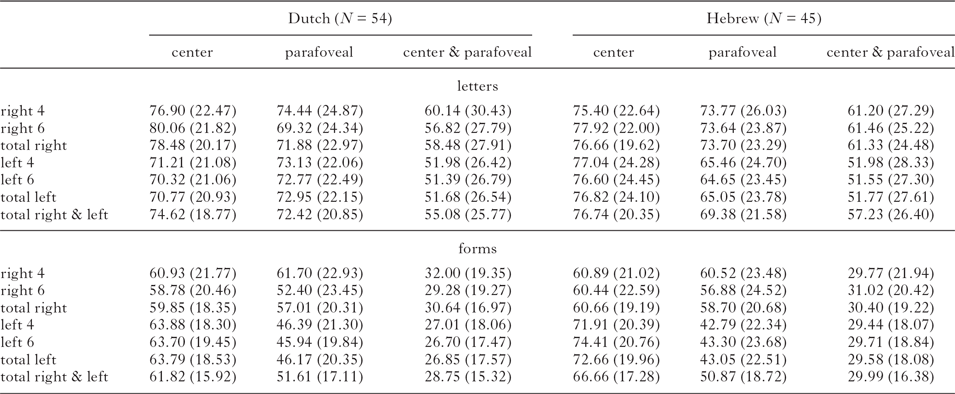
To test whether identification of letters outperformed identification of letter-like forms, we compared correct identification of both letters (the center letter plus the parafoveal letter at distance 4 or 6) with correct identification of both forms (the center form plus the parafoveal form at distance 4 or 6). Paired samples t-tests yielded that children’s identification of letters (M = 56.06%, SD = 25.95) outperformed their identification of forms (M = 30.53%, SD = 17.93) (t(98) = 12.94, p < .001). Outcomes were similar for Dutch and Israeli children; see Table 1.
Means and standard deviations of the percentage correctly identified items in the perceptual span tasks per side (right, left) and distance (4, 6) for each group (Dutch, Hebrew) separately. Items were coded in three different ways: (1) center: % of items where the letter/form in the center was correctly identified independent of whether or not the letter/form in the parafovea was correct; (2) parafoveal: % of items where the letter/form in the parafovea was correctly identified independent of whether or not the letter/form in the center was correct; (3) center & parafoveal: % of items where each of the two letters/forms were correctly identified.

3.3. eye movement variables
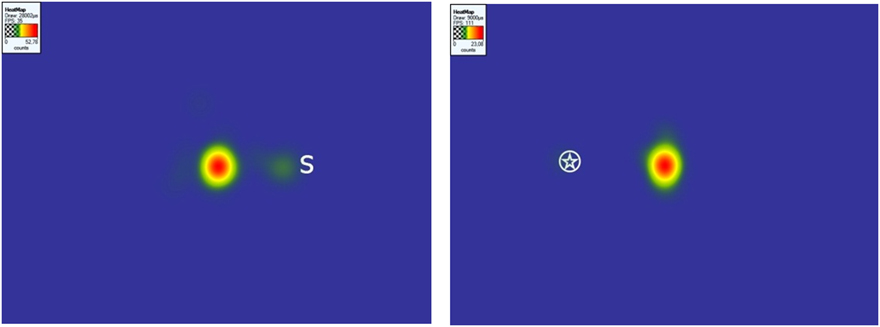
As indicators of visual attention, we computed for each participant the number of fixations on center and parafoveal AOIs during the presentation of 300 ms. Only the center letter (M = 0.92, SD = 0.20) or letter-like form (M = 0.82, SD = 0.20) was fixated, mostly once, while the parafoveal letter (M = 0.19, SD = 0.21) or letter-like form (M = 0.20, SD = 0.24) was rarely fixated, which indicates that correct identification of the parafoveal letter/letter-like form indeed was a measure of perceptual span (see also Figure 3).
The heatmaps represent fixations of all participants. The black area in the inner circle indicates the highest number of fixations and the outer light gray area the least. In both examples, the letter in the center (left panel) or the letter-like form in the center (right panel) were fixated most often, whereas there were hardly any fixations on the parafoveal area which indicates that correct identification of the parafoveal letter/letter-like form was indeed a measure of perceptual span. Red indicates the highest number of fixations and green the least, with yellow in between.
3.4. identification of letters and letter-like forms in the parafovea
To test Dutch and Hebrew children’s letter identification in the parafovea (left versus right), we focused on items with both letters correct. We can only be sure in those cases that children had recognized the parafoveal letter correctly. We carried out an ANOVA with side (left vs. right) and distance (4 versus 6) as within-subjects factors and orthography (Dutch vs. Hebrew) as between-subjects factor. We found higher scores for items with the parafoveal letter right from the center (M = 59.91%, SD = 26.31) than for items with the parafoveal letter left from the center (M = 51.73, SD = 26.89) (F(1,97) = 25.43, p =.000, ηp 2 = .21). Apparently young children’s perceptual span to the right exceeds the perceptual span to the left. Distance did not cause a main or an interaction effect, nor did orthography (Dutch vs. Hebrew).
To investigate whether, just as with the identification of letters, hemispheric dominance or reading direction would affect young children’s identification of letter-like forms in the parafovea, we tested Dutch and Hebrew children’s number of correct items. Overall correct identification of letter-like forms was rather poor (M = 29.31%, SD = 15.74). We found a non-significant effect of orthography (F(1,97) = 0.15, p = .70, ηp 2 = .002). Unlike the task with letters, side was non-significant (F(1,97) = 1.84, p = .18, ηp 2 = .02); distance also had no effect (F(1,97) = 0.14, p = .71, ηp 2 = .001). See Table 1 for means and standard deviations.
3.5. differences between foveal and parafoveal letters/letter-like forms
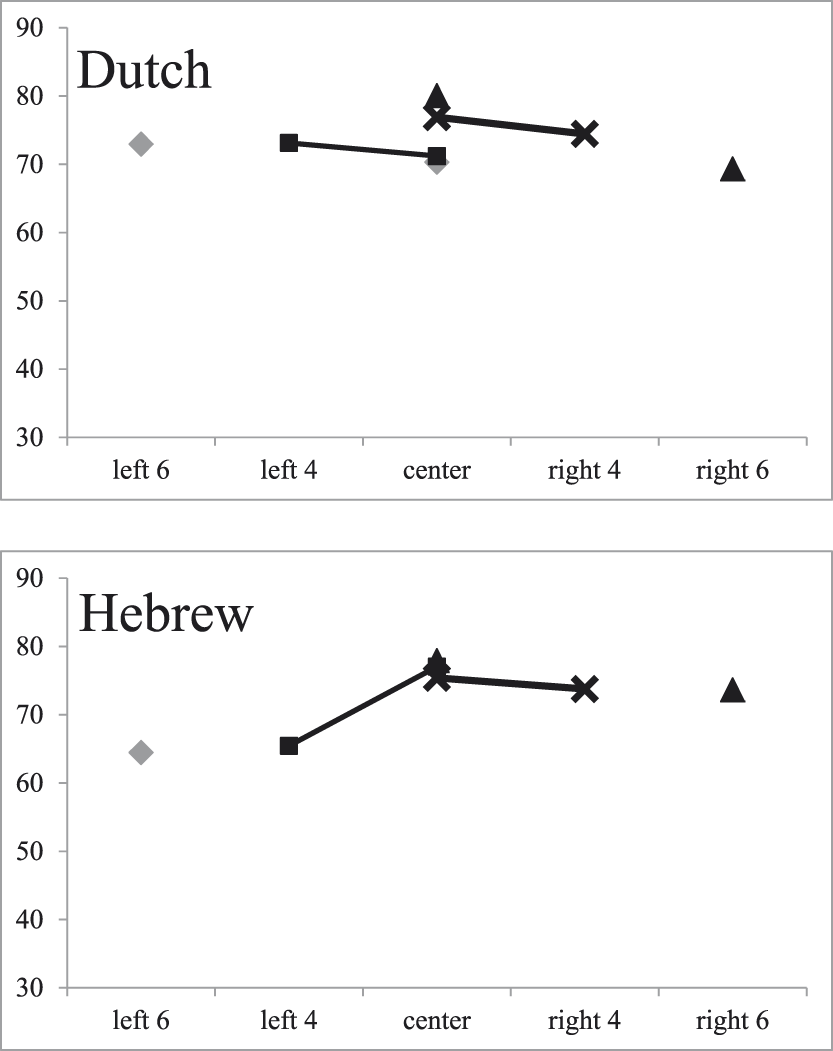
We also analyzed scores on the center and parafoveal letters separately. We conducted an ANOVA with letter location (center vs. parafoveal) and side (right vs. left) as within-subjects factors and orthography (Dutch vs. Hebrew) as a between-subjects factor. To test the impact of a parafoveal letter on the center letter, the coding took account of whether the center letter was combined with a parafoveal letter to the right or a parafoveal letter to the left. There were main effects for letter location (F(1,97) = 14.03, p < .001, ηp 2 = .13) and side (F(1,97) = 13.38, p < .001, ηp 2 = .12), indicating higher scores for the center letter (M = 75.68, SD = 1.97) than the parafoveal letter (M = 70.90, SD = 21.12), and a higher identification rate to the right (M = 75.18, SD = 21.43) as compared to the left (M = 71.40, SD = 22.82). Orthography did not yield a main effect (F(1,97) = 0.01, p = .91, ηp 2 = .00), but the interactions location × orthography (F(1,97) = 4.07, p = .046, ηp 2 = .14) and location × side × orthography (F(1,97) = 9.71, p = .002, ηp 2 = .09) were significant. As can be derived from Figure 4, Hebrew children recognized the center letter more accurately than the parafoveal letter, irrespective of side. One surprising result was that in the Dutch group the center letter did not always yield higher scores than the parafoveal letter. The children recognized the center letter more accurately than the parafoveal letter to the right (paired sampled t-test: t(53) = –3.12, p = .003), whereas scores on the center letter with the parafoveal letter to the left did not differ (t(53) = 0.78, p = .44). An explanation for this pattern might be that Dutch children focused on the leftmost letter when a series of letters was presented; they had learned to target the first letter in names and other words, in Dutch appearing as the leftmost letter (e.g., Ehri, Reference Ehri2005). Hebrew children, on the other hand, did not show a similar effect in recognizing the center letter. As is shown in Figure 4, they were always far more accurate in recognizing the center letter compared to the parafoveal letter. Apparently, in Hebrew, visual attention was not influenced by a preference for the first letter of a series, as we found in the Dutch group.
Percentage correct identification of the center and the parafoveal letters by visual field (left versus right) separately plotted for distances 4 and 6, for Dutch (upper panel) and Hebrew children (lower panel). Israeli children recognized the center letter more accurately than the parafoveal letter, irrespective of the side where the parafoveal letter appeared. Dutch children recognized the center letter more accurately than the parafoveal letter when the parafoveal letter was presented to the right of the center letter. When the parafoveal letter was presented left, identification of this letter was equal to the identification of the letter in the center.

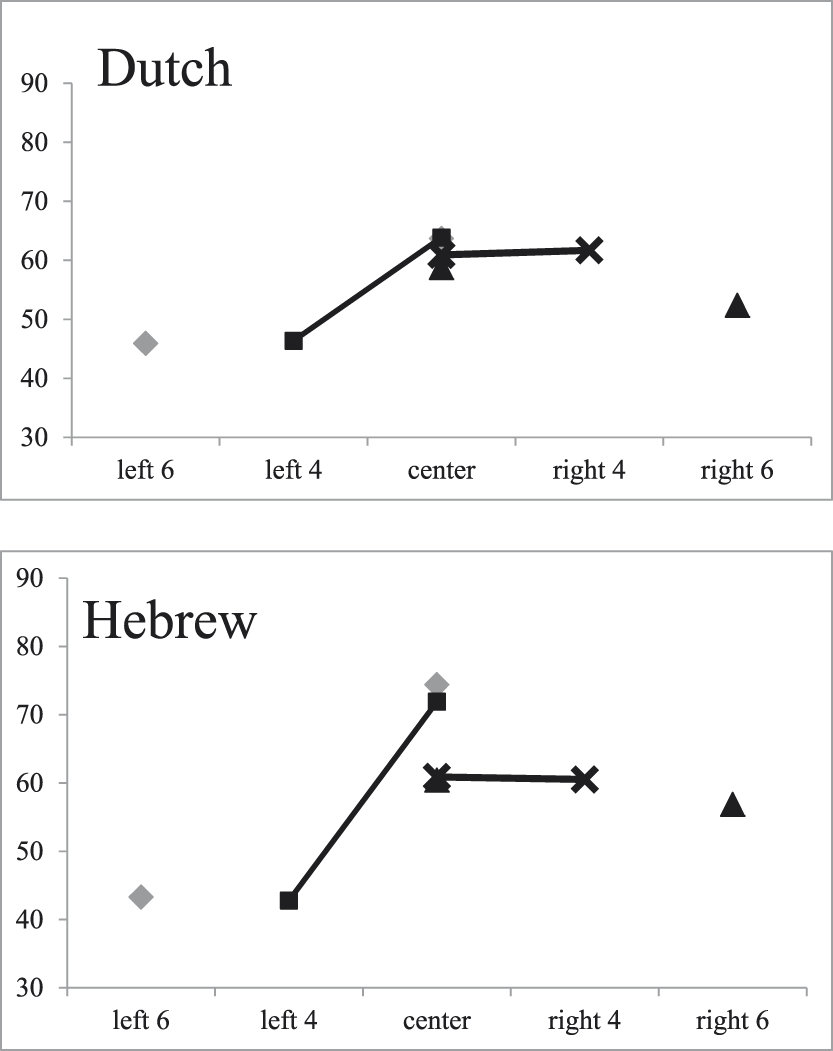
Next we tested the effect of location on recognition of letter-like forms. We coded the items distinguishing the center form and the parafoveal form right or left from the center and used percentages correct in the analysis. Similarly to how the center letter was coded, center forms also received a code ‘right’ or ‘left’. The main effect of orthography was non-significant (F(1,97) = 0.51, p = .48, ηp 2 = .01). There were, however, main effects for location (F(1,97) = 44.99, p < .001, ηp 2 = .32) and side (F(1,97) = 4.92, p = .029, ηp 2 = .048), meaning higher scores on the identification of the center form (M = 64.24, SD = 16.64) as compared to the parafoveal form (M = 51.24, SD = 17.77), and on average higher scores on forms presented to the right (M = 59.07, SD = 19.52) than on forms to the left (M = 56.42, SD = 20.46). These main effects were further specified by a significant location × side interaction (F(1,97) = 41.22, p = .001, ηp 2 = .30) and a non-significant three-way interaction location × side × orthography (F(1,97) = 3.76, p = .055, np 2 = .04). As is shown in Figure 5, for Dutch as well as Hebrew children a parafoveal form was equally well identified as the center form when the parafoveal form appeared to the right, whereas both groups identified the center form better than the parafoveal form when this form was projected to the left. It was more difficult to identify the parafoveal form accurately when presented left from the center form, and this was true for both Dutch and Hebrew children. Apparently, young children’s perceptual span to the right is larger than the perceptual span to the left, consistent with the lateral dominance of the left hemisphere of the brain for the processing of contours (Klingberg, Reference Klingberg2013). It is notable that, especially in the Hebrew group, the score on the center form was rather high when the parafoveal form was projected to the left (t(44) = –4.37, p < . 001). We assume that, as a result of a larger perceptual span to the right, forms in the right visual field attracted attention and distracted children’s attention from the center form. Children divided their attention over two forms and may therefore have made more errors in recognizing the center form. By contrast, a form projected to the left of the center form did not attract as much attention as a form projected to the right, and did therefore not distract from the center form. As a result children made relatively few errors in recognizing the center form with a parafoveal form to the left.
Recognition of the center versus the parafoveal form by side (left versus right), separately plotted for distances 4 and 6 for Dutch (upper panel) and Hebrew children (lower panel). When the parafoveal form was presented right from the center form, children were better able to take notice of both the center and the parafoveal form, which in turn were equally well identified. When the parafoveal form was presented left from the center, children were less able to take notice of the parafoveal form, which favored identification of the center form.

4. Discussion
For left-to-right orthographies, many studies have shown a larger perceptual span to the right, whereas results vary for right-to-left orthographies. This study, testing the perceptual span of prereaders, shows that Dutch as well as Hebrew children process letter information in the right visual field with more ease than in the left. Apparently, for readers at the start of learning to read, the reading direction in the dominating orthography does not affect the preference for information to the right or left, whereas cerebral conditions do. A letter presented in the right visual field is easier to recognize, probably because it is more directly connected to the contour-recognition area that is located in the left hemisphere (Cabeza & Nyberg, Reference Cabeza and Nyberg2000). For a letter presented in the left visual field, interhemispheric transfer is needed, which may interfere with letter recognition and result in more errors (Dehaene, Reference Dehaene2009, Reference Dehaene2013). The finding of Pollatsek and colleagues for skilled Hebrew readers, as well as the studies of Jordan and colleagues (Jordan et al., Reference Jordan, Almabruk, Gadalla, McGowan, White, Abedipour and Paterson2014) for skilled Arabic readers, suggest that Hebrew and Arabic readers have learned to concentrate on text features to the left, a more appropriate strategy when reading a text written from right to left. Research specifying the processes that enable this transition, for instance profiting from the morphologic structure of Arabic, has been lacking until now.
For letter-like forms, we also found a preference for the right visual field for Dutch as well as Hebrew children. The overall score on letter-like forms was much lower than on letters (29% versus 56%); this may be due to the fact that the letter-like forms are not stored in memory, which makes memorizing more difficult. We might expect that if practice were to have been continued, forms would have been stored, which will make identification easier (Dehaene, Reference Dehaene2013; Pelli, Burns, Farell, & Moore-Page, Reference Pelli, Burns, Farell and Moore-Page2006). We therefore inspected scores on letter-like forms throughout the test items. As expected, the number of correctly recognized letter-like forms increased after repeated encounters with the forms. The number of correct items increased from 29% for the first third of test items to about 42% for the final third of test items (t(111) = –7.65, p < .001).
It should be pointed out that the perceptual span of prereaders is smaller than the five to seven letters to the right of the fovea reported for second-graders (Häikiö et al., Reference Häikiö, Bertram, Hyönä and Niemi2009; Rayner, Reference Rayner1986). The prereaders in this study were often unable to recognize parafoveal letters correctly. In about half of the cases, they failed regardless of whether the span encompassed four or six letters. This supports the conclusion that processing letters is an effortful process in this stage, with the result that the distance from which information can be acquired becomes smaller (Henderson & Ferreira, Reference Henderson and Ferreira1990). On the other hand, the task in the current study was not identical to that of Rayner, because our study incorporated participants who were not yet able to read words or sentences. Single letters (or letter-like forms) were therefore presented instead of readable text, as was done by Rayner (Reference Rayner1986) and Häikiö et al. (Reference Häikiö, Bertram, Hyönä and Niemi2009). A lack of content may have made it harder to memorize letters which may also explain the moderate scores whatever the eccentricity of the parafoveal letter/form.
Orthography does not affect the direction of the perceptual span of prereaders, but has some effect on how children divide their attention over a series of letters. Dutch children were as accurate in recognizing the left parafoveal letter as the center letter. Emergent readers’ attention to the first letter of a word might be a likely reason for this finding (Biemiller, Reference Biemiller1970; Ehri, Reference Ehri2005; Marchbanks & Levin, Reference Marchbanks and Levin1965; Savage et al., Reference Savage, Stuart and Hill2001). In Dutch – a language that is read from left to right – the parafoveal letter that appears left of the center letter may be considered by Dutch children as the first letter of a word, which raises the chance that they pay more attention to this letter than to any other visible letter, thus resulting in correct identification. The first-letter effect was not present in the Hebrew group. The Dutch children might have had more experience with reading words than the Israeli children, and therefore process letters differently from letter-like forms, while the Israeli children had not yet reached this level. It is also possible that it was not experience with reading that differs, but the complexity of the learn-to-read task. Israeli children have to get used to a new convention of how to look at words, while the reading direction is in line with the brain’s morphology for the Dutch. Due to the structure of the Hebrew language, the Hebrew children focused mainly on the center letter and performed much better on the center letters as opposed to the parafoveal letters. Hebrew is a very condensed language with a large amount of morphological information in the words. Words are short and formed from a root with prefixes and suffixes (Deutsch, Frost, Pelleg, Pollastek, & Rayner, Reference Deutsch, Frost, Pelleg, Pollastek and Rayner2003). Such features may have led the Hebrew children to focus on the center of the word where the root usually appears.
It is less likely that children focus attention on the first form when forms are not real letters because the series of forms does not elicit the impression of writing. However, memorizing two unknown forms may be challenging, especially when children notice a parafoveal form to the right in addition to the central form. This may explain children’s rather poor (60%) performance on the central form under that condition (Williams, Reference Williams1988). As we saw, the perceptual span to the left is smaller and children may not notice the form projected left from the center form. They then consequently concentrate on the center form, which improves their performance on this form. The pattern is similar for Dutch (64%) and Hebrew children (73%) but more pronounced for the Hebrew children.
4.1. limitations
As always, this study has some limitations. One is the impact of visual short-term memory on the outcomes. Children had to keep the letters or letter-like forms in mind until the next screen appeared, when they could then select the letters/forms that they had seen. It seems not too far-fetched to assume that kindergarten children are able to memorize two letters/forms. Pelli et al. (Reference Pelli, Burns, Farell and Moore-Page2006), for instance, found that subjects learning a new alphabet had a visual memory span of two letters. However, subjects in Pelli et al.’s study were adults and not children.
Because Dutch and Hebrew children’s letter knowledge did not differ, they could similarly benefit from a rehearsal strategy by phonological language areas in the left hemisphere. Effects of rehearsal on visual memory were very small in Pelli et al.’s (Reference Pelli, Burns, Farell and Moore-Page2006) study (2006). Therefore we do not consider rehearsal of verbal labels to be a threat to current outcomes, but we cannot exclude that children respond differently.
4.2. implications
The possibility that reading direction in the dominating orthography could alter the way printed words are perceived has never been ruled out. However, until now, studies testing the perceptual span in languages read from right to left (Jordan et al., Reference Jordan, Almabruk, Gadalla, McGowan, White, Abedipour and Paterson2014; Paterson et al., Reference Paterson, McGowan, White, Malik, Abedipour and Jordan2014; Rayner, Reference Rayner1985) did not take into account possible benefiting effects of the mother language. Our results seem to indicate that culture as settled in reading direction does not modify the preferences in the visual pathway. The cortical network that supports letter recognition seems to comprise components of the visual cortex in the left hemisphere. For both Hebrew and Dutch children, the perceptual span to the right is larger than the span to the left, which may mean that left-to-right reading is easier to learn than right-to-left reading. Nevertheless, we noticed in the Dutch group some effect of the left-to-right reading direction on how prereaders divide attention over a series of letters. Dutch emergent readers learn to focus on the first letter of a word, which may explain why they recognize the parafoveal letter as well as the center letter when the parafoveal letter appears to the left and may be considered to be the first letter, as in words. In Hebrew, we did not find a similar effect of reading direction, probably because the morphological constraints in Hebrew modulate readers’ focus or optimal viewing position in words (Deutsch & Rayner, Reference Deutsch and Rayner1999; Farid & Grainger, Reference Farid and Grainger1996). Children learning to read in a language written from right to left may need some more practice in processing visual information according to their reading direction in order to become fluent readers. That means that, under the influence of reading practice, the brain adapts to fluent reading as may appear from reduction of the cortical volume due to dendritic and synaptic pruning (e.g., Linkersdörfer et al., Reference Linkersdörfer, Jurcoane, Lindberg, Kaiser, Hasselhorn, Fiebach and Lonnemann2014). We speculate that reading direction developed not in accordance with internal preferences but is the outcome of accidental, external conditions. Differences in reading direction may, for instance, originate from the sort of materials mainly used for writing in the earliest stage of writing. When scratching letters in clay tablets, for almost all people (being right-handed), left to right was preferable in order to prevent inscriptions that were not yet dried being deleted. Semitic writing was often engraved on hard surfaces by holding the chisel with the right hand while the stone was moved up with the left arm, thus creating a preference for a right-to-left writing direction.