Introduction
‘We should never dismiss older people's “war stories” as the trivia of the past’ (Hunt Reference Hunt2007: 158). This article develops this point by illustrating how memories and perceptions of wartime experiences can have resonance in the everyday lives of many older men and women many years after the actual events. Experiences of war have long-term and far-reaching implications and can pose a significant ‘threat to the physical and mental health of individuals and societies’ (Davies Reference Davies2001: 99). McCarthy and Davies (Reference McCarthy and Davies2003) argue that recent research has shown that many civilians and Second World War veterans display war-related psychological difficulties over 50 years later (Davies Reference Davies1997; Hunt Reference Hunt1997). Indeed, the effects of military service in later life is a growing concern, as an increasing number of veterans of various conflicts move into older age (Settersten Reference Settersten2006; Settersten and Patterson Reference Settersten and Patterson2006). Some understanding of the long-term impact of war has developed over the past two decades (Hunt Reference Hunt2007), yet significant deficits in our knowledge remain. It is widely recognised that ‘we are only just beginning to develop an understanding of the long-term problems experienced by war veterans and others who have been traumatised’ (Hunt and Robbins Reference Hunt and Robbins2001a: 180). While such research is of importance, there is also value in researching how wartime experiences inscribe themselves into the everyday lives of older men and women, and how such experiences manifest at different stages of the lifecourse (Burnell, Coleman and Hunt Reference Burnell, Coleman and Hunt2010), both for those who go away to war and for those who experienced their wartime years at home.
This article contributes to our emerging understanding of this area by reporting on how wartime experiences intersect with the everyday lives of older men and women, raising issues in relation to the social support and care that such individuals receive in contemporary society. Support accessed through social connections is critical for older men and women who have experienced traumatic or difficult events in their lives (Rook Reference Rook1987). Much attention has coalesced around understanding war veterans' access to social support (Burnell, Coleman and Hunt Reference Burnell, Coleman and Hunt2006). Burnell, Coleman and Hunt (Reference Burnell, Coleman and Hunt2010: 58) comment that ‘in recent years, there has been a drive to understand these social support processes’, and they identify three emerging themes: ‘comradeship’, ‘family support’ and ‘societal support’. Despite the advantages that social connections offer, many older veterans may find themselves today located in isolating and alienating everyday circumstances (Cook and O'Donnell Reference Cook and O'Donnell2005), with limited access to social networks. Krause (Reference Krause, Markides and Cooper1989) views social support as providing a ‘coping mechanism’ for those whose experiences are understood as traumatic in three ways: as a moderator (whereby social support has a moderating effect on stress/a stressful event); a suppressor (whereby social support increases in accordance with levels of stress, suppressing the effects); and a distress-deterrent (also referred to as ‘counter-balancing’, stress and social support are seen as having no relationship but as having additive effect on the outcome). It should be pointed out that many veterans were told to ‘go home and don't talk about your experiences’ upon their return from the Second World War (Hunt and Robbins Reference Hunt and Robbins2001a: 175). The strategies of avoiding and suppressing traumatic memories may contribute in further alienating older men and women within their social groupings, and many may experience difficulties with anger that affect their relationships with family members and friends (Cook and O'Donnell Reference Cook and O'Donnell2005). Interviews conducted with 25 Second World War veterans undertaken by Hunt and Robbins (Reference Hunt and Robbins2001a) show that comrades are frequently turned to for support, acting as a critical support network. As such, veterans' associations are pivotal in aiding veterans to cope with their wartime experiences. A key point emerging from the literature is that supportive social networks are beneficial to veterans' wellbeing in older age (Burnell, Coleman and Hunt Reference Burnell, Coleman and Hunt2010).
There have also been significant developments within the literature in terms of how wartime experiences are conceptualised. There are many older men and women, both veterans and civilians, who are troubled by their memories of the Second World War, and research tends to be positioned within an expansive body of literature detailing how particular conditions, such as Post-Traumatic Stress Disorder (PTSD), manifest and are treated following war. Barron, Davies and Wiggins (Reference Barron, Davies and Wiggins2008) observe that PTSD is the most extensively researched anxiety disorder, and it is noted that PTSD is often studied in relation to war veterans (Brewin, Andrews and Valentine Reference Brewin, Andrews and Valentine2000). Hunt and Robbins (Reference Hunt and Robbins1998) identify three strategies used to cope with traumatic memories: processing (consciously dealing with memories as they emerge); avoidance (circumventing situations which they know will activate memories); and social support (discussing memories with family or comrades). It should be recognised that wartime experiences vary, and specific negative events such as Prisoner of War or Holocaust experiences have been found to be particularly traumatic (see Hunt and Robbins Reference Hunt and Robbins2001b). Such studies demonstrate how older men and women's experiences of war have long-term implications by illustrating how traumatic experiences continue to influence veterans' psychological wellbeing into older age. Indeed, Second World War experiences are asserted to have had profound and long-lasting impacts on older men and women's sense of self-identity. Links between wartime experiences and their impact on veterans' self-identity are demonstrated in Matsuki's (Reference Matsuki2001: 548) research with Japanese people born between 1926 and 1934, who ‘pragmatically and strategically created situated meanings of the “there and then” in the “here and now”’. Matsuki (Reference Matsuki2001: 548) argues that specific meanings in relation to identity and experiences are reconstructed in relation to ‘the midst’ of present-day life, and local and global politics surrounding their generation.
This article builds upon existing research by exploring how Second World War experiences intersect with the practical lives of older men and women. The research was conducted as part of the EU-funded project ENABLE-AGE, which examined the relationship between the home environment and healthy ageing from the perspectives of very old men and women, conducted in five European countries (Germany, Hungary, Latvia, Sweden and the United Kingdom (UK)) (Iwarsson et al. Reference Iwarsson, Wahl, Nygren, Oswald, Sixsmith, Sixsmith, Széman and Tomsone2007). The data collected allowed insights into how war experiences continue to influence their practical lives some 60 years later. The wider findings from the ENABLE-AGE project show that older people would prefer to stay at home living independently for as long as possible (Fänge and Dahlin-Ivanoff Reference Fänge and Dahlin-Ivanoff2009), supporting other evidence in the literature (Quine and Morrell Reference Quine and Morrell2007). A key outcome of ENABLE-AGE was that enabling people to ‘age in place’ in a familiar, accessible and appropriate home environment benefits the older person in terms of their health and quality of life, while also constituting a cost-effective solution to the challenge of an expanding population of very old people (Sixsmith and Sixsmith Reference Sixsmith and Sixsmith2008; Tinker et al. Reference Tinker, Askham, Hancock, Mueller and Stuchbury2001). Such an approach, however, is highly reliant upon older people's access to appropriate support networks (Tinker Reference Tinker2002). While experiences of wartime events were not the central focus of the ENABLE-AGE project, this emerged as an important theme in the analysis of qualitative interviews, particularly for the UK participants. Wartime experiences emerged only to a limited extent from the data collected in other countries, which precludes them from the present analysis. This article illustrates how past experiences continue to shape participant's present-day experiences, their social relationships and how they respond to everyday situations and environments (e.g. their homes), with important implications for the kinds of care and support services provided to them.
Methods
Rationale
This article draws on qualitative data collected as part of the ENABLE-AGE project and is based exclusively on UK participants' accounts. The study focused on older people's thoughts, attitudes, interests and values, experiences and meanings related to healthy ageing at home. Alongside a longitudinal survey and policy review of older people living alone at home, the ENABLE-AGE project involved a qualitative study to explore the relationship between home and healthy ageing. Two of the authorsFootnote 1 were actively involved in the conceptualisation of the ENABLE-AGE project, and the collection, analysis and interpretation of data. All authors worked collaboratively in the construction and development of themes in the production of this article.
The qualitative study adopted a grounded theory approach to data collection and analysis (Charmaz Reference Charmaz2006; Glaser and Strauss Reference Glaser and Strauss1967; Strauss and Corbin Reference Strauss and Corbin1997). Within grounded theory, the development of theory is ‘derived from data, systematically gathered and analysed through the research process’ (Strauss and Corbin Reference Strauss and Corbin1998: 12). The approach is based on the logic of discovery rather than the logic of verification (theory building rather than theory testing).
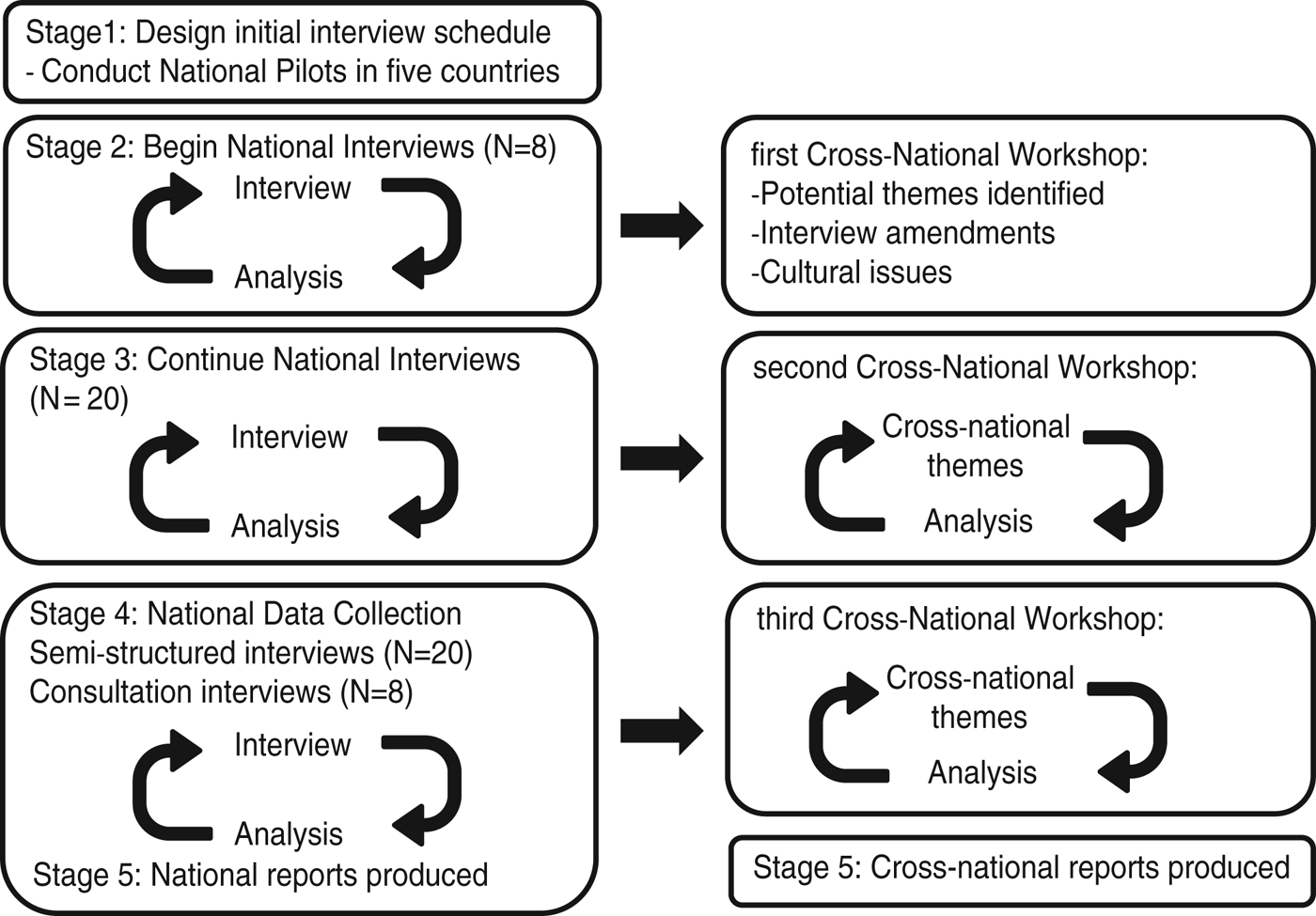
The qualitative research carried out within the ENABLE-AGE project used semi-structured interviews (Smith Reference Smith, Smith, Harre and van Langenhove1995) conducted across five data stages (Figure 1). In total 40 semi-structured interviews were conducted in the UK.Footnote 2 Initially, eight UK interviews were conducted and analysed within the UK team, followed by an international analysis workshop. A further 12 UK interviews were then undertaken and analysed within the UK team and a second international analytical workshop. The remaining 20 UK interviews were undertaken and analysed as below. This iterative process of data collection and national and international analysis ensured the ‘grounded theory approach’ built up from a strong UK base yet incorporated international perspectives where relevant. Findings were written up in national reports and harmonised in a cross-national report.
The research process.

Interviews
A semi-structured interview schedule was designed to explore key concepts underpinning the ENABLE-AGE project (Sixsmith et al. Reference Sixsmith, Sixsmith, Green, Kennedy, Griffiths, Ball and Pimor2005): home, independence, participation, health and wellbeing, and societal supports. Semi-structured interviews typically lasted between one and two hours in duration, and were conducted in the older person's own home to ensure their comfort and convenience. Field notes were used to document the researcher's interpretations of the background/context of the interview, the key points revealed in the interview in relation to research questions, initial ideas for analytical themes, the general tone of the interview and a reflexive analysis. In addition, eight consultation interviews conducted in Stage 4 of the research process (see Figure 1) further encouraged participants to reveal their understandings of social participation, community and health within their experiences of home life.
Sampling and recruitment
The qualitative sample was drawn from the wider ENABLE-AGE survey sample. This sample was generated from a longitudinal survey comprising two measurement points and elicited 376 respondents in the UK (Oswald et al. Reference Oswald, Schilling, Wahl, Fänge, Sixsmith and Iwarsson2006). Those who agreed to be interviewed were recruited into the qualitative study, stratified by age and gender. This provided a self-selected sample of participants who were interested in the research topic of home and healthy ageing.
Participants of the interview were people who lived alone in their own homes in the Wirral Peninsula, which is located in north-west of England. The research team aimed to generate a structured sample in relation to gender and age. Twenty participants were born in the period 1914–19 and 20 between 1920 and 1923. Ages therefore ranged between 80 and 90 at the time of the interviews. Each of these groups comprised 12 females and eight males. In this paper, male perspectives of wartime experience receive more attention due to their higher overall levels of active involvement in war compared to females. The sample was structured to reflect diversity criteria (in relation to the aims of grounded theory) in two key project topic areas: health (from good and poor) and participation in social/community life (from very involved to not involved). Additional attention was paid to the inclusion of participants who came from different economic backgrounds (below and above the national average). Twenty-nine per cent of the sample lived in sheltered accommodation, 7 per cent were classed as being highly dependent and 26 per cent were housebound. Participants in the additional consultation interviews were selected on the basis of the content of their original interviews. This was assessed in relation to themes identified where extra clarification was required to strengthen the study findings. In the UK, ethical approval was sought and gained from The Multicentre Research Ethics Committee for Wales. This ensured that informed consent, privacy, confidentiality and protection of participants from harm were observed in accordance with disciplinary ethical codes of practice (British Psychological Society 2002).
Team-based data analysis
Interview data were analysed according to the key principles of grounded theory (involving the gathering of data, synthesising information, analysing and interpreting information, and conceptualising key findings) as described by Charmaz (Reference Charmaz and Smith2003, Reference Charmaz2006). This approach was amended to allow national and cross-national team-based analyses (illustrated in Figure 1). Following intensive coding of transcripts by all team members, key themes were identified during a full team meeting. Additionally, cross-national workshops involving the full international research team took place to discuss the data collection process, analysis and practice-based issues. Grounded theory is a creative approach which requires the researcher to be open to multiple possibilities (or the multiple realities of social experience) in order to explore social contexts from different perspectives. By adopting such an approach, a number of themes emerged from older people's everyday accounts that demonstrate the significance of perceptions of wartime experiences.
Key considerations and limitations of the research process
The connections between wartime experiences and everyday life were not the primary focus of the research project. The data, however, is robust in the sense that it emerged naturally through the research process from the everyday accounts of older men and women, rather than being pre-imposed via the interview schedule. The findings provide a new perspective through which to understand perceptions of wartime experiences and how they continue to influence everyday life.
Exploring the experiences of older men and women can be methodologically challenging, and a number of successful strategies for interviewing very old people were adopted. In a practical sense, it is crucial to recognise the respective ages of older men and women in relation to the length of research interviews. Anchoring discussion with key dates and repetition of key questions and responses were found to be critical in gaining in-depth data. The interviewers were trained in a series of workshops to support both older men and women to participate in the research, paying attention to levels of fatigue, use of facilities (e.g. toilet) and ability to concentrate. For example, where necessary arrangements were made to conduct follow-up interviews rather than impose a singular lengthy and tiring interview. In addition, interviewers were trained to be aware of each participant's functional capacities (e.g. visual impairment, mobility, difficulties hearing, cognitive impairment, etc.). Successful interviewing strategies included checking appropriate auditory levels, repetition of questions and responses, and orientating questions with reference points (using specific dates or events).
Attention was also paid to the possibility of gender and power issues influencing the interview dynamics. In particular, older men can be difficult to access when recruiting participants (Stratton and Moore Reference Stratton and Moore2002). Once older men have agreed to participate, past research has suggested that they may find it more difficult to verbalise their emotions and feelings, perhaps related to issues of masculinity (Schwalbe and Wolkomir Reference Schwalbe and Wolkomir2001) where revealing emotions can be perceived as socially less acceptable. The interviewers in this research were female, and men appeared at ease to talk freely about sensitive issues in these circumstances. Inequalities in power throughout the interview could stem from gender (male interviewer–female participant), age (younger interviewer–older participant), employment status (employed interviewer–retired older person) and so on. During the interviews, such potential power differentials were raised by interviewers who ensured participants were aware that they were the experts of their own experience (Harre and Secord Reference Harre and Secord1972) and interviewers were there to learn from this. This helped in establishing good rapport and listening carefully was a critical skill in conducting good quality interviews. Wartime storytelling can be particularly challenging due to the length of time since the war ended and the relevance of particular stories to the research design (Hunt Reference Hunt2007) (i.e. it can be difficult for the researcher to establish which ‘stories’ to encourage because they may eventually provide useful research materials that require re-focusing on the research questions). As the interviews were conducted within the older person's own home (for their convenience and comfort), being aware of and abiding by the explicit or tacit rules of the older person's home was also essential to enhanced discussion.
Findings
In this section we first reflect briefly on the nature of ‘home’ within the ENABLE-AGE research and the contrasting ways experiences of accommodation during the war shaped present-day meaning of home. Then we present findings on two key perspectives in relation to wartime experiences: the participants' social worlds; and the unique skills and characteristics related to that time in their lives.
The nature and meaning of home
Many of the participants referred to wartime as a defining period in their lives, with implications for how they experienced their homes in subsequent years. Most men in the study discussed how the lifestyle that war entailed continued to influence their feelings of being settled at home. They described how they frequently moved home in a nomadic fashion after the war, and they tended to emphasise how their wartime experiences allow them to easily adapt to different residences. Being able to create feelings of home in a range of different places and short-term living conditions was described as being highly important by older men, while also minimising the value of privacy and long-term stability. In so doing, Des explained how he is able to adapt and settle almost anywhereFootnote 3:
Well, of course, through my experiences during the war and so on, I left [name of place] when I was 20 and er I was sent, with the Army, here there and everywhere, and I got used to roving about. So I can settle down more or less anywhere.
It is unclear whether or not residential changes were conscious decisions for all, but the data suggested that certain individuals actively sought changes in their living arrangements, and often the desire to live somewhere else was associated with specific wartime experiences. For example, Ken described his feelings of being unsettled at home:
When I was 17, I joined the Army. And that was it. Then the war broke out and I was in the Army for other six or seven years (laughs) and then believe it or not I went back in again. I just couldn't rest, couldn't settle down anywhere, you know, this has been my longest I think, in [name of place], for seven years round here. I've been here about nine years.
While the notion of home was presented by many participants as being relatively unstable, not all interviewees experienced the same instability in their residential dwellings following the war. For some, their experiences of destruction, especially the bombing of homes, created a strong desire to live in a stable and meaningful home. Edith explained how her experiences of poor living conditions during the war were directly linked with the intrinsic value given to her present home:
Well this house, this bungalow, is very special to me because I was born so long ago and I've lived through two world wars and in the second one we didn't have a home, that was, it was during then that I was married but my husband was a soldier away and I just lived anywhere at all with anybody. Afterwards we tried to settle down somewhere and we couldn't find anywhere, because there were no houses built and everybody wanted somewhere to live. We lived in the most shocking places, the most dreadful places, umm, you would hardly believe it if I was to really go into detail, but bomb-damaged houses open to the sky, and just packing cases, we did have a bed to sleep in but no carpets on the floor and nothing to cook with, no, not any hot running water running anywhere, there was a bathroom with a, it had got cold water there, but it was a bomb-damaged house, in [name of place] we went back there because my husband could come out of the Army more quickly if he would go back to the job he left, because he was a teacher so that's why we tried to find our first home.
Participants indicated that their experiences of accommodation during the war shaped how they construct their homes in the present. Many in the study suggested difficulties in feeling ‘at home’, and associated such emotions with their wartime experiences. However, the qualitative interviews encouraged participants to discuss their lives and home environments in their own terms and the subsequent analysis revealed the way wartime experiences appeared to be fundamental to many aspects of their everyday lives, even 60 years after the actual events themselves.
Perspectives in relation to wartime experiences
The analysis suggested two key perspectives within their accounts. The first of these focuses on the way participants described their connections with their social worlds in terms of both feelings of belonging and exclusion and linked this to the comradeship they had enjoyed during the war. Indeed, comradeship was understood as a necessity for wartime survival, imparting lifetime social values which have remained core aspects of their sense of self in older age. Wartime experiences were identified as a key bonding factor with others in the community, yet such experiences also highlighted the ways in which the modern world appears to no longer afford the same community spirit that once existed. Instead, participants sometimes felt themselves socially alienated from younger generations, who do not share the attitudes or values created through collective experiences of war. Four key themes emerged from participants' accounts in this respect: ‘comradeship’, ‘storytelling about the war’, ‘community and alienation’ and ‘long-term physical effects’. A second perspective within participants' accounts provided a sense of the unique and defining characteristics of the wartime generation, who saw themselves as having different values, causally related to war, that distinguished them from younger generations. They felt that their experience of war provided a set of skills, both everyday practical skills (e.g. cooking, cleaning, etc.) and character traits (e.g. resilience, adaptability, etc.). The analysis identified three themes in this respect: ‘managing’, ‘resilience and adaptability’ and ‘independence’.
Comradeship
Participants talked about how perceptions of collective wartime experiences and comradeship with peers are key aspects within their daily social lives today. However, the ways in which such connections are maintained were gendered. Older men described how their connections with peers (usually other men) within veterans' associations helped them to define their identity. Such associations allow individuals to seek out peers who, like themselves, had experienced defining moments in their lives during the period 1939–45. Albert described how friendships are formed rapidly through shared experiences as the events of war are recounted:
Well I'm an ex-RAF [Royal Air Force] chap and we have an association. Somebody said to me, a relative said, ‘When you get up there [The Wirral] you want to find out about the RAF club’. So I went up there and walked in there said ‘I'm an ex-RAF chap, I want to join’. I made friends straight away, really. They all said ‘Where are you from?’, they all crowded round and it started from there. I mean I'm going out tonight.
Older men highlighted how they had been involved in veterans' associations for a long time and such ties were highly valued. They were seen as key venues through which social connections were created and maintained. Veterans' associations were found to be useful when moving to a new geographic area, as immediate friendships could be made. Moreover, men, like John, described how such connections resulted in a sense of rootedness in their communities, whereby shared experiences and understandings from the past transcended present-day differences:
Yes, oh yes, they are different people. There is something about the Navy that you can't explain, but once you've been together you seem to stick, not like the Army and Air Force who are spread out, you see on a ship you are living in one another's pockets you know. You get this attachment, I mean even to the ship, the lads used to think the ship had a heart, oh they did. They were the real sailors as I used to call them, they were in the Navy before the war, I was just in for the war. They used to clean and polish it [the ship] in their own time.
Veterans' associations, for some, formed the main hub of their social lives. As such, veterans' associations were not simply anachronistic reminders of the past, but functioned as vehicles for meaningful social connections in current everyday life. Indeed, once comradeship was encountered through veterans' associations, some men were inspired to join multiple associations. As John said:
I belong to the [name of Royal Naval Association] in Liverpool, used to be the RNVR [Royal Navy Volunteer Reserve] place and I'm in there and also in the, er … one from Malta, the George Cross Island Association and I go once a month to Liverpool, we all meet at the naval place there, have a meeting and a drink and a sandwich. Oh and I'm in another association, the first ship I was on, ‘E-boats’ they call them.
Men in this study actively employed their wartime memories to build connections across time and into the present in which shared values were transmitted. The data do not suggest that men in the sample accessed emotional support from comrades when meeting together either to process or cope with traumatic experiences. Rather, participants were enabled to express a central aspect of their own identity, which was shaped through their perceptions of wartime experiences and reflected in the identities of their comrades. The intricacies of comradeship were exposed through shared values of reciprocity, resilience and communitarianism.
Veterans' associations were highly valued by many of the men in the sample as places where they could connect with other people, mainly other men, who were perceived to share similar experiences of war. All men in the sample shared positive feelings towards veterans' associations, and these findings are striking considering the unprompted nature of these discussions.
The friendships that women reported were equally valued but distinct. While men tended to identify veterans' associations as sites where they met with comrades, women usually highlighted the home as the place where they would spend time with others, mainly other women, who were perceived as like themselves. For instance, Ella described friendships that were formed during the war that continue into the present day:
I have a lot of friends, friends from the war. I worked with her sister during the war in [name of company] and er 'cause [J] married and moved away but [I] she never married but she came on the friendship and we see each other every other week. I go to her house or she'll come to me and we have a meal.
The women highlighted how many of their closest friends shared collective perceptions of wartime experiences. These social contacts were highly valued and a few participants described how they overcame significant practical obstacles in relation to their respective age and mobility, to maintain such social ties. For instance, Ella discussed difficult travel arrangements to meet regularly with comrades:
Then on a Tuesday I go all the way to [name of place] that's past [name of place]. I get three buses there and three buses back to see [neighbour's name], she was a neighbour in [name of area] and her husband was very good to my eldest son.
Overall, shared perceptions of wartime experiences were found to be a key aspect of both older men and women's social connections with comrades in their communities. The data show significant differences based on gender, as men tended to meet with comrades, usually other men, in veterans' associations, whereas women usually met with their comrades, usually other women, in their homes.
Storytelling about the war
The findings of this study show that older people, particularly men, spend time recounting wartime stories. Particular anecdotes appeared to be highly valued by themselves and others within their community. Wartime stories acted as talking points within the social circles, a dramatic moment in their lives when they all participated in the act of creating history itself. Des was in the process of writing his own autobiography in which he planned to describe his own wartime adventures:
Yes. I had a very adventurous time when the, er, war broke out … Afterwards, I went out into the Persian Gulf to join an oil company, so I've got plenty to recall, which is of great interest to the family and friends. I'm busy at the moment writing my autobiography.
No evidence was found to suggest that these stories of wartime focused specifically on the trauma of the events; rather they provide the context to discuss special moments in their lives. For Albert, recounting his wartime experiences to others and hearing the experiences of others like him had become an important aspect of his social life. The act of storytelling and sharing wartime experiences strengthened his relationships with comrades, often in a very convivial manner:
Every Friday night we have a night, at least eight of us we go to the RAF club get together and have a chat, about the war and what they could have done better. We are all good-humoured all the time, we all in the same boat as each.
Women also shared wartime stories with each other and Irene recalled her experiences in the Auxiliary Territorial Service (ATS) with humour. She described how she had to adapt to shared living conditions during the war, which shaped her abilities to compromise and negotiate. Irene's account illustrates how such wartime stories emphasised events that were experienced by many, informing her sense of comradeship with her peers:
During the war, which was a long time ago, I was in the ATS and I was a sergeant and this is the sort of thing you got, you've got 40 girls in the (unclear) room, and this one at the top had a gramophone in those days, a record player now, a gramophone and (laughs) she was very fond of (unclear). One down the other end [of the room] had a gramophone and she liked I think (unclear) something in G-minor and, consequently, I threatened to bang their heads together. I said, ‘You can play for half an hour and you can play for half an hour’, but, that's the sort of thing you get when you got people together. You're not all going to agree.
Overall, older men and women enjoyed visiting each other to hear stories of particular wartime events, describing such gatherings as eventful. Reflecting on the data presented in this article, such meetings may have afforded people of the same generation the opportunity to express an aspect of their identity not available elsewhere, through activities like storytelling which served to bind them together through sharing experiences.
Community and alienation
A number of the participants also remarked on how their lives in recent years contrasted with their way of life during the war years. This was explained as a loss of a sense of community, which had been replaced with a sense of increasing social alienation. The participants reported that wartime experiences had instilled a sense of communitarianism, and felt that this togetherness was no longer reflected in their local communities today and was perhaps used as a justification of the disengagement from their community. Older people often have physical and emotional isolation from the society they presently live in; they often identify the place of their past as an ideal place to live and feel more emotionally aligned with the people of their past society (Sixsmith and Boneham Reference Sixsmith and Boneham2003). Edmund described how ‘nowadays’ one is more inclined to think about oneself, conflicting with values of communitarianism established through wartime experiences:
They [neighbours] don't seem to need any help. I don't know them [neighbours] a lot you know. Nowadays it's not the same as it used to be. Too much selfishness, too much selfishness, I think it's part of the make-up selfishness … I'm not condemning, not all people are selfish, but there's a lot of selfish people and the scheme of things seems too based on selfishness. You look after yourself and of course you must look after yourself, if you can't look after yourself, you can't look after anyone else, can you?
Some participants described frustrated attempts at creating connections with others in their local communities, which were often dismissed, reinforcing a sense of alienation. For example, Sidney described how ‘the young’ do not appreciate the value of living through wartime events and suggested an explicit ‘rejection’ of older people in modern society. This has resulted in Sidney being suspicious of others in his locale:
It's the time we're living in really; people seem to reject old people. You know, they kind of snub you and don't take notice of you. Lots of them [older people] have been prisoners of war and people don't realise what tales people have got to tell, and some people see somebody hobbling along and, the young don't, they take umbrage, you know, if they could trip them up, they would.
These types of accounts illustrate an individual, rather than collective, attitude which was seen as a weakening of trust within the community. Edmund goes on to describe how he does not have meaningful relationships now with his neighbours within the local community, and little support is exchanged within these social networks. These types of modern-day exclusionary experiences are a stark contrast to enforced ‘mixing’ during the war, when individuals were forced to live together:
I don't miss the crowd, er, I mean this Bank Holiday I'm glad to stay here I don't want to go out in the crowds, queuing up and that sort of thing. In fact the holidays come and go and I don't notice them but I do notice them they come on me before I'm only told it's a holiday (laughs). So I don't mix much with anyone.
The perceived shift from communitarianism to individualism was reflected in some participants deciding to live in relatively isolated circumstances, often suspicious of younger people who are seen to have different societal values. This perspective contrasts strongly with the ‘comradeship’ described in the previous section. The stories exchanged between comrades maintain a sense of wartime togetherness, contrasting with a contemporary world that no longer reflects their values.
Long-term physical effects of wartime
A number of participants discussed the physical effects of their wartime experiences, including sensory impairment and loss of limbs. The impacts of these injuries appeared to add to a sense of isolation for them. For example, Edmund described the impact of the damage to his hearing as a result of his actions in the war. For him, this was a highly salient aspect of war in relation to his personal identity. Although Edmund spoke of himself as being sociable by nature, his war injury has had a profoundly negative effect on his social life:
It [hearing] was damaged in the war and er the only damage that I suffer from is speech and listening to people talk. It's alright talking to you now with no noise and no other people around. I mean I like company. I used to play football about 82, 83 and I used to enjoy the banter and the drinks after but I'm hard of hearing as well you see.
Edmund suggested that meeting in public spaces was particularly challenging due to his hearing disability. When interviewing Edmund, he recalled how he became aware of his own hearing disability:
I was lost. I thought there was something wrong with me until I found out I was hard of hearing. And for years I've been hard of hearing and I didn't know that I was hard of hearing and with company I found I was drifting out of it, not knowing what was going on. My trouble is it's difficult to follow language with some people and some people's voices are worse than others. So in company I feel a bit out of it so I tend to avoid company as much as anything.
Physical impairments such as hearing loss resulted in some participants being excluded from peer-networks, when core aspects of their self-identity are affirmed through activities such as storytelling. This issue has considerable implications in terms of the quality of life among those who have contributed heavily to society through their wartime service. The data suggested that appropriate supportive networks were not available to older men and women with specific disabilities:
I'm not a great mixer really I don't think, partly because I don't enjoy being in a crowd because of my difficulty of hearing. Almost deliberately, you know so it's easy to talk to one person like you I could talk all day. For years now I've had this difficulty of hearing (inaudible word) I can hear everything I can hear voices it's not that I don't hear people talking I hear them loud enough but it doesn't make sense.
While the effects of wartime experiences on participants' social relations are mixed, living in war for prolonged periods helped them to develop a number of individual skills. Almost all participants expressed feelings of pride and happiness in attributing such individual skills and characteristics to their personalised experiences of war.
Managing
Going without and ‘making do’ was a common experience for almost everyone who endured the war years. Participants reported that rationing was the order of the day, which left little room for luxury goods such as clothing, tea or coffee. Everyday items became scarce and difficult to access. They explained how many personal possessions were destroyed during the war and how they lived with the feeling that specific objects could be taken away at any time. Des remembered vividly the austerity of the war years, and he contrasted the frugalness of his own generation with what he interpreted as more materialistic generations that followed:
I think it [skill of managing] is to do with my generation, especially during the war because we were taught to save certain things during the war because of shortage of simple things like bottles and things like that (laugh) and little bits of string and wrapping paper and so on. So therefore my generation tend to be more conservative in that aspect and erm not so use to the consumer society that every generation take for granted now.
Des described how he stored all manner of everyday items for possible future use. He had many plastic bags, balls of string, elastic bands and so on, all of which might ‘come in handy’. He, and other participants, disliked today's ‘throw-away’ society when for them everyday items were valuable in themselves. Milly's account of her experience was similar to that of Des:
Living through the war, we didn't throw anything away and everything was saved (laughs). We were all in the same boat you see, in those days. We were all living in one room and erm there wasn't enough room for everybody. There was never a lot of money to go around but we always managed.
Being able to manage financially was a major concern for some of the participants and they credited their capability in this respect to their wartime experiences. Both Des and Milly considered that the value placed upon material possessions by contemporary society did not equip younger people with the skills and attitudes required for living comfortably in old age. The data suggested greater investments were made in social connections than material objects in the past, reflecting a time when possessions, or indeed houses, were destroyed during raids. For Marge, the area in which she resided during the war was heavily bombed because of nearby docks/shipbuilding and military targets, and she outlined the relative instability of her living circumstances:
People like to buy antiques and spend a lot of money, for what really? For what? Is it to impress other people you think? I don't put any great value on things. I suppose the war might have had a lot to do with it. Because during the war you realise that whatever you've got you are going to lose it. You thought, tomorrow I could lose it all. Because of the bombing, we had a lot of bombing because the B docks were a great attraction. So on the riverfront, it was bombardment. I used to think to myself, ‘well I could lose all this tomorrow, the house could be demolished’. A lot of damage of course was done to the house, it was badly damaged. The windows, a lot of things were destroyed. That taught us not to value property or anything we possess.
Overall, participants described how their wartime experiences informed their ability to manage when faced with restrictions in access to goods. These types of experiences highlight further the importance of shared perceptions of wartime experiences, as they were forced to live with one another during the war. On the one hand, specific possessions were valued by participants, as these could be taken away. But, on the other hand, the same items were interpreted as unimportant, illustrating a preparedness to manage if their possessions are taken away. The ability to cope was related by participants to their wartime experiences of austerity and deprivation, experiences that younger generations do not share.
Resilience and adaptability
Participants distinguished their feelings of home from their physical residence. As such, less emphasis was placed upon material objects in their home; rather greater weight was given to the practical functions of specific objects. Ann explained how her wartime ‘barrack’ living conditions influenced her feelings of home in the years following the war:
During the war which was a long time ago, I was in the ATS for 16 years and I was used to barrack life and my husband was in the Royal Navy. So we were both used to, what you might term, barrack life or living with people…
Ann felt that her time in the ATS allowed her to adapt to changing circumstances in the present. For instance, she compared her experiences with that of her sister, who struggled with ‘barrack life’ and now has not adapted well to living in sheltered accommodation:
I was used to it [barracks]. Now my sister, my eldest sister, the one that had the stroke, she owned her own house but was scared she was on her own. So she went into sheltered accommodation but she hated every minute of it.
Participants' wartime experiences provided them with skills of resilience and adaptability to changing living circumstances. Indeed, such resilience and adaptability may even be reflected in higher than average longevity of the participants. Overall, the data illustrate how the older men and women in the study responded to their present everyday living circumstances using abilities acquired during the Second World War.
Independence
The theme of independence was raised frequently when participants described how they had been changed by their wartime experiences. While comradeship led to a sense of togetherness between veterans, the accounts of participants stressed the importance of acquiring essential everyday skills in order to ‘survive’ by themselves. Men who took part in the study discussed how military life involved being self-sufficient and disciplined. During their time in military service, men learned many domestic skills (e.g. sewing and darning socks, repairing and ironing uniforms, keeping their kit tidy and clean). For example, Edward described having developed skills such as cooking, and maintaining tidiness during his service in the Navy. Men who joined the Catering Corps learned the cookery and pastry skills needed to feed and keep armies on the move, an expertise which has been important in his civilian life in later years:
Yeah, even if you're out in the middle of the ocean and there's nobody else around, the Navy made you get up and get washed and dressed and put your bedding away. Cooking yeah and mending things, mending televisions and I was in electrics for a long time in the Navy as I was a seaman originally, torpedoes, mines, depth charges, you did everything in those days.
Similarly, John described how he acquired new culinary skills and the means to maintain the level of cleanliness expected of him during his time in the Royal Navy.
They give you a ‘housewife’ in the Navy, it's a long piece of cloth with pockets in and you keep your needles and cottons in. I've got that and I've got the badge off my arm and one brass button, that's all…
These types of skills, acquired during the war, informed participants' understanding of their own independence, as they viewed themselves as having the necessary skills to survive. It should be noted that all participants lived alone when interviewed, and skills acquired through their wartime experiences were relevant to how they looked after themselves and how they did not wish to be a burden on other family members.
Participants also discussed how military service involved surviving in very harsh conditions. The data suggest that such experiences can influence, to varying extents, how older men and women construct and live in their present homes. For instance, Des described being very independent in his present daily life. Learning essential survival skills during war, and being trained to survive with few belongings, Des felt home comforts were not necessary aspects of his current living conditions. This is particularly telling as he consciously justified owning a ‘softer’ mattress to meet his needs in old age:
I'm very self-sufficient. And er I don't go for (inaudible word). I mean, if a chair's got four legs and a few cushions, I'm just as content with that as if someone was to buy me the finest (inaudible word) armchair the world has ever produced. And it's the same with sleeping arrangements. Having slept on sandbags and bare tables and even the lovely tracks of trains during the war, I virtually can sleep anywhere when I'm tired. But now I'm a bit older I do have a softer mattress.
Female participants also described a greater sense of independence during the war. As husbands, fathers and brothers were fighting in foreign lands, wives and daughters left the domesticity of the home, to be employed in traditionally male-orientated working environments to support the war effort. In so doing, females learnt the skills to make munitions, disrupting gendered expectations about the way women would otherwise have lived. For example, Victoria detailed her situation when her newly wedded husband left for war:
Some people was very kind when my husband went abroad. We were only married four days before he [husband] went abroad and he didn't come back for three years. It was a case of waiting for letters to come and [name of her child] was a very small a baby it was difficult … I was working (inaudible word) which was er hard work but er we used to have to get up to various mills and places that had been bombed. It was very interesting, I quite enjoyed it. I had some good friends, most of us would be married women who were on their own and their husbands had been gone … I think it probably made me more independent.
Discussion
Previous research has shown that many individuals who lived through the Second World War continue to exhibit psychological difficulties in older age (Davies Reference Davies1997; Hunt Reference Hunt1997; McCarthy and Davies Reference McCarthy and Davies2003). Much of the research into the impact of war experiences has been driven by a clinical perspective, focusing on the negative psychological effects of traumatic events. While this approach is important, the findings of the present study suggest the need for a wider perspective. The implications of living through the Second World War need to be understood in social terms, as shaping older men and women's everyday lives, and not only in terms of how they lead to psychological difficulties in later life. It is important to allow older people to conceptualise their own experiences, rather than confine the relevance in their accounts with notions of trauma and stress. While such conceptualisations have been valuable, especially in relation to PTSD and related conditions, it can be argued that we tend to investigate wartime experiences through a partial lens. The findings presented here illustrate varying depictions of the effects of wartime experiences, which contain both positive and negative connotations. Wartime experiences resonate in many aspects of the present-day lives of older men and women, with implications for the types of formal and informal support they may need, how they negotiate their changes in their health and functional status, and their participation within society. Furthermore, the findings illustrate how older men and women's daily lives are influenced by their personal historical context, in addition to a collective historical context. The Second World War was a key period in the lives of participants, which informs how they are proactive in responding to their everyday environments.
Social support is increasingly understood as critical to the everyday lives of older men and women (Burnell, Coleman and Hunt Reference Burnell, Coleman and Hunt2006, Reference Burnell, Coleman and Hunt2010). The theme of comradeship was identified as a key aspect of participants' lives, highlighting how shared experiences of war form the basis for social connections with peers, while meeting with peers was often a principal activity in daily life. Conversely, the study revealed how some participants attempted to create connections by drawing on their experiences and interests, but often felt that these were not valued, while others were suspicious of younger people, seeing them as threatening due to contrasting social values and experiences. The data indicate that some older people view younger generations as disinterested, and consequentially many feel alienated, unable to access meaningful support through social connections (Krause Reference Krause, Markides and Cooper1989). Indeed, the data suggest older people distinguish themselves from younger generations by their own sense of identity, informed by feelings of togetherness and camaraderie. The findings concur with the results of Barron, Davies and Wiggins (Reference Barron, Davies and Wiggins2008), by illustrating how some older men and women may interpret themselves as being separated from wider society. Hunt and Robbins (Reference Hunt and Robbins2001a: 181) pose the question, when recognising that many older people may not have access to social networks to cope with their memories, ‘should we as society accept this, or should we be providing appropriate outside social support, not only for veterans, but also for their families?’ Research suggests that levels of perceived social connectedness are more important than perceived availability of formal support for the health and wellbeing of older adults (Ashida and Heaney Reference Ashida and Heaney2008), and, as such, the issue of social engagement becomes pivotal in the ongoing wellbeing of the ‘older old’.
For many of our sample, the Second World War was a formative period in their lives, with many implications for how participants experienced their later lives. Such experiences have contributed towards the development of skills and characteristics such as ‘managing’, ‘resilience and adaptability’ and ‘independence’. These skills and characteristics may serve to define how they have begun to negotiate a transition to dependence, which for most is difficult. As such, some older people may not actively seek support but instead ‘make do’ as their condition declines, raising important health and social care concerns. Such concerns are augmented when taking into account how UK social and health services (with current resource constraints) are unlikely to actively offer support that recognises and maintains the valued independence and adaptability of wartime generations.
The findings also established how wartime storytelling is embedded in many aspects of present-day life and is not solely a means for coping with traumatic memories. The participants tended to avoid emotional topics, both past and present, and anchored their stories in the events of war (see also Burnell, Coleman and Hunt Reference Burnell, Coleman and Hunt2010). Veterans' associations, while being highly valued, were not venues for discussing distressing experiences and, as Hunt and Robbins (Reference Hunt and Robbins2001a, Reference Hunt and Robbins2001b) argue, support for coping with these types of experiences may be sought from elsewhere. While Hunt and Robbins (Reference Hunt and Robbins1998: 63) suggest veterans ‘tak[e] control of their memories’ by developing narratives about traumatic experiences, the data from this study show how storytelling is part of the everyday lives of many older men and women. Wartime experiences were seen as shaping the characteristics of a person's sense of self-identity that were mobilised to cope with present-day life and circumstances.
The accounts of participants illustrated in this paper have significant implications for UK policy. Contemporary society can be seen to have shifted into a ‘late-modern’ condition, where everyday life is increasingly characterised by a higher volume of choices, increased risks and greater uncertainty (Bauman Reference Bauman2007; Beck Reference Beck1992; Giddens Reference Giddens1991). A major issue for many older men and women is planning how to meet their long-term care requirements, and ‘staying put’ at home has been a major thrust of UK policy on older people and housing (Robson, Nicholson and Barker Reference Robson, Nicholson and Barker1997). As individuals are faced with critical long-term decisions such as whether to move into residential care, the evidence of this study suggests some older men and women draw on their wartime experiences in relation to themes of ‘managing’ and ‘independence’ as they remain at home. As the process of ageing for some older people may limit levels of independence, transitions to dependence can be challenging given a lifetime of self-reliance. When moving into residential care some people may find themselves unable to access emotional support from their comrades, further intensifying pressures upon health and social care providers to deliver adequate care. Such points become increasingly pertinent given the prolonged lifespan of those individuals who have experienced conflict and wartime.
Reflecting on the research findings, it is important to consider that the study focused on developing some key themes within the accounts of a sample of people in one part of the UK and did not address the variations that may exist in how different people interpret their experiences of wartime. As Coleman (Reference Coleman1986) demonstrated, the salience and implications of one's past experiences may vary between individuals. Furthermore, the wider research did not focus on Second World War experiences of participants, and thus the exposure to traumatic events or the in-depth nature of service were not discussed in great detail. As such, further research is required to explore the long-term implications of war experiences and their intersections with present everyday life beyond the health-care consequences of exposure to traumatic events. Cross-country research shows that wartime experiences and their long-term physical and psychological implications varied considerably between the different countries, while wartime experiences have also been found to be differentiated based on an individual's class and gender (Bracken, Giller and Summerfield Reference Bracken, Giller and Summerfield1995; Davies Reference Davies2001; Knight Reference Knight2012). Nevertheless, it is important to state the obvious: that a world war is a very special and unique social experience and one that has left a legacy that shapes how these older people have chosen and continue to choose to live their daily lives. On the one hand, the experience of the Second World War appears to have bound people together in ways that subsequent generations would find it hard to imagine or empathise with. The findings suggest that the binding together of the wartime generation comprised elements that could not be replicated in other historical niches: the comradeship of brothers-in-arms; the emotional and practical coping strategies for dealing with adversities, loss and deprivation; the common goal of surviving as a nation, society, culture, neighbourhood and family. While these themes can be found in different times and contexts, the Second World War uniquely brought them to bear on the social experience on an entire generation. Conversely, the strong and unique cultural ties and experiences that bind together the wartime generation also appear to have an alienating effect across the generations.
Acknowledgements
The authors would like to thank all study participants, consortium and national team members for their contribution. The project ENABLE-AGE (Enabling Autonomy, Participation and Well-being in Old Age: The Home Environment as a Determinant for Healthy Ageing) was funded by the European Commission (QLRT-2001-00334).