“Far, far away from our areas, somewhere beyond the Mountains of Darkness, on the other side of the Sambatyon River…there lives a nation known as the Red Jews.”Footnote 1 The Red Jews are best known from classic Yiddish writing, most notably from Mendele's Kitser masoes Binyomin hashlishi (The Brief Travels of Benjamin the Third). This novel, first published in 1878, represents the initial appearance of the Red Jews in modern Yiddish literature. This comical travelogue describes the adventures of Benjamin, who sets off in search of the legendary Red Jews.Footnote 2 But who are these Red Jews or, in Yiddish, di royte yidelekh? The term denotes the Ten Lost Tribes of Israel, the ten tribes that in biblical times had composed the Northern Kingdom of Israel until they were exiled by the Assyrians in the eighth century BCE. Over time, the myth of their return emerged, and they were said to live in an uncharted location beyond the mysterious Sambatyon River, where they would remain until the Messiah's arrival at the end of time, when they would rejoin the rest of the Jewish people.Footnote 3
Why, however, do the Ten Tribes take on this specific color in Yiddish, a unique feature that is not present in any other Jewish language?Footnote 4 This choice of color is by no means random, nor is it merely a humorous stylistic device that originated in nineteenth-century Eastern European Jewish tradition, as the standard dictionaries suggest.Footnote 5 This particular attribute had in fact been part of Yiddish linguistic usage long before it was employed by Mendele and later by Sholem Aleichem for their satirical strategies in the Haskalah spirit. To understand why the Jews beyond the Sambatyon are deemed “red” in Yiddish, we must turn back several centuries—namely to the world of shared, albeit contested Jewish and Christian apocalyptic beliefs in late medieval and early modern Germany.
In recent years, Israel Yuval, Peter Schäfer, Daniel Boyarin, David Biale, and others have shown that Judaism and Christianity, during their formative phases in late antiquity, arose from a shared literary, cultural, and religious setting. Furthermore, these scholars have shed light on a Jewish-Christian discourse and interaction that accounts for the interdependence of central aspects of the two religions and cultures through the Middle Ages and well into modernity.Footnote 6 The Red Jews provide an additional example of a common language among Jews and Christians, reflecting the premodern circulation of ideas.Footnote 7
This article explores how the idea of the Red Jews—a vernacular characterization of the Ten Lost Tribes among both Jews and Christians in the German lands—developed in, and adapted to, changing religious, cultural, and political contexts from the time of its origin in the later thirteenth century. This article begins with the evolution of this expression, its etymology, and the legend of the Red Jews in premodern Jewish-Christian polemics. As in many other cases of dialogical formation in Judaism and Christianity, the belief in the Red Jews that was shared by Jews and Christians has an entangled history. While I am primarily applying the concept of histoire croisée as developed in France by Michael Werner and Bénédicte ZimmermannFootnote 8 to this study of the Red Jews, another methodological approach contributes to my understanding of this term and its use among medieval and early modern Jews and Christians: Amos Funkenstein's counterhistory, a polemical strategy defined as “the systematic exploitation of the adversary's most trusted sources against their grain.” By adopting the adversary's motifs and giving them a new meaning, it aims to deconstruct his collective narrative and thus negate his identity.Footnote 9 Counterhistory can in fact explain both the Christian origins of the Red Jews and their subsequent Jewish adoption and adaptation. Following this analysis, I place the discussion into a broader framework, addressing general questions about the interpenetration of Jewish and Christian end-time expectations in Reformation Germany, and conclude with a brief overview of the Nachleben of the Red Jews in modernity.
The Origins of the Red Jews
The term “Red Jews” first crops up in German during the second half of the thirteenth century, and the first text to mention them is the courtly epic Der Jüngere Titurel (The Younger Titurel), dated to the 1270s. The author claims to have encountered the Red Jews in Asia, where they are enclosed on one side by high mountains called Gog and Magog, after two peoples, and on another side by a river filled with stones that flows so wildly that any attempt at crossing is futile. If the savage Red Jews were not safely contained, he continues, “swift and wild is their host over the whole world,” threatening “Christians and heathens” with their military power.Footnote 10 As Andrew Gow has shown in his seminal study of the Christian legend of the Red Jews that was immensely popular in German literature and theology from the late thirteenth century through the early Reformation period, the Christian construct of the Red Jews is essentially a distorted variant of the Jewish legend of the Ten Lost Tribes.Footnote 11 The German fable conflates the Jewish story with two other unrelated traditions, one from classical antiquity and one from the Bible. According to the Alexander Romance, Alexander the Great locked away the barbarian peoples, the “unclean nations,” behind a legendary barrier in Asia in order to protect the civilized world. This episode was merged with the Jewish-Christian tradition of the apocalyptical enemies, Gog and Magog, going back to various prophetic references, especially Ezekiel 38–39 and Revelation 20.Footnote 12 With the Latin translation of the influential Revelations of Pseudo-Methodius at the latest (ca. 700 CE), Western Christendom generally equated Gog and Magog with the very same peoples confined by Alexander.Footnote 13 Finally, in the late twelfth century, the Parisian scholar Petrus Comestor explicitly associated the trapped peoples, i.e., Gog and Magog, with the Ten Lost Tribes of Israel.Footnote 14 The gradual fusion of these three tales, Gow concludes, yielded a powerful myth about the Ten Tribes as the “unclean apocalyptic Jewish destroyers of Christianity.” Christians in Germany were terrified of this horrific people, which they later labeled the “Red Jews,” who would go forth during the last days to wreak havoc on believers. As henchmen of Antichrist, Jesus's archenemy and the personification of evil, however, they would triumph for only a short time before being defeated by Jesus upon his return to earth.
While the vicious role of the Ten Tribes was known throughout late medieval Christian Europe, only in German literature, where the legend was especially powerful and more intensely anti-Jewish than anywhere else, were the Ten Tribes depicted with distinctive coloring. Only here was a specific name given to the imaginary Jewish people of the apocalypse that has no parallel in other European languages.Footnote 15 The sixteenth-century French scholar Guillaume Postel was actually puzzled by the term “Judaei rubri” (Red Jews). When he came across this legend in a Latin translation of the convert Victor of Carben's ethnography of Jewish life and ritual (originally published in German in 1508), he asked whether this people was a “figmentum,” Victor's own “invention.” Unable to find corroborating prooftexts, Postel made a note in the margin of his copy of the book, which has been preserved in the National Library of France: “Ubi est regestum?”—“Where is this written?”Footnote 16 Obviously, Postel was unfamiliar with this name for the Ten Tribes that was employed in Germany.
Victor of Carben, the convert from Judaism to Christianity who naturally could draw on both Jewish and Christian sources indeed seems to reflect Jewish parlance as well, rather than merely using a German-specific term to appeal to a Christian, German-speaking audience. Victor informs his readers that his former coreligionists, “young and old,” believed in the existence of a Jewish kingdom in the Caspian Mountains. To them, “these Jews are the mighty Red Jews.”Footnote 17 Another convert, Antonius Margaritha from Regensburg, confirms that the Jews in that period called the Ten Lost Tribes “Red Jews.” They had little Hebrew and German (i.e., Yiddish) booklets that told “many lies and fairy-tales” about them and the Sambatyon River beyond which they lived.Footnote 18 German Jews, like their Christian contemporaries, obviously were also familiar with the term and the idea of the Red Jews, and by the sixteenth century the expression “Red Jews” had become a vernacular name for the Ten Lost Tribes among Jews in the German lands.
While the earliest extant Yiddish texts that include the term “Red Jews” stem from the last two decades of the sixteenth century, the writings of converts move the earliest textual evidence for its Jewish use to the beginning of the century. Margaritha's account indicates, however, that by 1530 the term had been widely used among Jews for so long that its etymological origins had fallen into oblivion. Margaritha adds that he is quite curious why they used this particular term. The impression we get from the convert sources that “Red Jews” was the common expression for the Ten Tribes among the Jews of Central Europe (that to them the two terms were indeed interchangeable)Footnote 19 is corroborated by editors and translators of Yiddish and Hebrew stories about the Red Jews in the sixteenth and seventeenth centuries who refer to older versions of the legend, some of which they claim were found in rare and old Ashkenazi prayer books.Footnote 20 Certainly these stories had already circulated as oral tales for many years before having been composed as written narratives.Footnote 21 In sum: Although, we don't have firsthand evidence that German Jews were already using the term “Red Jews” in the late Middle Ages, it makes sense that they did. It can also be assumed that the term “Red Jews” became part of Yiddish linguistic usage soon after this name for the Ten Tribes appeared in the German vernacular of the surrounding society in the late thirteenth century. Indeed, it seems to have directly passed from German into Yiddish given that the expression and, most importantly, the tale that developed around it relates directly to Christian tradition, as I will argue.Footnote 22
Shared Beliefs
The Ten Tribes traditionally assumed a role in Jewish apocalyptic thought that was almost identical to their function in the medieval Christian version of the dramatic events of the Last Days. Already after the destruction of the Second Temple, rabbinical sources attest to the expectation that these mighty warriors, led by Messiah ben Joseph (Ephraim), would finally free Israel from the yoke of Edom, i.e., Rome,Footnote 23 which would soon become equated with Christianity. The idea of the Christians’ apocalyptic doom is based on the biblical prophecies about the fall of Edom. Before giving birth to the twins Esau/Edom and Jacob/Israel, God announced to their mother, Rebecca: “Two nations are in thy womb, and two peoples shall be separated from thy bowels; and the one people shall be stronger than the other people; and the elder shall serve the younger” (Genesis 25:23). The older son is Esau and the younger one Jacob, who eventually takes possession of his brother's birthright as the firstborn, thus becoming the father of the people of Israel. The Bible translates the hatred between the two brothers into the struggle of two ancient peoples, the Israelites and the Edomites, which reaches its resolution in accordance with Genesis 25 when David, king of Israel, subjugates Edom. However, in the first century CE, when the Jewish kingdom lost its political independence to Rome and the Temple was destroyed, the typology had to be interpreted differently: Edom became synonymous with Rome, and the elder's fall was deferred into the messianic future. Israel's redemption was now contingent upon the fall of Edom/Rome. Rome's Christianization in the fourth century CE added a religious layer of interpretation: in addition to being a political entity, an empire, Edom/Rome would henceforth be identified with the Christian church as well.Footnote 24
The seventeenth-century Protestant theologian Hermann Fabronius includes the Jewish scenario for these apocalyptic wars in his description of Various Superstitious Ceremonies and Curious Customs Practiced by the Dispersed Jews: prior to the arrival of Messiah ben David, the powerful Messiah ben Joseph, a descendant from one of the Lost Tribes, will “come from the land beyond the Sambatyon River…together with the tribes of Ephraim, Manasseh, Benjamin, and some of the children of Gad…, go into battle, attack the King of Edom…, that is, the Roman Empire.”Footnote 25 Messiah ben Joseph will die in battle, but his campaign is a preparation for the reign of the Davidic Messiah. During the Middle Ages and early modern times, a hopeful rumor would occasionally circulate among European Jews that the messianic army made up of their distant brothers was about to end their oppression in the Diaspora.Footnote 26 In Germany, the Jews knew that “when the exile will come to an end, they [the Red Jews] will also come to our aid then.”Footnote 27 They were sure that “the Red Jews would have come long ago and liberated us,”Footnote 28 if it weren't for the Sambatyon that isolated them from the rest of the world. According to legend, that river was impossible to cross during the six ordinary days of the week due to its roaring waters and the stones, sand, and rubble that it carried. It rested on the Sabbath only, when the Jews were prohibited from traveling across. Not until the end of time will God stop the wild guardian of the Lost Tribes and allow them to traverse the Sambatyon.Footnote 29
In sixteenth-century Germany, the Red Jews, as both Jews and Christians called the Ten Lost Tribes there, played an important role in both Jewish and Christian apocalyptic expectations and popular thought. Given that exacting revenge on the Christians was a central feature of Ashkenazi messianism in medieval and early modern Central Europe, as Israel Yuval has shown, the Jews longed for their red brethren as much as eschatological avengers as in the role of messianic saviors. The Red Jews would be instrumental in God's ultimate revenge for Edom's many sins against his people. After all, according to the medieval concept of translatio imperii, the Holy Roman Empire succeeded the Roman Empire proper and was the legitimate continuation of the Imperium Romanum, so that the Jews in Germany not only lived under Christian dominion but also suffered Edom's immediate rule.Footnote 30 The menace to the Christian world that emanated from the Red Jewish kingdom is described by Victor of Carben, who offers an interesting variant on the Exodus account:
These Jews are the mighty Red Jews. There are even more of them than there are Christians in all of Christendom, just as you Christians are now more than we are, as you will well realize then [at the end of times]. Because from the twelve tribes of Israel, not more than two, that is, the Tribes of Reuben and of Gad [!], have come out [of Egypt], and all these lands [of exile] are full of them. Numbers 32. From this, you can tell how immense the host of the Ten Tribes who remain enclosed there must be, [they] who can still help us and who will free us from our imprisonment.Footnote 31
For both premodern Jews and Christians, the Red Jews did not merely belong to the realm of legend, but were real entities. Through the Reformation, their existence somewhere in the unknown vastness of the world was a virtually undisputed fact. The Red Jews were considered a political-military entity like any other nation. Until well into the sixteenth century, they could be found on numerous world maps, usually located in the far northeastern reaches of Asia. They disappeared from cartography only when geographical knowledge of distant regions of the world became more detailed and accurate during the age of exploration. On the vernacular mappa mundi by Hans Rüst from Augsburg, which was published as a pamphlet in three different editions in 1480, contains this Jewish people even twice in two different places and under two different names (fig. 1). As the German inscription in the East (i.e. the top of the map) explains with reference to the Alexander legend, Gog and Magog are contained behind the Caspian mountain range, where a figure wearing a Jewish hat represents their empire.Footnote 32 Hence their Latin cartographic name: “enclosed Jews” (iudei clausi).Footnote 33 Hebrew and Yiddish texts from the Middle Ages and the early modern period likewise refer to the Ten Tribes as “enclosed” or “hidden” (genuzim)—perhaps by the Sambatyon?Footnote 34—and the Jewish Alexander legend also links their dwelling place to the “mountains of darkness.”Footnote 35 In the south, an island in midst of the red colored Red Sea is explicitly labeled as the dwelling place of the Red Jews.Footnote 36 At regular intervals, travelers set out for the Sambatyon and the imagined Jewish tribes on its other shore, bringing back fantastic accounts of their distant kingdom and its inhabitants that were greatly popular among European readers, Jewish and Christian alike.Footnote 37 The age of exploration with its groundbreaking discoveries, as well as a flood of wondrous news about unknown lands and exotic peoples, further intensified interest in the Lost Tribes in early modern times.Footnote 38
Hans Rüst, Mappa mundi (Augsburg, ca. 1480).

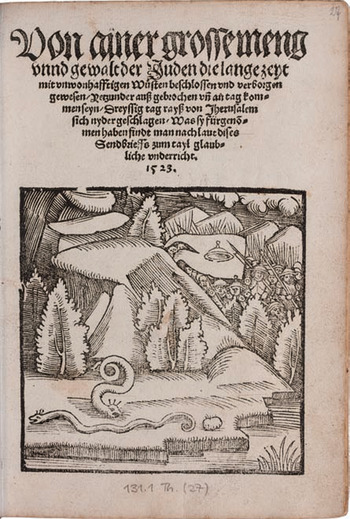
In 1523, a year of heightened apocalyptic expectations, “news of the saviors from beyond the Sambatyon River spread throughout all lands.”Footnote 39 Several German pamphlets reported that the Red Jews had finally taken action and were marching toward the land of Israel. One of them bears the title, Concerning a great multitude and host of Jews, long enclosed and hidden by uninhabitable deserts, who have now broken out and appeared, encamped thirty days’ journey from Jerusalem.Footnote 40 Its frontispiece has an illustration of the Red Jews as a powerful army, heavily armed with armor and lances (fig. 2). Emerging from beyond a mountain range, they are about to cross the Sambatyon, which flows calmly before them. Again, the pointed Jewish hat, which also adorns their flag, characterizes them as Jews.
Von ainer grosse meng vnnd gewalt der Juden, (Augsburg) 1523.

German Jews and Christians discussed the sensational news of the Red Jews' return from time to time. After all, the developments beyond the Sambatyon were of concern to both religious communities. For one group, a new political situation whose outcome seemed predictable on the basis of deep-rooted apocalyptic ideas was a reason to rejoice; for the other, to be terrified.Footnote 41 Interreligious discourse naturally bore polemical overtones. The Jewish adaptation of the Christian expression “Red Jews” itself conducts a polemic with the term's rival Christian usage and the idea behind it. While the Red Jews had originally been created as characters in a Christian anti-Jewish counterhistory to the Jewish hope for the return of the Ten Tribes, Yiddish prose responded to the challenge of the Christian interpretation with its own anti-Christian counterhistory, or rather a “counter-counter-story.”
Polemical (De-) Construction
The key to the polemical construction of the Red Jews is the term's implication, associating Jews with the color red. Various explanations have been advanced about why Jewish and Christian fantasies conjured an image of the Ten Tribes as being red. Older theories derive this attribute from the historical ethnic groups that have been identified with the Ten Tribes in some way: an Arab tribe known as Ḥimir (whose word root means “red” in Arabic), red-skinned people in China, Native Americans, the Mongols who invaded Europe in the thirteenth century wearing red garments and headdresses,Footnote 42 or the Khazars with their purportedly “slight Mongolian pigmentation.”Footnote 43 However, the sources do not support any of these speculations.
According to David Biale's expansion of Funkenstein's concept of counterhistory, this genre is not limited to the reversal of pejorative motifs. Alternative folkloristic traditions may also be incorporated to manipulate the rival's topoi.Footnote 44 In this sense, the Christian coloring of the Jews beyond the Sambatyon fit medieval color symbolism, as Gow has noted.Footnote 45 While the logic behind the moral definition of colors is both ambiguous and subjective, red—already a color that signified warning in ancient Egypt and other societies during antiquity—often held strong negative connotations in medieval and early modern Europe. Red was equated with maliciousness and deceitfulness, dangerousness and ferocity, among other things. Therefore, red was often used to stigmatize the enemies of Christ, including Jews (other flashy colors, like yellow, were similarly used to single out certain characteristics). Red hair, which has always been a minority feature across all ethnic groups and societies, was presumed to be an outward sign of a vicious and false character because it differed from the norm and was therefore suspicious. Accordingly, Christian religious art portrayed the enemies of Christ in general and the traitor Judas Iscariot in particular with red hair and a red beard, and sometimes even with a red complexion, as a stigma of his betrayal. The sinister symbolism of the color red was even ingrained in speech: in Middle High German, red acquired the secondary meaning of “false” and “cunning.”Footnote 46
The Red Jews epitomized the notion of the negative definition of the color red. Did they not personify the ultimate Jewish evildoers, the last and worst antagonists of Jesus who were in league with his archenemy, the Antichrist? It is not at all surprising, then, that the Ten Tribes were imagined as Red Jews, with red hair and red beards, as shown in this example from a fifteenth-century illustrated historical Bible (fig. 3): the drawing presents Alexander closing off the Red Jews, who have red hair and beards; in contrast, Alexander has blond or light-brown hair. Similarly, the late fourteenth-century Antichrist window in St. Mary's Church in Frankfurt (Oder), which renders the biography of the Antichrist in a splendid work of stained glass, depicts the Red Jews in red clothing and with red faces to emphasize their hostility and aggression (fig. 4).Footnote 47 Characterized as Jews by their pointed Jewish hats, they wait beyond the Sambatyon River for the Antichrist, whom they will aid in his apocalyptic destruction of Christianity.Footnote 48
Historical Bible, fifteenth century.

Antichrist window of St. Mary's Church, Frankfurt (Oder), ca. 1360.

While the negative implications of the color red undoubtedly fit the distorted myth of the Ten Tribes in German apocalyptic lore and a mutual influence of image and text can be taken for granted, it is unlikely that this entirely explains the etymology of the name of the imagined people of the apocalypse. Additional traditions must be taken into consideration. Annette Weber recently suggested an alternative source for attributing this color to the Ten Tribes. She points out that in the ninth century, Eldad ha-Dani had already described the beautiful red linen robes of the Sons of Moses who, he claims, were living near his own tribe, the tribe of Dan, separated from each other only by the Sambatyon. The Sons of Moses are the Levites who are believed to have been carried off on a cloud following the destruction of the First Temple. According to Eldad, their descendants dyed their robes scarlet red with the help of cochineal, reminiscent of the historical garment worn by the biblical high priest.Footnote 49 When the term “Red Jews” was coined in Germany, Eldad's story was indeed known among Christians, at least partially, as its adaptation by the popular Prester John tradition proves. Prester John was the fabled king of a distant utopian empire in Christian lore. Parallel to the Jewish belief in saviors behind the Sambatyon, during the Crusades Christians pinned their hopes for a potential ally against the infidels on Prester John, who was believed to dwell beyond the Arab lands. In the letter that he supposedly sent to the twelfth-century Byzantine emperor Manuel I Komnenos, Prester John lists the Ten Lost Tribes among his multitude of vassals, drawing on the Jewish Eldad ha-Dani tradition.Footnote 50
Early Reformation theologians advanced a different explanation of the Red Jews’ etymology altogether. In 1529, Justus Jonas, Martin Luther's translator, speculated: “It seems to me, however, this term ‘Red Jews’ indicates that they are Edom, since Edom means red.”Footnote 51 While it cannot be determined if this really played into the term's genesis in the late Middle Ages, at least by the sixteenth century the polemical motif of the Red Jews was linked to the respective Jewish and Christian typological interpretations of the Biblical pair, Esau/Edom and Jacob/Israel. The Christian interpretation of Genesis 25:23 inverted the Jewish understanding of the verse that self-identifies with Jacob/Israel and equates the Christian other with Esau/Edom, identifying Christianity as Jacob/Israel and the Jews as Esau/Edom. The Christians claimed that the church had superseded the people of Israel as God's chosen one, thus becoming the new, true Israel (verus Israel). Based on Paul's distinction between carnal Israel, i.e., the Jews, being rejected by God, and the election of spiritual Israel, i.e., the Christians, the church fathers transformed the implied equation of Esau as the Jews and Jacob as the church from the Epistle to the Romans into doctrine (Romans 9:6–13).Footnote 52 Thus, each side claimed the victorious identity of Israel, the people of God, and attributed the role of Edom, the servant, to the other.
Edom in the Bible is derived from the color red, ’adom in Hebrew, which has the same triliteral root. Accordingly, Edom is “the red one,”Footnote 53 meaning that, in the figurative sense, the loser in the drama of Heilsgeschichte (Salvation History) is red. Esau, in fact, is described as being red from birth: “And the first came forth ruddy (’admoni), all over like a hairy mantle; and they called his name Esau” (Genesis 25:25). Both Jews and Christians drew on this biblical etymology when marking the other as Edom. On the one hand, a late addition to the medieval Ashkenazi Piyyut Ma‘oz ẓur (Stronghold of Rock), which is first documented in the early modern era, refers to Christianity as “the red one in the shadow of the cross.”Footnote 54 On the other hand, Melito of Sardis explains that the Jews were called Edom because they were red with the blood of Christ clinging to their hands.Footnote 55
Both Jews and Christians were painfully aware of the other's designation of their own group as Edom and took efforts to deny it, each vindicating their own interpretation.Footnote 56 When sixteenth-century German literature described the Ten Tribes as Red Jews, it was drawing on the long-established formula that equated Jews with Edom, as Jonas suggests. Another source, several decades later, supports this interpretation of the German term “Rote Juden.” The text speculates that they
…are called the Red Jews, perhaps from Edom or their bloodthirst.Footnote 57 Therefore, the European Jews secretly favor them and hope they will free them to return to their land. They rejoice when the Turk arises against Christendom, and they hope the scepter shall then be taken from the Christians because all their scribes say that they cannot regain their kingship while the Edomites are holding the scepter. By such name they call us, the Christians.Footnote 58
The author, Georg Nigrinus (Schwarz), a pastor in Gießen in Hesse, also explains the term “Red Jews” according to the Christian version of the biblical typology of Edom. At the same time, however, he uses a polemical device that typifies the genre of counterhistory: the German term “Red Jews” not only supports the Christian typology that equates Edom with the Jews, but also inverts the Jewish scenario that casts Edom, i.e., the Christians, as condemned to perish. The Christian narrative of the Red Jews takes the role of the red underdogs from the Christians and transfers it to the Ten Tribes—who, in the rival Jewish view, are Edom's expected destroyers.Footnote 59
The Jewish reworking of the Christian legend in Older Yiddish uses the etymology of the expression “Red Jews” and the association of Jews with the color red as its starting point. In the Yiddish counterstory, the redness of the Jews beyond the Sambatyon acquires new meaning, since it is not derived from Edom, but King David. Besides Esau/Edom, the Bible also describes David as “red,” using the same Hebrew word “’admoni,” ruddy. When David was brought before Samuel, it is said, “he was ruddy (’admoni).”Footnote 60 With this clever device, Older Yiddish literature created a polemical satire that negated the Christian significance of the Red Jews. The key here is the second passage in the book of Samuel, which once more ascribes the attribute of ruddiness to David at the opening of his famous fight with the Philistine giant Goliath from which, as is well known, David comes off as the winner.Footnote 61 The Yiddish tale reinvents the myth of the Red Jews in the pattern of “David versus Goliath” and restores its protagonists’ victorious standing.
There are several early modern Yiddish versions of the Jewish Red Jews' tale that have been preserved in manuscripts and in print. The oldest known and most popular one, which modern scholarship calls Ma‘ase ’Akdamut (The Story of ’Akdamut),Footnote 62 is found in a small cycle of hagiographic stories about Meir Shatz of Worms. Meir Shatz, an eleventh-century composer of liturgical poetry from the German Rhineland, is most widely known as the author of ’Akdamut milin (The Introduction to the Words), the Aramaic piyyut that pictures Israel's splendid salvation in messianic times and, according to the Ashkenazi rite, is recited before the Torah reading on the first day of Shavuot.Footnote 63Ma‘ase ’Akdamut, the legend about the composition of this piyyut (the only Yiddish story in an otherwise Hebrew narrative cycle) centers around the myth of the Red Jews.
While its date of composition is unclear, the tantalizing story about Rabbi Meir and the Red Jews was immensely popular in the sixteenth century due to its connection with a favorite piyyut.Footnote 64 The censor's lists that recorded all books owned by the Jews of Mantua in 1595 attest to the story's popularity; they note eight copies of its first freestanding printing, which appeared under the title Megiles Reb Meyer in Cremona circa 1560 (now lost).Footnote 65 The earliest written records of the tale (which have all been lost as well), however, were not composed in the vernacular, but in Hebrew. Most likely they originated in liturgical commentaries on piyyutim and were included in early Ashkenazi maḥzorim. Accordingly, a northern Italian editor explains the need for his new Hebrew translation of the story, dating from 1630, since at that time the text was only extant in Yiddish—except for the Hebrew versions found in a few old prayer books.Footnote 66 The first known Yiddish printing from 1560 Cremona, as recorded in the Mantua inventory in 1595, on the contrary, was a translation from the Hebrew.Footnote 67 Thus the earliest extant text of Ma‘ase ’Akdamut—and of a Yiddish version of the story of the Red Jews in general—dates from the late sixteenth century. It is included in a Yiddish manuscript of edifying historical and narrative texts (c. 1580–1600), which, besides Ma‘ase ’Akdamut, also features another version of the tale of the Red Jews as included in a 1579 letter from Safed.Footnote 68 Under various titles, both stories were printed in the early modern period and even later. Ma‘ase ’Akdamut saw at least four more Yiddish editions in the seventeenth and eighteenth centuries from publishing houses in Fürth and Amsterdam,Footnote 69 while the letter from Safed only appeared in print once, together with a miracle tale about Isaac Luria, in the 1660s in Prague.Footnote 70
The Yiddish story of the Red Jews depicts a Jewish community that is being threatened by a Christian enemy (in Ma‘ase ’Akdamut, the historical Jewish community of Worms is specified). A vicious Christian sorcerer, who is a master of the dark magical arts and a notorious Jew hater, uses magic to kill thousands of Jews. When the Jews turn to the authorities for protection, the sorcerer declares that he will do the Jews no more harm providing that one condition is met: within one year, the Jews must present to the sorcerer someone who can match his magical skills. Should the Jews fail, the sorcerer will destroy them all. The Jews have no alternative but to agree, and they desperately begin to seek a miracle worker who is able to compete with the dreadful magician. The search extends far and wide, even beyond the Sambatyon, where a messenger (Meir Shatz in Ma‘ase ’Akdamut) is sent to the Red Jews, who agree to dispatch one of their own to help those in distress. At the climax of the story, this Red Jew duels with the Christian magician in a sorcery contest. The end, of course, is a happy one: the Red Jew is victorious over the evil Christian sorcerer and thereby saves his brothers from doom. Ma‘ase ’Akdamut adds: since the contest would take place on the eve of Shavuot, Meir Shatz composed a piyyut for the festival in honor of the events, ‘Akdamut milin, signing his work in the form of a name acrostic. Since he would be staying in the land of the Red Jews to avoid violating the Sabbath again—he had had to wait for the calm Sabbath waters in order to cross the Sambatyon the first time—Meir Shatz asked the Red Jew, when he was departing for Worms, to bring that piyyut to Germany for inclusion in his hometown's Shavuot liturgy as a remembrance of him.Footnote 71
On the level of typological identification, the analogous motifs that these Yiddish narratives of the Red Jews share with the biblical story about David and Goliath are unambiguous. The Christian oppressor plays the role of Goliath. His adversary, the Red Jew, represents David. From this it becomes clear why the story in Older Yiddish only defines this one Red Jew, the savior from beyond the Sambatyon, as a “little Red Jew” (rot yudlayn).Footnote 72 Collectively, the “trans-Sambatyoniks” are always called “Red Jews” without a diminutive form (rote yudn and not royte yidelekh, as in modern Yiddish).Footnote 73 Described as “old,” “limping,” and “lame,” the little Red Jew is introduced to the reader as a weak character from the narrative's beginning.Footnote 74 The Yiddish story's frail hero is by no means a prototype of the mighty and terrifying muscular Red Jews of German lore. Neither is he the proud hero and brave warrior depicted in Eldad ha-Dani's image of the Ten Tribes. He is another David, who stands up against an enemy whose supernatural powers seem superior in every respect, a boy who does not seem to have a chance in this competition of unequal combatants. In one version of the story, the saviors from afar are two seven-year-old children, a boy and a girl.Footnote 75
It is exactly David's redness that displays his supposed weakness. When David confronts Goliath, the Philistine can hardly believe his eyes when he sees whom King Saul has sent into battle. “He disdained him; for he was but a youth, and ruddy (’admoni), and withal of a fair countenance.”Footnote 76 The construction of this sentence seems to indicate that whatever “’admoni” described was probably meant to be a positive attribute that complemented David's good looks. In this sense, the medieval Jewish commentator David Kimḥi has interpreted David's ruddy appearance as “rosy,” meaning young, sensitive, and handsome.Footnote 77 Two passages in Rashi also take a red complexion to indicate health and physical beauty.Footnote 78 One certainly would not ascribe any of those attributes to the dangerous, vicious, and barbaric people conjured by the Christian apocalyptical imagination. Thus, that earlier Christian definition of the Red Jews is derided by their last triumph in the Yiddish story: they prevail through the skills of one of their own who, measured by his physical strength is weak and by character innocent, like a child.
The biblical paradigm can be traced throughout the Yiddish tale of the Red Jews. There, Goliath challenges the Israelites to conclude the war in a duel between one representative from each side. Here, the magician demands a sorcery contest.Footnote 79 His words are similar to those that Goliath calls out to the people of Israel: “Choose a man for you, and let him come down to me. If he be able to fight with me, and kill me, then will we be your servants; but if I prevail against him, and kill him, then shall ye be our servants, and serve us.”Footnote 80 The sorcerer in Ma‘ase ’Akdamut promises: provided “that they send me somebody within one year who will be able to engage in a sorcery competition with me, I won't harm them. However, if in one year they have not sent me anyone, I will slay them all.”Footnote 81 A late translation of the Red Jews’ story into Hebrew explicitly compares the wickedness of the Christian villain with Goliath.Footnote 82 Just as King Saul initially hesitates to send the young shepherd David into battle, the Jews in the Yiddish legend doubt that the outwardly weak little Red Jew could triumph against the mighty Christian who is in league with the devil: “How can such a limping little manikin possibly stand up to the monk? What has R. Meir done to us?”Footnote 83 As expected, when the little Red Jew steps forward to take on the challenge, the black magician mocks his apparently mismatched contender: “How the Jews make fun of me! Why do they give me a little, trembling manikin for the magical contest?”Footnote 84 These words echo Goliath's surprise and annoyance when he first sees David: “Come to me, and I will give thy flesh unto the fowls of the air, and to the beasts of the field.”Footnote 85 Here, the 1630 Hebrew translation of Ma‘ase ’Akdamut directly quotes the book of Samuel and borrows freely from the biblical text in formulating the brave little Red Jew's response to the sorcerer: “This day won't pass before the Lord has presented your beaten carcass to the eyes of this assembled people.”Footnote 86 In the end, the little Red Jew indeed succeeds in the seemingly impossible task, emulating David who beat the gigantic, heavily armed warrior Goliath simply with a stone and his slingshot. He overcomes the sorcerer's black magic with the use of divine names and kills him.Footnote 87 Even the happy ending of Ma‘ase ’Akdamut finds its model in the biblical narrative: Saul had promised his daughter as a wife to the man who would defeat the Philistine.Footnote 88 In Ma‘ase ’Akdamut, the little Red Jew marries Meir Shatz's daughter and Meir Shatz himself marries the daughter of the little Red Jew, becoming both his son-in-law and his father-in-law.Footnote 89
The Yiddish story switches the ultimate allocation of good and evil in the German drama of the Red Jews. When, on the one hand, the original Christian concept of the sinister Red Jews derived from Edom is replaced in favor of a Davidic lineage, the Red Jews come to represent the heroes in the Yiddish version of the tale. This is in accordance with aggadic sources that discuss the different meanings of redness with respect to Esau and David: when Samuel caught sight of David, he was frightened because he thought the future king of Israel a second Esau, interpreting David's redness as a physical sign of his determination to shed blood. God, however, put Samuel at ease. Unlike Esau, David would only kill those who would forfeit their lives through sinful deeds.Footnote 90 On the other hand, the evil Christian becomes a metaphor for Edom, whose wickedness is portrayed in both Jewish and Christian traditions and whom King David had subjugated in the guise of the ancient Edomites.Footnote 91
Yet another level of meaning lies in the Red Jews’ epithet: “Sons of Saviors” (Bne Moshi‘im). For support, the prophet Obadiah is quoted: “and saviors shall come up on Mount Zion.”Footnote 92 The early modern reader of Yiddish would have been familiar with the context of this verse from the daily morning service. Following the recitation of the Song of the Sea, the liturgy points to the destruction of Esau/Edom and the elevation of Israel: “And saviors shall come up on Mount Zion to judge the mount of Esau; and the kingdom shall be the Lord's.”Footnote 93 The midrash knows that the avenger in the struggle with Edom––the red one––will also be red, namely “clad in red.”Footnote 94Lekaḥ tov, toward the end of the commentary on parashat Va-yishlaḥ, reveals the one who will exact messianic vengeance, referring explicitly to David's redness: it will be accomplished “by Messiah ben David who is called ‘ruddy, and withal of beautiful eyes.’”Footnote 95
The Yiddish story of the Red Jews can be read as an allegory of the Jewish hope for redemption. David's biography as “The Red Jew” in fact serves as a typological model for Israel's salvation from captivity and dispersion by the advent of the King Messiah from the house of David. An aggadic midrash included in the late medieval Yalkut ha-Makhiri explains that David's brothers wanted to kill their mother and David because they saw his redness as proof that he had been conceived in adultery. Jesse, however, asserted that henceforth his youngest son would be considered as a slave instead, and David came to herd his father's flock for many years—until he was anointed as king over Israel.Footnote 96 And it is here that the Bible first introduces David as “red.” When David is brought before Samuel, it is observed “and he was ruddy…. And the Lord said: ‘Arise, anoint him; for this is he.’”Footnote 97 The double wedding at the close of Ma‘ase ’Akdamut serves as an emblem of messianic redemption. It symbolically anticipates the ingathering of the Jewish people at the end of time, when the Ten Lost Tribes of Israel will be reunited with their brothers and sisters of the Diaspora.
The multilayered counterhistorical construction of the Yiddish story that gives new meaning to symbols and elements in the Christian original also gives the little Red Jew in Ma‘ase ’Akdamut a name that is fraught with symbolism: he is called Dan.Footnote 98 In Jewish tradition the tribe of Dan is central to redemption: not only is it anticipated as the maternal line of the Messiah,Footnote 99 but among the Ten Tribes Dan is the bravest and most experienced in warfare.Footnote 100 Yet again, the story undermines the rival Christian interpretation of Dan as the tribe from which the Antichrist will spring.Footnote 101 Rather, here the role of the savior's last enemy, who is doomed to fail in the end, is allocated to the wicked sorcerer who, like the Antichrist, is a master of the dark magical arts.Footnote 102 It is not incidental that the polemical medieval Jewish version of the life of Jesus, Toldot Yeshu, confers many characteristics of the Antichrist on Jesus, as a false Messiah and as a magician. He too, according to Toldot Yeshu, is involved in a magical contest, namely with Judas Iscariot who, like the little Red Jew, invokes the divine name. Perhaps this antigospel, which was very popular among Jews in the German lands in the Middle Ages and early modern times, inspired the Yiddish Red Jews story with its culmination in a magical contest between the forces of good and evil.Footnote 103
Furthermore, for early modern Yiddish speakers, the redness of the Ten Lost Tribes unambiguously refuted the Christian interpretation of Genesis 49:10: “The scepter shall not depart from Judah, nor a lawgiver from between his feet, until Shiloh come; and unto him shall the gathering of the people be.” According to the classic Christological understanding of Shiloh as Messiah, this ostensibly proved Jesus as the Messiah, because Israel had lost its political sovereignty around the time of Jesus and had been in exile ever since.Footnote 104 While the Jewish belief in the continued existence of an independent Jewish kingdom beyond the Sambatyon River countered Christian exegesis, the Red Jews demonstrated this in vivid color. After all, crimson was the color of dominion. “Therefore, the Jews of that country [beyond the Sambatyon] are called the Red Jews,” claimed Paul Joseph, who served as a rabbi in Posen prior to his conversion to Christianity in 1611.Footnote 105 Likewise, a little booklet written in the mid-eighteenth century explains this unique expression for the Ten Tribes among the Jews in Germany on the basis of their red clothing. Friedrich Albrecht Augusti of Eschenberga (near Gotha), another convert to Christianity, declares that among his former coreligionists, the name Red Jews “is highly esteemed and glorious,”
both on account of the red and lively color of their faces and the exquisite purple clothes, which they wear as a free people in order to distinguish themselves from all other [Jews] living in misery. [A footnote explains:] The European and Asian Jews are not allowed to wear any red clothes because they are still in mourning over the Temple and the city of Jerusalem. The color red is a sign of freedom and of the greatest joy among Jews. Royal children were privileged [to wear red], a color that distinguished them from others. The Red Jews, however, so they say, have experienced no galut, no ḥorban, i.e., no captivity and no destruction. These Jews wear the most beautiful purple; no one can forbid them [from doing so].Footnote 106
Jewish-Christian Messianism
The Christian origin and the Jewish adaptation of the image of the Red Jews lie within the unique framework of Jewish-Christian apocalypticism in premodern Germany. As Elisheva Carlebach and Israel Yuval were the first to suggest, Jewish yearning for redemption was firmly embedded in the environment of the surrounding Christian society.Footnote 107 While Christian attitudes regarding the Jews' continued anticipation of a Messiah other than Jesus were negative by default, a particularly hostile and uniquely distorted notion of Jewish messianism became deeply entrenched in medieval German culture. Here, Christian polemics against Jewish messianic belief were especially diverse and dynamic. Vernacular texts, public plays, and pictorial representations display numerous variants that were either completely unknown in the other European languages or less potently anti-Jewish than the German version—as in the case of the Red Jews.Footnote 108 The themes and motifs that had been popular in the Middle Ages were no less influential in the sixteenth century, across Christian denominations.Footnote 109 The early modern period, however, also brought changes that affected Christian perceptions of Jewish messianism. Besides the invention of the printing press that—with the newly printed books in the vernacular, illustrated texts, and pamphlets in particular—enabled an increasingly wide audience to participate in public discourse,Footnote 110 a new literary genre was born in sixteenth-century Germany: polemical ethnographies of Jews and Judaism. The theoretical study of biblical texts for the most part, and abstract discussions of Jewish doctrine, made room for a critique of the practices of contemporary Jewry. The Christian study of Judaism was augmented by observations of how Jews really lived and behaved. The ethnographies, first authored by converts from Judaism, claim to provide realistic portrayals of Jewish life, religion, and ritual. This very popular genre was written almost exclusively in German, and it had a decisive role in shaping early modern perceptions of Jews and Judaism among German Christians. In contrast to the Middle Ages, when knowledge of the Jews and their religion was primarily based on literary stereotypes, Christians now had access to firsthand, if biased, insights.Footnote 111
Christian views of Jewish messianic yearnings were largely derived from Christianity's own apocalyptic concepts. This becomes most conspicuous with regard to the idea of the Jewish Antichrist. This notion envisioned the Antichrist as the savior whom the Jews longed for, with the Jews as his first and most faithful allies.Footnote 112 During the late fifteenth century the entire Jewish people, awaiting the Messiah and consequent redemption, was increasingly viewed as a willing party to an evil scheme: while the Jews feigned loyalty to their Christian overlords, and the Christian world ridiculed and pitied them for being deceived by their false messianic hopes, Jewish messianism was exposed as being a malicious plot against much-hated Christianity, for the long-expected Jewish Messiah would be none other than the dreaded Antichrist.Footnote 113 By equating the Jewish Messiah with the Antichrist, the Christian mind inextricably intertwined Jewish messianism with the wish to annihilate Christendom. Fears and aggressions originally associated with the Antichrist and his apocalyptic reign of terror were now projected onto the Jewish (pseudo-)messiah and his Jewish followers.Footnote 114 Although misconceptions and polemical interpretations were typical in Christian thought, vengeance as a response to centuries of Christian oppression was indeed a vital element of premodern Ashkenazi messianism.Footnote 115 The ethnographic publications of converts like Victor of Carben, Johannes Pfefferkorn, and Anthonius Margaritha—including detailed explications of revenge and anti-Christian violence in Jewish apocalyptic thought—suggest that Christians in early modern Germany had access to information that explicitly linked Jewish redemption to their own downfall.Footnote 116 It is hardly a wonder that Jewish messianic aspirations, as combined with the Christian distortions applied to it via anti-Jewish eschatology, were perceived as a real danger to Christian society, with concomitant harsh political and social consequences for the Jews in the Holy Roman Empire.Footnote 117 Jews in Germany were painfully aware of the negative assessment of their hopes for redemption in the surrounding Christian society and culture. Their reactions to such hostile Christian views were manifold—the Yiddish fable of the Red Jews is just one example.Footnote 118
Their cognizance of German attitudes toward Jewish messianism had an impact on the ways that Ashkenazi Jews in Germany conveyed their longing for the coming of the Messiah. Deeply fearful of sparking Christian reactions, they became extremely cautious in their manner of expressing messianic hopes in public. Moreover, the Talmud itself, understanding the morally and socially destructive force of failed messianic promises, dismisses apocalyptic calculations and revolutionary attempts to hasten the end.Footnote 119 Given the hostile Christian view of Jewish messianism, it seemed most logical for Jews in medieval and early modern Germany to follow this traditional stance.Footnote 120 Carlebach has argued convincingly that, particularly in this geographic area, a genuine need for caution triggered Jewish self-censorship with regard to apocalyptic matters.
This does not mean, however, that Jews in Ashkenaz refrained from participating in the messianic fervor that seized all of Reformation Europe, Jews and Christians alike.Footnote 121 In light of their precarious position in Christian society, the Jews took care when presenting themselves before Christian observers. Thus, Jewish historiography seems to have attempted to disguise Jewish messianism by retroactively downplaying or concealing the reality and nature of failed messianic movements.Footnote 122 Furthermore, Jews in Germany vigilantly warned members of their community against overly visible messianic activities and attempted to restrict apocalyptic speculation to esoteric circles. Ideas about the last days that could be offensive to Christians were circulated secretly and, it seems, were mostly transmitted orally.Footnote 123 The apocalyptical dimension of a wonder tale from Worms, for instance, is known only from the German ethnographical work of a convert. A small late-fifteenth-century collection of Hebrew stories in a manuscript from the Italian Senigallia includes this tale. During the Black Plague of 1349, the burghers of Worms persecuted the Jews of their city. Suddenly, a marble column appeared in the Jewish cemetery. Reaching into the sky, it grew even taller than the cathedral, and it leaned menacingly toward town. The intimidated Christian tormentors retreated, and the Jews were saved. The column remained as a warning symbol for a few days and only sank back into the ground when quiet had returned. To this very day, the writer claims, the stele stands in the Jewish cemetery in Worms, about two cubits high.Footnote 124 In the early sixteenth century, Pfefferkorn revealed a juicy detail to the Christians: the legendary column was reputed to measure the time that remained until the coming of the Messiah. Each day, it would sink into the earth a little more, until it would be swallowed up completely on the day of redemption, signifying everlasting liberation from Christian violence.Footnote 125 Although the stele in this tale passively threatened the Christian persecutors in the mid-fourteenth century, they knew that the end of times would have bloody vengeance in store.
The mechanics of censorship were at work in case of the Red Jews, too. In a Hebrew manuscript from northern Italy, the passage that retells the legend of the Red Jews has been crossed out, either by the author Abraham Jagel himself or a later hand, and is barely legible.Footnote 126 Probably for the same reason, the beadle, Juspa Shammes of Worms, did not include Ma‘ase ’Akdamut in his famous collection of stories from his hometown, Mayse nisim, that he recorded in the mid-seventeenth century. The Yiddish version of Mayse nisim that his son, Eliezer Lieberman, brought to print in Amsterdam in 1696 (after his father's death) indeed refers to a printed version of Ma‘ase ’Akdamut, but the tale itself is not included in this rich corpus of Jewish lore.Footnote 127 Notwithstanding its absence, Juspa, along with every other Jew of his generation in Worms, was undoubtedly familiar with this important legend about one of their local heroes.
Similarly, Jewish children learned the piyyut ’Akdamut milin in school,Footnote 128 but in Juspa's lifetime this liturgical poem—which, as aforementioned, was ascribed to Meir Shatz, a native son who was one of the most prolific poets of Ashkenaz—was not recited in the synagogue in Worms, although it had become part of Ashkenazi liturgy everywhere else. The Jews of seventeenth-century Worms were aware of their exceptional position in abstaining from reciting ’Akdamut on the first day of Shavuot, the festival that was linked to the legendary rescue of their community by the little Red Jew. Judah Loew Kirchheim, in the book of customs that he compiled circa 1625, felt obligated to give a reason for the omission of this famous piyyut from the city's rite. According to Kirchheim, there had been a certain cantor in Worms who once sang the ’Akdamut with such a beautiful voice and great fervor that when he concluded, God immediately swept him up to heaven. Afterward, ‘Akdamut was no longer recited in Worms. This explanation is so flimsy that even Kirchheim himself is hardly convinced. He adds that the real reason has likely been forgotten.Footnote 129 The date when ’Akdamut was abolished in its hometown is unclear. The famous Worms Maḥzor of 1272, which did not originate in the city but apparently came into the possession of the Worms Jewish community one generation later, includes the piyyut. While the maḥzor is full of marginal notes, there is no comment about ’Akdamut indicating that it would no longer be recited in Worms.Footnote 130 It seems that with an eye to their Christian neighbors, Worms Jewry took pains to avoid associating themselves officially with the hymn and the legendary reason why the city's famous cantor Meir Shatz had composed ’Akdamut milin. After all, one could not deny that Ma‘ase ’Akdamut was directed against the Christian authorities. It both celebrated and conjured the victory of the Red Jews over Edom.Footnote 131
The Yiddish tales of the Red Jews are part of a hidden layer of Jewish popular culture in early modern Central Europe expressing an anti-Christian sensibility. The material known from this period, particularly in Yiddish, represented a vital strategy of theological, social, and cultural persistence within a hostile, powerful, and seemingly invincible Christian society.Footnote 132 The belief in the Red Jews—like the Ten Tribes in general—served an important psychological function. It shielded the community against any doubts about God's assurance that oppression and suffering, which had marked Jewish history for centuries, must inevitably be lifted. The Red Jews reminded the Jews of Ashkenaz that, even if sometimes it did not seem so, the God of Israel would never abandon his people. The day would come when the weak would finally triumph over the mighty.
The term “Red Jews” encountered in Yiddish literature emerged from familiarity with its German counterpart, itself a counterstory to the Jewish narrative about the Ten Tribes. What we witness here, however, is not just a disentangling from Christian distortions applied to the Jewish original. The Yiddish myth of the Red Jews in fact served two complementary ends. First, it subverted the German apocalyptic myth by following its logic, but substituting an alternative narrative, thus rendering explicit the anti-Christian twist in the Hebrew Ten Tribes’ legend. The Red Jews are both messianic saviors and, as in the German nightmare, destroyers of Christendom who avenge the age-old oppression of the Jews. At the same time, the Yiddish story of the Red Jews confirmed the Jewish messianic belief that Edom's fall would be carried out by the Ten Tribes.
Messianic resistance against Christianity as personified by the Red Jews was deep seated in German-Jewish culture by way of its vernacular language and literature and was anchored in its liturgy. It seems that among Ashkenazi Jews, an immediate sense of apocalyptic efficacy was attached to the recitation of the piyyut itself. In the eighteenth century, Isaac Wetzlar, a learned and well-traveled Jewish businessman from Celle in Lower Saxony, noticed that in the synagogues of Europe, ’Akdamut was indeed said for the coming of the Messiah. But he lamented that this alone would be of no avail if another mystical hymn, Shir ha-yiḥud, was neglected in many places and no longer recited daily as prescribed.Footnote 133 In addition to the place of ’Akdamut milin in the communal service, among Ashkenazim it remained customary to recite Ma‘ase ’Akdamut each year on the festival of Shavuot as well. Abraham Jagel reports that some communities possessed a special scroll for this purpose, which he had witnessed in Mantua. During his visit, Jagel probably saw a copy of the lost first print of Megiles Reb Meyer.Footnote 134 It was not unusual to incorporate a “Second Purim” into the festival cycle of the year to commemorate the local community's deliverance from persecution, modeled after the Purim festival that celebrates how Queen Esther had saved the Persian Jews. Normally, a special megillah was composed for this local or regional holiday, relating the events in the style of the Scroll of Esther.Footnote 135 The Jews of Frankfurt, for example, commemorated their return to the city after their temporary expulsion during the Fettmilch uprising in 1614 to 1616 in Megilat Vinẓ. A Hebrew version was recited in synagogue, like Megilat Esther on Purim, while an additional Yiddish version was read privately at home.Footnote 136 Accordingly, the Yiddish Megiles Reb Meyer may also have been read on Shavuot in a private setting. In contrast to other megillot, Megiles Reb Meyer does not merely refer to an (alleged) historical event.Footnote 137 Rather, it is future oriented, foretelling the apocalyptic destruction of Edom that is inscribed in the annual Jewish liturgy through the constructed remembrance of a miraculous salvation. Incidentally, just before Shavuot the Jewish communities of the Rhineland commemorated the anti-Jewish pogroms of the First Crusade. Yuval argues that local fast days in remembrance of the martyrs of 1096 were also intended to evoke God's wrath and spur God to finally destroy Edom and send the Messiah. When celebrating the Red Jew's triumph as apocalyptic avenger on Shavuot, it was typologically anticipated that God would answer his people's prayers.Footnote 138
The Red Jews demonstrate how expressions of Jewish messianism and Christian apocalypticism in the century of the Reformation informed one another: how Jews and Christians mutually perceived, reacted to, and influenced each other's messianic claims and apocalyptic beliefs. The eschatological discourse of the two faith communities in Germany is remarkable for the seeming paradox of a relationship that is alternatively constricting and fertile. It oscillated between two poles, since Jewish and Christian end times are incompatible by definition. While the hopes and fears of one inhibited the expression of the other, particularly in the case of the Jews articulating their own yearnings, their simultaneous desires for the end of time strengthened the competing religions' expectations. I suggest that the uniquely hostile Christian perception of Jewish messianism that was conveyed in the anti-Jewish thread of Christian apocalypticism provided a foundation for the close interpenetration between Jewish and Christian apocalyptic lore in early modern German lands. Indeed, knowledge of the other's rival interpretation of the same events and scriptural sources affected, formed, and renewed both Jewish and Christian conceptions of the last days. Jews and Christians sought to manipulate and integrate one another's expectations in order to undermine their interlocutor's competing eschatological ideology and thereby serve their own apocalyptic-messianic agenda. As a result, Jews adopted Christian apocalyptic beliefs while giving them an anti-Christian twist, and vice versa. After all, communicating a position that distinguishes oneself from the other requires a common language.
Ultimately, the premodern circulation of the Red Jews’ story is an expression of the ancient Jewish-Christian quarrel about the identity of Edom. Each side passes the eschatological loser Edom to the other, while identifying itself with his victorious brother Israel. The Yiddish story not only undermines the Christian apocalyptic construction of a fictitious people known as the Red Jews, but it overturns the self-perception of the Church as the true Israel that superseded the people of Israel as God's chosen people and became the bearer of eschatological victory and truth. The result is a mutual deconstruction of the explaining narrative of the other's identity and an affirmation of its own self-understanding as a partner in an uninterrupted covenant.
Naturally, subversive opinions such as those linked to the Red Jews are hard to find in public discourse. Resistance was rather offered in “hidden transcripts,” as James C. Scott has aptly called the covert traditions of repressed groups that reflect a very different evaluation of their situation than their public posture might suggest.Footnote 139 In Ashkenaz, this stance was expressed in various cultural contexts: besides explicit anti-Christian polemics like Toldot Yeshu and Hebrew prayers that contained anti-Christian passages and curses, certain core beliefs such as the future role of the Ten Tribes or the Red Jews were essentially directed against Christianity, and invectives like the practice of referring to Jesus as “the hanged one” blasphemed Christianity expressis verbis through various pejorative phrases and terms of mockery.Footnote 140 Much of this seems to have taken place in a less-restrained way in Yiddish culture, both orally and in writing. The vernacular Yiddish text as a medium was less prone to Christian scrutiny in search of anti-Christian statements than the canonical works of Judaism that were written in Hebrew and Aramaic. Not until the sixteenth century did ethnographies written by converts offer the Christian readership a closer glimpse into Jewish tradition beyond the Talmud and siddur. At first, Christian Hebraists who studied Yiddish in that era were mainly interested in its linguistic and paleographic aspects as part of their humanistic quest to better understand the Hebrew Scriptures. Yiddish literature did not gain importance for their polemical and missionary work until the late seventeenth and particularly the eighteenth century.Footnote 141 Significantly, in 1477 the Dominican preacher and member of the faculty at the University of Ingolstadt, Peter Schwarz (Petrus Nigri) knew nothing of the Yiddish tradition of the Red Jews and its anti-Christian design. He was familiar with the Jews “beyond the Red Sea” merely as misguided warrantors of the false Jewish belief in the continued existence of a sovereign Jewish kingdom.Footnote 142
The Red Jews in Jewish Modernity
The Red Jews vanished from Christian belief circa 1600,Footnote 143 but meanwhile, in the Yiddish-speaking world, the idea was proving to be increasingly persistent and versatile. The Red Jews enjoyed long-lasting popularity in Central European Jewish culture at least through the mid-eighteenth century.Footnote 144 After that time, while Yiddish gradually diminished as a medium of cultural creativity in modern Western Europe, the legend was kept alive among Yiddish speakers in Eastern Europe who later brought it to Israel and America. The print history of Ma‘ase ’Akdamut symbolizes the eastward migration of the Red Jews. The story appeared in Yiddish at least six times between the sixteenth and nineteenth centuries in West-Central Europe, ending with its 1805 printing in Amsterdam, as far as can be established. From that same year through 1916, Ma‘ase ’Akdamut was published in at least four different editions in Lemberg (Lvov).Footnote 145 Among Hasidic groups, it continues to be printed today, in both Yiddish and Hebrew.Footnote 146
While the Red Jews were originally found only in the vernacular, namely Yiddish and German, the myth spread beyond the Yiddish-speaking world to add yet another variant to the rich Jewish legendary tradition about the Ten Lost Tribes of Israel. Hebrew and Arabic stories from Italian, Sephardi, North African, and Oriental Jewries, having been transmitted both written and orally from the seventeenth century to the present, speak of a savior from beyond the Sambatyon and his miraculous rescue of an imperiled Jewish community. They are essentially variations on the tale of the Red Jews that originated in Older Yiddish. The term “Red Jews,” however, remains almost exclusive to Yiddish.Footnote 147 Not even the Sephardi scholar Menasseh ben Israel of Amsterdam, who gathered a wealth of material on the Ten Tribes in the mid-seventeenth century, mentions them by name.Footnote 148 As in the 1630 Hebrew translation of Ma‘ase ’Akdamut (cited above), “Red Jews” is usually rendered neutrally as “Ten Tribes,” “Sons of Moses (Bne Moshe),” or simply “Jews beyond the Sambatyon,” and the like.Footnote 149
The relocation of the Red Jews motif was not merely a geographic change. Its removal from constant polemical confrontations with Christian rivals led to a shedding of its anti-Christian barb. The Red Jews’ image shifted away from being a key instrument in the Jewish-Christian dispute about the identity of verus Israel, and their role as saviors came to the fore. They personified hope for salvation in its broadest sense—from exilic existence and the problems of life as a minority. Thus, the Hebrew variants may replace the evil Christian sorcerer with a king, an imam, a Jewish convert to Islam, or the Muslim population in general. Based on the Western Yiddish original, where the weak triumph over the strong, these later stories are often designed as an exegesis of Deuteronomy 32:30: “How should one chase a thousand, and two put ten thousand to flight?” Likewise, the savior from the Ten Tribes embodies physical inferiority: taking the form of a small boy or girl, or someone with a physical limitation, such as being blind in one eye or having one arm.Footnote 150
While the Red Jews left the frame of Jewish-Christian polemics long ago, their ideological roots in modern Yiddish are still clearly visible. Mendele Moykher Sforim, in his Travels of Benjamin the Third, consciously plays on these historical tropes. His main character, Benjamin, intends to speak with the Red Jews in their native language, which he claims is the language of the piyyut ’Akdamut milin, as composed by Eldad ha-Dani, who after all came from the Red Jews.Footnote 151’Akdamut, however, is not mentioned in the Eldad tradition, to the best of my knowledge. Mendele here draws on Ma‘ase ’Akdamut, freely combining it with the famous story about the ninth-century traveler. In nineteenth- and twentieth-century Eastern Yiddish, the collective diminutive royte yidelekh, little Red Jews—in contrast to rote yudn, Red Jews, in Western Yiddish—still serves to remind us of this expression's etymological origins.