




No CrossRef data available.
Article contents
SCREENING FOR COLORECTAL CANCER USING THE FECAL OCCULT BLOOD TEST: AN ACTUARIAL ASSESSMENT OF THE IMPACT OF A POPULATION-BASED SCREENING PROGRAM IN CANADA
Published online by Cambridge University Press: 21 April 2004
Abstract
Objectives: A series of randomized controlled trials have demonstrated that screening for colorectal cancer (CRC) using the fecal occult blood (FOB) test can decrease mortality from this disease. These findings were used to develop an actuarial model to estimate the impact that a FOB screening program for colorectal cancer would have on the Canadian population.
Methods: The mortality experience of the year 2000 cohort of Canadians fifty to seventy-four years of age, with follow-up extending to 2010, was modelled according to three scenarios: no screening, annual screening, biennial screening. The primary screening tool was the FOB test using unrehydrated samples, with follow-up of positive test results using colonoscopy. The framework of the model was developed based on published findings from the relevant randomized controlled trials, available data, and a literature review that yielded parameter values for some model items.
Results: During the 10-year follow-up of the cohort, we estimated that 4,444 and 2,827 deaths would be averted with annual and biennial FOB screening, respectively. We estimated that for an annual FOB screening program, approximately 3,400 FOB tests would be required to prevent one death, whereas 2,700 tests would be required within a biennial program.
Conclusions: Our analysis documents the population health impact of using the FOB test to screen for CRC. Additional information on the natural history of the disease, and Canadian pilot data are needed to better model the effectiveness of population-based FOB screening programs.
Information
- Type
- RESEARCH NOTES
- Information
- International Journal of Technology Assessment in Health Care , Volume 19 , Issue 4 , December 2003 , pp. 715 - 723
- Copyright
- © 2004 Cambridge University Press
Notwithstanding recent decreases in the incidence of colorectal cancer (CRC), this disease remains the third most commonly diagnosed cancer in Canada (24). Continued increases in the number of incident and decedent cases of CRC will manifest in the near-future given anticipated increases in life expectancy, as well as the aging of the postwar “baby boomer” population (31).
The presumed natural history of CRC and an improved prognosis among patients diagnosed at an earlier stage of this malignancy (33) support a role for screening to reduce CRC mortality. A series of randomized controlled trials have demonstrated that screening for CRC using the fecal occult blood (FOB) test lowers colorectal cancer mortality rates by 15% to 25% (7;11;12;18;19). As the randomized control trial (RCT) is regarded as the optimal study design to evaluate the efficacy of a screening program, these studies provide convincing evidence that FOB screening can decrease mortality.
Although mortality reductions were observed with screening within each RCT, there is an incomplete understanding of the mechanism(s) through which FOB screening achieves these results. It is generally accepted that most CRCs develop from adenomatous polyps (benign dysplastic precursor lesions; 9;22). This finding has led some to posit that the incidental detection and removal of polyps within a screening program reduces the incidence of CRC, and by extension, prevents death (14;15;22). Reduced CRC incidence rates among subjects who undergo endoscopic examination relative to those who do not lends credence to this hypothesis (21;32). However, no significant differences in the incidence of CRC have been noted across the randomized groups in each of the three trials (7;12;18;19), although it is possible that such differences cannot yet be detected due to insufficient follow-up. Variations in the stage distribution of cancers between the screened and unscreened groups in trials suggest that screening reduces mortality by detecting CRC at an earlier stage, thereby, improving prognosis.
Microsimulation models have been developed using findings from the RCTs to evaluate the impact of FOB screening by generating life histories of hypothetical cohorts for a variety of screening scenarios (8;16). CRC microsimulation models are constrained by many unresolved questions about the natural history of this disease. For example, there is limited knowledge about the proportion of malignancies that develop in the absence of adenomatous polyp(s), and the distribution of dwelling times. Herein, we apply an actuarial model that circumvents some of these difficulties in modeling the natural history of the disease (Figure 1). We incorporate the mortality reductions observed in the RCTs to estimated mortality experience of the Canadian population between 2000 and 2010. We then work backward to estimate several of the model outputs.

Overview of actuarial model used to estimate the impact of fecal occult blood (FOB) screening for colorectal cancer among a cohort of Canadians fifty to seventy four years of age in 2000, followed up until 2010 with screening either at one or two-year intervals. The dagger symbol indicates that the total number of colonoscopies was estimated by first calculating the number of screen-detected cancers that occurred during follow-up, and then applying the distribution of outcomes for colonoscopy as observed in the Funen and Nottingham trials. Similarly, using the total number of colonoscopies and the data for these two trials, the number of screen-detected adenomas and negative colonoscopy test results were estimated.
METHODS
The underlying assumptions of our actuarial model are outlined below. Briefly, the impact of FOB screening using the unrehydrated Hemoccult® II test was evaluated in a cohort of Canadians fifty to seventy-four years of age followed up prospectively for 10 years. Both annual and biennial screening intervals were considered. Lifetable analyses were undertaken to characterize the lifetime risk reduction in CRC mortality attributable to screening. The cohort was defined by Canadian population estimates for the year 2000 according to five-year age groupings (4).
We first estimated the number of person-years of follow-up by applying Canadian mortality rates to the annual population estimates to model the mortality of this fixed cohort annually between 2000 and 2010. Age- and sex-specific incidence and mortality rates were then multiplied by the number of person-years in each age-sex stratum to estimate the number of Canadians who would develop and die from CRC. These estimates represent the mortality experience of the cohort assuming that there was no FOB screening program.
Compliance
The effectiveness of a screening program depends on participation rates of the target population. Participation has been shown to vary widely by age, gender, region, setting, perceived level of risk, and recruitment strategies (2;10;17;28). A review of participation rates for CRC screening programs indicated that the median adherence rate to programmatic offers of FOB is between 40% and 50%, and that approximately 50% of those initially offered testing in unselected populations will respond to minimal prompts (29). Our model assumed that 50% of those eligible would not participate in the program and that they would attend 50% of all eligible screens. Our model assumed that 80% of those with a positive FOB test would agree to undergo a colonoscopic examination, a figure equivalent to the corresponding figure in the Minnesota trial (18).
Changes in Mortality Due to FOB Screening
Our model assumed that screening reduces mortality by identifying and treating in situ cancers at an earlier stage and increasing the number of deaths due to complications from colonoscopy. We applied the 18% reduction in CRC mortality that was observed in the Funen trial to our biennial model. Similarly, we applied the 33% reduction of the Minnesota trial to our annually screened cohort. After adjusting for the difference in assumed levels of participation in the Canadian cohort, the projected decrease in CRC mortality that was incorporated into our model was 22% (50/75×33%) and 14% (50/65×18%) for annual and biennial screening, respectively. The denominators in the above calculation (75 and 65) are similar to overall participation rates observed in the Minnesota and European trials, respectively.
Age- and sex-specific rates were applied to the person-years of follow-up to estimate the cumulative number of incident cases and deaths from CRC between 2000 and 2010. By applying the respective 22% and 14% reductions for annual and biennial FOB screening, the number of CRC deaths averted in the screened cohort was estimated. The total number of person-years accrued within the screened population was adjusted for the decreased number of CRC deaths. However, this additional number of person-years accrued was negligible relative to the total person-years accumulated by the screened and unscreened populations. This finding permitted the number of CRC deaths in the screened group (DSc) to be approximated in the following manner:

where DSc=CRC deaths in the screened population; DN=CRC deaths assuming that no FOB screening was offered; k=0.86 and 0.78 for biennial and annual screening, respectively. Based on previous reports, we assumed that two deaths would occur for every 10,000 colonoscopies (1).
Colonoscopic Examinations
The projected number of colonoscopies performed during the 10-year follow-up interval was based on the total number of incident cancers, and the proportion of cancers that were detected through a positive FOB screen. We assumed that a positive FOB test in the annual screening group identified 50% of all incident cancers and similarly 40% in the biennial screening group. These figures are consistent with evidence obtained within the RCTs (18). In particular, with biennial screening, the overall proportion of interval cancers in the screened group was 34%, 39%, and 50% for the Funen, Minnesota, and Nottingham trials, respectively (7;12;18). More recently, among five biennial screening rounds, 58% of all incident CRCs were interval cancers (27). For annual screening, the corresponding figure for the Minnesota trial was 50% (18).
After calculating the number of screen-detected cancers through colonoscopy, the total number of colonoscopies performed was estimated using results from the two European trials (7;12). In the Funen trial, 56.5% of colonoscopies were negative for cancer, whereas adenomas and CRCs were detected in 30.0% and 13.5% of the exams, respectively. The corresponding percentages in the Nottingham trial were 53.9%, 34.6%, and 11.5%. Data from the Minnesota trial were not used in this calculation because the trial used rehydrated samples.
FOB Tests
To estimate the number of tests that would be performed in our cohort, the number of person-years among nonparticipants, after a colonoscopy, and after the detection of an interval cancer must be subtracted from the total number of person-years. We assumed that, on average, these colonoscopy and interval cancer events occurred midway through the follow-up. Similar methods were used to derive the number of FOB tests for biennial screening, while adjusting these estimates by a factor of two to take into account the increased screening interval.
Stage Distribution of Incident CRCs
The number of incident CRC cancers was calculated for the cohort assuming no screening was offered, and for both annual and biennial screening programs. The stage distribution of the unscreened population was based on a chart review of 700 cases (26). Staging for the biennial screened group was based on the mean stage distribution observed in the European trials (7;12), whereas the Minnesota trial formed the basis of the distribution for the annually screened group (18).
Lifetable Analysis
Abridged lifetables were constructed using the Canadian mortality and cancer incidence data (13). Previously described procedures (5;30) were used to calculate the lifetime probability of developing and dying from CRC. These methods were adapted to calculate life expectancy and the probability of dying from CRC, by age, for the three screening scenarios considered.
RESULTS
With biennial screening, an estimated 7.6 million FOB tests will be performed during the 10-year follow-up of the cohort, and between 141,844 and 166,513 colonoscopies will be done as a result of a positive FOB screen. A total of 2,827 CRC deaths would be avoided, while 28 to 33 individuals are projected to die from complications of colonoscopy. Based on the model output, 2,700 FOB tests are needed to avert one CRC death.
The corresponding results for the annual screening program are also presented Table 1. A total of 4,444 fewer CRC deaths were observed in the 10-year follow-up of the cohort relative to the scenario in which no screening was offered. Approximately 15 million FOB tests will be performed during the follow-up of the cohort, while between 141,844 and 166,513 colonoscopies will be done among those having positive FOB screens. Approximately, 3,400 FOB tests are needed to avert one CRC death.

Assuming that participants of a screening program attend 50% of all eligible screens between the ages of 50 and 74, we estimated that annual screening would avert 5,878 CRC deaths within a cohort of one million 50-year-olds. In contrast, assuming equivalent participation rates, biennial screening will avert 3,734 CRC deaths in the same such cohort. The effects on life expectancy based on the screening interval and the age at first screen are provided in Table 2.

DISCUSSION
The purpose of this work was to estimate the population impact of FOB screening for CRC on Canadian mortality. This estimation was accomplished using data from the randomized controlled trials (7;12;18;19). Generalizing these findings to a population-based screening program is not straightforward. Individuals that participate in randomized controlled trials may have different background risk profiles and more intensified follow-up, and treatment interventions may differ from those provided at the general population level. Furthermore, the sensitivity and specificity of screening tests used within the context of a randomized controlled trial may be higher than those used at a population-based level as study technicians are usually better trained and the participants may be more likely to follow dietary recommendations (20). In summary, to achieve the same reductions observed in the trials, sufficient resources must be dedicated to recruit and maintain follow-up of participants and to ensure adequate and timely surveillance of those with positive test results. Our model is based on the current performance of the FOB test. Therefore, future improvements in the sensitivity and specificity of these tests may result in a larger reduction in CRC mortality due to screening, and reduce the number of colonoscopic examinations due to a decreased number of false-positive test results.
Changes in CRC incidence and mortality rates that will occur between 2000 and 2010 were not incorporated into the model. CRC incidence rates are partly affected by changes in behavioural risk factors (25). Mortality rates will continue to be affected by changes in treatment procedures. It is difficult to assess the net effect of these changes in rates on our model outputs.
Ideally, comparisons between the effectiveness of annual versus biennial screens would incorporate knowledge of the dwelling time. This term is defined as the time period in which the cancer is detectable by the test but does not present with overt clinical symptoms. There remains uncertainty about the nature of this dwelling time distribution. By using the Funen data, the mean dwelling time was estimated at 2.1 years; however, the authors recommended that these results be interpreted cautiously due to a large 95% confidence region (6). Recent analyses found that the simulated number of CRC deaths prevented by screening strategies is doubled when this dwelling-time distribution was assumed to be constant rather than exponentially distributed (15). Because the dwelling time distribution of CRC is likely influenced by the size and site of occurrence of the adenoma, taking these differences into account using simulation models is not easy. An improved understanding of the biological mechanism is needed, and such information needs to be incorporated into models to better discriminate between the effectiveness of annual versus biennial screening regimens.
These analyses suggest that life expectancy among persons screened will increase by 11 to 27 days, depending on the age when first screened and the screening interval. Although seemingly small, the magnitude of this increase in life expectancy should not be discounted. To put into context, a 5% decrease in current Canadian all-cause mortality rates across all age groups will result in a gain in life expectancy of approximately 150 days. Elsewhere, analysis that assumed a 40% decrease in CRC mortality among Americans fifty to seventy-four years of age who participated in occult fecal blood and sigmoidoscopy screening, projected an average gain in life expectancy of 44 days (3). Differences between our projections and theirs can be partly attributed to our assumption of a 22% and 14% decrease in CRC mortality with annual and biennial screening rather than the 40% that was used in their study.
Forecasts of the impact of an 8-year population-based biennial FOB screening program in New Zealand were recently made (23). It was estimated that 2,150 FOB tests had to be performed to prevent one cancer death. In our model, we estimated that approximately 2,700 FOB screens are needed to prevent one cancer death. The Canadian estimates are likely higher because it was assumed that 60%, rather than 50% of cancers were missed among the group undergoing biennial screens. Furthermore, our model incorporated a 14% mortality reduction due to FOB screening, which is lower than that in the New Zealand model (15%) that was based on data from the Nottingham trial (7).
Microsimulation was recently used to evaluate the effect of biennial FOB screening in a hypothetical cohort of one million persons (15). The cohort was assumed to have the same structure as the 1993 U.S. population. It was estimated that 2,700 CRC deaths would be avoided. The number of FOB screens needed to prevent one CRC death was much higher in our population. The estimates by Loeve et al. may have been lower for several reasons, including the assumption of perfect attendance during the screening interval, 100% cure after the detection of a polyp through screening, different age distribution of the cohort and a different age range of the eligible population (fifty to eighty years of age). Moreover, their model assumptions are based largely on the results from Minnesota RCT (18;19) that has demonstrated a greater benefit from FOB screening relative to the European trials.
In conclusion, the outputs derived from our model are dependent on a large number of assumptions. We have tried to synthesize the results from the RCTs and pertinent literature into a simplified model to best approximate the impact of FOB screening. Nonetheless, this was done with the understanding that there remain considerable uncertainties about the natural history of CRC, the willingness of individuals to participate in initial and subsequent screens, and the utility of other screening tools to evaluate individuals with a positive FOB.
The success of any screening program is dictated by the willingness of eligible persons to participate. Unfortunately, at the time of this study, there are no data on Canadian participation rates for FOB screening. Pilot data are urgently required to determine the optimal method to persuade individuals in the general population to participate in an FOB screening program. As our understanding of the natural history of colorectal improves and pilot data become available, the flexibility of microsimulation techniques will permit more complex and valid models to be developed.
POLICY IMPLICATIONS
Increasingly, decisions that may ultimately affect health policy rely on evidence-based information. Although the results of RCTs provide some of the best evidence for the decision-making process, this information is not always available and, furthermore, may not be generalizable to a given population. In the absence of such information, alternate sources of evidence may prove useful in addressing unanswered questions. We have demonstrated that modeling is a useful tool in estimating the potential effectiveness of a population-based screening program for colorectal cancer in Canada. Not only can modeling estimate the potential reduction in mortality achievable through a successful screening program, but the issues of participation and compliance, which are critical to the ultimate success of the program can be addressed
We appreciate the insightful comments provided by members of the Health Analysis and Modelling Group at Statistics Canada, specifically those by Jean-Marie Berthelot, Bill Flanagan, and Cristel LePetit. Furthermore, we thank the Steering Group on Modelling that was formed by the National Committee on Colorectal Cancer Screening for their input on this project. Data were provided to Health Canada from the Canadian Cancer Registry at Statistics Canada. The cooperation of the provincial and territorial cancer registries that supply the data to Statistics Canada is gratefully acknowledged.
References
Agency for Health Care Policy and Research.
1998
Colorectal cancer screening.
Technical Review 1. AHCPR Publication No. 98-0033.
Rockville, MD:
Agency for Health Care Policy and Research
Bat L,
Pines A,
Ron E et al.
1986
A community-based program of colorectal screening in an asymptomatic population: Evaluation of screening tests and compliance.
Am J Gastroenterol.
81:
647-
651.Google Scholar
Byers T,
Gorsky R.
1992
Estimates of costs and effects of screening for colorectal cancer in the United States.
Cancer.
70:
1288-
1295.Google Scholar
George MV,
Norris MJ,
Nault F,
Loh S,
Dai S.
1994
Population projections for Canada, provinces and Territories 1993-2016.
Population Projections Section Catalogue 91-520.
Ottawa, ON:
Statistics Canada, Demography Division, Population Projections
Goldberg ID,
Levin ML,
Gerhardt PR,
Vincent H.
1956
The probability of developing cancer.
J Natl Cancer Inst.
17:
155-
173.Google Scholar
Gyrd-Hansen D,
Sogaard J,
Kronborg O.
1997
Analysis of screening data: Colorectal cancer.
Int J Epidemiol.
26:
1172-81.Google Scholar
Hardcastle JD,
Chamberlain JO,
Robinson MH et al.
1996
Randomised controlled trial of faecal-occult-blood screening for colorectal cancer [see comments].
Lancet.
348:
1472-
1477.Google Scholar
Health Analysis and Modelling Group SC.
2000
Colorectal Screening Program: Results from the POHEM model
Hill MJ,
Morson BC,
Bussey HJ.
1978
Aetiology of adenoma–carcinoma sequence in large bowel.
Lancet.
1:
245-
247.Google Scholar
Hobbs FD,
Cherry RC,
Fielding JW,
Pike L,
Holder R.
1992
Acceptability of opportunistic screening for occult gastrointestinal blood loss.
BMJ.
304:
483-
486.Google Scholar
Kewenter J,
Brevinge H,
Engaras B,
Haglind E,
Ahren C.
1994
Results of screening, rescreening, and follow-up in a prospective randomized study for detection of colorectal cancer by fecal occult blood testing. Results for 68,308 subjects.
Scand J Gastroenterol.
29:
468-
473.Google Scholar
Kronborg O,
Fenger C,
Olsen J,
Jorgensen OD,
Sondergaard O.
1996
Randomised study of screening for colorectal cancer with faecal-occult-blood test [see comments].
Lancet.
348:
1467-
1471.Google Scholar
Laboratory Centre for Disease Control.
2000
Mortality and incidence rates calculated using the Canadian Mortality Base and National Cancer Incidence Reporting System.
Laboratory Centre for Disease Control
Levin B.
1999
Colorectal cancer screening: Sifting through the evidence [editorial comment] [see comments].
J Natl Cancer Inst.
91:
399-
400.Google Scholar
Loeve F,
Boer R,
van Oortmarssen GJ,
van Ballegooijen M,
Habbema JD.
1999
The MISCAN-COLON simulation model for the evaluation of colorectal cancer screening.
Comput Biomed Res.
32:
13-
33.Google Scholar
Loeve F,
Brown ML,
Boer R et al.
2000
Endoscopic colorectal cancer screening: A cost-saving analysis [see comments].
J Natl Cancer Inst.
92:
557-
563.Google Scholar
Macrae FA,
St John DJ,
Ambikapathy A,
Sharpe K,
Garner JF.
1986
Factors affecting compliance in colorectal cancer screening. Results of a study performed in Ballarat.
Med J Aust.
144:
621-
623.Google Scholar
Mandel JS,
Bond JH,
Church TR et al.
1993
Reducing mortality from colorectal cancer by screening for fecal occult blood. Minnesota Colon Cancer Control Study [published erratum appears in N Engl J Med. 1993;329:672] [see comments].
N Engl J Med.
328:
1365-
1371.Google Scholar
Mandel JS,
Church TR,
Ederer F,
Bond JH.
1999
Colorectal cancer mortality: Effectiveness of biennial screening for fecal occult blood [see comments].
J Natl Cancer Inst.
91:
434-
437.Google Scholar
Marshall JB.
1996
Colorectal cancer screening: Present strategies and future prospects [see comments].
Postgrad Med.
99:
253-64.Google Scholar
Muller AD,
Sonnenberg A.
1995
Prevention of colorectal cancer by flexible endoscopy and polypectomy. A case-control study of 32,702 veterans [see comments].
Ann Intern Med.
123:
904-
910.Google Scholar
Muto T,
Bussey HJ,
Morson BC.
1975
The evolution of cancer of the colon and rectum.
Cancer.
36:
2251-
2270.Google Scholar
National Advisory Committee on Health and Disability, Working Party on Screening for Colorectal Cancer.
1998
Population screening for colorectal cancer.
Wellington:
Ministry of Health
National Cancer Institute of Canada.
2000
Canadian cancer statistics 2000.
Toronto, ON:
National Cancer Institute
No authors listed. Harvard report on cancer prevention.
1999
Volume 3: Prevention of colon cancer in the United States.
Cancer Causes Control.
10:
167-
180.
Tazi MA,
Faivre J,
Lejeune C et al.
1999
Interval cancers in a community-based programme of colorectal cancer screening with faecal occult blood test.
Eur J Cancer Prev.
8:
131-
135.Google Scholar
Van Dam J,
Bond JH,
Sivak MV Jr.
1995
Fecal occult blood screening for colorectal cancer.
Arch Intern Med.
155:
2389-
2402.Google Scholar
Vernon SW.
1997
Participation in colorectal cancer screening: A review [see comments].
J Natl Cancer Inst.
89:
1406-
1422.Google Scholar
Villeneuve PJ,
Mao Y.
1994
Lifetime probability of developing lung cancer, by smoking status, Canada.
Can J Public Health.
85:
385-
388.Google Scholar
Waters C,
Huchcroft S,
Mao Y et al.
1999
Colorectal cancer in Canada to the year 2010.
Ottawa, ON:
Cancer Bureau, Laboratory Centre for Disease Control
Winawer SJ,
Zauber AG,
Ho MN et al.
1993
Prevention of colorectal cancer by colonoscopic polypectomy. The National Polyp Study Workgroup [see comments].
N Engl J Med.
329:
1977-
1981.Google Scholar
Wingo PA,
Ries LA,
Parker SL et al.
1998
Long-term cancer patient survival in the United States [see comments].
Cancer Epidemiol Biomarkers Prev.
7:
271-
282.Google Scholar
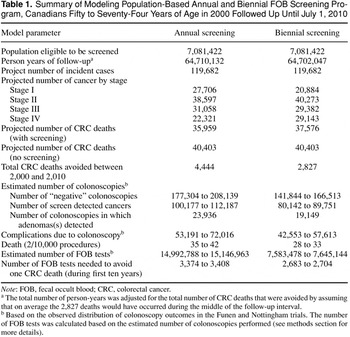
Summary of Modeling Population-Based Annual and Biennial FOB Screening Program, Canadians Fifty to Seventy-Four Years of Age in 2000 Followed Up Until July 1, 2010
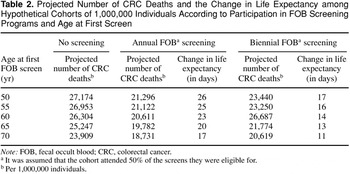
Projected Number of CRC Deaths and the Change in Life Expectancy among Hypothetical Cohorts of 1,000,000 Individuals According to Participation in FOB Screening Programs and Age at First Screen
 You have
Access
- 2
- Cited by