Introduction
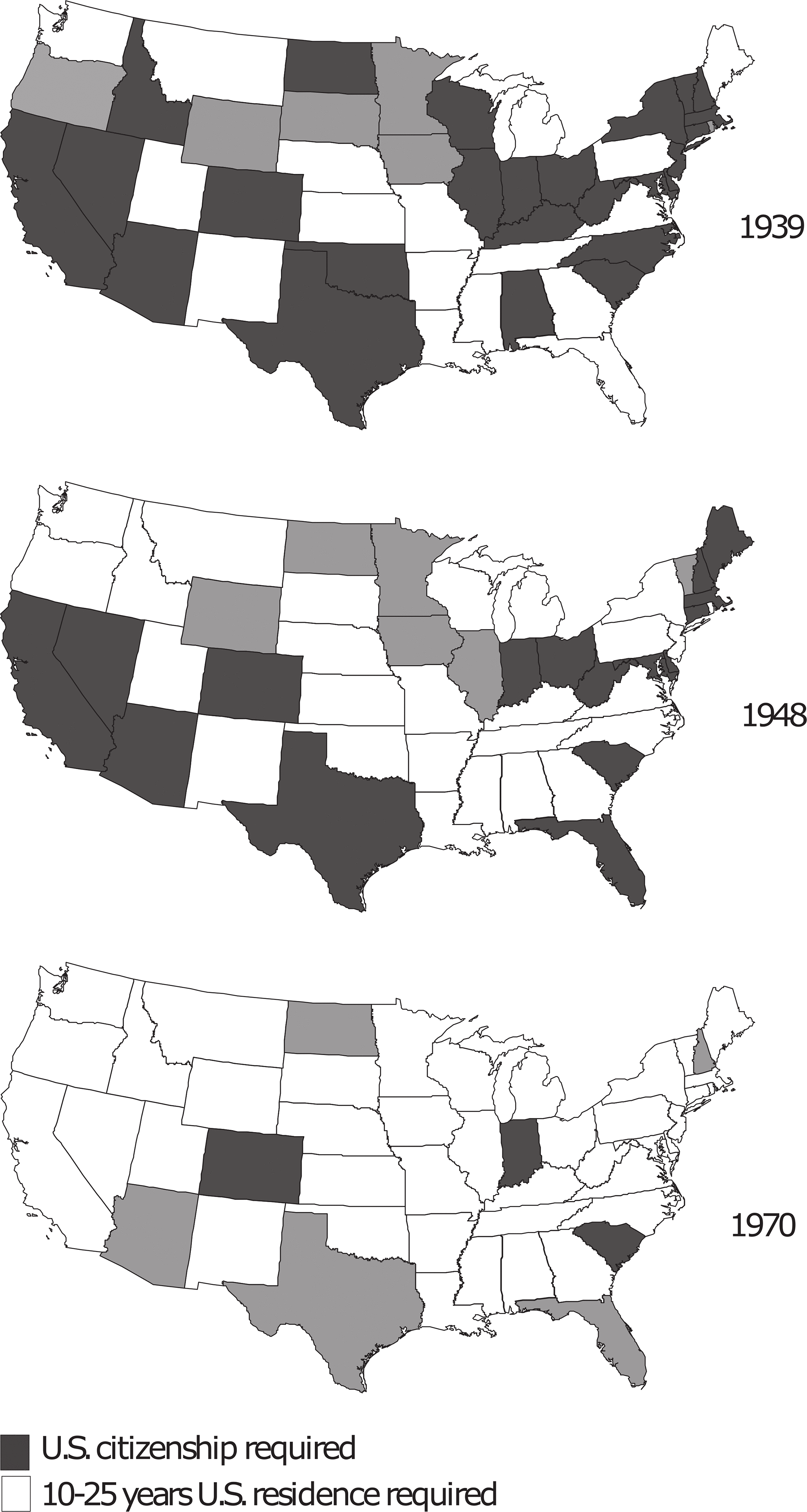
When do states extend social rights to noncitizens? I explore this question by examining the extension of public assistance to elderly noncitizens after the passage of the 1935 Social Security Act. Responsible for establishing America’s modern welfare system, the act created Social Security, unemployment insurance, and means-tested assistance for needy children, the elderly, and the blind. While the act contained no federal alienage restrictions, states were permitted to bar noncitizens from means-tested programs. Only Texas adopted a citizenship requirement for Aid to Dependent Children. Alienage restrictions were more popular in Old Age Assistance (OAA), the largest of the three categorical assistance programs. In 1939, 25 states had alienage restrictions for OAA and 6 more had 10–25 year residence requirements for noncitizens only (see figure 1). Within a decade, 10 states had dropped these alienage restrictions. By 1970, just before the Supreme Court ruled such state-level restrictions unconstitutional (Graham v. Richardson 1971), only eight states had citizenship requirements for OAA, and most of these permitted long-term residence in lieu of citizenship.
State citizenship requirement for old age assistance, 1939, 1948, and 1970.
Sources: Carter and Doster Reference Carter and Doster1949; US Department of Health, Education, and Welfare 1970.

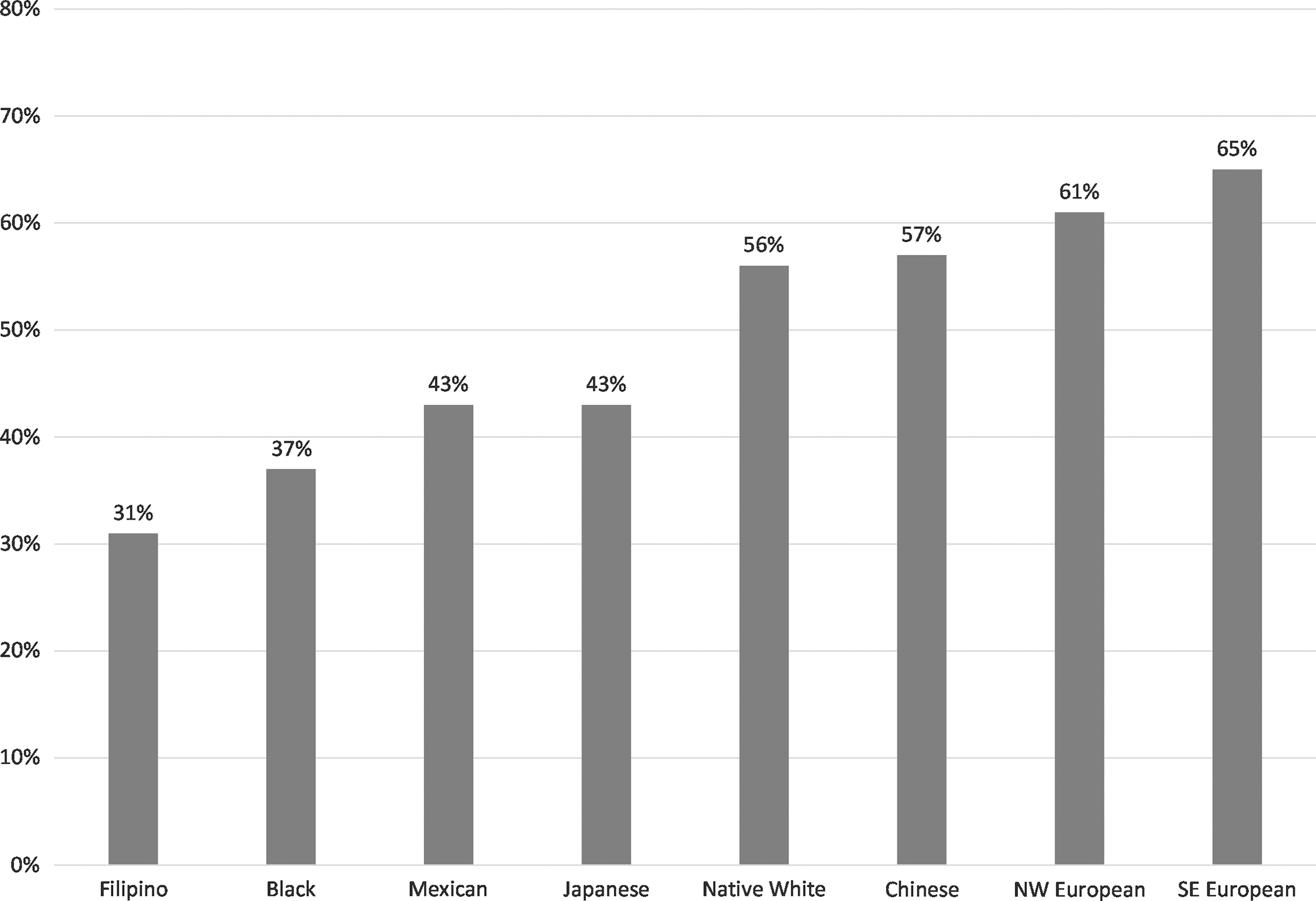
Though most states eventually extended aid to noncitizens, the timing was racially patterned. Apart from New Mexico, which never adopted a citizenship requirement, states in the southwest were slow to repeal restriction. By 1950, 87 percent of elderly Mexican and 75 percent of elderly Asian noncitizens lived in states where all noncitizens were barred from OAA compared to just 36 percent of European noncitizens. Moreover, like Black Americans, Mexicans, Filipinos, and Japanese often worked in agriculture or domestic service, two occupations initially excluded from Social Security. As such, only 31 percent of Filipino and 43 percent of Japanese and Mexicans worked in covered occupations in 1940, compared to 56 percent of native-born Whites and 63 percent of European immigrants (see figure 2) (author calculation, IPUMS). When Social Security benefits were first distributed in 1940, older workers were grandfathered into the program and only required to work six quarters to receive benefits, which were available without regard to citizenship or legal status (Fox Reference Fox2012). Thus, where European immigrants were excluded from OAA, they might be eligible for Social Security. Mexican, Japanese, and Filipino noncitizens were less likely to be covered at all.
Percent of workers in occupations covered by Social Security, 1940, by race and nativity.
Source: Author calculation, 1940 IPUMS.

Scholars have overlooked this extension of social rights to noncitizens. Welfare scholars have examined variation in OAA benefit levels or eligibility requirements and the effects on Black Americans (Amenta et al. Reference Amenta, Caren and Olasky2005; Amenta et al. Reference Amenta, Carruthers and Zylan1992; Quadagno Reference Quadagno1988), but noncitizens are not part of this narrative. Immigration scholars, meanwhile, typically limit their attention to the last quarter century. In 1994, California voters passed Proposition 187, which barred unauthorized immigrants from most nonemergency services and mandated cooperation between service providers and immigration officials. Proposition 187 was invalidated by the courts before it was implemented. Nevertheless, it helped spawn similar measures at the state and federal levels (Calavita Reference Calavita1996; Fujiwara Reference Fujiwara2008; Jacobson Reference Jacobson2008).
Examining the extension of social rights historically can help us rethink our understanding of contemporary struggles. The Personal Responsibility and Work Opportunity Reconciliation Act of 1996 (PRWORA) limited noncitizens’ access to federal assistance and authorized states to establish citizenship requirements. It also gave states the option to use state funds to aid noncitizens not covered by federal law. The result was a “patchwork” of immigrant aid policies across states. Some scholars argue that the devolution of authority for immigrant eligibility represented a “new experiment in federalism” (Spiro Reference Spiro1997; Zimmerman and Tumlin Reference Zimmerman and Tumlin1999: 2). Others resist this characterization, noting that states have long played a role in immigration and alienage policy (Filandra Reference Filandra2009; Gulasekaram and Ramakrishnan Reference Gulasekaram and Ramakrishnan2015; Provine and Varsanyi Reference Provine and Varsanyi2012). Ignored in these accounts: The Social Security Act implicitly authorized states to set their own eligibility requirements for noncitizens. Examining this “older” experiment in immigration federalism (1935–71), may help us better understand the limits and possibilities of the “new” immigration federalism (1996–present).
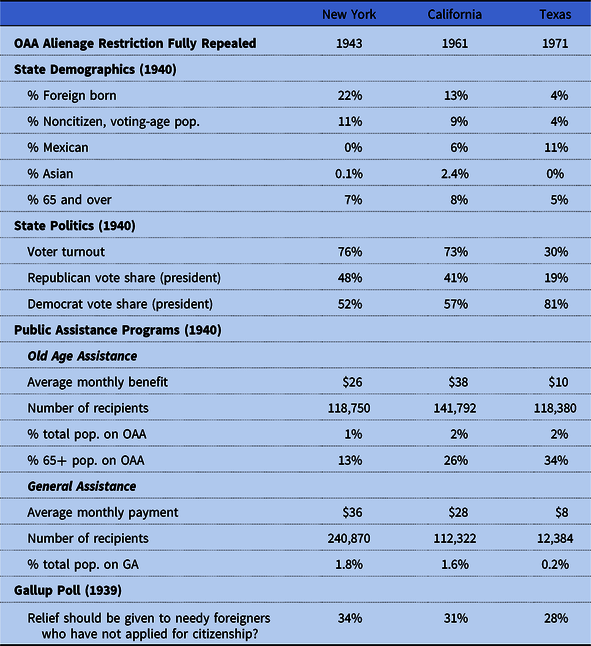
Why did most states abandon alienage restrictions in OAA between 1935 and 1971? And what explains variation in timing in the extension of social rights to noncitizens? To answer these questions, I rely on in-depth cases studies of New York, California, and Texas. Due to rampant nativism and economic strain, all three barred noncitizens from OAA in 1936, as did most states with significant noncitizen populations. But New York eliminated its citizenship requirement in 1943, California in 1961, while Texas only fully repealed restriction in 1971 when the Supreme Court forced the issue. I chose these states because they had significant numbers of noncitizens but varied in the racial composition of their immigrant populations. In the early twentieth century, the majority of noncitizens in New York were European, the majority in Texas were Mexican, and California was home to large numbers of Mexican and Asian immigrants. To be sure, these states differed in their prevailing political orientations and the generosity of their public assistance programs. Yet they varied little in their early public opposition to extending relief to immigrants; roughly a third of residents in each state in 1939 supported giving relief to “needy foreigners” who had “not applied for citizenship” (see table 1).
The three states compared

Sources: State demographic data come from: U.S. Bureau of the Census 1943a: 51–52, 63, 74, 78–79; author calculation, IPUMS (Ruggles et al. Reference Ruggles, Genadek, Goeken, Grover and Sobek2015). State politics data come from: U.S. Bureau of the Census 1975: 1071–72, 1077–78. Public assistance program data come from: Friedberg Reference Friedberg1998: 31–32; U.S. Bureau of the Census 1941: 381–82. Poll data come from: Gallup Poll #144, January 12–17, 1939; National Adult [Weighted] Sample, N = 3,063.
To flesh out these cases, I rely on government reports, newspapers, and archival records of individuals, civic organizations, and government bodies involved in efforts to repeal alienage restrictions. My analysis focuses not just on positive cases—those moments when restrictive policies were repealed—rather, I traced the narrative through time. Doing so revealed that in all three states, attempts to repeal alienage restrictions were defeated. It also revealed partial victories, as when benefits were extended to elderly noncitizens with 25 years US residence in Texas (1967). Such defeats and partial victories offer additional points of traction on the causal narrative. To assess the generalizability of the findings, in the conclusion I test the insights generated here against data from other key states.
Much of the scholarship on immigrant rights highlights the importance of policy venues, demographic change, partisanship, bureaucrats, political power, and framing. I highlight the role of federal and state institutions, including policies and policy feedbacks, arguing that the repeal of state-level alienage restrictions in OAA was influenced by the complex interplay between institutions and immigrant political power. First, I demonstrate that federal welfare policy between 1935 and 1971 promoted the repeal of antiimmigrant state welfare policies. State-level welfare policies, however, could alter the power of federal incentives, resulting in the entrenchment of antiimmigrant policies in some states. Second, I show that institutionalized racism decreased the electoral power of Asians and Latinos, further delaying noncitizen inclusion. These state-level institutional and political contexts, in turn, created obstacles and opportunities for advocates committed to repealing alienage restrictions. In the final section, I show that success came when advocates adapted strategies to fit the institutional and political context.
Literature
Over the last two decades, social scientists studying immigrant rights and immigration federalism have examined when and where proimmigrant policies arise. One theory highlights policy venues. Scholars argue the courts are “uniquely shielded from the populist pressures that democratically accountable governments face.” In the last half century, they have been the “champions of individual rights” clashing against “restriction-minded state executives” (Joppke Reference Joppke2001: 340; see also Guiraudon Reference Guiraudon, Bommes and Geddes2001). Sainsbury argues that immigrants only first gained access to welfare “in the early 1970s when the Supreme Court ruled that state governments could not deny welfare benefits to legal resident aliens” (Reference Sainsbury2012: 30). Yet by the time the Court ruled state-alienage restrictions unconstitutional, the vast majority of states had already extended social rights to noncitizens without prodding from the court.
Another theory points to partisanship and ideology. Gulasekaram and Ramakrishnan (Reference Gulasekaram and Ramakrishnan2015) found that communities were more likely to adopt proimmigrant policies when controlled by Democrats (see also Reese and Ramirez Reference Reese and Ramirez2002; Steil and Vasi Reference Steil and Vasi2014). Similarly, Chavez and Provine (Reference Chavez and Provine2009: 78) find that proimmigrant laws are associated with “more liberal citizen and governmental orientations” (see also Filandra Reference Filandra2009; Graefe et al. Reference Graefe, De Jong, Hall, Sturgeon and VanEerden2008; Hero and Preuhs Reference Hero and Preuhs2007). I find that Democrats and liberals were more likely to support aid for noncitizens. But in some cases, Republicans pushed for inclusion. In New York, Governor Herbert Lehman (D) vetoed a bill to extend OAA to noncitizens that had wide bipartisan support. His Republican successor, Thomas Dewey, signed the bill instead.
Some scholars emphasize demographic context. Chavez and Provine find that proimmigrant laws “are associated with larger Hispanic concentrations [and] growing foreign-born populations” (Reference Chavez and Provine2009: 78). Other studies find no significant effects of immigrant or racial context (Filandra Reference Filandra2009; Hero and Preuhs Reference Hero and Preuhs2007; Steil and Vasi Reference Steil and Vasi2014). I find that states with more Latino or Asian immigrants were slower to repeal restrictive laws. But demography is not destiny. California eventually repealed its alienage restrictions, and Texas made important strides toward that end as well.
Instead of demography, others highlight immigrant or coethnic political power. Gulasekaram and Ramakrishnan (Reference Gulasekaram and Ramakrishnan2015) find that communities are more likely to adopt proimmigrant policies if the Latino electorate is large and immigrant rights organizations have strong organizational capacity. Steil and Vasi (Reference Steil and Vasi2014) find similar results in communities with more Latino leaders, proimmigrant community organizations, and immigrant rights marches, while De Graauw underscores the importance of nonprofit organizations in “making immigrant rights real” (Reference De Graauw2016). Reese documents how immigrant rights groups mobilized to restore public assistance to some legal immigrants barred by PRWORA (2011: 48). In this movement, cross-racial coalitions increased “organizational resources and reach” and “helped to legitimize their demands” because the cuts affected immigrants who were both positively (Asians and refugees) and negatively (Latinos) constructed (55). I, too, find that electoral power and organizational capacity matter, though I demonstrate how institutionalized racism shaped both.
Other scholars underscore the significance of sympathetic bureaucrats (Fox Reference Fox2012; Marrow Reference Marrow2009; Paquet Reference Paquet2015) for the adoption or implementation of proimmigrant policies. State welfare bureaucrats in all three states (eventually) supported the extension of social rights, but they played a minor role in the process. Moreover, in 1938 the N.Y. State Department of Social Welfare helped kill a bill to extend aid because they feared it was too costly (New York State 1941). While they quickly reevaluated their assumptions, their early opposition delayed repeal by a few years.
Lastly, some scholars highlight the importance of framing. Brown (Reference Brown2013) shows that advocates in California took advantage of frames privileging legal over “illegal” immigrants to push state legislators to adopt more inclusive policies for legal immigrants in the wake of welfare reform. Advocates also developed effective counterframes to contest negative constructions of immigrants. They singled out Hmong as especially deserving because of their refugee status, traumatic experiences, and military assistance during the Vietnam War, increasing support for immigrant benefit restoration. But benefit restoration sometimes narrowly targeted those deemed most “deserving” (Fujiwara Reference Fujiwara2005; Reese Reference Reese2011; Reese and Ramirez Reference Reese and Ramirez2002). Yet framing choices do not explain the timing of repeal. Advocates framed their arguments in broadly similar ways across cases, highlighting labor performed, taxes paid, time in the United States, barriers to naturalization, and their (children’s) military service. Yet appeals to “deservingness” helped one group. In California, the Japanese American Citizens League (JACL) argued that Japanese were especially deserving of OAA because of their inability to naturalize, low welfare use, and lawful presence. With such appeals, they won legislation in 1955 that narrowly benefited their group.
Institutional and Political Context
I highlight a factor that receives less attention in the immigration federalism literature: institutions. Scholars have underscored the importance of institutions in explaining growing subnational involvement in immigration policy making (Paquet Reference Paquet2017) or changes in federal immigration policy over time (Tichenor Reference Tichenor2002). Far less attention has been devoted to the role of institutions in the adoption of pro- (or anti-) immigrant policies at the subnational level.
I borrow insights from historical institutionalists to better understand the extension of social rights to noncitizens. Formal political institutions include electoral and legislative rules, the distribution of political authority, bureaucratic capacity, the organization of party systems, and the like. But policies are also important political institutions (Pierson Reference Pierson, Shapiro, Skowronek and Galvin2006) that can have “important indirect influences on policy” (Amenta and Tierney Reference Amenta, Tierney, Béland, Morgan and Howard2014). This scholarship demonstrates that “new government policy creates new politics,” and that “conflicts over policy are structured by the interests and institutions created by earlier decisions” (Weir Reference Weir, Shapiro, Skowronek and Galvin2007: 271). Institutions alone do not “determine policy outcomes.” As Pierson explains, “While the ‘rules of the game’ are of tremendous significance, so are the identities, interests, and resources of the ‘players.’ Policy outcomes depend on the interplay of these factors, rather than being dictated by institutions alone” (Reference Pierson1995: 463).
Existing policies can generate feedbacks that expand state capacities. They can also create “lock-in effects” that constrain future policy making (Béland Reference Béland2010; Pierson Reference Pierson1993). Path-departing change is possible (Béland Reference Béland2010: 575). To understand how, we must consider how institutional and political context shapes opportunities and obstacles for advocates, and how they adapt their strategies in response. Amenta suggests that challengers’ “strategies must match” their political contexts (Reference Amenta2006: 33). Where the political or institutional context is unfavorable, challengers must also be more assertive to succeed (29).
In what follows, I argue that variation in institutional and political context helps explain the timing of repeal. State decisions to extend OAA to noncitizens were influenced by policy decisions at the federal level, and prior state policy decisions. They were also a function of immigrant political power, which was shaped by racially discriminatory laws and policies, depressing the power of non-White immigrants. These varied institutional and political contexts created obstacles or opportunities for immigrant advocates, altering their strategies for action and effort required to push legislation through. Where the context was favorable, elite-led lobbying sufficed. Where it was not, advocates adopted new strategies to match the context. This included narrowing the legislative scope, increasing political power to pressure the legislature, or building a public campaign wedding the interests of citizens and noncitizens.
Institutions
The most important federal policy influencing state actions was the Social Security Act, under which the federal government provided states with matching grants for assistance to the elderly, blind, and dependent children. Federal money functioned as carrot and stick. States that met broad federal guidelines received millions in federal funds. The federal government could also withhold a state’s entire grant if it refused to follow their rules. Under this system of cooperative federalism, states became dependent on these funds but also, often, deeply resentful of federal oversight (Tani Reference Tani2016).
Before the Social Security Act, states with old age pensions not only limited benefits to US citizens (New York), most required recipients to be citizens for 15 years (California). The Act stipulated that means-tested programs could not be denied to otherwise eligible citizens (Fox Reference Fox2012: 263). To receive federal funds, 22 states had to eliminate provisions disqualifying recently naturalized citizens (American Public Welfare Association n.d.).Footnote 1 The act thus encouraged the liberalization of existing state laws, or the creation of an old age aid program where none existed (Texas) (Griffin Reference Griffin1959).
The Social Security Act allowed states to bar noncitizens from means-tested programs. Frances Perkins (Secretary of Labor) and Harry Hopkins (top relief administrator)—who helped draft the Social Security Act—believed that noncitizens were entitled to assistance (Fox Reference Fox2012). Support for state discretion represented federal officials’ “steam valve” approach to federalism, which ensures that “one state’s preferences, frustrated at home, are not visited on the rest of us by way of Washington” (Spiro Reference Spiro1997: 1627). Nativism was rampant and federal officials worried that if they tried to mandate coverage, the Senate would amend the social security bill to preclude states from covering noncitizens. Instead, federal officials tried to convince states to adopt inclusive policies, reminding them that restriction was not required, and suggesting alternative residency provisions instead (Fox Reference Fox2012).
More powerful were the financial incentives in the act. At the outset, the federal government paid half the cost of OAA. The availability of federal matching funds without consideration of citizenship encouraged states to cover noncitizens. Noncitizens were typically covered by General Assistance (GA), a state and local aid program for individuals ineligible for categorical assistance. GA benefits were low, and the program stigmatized, so recipients virtually always preferred OAA. While GA was funded with state and/or local funds only, OAA was funded with a combination of federal, state, and sometimes local funds. Many states—especially immigrant-heavy ones—discovered it was cheaper to cover noncitizens on OAA than on GA, because the former brought federal dollars.
Federal reimbursement policies spurred the elimination of alienage-based restrictions between 1935 and 1971. The power of federal incentives is clear in New York. In 1943, officials estimated that 12,000 noncitizens could transfer from GA to OAA if the citizenship requirement was eliminated. By doing so, New York would receive more than $2 million in federal funds, decreasing local costs by $1 million and state costs by $500,000 (New York State 1943a). When Governor Dewey signed legislation eliminating the alienage restriction in 1943, he said: “[B]y reason of Federal contributions … this change in the law will, in fact, cost the State less than if the change were not made” (Schibsby Reference Schibsby1943: 144). Federal welfare policy encouraged the proliferation of proimmigrant state policies, just as federal officials hoped it would.
Not all states responded to federal incentives in the same way. To maintain their racialized labor system, southern states kept welfare benefit levels low (Katznelson Reference Katznelson2005; Quadagno Reference Quadagno1988). But not all states experienced federal incentives in the same way, either (Derthick Reference Derthick1970). State and local funding arrangements for GA and OAA influenced the power of federal incentives. In states where GA was funded primarily through state funds, federal incentives were straightforward. Moving noncitizens from GA to OAA decreased state costs, because OAA costs were shared with the federal government. But where GA was funded primarily through local funds, cost savings went primarily to local—not state—government. Because states paid a significant share of OAA (50–100% of the nonfederal share), moving noncitizens to OAA might cost the state money, especially in states with large numbers of noncitizens. While state residents would benefit either way from an infusion of federal dollars, the incentives for state officials—responsible for squaring state budgets—varied based on the outcomes of previous policy decisions.
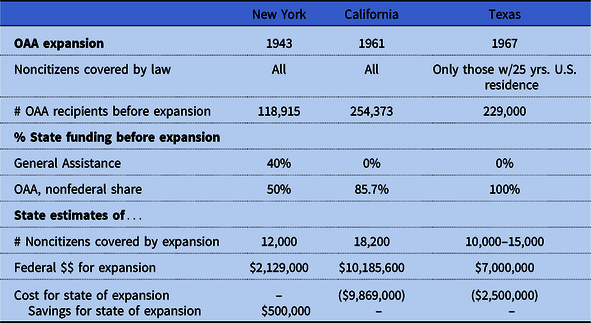
In New York, where the state paid 40 percent of the cost of GA and 50 percent of the nonfederal share of OAA, moving noncitizens to OAA saved the state $500,000 (see table 2). California and Texas, by contrast, had a smaller incentive to repeal restriction because GA was funded entirely by local government (and in Texas, GA was virtually nonexistent). Moreover, these states paid a larger portion of the nonfederal share of OAA (86% in California and 100% in Texas). Moving noncitizens to OAA would increase state costs by $9.9 million in California and $2.5 million in Texas. This made it harder for advocates to push legislation through in these states. Past policy decisions thus helped entrench antiimmigrant policies.
State estimates of consequences of OAA noncitizen expansion efforts

Eliminating alienage restrictions in Texas was stymied by an additional institutional barrier. Spending and eligibility requirements were written into the state constitution. Any increase in public spending or change in eligibility requirements had to pass the legislature and survive a public vote, before making another round through the legislature. In California and New York, only elected officials voted to change eligibility requirements or spending levels. The additional veto points in Texas made repeal more difficult. The welfare spending ceiling made things worse. Without a corresponding increase in the spending ceiling, adding noncitizens to OAA would decrease benefits for those already receiving aid, creating a trade-off between aid for citizens and aid for noncitizens.
The significance of Texas’ constitutional provision was evident when, in 1951, voters rejected a proposed constitutional amendment to increase the OAA benefit level and the spending ceiling for public assistance, while eliminating a clause limiting assistance to “bona fide Texas citizens” (Anonymous 1951b; Texas Legislative Council 1965: 38). This change would empower the legislature to decide whether noncitizens could receive aid. Opponents claimed that if noncitizens were granted OAA, the entire increase in the spending ceiling would go to noncitizens. “It is on that point that opponents … are hammering,” noted one newspaper. “The amendment would open the pension rolls to aliens who will use up the bulk of the extra $7,000,000 a year” (Anonymous 1951b). Concerns about the “alien question” led Texas voters to reject the measure, 56 to 44 percent (Castlebury and Kuempel Reference Castlebury and Kuempel1969).
Political Power
Immigrant political power is another key part of this story. Institutionalized racism strongly influenced the political integration of immigrants. To vote, immigrants had to naturalize. Yet naturalization was historically reserved for free White persons (Haney López Reference Ian2006). Chinese immigrants only won the right to naturalize in 1943, while Japanese and Koreans were barred from naturalization until 1952 (Ngai Reference Ngai2004: 38). Mexicans were not formally barred from naturalization. But in 1940, only 13 percent were naturalized, compared to 78 percent of northern and western and 65 percent of southern and eastern Europeans (author calculation, IPUMS). Low naturalization levels resulted from low socioeconomic status and literacy levels. But discrimination also discouraged Mexicans from naturalizing (Fox and Bloemraad Reference Fox and Bloemraad2015).
Naturalization barriers ensured that where alienage restrictions existed, they disproportionately affected Mexicans and Asians. Of the 4,700 immigrants first accepted for OAA in California, more than 3,800 were European, only 19 were Mexican, and 33 were from Asia (29 of which were classified as White) (California Social Welfare Board 1937: 27). Moreover, without the franchise, noncitizens had difficulty making their voices heard. US-born children of immigrants were eligible to vote and represent the interests of their parents and coethnics. But the Asian American population was small, the result of racist immigration laws like the Chinese Exclusion Act of 1882. Asian immigrants and Asian Americans combined, therefore, made up only 2.4 percent of California’s population in 1940 (US Bureau of the Census 1943a: 52), limiting their electoral influence. In New York, European immigrants represented 21 percent of the population, while an additional 33 percent were children of immigrants (author calculation, IPUMS).
Though small numbers decreased Asian political power, it also decreased the cost of inclusion in OAA. Not so for Mexicans. Mass repatriation during the Great Depression decreased the population by 20 to 40 percent (Balderrama and Rodríguez Reference Balderrama and Rodríguez1998), but Mexicans were more numerous than Asians, representing 6 percent in California in 1940 and more than 11 percent in Texas (author calculation, IPUMS). Mexican Americans also had low voter registration rates due to laws and practices designed to decrease their political participation (Márquez Reference Márquez2014). As such, “less than 10% of the Spanish-speaking people of California were registered to vote” in 1947 (Community Service Organization 1965).
Small numbers, barriers to naturalization, and low voter registration rates meant little political representation. At least a quarter of New York State legislators in 1943 were White ethnics, individuals who were Catholic or Jewish, had origins in southern or eastern Europe, or were naturalized immigrants.Footnote 2 But there were no Asians or Mexicans in the California legislature until the 1960s (California Latino Legislative Caucus 2017). And until 1953, the Texas legislature counted only one Latino (Texas Politics Project 2017). Descriptive and substantive representation matters because in each state coethnic politicians and those representing immigrant communities pushed hardest for inclusion. It was especially important in California and Texas where extending OAA would cost the state considerable funds, to benefit a group—Mexican immigrants—who were negatively constructed.
Electoral strength and political representation constitute one side of political power, interest group strength constitutes another. In each state, victory came only when advocates fought for inclusion of noncitizens in OAA. But racial discrimination influenced interest group agendas, delaying efforts to repeal restriction in California and Texas. New York advocates began efforts to extend OAA in 1935. In California and Texas, efforts began only in the 1950s. Asian and Mexican groups were battling discrimination along multiple fronts. While New York was repealing its alienage restriction, the federal government was forcibly relocating Japanese from their homes in California to internment camps. Mexicans and Asians were also fighting against police brutality, school segregation, racial housing covenants, and racial prerequisites to naturalization, among other discriminatory practices (Brilliant Reference Brilliant2010; Krochmal Reference Krochmal2016). While European immigrants suffered from discrimination, the conditions they encountered were nothing like what Mexicans and Asians faced (Fox and Guglielmo Reference Fox and Guglielmo2012). The need to fight against discrimination along multiple fronts delayed efforts to repeal alienage restrictions in California and Texas.
In California and Texas, advocates’ attention to OAA was also delayed by efforts to increase group political power. For example, various civic organizations in Texas—the American GI Forum, League of United Latin American Citizens, Political Association of Spanish-Speaking Organizations—sponsored poll tax and get-out-the-vote drives during the 1950s and 1960s (Márquez Reference Márquez2014). As a result, by 1965, nine state legislators were Latino, representing 5 percent of the total (Texas Politics Project 2017). These legislators proved critical in efforts to extend OAA to noncitizens.
Strategies for Action
The state-level institutional and political contexts created obstacles and opportunities for advocates who battled alienage restrictions. In this section, I show how advocates’ strategies for action varied depending on the institutional context each faced as well as the political power of the affected community.
Elite-Led Lobbying
Where the institutional and political context were favorable, advocates’ task was straightforward. They made their case for inclusion to elected officials and found allies to push the legislation through. This was the situation in New York where immigrants had significant political power and where the extension of aid to noncitizens would save the state money.
Leading the charge against alienage restriction in New York was Abraham Epstein, a Russian immigrant, and head of the American Association for Social Security. Epstein worked closely with the Foreign Language Information Service, New York Committee on Naturalization, National Council on Naturalization and Citizenship, and Workmen’s Sick and Death Benefit Fund. Together, they organized under the New York Permanent Conference on Old Age Security (hereafter, Permanent Conference), a group “composed of nearly 300 of the City’s leading church, civic, welfare and labor organizations” (N.Y. Permanent Conference, 1931). Unlike in California and Texas, efforts to extend OAA to noncitizens were mostly an elite-run affair. When a bill to liberalize OAA passed the legislature in 1941, the Permanent Conference called it “a remarkable victory since, outside of the American Association for Social Security, the Permanent Conference was alone promoting this legislation” (N.Y. Permanent Conference 1941).
The push to expand OAA began in 1935. The Permanent Conference lobbied Governor Lehman to support inclusion of noncitizens (Epstein to Lehman Reference Epstein and Lehman1935). While their pleas went unheeded, advocates continued to make the case for inclusion. Noncitizens, they told the governor, were worthy of aid and a proper “responsibility of our community.” Through toil and hard work, they had contributed “to the welfare of the state and the nation and have paid their just proportion of taxes.” Immigrants faced barriers to naturalization. Crucially, inclusion was cost-effective because the federal government would cover half the cost. “The proposed amendment,” therefore, would “not prove burdensome to the state” (Epstein to Lehman 1937).
Advocates found supporters in the legislature. Most were Democrats, members or representatives of ethnic communities affected by the legislation, including Senators Julius Berg and Samuel Mandelbaum. By 1940, the first and second generation represented more than half of New York residents; 67 percent of European immigrants were naturalized (author calculation, IPUMS). Politicians could ill afford to ignore their interests altogether. Assemblyman Fred Moritt, son of Russian immigrants, was a vocal proponent of the legislation. A Democrat from Brooklyn, Moritt explained that he knew from “personal knowledge” hundreds of constituents who did not receive OAA “because they cannot prove” birth in the United States because old documents had been lost or destroyed. Many immigrants struggled “to pass the literacy test.” These folks were nonetheless worthy of assistance (New York State 1943a).
Finding allies was facilitated not just by the political power of immigrants but also by the favorable institutional context. A number of upstate officials wrote to Governor Lehman urging his support. While some highlighted the deservingness of immigrants, most stressed cost savings. The Warren County Commissioner of Public Welfare wrote: “[T]here is no reason why aliens over sixty-five should cost the local community 60% of the total costs while receiving home relief when persons on Old Age Assistance cost the local community only 25%.… [I]t is poor business to continue losing … two million dollars in reimbursement from the Federal Government” (New York State 1941). That said, the fiscal benefit of extending aid was not immediately obvious to all. Governor Lehman vetoed a bill to extend OAA to noncitizens in 1941 concerned that state estimates projecting cost savings were unreliable (ibid.). He worried that more people would sign up for OAA than GA because the former carried less stigma (New York State 1943a). Concerns about costs, however, were quickly dispelled.
Lehman was succeeded by Governor Dewey; Republicans controlled the legislature as well. In 1943, Moritt, joined by two Italian American Republicans, introduced legislation to extend OAA to noncitizens (ibid.). By refusing access to OAA, New York was “losing federal aid,” the measure’s sponsors said (Anonymous 1943). The legislation passed without opposition. In addition to touting the savings, Dewey said “Persons in dire need are entitled to the care of the community, whether they be citizens or aliens” (Schibsby Reference Schibsby1943: 144).
Narrowing the Legislative Scope
Where the political and institutional context were less favorable—because immigrants had less political power and extending OAA would sap state funds—advocates could not rely on elite-led lobbying alone. They had to adopt additional strategies, which varied depending on the political and institutional context they faced. The JACL in California chose to narrow the scope of the legislation to target a “deserving” subset of noncitizens. This strategy reduced the cost and provided a persuasive rationale for expending state funds.
The JACL launched their first effort to expand OAA in 1951, years after New York expanded aid to noncitizens. By then, nearly half the states extended OAA to noncitizens. The political context in California was also starting to improve. Japanese Americans were not a potent voting bloc. Nevertheless, a string of court cases in the 1940s “dismantled California’s alien land, school segregation, and antimiscegenation laws, as well as its court enforcement of racially restrictive housing covenants” (Brilliant Reference Brilliant2010: 125). Public perceptions were starting to shift, too. Due in part to Cold War concerns, government officials helped construct an image of Japanese as “model American citizens” (Kurashige Reference Kurashige2008). With these victories in hand, the JACL made expanding OAA its top legislative priority.
The institutional barriers to inclusion were significant. The JACL worried that any attempt to extend aid to noncitizens would fail due to cost. In 1951, Assemblyman Edward Elliott (D-East Los Angeles) introduced a bill to extend OAA to noncitizens with 25 years US residence (Allen Reference Allen1951). The estimated annual cost was $7.5 million. Convinced the measure would not pass, the JACL tried to narrow the legislative scope. They arranged for H. E. Dillinger (D-Placerville) to introduce a bill that restricted eligibility to lawfully entered immigrants who had “filed first papers for naturalization, even though ineligible to citizenship.” This limited eligibility to Koreans and Japanese, the only two groups still ineligible to citizenship, decreasing state costs to $450,000 per year. Still, the JACL worried that “any legislation which costs money will have tough sledding,” requiring “a great deal of work on the Senate Finance members” (Ishikawa Reference Ishikawa1951; JACL-ADC Legislative Committee 1951).
JACL representatives Sam Ishikawa and Tats Kushida made their case for targeting Issei. “Japanese aliens” were “the only major group in America ‘ineligible’ for citizenship because of their race,” so they had “no recourse to qualify for these benefits.” Internment, moreover, had left many destitute. They underscored that Issei were “legally resident Japanese aliens” who had been “exemplary American citizens in every sense.” They were longtime residents who paid taxes, contributed generously to charities, and whose sons had served valiantly in the war. Issei had also never been a “dependent” group. They urged passage so that “critically needed aid be made available to this deserving group of aliens” (JACL Anti-Discrimination Committee 1951). By framing Issei as “deserving” because they were “legally resident aliens” who had never been “dependent,” the JACL was drawing an implicit contrast to others who might benefit from a pension. Many Mexican and Chinese immigrants were living in the country illegally (Jacobs Reference Jacobs1995: 50; Ngai Reference Ngai2004: 204). And since at least the 1920s, Mexicans had been (unfairly) stereotyped as welfare dependent (Fox Reference Fox2012).
While the institutional context represented a significant obstacle, it also presented (unlikely) allies. SB734 was reported out of the Senate Social Welfare Committee without opposition due to support from the County Supervisors Association, one of the state’s most powerful lobby groups. They supported SB734 because it would cost counties less to pay their share (15%) of OAA rather “than … bear the full cost” of GA. The legislation ran into trouble, however, in the Senate Finance Committee. County representatives prevailed upon Dillinger to amend the legislation to extend OAA to all noncitizens thereby saving counties even more money. But this also increased annual state costs to more than $7.5 million (Kushida Reference Kushida1951). Convinced the amended bill would die in committee, the JACL lobbied to restrict benefits to Issei. The amended bill was placed under submission, and the legislature adjourned before the bill made it to the floor (Anonymous 1951a).
Certain that cost concerns had doomed earlier bills, the JACL again pursued legislation targeting Issei. In 1955, Assemblyman S. C. Masterson (D-El Cerrito) introduced a bill to extend OAA “to any person who, because of race or national origin, was ineligible to citizenship prior to December 24, 1952 and who has lived in the United States continuously for 25 years” (Ishimaru and Satow Reference Ishimaru and Satow1955). The bill had eight coauthors, all but one were Democrats. It passed the Assembly and Senate overwhelmingly and was signed by Governor Goodwin Knight (R). “When the first few Issei and Nisei returned from their relocation,” one representative explained, “they were met with … open hostility in many areas.” The passage of the OAA bill was “a vindication.” “In a short decade we have won our place; we have come home” (Ishimaru Reference Ishimaru1955). “Ten years ago the race baiters … had a field day at our expense.… But the difference now is they know they must contend with a hard hitting, fighting organization called the Japanese American Citizens League” (Going our way? n.d.).
While Masterson’s legislation represented a victory for the JACL, it left more than 15,000 elderly noncitizens in California—many Mexican—without assistance (Pensions for non-citizens, n.d.). Narrowing the scope of the legislation to skirt the unfavorable institutional context was not a viable option for Mexicans in California or Texas. In both states, advocates proposed measures to extend aid to noncitizens with 20 to 25 years US residence, yet such measures, by themselves, gained little traction. The cost of inclusion was deemed too high. In both states, success came only after Mexican Americans built greater political power, but the differing institutional context in each state shaped their strategies for action.
Organized Pressure on the Legislature
The Community Service Organization (CSO) led the fight to fully repeal alienage restrictions in OAA in California. Formed in 1947, it aspired to be a “Mexican NAACP.” CSO members began organizing in Boyle Heights where only 4,000 out of 25,000 eligible Mexican Americans were registered to vote. Organizers walked the neighborhood, knocked on doors, and visited families (Thompson Reference Thompson2016: 64). At these house meetings the “issue of benefits for elderly immigrants” first “surfaced.” But the CSO did not feel they were “in a position … to pursue the issue” (Burt Reference Burt2007a: 140). Instead, they focused on increasing political power. In 1947, they launched naturalization and voter registration campaigns. By 1953, they had three chapters and tens of thousands of newly registered voters. Only then did they feel “strong enough to organize around a statewide issue” (Burt Reference Burt2007b).
In 1953, the CSO tried to pressure the legislature to extend OAA to noncitizens with 25 years US residence. They testified in favor of the legislation, and the CSO urged its chapters to initiate a letter-writing campaign (Brilliant Reference Brilliant2010: 135). These efforts were unsuccessful. In 1955, the CSO formed “a special legislative committee,” including Tony Rios, Gil Anaya, and Bob G. Gonzales, “to renew action on proposed legislation” to expand OAA. Gonzales “made three trips to Sacramento to lobby for this bill.… Because of lobbying action by all of the California [CSO] chapters, the bill progressed much further than it did in 1953” (Ross Reference Ross1955).
The following legislative session, the CSO increased their efforts further, organizing a petition drive, meeting with community groups, resuming the letter-writing campaign, engaging the press, and securing endorsements from elected officials (Community Service Organization 1957). Alongside representatives from the United Steel Workers, Catholic Charities, Jewish Labor Committee, and California Federation for Civic Unity, they met Governor Knight. While a bill to extend aid to longtime resident noncitizens passed the legislature, Knight vetoed it. Explaining the record number of bills vetoed that session, he said: “I’d rather be unpopular for a time and keep the state solvent, instead of being hailed as a Republican Santa Claus” (Anonymous 1957).
The CSO tried again in 1959. The Democrats took the legislature and the governor’s mansion in 1958. Roughly 9 in 10 Mexican Americans voted for Edmund “Pat” Brown Sr. (Brilliant Reference Brilliant2010: 167), and they hoped their loyalty would be rewarded (Burt Reference Burt2007a: 178). The CSO lined up endorsements, including the JACL, county supervisors, various Catholic and Jewish welfare groups, as well as social worker and labor organizations. Edward Roybal, the first Mexican American elected to the L.A. City Council in the twentieth century, convinced the council to endorse the bill. Roybal sent copies of the resolution to Brown and other state legislators, many of whom pledged their support (ibid.). Meanwhile, the CSO devoted more resources to the issue, assigning Dolores Huerta to work as a lobbyist. This was “the first time … the Spanish-speaking community had one of their own as a full-time legislative advocate at the State Capitol” (Huerta Reference Huerta1961). Advocates met with Brown (Burt Reference Burt2007a: 178). According to Mark Brilliant, “The Governor was not opposed to the measure in principle,” but “it was at the bottom of his priority list, because of the expense involved” (2010: 166). The bill to extend OAA ran aground when Ways and Means Committee Chairman Jesse Unruh (D) rejected it, calling it “pure fiscal irresponsibility … to extend old age pensions to 13,000 aliens in California” (Anonymous 1959). The CSO blamed Brown for the defeat.
Despite repeated setbacks, the CSO saw an opening in 1961. The political context looked more favorable. John F. Kennedy’s advisors worried the presidential election would be close, so they worked with the CSO and others to mobilize voters (Burt Reference Burt2007a: 187). Since 1947, the CSO had registered more than 400,000 new voters (Burt Reference Burt2007b); Mexican Americans now represented 6 percent of registered voters giving them leverage to pressure elected officials. That year, Assemblyman Phillip Burton (D) introduced a bill to eliminate the citizenship requirement altogether. Burton, who represented parts of San Francisco including Chinatown, promised his constituents he would help “correct such ‘injustices’” (Jacobs Reference Jacobs1995: 50).
Huerta was not sanguine at first. Despite the more favorable political context, the institutional context remained unchanged. “The problem this year is very much the same as in 1959—Finances. The good Gov. Brown claims the state budget cannot support the expenditures” (Huerta to Legislative Committee 1961). The estimated state cost for AB5 was more than $9 million (CA Governor’s Chaptered Bill Files 1961). Still, advocates rallied labor, religious leaders, and other minority groups, while CSO chapters resumed their letter-writing campaign. The County Supervisors Association remained eager to move noncitizens off GA to save counties up to $7 million (Wedemeyer Reference Wedemeyer1961). Mexican Americans pressured the governor, warning Brown that “We will have a serious situation on our hands … if the impression goes abroad that” the CSO’s “just aspirations did not receive a proper hearing” (Grillo to Brown Reference Grillo and Brown1961).
Early in the legislative session, Brown opposed the bill. By May, concerns over his upcoming reelection and the availability of new federal funds changed his position (Brown Reference Brown1961). A recent increase in Social Security benefits would decrease OAA grants for those getting both, saving the state $3.5 million. The state also found a way to claim additional federal money for elders receiving medical assistance only (Wedemeyer Reference Wedemeyer1961). With some funds to pay for the legislation secured, Brown endorsed AB5 and urged the legislature’s support.
With a more auspicious political context and the negative consequences of the institutional context reduced, advocates pressed their case. Burton told colleagues that “AB-5 is the most important piece of Social Welfare Legislation before us” (Huerta Reference Huerta1961). To alleviate cost concerns, he claimed the bill would add only 8,000 noncitizens to OAA during the first six months (Burt Reference Burt2007a: 200), eliding the fact the state anticipated providing aid to more than 18,000 annually going forward (CA Governor’s Chaptered Bill Files 1961). He also wielded his power as Assembly Social Welfare Committee Chair to threaten to hold up the bills of Senate Social Welfare Committee Chair, James Cobey, if he did not allow AB5 to reach the floor. A Central Valley Democrat, Cobey won his seat with the help of the CSO’s voter registration drive. Huerta pressured Cobey, sending noncitizens whose children had served (and died) in World War II, to sit in his office, holding pictures of their sons, urging him to pass AB5 (Burt Reference Burt2007a: 200). Cobey released the bill, and it passed the Senate, 28-1. In July, Brown signed AB5 into law.
Repealing alienage restrictions in California was no easy feat. Years of work devoted to organizing and voter registration had borne fruit. “Four times they made their fight; four times they failed,” the CSO recounted. “But each time they lost, they learned, they organized and they grew in strength. They built a vast net-work of Chapters through the state” (Community Service Organization, n.d.). They sent tens of thousands of letters to state legislators (Pitti Reference Pitti2004: 164), and they registered hundreds of thousands of new voters. “And when, in 1961, with 400,000 vote-guns covering them, they marched again to Sacramento, this time they came not as cowed petitioners to court, but upright, proud and fully-conscious of their new role as a force to be reckoned with in … California” (Community Service Organization, n.d.). A remarkable feat. Even so, without the influx of federal funds it is not clear the legislation would have passed in 1961—18 years after New York extended aid.
Building a Public Campaign
Of the three states, Texas had the most unfavorable institutional context. Like California (and unlike New York), GA was entirely locally funded; extending OAA to noncitizens would cost state money. Unlike the other two states, welfare spending and eligibility requirements were written into the state constitution. Advocates, therefore, had to find a way around the institutional constraints. An elite-led lobbying strategy alone (as in New York) was not an option, and neither was a bottom-up campaign focused on pressuring legislators (as with the CSO in California). Eliminating the citizenship requirement in Texas also required a public vote. A different institutional context required a different approach.
The second drive to extend OAA to noncitizens (after the failed 1951 legislative referendum) began in 1964. By then, Texas was one of only four states to bar all noncitizens from OAA. Mexican Americans formed the Committee to Save Our Senior Non-Citizens. Cochairs Antonio Calderon and Platon Lerman worked closely with the Bishop’s Committee for the Spanish-Speaking and Mexican American groups throughout the state (Save Our Senior Non-Citizens 1964). The following spring, Representative Joe Bernal (D-San Antonio), chairman of the Mexican American Democrats of Texas, introduced a measure in the House (HJR66) to grant OAA to noncitizens who were longtime US residents (Texas Legislature 1965: 518). First elected in 1964, Bernal was one of nine Latino legislators, a testament to years of voter registration work by Mexican Americans. “The greatest social and economic needs in Texas,” said Bernal were “among the 31,000” noncitizens many of whom “have no income whatsoever” (Anonymous 1965a). “Many aliens have contributed … through work and taxes and have given sons and daughters in service to the nation. ‘Some … are better citizens than some who were born here,’” he proclaimed (Anonymous 1965c). Bernal’s measure had eight cosponsors: six were Latino and one was Chinese American (Texas Legislature 1965: 518).
Advocates lobbied legislators and found allies in and outside of government. Calderon and Lerman testified that noncitizens were living “under ‘a kind of peonage’ because they are aliens.” While some communities provided GA “to help aged, needy aliens,” county “funds were limited” (Vasquez Reference Vasquez1965). They also enlisted others, including the San Antonio Urban Renewal Agency, San Antonio Housing Authority, Governor’s Committee on Aging, and State Welfare Department. Other supporters included the San Antonio and South Texas Chambers of Commerce, San Antonio and Austin City Councils, and Texas Municipal League. The breadth of support was no doubt influenced by growing attention to poverty, spurred by the War on Poverty and civil rights movement.
One barrier to passage was cost. House Appropriations Committee Chairman Bill Heatly (D-Paducah) opposed the measure, fearing it would cost the state $10.4 million annually (Anonymous 1965c). Supporters countered that the federal government would pay 74 percent of the cost thanks to a new reimbursement formula for poor states (Anonymous 1965d). The state would only be liable for $2.5 million (Anonymous 1965b). The measure passed the House by a two-thirds majority, a requirement for proposed constitutional amendments (Anonymous 1965c). In the Senate, it was folded into another bill, sent to voters as Constitutional Amendment 3.
Key to winning over the electorate was combining the extension of aid to noncitizens with aid to US citizens. Constitutional Amendment 3 replaced the strict citizenship requirement for one that extended OAA to noncitizens with 25 years US residence. The amendment also expanded the age limit for AFDC from 16 to 18, a requirement under a new federal law. Without the change, Texas would lose federal matching funds for health care to OAA recipients, endangering access to health care for 230,000 elderly Texas citizens. By combining the two issues, legislators tied the fate of noncitizens to those of citizens, reducing the perception of a trade-off (Texas Legislative Council 1965: 36–37). Combining the issues also brought more groups to the coalition, including the Texas Hospital Association, Jewish Social Services Federation, and Texas Nursing Home Association (Anonymous 1965f). Advocates made speeches and distributed 32,000 brochures across the state (Anonymous 1965e). The Catholic Church did outreach, inviting their “Protestant and Jewish friends” to support the cause (Lucey Reference Lucey1968). The chairman of the Governor’s Committee on Aging explained that if the amendment failed, “$25 million in federal money would ‘be lost to the Texas economy and would be siphoned off to other states’ without reducing Texans’ tax burden” (Jones Reference Jones1965). With millions of federal dollars on the line, voters passed the amendment (70-30%) (Ford Reference Ford1965). Advocates scored a significant victory not simply through organizing and coalition building, but by taking advantage of the power of the federal state.
Constitutional Amendment 3 gave the legislature authority to provide OAA to long-term resident noncitizens. During the following legislative session, Bernal introduced a bill to extend OAA to noncitizens with 25 years US residence. Governor John Connally, a conservative Democrat, endorsed it (Texas Legislature 1967). Connally’s “political advisors thought” he needed “to bolster his standing among Mexican-American voters.” To counter claims of anti-Mexican bias, he appointed 25 conservative Mexican Americans to various state regulatory commissions (Márquez Reference Márquez2014:74). Granting assistance to aged noncitizens provided an opportunity to curry favor without capitulating to more “radical” demands like school desegregation.
The governor signed legislation extending OAA to long-term resident noncitizens in 1967. Welfare officials estimated that at least 10,000 individuals might be eligible for aid within the first two years (Anonymous 1967). Yet many noncitizens were unable to prove 25 year’s residence, having not retained the proper records (US Senate Committee on Aging 1969). Alienage restrictions were only eliminated in full when the Supreme Court intervened, ruling in Graham v. Richardson (1971) that such state-level measures were unconstitutional.
Conclusion
Scholars have studied the New Deal’s impact on state politics, administrative capacities, and welfare policies. Some concluded it had a surprisingly limited effect on states (Patterson Reference Patterson1969; Weir Reference Weir2005), perhaps except where federal programs, like the Social Security Act, provided financial incentives (Amenta Reference Amenta1998; Derthick Reference Derthick1970; Tani Reference Tani2016; Weir Reference Weir2005). Even then, states retained substantial control over the administration of means-tested programs, and they often resisted federal efforts to raise standards and ensure equal access (Lieberman Reference Lieberman1998; Tani Reference Tani2016; Weir Reference Weir2005).
The New Deal had a significant impact on the state-level extension of social rights to noncitizens. The Social Security Act prevented states from discriminating against naturalized immigrants, forcing 22 to amend their old age pension laws. It also provided financial incentives for states to extend OAA, encouraging many to drop their alienage restrictions. These incentives had a strong effect on New York. While the savings were modest, the state did not have to locate additional revenue to pay for inclusion, and they could rationalize the potentially unpopular move, citing state and local cost savings. Other states justified expansion on similar grounds (Anonymous 1953). Thus, coverage of noncitizens expanded. In 1939, 80 percent of elderly noncitizens lived in a state with an alienage restriction. By 1970, only 14 percent did, and only 2 percent lived in a state barring all noncitizens (author calculation, IPUMS). These findings underscore the significance of federal welfare policies (beyond PRWORA) for immigration federalism.
State choices about financing GA and OAA, however, affected the power of federal incentives. In New York, the state paid 40 percent of the cost of GA and only 50 percent of the nonfederal share of OAA so moving noncitizens to OAA was cost-effective. By contrast, in California and Texas, GA was entirely county funded, while these states paid a larger share of OAA. Including noncitizens in OAA required lawmakers there to locate significant funds.
States that resisted extending social rights to noncitizens tended to have unfavorable institutional contexts. Of the eight states with alienage restrictions for OAA in 1970, five (Colorado, Indiana, Florida, New Hampshire, and Texas) funded GA entirely through local funds. In a sixth (North Dakota), state funding was “restricted for specific purposes,” meaning the majority of GA costs were born by local government (US Social and Rehabilitation Service 1970). However, even in states with unfavorable institutional contexts federal incentives could indirectly affect repeal by providing incentives for local officials to lobby state officials. Local officials in New York and California stood to benefit from federal aid if state alienage restrictions were repealed, and they joined coalitions demanding OAA for noncitizens. Because GA in Texas was severely underfunded, local officials there played a smaller role in repeal.
An additional impediment to inclusion in Texas: spending and eligibility requirements were written into the state constitution. Expanding OAA required a public vote and two rounds through the legislature. The spending ceiling also increased the perception of a trade-off between spending on citizens and noncitizens. The task for advocates in Texas was therefore more difficult. They had to craft a constitutional amendment that minimized the perceived trade-off and build a coalition broad enough to convince voters to extend assistance.
In California and Texas, the cost of extending OAA and the low political power of the Mexican community delayed the extension of aid to noncitizens. What about states where these factors were not initially aligned? Massachusetts had a politically integrated (heavily Irish) immigrant community (Gratton Reference Gratton1986: 170–71), but an unfavorable institutional context; GA was funded largely (>75%) through local funds (US Advisory Council on Social Security 1949: 132). Local communities tried to pressure state officials to abandon citizenship requirements so they could “collect federal and state funds” (Traverso Reference Traverso2003: 114). In 1950, a bill to repeal the citizenship requirement stalled in the house because “the bill contained no provision for financing the new relief expense” for “the state” (Carr Reference Carr1950). The alienage restriction was only repealed in full in 1961, the same year as California (US Social Security Administration 1962).
Arizona’s Mexican-origin community was not politically integrated until the 1970s (Meeks Reference Meeks2007), but the state had a favorable institutional context. It was responsible for the full cost of GA, creating a strong incentive to move noncitizens to OAA. In 1952, Representative R. H. Wallace (R-Maricopa) proposed a bill to extend OAA to noncitizens with 25 years US residence because keeping noncitizens on GA was costing $18,000 a month in federal matching funds. Because GA was financed by state funds, the “entire burden of their maintenance” was falling “upon the state” (Anonymous 1952a). Wallace’s bill was signed into law (Anonymous 1952b). In 1962, Arizona’s residence requirement for noncitizens was lowered to 15 years (Adams Reference Adams1963), matching the state’s residence requirement for GA (Arizona Legislature 1962). Institutional incentives mattered even where the prime beneficiaries were Mexican immigrants who were not politically integrated. They were not enough to eliminate the alienage restriction altogether.
While institutional incentives mattered, institutionalized racism and its effect on immigrant political power mattered, too. States with more non-White immigrants were slower to abandon alienage restrictions. California only extended aid to all noncitizens in 1961. Arizona, Colorado, and Texas only did so when the Supreme Court forced the issue in 1971.Footnote 3 Nevertheless, demography was not destiny. California and Texas (and Arizona) extended aid to (some) elderly noncitizens. California first extended OAA to “aliens ineligible to citizenship” in 1955. This partial victory came despite the low electoral power of the Japanese and was due to the efforts of the JACL, and their framing of Issei as deserving. Important, too, was narrowing the legislative scope: the number of “aliens ineligible to citizenship” was small, limiting the state cost of inclusion. Eventually, California extended assistance to all elderly noncitizens and Texas extended aid to longtime resident noncitizens. Doing so required a massive organizing effort by advocates and sympathetic legislators. Significant victories came only after Mexican communities in both states increased their electoral power. Important, too, was Texas legislators’ decision to tie noncitizens’ OAA access to citizens’ access to federally funded health care. Doing so decreased the perception of a trade-off, and skillfully made use of the power of the federal state.
This research demonstrates that efforts to promote immigrant rights at the subnational level are not simply dependent on organizational capacity, broad coalitions, sympathetic bureaucrats, or savvy framing choices. Rather, immigrant advocates in different states may well be operating on radically different terrains. This is not simply a function of the ideological or partisan mix of legislators, but it may also be the result of institutionalized racism, which can inhibit access to descriptive and substantive representation for certain groups. Critical, too, are the legacies of previous state welfare policies choices, and how those choices interact with design features of federal welfare policies.
Given the highly partisan nature of contemporary debates about immigration and welfare, it is noteworthy that the extension of social rights to noncitizens between 1935 and 1971 was not particularly partisan. While Democrats were early supporters of noncitizens in each case, Republican governors signed the bills to extend social rights to noncitizens in New York and to noncitizens previously ineligible to citizenship in California. Moreover, in each case, the measures passed with large bipartisan majorities. It was only in the aftermath of contentious debates over the Sensenbrenner immigration bill (H.R. 4437) in 2005—a highly restrictive measure that spawned a massive wave of immigrant rights protests—that partisan divides over immigration and immigrant integration policy became fully entrenched (Gulasekaram and Ramkrishnan 2015; Wong Reference Wong2017).
Rather than partisanship, I highlight the significance of institutions, demonstrating that federal and state welfare policies can promote the repeal of antiimmigrant policies or help entrench them. Such policy feedbacks can also influence the politics of immigrant restriction. As I show elsewhere (Fox Reference Fox2016), when the federal government stopped reimbursing states for welfare and Medicaid provided to unauthorized immigrants in 1973, states discovered they had to provide some benefits to unauthorized immigrants (especially emergency health care), but now without any federal reimbursement. As a result, state and local officials began collecting data to prove that unauthorized immigrants were a drain on state and local coffers to convince federal officials to offer financial support. In other words, state and local officials wanted to return to the old state of affairs, pre-1973, when the federal government allowed states to restrict noncitizens but reimbursed states that covered them. Efforts to document and publicize the local costs of unauthorized immigration, however, inflamed antiimmigrant politics on the ground, leading federal officials to withdraw support further. Thus, in a federal system where subnational units are ultimately responsible for the welfare of residents, restrictive federal policies can heighten conflict over immigration and immigrant incorporation.
Finally, my research suggests that even if the period of heightened nativism should dissipate, we are unlikely to see the same broad trends toward inclusion evident in the postwar period. When Congress barred most recent legal immigrants from welfare and Medicaid in 1996, it prevented states from using federal funds to cover these immigrants. When viewed in light of the “old” experiment in immigration federalism described here, the federal government now offers fewer incentives to extend aid to noncitizens. Some states have used their own funds to cover noncitizens not covered by federal law, especially in states, like California, where immigrants have significant political power (Reese Reference Reese2011; Reese and Ramirez Reference Reese and Ramirez2002). But even then, state coverage is often reserved for populations deemed deserving. Unless federal law is changed, coverage of noncitizens will likely remain uneven and incomplete even if nativism wanes. And any progress toward noncitizen inclusion, this article suggests, is likely to come from the efforts of immigrants and their allies to gain political power and leverage over state officials in ways tailored to their institutional and political contexts.
Acknowledgments
Special thanks to Esther Cho and Jane K. Ohgami for their research assistance, and to Julia Adams, Irene Bloemraad, Dani Carrillo, Emily J. Charnock, Cristina Mora, Marie Provine, members of the Yale CHESS workshop, participants at the Winant Symposium on Social Movements and the American State at Oxford University, as well as several anonymous reviewers for their helpful comments on earlier drafts.