1. INTRODUCTION
UNBEKNOWNST TO THOSE WHO WOULD EVENTUALLY PURCHASE IT, Apple’s iPad was built in harsh working conditions widely considered to be characteristic of a “sweatshop.”Footnote 1 Indeed, according to eye-witness accounts and independent reports published by worker advocacy groups and the company itself, the workers assembling iPads and other Apple devices in a factory owned by Foxconn Technology GroupFootnote 2 in Chengdu, China were not only paid less than the statutory minimum wage but they regularly worked 12 hours a day, six days a week while being exposed to toxic chemicals and other potentially deadly safety hazards as well.Footnote 3 Disregard for workers’ health at the factory was sufficiently widespread that some employees were required to remain on their feet for so long at their work stations that their legs swelled until they could hardly walk: “‘It’s hard to stand all day,’ said Zhao Sheng, a plant worker” (Duhigg and Barboza, Reference Duhigg and Baraboza2012). Unsurprisingly, therefore, many have concluded that the only morally appropriate response to these types of conditions is to regulate sweatshops or even abolish them altogether.Footnote 4
But as defenders of sweatshops have forcefully argued, such an inference might be too quick. For obscured by these harsh working conditions is an often-ignored fact. Every year tens of thousands of young men and women travel from impoverished areas of rural China to seek employment in one of the country’s growing number of electronics factories. Indeed, one such factory is the Foxconn assembly plant that manufactures iPads and other Apple devices in Chengdu.Footnote 5 Sweatshops workers choose, in other words, to work in sweatshops. And the fact that they do so constitutes a powerful argument in their defense. Call this the Choice Argument for Sweatshops (or the “Choice Argument” for short).Footnote 6
Versions of the Choice Argument have been defended by both popular journalists and academic economists and philosophers alike (Bardhan, Reference Bardhan2005; Bhagwati, Reference Bhagwati2004; Krugman, Reference Krugman1997; Kristof, Reference Kristof2006; Kristof, Reference Kristof2009; Kristof and WuDunn, Reference Kristof and WuDunn2000; Maitland, Reference Maitland, Beauchamp and Bowie1996; Martinez-Mont, Reference Martinez-Mont1996). In this article I examine what is arguably the most sophisticated defense of sweatshops on grounds of choice to date: Matt Zwolinski’s (2007) article, “Sweatshops, Choice, and Exploitation.”Footnote 7 According to Zwolinski, the fundamental aim of the Choice Argument is not to defend the moral desirability of sweatshops or the moral praiseworthiness of the multinational corporations (MNCs) or managers who own and operate them. To the contrary, the aim of the Choice Argument is simply to defend the claim that it is morally wrong or impermissible for third parties to (either directly or indirectly) interfere with the choice of sweatshop workers to work in sweatshops (by, e.g., banning, boycotting, or legally regulating sweatshop labor).Footnote 8 The Choice Argument seeks, in other words, to shift the burden of proof onto those who wish to regulate sweatshop labor. It does so by forcing critics of sweatshops to specify the conditions under which it is morally permissible to interfere with sweatshop workers’ choice.
My aim in this article is to meet that burden. Unlike other critics of sweatshop labor, however, my argument will not proceed from contested economic or moral assumptions. To the contrary, my strategy will be to demonstrate that even if we grant the truth of the economic and moral assumptions made by defenders of the Choice Argument, it nevertheless does not follow that it is morally wrong to interfere with the choice of sweatshop workers to work in sweatshops. The Choice Argument thus fails on its own terms.
My argument proceeds in three stages. First, to lay the groundwork for the discussion that follows, I begin by briefly examining the basic shape and contours of the Choice Argument. In particular, I distinguish between (1) autonomy and (2) preference justifications for why the choice of sweatshop workers to work in sweatshops is said to establish a claim of non-interference on their behalf. Second, I challenge the Choice Argument on both of these grounds. More specifically, I argue that, pace defenders of the Choice Argument, there are strong reasons for believing that one of the only ways to take the autonomy and preferences of sweatshop workers seriously is by regulating sweatshop labor. Finally, I conclude by responding to the objection that regulating sweatshop labor is in fact harmful to sweatshop workers because it leads to a decrease in sweatshop employment as a result.
2. RECONSTRUCTION OF THE CHOICE ARGUMENT
Zwolinski’s defense of the Choice Argument can be formulated as follows (2007: 695):
(1) Sweatshop workers choose to work in sweatshops.
(2) The fact that sweatshops workers choose to work in sweatshops is strong (albeit defeasible) evidence that they believe that working in sweatshops is their best available alternative.
(3) The fact that they believe that working in sweatshops is their best available alternative is strong (albeit defeasible) evidence that we will harm sweatshop workers by taking that option away.
(4) By the same token, the fact that sweatshop workers choose to work in sweatshops is strong (albeit defeasible) evidence that we will violate their autonomy by taking that option away.
(5) It is wrong to harm people and/or violate their autonomy.
(6) Therefore, it is wrong to take the option of sweatshop labor away from sweatshop workers who choose to work in sweatshops.
Now there are three initial points to emphasize about this argument. First, as Zwolinski puts it, there are two separate reasons why sweatshop workers’ choice to work in sweatshops is morally significant or “transformative” (2007: 691). The first is based on the value of sweatshop workers’ autonomy (premises (1), (4), (5), and (6)) whereas the second is based on the value of sweatshop workers’ preferences (premises (1), (2), (3), (5), and (6)). In the end, both justifications seek to shift the burden of proof onto those who wish to regulate sweatshop labor. They do so by forcing defenders of sweatshop regulation to specify the conditions under which it is morally permissible to interfere with the choice of sweatshop workers to work in sweatshops and thereby violate their autonomy or otherwise harm them. Let us consider these justifications in turn.
According to the “autonomy” justification of the Choice Argument, the reason why it is wrong to interfere with the choice of sweatshop workers to work in sweatshops is that doing so fails to respect the “desires, goals, and projects that are expressive of [their] authentic self” or “will” (Zwolinski Reference Zwolinski2007: 691). Indeed, it would be wrong to interfere with their choice to work in a sweatshop even if the consequences of them doing so were actually bad for them. For that is precisely what respecting an individual’s will or autonomy entails. By way of analogy, consider the fact that it would be morally wrong or impermissible to interfere with an individual’s choice of marriage partner even if it was detrimental to their well-being overall.
Now it is, of course, true that not all autonomous choices generate strong claims of non-interference on an individual’s behalf. Some choices may be sufficiently destructive of an individual’s interests (e.g., voluntary slavery) that they fail to warrant such a concern. But when the subject matter of choice is of central importance to an individual’s core projects or commitments, then it seems reasonable to assume that they would. And, in Zwolinski’s view, the choice of sweatshop workers to work in sweatshops is of central importance to them in exactly this way. As he puts it: “Sweatshop workers do not generally choose to work in order to gain some extra disposable income for luxuries, or simply to take pleasure in the activity of working. They work to survive, or to help their families survive, or so their children can gain an education and escape the misery of poverty that drove them to sweatshops in the first place” (2007: 692). For that reason, their choice to work in a sweatshop deserves our respect.
According to the “preference” justification of the Choice Argument, by contrast, the reason why it is wrong to interfere with the choice of sweatshop workers to work in sweatshops is that doing so is likely to make them worse off (Zwolinski, Reference Zwolinski2007: 694). A sweatshop worker’s choice to work in a sweatshop provides us with information about her preferences. In particular, it signals that she prefers that form of employment to each and every alternative that is currently available to her. If we assume, therefore, that individuals are the best judges of their own interests, then it seems to follow, quite straightforwardly, that removing that option is likely to cause them harm.
The second point to emphasize about the Choice Argument is that the justification of premises (1)-(3) depends on contested economic and moral assumptions. Indeed, it is here that much of the debate in the literature has focused. Premise (1), for example, assumes that sweatshop workers’ choice to work in sweatshops is genuinely “voluntary.” But that might not be the case. Some argue that, in the absence of any reasonable or acceptable alternatives, such a choice is actually “forced” (Cohen, Reference Cohen1983, Reference Cohen and Ezorsky1987; Olsaretti, Reference Olsaretti1998, Reference Olsaretti2004). Others claim that the choice to work in a sweatshop is unduly coercive because of the background conditions in which it is made (Barry and Reddy, Reference Barry and Reddy2008: 60-61; Walzer, Reference Walzer1983). Premise (2), moreover, assumes that we can legitimately infer that sweatshop workers prefer to work in sweatshops, or that working in sweatshops is the best available alternative to them, simply by observing that sweatshops are where they happen to work. But there are grounds for being skeptical of this assumption as well. On the one hand, this assumption fails to take into account the fact that in circumstances of extreme deprivation or poverty people tend to develop “adaptive preferences” and thus adjust their aspirations to what they perceive as their very limited choice set (Nussbaum, Reference Nussbaum2000; Sen, Reference Sen2009). On the other hand, this assumption also seems to ignore the vey real possibility that the range of feasible alternatives facing sweatshop workers is not fixed or given but can be radically transformed by acts of “moral imagination” (Arnold and Hartman, Reference Arnold and Hartman2003) or “positive deviancy” (Arnold and Hartman, Reference Arnold and Hartman2005; Hartman et al., Reference Hartman, Arnold and Wokutch2003) by MNCs operating in the developing world instead. Premise (3), finally, assumes that increasing the price of sweatshop labor via minimum wage laws or other regulations will predictably lead to a decrease in sweatshop employment. But the evidence for this assumption is mixed. Some critics of sweatshops have argued that due to market imperfections (Arnold and Hartman, Reference Arnold and Hartman2005) or productivity gains from improved workplace conditions or remuneration (Pollin et al., Reference Pollin, Burns and Heintz2004), regulating sweatshop labor will not in fact lead to a decrease in sweatshop employment as a result.
As stated above, however, I will not challenge any one of these assumptions here. Nor will I invoke any novel ones of my own. Instead, my strategy in what follows will be to grant the truth of the economic and moral assumptions made by defenders of the Choice Argument and demonstrate that it is morally permissible to regulate sweatshop labor nevertheless.
The third, and final, point to emphasize about the Choice Argument is that its conclusion is that “it is wrong to take the option of sweatshop labor away from sweatshop workers who choose to work in sweatshops.” Indeed, throughout the course of his discussion, Zwolinski claims that interfering with the choice of sweatshop workers to work in sweatshops “takes away” (2007: 695, 696, 697, 701, 702, and 712), “removes” (2007, 694, 697, and 702), or “eliminates” (2007: 703) such an option from them. But what exactly does that mean?
One natural interpretation of these phrases is that it would be morally wrong or impermissible to ban sweatshops. And that is in fact one of the policies to which the Choice Argument is opposed.Footnote 9 The difficulty with this interpretation, however, is that the question of whether or not we ought to “ban” sweatshops is a red herring. To see why, notice that the term “sweatshop” is potentially misleading when used in this context. An employee who assembles iPads and other Apple devices at the Foxconn factory in Chengdu might say, for example, that she “works in a sweatshop.” If we banned sweatshops, then it would seem to follow that she would be effectively prevented from working in this particular factory. Strictly speaking, however, that is false. Sweatshops are not distinct places of employment in the same way that office buildings and construction sites are. To the contrary, any place of employment can be accurately characterized as a sweatshop insofar as it satisfies the working conditions mentioned above, i.e., one wherein workers are typically subject to income for a 48 hour workweek less than the overall poverty rate for that country and/or systematic health and safety risks due to negligence or the willful disregard of employee welfare (Arnold and Hartman, Reference Arnold and Hartman2006).
But if that is the case, then it does not make any sense to say that we ought to “ban” sweatshops.Footnote 10 Workplaces like the Foxconn factory in Chengdu are not going to be removed or eliminated simply because they are legally required to comply with certain basic rules and regulations. To say that we ought to “ban” sweatshops is, therefore, extensionally equivalent to saying that we ought to legally regulate the conditions that so characterize them. Now that is not to deny, of course, that effectively ensuring that all workplaces comply with certain basic rules and regulation might lead to a decrease in sweatshop employment. But that is an empirical question and, as such, requires evidence in its defense.Footnote 11 In other words, from the fact that (effective) sweatshop regulation “takes away,” “removes,” or “eliminates” the defining characteristics or conditions of sweatshops, it does not necessarily follow that sweatshop workers will thereby be deprived of their jobs. To the contrary, the truth of that claim depends entirely on whether or not regulating sweatshop labor will in fact lead to a decline in sweatshop employment as a result. For the sake of accuracy, therefore, I will refrain from using the phrases “take away,” “remove,” or “eliminate” the option of sweatshop labor and focus on the policy of legally regulating sweatshop labor instead.Footnote 12
3. AUTONOMY AND CHOICE
With these points as background, we are now in a position to launch our critique of the Choice Argument. To that end, I will challenge the Choice Argument on both (1) autonomy and (2) preference grounds. My thesis is that, pace defenders of the Choice Argument, there are strong reasons for believing that one of the only ways to take the autonomy and preferences of sweatshop workers seriously is by regulating sweatshop labor.
Let us begin with the “autonomy” justification of the Choice Argument first. Given our desire or aim to avoid the ambiguities mentioned above, the “autonomy” justification of the Choice Argument can be reformulated as follows:
(1) Sweatshop workers choose to work in sweatshops.
(4) The fact that sweatshop workers choose to work in sweatshops is strong (albeit defeasible) evidence that regulating sweatshop labor will violate their autonomy.
(5) It is wrong to violate people’s autonomy.
(6) Therefore, it is wrong to regulate sweatshop labor.
My strategy in what follows will be to demonstrate that even if we grant the truth of these assumptions for the sake of argument, it nevertheless does not follow that it is morally wrong to regulate sweatshop labor. The “autonomy” justification of the Choice Argument thus fails on its own terms.
The central claim that I will advance in this regard is that there are conditions under which sweatshop regulation is required not to overrule the autonomous choices of sweatshop workers but rather to give effect to those choices themselves.Footnote 13 The reason is that sweatshop workers would not be able to give effect to their autonomous choices under these conditions except via exercises of collective action that can only be pursed successfully if they receive recognition from the law. Hence, one way to respect the autonomy of sweatshop workers is, paradoxically, by regulating sweatshop labor.
To illustrate this point, consider the following case for a maximum working hour law for sweatshop workers (Mill, Reference Mill and Robson1965: 958).Footnote 14 Assume that there are two possible states of the world: one in which all sweatshop workers work a maximum of nine hours a day and another in which all sweatshop workers work a maximum of ten hours a day. Assume further that, in both possible states of the world, sweatshop workers are paid according to the same daily wage schedule or rate, e.g., X dollars a day irrespective of whether they work nine or ten hours. Finally, assume that each sweatshop worker is free to choose how many hours they will ultimately work in a day. Will each and every sweatshop worker choose to work nine rather than ten hours?
At first glance, the answer to this question seems almost certainly to be “yes.” Why would a sweatshop worker choose to work more hours rather than less if doing so has no effect on his or her overall rate of pay? To the contrary, it seems fairly safe to say that, from the point of view of each sweatshop worker, doing so would be entirely irrational. Indeed, we can put this point more strongly by noting that defenders of the Choice Argument have actually provided us with a test or standard by which we can reliably determine how sweatshop workers will, in expectation, autonomously exercise their choice. We can simply ask which of the two options available to them best realizes the “desires, goals, and projects” that are “expressive of their authentic self” or “will” (Zwolinski, Reference Zwolinski2007: 691). And, according to this test or standard, there are strong grounds for believing that each and every sweatshop worker will ultimately choose to work a maximum of nine rather than ten hours a day. What reason, after all, would they have to work more than nine hours if doing so does not help them to better realize their central projects and goals?
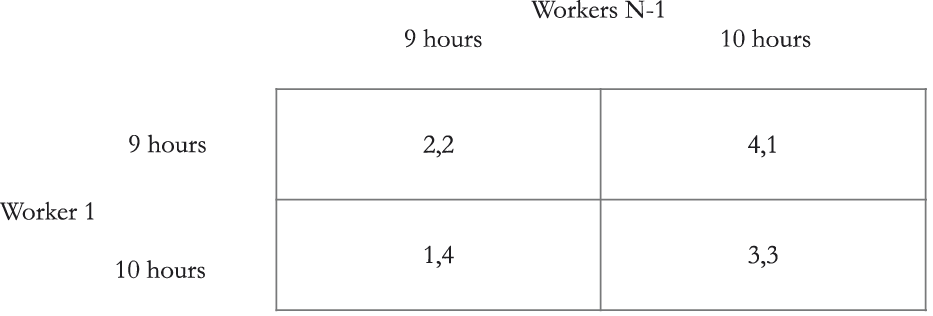
Upon further reflection, however, that might not be the case. My claim is that sweatshop workers will be able to effectively work a maximum of nine hours per day only if they enforced their choice via the coercive mechanism of the law. Why? The reason is that sweatshop workers face a collective action problem, that is, a conflict between the interests of each sweatshop worker taken singly or alone and the interests of the group or class of sweatshop workers taken as a whole. More precisely, this problem has the strategic structure of a Prisoner’s Dilemma: a barrier to successful collection action that arises when each sweatshop worker knows that she ought always to choose to work ten hours no matter what the other sweatshop workers choose to do despite the fact that they all agree that the most desirable outcome is one which there is a nine-hour maximum working day.
To see why, consider the choice to work nine or ten hours a day from the perspective of a single sweatshop worker. Call her Worker 1 (or “W1” for short). W1 will reason as follows: assume that all other sweatshop workers work nine hours a day for X dollars. Should I choose to work nine or ten hours a day myself? If I work nine hours a day, then, like all the other sweatshop workers, I will receive X dollars. If, however, I work ten hours a day, then I will receive X dollars, like all the other sweatshop workers, plus wages for an additional hour of work as well (say, X + ε). Thus if all other sweatshop workers work nine hours a day for X dollars, then I ought to choose to work ten hours a day myself. Now assume that all other sweatshop workers work ten hours a day for X dollars. Should I choose to work nine or ten hours a day myself? If I work nine hours a day when all other sweatshop workers work ten, then I will either be paid less than the other sweatshop workers (say, X - ε) or else risk losing my job. By contrast, if I work ten hours a day, then, like all the other sweatshop workers, I will receive X dollars. Thus if all other sweatshop workers work ten hours a day for X dollars, then I ought to choose to work ten hours a day myself. And so the upshot is that no matter what the other sweatshop workers choose to do, I ought always to choose to work ten hours. In the jargon of game theory, the choice to work ten hours a day is the dominant strategy for each and every sweatshop worker and [10, 10] is the unique Nash Equilibrium of the game. By choosing to work ten hours a day, in other words, each sweatshop worker is making the best choice that he or she can, given the choices of all the other sweatshop workers.
Indeed, we can formally represent the situation faced by each sweatshop worker by the following payoff matrix:
Prisoner’s DilemmaFootnote 15

And since the set of choices faced by each sweatshop worker is perfectly symmetrical, the logic that applies to each is exactly the same as the logic that applies to all. Contrary to what we initially assumed, therefore, each sweatshop worker ought rationally to choose to work ten hours. As John Stuart Mill puts it: “A workman who refused to work more than nine hours while there were others who worked ten, would either not be employed at all, or if employed, must submit to lose one-tenth of his wages. However convinced, therefore, he may be that it is the interest of the class to work short time, it is contrary to his own interest to set the example, unless he is well assured that all or most others will follow it” (1965: 958).
The upshot is that the choice to work a maximum of nine hours a day instead of ten cannot be effectively guaranteed by the free or unforced agreement of the group or class of sweatshop workers as a whole. For the difficulty, once again, is that because sweatshop workers as a group or class face a collective action problem—in which the logic for each is to favor a nine-hour day as a general rule but to work ten hours in their own case—they will all end up working ten hours a day for the same rate as before if they are not legally prevented from doing so. In fact, even if the choice to work nine hours a day were spontaneously adopted by unanimous agreement, it would still not result in a stable equilibrium among sweatshop workers. For, as we have seen, it would always be in the rational interest of each sweatshop worker to violate it. From the point of view of the group of sweatshop workers as a whole, therefore, it is insufficient to simply extend to each worker the right or freedom to contract for a nine-hour working day. Rather, what is necessary is to prohibit every one of them from working ten hours a day or more. And that, in turn, helps to explain why it is in the interest of each sweatshop worker to enforce his or her collective choice via the coercive mechanism of the law.Footnote 16
Now here it might be tempting to object that the best of all possible worlds would in fact be one in which some sweatshop workers are free to choose to work nine hours a day for X dollars while others are free to choose to work ten hours a day for X dollars plus wages for an additional hour of work as well. For in this world, and in this world alone, each and every sweatshop worker would be able to choose the exact combination of hours and wages that best realizes the “desires, goals, and projects” that are “expressive of [his or her] authentic self” or “will” (Zwolinski, Reference Zwolinski2007: 691). By contrast, the world in which all sweatshop workers are prohibited from working ten hours a day or more is one in which not all sweatshop workers are able to realize their autonomous choice.Footnote 17
The problem with this objection, however, is that it falsely assumes that [9, 10] or [10, 9] is a stable equilibrium of the game. But, as we have seen, the only stable, or Nash, equilibrium of the game is [10, 10]. And that means that, given the choices of all the other sweatshop workers, the best choice of each sweatshop worker is always to work ten hours a day. For as soon as some sweatshop workers begin to work ten hours, then the others know that they ought to do the same as well. Otherwise they will either be paid less than the other sweatshop workers, or worse still, they will risk losing their jobs. Hence, in virtue of the logic of the collective action problem they face, they all will end up choosing to work ten hours a day for the original amount of X dollars.Footnote 18
For the sake of clarity, let me emphasize that the point of this example is not simply to endorse the establishment of a maximum working hour law for sweatshop workers. To the contrary, the example is mainly intended to illustrate the point that, under certain well-defined circumstances, the only way to take the autonomy of sweatshop workers seriously is by legally regulating sweatshop labor. To that end, I have argued that legal regulation might be the only way to give effect to the choice of sweatshop workers who are faced with a collective action problem.Footnote 19 In these types of situations, in other words, the only way to secure the autonomous choice of sweatshop workers is by legally denying them certain courses of action right from the very start, i.e., the choice to work ten hours. Notice, however, that if legal regulation is the only effective way to secure the choice of sweatshop workers in the face of such collective action problems, then it is false to say that the reason why it is wrong to interfere with the choice of these workers to work in sweatshops is that doing so fails to respect their autonomy. For in contrast with others forms of intervention that seek to override an individual’s choice for his or her (purported) own good, the interference in question simply serves to help or enable sweatshop workers to get the choice that they desire but cannot obtain without it (Wertheimer, Reference Wertheimer1996: 304). My critique of the Choice Argument does not, therefore, illegitimately assume that sweatshop workers are mistaken about the true object or nature of their choice. Rather, it merely attempts to show how legal regulation can help sweatshop workers realize their choice in situations in which they are effectively prohibited from doing so via individual action alone.Footnote 20
At this point, however, one might object that it is morally wrong to establish a maximum working hour law for sweatshop workers because doing so causes more harm than good, i.e., it leads to a decrease in sweatshop employment as a result. But in reply it must be said that this objection misses the mark. For recall that the reason why the “autonomous” choice of sweatshop workers is morally valuable or transformative is that it reflects the “desires, goals, and projects that are expressive of [their] authentic self” or “will” (Zwolinski, Reference Zwolinski2007: 691). It thus provides us with a reason for not interfering with their choice even if we believe that doing so will make them worse off. But if that is the case, then the real target of this objection is actually the “preference” justification of the Choice Argument. And so it is to that argument that we now turn.
4. PREFERENCE AND CHOICE
The “preference” justification of the Choice Argument can be formulated as follows:
(1) Sweatshop workers choose to work in sweatshops.
(2) The fact that sweatshops workers choose to work in sweatshops is strong (albeit defeasible) evidence that they believe that working in sweatshops is their best available alternative.
(3) The fact that they believe that working in sweatshops is their best available alternative is strong (albeit defeasible) evidence that we will harm sweatshop workers by regulating sweatshop labor.
(5) It is wrong to harm people.
(6) Therefore, it is wrong to regulate sweatshop labor.
Recall, furthermore, that I will not challenge any one of these assumptions here. Instead, to make the task of critiquing the “preference” justification of the Choice Argument more difficult, I will not only grant the above premises for the sake of discussion but I will also reformulate them in a way that makes the initial presentation of the argument even stronger. By that I mean I will accept and set aside without further comment premises (1) and (5) above and reformulate premises (2) and (3) in such a manner that they refer not to the mere “beliefs” of sweatshop workers but to what I will henceforth assume are actual matters of empirical fact. This will effectively preclude me from challenging the accuracy of sweatshops workers’ beliefs about the available alternatives that they currently face as well the expected or predictable consequences of regulating sweatshop labor. In other words, I will assume for the sake of argument that working in a sweatshop is indeed their best available alternative and that regulating sweatshop labor will in fact harm sweatshop workers by leading to, say, a decrease in sweatshop employment as a result.
Applying these modifications to the “preference” justification of the Choice Argument thus yields the following reformulation:
(2*) Sweatshops are better for sweatshop workers than the available alternatives.
(3*) Regulating sweatshop labor will cause sweatshop workers harm.
(6*) Therefore, it is wrong to regulate sweatshop labor.
The difficulty, however, is that, even on this stronger formulation, the Choice Argument is invalid. From the fact that (2*) sweatshops are better for sweatshop workers than the available alternatives and that (3*) regulating sweatshop labor will cause sweatshop workers harm, it does not follow that (6*) it is wrong to regulate sweatshop labor. Why? The reason is that there are negative elements in virtually all social and economic practices. Every legal change, that is to say, has benefits as well as costs. Morally speaking, what matters is which is greater overall.Footnote 21
Unfortunately, Zwolinski’s claim is simply that increasing the price of sweatshop labor via minimum wage laws or other worker benefits will lead to, say, a decrease in sweatshop employment as a result. No attempt is made, however, to compare this expected harm with the expected benefits that result from regulating sweatshop labor. Thus, even if Zwolinski is correct in assuming that laws regulating working conditions will “take sweatshop jobs away from their workers by making their continued employment no longer economically viable for their employers” (Zwolinski, Reference Zwolinski2007: 697), it nevertheless does not follow that it is morally wrong to regulate sweatshop labor. For, as I will demonstrate below, there are very strong grounds for believing that the benefits of regulating sweatshop labor significantly outweigh the costs.
To see why, consider a proposal to regulate sweatshop labor by increasing the minimum wage paid to sweatshop workers. Let us begin by noting that this proposal has two direct effects on sweatshop workers: one positive and one negative. Footnote 22 The positive effect of increasing sweatshop worker wages is, of course, that sweatshop workers will have more income. Indeed, given the fact that sweatshop workers are, generally speaking, quite badly off, the almost certain effect of additional worker income will be a large welfare gain. The negative effect, by contrast, is that as the cost of labor increases, employment in developing world sweatshops will decrease as a result.Footnote 23 We must be careful, however, to distinguish the direction of the disemployment effect (which, by assumption, is negative rather than positive) from its magnitude, i.e., how large or small it will be. Given a downward sloping labor demand curve, an increase in the minimum wage paid to sweatshop workers will almost certainly decrease the quantity of labor employed in sweatshops. But the magnitude of the disemployment effect will depend on the precise nature of the increase as well as the wage elasticity of labor demand, i.e., the rate of change in the employment of sweatshop workers given the corresponding increase in the minimum wage. No one denies, after all, that fixing a wage floor at, say, 100 times the current level will have a significant disemployment effect. But that does not imply that the negative employment effects associated with a relatively modest increase in the minimum wage will be of the same order of magnitude as well.Footnote 24 In order to determine whether it is morally wrong to regulate sweatshop labor, therefore, we must estimate the relative size of each one of these effects and determine whether the benefits are expected to outweigh the costs.Footnote 25
For that reason, it is worth emphasizing that Zwolinski presents virtually no empirical evidence in defense of the “preference” justification of the Choice Argument. Rather, he simply states that this part of his argument is an “empirical speculation which, though reasonably supported by economic theory, cannot be defended in this paper” (2007: 718, n. 24; emphasis added). This omission is even more surprising in light of the fact that he explicitly acknowledges that the “success of [the Choice Argument] is extremely sensitive to a wide range of empirical facts” (2007: 696) and that “if these assumptions turn out to be false, then the consequentialist case against the legal regulation of sweatshops is significantly weakened” (718, n. 24).
Fortunately, however, Zwolinski has since (partially) corrected this omission in a co-written article with economist Benjamin Powell (Powell and Zwolinski, Reference Powell and Zwolinski2012). Let us therefore consider in that regard the only empirical analysis of developing world sweatshops that Powell and Zwolinski cite, namely, Harrison and Scorse’s (Reference Harrison and Scorse2010) study of the employment effects of minimum wage laws in Indonesia. They estimate that in Indonesia a “100 percentage point increase in the real minimum wage would be accompanied by employment declines between 12 and 36%” (Harrison and Scorse, Reference Harrison and Scorse2010: 263). Powell and Zwolinski thus conclude on the basis of this evidence that there are strong grounds for believing that regulating sweatshop labor would be morally wrong.
There are two reasons, however, why we must exercise caution in interpreting these results. The first is the exceptional and country-specific nature of their findings. For, as Harrison and Scorse explicitly acknowledge, “Indonesia…is an unusual case” (2010: 263, n. 17). On the one hand, the minimum wage in Indonesia quadrupled in nominal terms and doubled in real terms over a five-year period in the early 1990s (Rama, Reference Rama2001; Alatas and Cameron, Reference Alatas and Cameron2008; Harrison and Scorse, Reference Harrison and Scorse2010). Most countries in the developing world do not, however, experience such sharp increases in the value of the minimum wage over such a short length of time. Indonesia is clearly the exception in this regard, not the rule.
On the other hand, and in stark contrast once again to Harrison and Scorse’s own findings, most studies demonstrate that increases in the minimum wage have only modest negative effects on employment in the developing world (Freeman, Reference Freeman, Rodrik and Rosenzweig2009: 4667-4670).Footnote 26 Of course, this does not mean that labor demand curves in the developing world do not slope downward or that extremely high increases in the minimum wage may significantly decrease employment as a result. Rather, it suggests, in the words of Freeman, “that governments set minimum wages with due consideration to the risk that minima can cause more harm than good” (2009: 4667). Indeed, the fact that some studies find that increases in the minimum wage have modest negative effects on employment suggests that increases in the minimum wage are a potentially viable anti-poverty tool. For the above reasons, therefore, it clearly would be a mistake to generalize from the particularities of the Indonesian case.
The second, and perhaps more important, reason why we must exercise caution in interpreting these results, is that despite the fact that Harrison and Scorse consistently find a robust and negative impact of the minimum wage increase on employment, the benefits of regulating sweatshop labor still significantly outweigh the costs.Footnote 27 To see why, let us suppose, following Harrison and Scorse, that we have an employment elasticity of -0.12, -0.18, and -0.36, respectively, and a minimum wage increase of 100 percent. From this it follows that a 100 percent increase in the minimum wage paid to Indonesian sweatshop workers would be accompanied by a decrease in employment of 12, 18, or 36 percent. In order to calculate the overall effect of the minimum wage increase on affected sweatshop workers, we would thus need to subtract the cost of decreased sweatshop employment from the benefits of increasing the minimum wage. And irrespective of the precise nature of the employment elasticity involved, the upshot is that affected sweatshop workers will collectively realize an income gain of either 76 [(0.88)(1.0)-(0.12)(1.0)], 64 [(0.82)(1.0)-(0.18)(1.0)], or 28 percent [(0.64)((1.0)-(0.36)(1.0)].Footnote 28
It is important to emphasize, however, that one potential difficulty with this argument is that in anticipation of the proposed increase in the minimum wage paid to sweatshop workers, firms might simply relocate to countries with lower labor costs. And this may lead, as the Choice Argument predicts, to significant harm to sweatshop workers that is not captured in the above analysis of the developing world sweatshop employment effects of minimum wage laws. Why? The reason, quite simply, is that it is only possible to reliably calculate the employment effects of increases in the minimum wage paid to sweatshop workers for firms that exist in both the initial and final years of comparison, i.e., Indonesia in 1990 and 1996.Footnote 29 But if a firm either shuts down or relocates to another country, then it is no longer included in the calculation of those results.Footnote 30
For that reason, we also need to consider the effect that this proposal has on the likelihood or incidence of firm exit, i.e., the decision of MNCs and the local managers who own and operate sweatshops to relocate to countries with a more favorable climate of investment. Firms that were initially attracted to the workforce of a particular country because of low labor costs might, in other words, now have an incentive to relocate abroad. And even if existing firms do not relocate, then new investment could instead be channeled to countries offering lower worker wages such as Bangladesh, China, or Vietnam.
Assuming, therefore, that the threat of firm exit is real, does it thereby vindicate the Choice Argument as a result? To answer this question, it is necessary to distinguish between two different types of cases: (1) those in which firms shift production from the developing to the developed world as a result of a loss in the former’s global comparative advantage; and (2) those in which firms shift production to other countries in the developing world with marginally lower labor costs.
Consider type (1) cases first. If firms decided to relocate to countries in the developed world, then this would indeed have a negative effect on developing world sweatshop workers. Indeed, such a decision would involve a massive transfer of global income to the rich from the poor. Fortunately, however, this is a highly unlikely if not wholly improbable scenario in the real world. To see why, note that developing world sweatshop workers enjoy a decisive cost advantage in the production of labor-intensive goods vis-à-vis workers in the developed world. And this will not disappear simply as a result of the cost increases likely to be generated by the adoption of a higher minimum wage. To the contrary, as Barry and Reddy explain, “In the presence of large North-South cost differentials, the level of cost increase needed to make uneconomical Southern production of commodities that employ labor intensively in their production (i.e., to displace production from the South to the North rather than from one developing country to another) would have to be massive indeed (2008: 36).Footnote 31 There are thus strong grounds for believing that the threat of relocation to developed countries is not as strong a possibility as it might initially seem.
Type (2) cases, by contrast, are a far more likely possibility. There are, however, two reasons why such a threat would not necessarily be harmful to developing world sweatshop workers overall. First, from the fact that some firms might exit it does not follow that they all will. The magnitude of the relocation effect depends, therefore, on both the number of firms that actually exit plus their relative size overall, i.e., the amount of sweatshop workers that they previously employed. By way of example, consider Harrison and Scorse’s (2010) analysis of whether the cost pressures imposed by higher minimum wages in Indonesia induced more firms to shut down operations there altogether. For if the cost pressures imposed by higher minimum wages led to an increase in relocation abroad, then the benefits of higher wages could potentially be offset by a higher incidence of job loss. Their results suggest, however, that there is no evidence that exporters or foreign-owned firms were more likely to shut down as a result of increases in the minimum wage paid to sweatshop workers. In fact, not only were these firms less likely to exit but the “remaining TFA [textile, footwear, and apparel] plants...increased production worker employment by as much as 50 percent” (Harrison and Scorse, Reference Harrison and Scorse2010: 267; emphasis added). And this can be explained by the fact that exporters and foreign-owned firms in the TFA sector are significantly larger than other plants in terms of the number of workers that they employ. Hence, even if some firms might have been significantly more likely to exit, employment increases within surviving plants would have more than compensated for that loss.Footnote 32
Second, even if we were to grant, for the sake of argument, that the threat of capital flight is real, it still does not follow that it would be morally wrong to increase the minimum wage paid to sweatshop workers. To the contrary, that would simply imply that it might be ineffective to do so in one country at a time. But that is not an argument against sweatshop regulation, but actually one for it: specifically, it is an argument for ensuring that a wide range of sweatshop-intensive countries in the developing world coordinate their minimum wage at, say, the regional level. One might, of course, oppose such a policy on feasibility grounds—given current social and economic conditions, it might be extremely difficult to put it into effect. But that does not mean that such a policy would be morally undesirable or that it would be impossible to realize to a greater or lesser extent. The real question is not whether we can perfectly implement such a proposal in the here and now but whether specific attempts to do so can partially contribute to that end. To deny that claim is to make the possibility of fully realizing an ideal a necessary condition of pursuing the ideal itself, and that would be absurd.Footnote 33
My argument thus far has been that even if defenders of the Choice Argument are correct in assuming that large mandated increases in sweatshop worker wages will lead to a decrease in sweatshop employment as a result, it does not follow that it would be morally wrong to regulate sweatshop labor. To the contrary, there are strong grounds for believing that such regulation would lead to a large increase in the welfare of sweatshop workers overall.Footnote 34
At this point, however, one might object that even if regulating sweatshop labor leads to a large increase in the welfare of sweatshop workers overall, it would nevertheless be wrong to do so because it does not benefit each and every single one of them. More specifically, focusing on the aggregate harms and benefits to sweatshop workers as a whole fails to take seriously the welfare of those who as a result of the proposed increase in wages would subsequently be unemployed. Now if this objection could be sustained, then it would indeed constitute a powerful critique of sweatshop regulation. For it would entail that it is morally wrong or impermissible to regulate sweatshop labor just in case doing so causes a decrease in sweatshop employment and thus irrespective of whether or not it represents a large gain in the welfare of sweatshop workers overall.
There are, however, three points in response. First, there are very strong grounds for believing this moral position to be false. Consider the fact that it would imply, absurdly, that no amount of welfare increases to the vast majority of all sweatshop workers, however high, can ever justify any amount of welfare decreases to a tiny minority of them, however low. A hundred-fold increase in wages to 99% of all sweatshops workers would, for example, be outweighed by the loss of employment to only 1% of them. On its face, this seems fundamentally implausible. Indeed, if we were to generalize this position even further, then it would also seem to condemn social and economic practices that defenders of sweatshops almost universally praise. It is conceivable, for example, that despite the overall benefits of free trade, a small number of workers will be made worse off as a result. But that is surely not a sufficient reason to reject the moral permissibility of establishing open markets.
Second, this objection tacitly assumes that it is possible to avoid the problem of aggregating harms and benefits to affected sweatshop workers in the first place. But that is false. To the contrary, all legal and economic orders—including the status quo—represent particular ways of distributing harms and benefits to those who are affected by them. In Rawls’ apt phrase, they “favor certain starting places over others” (1999: 7). And since each system of social organization necessarily harms some and benefits others, no reform or change to the existing legal and economic order can be condemned simply on the ground that certain individuals fare worse under it than they would under a feasible alternative. To assume otherwise would be to illegitimately privilege the status quo.
One particularly forceful way to see this point is by employing the so-called “Reversal Test” (Bostrom and Ord Reference Bostrom and Ord2006). If defenders of sweatshops object to an increase in the minimum wage paid to sweatshop workers because of the potential loss in employment that would occur as a result, then the question arises as to whether they would similarly object to a corresponding decrease in the minimum wage paid to sweatshop workers if that had the potential to lead to a large employment gain, e.g., by paying twice as many sweatshop workers half the current wage. If not, and it seems reasonable to assume that no one thinks that sweatshop workers are overpaid, then the burden falls on those who object to an increase in the minimum wage paid to sweatshop workers to explain why the current wage is in fact the optimum one. Failure to do so would provide us with strong grounds for believing that those who object to such an increase exhibit an arbitrary bias in favor of the status quo.
Third, and finally, it is important to emphasize that the above defense of sweatshop regulation does not constitute an absolutist argument for a conclusion that partly hinges on empirical results. Rather, my claim is simply that it is false to say that, as a general rule, it is morally wrong to regulate sweatshop labor. Note that this also suggests that if the costs of regulating sweatshops do in fact outweigh the benefits, then this would indeed be a decisive reason not to regulate them. But the burden of my argument has been to show that, given the nature of the empirical evidence at hand, there are strong grounds for believing that the benefits of regulating sweatshop labor substantially outweigh the costs. It is thus a mistake to reject sweatshop regulation on the basis of its potential costs alone.
5. CONCLUSION
Sweatshop workers choose to work in sweatshops. But the fact that they do so is not a powerful argument in their defense. To the contrary, my aim in this article has been to show that even if we were to grant the truth of the economic and moral assumptions made by defenders of the Choice Argument, it nevertheless does not follow that it is morally wrong to regulate sweatshop labor. This is an important result. If what is arguably the most sophisticated defense of sweatshops on grounds of choice fails on its own terms, then the case for regulating sweatshop labor is even stronger than it appeared at first glance. Recognizing that sweatshop workers choose to work in sweatshops does nothing to change that fact.
ACKNOWLEDGEMENTS
For helpful comments and discussion, I would like to thank audience members at New York University, The Carol and Lawrence Zicklin Center for Business Ethics Research at The Wharton School, University of Pennsylvania, and Georgetown University. I am particularly grateful to Miguel Alzola, Jason Brennan, Thomas Donaldson, John Hasnas, Peter Jaworski, Tae Wan Kim, William Laufer, Ryan Pevnick, Amy Sepinwall, Lucas Stanczyk, and the Editor and three anonymous reviewers at this journal. My greatest debt is to Mat Coakley for innumerable valuable discussions on the ethics of sweatshops.