Introduction
Maximizing the quality of life (QOL) of persons with dementia (PWD) is a major goal of care and a primary outcome of intervention studies (Weyerer and Schäufele, Reference Weyerer and Schäufele2003). The World Health Organization (The WHOQOL Group, 1995) has defined QOL as people's perceptions of their health, considering their culture, values, goals, and expectations. Researchers suggest that QOL extends beyond subjective perception and must include objective measures, such as behaviors, social observations, and functional independence (Lawton, Reference Lawton, Birren, Lubben, Rowe and Deutchman1991).
Typically, QOL ratings are based on self-report because this approach emphasizes the subjective nature of the person's experience. In the case of dementia, self-reported QOL has been lauded for respecting the autonomy and voice of the person with dementia. Self-reported PWD QOL seems particularly appropriate for individuals in mild-to-moderate stages of dementia (Logsdon et al., Reference Logsdon, Gibbons, McCurry and Teri2002).
In cases of more advanced dementia, self-report of QOL may be unreliable due to patients’ deterioration in language, comprehension, and levels of awareness (Albert et al., Reference Albert1996). When the subjective world of the person with dementia is not accessible, proxy reports from caregivers and healthcare providers can provide important and valid information on global QOL, as well as specific characteristics, such as health, function, and behavior. Albert et al. (Reference Albert1996) used proxy reports of positive affect and higher activity to define higher ratings of QOL in persons with severe dementia, and found that greater cognitive and physical function and the absence of psychiatric symptoms predicted higher proxy-rated PWD QOL. Cordner et al. (Reference Cordner, Blass, Rabins and Black2010) reported that higher levels of PWD QOL (as rated by nursing home staff proxy reports) correlated with higher cognitive function and fewer behavioral disturbances in the PWD, as well as whether or not the PWD was receiving pain medication.
Despite the success and necessity of proxy PWD QOL measures, there is some evidence that proxy reports may include measurement bias. Studies have repeatedly found that when QOL ratings for PWD are reported by both the PWD and a proxy, proxy reports of PWD QOL levels are significantly lower than the PWD self-report (Hoe et al., Reference Hoe, Katona, Orrell and Livingston2007). These lower proxy QOL ratings are predicted by proxy depression, stress, and increased perception of caregiver burden (Karlawish et al., Reference Karlawish, Casarett, Klocinshi and Clark2001; Logsdon et al., Reference Logsdon, Gibbons, McCurry and Teri2002; Sands et al., Reference Sands, Ferreira, Stewart, Brod and Yaffe2004; Schiffczyk et al., Reference Schiffczyk, Romero, Jonas, Lahmeyer, Müller and Riepe2010), as well as kin relationship of the proxy to the PWD. Larger proxy and patient discrepancies emerged when proxy reporters were adult offspring caregivers, as opposed to spousal caregivers (Novella et al., Reference Novella2001). This study also reported that larger discrepancies in proxy and PWD QOL reports were increased with greater cognitive impairment in the PWD.
The current study examined the role of PWD characteristics in explaining proxy- and self-reported QOL differences. First, we examined whether or not there were significant differences in QOL ratings in a large population-based sample of PWD and their caregivers. We hypothesized that even in our non-clinical community-based sample, proxy- and self-reported QOL reports will differ. We examined whether differences between PWD-rated and proxy-rated QOL were explained by characteristics of the person with dementia, and hypothesized that PWD health and dementia severity, cognitive and physical function, and behavioral symptoms would be associated with differences in proxy- and self-reported PWD QOL.
Methods
Participants
Participants in the current study were part of the Cache County Dementia Progression Study (DPS), a subset of PWD recruited from the parent Cache County Memory Study (CCMS). CCMS was a population-based sample of elderly residents of Cache County, Utah, aged 65 years and older as of 1 January 1995 (N = 5,677). A detailed description of the recruitment, procedures, and methods used in CCMS and the DPS have been reported previously (Breitner et al., Reference Breitner1999; Tschanz et al., Reference Tschanz2011); in brief, all CCMS participants were screened for dementia using an in-depth, multistage protocol involving a panel of experts (Breitner et al., Reference Breitner1999) and were reassessed using a similar protocol at three subsequent waves over 10–12 years. Individuals in CCMS who were diagnosed with incident dementia (i.e. identified within two–three years of their dementia onset) were invited to enroll in the DPS and followed every six months thereafter by a research nurse and neuropsychological technician to characterize the course of dementia progression and its predictors. Their caregivers were also invited to participate in the DPS. The current study uses information from 164 care dyads at DPS initial visit.
Procedures
As part of DPS, both patients (self-rating) and their caregivers (proxy-rating) participated in a comprehensive battery of assessments. For the current study, variables related to QOL of PWD, dementia severity, and functional level of the PWD are relevant to analyses, and are described below.
Measures
Quality of life
PWD and their caregivers were asked to rate the QOL of each dementia participant on a 5-point Likert scale, with values ranging from (1) “excellent,” (2) “good,” (3) “fair,” (4) “poor,” and (5) “very bad.” While various QOL measures have been included in research on dementia (for a review, see Black and Rabins, Reference Black, Rabins, Burns, Ames and O'Brien2005), single-item global measures of QOL have also been utilized in a variety of studies of PWD (Katsuno, Reference Katsuno2005) and demonstrate reliability and validity in samples without dementia (de Boer et al., Reference de Boer2004) and samples with dementia (Lucas Carrasco and March, Reference Lucas Carrasco and March2010). The advantage of using a global measure of QOL is that alternative measures which include specific subscales related to impairment, disease severity, and behavioral symptoms overlap significantly with the predictor variables of interest in the current analyses.
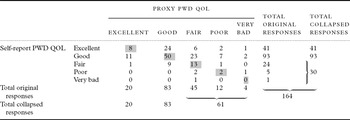
Twenty-three percent of PWD rated their QOL as “excellent,” while 58% gave a rating of “good,” 16% gave a rating of “fair,” 3% gave a rating of “poor,” and less than 1% rated their QOL as “very bad.” Twelve percent of informant QOL ratings (of PWD QOL) fell into the “excellent” category, 50% into the “good” category, 27% into the “fair” category, 8% into the “poor” category, and 4% fell into the “very poor” category. Cross-tabulations of these frequencies were calculated and are displayed in Table 1. Few participants rated QOL in the fair, poor, and very bad categories. Thus, these three categories were combined, leaving three levels of ratings: “excellent,” “good,” and “fair, poor, or very bad.” The “fair/poor/very poor” category was used as the reference group, similar to the approach of Helvik et al. (Reference Helvik, Engedal, Krokstad and Selbæk2011) in their sample of older adults without dementia. To examine discrepancies between PWD self-rated QOL and caregiver proxy-rated QOL for the patient, difference scores were computed and used as the dependent variable in multiple regression models (with positive difference scores indicating PWD ratings were higher than proxy ratings).
Cross-tabulations: self- and proxy-reported PWD QOL ratings

Note: PWD = persons with dementia; QOL = quality of life. Forty-four percent of dyads (N = 73 out of 164; shaded boxes above) had congruent responses on their ratings of PWD QOL. Proxy reports were lower than self-reports for 41% of dyads (N = 67 out of 164). Proxy reports were higher than self-reports for 15% of dyads (N = 24 out of 164).
Covariates
Age of dementia onset, education, and gender of the PWD were included in the analyses as covariates. The remaining scales below describe independent variables of interest, related to health and functioning in the PWD.
Cognition
The Mini-Mental State Examination (MMSE) is a global measure of cognitive ability, assessing attention, memory, orientation, language, and visuospatial ability. The overall score ranges from 0 to 30 (Folstein et al., Reference Folstein, Folstein and McHugh1975). This widely used scale was administered to dementia participants to provide a global assessment of cognitive impairment.
Daily functioning
The Dementia Severity Rating Scale (DSRS) is a caregiver-rated measure of functional ability in the areas of memory, language, community and home affairs, and basic care (Clark and Ewbank, Reference Clark and Ewbank1996). Scores range from 0 to 61 points, with higher scores indicating worse functioning.
Neuropsychiatric (behavioral) symptoms
The Neuropsychiatric Inventory (NPI) is a caregiver rating that assesses neuropsychiatric symptoms (NPS) in dementia in 12 domains. If endorsed, each symptom was rated according to frequency and intensity. These scores were multiplied to yield individual symptom scores. A total score across all 12 symptoms was calculated (range from 0 to 144 points) with higher scores indicating worse symptoms (Cummings et al., Reference Cummings, Mega, Gray, Rosenberg-Thompson, Carusi and Gornbein1994).
Dementia severity
The Clinical Dementia Rating (CDR) is a structured clinician rating of dementia. Scores in six areas are combined to obtain a composite score ranging from 0 to 5 (Morris, Reference Morris1997). For analyses, we used the sum of boxes score, a global score summing across each domain (range from 0 to 30 points; higher scores indicate greater impairment). Our study used the sum of boxes method for the CDR because it is more sensitive to cognitive changes in mild cognitive impairment and dementia than the composite CDR score (Pavlik et al., Reference Pavlik, Doody, Massman and Chan2006).
Medical comorbidity
The General Medical Health Rating (GMHR; Lyketsos et al., Reference Lyketsos1999) is a clinician assessment of severity of medical comorbidity in dementia patients. GMHR scores were rated as “excellent, good, fair, or poor.”
Statistical methods
Spearman correlation coefficients were calculated to explore the relationship between ratings of QOL, demographic information, and assessment questionnaires. Polychotomous logistic regression (LR) models were then estimated to examine relationships between independent variables and patient QOL ratings by study participants or their caregivers. Independent variables included education, age at dementia onset (determined as the age when the participant first met DSM-III-R criteria for dementia), gender, MMSE, DSRS, CDR, NPI, and GMHR scores.
To assess predictors of differences between patient self-reported and caregiver proxy-reported QOL, the difference between patient self-ratings and caregiver proxy QOL ratings was computed for each participant and utilized as the dependent variable in a multiple linear regression model regressed on the same independent variables.
Results
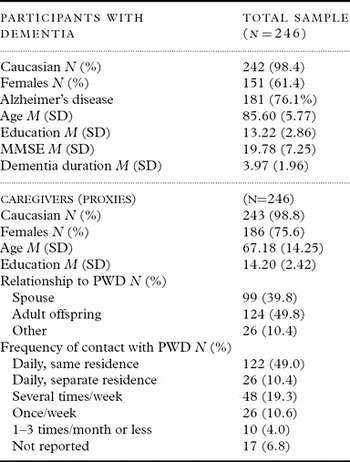
There were 246 patient/caregiver dyads at the initial visit. Table 2 displays sociodemographic and other relevant aggregate descriptors of the sample. Of these 246 dyads, 82 (33%) had some level of missing data on the QOL measures and were not included in the current analyses. Specifically, 64 dyads (26%) had missing proxy-reported PWD QOL, 9 dyads (3.7%) had missing QOL data on both proxy- and self-reported QOL measures, and 9 dyads (3.7%) had missing PWD self-reported QOL data. The final sample for analyses was 164. A comparison between those with missing data versus those with complete data revealed that these groups did not differ at a level of p < 0.05 on PWD gender (all categorical variables tested using χ 2), or mean age of dementia onset, years of education, or mean NPS (t-tests), or caregiver gender, kin relationship, frequency of caregiving (all categorical variables tested using χ 2), mean age, or mean years of education (t-tests). However, dyads with missing QOL data were lower on mean PWD MMSE scores (t(df = 92.53) = –7.4, p < 0.001) and higher on CDR scores (t(df = 96.52) = 6.68, p < 0.010 i.e. greater functional impairment).
Summary of demographic characteristics

MMSE = Mini-Mental State Examination; PWD = persons with dementia
Percentage agreement between patient QOL and proxy QOL
Using the original QOL variable (where categories of fair, poor, and very bad are kept separate), 44% of dyads (73 out of 164; see Table 1) had congruent responses on their ratings of PWD. Proxy reports were lower than self-reports for 41% of dyads (N = 67), and proxy reports were higher than self-reports for 15% of dyads (N = 24). A Spearman's ρ correlation of the proxy- and self-reported QOL scores yielded a statistically significant association between the reports (ρ = 0.289, p < 0.01).
Predictors of patient QOL self-ratings
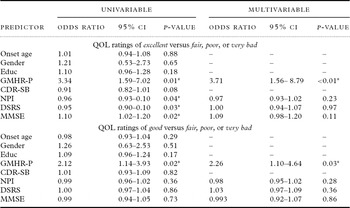
Table 3 displays results of polychotomous LR, with patient QOL ratings as the dependent variable. Results are shown as odds ratios (OR), with 95% confidence intervals, predicting “excellent” or “good” ratings compared to “fair, poor, or very bad” ratings. In univariable models, the following were predictors of higher QOL ratings: higher GMHR (better general health), fewer NPS on NPI, better functional ratings on DSRS, and higher MMSE. These variables significantly predicted the “excellent” ratings from the “fair, poor, very bad” ratings. Predicting “good” ratings from the “fair, poor, very bad” ratings was GMHR. In the multivariable model, only the GMHR score significantly distinguished “excellent” and “good” ratings from “fair, poor, very bad” ratings.
Predictors of patient QOL ratings

Note: *p < 0.05. Multivariable model includes all variables significant in univariable analyses. Educ = Education; GMHR-P = General Medical Health Rating – Patient; CDR-SB = Clinical Dementia Rating – Sum of Boxes; NPI = Neuropsychiatric Inventory; DSRS = Dementia Severity Rating Scale; MMSE = Mini-Mental State Examination.
Predictors of caregiver ratings of patient QOL
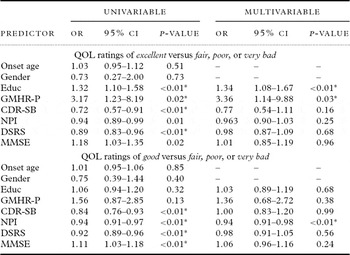
Table 4 displays results of polychotomous LR, predicting caregiver ratings of patient QOL from the predictor variables. Results are shown as OR, with 95% confidence intervals, predicting “excellent” or “good” ratings compared to “fair, poor, or very bad” ratings. In the univariable models, the following were predictors of higher QOL ratings: higher GMHR scores (better general health), higher education, fewer NPS on the NPI, better functional ratings on DSRS, higher MMSE, and lower CDR. These variables significantly predicted the “excellent group” from the “fair, poor, very bad” group, and the “good” from the “fair, poor, very bad” group, with the exception of GMHR and education that only predicted “excellent” ratings from the reference. In the multivariable model, NPI distinguished “good” ratings from “fair, poor, very bad” ratings. More education and higher GMHR score significantly distinguished “excellent” ratings from “fair, poor, very bad” ratings.
Predictors of caregiver ratings of patient QOL

Note: *p < 0.05. Multivariable model includes all variables significant in univariable analyses. OR=odds ratio; Educ = Education; GMHR-P = General Medical Health Rating – Patient; CDR-SB = Clinical Dementia Rating – Sum of Boxes; NPI = Neuropsychiatric Inventory; DSRS = Dementia Severity Rating Scale; MMSE = Mini-Mental State Examination.
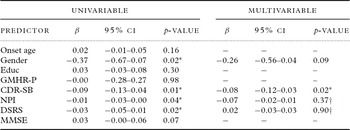
Predictors of differences in self-reported versus proxy-reported QOL ratings are displayed in Table 5. In the univariable models, gender, NPI, DSRS, and Clinical Dementia Rating – Sum of Boxes (CDR-SB) all significantly predicted the outcome variable. In the multiple regression model using stepwise backward elimination, only CDR-SB predicted differences in ratings with fewer differences evident in patients with higher CDR (more severe dementia) (β = –0.076, p < 0.01).
Predictors of differences in self- versus caregiver QOL ratings of patient

Note: *p < 0.05. Multivariable model includes all variables significant in univariable analyses. †Variables that were excluded in multiple stepwise regression with backward elimination. Educ = Education; GMHR-P = General Medical Health Rating – Patient; CDR-SB = Clinical Dementia Rating – Sum of Boxes; NPI = Neuropsychiatric Inventory; DSRS = Dementia Severity Rating Scale; MMSE = Mini-Mental State Examination.
Discussion
There was only a modest level of agreement between proxy- and self-reported PWD QOL ratings upholding our hypotheses and supporting past research: 44% of dyads agreed on QOL scores, and a correlation between reports suggested a modest but statistically significant association. It was more common that proxies reported lower PWD QOL than PWD QOL self-report (41% of dyads). While past research has found links between caregiver factors such as increased depressive symptoms and burden and lower caregiver proxy-rated reports of PWD QOL (Karlawish et al., Reference Karlawish, Casarett, Klocinshi and Clark2001; Logsdon et al., Reference Logsdon, Gibbons, McCurry and Teri2002; Sands et al., Reference Sands, Ferreira, Stewart, Brod and Yaffe2004; Schiffczyk et al., Reference Schiffczyk, Romero, Jonas, Lahmeyer, Müller and Riepe2010), the current study focused on variables related to the functioning of the PWD to explain these differences. QOL self-ratings were associated with medical comorbidity while caregiver ratings of PWD QOL were primarily influenced by NPS. These results support findings from smaller convenience samples reporting associations between lower QOL scores and NPS (Hurt et al., Reference Hurt2008), poor health (Esteban y Pena et al., Reference Esteban y Pena, Jimenez Garcia and Diaz Olalla2009), or lower education (Heyworth et al., Reference Heyworth, Hazell, Linehan and Frank2009). Given the population-based design of this study, the generalizability of such findings is broadened.
Not surprisingly, we found CDR-SB to be the major predictor of differences between proxy- and self-reported ratings of QOL, whereas NPI scores did not contribute significantly to explaining differences between proxy- and self-reported ratings of PWD QOL. This contrasts with the findings of others that the NPI symptoms of burden and depression correlate with proxy QOL ratings for the PWD (Hurt et al., Reference Hurt2008; Mougias et al., Reference Mougias, Politis, Lyketsos and Mavreas2011). These variables also have been reported as predictors of differences between self- and proxy-ratings of QOL (Sands et al., Reference Sands, Ferreira, Stewart, Brod and Yaffe2004). One plausible explanation is that this was a community-based sample, rather than a convenience sample, and that distressed caregivers were less likely to be oversampled in the current study.
There is a large body of literature investigating the meaning of QOL, domains of QOL assessment, and methodologies to measure QOL. Investigators have grappled with defining complex and abstract notions and providing operational definitions of QOL, especially in the context of dementia. Many assessments of PWD QOL exist which capture the multidimensional aspects of QOL (e.g. behaviors, social interactions, functioning; Lawton, Reference Lawton, Birren, Lubben, Rowe and Deutchman1991; activity and mood; Albert et al., Reference Albert1996). While the single-item QOL measure does not allow us to investigate each of these QOL components on a closer level, a single-item, global assessment is appropriate in epidemiological settings and for the current analyses for several reasons. First, responding to questions that require contemplation, introspection, and sustained attention becomes increasingly difficult for moderately to severely cognitively impaired individuals. In addition, queries that require higher order cognitive skills, such as analysis or synthesis, are also not feasible. Simplification of the language and number of items in a self-assessed QOL scale for individuals across varying degrees of impairment provides one solution to this problem. Second, the independent variables of interest in the study are related to behavior, functioning, and other dementia-specific factors, which we chose to examine as predictors of QOL ratings in the current study.
The sample utilized in this study has both strengths and limitations. An advantage of the sample is that it is drawn from a population and not a clinical setting. The majority of assessments of PWD QOL are derived from patient samples of PWD or other samples of individuals self-selecting or proxy-selected into clinical settings. Clinical samples of PWD and their caregivers may be more impaired, more stressed, or otherwise less generalizable to the population of PWD and their caregivers. In the current study, however, we should also recognize that approximately 90% of Cache County residents are members of The Church of Jesus Christ of Latter Day Saints (Norton et al., Reference Norton2006). Having an ethnically and religiously homogeneous population minimizes potentially confounding variables, such as cultural and lifestyle differences, as well as the effects of smoking and alcohol consumption upon study outcomes. However, results from this population may have restricted generalizability to other populations.
Finally, the use of a cross-sectional analysis did not allow for assessment of QOL ratings across time. The unique pattern of plateaus, declines in health, followed by regaining a lowered level of function that characterizes the course of dementia has a profound effect upon PWD and caregivers. Longitudinal assessment will be needed to improve our understanding of the dynamics of QOL ratings across time and their predictors.
Implications
The results from the current study have important clinical implications. The current standard of dementia care is generally palliative in nature, one aspect of which is to maximize QOL and limit suffering. The accurate measurement of the subjective experience of a person with dementia is difficult, particularly with increasing dementia severity. Gaining insight into patient characteristics that influence proxy reports of PWD QOL is important for both clinicians and proxy caregivers to improve the accuracy of ratings and consider this component of care independently of the symptoms of dementia. Comparing self and proxy PWD QOL early in the course of dementia may inform caregivers as to how the patient's dementia symptoms influence their ratings of PWD QOL, with the goal to provide more accurate assessments when the patient is no longer capable of self-report.
Conflict of interest
None.
Description of authors' roles
Drs. Morrison, Buckley, Tschanz, and Lyketsos were primarily responsible for formulating research questions and drafting the original paper. Drs. Buckley, Fauth, and Tschanz were responsible for the revision of the paper. Drs. Buckley and Tschanz provided expertise in statistical analysis. Drs. Rabins, Piercy, and Norton reviewed the paper for intellectual content and provided suggestions for relevant literature where appropriate. DPS senior contributors (co-authors) are Drs. Lyketsos and Tschanz.
Acknowledgments
This research was supported by the National Institute on Aging grants R01AG21136, R01AG1183, and R01AG18712 as well as by the National Institutes of Health grants R01AG11380 and P50AG05146. Other Cache County Study of Memory, Health, and Aging Investigators include: Dr. James Anthony, Dr. Erin Bigler, Dr. Ron Brookmeyer, Dr. James Burke, Dr. Eric Christopher, Dr. Jane Gagliardi, Michael Helms, Dr. Christine Hulette, Liz Klein, Carol Leslie, Dr. Lawrence Mayer, Dr. John Morris, Dr. Ronald G. Munger, Dr. Chiadi Onyike, Dr. Truls Ostbye, Dr. Ron Petersen, Dr. Carl Pieper, Dr. Brenda Plassman, Dr. Pritham Raj, Russell Ray, Linda Sanders, Dr. Ingmar Skoog, Dr. David Steffens, Dr. Marty Toohill, Leslie Toone, Dr. Jeannette Townsend, Lauren Warren, Dr. Michael Williams, and Dr. Bonita Wyse.
The board-certified or board-eligible geriatric psychiatrists or neurologists who examined the study members included: Drs. Steinberg, Breitner, Steffens, Lyketsos, and Green. Dr. Williams also examined several subjects and provided expert neurologic consultation. Autopsy examinations were conducted by Dr. Townsend. Ms. Leslie coordinated the autopsy enrollment program. Diagnosticians at the expert consensus conferences included Drs. Breitner, Burke, Lyketsos, Plassman, Steffens, Steinberg, Tschanz, and Welsh-Bohmer.