Treatment of urinary tract infection (UTI) is one of the largest contributors to inpatient antimicrobial use. 1 , Reference Gandhi, Flanders and Markovitz 2 In the absence of signs or symptoms of UTI, a positive urine culture is labeled asymptomatic bacteriuria (ASB), and antimicrobials are withheld except in pregnancy or prior to a urological procedure with mucosal bleeding.
Previous studies have shown that urine cultures are commonly obtained for non–guideline-based indications.Reference Hartley, Kuhn and Washer 3 To identify opportunities for improvement, we reviewed medical records in a diverse group of hospitalized patients to evaluate indications for urine cultures, appropriateness of antimicrobial use, and rationale for inappropriate treatment of ASB.
METHODS
For this study, our inclusion criteria were the following: all patients 18 years or older between February 2008 and February 2009 at the University of Michigan Health System whose first urine culture obtained during hospital admission was positive; results were returned while the patient was hospitalized, the patient was on antimicrobials within 72 hours after urine culture collection; and the patient was not involved in another study. Two hospitalist investigators (SH, SV) reviewed medical records of eligible patients until a sample size of 150 was obtained. Exclusion criteria included the following: urinary stents, nephrostomy tubes, prior renal transplant or urinary diversion surgery, admission to the intensive care unit at the time of culture, pregnancy, receiving treatment for a UTI as an outpatient at the time of admission, or receiving empiric treatment for a UTI >48 hours prior to urine culture.
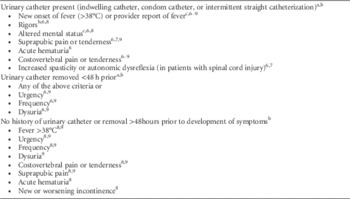
Indications for testing and treatment according to published guidelines and consensus conferences were compiled. The final list of indications required consensus by the study team (Table 1).Reference Hartley, Kuhn and Washer 3 – 9 Utilizing documentation of guideline-based signs and symptoms in the absence of an alternative cause, all charts were adjudicated by 2 hospitalists and 2 infectious diseases physicians (LW and TG).Reference Nicolle, Bradley and Colgan 4 – 9 Consensus was achieved in every case.
Appropriateness Criteria for Sending a Urine Culture Based on National and Professional Society Guidelines and Consensus StatementsReference Nicolle, Bradley and Colgan 4 – 9

a Criteria presented by Hooten is Level A-III, consistent with good evidence to support a recommendation for or against and represents evidence of opinions of respected authorities based on clinical expertise, descriptive studies, or reports of expert committees.Reference Hooton, Bradley and Cardenas 6
b Additional guidelines and the consensus statement did not state a level of evidence and, therefore, are assumed to reflect expert opinion.Reference Nicolle, Bradley and Colgan 4 , Reference Gupta, Hooton and Naber 5 , 7 – 9
c Without an alternative diagnosis.
RESULTS
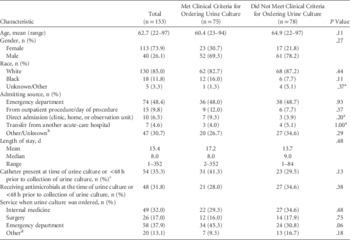
A total of 375 patients met the following criteria: first urine culture obtained during hospital admission was positive, treatment with antimicrobials initiated within 72 hours of urine culture collection, and not involved in another study. Of these patients, 224 were screened and 71 were excluded, leaving 153 in the final sample for detailed chart review (Table 2). Of these 153 patients, 59 (38.6%) had UTIs and 94 (61.4%) had ASB. Fever was the predominant guideline-based criterion in both groups; fever was present in 47 patients (30.7%). Of the 23 patients with ASB in the presence of a guideline-based criterion, 20 (87.0%) had fever. However, these fevers were related to sources other than the urinary tract.
Patient Characteristics

a P values were determined from the Fisher’s exact test.
b Includes DPU, distinct part unit (rehab unit/psych unit - separate admission) and unknown/missing.
c Does not include condom catheters.
d Family medicine, Physical Medicine and Rehabilitation, Psychiatry Emergency Department, Neurology, and Neurosurgery.
Of the 59 patients with UTIs, 12 (20.3%) had complaints specific to the urinary tract including suprapubic pain or tenderness, costovertebral pain or tenderness, urination urgency, or urination frequency. None of the 94 patients (0%) in the ASB group (P<.001) reported any of these symptoms.
Of patients with ASB, 71 (75.5%) had no guideline-based indication for urine culture. Only 40 (56.3%) of these patients had a clinical indication for testing documented in the medical record. The most frequently documented non–guideline-based indications were change in character of urine (N=10; 14.1%), altered mental status in the absence of a urinary catheter (N=9; 12.7%), and leukocytosis (N=7; 9.9%).
Among the entire study group of 153 patients, 51 (33.3%) were receiving antimicrobial treatment when the urine culture was collected. Of these 153 patients, 117 (76.5%) were treated for a UTI within 72 hours of culture, including 60 (63.8%) of those with ASB and 57 (96.6%) of those determined to have UTIs. Antimicrobials were started in 59 of the 60 patients (98.3%) treated for ASB within 72 hours of urine culture, and were initiated with a mean time to first dose of 0.9 days, a mean duration of 9.1 antimicrobial days, and collectively totaled 435 antimicrobial days.
DISCUSSION
The interpretation of a positive urine culture in hospitalized patients is complex, and treatment of ASB is a driver of antimicrobial overuse in hospitals. In our study, >60% of positive urine cultures represented ASB, and treatment of these patients resulted in 435 days of unnecessary antimicrobial administration. Current guidelines describe clinical symptoms specific to the urinary tract including suprapubic pain or tenderness, urgency, frequency, and costovertebral angle tenderness or pain. Their presence increases the likelihood of an underlying UTI.Reference Nicolle, Bradley and Colgan 4 – Reference Hooton, Bradley and Cardenas 6 In our study, all 12 patients with these symptoms had a UTI, but the occurrence of these symptoms was unusual. More commonly, urine cultures are sent without clear guideline-based indications (N=78, 51.0%) or in the presence of a single non-specific criterion for UTI (eg, fever). A change in the character of the urine was the most frequently documented non–guideline-based indication for obtaining a urine culture despite it being a poor indicator of UTI.Reference Nicolle, Bradley and Colgan 4 – Reference Hooton, Bradley and Cardenas 6 The evaluation of a hospitalized patient with leukocytosis or altered mental status is challenging; these signs and symptoms may be caused by multiple possible etiologies, including infection. The geriatrics literature currently supports evaluation for an underlying infection (including UTI) in elderly patients with altered mental status, but this recommendation is inconsistent with UTI guidelines.Reference Inouye 10 Differences in guidelines may lead to confusion in application by clinicians and potentially explains the use of this clinical indication in our study population.
Antimicrobials for patients with ASB were often newly initiated, frequently within 24 hours of culture. The mean duration of therapy was consistent with a complete course for a complicated infection (7.4 calendar days), implying that few patients started on antimicrobial therapy at the time of evaluation had their antimicrobials discontinued.
Our study has important limitations. The retrospective design relies on determination of manifestations of UTI based on documentation at the time of care. While our adjudication process focused on the information that was available to clinicians at the time of decision making, a potential for bias exists in interpretation given that the clinical outcome was apparent at the time of review. Additionally, the results from a single center may affect generalizability. However, prior findings of poor performance in the overtreatment of ASB suggests that the problems we identified may be widespread.Reference Gandhi, Flanders and Markovitz 2 , Reference Leis, Rebick and Daneman 11 , Reference Trautner, Kelly and Peterson 12 These limitations should be interpreted in the setting of the strengths of our evaluation, which include a rigorous method for medical record abstraction, consolidation of multiple national guidelines and consensus statements to a single list of criteria, and adjudication of all charts by 2 infectious diseases physicians and 2 hospitalists.
Our study highlights the overtreatment of ASB in the hospital and identifies areas in which additional guidance would be helpful. In addition to the tools and strategies previously shown to be effective (eg, audit and feedback and modified laboratory reportingReference Leis, Rebick and Daneman 11 , Reference Trautner, Kelly and Peterson 12 ), improvement efforts should include better guidance on the evaluation of nonspecific signs or symptoms (eg, fever) and common drivers of urine culture ordering inconsistent with guidelines, such as altered mental status and leukocytosis. Furthermore, after providers initiate antibiotics for possible UTI, a second level of assessment should occur that includes a review of culture results, consideration of competing diagnoses that trigger diagnostic testing (eg, fever), and reassessment of the indications for antimicrobial administration. Tools for improving antimicrobial use include the “Get Smart for Healthcare” program recently launched by The Centers for Disease Control and Prevention. 1 The program encourages clinical documentation of the indication, dose, expected duration of antimicrobials and that the prescribing decision be intentionally re-evaluated at a 48-hour antibiotic “timeout.” In summary, multimodal interventions are needed to improve antimicrobial use in hospitalized patients with suspected UTI and should include increased awareness of guideline-based signs and symptoms, resolution of conflict between guidelines (eg, evaluation of altered mental status), routine re-evaluation of antimicrobial indications, and opportunities for tailoring therapy 48 hours after its initiation.
Acknowledgments
Financial support: Support for this study was provided by the CDC Foundation.
Potential conflicts of interest: LK, LW, TG, AM, SF reports that money has been paid to their institution as a grant from the CDC Foundation. SH reports payment by the Society of Hospital Medicine for consultancy. LW reports that money has been paid to her institution for grants/grants pending from the National Institutes of Health (NIH)/National Institute of Allergy and Infectious Diseases (NIAD). JM reports that money has been paid to her institution for grants from the Agency for Healthcare Research and Quality (AHRQ) and the NIH Loan Repayment Programs (NIH-LRP). JM also reports her employment by the University of Michigan Health System; payment for lectures including service on speakers bureaus for various professional and non-profit organizations (eg, Society for Healthcare Epidemiology of America (SHEA), and the Central Society for Clinical Research, Wound Ostomy & Continence Nurses Society); payment for manuscript preparation from RAND/AHRQ honorarium for preparation of the AHRQ Chapter update on prevention of catheter-associated UTI; payment for development of educational presentations from SHEA; money paid to her institutions for grants/grants pending from the AHRQ; and reimbursement for travel/accommodations/meeting expenses unrelated to activities listed from the AHRQ and the Blue Cross Blue Shield of Michigan Foundation. CC reports payment for her editorial work at Infection Control and Hospital Epidemiology and payment for travel/accommodations/meeting expenses from SHEA for unrelated activities. AM is a shareholder of Pfizer Pharmaceuticals and served on the speaker’s bureau for Cubist Pharmaceuticals in 2011–2012. SF reports payment for consultancies for the Institute for Healthcare Improvement and the Society of Hospital Medicine; royalties from Wiley Publishing; honoraria for various talks at hospitals as a visiting professor; grants from the CDC Foundation, Blue Cross Blue Shield of Michigan, the Michigan Health and Hospital Association, and the AQRQ; and payment for expert witness testimony. SS reports that money has been paid to the University of Michigan as grants/grants pending from the NIH, the Veteran’s Administration, and the AHRQ, the Blue Cross Blue Shield of Michigan Foundation. SS also reports his employment by the University of Michigan and Ann Arbor VA Medical Center; payment for expert testimony on legal cases focusing on medical malpractice; payment for lectures including service on speaker’s bureaus; honoraria for talks at academic meetings, group-purchasing organizations (eg, VHA, Premier), state hospital associations (eg, Michigan Health and Hospital Association); honoraria for visiting professorships; payment from nonprofit foundations (eg, IHI); royalties from Lippincott Williams and Wilkins, McGraw-Hill, and Wiley-Blackwell for books he has authored or edited; as well as stock/stock options from Doximity and Jvion. SV and AS report no conflicts of interest.