Introduction
Highly weathered soils of the humid tropics are often low in plant nutrients due to the rapid mineralization of organic matter and limited nutrient retention capacities (Tiessen et al., Reference Tiessen, Cuevas and Chacon1994; Glaser et al., Reference Glaser, Lehmann and Zech2002). Tropical soils, in general, have very low cation exchange capacities because of the low organic matter contents and the predominance of highly weathered clay minerals such as iron and aluminium oxides and kaolinite. As a consequence, nutrients applied to annual crops are leached rapidly below the root zone, resulting in low nutrient use efficiencies (Cahn et al., Reference Cahn, Bouldin, Cravo and Bowen1993; Lehmann et al., Reference Lehmann, Da Silva, Steiner, Nehls, Zech and Glaser2003; Renck and Lehmann, Reference Renck and Lehmann2004).
Application of organic amendments plays a significant role in enhancing the productivity in strongly weathered tropical soils (Tiessen et al., Reference Tiessen, Cuevas and Chacon1994; Steiner et al., Reference Steiner, Teixeira, Lehmannm, Nehls, de Macêdo, Blum and Zech2007). Organic amendments not only serve as a reservoir of plant nutrients such as nitrogen (N), phosphorus (P) and sulphur (S), but also improve the soils' nutrient retention capacity, thus help in keeping applied nutrients in the main root zone of annual crops. Application of organic amendments increases the soil organic matter content and subsequently improves the soil organic carbon (C) pool (Bauer and Black, Reference Bauer and Black1994; Lal, Reference Lal2004; Backer et al., Reference Backer, Schwinghamer, Whalen, Seguin and Smith2016). However, commonly used organic soil amendments, such as animal manure, compost and green manures, decompose rapidly in hot and humid tropical environments (De Costa and Sangakkara, Reference De Costa and Sangakkara2006; Sukartono et al., Reference Sukartono, Kusuma and Nugroho2011), thus requiring large quantities or repeated applications to maintain long-term soil fertility.
Application of organic material having high recalcitrant C or high C/N ratio is an option worth investigating, as these decompose slowly and therefore are retained in the soil for a long period of time (Sommerfeldt and Mackay, Reference Sommerfeldt and Mackay1987; Kimetu et al., Reference Kimetu, Lehmann, Ngoze, Mugendi, Kinyangi, Riha, Verchot, Recha and Pell2008). Once applied, these amendments can help maintain the organic C level in soils and improve soil fertility. Biochar (BC) is one such organic soil amendment, which is resistant to decomposition and degradation due to condensed aromatic structures of its compounds (Schmidt et al., Reference Schmidt, Skjemstad, Gehrt and Kögel-Knabner1999; Glaser et al., Reference Glaser, Balashov, Haumaier, Guggenberger and Zech2000; Lehmann, Reference Lehmann2007). Increases in soil fertility and crop yields with BC application have been demonstrated in both tropical and temperate soils, with the greatest positive effects in nutrient-poor, acidic soils (Novak et al., Reference Novak, Busscher, Laird, Ahmedna, Watts and Niandou2009; Van Zwieten et al., Reference Van Zwieten, Kimber, Morris, Chan, Downie, Rust, Joseph and Cowie2010; Jeffery et al., Reference Jeffery, Verheijen, van der Velde and Bastos2011, Reference Jeffery, Abalos, Prodana, Bastos, van Groenigen, Hungate and Verheijen2017). Commonly available high C/N ratio amendments, such as rice straw, sawdust, woodchips and rice husks, may also retain C for a long period. Wood-based materials are usually not preferred as organic soil amendments due to their low concentrations of readily available nutrients (El Halim and El Baroudy, Reference El Halim and El Baroudy2014); however, wood-based amendments can be used as a high C source. Because of their low N and high C content, amendment of such materials may lead to immobilization of nutrients, particularly N, for variable durations, thus affecting the plant growth negatively (Six et al., Reference Six, Conant, Paul and Paustian2002). To overcome this, wood-based material can be pre-incubated with N-rich materials such as animal wastes. For example, pre-incubating sawdust with cattle manure for about 4–8 weeks under room temperature effectively decreased the C/N ratio of the material (Olayinka and Adebayo, Reference Olayinka and Adebayo1984, Reference Olayinka and Adebayo1989; Mariaselvam et al., Reference Mariaselvam, Dandeniya, Indraratne and Dharmakeerthi2014), thus reducing the negative impact on plant growth through N immobilization. The combined application of organic manure and mineral fertilizers is also identified as a promising approach to improve soil fertility and crop yields in tropical soils (Lehmann et al., Reference Lehmann, Da Silva, Steiner, Nehls, Zech and Glaser2003; Bedada et al., Reference Bedada, Karltun, Lemenih and Tolera2014; Wei et al., Reference Wei, Yan, Cao, Christie, Zhang and Fan2016).
In developing countries of the tropics, with small field sizes and high field-to-field variation in native soil nutrient supply, adopting site-specific nutrient management practices is crucial to increase crop yields to their yield potential. A field study conducted simultaneously with the current study in an Entisol in the wet zone of Sri Lanka showed that the combined application of site-specific fertilizer (SSF) with either BC or a pre-incubated cattle manure–sawdust mixture (CS) improved soil fertility and yield of maize (Mariaselvam et al., Reference Mariaselvam, Dandeniya, Indraratne and Dharmakeerthi2014). However, the influence of amendments on soil C pool and the overall soil quality was not investigated in the study. Another field study comparing rock powder and BC as amendments showed significant increases in cation exchange capacity (CEC), organic carbon, potentially mineralizable nitrogen (PMN) and carbon management index (CMI) in soil with BC application, but not with rock powder (Chathurika et al., Reference Chathurika, Indraratne, Dandeniya and Kumaragamage2016a).
The objectives of the current study were to (1) quantify and compare the soil organic C pool based on treatments of a site-specific balanced fertilizer with or without BC or CS, (2) investigate the application of site-specific balanced fertilizer with or without BC or CS on soil fertility parameters and maize yield. The current study hypothesized that the application of site-specific balanced fertilizer in combination with recalcitrant organic soil amendments will improve soil organic C pool and build up residual nutrients in soils with low fertility, resulting in enhanced crop growth and yield. This hypothesis was tested in a poorly fertile Alfisol in the intermediate zone mid-country of Sri Lanka by evaluating the effect of an SSF application with either BC or CS, on soil C levels, residual soil nutrients and maize yield.
Materials and methods
Study site
The field study was conducted at the University Experimental Station, Dodangolla, Sri Lanka (07o17′ N, 80o42′ E, 425 m a.s.l.) at an intermediate zone mid-country (IM3c). The soil was Reddish Brown Latosolic (RBL; Rhodudalfs) (De Silva et al., Reference De Silva, Dassanayake, Mapa, Mapa, Dassanayaka and Nayakekorala2005). For the intermediate zone of Sri Lanka, some of the main soil constraints identified for crop growth include low organic matter content, low nutrient retention and deficiency of available plant nutrients (Kumaragamage and Kendaragama, Reference Kumaragamage, Kendaragama, Mapa, Somasiri and Dassananyaka2010). A low productive field was selected based on the available farm records.
Initial soil characterization
Representative surface soil samples were collected by the grid random sampling method at the beginning of the field study. Then a composite soil sample was air-dried, sieved (2 mm) and four replicate sub-samples were analysed for basic soil properties and available nutrients. Soil pH (1:2.5 soil:distilled water) and electrical conductivity (1:5 soil:distilled water) were measured using a pH meter (Model 510, EuTech Instruments, Singapore) and a conductivity meter (EuTech, Singapore), respectively. Soil textural fractions were determined by the pipette method (Gee and Or, Reference Gee, Or, Dane and Topp2002). Cation exchange capacity was determined using ammonium acetate (NH4OAC) buffer solution at pH 7.0 (Sumner and Miller, Reference Sumner, Miller and Sparks1996). Organic C contents of the soils were determined by digestion with an acid dichromate solution and titrating with ferrous ammonium sulphate according to a modified Walkley and Black method (Nelson and Sommers, Reference Nelson, Sommers and Sparks1996). Available nutrients (ammonia nitrogen [NH4+-N], phosphorus [P], exchangeable potassium [K], calcium [Ca] and magnesium [Mg], copper [Cu], iron [Fe], manganese [Mn], sulphate [SO4−2-S] and zinc [Zn]) were extracted using a three-step extraction procedure (Portch and Hunter, Reference Portch and Hunter2002; Kumaragamage and Indraratne, Reference Kumaragamage and Indraratne2011). Soil collection and analysis for basic properties and available nutrients are described in more detail in Chathurika et al. (Reference Chathurika, Indraratne and Dandeniya2014).
Analysis of soil amendments
Organic soil amendments with high C/N ratio, i.e. sawdust BC and pre-incubated CS, were used to improve the soil organic C pool and thereby increase nutrient retention capacity of the soil. Sawdust from Alstonia macrophylla was collected from a commercial timber mill to prepare BC. Biochar was produced by slow pyrolysis at a temperature of ~600 °C (Dharmakeerthi et al., Reference Dharmakeerthi, Chandrasiri and Edirimanne2012) at the Rubber Research Institute, Agalawatta, Sri Lanka. Cattle manure was collected from healthy cows in the cattle barn of the Faculty of Veterinary Medicine and Animal Science, University of Peradeniya and mixed with sawdust (particles <2 mm) at a ratio of 2:1 (sawdust:cattle manure) on a fresh weight basis and pre-incubated for 2 months at 20 ± 2.0 °C to facilitate partial decomposition of the material. Available P, K, Ca and Mg of BC and CS samples were determined in four replicates using the same procedures used for soil analysis.
Field experiment
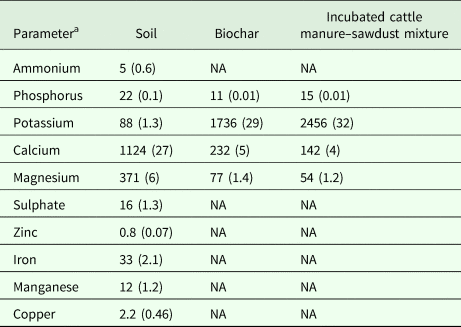
An SSF recommendation formulated previously for the experimental site (Chathurika et al., Reference Chathurika, Indraratne and Dandeniya2014) was used to correct nutrient deficiencies. Treatments used for the field study were: control (no fertilizers and no amendments), SSF (150 kg N/ha, 92 kg phosphorus pentoxide [P2O5]/ha, 30 kg potassium oxide [K2O]/ha and 5 kg S/ha applied as urea, triple superphosphate, muriate of potash and zinc sulphate, respectively), BC applied at 10 t/ha with SSF (BC + SSF) and CS applied at 20 t/ha with SSF (CS + SSF). As BC contained a high amount of available K (1736 mg/kg), the amount of muriate of potash used was cut by 6% from BC + SSF treatment. Similarly, since CS contained 2456 mg/kg of K, the amount of muriate of potash used was cut by 20% for CS + SSF treatment to ensure a balanced nutrient supply that matches the SSF treatment.
The treatments were arranged in a randomized complete block design with four replicates in 3.2 × 3.6 m plots. Each plot had 66 planting holes. To minimize the cost of application at farmer scale, Major (Reference Major2010) suggested that BC could be applied to individual planting holes (72 cm2 area, 20 cm depth). Therefore, in the current experiment, both BC and CS rates were calculated based on the area of the planting hole and added to each planting hole 2 days before planting. The actual amount of BC and CS applied to each planting hole was 7.2 and 14.4 g, respectively, which is equivalent to 10 and 20 t/ha on an area basis. Fertilizers were also added to the planting hole, with the amount of fertilizer per hole calculated by dividing the rate in kg/ha by the number of plants/ha. Urea was applied as a split application (75 kg/ha as a basal dressing at planting and the remaining 250 kg/ha as a top dressing 1 month after planting). Maize (Zea mays L.) variety Sampath was planted at 60 × 30 cm spacing with one plant per hole. Other cultural practices were adapted as recommended by the Department of Agriculture, Sri Lanka (DOA, 2013). The field experiment was conducted for two consecutive seasons; the first during the Yala season from May to August 2013 (2013 Yala) and the second during the Maha season, from December 2013 to March 2014 (2013/2014 Maha). In the second season, the same amounts of amendments were applied as described before. To study the residual effects of amendments, maize was grown for a third season during the Yala season from May to August 2014 (2014 Yala) in the same fields, with no organic amendments but only SSF applied to all treatments except for the control. During land preparation of the second and third seasons, the amendments added into the planting hole were mixed well within the plot, avoiding mixing between plots. Weather data (temperature and rainfall) were collected from a WatchDog 2900ET Weather Station located in situ. The mean seasonal temperature was 24.5 °C and rainfall was 430 mm/season during the first season (2013 Yala), while the second season (2013/2014 Maha) received 174.3 mm/season rainfall with a mean seasonal temperature of 23.8 °C.
Grain yield was taken at maturity, i.e. 105 days after planting. Yield data for the third season could not be taken because of severe crop damage by wild boar. For the first two seasons, all maize cobs were harvested avoiding border rows and cobs were shelled by hand. Grains were dried first in the sun and then at room temperature to obtain the grain yield at 13% moisture content. One thousand seeds were counted from each sample and oven-dried at 60 °C to obtain the 1000-seed weight, and the length of fresh cobs was also measured as yield components.
End of season soil analysis
Nine soil samples were collected from each plot systematically at the end of each season, including the third season. Samples were taken close to the plant base, avoiding plants in border rows. Samples were mixed to obtain a composite sample, which was used for soil analysis. Soils collected at the end of seasons were analysed for organic C, available P and exchangeable K using the same procedures described earlier. To measure soil active C, 2.5 g of soil was shaken for 2 min with 0.02 M potassium permanganate (KMnO4) solution and centrifuged for 5 min. Absorbance of the purple colour was measured by an ultra-violet (UV) visible spectrophotometer (Genesys 10S UV-Vis, Thermo Scientific, Waltham, MA, USA) at 550 nm wavelength (Weil et al., Reference Weil, Islam, Stine, Gruver and Samson-Liebig2003). Carbon management index was calculated using the carbon pool index (CPI) and the lability index (LI) based on active carbon and organic carbon data (Blair et al., Reference Blair, Lefroy and Lisle1995). Carbon values determined for unamended soil (control treatment) were used as reference values in the calculations.
 $${\rm Carbon\;\ pool\;\ index\;} ({\rm CPI}) = \displaystyle{{{\rm Sample\;\ total\;\ C}} \over {{\rm Reference\;\ total\;\ C}}}$$
 $${\rm Lability\;\ of\;\ carbon\;} ({\rm L}) = \displaystyle{{{\rm C\;\ in\;\ fraction\;\ oxidized\;\ by\;\ KMn}{\rm O}_4} \over {{\rm C\;\ remaining\;\ unoxidized\;\ by\;\ KMn}{\rm O}_4}}$$
 $${\rm Lability\;\ index\;} ({\rm LI}) = \displaystyle{{{\rm Lability\;\ of\;\ the\;\ C\;\ in\;\ sample}} \over {{\rm Lability\;\ of\;\ C\;\ in\;\ reference}}}$$
 $${\rm Carbon\;\ management\;\ index\;} ({\rm CMI}) = {\rm CPI} \times {\rm LI} \times 100$$
In the above equations, CPI and LI indicate the proportional change in total and labile soil C, respectively, comparing soils of the amended treatments with the unamended control; thus, CPI and LI values >1.0 reflect that amended treatments increase the total C and labile C, respectively. The CMI, calculated using both CPI and LI, provides a sensitive measure of the change in labile C in comparison to non-labile C in soil organic matter as affected by agricultural practices and values >100 indicate an increase of soil quality in the treatment with respect to the reference. The CMI is a better index than total organic C content for understanding the changes in soil C dynamics when treated with organic amendments.
The PMN of fresh soil was analysed by estimating N availability from NH4-N produced by the waterlogged incubation method described by Keeney (Reference Keeney and Stevenson1982). Ammonium-N was extracted using 2 M potassium chloride (KCl) and ammonium concentration was measured colorimetrically at 680 nm by the salicylic acid method (Markus et al., Reference Markus, McKinnon and Buccafuri1985).
Wet aggregate stability of the soil was measured by the single sieve method (Kemper and Rosenau, Reference Kemper, Rosenau and Klute1996). In brief: air-dried 1–2 mm aggregates were placed in sieves (24 mesh/cm, hole size 0.26 mm) and samples were pre-wetted using wetting chamber aerosol spray. Sieves with pre-wetted aggregates were placed in the sieving equipment, which provided a stroke length of 1.3 cm at a frequency of 35 cycles/min. The amount of aggregates remaining on the sieve at distinct time intervals up to 15 min was determined by oven-drying samples at 105 °C overnight.
Statistical analysis
Analysis of variance (ANOVA) for organic C, active C, LI, CPI, CMI, PMN, available P, exchangeable K, yield and yield components was performed using mixed procedure by SAS statistical software (SAS 9.1) with a two-factor factorial using season and treatment as a fixed effect. Normality of data was tested using the Shapiro–Wilk statistic (W < 0.9) from PROC UNIVARIATE. For data that were not normally distributed, natural log-transformed data were used for analysis to meet the assumption of normality of residuals. The LSMEANS function in SAS was used to compare treatment means, with adjustments made using Tukey's pairwise-comparison method.
Results
Soil characterization and amendment properties
The soil was sandy loam, slightly acidic (pH of 5.6 ± 0.21), non-saline (EC < 0.2 dS/m), with very low soil organic matter content (7.5 ± 0.40 g/kg) and moderate CEC (14 ± 1.2 cmolc/kg). Available nutrient concentrations in the soils were generally low (Table 1). Both organic amendments used in the study were alkaline, with a pH of 8.7 ± 0.04 in BC and 7.8 ± 0.03 in the CS. Total C content in BC and CS was 735 and 529 g/kg, with C:N ratios of 107:1 and 52:1, respectively. Both BC and CS had high concentrations of available K, but concentrations of other tested nutrients were low (Table 1).
Available nutrient concentrations (mg/kg) of soils (mean of four replicates ± standard error) and amendments used for the study

NA, not analysed.
a Standard error of the mean is given in parentheses.
Amendment effects on the soil carbon pool
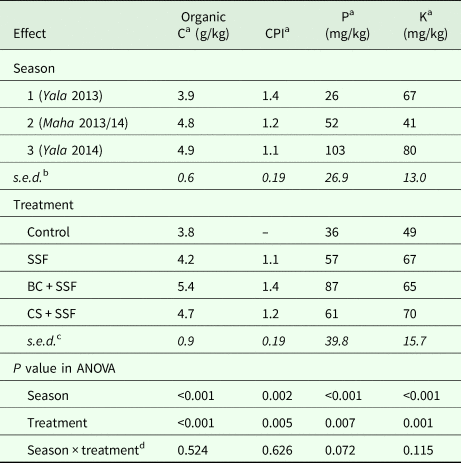
A significant (P < 0.05) seasonal variation was observed for soil organic C and CPI (Table 2). There was no significant interaction of season × treatment on both organic C and CPI. Mean CPI across treatments was significantly (P < 0.05) greater at the end of the first season, compared with the second and third seasons. However, even at the end of the third season, CPI was >1.0, showing a residual effect when the crop is grown with fertilizers and soil amendments than without any external inputs. The treatment effect was significant (P < 0.05) and consistent, with BC + SSF resulting in significantly (P < 0.05) greater CPI values than SSF (Table 2).
Effect of cropping season and different amendment treatments on organic carbon (C), available phosphorus (P), exchangeable potassium (K) and carbon pool index (CPI)
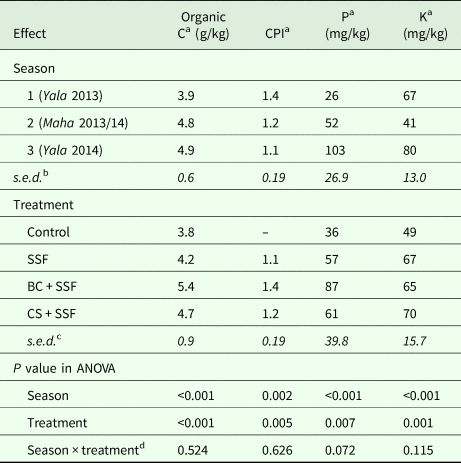
SSF, site-specific fertilizer (150 kg nitrogen/ha, 92 kg phosphorus pentoxide/ha, 30 kg potassium oxide/ha and 5 kg sulphur/ha); BC + SSF, biochar applied at 10 t/ha with SSF; CS + SSF, incubated cattle manure–sawdust mixture applied at 20 t/ha with SSF.
a Values are means of four replicates.
b Standard error of difference between means of seasons.
c Standard error of difference between means of treatments.
d Season × treatment were not significant (P > 0.05) for all parameters.
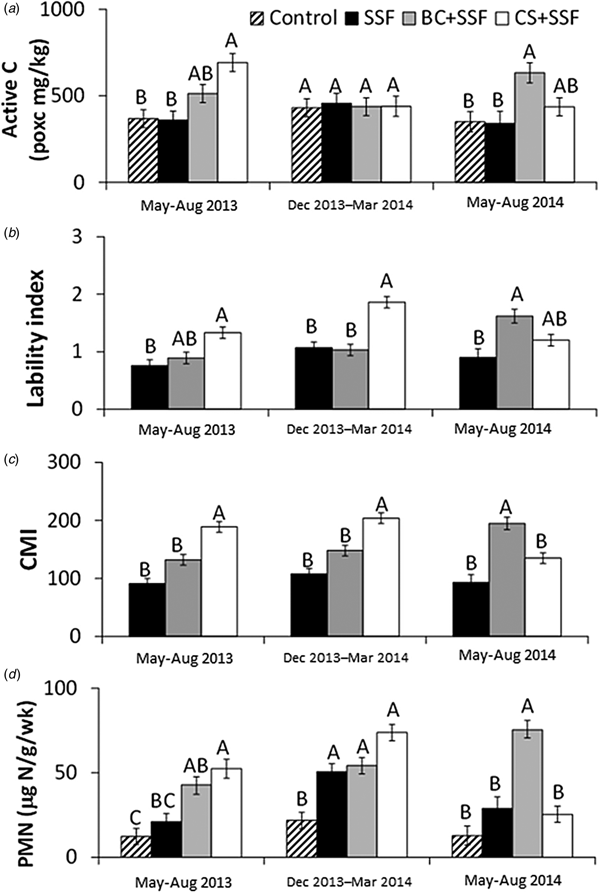
For soil active C, the treatment effect was significant with also a significant (P < 0.05) season × treatment interaction (Fig. 1(a)). Application of BC + SSF and CS + SSF improved active C content in soil only in the first and the third seasons compared with SSF and the control (Fig. 1(a)). While this effect was significant (P < 0.05) for CS + SSF in the first season, only the effect of BC + SSF was significant (P < 0.05) in the third season (Fig. 1(a)).
Two-way interaction effects of season and treatment on (a) active carbon measured as permanganate oxidizable C, (b) lability index, (c) carbon management index (CMI) and (d) potentially mineralizable nitrogen (N). C, control; SSF, site-specific fertilizer (150 kg nitrogen/ha, 92 kg phosphorus pentoxide/ha, 30 kg potassium oxide/ha and 5 kg sulphur/ha); BC + SSF, biochar applied at 10 t/ha with SSF; CS + SSF, incubated cattle manure–sawdust mixture applied at 20 t/ha with SSF. Error bars represent the standard error of the mean (n = 4). In a given season, the treatments with the same letter above the bars are not significantly different in their means at P > 0.05.

For both LI and CMI, a significant (P < 0.05) season × treatment interaction was observed. In the first and second seasons, CS + SSF treatment resulted in the highest LI and CMI followed by BC + SSF (Figs 1(b) and (c)). In the third season, both LI and CMI were significantly (P < 0.05) greater in the BC + SSF treatment than CS + SSF and SSF treatments (Figs 1(b) and (c)). The average increase in CMI across all seasons was 62 and 81% for CS + SSF and BC + SSF treatments, respectively. However, the increase of CMI in the third season compared with the second season was as high as 120% for the BC + SSF treatment (Fig. 1(c)).
Amendment effects on soil nutrients and aggregate stability
The PMN was influenced significantly (P < 0.05) by treatment, but the effects were inconsistent across seasons resulting in a highly significant (P < 0.001) season × treatment interaction. In the first and second seasons, all amended treatments (SSF, CS + SSF and BC + SSF) had significantly (P < 0.05) greater PMN than the un-amended control treatment (Fig. 1(d)) with the exception of SSF in the first season. In the first season, the highest PMN was observed under CS + SSF treatment followed by BC + SSF, and the values were significantly (P < 0.05) higher than those observed under SSF alone. In the second season, all amended treatments (SSF, CS + SSF and BC + SSF) had significantly (P < 0.05) greater PMN than the un-amended control treatment, whereas the PMN levels of BC + SSF, CS + SSF and SSF were not significantly different (Fig. 1(d)). In the BC + SSF treatment, PMN levels continued to increase over the first and second seasons and remained the highest among treatments in the third season, although no further amendments were applied during the third season. In contrast, PMN levels in the CS + SSF and SSF treatments decreased at the end of the third season, with CS + SSF treatment showing a sharp decline from 74 to 25 µg N/g/week (Fig. 1(d)).
In comparison to the control, available P concentration was significantly (P < 0.05) greater in BC + SSF, while exchangeable K levels were significantly (P < 0.05) greater in SSF, BC + SSF and CS + SSF, than the control. The season effect was significant (P < 0.05) for available P and K contents (Table 2), with significantly (P < 0.001) greater levels in the third season compared with the first and second seasons (Table 2).
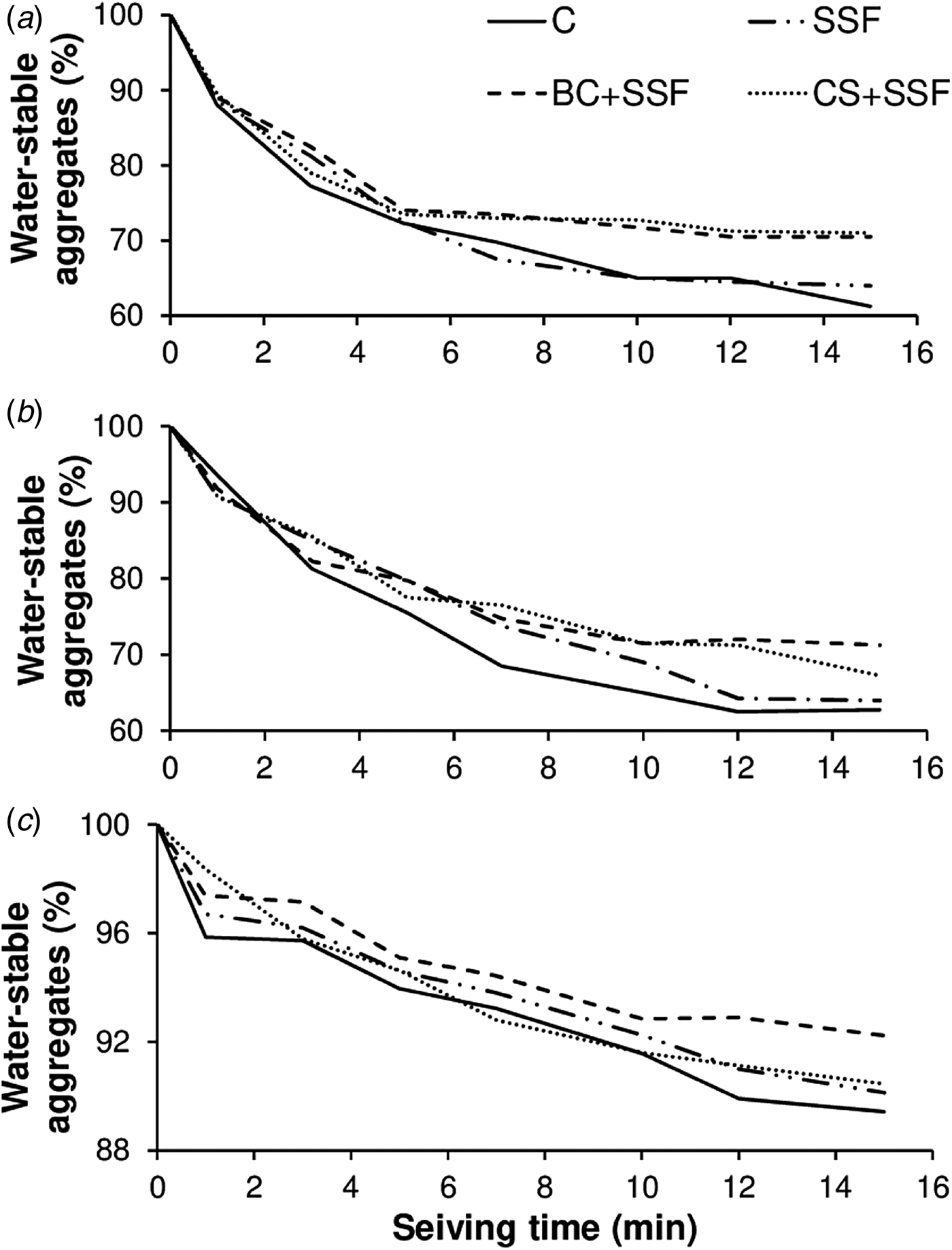
The proportion of stable aggregates remaining on the sieve after wet sieving was greater in BC + SSF and CS + SSF than in the control and SSF treatments at the end of the first and second seasons (Fig. 2). The increase in wet aggregate stability in BC + SSF and CS + SSF treatments was more than twofold compared with the control treatment. The third season showed a reduced effect of amendments on aggregate stability; however, all treatments had greater wet stable aggregate proportions than in the first two seasons.
Changes in soil wet aggregate stability at the end of the (a) first season, (b) second season and (c) third season for different treatments. C, control; SSF, site-specific fertilizer (150 kg nitrogen/ha, 92 kg phosphorus pentoxide/ha, 30 kg potassium oxide/ha and 5 kg sulphur/ha); BC + SSF, biochar applied at 10 t/ha with SSF; CS + SSF, incubated cattle manure–sawdust mixture applied at 20 t/ha with SSF.

Amendment effects on maize yield, cob length and 1000-seed weight
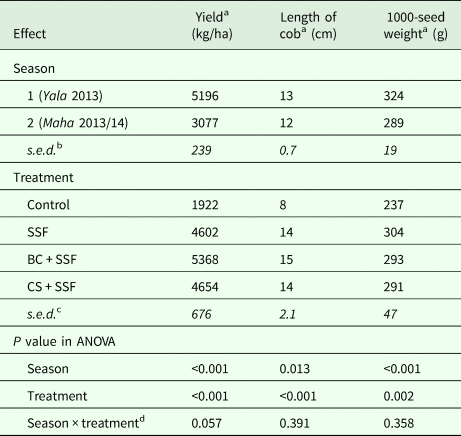
The main effects of treatment and season were significant for maize grain yield (P < 0.001), while cob length and 1000-seed weight also showed significant (P < 0.05) treatment and season effects. The interaction effects were not significant for yield, length of cob and 1000-seed weight (Table 3). Total grain yield of maize was significantly (P < 0.001) lower in the second season than in the first. Application of SSF alone or with BC or CS significantly (P < 0.001) increased maize grain yield, cob length and 1000-seed weight compared with the unamended control (Table 3). The greatest maize grain yield was seen for BC + SSF, which was significantly (P < 0.001) greater than CS + SSF and SSF treatments (15–16% increase), while the yield of CS + SSF treatment was not significantly different to that of the SSF treatment.
Effect of cropping season and different amendment treatments on maize grain yields and yield components in different seasons

SSF, site-specific fertilizer (150 kg nitrogen/ha, 92 kg phosphorus pentoxide/ha, 30 kg potassium oxide/ha and 5 kg sulphur/ha); BC + SSF, biochar applied at 10 t/ha with SSF; CS + SSF, incubated cattle manure–sawdust mixture applied at 20 t/ha with SSF.
a Values are means of four replicates.
b Standard error of difference between means of seasons.
c Standard error of difference between means of treatments.
d Season × treatment were not significant (P > 0.05) for all parameters.
Discussion
Amendment effects on soil carbon pool
The organic materials used had high C/N ratios, which should favour slow decomposition by fungal hyphae and associated microorganisms (Eiland et al., Reference Eiland, Klamer, Lind, Leth and Bååth2001), and thus maintained high organic C in the soil for a longer period of time than soil receiving no amendment. Treatments that received fertilizers with or without amendments had higher soil organic C contents than the control, and CPI values >1.0, which may be partly due to greater C inputs to soil through root biomass and leaf litter from improved crop growth. Because of the recalcitrant nature of BC, its application along with SSF increased CPI more than that under SSF and CS + SSF. Carbon pool index is considered an effective indicator of C retention in soil, with CPI < 1.0 reflecting lower C inputs and retention, and higher losses from the soil (Guimarães et al., Reference Guimarães, Gonzaga and Melo Neto2014). The treatment of soil with BC + SSF resulted in the greatest improvement to the carbon pool based on CPI values. The maintenance of CPI > 1.0 during the third season with no further application of SSF, BC + SSF and CS + SSF indicates the lasting effects of the soil amendments. Significant increases in CPI with soil amendment of BC and straw have been reported previously (Chathurika et al., Reference Chathurika, Indraratne, Dandeniya and Kumaragamage2016a; Zhang et al., Reference Zhang, Cheng, Feng, Sun, Zhao, Chen, Chen, Dyck, Wang, Zhang and Zhang2017). Zhang et al. (Reference Zhang, Cheng, Feng, Sun, Zhao, Chen, Chen, Dyck, Wang, Zhang and Zhang2017) reported a mean CPI value of 1.33 with the application of wheat straw at 8 t/ha with inorganic fertilizer, whereas mean CPI values increased to 1.44 and 1.78 with the application of wheat straw-derived BC at 8 and 16 t/ha, respectively, with inorganic fertilizer. However, it should be noted that Zhang et al. (Reference Zhang, Cheng, Feng, Sun, Zhao, Chen, Chen, Dyck, Wang, Zhang and Zhang2017) calculated CPI using the conventionally fertilized soil as the reference, whereas in the current study an un-amended control treatment was used as the reference in calculations of CPI and LI. In both studies, the CPI increased with the application of organic amendments. According to the study by Zhang et al. (Reference Zhang, Cheng, Feng, Sun, Zhao, Chen, Chen, Dyck, Wang, Zhang and Zhang2017), the % increases in CPI in soil with organic amendments compared with conventionally fertilized soil were 33% for wheat straw, 44% for the lower rate (8 t/ha) of wheat straw BC and 78% for the higher rate (16 t/ha) of wheat straw BC. In the current study, the % increase in CPI in CS + SSF and BC + SSF treatments compared with SSF were 10 and 30%. Thus, the magnitude of increase in CPI is less in the current study compared with values reported in Zhang et al. (Reference Zhang, Cheng, Feng, Sun, Zhao, Chen, Chen, Dyck, Wang, Zhang and Zhang2017).
The improvement of soil C with organic amendments was also reflected in active soil C, which is more closely related to biologically mediated soil properties than other soil C measures (Weil et al., Reference Weil, Islam, Stine, Gruver and Samson-Liebig2003; Ghosh et al., Reference Ghosh, Meena, Singh, Alam, Patra, Bhattacharyya, Sharma, Dadhwal and Mishra2018). The increase in active C resulted in LI > 1.0 with the application of BC + SSF and CS + SSF. Active C in BC + SSF and CS + SSF treatments decreased to values similar to the control and SSF treatments in the second season, most likely due to the drier environment (about half the rainfall than the first season) experienced during the second season. The two organic amendments behaved differently in increasing and maintaining active C in soils, mainly because of their differences in C lability. Wood-based BC contains high recalcitrant C which is not easily degradable by microorganisms (Steiner et al., Reference Steiner, Teixeira, Lehmannm, Nehls, de Macêdo, Blum and Zech2007), while animal manure-based CS contains highly labile C (Ghosh et al., Reference Ghosh, Meena, Singh, Alam, Patra, Bhattacharyya, Sharma, Dadhwal and Mishra2018). This difference in C lability among the two amendments resulted in greater active C and LI in CS + SSF, compared with LI in BC + SSF, during the initial stages, which decreased by the third season. Application of BC + SSF on the other hand, resulted in a greater LI in the third season, probably through increased microbial activity and enhanced availability of non-BC C in the soil. Demisie et al. (Reference Demisie, Liu and Zhang2014) also observed increases of 4 and 6% in LI 372 days after application of oak wood BC and bamboo BC, respectively, using a similar rate of BC application as in the current study. In the current study, the increase in LI was nearly 30% when averaged across the three seasons, with the greatest increase in the third season (residual), a few months after BC application.
The CMI gives an indication of overall soil C dynamics considering both total organic C in the soil and its lability. A CMI value >100 in amended treatments implies greater total C and/or proportion of labile soil C, relative to the reference (CMI = 100); higher CMI values result in greater improvements in soil quality. A decrease in total C and/or the proportion of labile C with amendment application would result in a CMI value <100. In the current study, not only did high C/N organic amendments increase the CMI with respect to the reference (control) and to the SSF treatments but a residual beneficial effect was clearly indicated, with significantly greater CMI in the third season compared with the SSF treatment. During the year of application, sequestration of organic C and soil quality improvement with CS + SSF amendment was greater than with BC + SSF amendment; however, the residual benefit was greater with BC + SSF than CS + SSF amendment. Increase in CMI with the application of various organic amendments such as BC, straw, farm yard manures, green manure and incubated CS have been reported previously (Demisie et al., Reference Demisie, Liu and Zhang2014; Chathurika et al., Reference Chathurika, Indraratne, Dandeniya and Kumaragamage2016a; Zhang et al., Reference Zhang, Cheng, Feng, Sun, Zhao, Chen, Chen, Dyck, Wang, Zhang and Zhang2017; Ghosh et al., Reference Ghosh, Meena, Singh, Alam, Patra, Bhattacharyya, Sharma, Dadhwal and Mishra2018). Demisie et al. (Reference Demisie, Liu and Zhang2014) observed an increase in CMI by 50–286% with oakwood BC and bamboo BC application after 372 days of application at similar rates as in the current study. The results of the current study imply greater organic C sequestration with BC + SSF amendment in the longer term than with CS + SSF amendment.
Overall, the application of site-specific balanced fertilizer in combination with recalcitrant organic soil amendments improved soil organic C pool in this poorly fertile soil as hypothesized. While CS was more effective in enhancing the soil labile C initially, BC amendment resulted in sustained beneficial effects. This finding is confirmed through investigating the residual effects in the third season, where active C and CMI were greater in soils amended with BC + SSF than CS + SSF in the third season.
Amendment effects on soil fertility
An increase in PMN with the application of fertilizer has been reported previously (Six et al., Reference Six, Conant, Paul and Paustian2002) and attributed to the increase in microbial biomass resulting in a rapid decomposition of native soil organic matter. As expected, amendment of BC or CS with SSF further increased PMN. Previous studies have shown that the change in PMN depends on both the quality and quantity of organic amendment added to soils (Chae and Tabatabai, Reference Chae and Tabatabai1986; Jin et al., Reference Jin, Johnson, Haney and Arnold2011). In the current study, PMN in the CS + SSF treatment decreased from the second to the third season (where no amendments were applied), probably due to decreasing microbial biomass and activity, which is reflected in the active C contents. This effect was not observed in BC + SSF treatment, where PMN increased further, in the third season, indicating the residual benefits of BC. Significant increases in PMN have been observed previously with BC and composted manure amendment (Bolan et al., Reference Bolan, Kunhikrishnan, Choppala, Thangarajan and Chung2012; Chathurika et al., Reference Chathurika, Indraratne, Dandeniya and Kumaragamage2016a). In a tropical Alfisol, Chathurika et al. (Reference Chathurika, Indraratne, Dandeniya and Kumaragamage2016a) reported a PMN of ~50 µg N/g soil/week with the application of BC + SSF, while the SSF treatment had PMN < 35 µg N/g soil/week; PMN values of both BC + SSF and SSF were similar to those of the first season in the current study.
Available P and K increased with the application of fertilizer as expected and remained at higher levels than the control treatment even in the third season, thus suggesting residual benefits of applied fertilizer. Application of organic amendments with fertilizer did not increase available P and K significantly when compared with the application of fertilizer alone. The results of the current study contradict previous studies reporting an increase in available P with organic amendments (Laird et al., Reference Laird, Fleming, Davis, Horton, Wang and Karlen2010; Chathurika et al., Reference Chathurika, Kumaragamage, Zvomuya, Akinremi, Flaten, Indraratne and Dandeniya2016b). In alkaline chernozemic soils, co-application of woodchip BC (20 t/ha) with fertilizers increased available P significantly, by ~12 mg/kg (Chathurika et al., Reference Chathurika, Kumaragamage, Zvomuya, Akinremi, Flaten, Indraratne and Dandeniya2016b), which was mainly attributed to the direct supply of P from BC that had high available P. In the current study however, both amendments had very low P contents when compared with the available P content in soil and are thus unlikely to be a direct source of P. While organic amendments had high levels of K, the fertilizer K rate was adjusted to account for the available K in amendments in the BC + SSF and CS + SSF treatments. Thus, the available K contents in soil were similar in the SSF, CS + SSF and BC + SSF treatments.
Wet aggregate stability is an indication of the soil's resistance to raindrop impact and water erosion. Soil organic C is one of the most important binding agents for forming stable aggregates. If aggregates are water-stable, the vulnerability of fertile topsoil to losses through erosion is reduced and soil retains more C, thus maintaining long-term soil fertility. In the current study, the improvement in wet aggregate stability was more prominent with organic amendments in the first and second seasons than in the third season. Both BC + SSF and CS + SSF amendments showed similar improvements in the first and second seasons; during the third season, wet aggregate stability was slightly greater in BC + SSF than CS + SSF amended soils. Increased aggregate stability with BC application has been observed previously by several researchers (Ouyang et al., Reference Ouyang, Wang, Tang, Yu and Zhang2013; Soinne et al., Reference Soinne, Hovi, Tammeorg and Turtola2014; Chathurika et al., Reference Chathurika, Kumaragamage, Zvomuya, Akinremi, Flaten, Indraratne and Dandeniya2016b). In contrast, Clark et al. (Reference Clark, Dodgshun, Sale and Tang2007) observed less aggregate formation with high C/N amendments due to reduced microbial activity with fewer bacterial by-products. Mean weight diameter is an important index of aggregate stability, calculated as the sum of the weighted mean diameters of all size classes, the weighting factor of each class being its proportion of the total sample weight. Both Ouyang et al. (Reference Ouyang, Wang, Tang, Yu and Zhang2013) and Chathurika et al. (Reference Chathurika, Kumaragamage, Zvomuya, Akinremi, Flaten, Indraratne and Dandeniya2016b) observed a significant increase in mean weight diameter with BC application to soils, suggesting the formation of more stable macro-aggregates, but this effect was only observed in sandy soils and not in clay soils. The mean weight diameter increased by twofold in a loamy sand with BC application at 20 g/kg, while there was no significant effect in a clay loam soil (Chathurika et al., Reference Chathurika, Kumaragamage, Zvomuya, Akinremi, Flaten, Indraratne and Dandeniya2016b). Both the type and the rate of amendment influence their effect on aggregate stability (Zhang et al., Reference Zhang, Cheng, Feng, Sun, Zhao, Chen, Chen, Dyck, Wang, Zhang and Zhang2017; Ghosh et al., Reference Ghosh, Meena, Singh, Alam, Patra, Bhattacharyya, Sharma, Dadhwal and Mishra2018). Zhang et al. (Reference Zhang, Cheng, Feng, Sun, Zhao, Chen, Chen, Dyck, Wang, Zhang and Zhang2017) observed that BC application at 8 t/ha had no significant effects on soil aggregation, while a significant increase in soil macro-aggregates was observed at a rate of 16 t/ha. Improved aggregate stability with regular additions of various other organic residues has been documented (Diacono and Montemurro, Reference Diacono and Montemurro2010; Ghosh et al., Reference Ghosh, Meena, Singh, Alam, Patra, Bhattacharyya, Sharma, Dadhwal and Mishra2018), with easily decomposable organic matter often showing an intense and transient effect while more recalcitrant ones show a lower but longer-lasting effect. The results of the current study confirm the long-lasting effect of recalcitrant materials such as BC in improving soil aggregate stability.
Yield, cob length and 1000-seed weight
Application of fertilizers with or without organic amendments improved the soil C pool and fertility and increased crop yield nearly twofold compared with the control. Total grain yield of maize was less in the second season than the first, probably because of the low seasonal rainfall received during the second season. The application of BC + SSF and CS + SSF improved the yield and yield components irrespective of the season, with BC showing the greatest effect. Positive effects of BC application on yield has been reported previously under field and controlled environment conditions (Glaser et al., Reference Glaser, Lehmann and Zech2002; Lehmann et al., Reference Lehmann, Da Silva, Steiner, Nehls, Zech and Glaser2003; Rondon et al., Reference Rondon, Lehmann, Ramírez and Hurtado2007; Chan et al., Reference Chan, Van Zwieten, Meszaros, Downie and Joseph2008). In poorly fertile, acidic tropical soils, BC amendment at 20 t/ha increased the maize yield by 28, 30 and 140% in the second, third and fourth years after application, respectively, through improving physical, chemical and microbiological properties of soils (Major et al., Reference Major, Rondon, Molina, Riha and Lehmann2010). In the current study, conducted on a poorly fertile soil from Sri Lanka, CS and BC amendment along with fertilizers improved the organic C pool and fertility of soil and enhanced maize yield, with BC showing a greater and possibly longer lasting effect.
Conclusions
Application of BC + SSF and CS + SSF improved the soil organic C pool and enhanced the soil fertility and productivity, as hypothesized. Biochar with SSF amendment showed a greater potential to improve the soil carbon pool and to maintain labile carbon for a longer period than a pre-incubated CS with SSF amendment. Site-specific nutrient management using a combination of high C/N ratio organic amendments with balanced fertilizer application can be recommended to maintain soil fertility and thereby increase crop yields for poorly fertile tropical soils. Long-term residual effects of such amendments on soil fertility and crop production should be further evaluated.
Financial support
We gratefully acknowledge the PGIA-2012 Higher Education for the Twenty First Century, Sri Lanka-Quality Innovation Grant-Window 3 for financial assistance.
Conflict of interest
None.
Ethical standards
Not applicable.