INTRODUCTION
Whale-watching (WW) is a prosperous activity around the world (Hoyt, Reference Hoyt2001), a reflection of a paradigm shift that now supports the daily efforts of the ‘new whalers’, and the resulting unprecedented number of cetacean sightings. While most studies related to WW focus on the impact of this growing activity (e.g. Bass & Duffus, Reference Bass and Duffus1999; Magalhães et al., Reference Magalhães, Prieto, Silva, Gonçalves, Dias and Santos2002), this type of ecotourism can and has been used as a source of valuable data and funding for cetacean research, mainly throughout the work of biologists or dedicated naturalists (e.g. Gordon et al., Reference Gordon, Steiner and Martins1995; Leaper et al., Reference Leaper, Fairbairns, Gordon, Hiby, Lovell and Papastavrou1997).
There are two main visual observation points related to WW that retrieve two different sources of data: observations on board and data from lookouts, when they operate. Both have in common the fact that they can be economically supported by tourism therefore data collection just needs to follow a determined experimental design, by experienced observers. They have been used successfully and one can have advantages and disadvantages over the other, or be complementary, according to the specific research in question (see Evans & Hammond, Reference Evans and Hammond2004). Problems and opportunities of the data from WW boats, concerning scientific purposes, have been analysed by Gordon et al. (Reference Gordon, Hiby, Lovell, Papastavrou, Fairbairns and Evans1994). The daily species checklist is the most basic type of data, and usually refers to observations made on board. This information is simply a daily list of the species sighted by the company's boat(s), with no additional information. So could there be any interest in this data for cetacean research? The following work attempts to outline its limitations and explore potentialities for research, based on Azorean WW data and present knowledge.
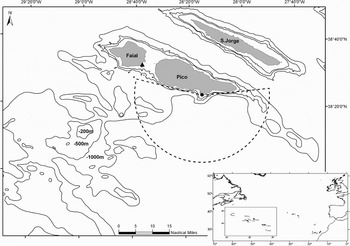
The Azores archipelago consists of nine volcanic islands, rising with several seamounts from a 2000 m depth delimited micro-plate (Needham & Francheteau, Reference Needham and Francheteau1972) in the North Atlantic (NA). It is located between 36°55′–39°43′N and 24°46′–31°16′W, on the east side near the Mid-Atlantic Ridge (Figure 1). The absence of a continental shelf on its coastal geomorphology provides the possibility to observe coastal and oceanic cetacean species, from land or boat. It represents the latitudinal distribution limit known for certain cetacean species in the north-east Atlantic (e.g. Hyperoodon ampullatus). In addition the occurrence of several migrating balaenopterids (e.g. fin whales: Chaves, Reference Chaves1924), resident delphinid species (Silva, Reference Silva2007) and others of unknown patterns of frequency (e.g. pilot whales, Globicephala macrorhynchus), make it an ecologically important observation point for cetaceans in the NA.
Azores archipelago in the North Atlantic context (northernmost islands on the bottom right of the image), and map of the main area covered, central group of islands, south Pico (inside dashed line - - -); (•) lookout location and (▴) Horta harbour.

Whale-watching first approaches data back to 1989, with ‘experimental’ trips using hydrophones, five years after the end of an important whaling tradition. It started officially in 1992 with one of the vigias from the whaling era, and a company based in Lajes on Pico. Currently it still uses many of the old observation points from land, to find the species and direct the boats, through binoculars and VHF radio. Most WW companies in the Azores, like in other places (e.g. Monterey Bay, CA), record the daily cetacean boat sightings to promote their activity, to present and future clients. Some are methodical and serious, accounting for several years of records.
Daily species checklist is a record of each species sighted daily, whenever observed, in the Azorean case, by the WW company boats. These data are recorded in a yes/no format for each species, in reference to a date. Although called ‘daily’, in the Azores most companies include reference to which part of the day (morning/afternoon) the sighting was made. The total number of boats operating during each part of the day is sometimes also recorded. These data are marked by discontinuities, as the boats do not go out to sea every day. Whale-watching companies operating with lookouts depend primarily on favourable weather conditions for species sighting, namely cloud cover (including rain and fog), wind velocity (Beaufort scale), glare and swell height; but also on clients' presence. Both these factors can cancel a WW trip and have actually determined the seasonal dimension of most companies operating in the Azores until now, and the resulting ‘environmental window’ available from these data (predominantly from April to October).
Once the conditions are reasonable for the lookouts and there are clients, other important factors come into play. Species behaviour and distance from the boat/departing harbour, taking into account the sea conditions (in this case wind speed and swell height) and least often, the age of the passengers, are possible sources of bias, specially for small size cetaceans, and species travelling on small pods. The type of boats, their size, number and engine power, vary per company and can change from year to year. Also, re-sighting of the same species/groups is a common event for regionally close companies, and should be taken in account if multiple data-sets are integrated from different sources. Nevertheless operators share a common goal of seeing as many different species as possible during each WW trip, providing some coherence in the modus operandi and increasing the checklist interest.
The following work develops the first approach to daily species checklist data, using Azorean WW to attain basic aspects of cetacean ecology, through comparison with sea surface temperature (SST).
MATERIALS AND METHODS
Daily checklist records from 2001 to 2006 were analysed, from the first WW company to record this type of data methodically in the region, ‘Espaço Talassa’. The study area corresponds to the main area covered by the lookout, with a maximum visibility of 12 miles from near Lajes do Pico, on the south coast of Pico Island, but also neighbouring areas (Figure 1). The area covered is over 698 Mn2, over depths of more than 1500 m. One to four semi-rigid boats performed 3-h trips, directed by one main lookout on land, between 0900 to 1300 and 1400 to 1800, from April to October.
A general sighting frequency for the years 2001 to 2004 was calculated using each morning and afternoon that at least one boat went to sea. The species recorded were: Hyperoodon ampullatus, Zifius cavirostris, Mesoplodon bidens, M. europaeus, Balaenoptera musculus, B. physalus, B. borealis, B. acutorostrata, Megaptera novaeanglia, Delphinus delphis, Tursiops truncatus, Stenella frontalis, S. coeruleualba, Grampus griseus, Globicephala macrorhynchus, Pseudorca crassidens, Orcinus orca, Physeter macrocephalus and Kogia breviceps. Fifteen day average SST values, from an area between 34°65′–42°67′N and 23°73′–33°51′W were used to describe maximum and minimum temperature for each of the above mentioned species. Processed satellite data from 16 April to 12 October in 2001–2003, and from 15 April to 11 October in 2004, was used on this analysis (provided by DOP-UAç/IMAR and DRP/SRAPA).
The second approach preformed was to assign morning and afternoon trips that at least one boat went to sea, to 1°C temperature classes from 16 May to 30 September 2005 and in 2006. For this set of data, daily 30 cm depth hand measurements made inside Horta harbour, were used (Figure 1; provided by the IMAR/DOP-UAç and DRP/SRAPA). Sighting frequencies of S. frontalis, S. coeruleualba, T. truncatus, G. griseus and D. delphis were used for comparison. Number of boats, type and engine power remained the same in this period. A Spearman correlation coefficient (Rs; P < 0.05; Siegel, 1956) was applied between sighting frequencies in the same temperature class using STATISTICA (StatSoft, Inc.), for each species between different years, and between all species in the same year.
RESULTS
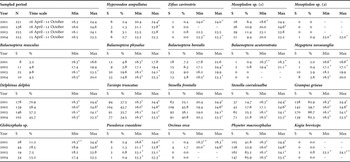
The number, sighting frequency and SST ranges for 19 cetacean species, from 3167 sightings between 2001 and 2004 are presented (Table 1; N = 967; corresponding to morning and afternoon trips that at least one boat went to sea). The potential for misidentification of small species of Mesoplodon based on morphological features is considerable even for experienced observers; they are here reported as Mesoplodon sp. (1) for M. bidens and Mesoplodon sp. (2) for M. europaeus. In the case of Globicephala it is known that most sightings are relative to the regionally referenced G. macrorhynchus, however, the author is aware of unreported sightings of G. melas based on underwater photographs, urging some caution on data interpretation. The Kogiidae were excluded from similar treatment since the author was onboard during both sightings.
Sighting frequencies and sea surface temperature ranges (°C) based on regionally remote sensed data (15 d averages; available by DOP/UAç), for 19 cetacean species sighted by a whale-watching company and recorded on a daily checklist, South Pico Island, Azores.

N, number of mornings and afternoons that at least one boat went to sea; S, number of sightings in mornings and afternoons; %, percentage of sightings; Min and Max, minimum and maximum sea surface temperature in degrees Celsius (°C); Mesoplodon sp. (1) is most probably M. bidens, and (2) M. europaeus.
*indicates values that coincide with the extreme average temperature registered during sample period.
+ indicates sightings isolated at least 15 d from others.
Species with sighting frequencies below 1% were Kogia breviceps, Balaenoptera acutorostrata, Orcinus orca and Zifius cavirotris. Pseudorca crassidens, all beaked and baleen whales were nearly below 10%. The exception was B. physalus, which together with Globicephala sp. and other delphinids stayed below 50% of sighting frequency. The species most observed during this period were Delphinus delphis, Grampus griseus and Physeter macrocephalus.
Sea surface average temperatures ranged between 16.0 and 24.6°C (Table 1), reflecting the end of the cold season and almost the entire warm season, that peaks in August with the highest values, and lasts until November (when the 18°C isotherm starts retrieving southward from north of the Archipelago; see Bashmachnikov et al., Reference Bashmachnikov, Laffon and Martins2004).
Ziphiidae sightings occurred always above 20.0°C, mostly between July and September, except for one isolated sighting of Mesoplodon sp. (1) in 18.6°C. Baleen whales were generally sighted from April to June–July. The B. musculus, B. physalus and Megaptera novaeanglia were not sighted frequently with average SST values above 20.0°C, while B. borealis sightings extended into higher SST values. Balaenoptera acutorostrata were only sighted rarely and, with all baleen whales except them, occurrences were registered in warmer waters, later in the season in 2003 and 2004. The Bryde's whale (B. edeni) although not present in these records, was sighted by the company for the first time in July 2004 (Steiner et al., Reference Steiner, Silva, Zereba and Leal2007).
Delphinus delphis, Tursiops truncatus, Stenella coeruleualba and G. griseus were sighted in general from April to October in the four years, occurring in the whole range of temperatures covered. Stenella frontalis were only sighted with average surface temperatures equal or above 18.95°C, usually appearing in mid-June, and present until the end of the sampling period. The other Delphinidae members include Globicephala sp. which were most sighted with temperatures above 17.4°C, appearing in early warm season. False killer whales (Pseudorca crassidens) were only sighted infrequently and temperatures were usually above 21.0°C. Orcinus orca specimens were sighted in high regional surface temperature values in 2003, and only once in 2002 but in temperatures between 16–17°C. The Physeteridae family members were observed during the entire period sampled, while on the other hand pigmy sperm-whales (Kogia breviceps) were sighted only in high SST values.
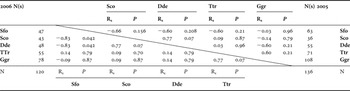
Within and between year Spearman correlation coefficients using sighting frequencies from temperature classes are given (Tables 2 & 3). Results reveal positive correlations between 2005 and 2006 for S. coeruleualba (Rs 0.89; P = 0.02) and marginally significant for S. frontalis (Rs 0.77; P = 0.07; Table 2). No significant correlations were found for the rest of the within species analysis between years. Inter-specific comparisons in the same year, revealed inverse correlation between sightings of S. frontalis and D. delphis (Rs−0.83; P = 0.04), as well as with S. coeruleualba (Rs−0.83; P = 0.04) in 2006. The last two species also revealed a positive correlation of sighting frequencies in temperature values, in both years (Rs 0.77; P = 0,07: identical values), which was nearly significant. A similar positive correlation between T. truncatus and G. griseus in 2006 was also found (Rs 0.77; P = 0.07).
Comparison of sighting frequencies on 1°C temperature classes (16 May to 30 September; range 17–23°C), between 2005 and 2006, for five cetacean species (Spearman Rs, P < 0.05).

Sfo, Stenella frontalis; Sco, Stenella coeruleualba; Dde, Delphinus delphis; Ttr, Tursiops truncatus; Ggr, Grampus griseus; Rs, Spearman correlation coefficient; P, P-value.
Comparison of sighting frequencies on 1°C temperature classes (16 May to 30 September; range 17–23°C), between five cetacean species within 2005 (upper right values), and 2006 (lower left) (Spearman Rs, P < 0.05).

N(s), sightings per species; Sfo, Stenella frontalis; Sco, Stenella coeruleualba; Dde, Delphinus delphis; Ttr, Tursiops truncatus; Ggr, Grampus griseus; N, total of mornings or afternoons with available temperature data; Rs, Spearman correlation coefficient; P, P-value.
DISCUSSION
The daily checklist registries from 2001 to 2004 included at least 20 of the 27 cetacean species sighted so far in the archipelago. Species not present have been observed only once, have not been sighted for more than 30 years or have been only positively identified from strandings or photographs (Chaves, Reference Chaves1924; Clarke, Reference Clarke1981; Reiner, Reference Reiner1981, Reference Reiner1986; Reiner et al., Reference Reiner, Goncalves and Santos1993; Gonçalves et al., Reference Gonçalves, Barreiros, Azevedo and Norberto1996; Steiner, Reference Steiner1995; Simas et al., Reference Simas, Herbert, Azevedo, Evans and Parsons1999; Barreiros et al., Reference Barreiros, Teves and Rodeia2006; Steiner et al., Reference Steiner, Silva, Zereba and Leal2007; plus G. melas and two beaked whales, Rui Prieto, personal communication).
The time scale was long enough to reveal six month multi-year occurrence for some species, and sighting frequency patterns for others, even though seasonally limited. Application to a wider regional data should be pursued in further works. As previously mentioned, there is not a pure systematic method of collecting these data, which might be behind possible failures in future validation for some species. Nevertheless sightings indicate the presence of species during this period, mainly for large cetaceans. One example is the species with sighting frequencies below 1%, which can be considered as rare to sight. In the case of Balaenoptera acutorostrata and Orcinus orca it is obvious that they were actually less frequent due to their size and sighting interest. In the case of Kogia breviceps and most beaked whales the method might be shadowing the real presence of these species that mix smaller sizes and evasiveness. Hyperoodon ampullatus, Pseudorca crassidens and baleen whales, were not frequently sighted (generally bellow 10%). Mesoplodons, Balaenoptera physalus together with Globicephala sp. were sighted more often (mainly below 15%). Excluding the scarcely sighted species data indicates that Balaenopterids, pilot whales, false killer whales, orcas and Hyperoodon ampullatus were not present during the whole season from 2001 to 2004, having a transient profile in the area during the sampled period.
The smaller delphinids (Stenella frontalis, S. coeruleualba, Delphinus delphis, Grampus griseus, Tursiops truncatus) and Physeter macrocephalus, were registered during six months (in all temperature ranges), on four consecutive years in the study area. Some authors have been reporting these species seasonally (e.g. Matthews et al., Reference Matthews, Steiner and Gordon2001; Silva et al., Reference Silva, Prieto, Magalhães, Cabecinhas, Cruz, Gonçalves and Santos2003; Pereira, Reference Pereira2006), and G. griseus have been sighted year-round in this area from 1992 to 2005 (João Gonçalves, personal communication). Photo-identification of P. macrocephalus indicates a year-round presence of the species, but only time-limited patterns of individual occurrence have been reported (Magalhães et al., Reference Magalhães, Silva, Prieto, Quérouil, Pinela and Santos2005). Only for Tursiops truncatus individual year-round residency has been proved (Silva, Reference Silva2007).
Stenella frontalis are an exception in this group, which might be considered as a seasonal-resident population. The arrival of this species in large numbers in the early warm season to the northernmost distribution known, for the north-east Atlantic, also showed an inverse sighting frequency correlation with D. delphis and S. coeruleualba. These were sighted during the whole period in all years, suggesting some sort of niche partitioning which is already under investigation with D. delphis (Querouil et al., in press), and should be extended to S. coeruleualba.
The reference of the company's first sighting of Balaenoptera edeni, was actually among the sources of data for the first article mentioning the species in the Azores (Steiner et al., Reference Steiner, Silva, Zereba and Leal2007). It is a clear indication of how important data becomes with any additional information, reiterating the urgent need to motivate biologists and skippers working on/with WW to publish their observations. In general, the simplicity of data was overcome by the diversity of sighted species and the dimension of the time scale. Data should keep being recorded and combined in the future with other areas as well as with higher SST definition, for increased robustness. Daily species checklist from WW is a low cost important source of information on cetaceans, which combined with other data-sets, can be a potential tool for assessment of long term changes.
ACKNOWLEDGMENTS
The author thanks all data collectors at ‘Espaço Talassa’, Serge Viallelle for authorizing data use; all involved in the DETRA project from DOP/UAç, namely Dr A. Martins and M. Figueiredo; R. Medeiros from Image DOP, the fastest map creator; and the anonymous referees for useful critiques and suggestions that contributed to the improvement of this paper.