Introduction
Service organizations play an increasingly important role in today's global economy and account for almost seventy percent of world GDP (Economy-overview., 2015). At the same time, in many countries, these organizations are confronted with a shrinking economy, emerging technology, and growing competition resulting in increased customer expectations of service providers (Wilder, Collier, & Barnes, Reference Wilder, Collier and Barnes2014). Conflicting and rapidly evolving customer needs and expectations create uncertainty (Raub & Liao, Reference Raub and Liao2012), and limit the effectiveness of highly prescriptive work roles in achieving organizational success (Bowen, Reference Bowen1990; Griffin, Neal, & Parker, Reference Griffin, Neal and Parker2007).
It is widely acknowledged that the performance of frontline service employees is crucial for service organizations' success and effectiveness (Borucki & Burke, Reference Borucki and Burke1999; Liao, Reference Liao2007; Liao & Chuang, Reference Liao and Chuang2004, Reference Liao and Chuang2007; Raub & Liao, Reference Raub and Liao2012). In financial service companies such as insurance companies where delivering financial services often requires a high level of involvement and considerable customer contacts (Chan, Yim, & Lam, Reference Chan, Yim and Lam2010), customers generally rely on service employees' behavior in forming their judgment about the quality of their experience and engagement with the service provider (Gremler & Gwinner, Reference Gremler and Gwinner2000). Moreover, contemporary employees need to be willing to do more than just execute core transactions, they need to be open to providing, if not even be solicitous and offering to provide, additional services to meet the customer's needs and/or the organization's goals (Nguyen, Johnson, Collins, & Parker, Reference Nguyen, Johnson, Collins and Parker2016). In light of the often-uncertain nature of the demands and expectations placed by customers on service organizations' employees, it is especially important that these employees adopt task-related discretionary service behaviors. Task-related discretionary service behaviors are defined as service employees' behaviors that are not prescribed or completely controlled by organizations, and are not performed according to pre-established scripts or detailed guidelines (Blancero & Johnson, Reference Blancero and Johnson2001) even though these behaviors are related to the tasks of service employees. To perform task-related discretionary service behaviors, service employees adapt to unstable working situations and show initiative in predicting future risks and obstacles and resolve them. This can be more necessary than formal tasks and predictable behaviors (Griffin, Parker, & Mason, Reference Griffin, Parker and Mason2010; Nguyen et al., Reference Nguyen, Johnson, Collins and Parker2016).
The approaches of adaptive service behavior (ASB) and proactive service behavior (PSB) are of vital importance to achieving favorable customer outcomes in service organizations, because frequently the customer's needs extend beyond the initial purpose of the communication or the contact (Nguyen et al., Reference Nguyen, Johnson, Collins and Parker2016). Social exchange theory (SET) can be employed to explain the effect of discretionary behavior of service employees on customers' voluntary and helpful behaviors (Chan, Gong, Zhang, & Zhou, Reference Chan, Gong, Zhang and Zhou2017). Although there are a modest number of studies examining ASB and PSB simultaneously (Strauss, Griffin, Parker, & Mason, Reference Strauss, Griffin, Parker and Mason2015), to the best of our knowledge, there is no research empirically examining their effect on customers' attitudes and behaviors.
Given the importance of task-related discretionary behaviors in the service sector, an understanding of the factors that can contribute to service employees' motivation to engage in these behaviors is crucial to enhance customer outcomes. Regardless of the well-established significance of ASB and PSB under uncertain working conditions (Nguyen et al., Reference Nguyen, Johnson, Collins and Parker2016), existing research is unclear regarding the role of the work context in shaping these behaviors. The role of the work context in attracting, retaining, and shaping behaviors that are effective at obtaining an acceptable fit between the employee and the organization (see Ashford, Blatt, and Walle, Reference Ashford, Blatt and Walle2003) needs research attention.
Social context variables, including organizational climate, are important for fostering discretionary service behaviors to improve organizational functioning and strategy (Parker, Bindl, & Strauss, Reference Parker, Bindl and Strauss2010). Generally, the idea that organizational climate can influence employee attitudes and behaviors has been well supported in academic literature (Ifinedo, Reference Ifinedo2018; Shanker, Bhanugopan, Van der Heijden, & Farrell, Reference Shanker, Bhanugopan, Van der Heijden and Farrell2017). In uncertain environments where job requirements are unclear and often unpredictable (Nguyen et al., Reference Nguyen, Johnson, Collins and Parker2016), interpersonal climate and social processes, such as managerial support and peer support, can motivate employees to feel safe and empowered to exercise their initiative and to anticipate a customer's possible needs (Parker, Bindl, & Strauss, Reference Parker, Bindl and Strauss2010; Wilder, Collier, & Barnes, Reference Wilder, Collier and Barnes2014). Thus, achieving positive organizational and customer outcomes are not solely dependent on hiring the ‘right’ people, such as those who are predisposed to be adaptive or proactive. Rather, the desired attitude, approach, and behaviors may be fostered in employees through the creation of an organizational climate that psychologically supports them (Wilder, Collier, & Barnes, Reference Wilder, Collier and Barnes2014). For example, employees who perceive that the organization cares about their well-being as a result of their positive perceptions of, or experiences with, the organization's remuneration policies or procedures or their supervisor's support, are more likely to be motivated and engaged (Dollard & Bakker, Reference Dollard and Bakker2010; Law, Dollard, Tuckey, & Dormann, Reference Law, Dollard, Tuckey and Dormann2011).
Some studies have examined the effect of various organizational climates on extra-role behaviors (Chan et al., Reference Chan, Gong, Zhang and Zhou2017; Liao & Rupp, Reference Liao and Rupp2005; Walumbwa, Hartnell, & Oke, Reference Walumbwa, Hartnell and Oke2010). However, there is no research that has empirically examined the effect of a psychologically supportive climate, specifically a psychosocial safety climate (PSC; climate for psychosocial health and safety) on discretionary service behaviors. PSC can provide important resources that shape, nurture, and sustain the adoption by employees of discretionary behaviors. In addition, some studies have considered how individual differences such as personality can affect proactive and adaptive behaviors (e.g., Griffin, Neal, & Parker, Reference Griffin, Neal and Parker2007; Griffin, Parker, & Mason, Reference Griffin, Parker and Mason2010; Neal, Yeo, Koy, & Xiao, Reference Neal, Yeo, Koy and Xiao2012). Although a modest number of studies have examined the interaction between individual characteristics and contextual factors in affecting proactive and adaptive behaviors (Nguyen et al., Reference Nguyen, Johnson, Collins and Parker2016), there is a lack of research into the positive state-like capabilities (rather than the traits) of service employees, which may interact with a PSC and influence task-related discretionary service behaviors operationalized in this study as ASB and PSB. Conservation of resource (COR) theory suggests that resources can be linked together leading to better human performance at work (Hobfoll, Reference Hobfoll2011).
Therefore, to address the research gap, this study examines to what extent PSC and employees' psychological capital (PsyCap; synergic interaction between individuals' resources of hope, efficacy, resiliency, and optimism) at the individual level both directly and interactively can positively influence ASBs and PSBs.
Certain organizational climates, practices, and behaviors can build individual, group, and organizational strengths and generate high performance (Cameron, Bright, & Caza, Reference Cameron, Bright and Caza2004). The state-like characteristic of PsyCap can develop the capability of employees and teams to deal with high demands in work environments (Friend, Johnson, Luthans, & Sohi, Reference Friend, Johnson, Luthans and Sohi2016). Although PsyCap has received a lot of attention in the literature (Avey, Reichard, Luthans, & Mhatre, Reference Avey, Reichard, Luthans and Mhatre2011; Friend et al., Reference Friend, Johnson, Luthans and Sohi2016; Kang & Busser, Reference Kang and Busser2018; Tsaur, Hsu, & Lin, Reference Tsaur, Hsu and Lin2019; Youssef-Morgan & Luthans, Reference Youssef-Morgan and Luthans2013), few empirical studies have been undertaken to apply the concept in multilevel models, particularly in service environments. Therefore, the current study aims to incorporate the construct of PsyCap in relation to its potential interaction with a psychosocially safe work environment to shape ASB and PSB, and contribute to enhanced customer engagement.
Literature review
Discretionary service behaviors (DSB)
Discretionary service behaviors, which are comprised of ASB and PSB, unlike other types of positive extra-role behaviors such as organizational citizenship behavior (Smith, Organ, & Near, Reference Smith, Organ and Near1983), are relevant because both of them are task-related and particular responses to unpredictable working environments such as service organizations (Nguyen et al., Reference Nguyen, Johnson, Collins and Parker2016).
ASB and PSB are vital in jobs with high demands and high control, because formal task elements may not always cover what is required for achieving positive customer outcomes (Nguyen et al., Reference Nguyen, Johnson, Collins and Parker2016). In service environments that are characterized by customer-based relationships, ASB is important, because, in most services, employees need to deal with and act in response to unpredictable customer needs and expectations. For example, in financial services such as insurance companies there are several insurance policies to offer, service employees need to suggest the appropriate policy to each customer based on customer's income, knowledge, lifestyle, age, and special needs. Employees who adapt their behavior for different customers are more likely to meet customers' expectations appropriately and consequently increase customer satisfaction (Coelho & Henseler, Reference Coelho and Henseler2012). Satisfied customers are more likely to stay loyal to their relationship with the firm. Customers remain loyal in a relationship if the attractiveness of adapted and offered services overweighs the switching costs (Coelho & Henseler, Reference Coelho and Henseler2012). PSB is also important, because it is less likely that task requirements are specified in advance in service relationships. Employees need to proactively scan the working environment and anticipate problems and act on them before they become unsolvable (Nguyen et al., Reference Nguyen, Johnson, Collins and Parker2016).
ASB is a desirable behavior that is considered as a solution to the evolving customer needs and expectations for greater variety, more specialized, and higher quality services (Coelho & Henseler, Reference Coelho and Henseler2012). ASB is defined as service employees' planned altering of ‘the service offering and/or adjustment of interpersonal behavior aimed at satisfying perceived consumer needs’ (Gwinner, Bitner, Brown, & Kumar, Reference Gwinner, Bitner, Brown and Kumar2005, p. 135).
Proactivity is about creating or controlling a situation rather than reacting to it after it has happened (Parker, Bindl, & Strauss, Reference Parker, Bindl and Strauss2010). PSB is defined as ‘an individual's self-started, long-term-oriented, and persistent service behavior that goes beyond explicitly prescribed service requirements’ (Rank, Carsten, Unger, & Spector, Reference Rank, Carsten, Unger and Spector2007, p. 366) aimed at solving problems, recommending improvements, or taking long-term responsibilities for an issue (Ohly & Fritz, Reference Ohly and Fritz2010). A forward-thinking approach is considered an important characteristic of PSB in service delivery. Proactive service employees use their own drive to act proactively to help their customers. They decide to do the most proper action without being prompted by supervisors, colleagues or customers (Raub & Liao, Reference Raub and Liao2012).
Psychological capital (PsyCap)
PsyCap, as the main construct of ‘positive organizational behavior’ is a form of positivity at an individual and/or collective level which has some correlations with personality constructs (Luthans, Avolio, Avey, & Norman, Reference Luthans, Avolio, Avey and Norman2007a). PsyCap refers to state-like positive personal and/or collective motivational resources, which can drive positive and extraordinary organizational behavior and performance. In the competitive working environment, the state-like and thus open to development characteristic of PsyCap can a play significant role in improving employees, teams and organizations' capability to adapt to challenges work situations (Friend et al., Reference Friend, Johnson, Luthans and Sohi2016). Drawing on the scientific criteria of positive organizational behaviors, namely, that they are developmental, measurable, and manageable for performance improvement, PsyCap is considered as a synergistic interaction of four positive resources. There are hope, efficacy, resiliency, and optimism (Luthans et al., Reference Luthans, Avolio, Avey and Norman2007a, Reference Luthans, Youssef and Avolio2007b).
Psychosocial safety climate (PSC)
PSC, a ‘climate for psychosocial health and safety,’ is a facet-specific component of organizational climate. It refers to shared perceptions of ‘policies, practices and procedures for the protection of worker psychological health and safety’ (Dollard & Bakker, Reference Dollard and Bakker2010, p. 580). PSC is considered as an upstream, organizationally healthy, conductive resource (Dollard & McTernan, Reference Dollard and McTernan2011), affected by senior management philosophies, values, and attitudes.
In general, high PSC is characterized by senior management support, involvement and commitment to employees' psychological health (Dollard, Tuckey, & Dormann, Reference Dollard, Tuckey and Dormann2012). The management gives priority to psychological health and safety versus productivity goals (Hall, Dollard, & Coward, Reference Hall, Dollard and Coward2010), well-established upward and downward organizational communication systems are in place in relation to psychosocial health and safety, and there is high level organizational involvement in stress prevention and psychological wellbeing (Dollard & McTernan, Reference Dollard and McTernan2011; Hall, Dollard, & Coward, Reference Hall, Dollard and Coward2010). PSC characteristics imply that senior management, in a high PSC, act quickly to address and correct psychological health issues (Idris, Dollard, Coward, & Dormann, Reference Idris, Dollard, Coward and Dormann2012). Managers also have the discretion to offer a variety of job resources, such as work flexibility, autonomy, and social support that can mitigate work pressures and work stress (demands) to enhance employees' psychological health (Dollard, Dormann, Tuckey, & Escartín, Reference Dollard, Dormann, Tuckey and Escartín2017). Therefore, as PSC is an organizational resource that is expected to have an effect on work context, low PSC results in poor job design, excessive levels of job demands and poor performance (Dollard & Bakker, Reference Dollard and Bakker2010).
Customer engagement behavior
Researchers and practitioners have increasingly recognized the importance of the firms' customer relationships by engaging customers with the firm and thereby fostering long-term interactions (Verleye, Gemmel, & Rangarajan, Reference Verleye, Gemmel and Rangarajan2014), competitive advantage, sales growth, and profitability (Voyles, Reference Voyles2007). Some studies consider customer engagement as an attitude (Brodie, Ilic, Juric, & Hollebeek, Reference Brodie, Ilic, Juric and Hollebeek2013) whereas others define it as a measurable behavior (Van Doorn et al., Reference Van Doorn, Lemon, Mittal, Nass, Pick, Pirner and Verhoef2010; Verleye, Gemmel, & Rangarajan, Reference Verleye, Gemmel and Rangarajan2014), and others as both attitude and behavior (Hollebeek, Reference Hollebeek2011; Kumar, Aksoy, Donkers, Venkatesan, Wiesel, & Tillmanns, Reference Kumar, Aksoy, Donkers, Venkatesan, Wiesel and Tillmanns2010; Vivek, Beatty, & Morgan, Reference Vivek, Beatty and Morgan2012). However, most empirical studies operationalized customer engagement as a behavioral manifestation (Kumar & Pansari, Reference Kumar and Pansari2015). Therefore, this study adopted behavioral manifestation, in line with Van Doorn et al., (Reference Van Doorn, Lemon, Mittal, Nass, Pick, Pirner and Verhoef2010) construct of customer engagement behavior (CEB). CEB is defined as a behavioral manifestation that goes beyond transactions toward the brand or firm (Van Doorn et al., Reference Van Doorn, Lemon, Mittal, Nass, Pick, Pirner and Verhoef2010) or as a voluntary resource contribution of customers to a brand or a firm, that is concerned with matters beyond the transaction (Jaakkola & Alexander, Reference Jaakkola and Alexander2014).
Based on the reasoning of (Kumar et al., Reference Kumar, Aksoy, Donkers, Venkatesan, Wiesel and Tillmanns2010), CEBs are voluntary and discretionary customer behaviors toward the firm. Customers can show CEBs in a multiplicity of forms, including cooperation, compliance, feedback, helping other customers and through, positive word of mouth (Verleye, Gemmel, & Rangarajan, Reference Verleye, Gemmel and Rangarajan2014). Cooperation can be labeled as benevolent actions to assist and help employees to complete their tasks (Verleye, Gemmel, & Rangarajan, Reference Verleye, Gemmel and Rangarajan2014). Compliance is defined as the degree to which the customer conforms to the firm's procedures and regulations. Since the success of customer participation and quality of service depend on customers' compliance with organizational rules (Verleye, Gemmel, & Rangarajan, Reference Verleye, Gemmel and Rangarajan2014), this form of CEB is also a relevant and valid perspective. Feedback, including suggestions for service improvement and customer voice (Verleye, Gemmel, & Rangarajan, Reference Verleye, Gemmel and Rangarajan2014), is another customer engagement behavioral manifestations toward both firms and their employees (Bove, Pervan, Beatty, & Shiu, Reference Bove, Pervan, Beatty and Shiu2009; Liu & Mattila, Reference Liu and Mattila2015).
Helping other customers can take different forms, including showing empathy (Verleye, Gemmel, & Rangarajan, Reference Verleye, Gemmel and Rangarajan2014), asking other customers to show patience (Bove et al., Reference Bove, Pervan, Beatty and Shiu2009) and assisting others to enjoy a higher quality experience (Kumar et al., Reference Kumar, Aksoy, Donkers, Venkatesan, Wiesel and Tillmanns2010). Word-of-mouth refers to informal communications between perceived non-commercial communicators and receivers in relation to specific issues/objects (Bove et al., Reference Bove, Pervan, Beatty and Shiu2009). It can include recommending a firm or brand to others, blogging and writing reviews (Bolton, Reference Bolton2011) which are, in some businesses, more important than repurchase intentions (Van Doorn et al., Reference Van Doorn, Lemon, Mittal, Nass, Pick, Pirner and Verhoef2010).
Theoretical framework and hypothesis development
Theoretical framework
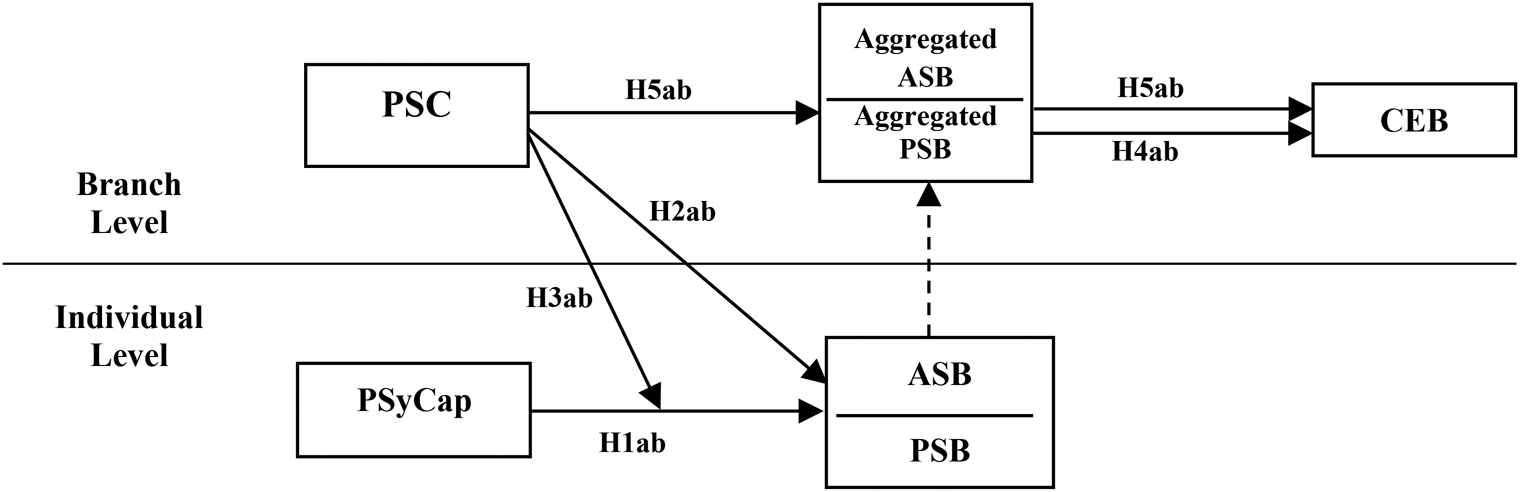
The theoretical framework for the study is developed so as to shape the conceptual model (Fig. 1) to be tested. COR and social exchange theories are employed to explain the proposed model.
Hypothesized multilevel model of discretionary behaviors in service organizations.

COR theory postulates that individuals attempt to acquire, develop, and preserve their valuable resources. Drawing on COR theory, personal and social resources can be linked as ‘resource caravans’ creating a synergy among them (Hobfoll, Reference Hobfoll2011). Resource caravans are created and conserved in ‘resource caravan passageways.’ PSC can act as ‘resource caravan passageways’ and maintain, supply, and protect a resource caravan (Loh, Idris, Dollard, & Isahak, Reference Loh, Idris, Dollard and Isahak2018). Therefore, in a positive PSC, employees' psychological resources and organizational level psychosocial resources can be combined and developed over time (Dollard & Bakker, Reference Dollard and Bakker2010).
In a high PSC, resources provided by senior management can interact with employees' PsyCap that can enhance employees' motivation to engage in task-related discretionary behaviors. Thus, PsyCap and upstream psychosocial resources (e.g., PSC) interact to drive frontline service employees' discretionary, task-related behaviors (ASB and PSB) in a service context.
Reciprocity reinforcement as one the norms of SET suggests that to sustain a relationship, benefits or beneficial treatments provided by one party should be repaid by the other party (Blau, Reference Blau1964). SET is also employed in explaining none-prescribed behaviors like discretionary and extra-role behaviors (Chan et al., Reference Chan, Gong, Zhang and Zhou2017). In the absence of formal commitments for reciprocity, to maintain their social exchange, the parties are more likely to reciprocate the received benefits (Gouldner, Reference Gouldner1960). According to SET, employees who perceive that the organization allocates substantial resources to enhance their well-being, trust the organization to provide more resources that they need to make decisions during their interactions. The support that they receive from management through job resource allocation (i.e., job control) motivates them to engage in going extra mile to help the organization and its customers (Salanova, Agut, & Peiró, Reference Salanova, Agut and Peiró2005).
As frontline employees are the key factors in most service encounters, they can influence the likelihood of customers' engagement in discretionary and helpful behaviors toward a firm and its employees (Bove et al., Reference Bove, Pervan, Beatty and Shiu2009), that is, CEBs (Verleye, Gemmel, & Rangarajan, Reference Verleye, Gemmel and Rangarajan2014). When the firm and its employees support their customers, for example through showing ASB and PSB, the customers experience positive feeling toward the firm and its employees (Claycomb & Martin, Reference Claycomb and Martin2002). After establishing an emotional bond between customers and service employees during the interaction, the relationship escalates to the stage of engagement (Pansari & Kumar, Reference Pansari and Kumar2017) to sustain the social exchange.
Employees' PsyCap and discretionary service behaviors
The evolving work context has changed employers' expectations from just doing prescribed work roles to performing discretionary behaviors and employees' expectations from job security and pay to personal and career development. In this working environment, the impact of PsyCap is expected to go beyond in-role performance improvement to extra-role performance that can result in desirable outcomes and extraordinary performance (Avey, Luthans, & Youssef, Reference Avey, Luthans and Youssef2010). The results of a meta-analysis showed that higher levels of PsyCap in workplaces are associated with a range of positive outcomes, including in-role and extra-role behaviors (Avey et al., Reference Avey, Reichard, Luthans and Mhatre2011). The underlying mechanism to explain how PsyCap can develop positive outcomes is in its positive psychological resources.
The state-like malleability of PsyCap and its focus on the behavioral performance impact at both individual and collective levels indicates the importance of these motivational and behavioral tendencies (Dawkins, Martin, Scott, & Sanderson, Reference Dawkins, Martin, Scott and Sanderson2015) with respect to service employees' behaviors (Friend et al., Reference Friend, Johnson, Luthans and Sohi2016). In other words, during highly demanding and rapidly changing interactions between service employees and customers, the state-like components of PsyCap, can act as valuable personal resources in meeting the demands or performance improvements of service employees. The discretionary nature of ASB and PSB are specifically related to broader, holistic, integrated outcomes of PsyCap. Components of PsyCap can motivate or support employees in doing their discretionary performance. For example, in service tasks, hope and efficacy give service employees internal motivation and confidence in serving customers (Wijewardena, Härtel, & Samaratunge, Reference Wijewardena, Härtel and Samaratunge2017). Efficacious service employees can provide customers with various service options and they proactively anticipate future needs and solutions. Hope provides them with motivational resources to find new ways to achieve service goals (Avey, Luthans, & Youssef, Reference Avey, Luthans and Youssef2010). In facing service failure, when hope and efficacy are not able to motivate employees to pursue specific goals, optimism can create an overall positive expectation about the future. The perseverance aspect of optimism encourages service employees to show tenacious effort toward achieving service goals. The reactive nature of resilience helps service employees to deal with setbacks and to try again. The integrated nature of PsyCap is very important, because when one of the components of PsyCap is lacking, the other components can compensate (Avey et al., Reference Avey, Reichard, Luthans and Mhatre2011). In general, PsyCap is an integrated psychological resource that supports service employees' adaptive and proactive performance. Therefore:
Hypothesis 1: Service employees' individual level PsyCap is positively associated with individual level ASB (a) and PSB (b).
PSC and discretionary service behaviors
PSC is an organizational resource that is expected to have an effect on work context and thus can have a wide range of outcomes (Dollard & Bakker, Reference Dollard and Bakker2010; Lee, Seo, Jeung, & Kim, Reference Lee, Seo, Jeung and Kim2019) through affecting employees' psychosocial safety, wellbeing, and job engagement (Lee & Idris, Reference Lee and Idris2017). In explaining how PSC affects working conditions, Loh et al. (Reference Loh, Idris, Dollard and Isahak2018) suggested two mechanisms. First, PSC helps employees and organizations to maintain, protect and supply resources at job level through supportive management decisions. In high PSC, employees perceive the organizational climate as supportive of their psychosocial well-being and eager to communicate with them about their concerns (Mirza, Isha, Memon, Azeem, & Zahid, Reference Mirza, Isha, Memon, Azeem and Zahid2019). Thus, employees expect to overcome the job demands with less effort and appraise demands as challenge stressors, which is expected to have a positive effect on performance and motivation (Lepine, Podsakoff, & LePine, Reference Lepine, Podsakoff and LePine2005).
The second mechanism suggests that PSC creates a sense of safety and security in organization signaling employees to use high levels of job resources to overcome job demands (Loh et al., Reference Loh, Idris, Dollard and Isahak2018). When working teams and/or team members conceive the organizational climate as a psychosocially safe, they feel safe to take the risk of engaging in risk-taking behavior. PSC can provide not only a wide range of instrumental, social, and emotional resources for employees' extra efforts, but can offset the deterrent effect of psychosocial hazards such as work stressors and workplace issues (Dollard & McTernan, Reference Dollard and McTernan2011; Mansour & Tremblay, Reference Mansour and Tremblay2018). Relying on the reciprocity norm of SET, employees who perceive that the organization supports their psychosocial safety, are more likely to be physically, emotionally, and cognitively engaged in their work (Dollard & Bakker, Reference Dollard and Bakker2010). Employees who are engaged in their work, invest extra effort in their tasks and exhibit extra-role behavior (Zhong, Wayne, & Liden, Reference Zhong, Wayne and Liden2016). Salanova and Schaufeli (Reference Salanova and Schaufeli2008) in their study found that work engagement as a sign of intrinsic work motivation increased employees' proactive behavior. Engaged service employees are motivated to achieve organizational goals and satisfy their customers; therefore, they adapt the service offering and responses to customers' needs and take initiative to address any service issues before happening (Li, Chen, Lyu, & Qiu, Reference Li, Chen, Lyu and Qiu2016). With a high level of job engagement, service employees are more likely to act proactively and make changes to their service offerings when they observe that formalized role prescriptions cannot meet customer demands.
In a high PSC context, employees are able to perform demanding service tasks and even go beyond and exhibit ASB and PSB when formalized role expectations are not able to meet customer needs. That is, PSC at an organizational level can shape ASB and PSB at individual levels. Accordingly, PSC should be positively associated with individual ASB and PSB.
Hypothesis 2: PSC at branch level is positively associated with ASB (a) and PSB (b) at the individual level.
Interaction between PSC and PsyCap
In every organization, there are cross-level interactions among individuals, teams, and the contextual factors that shape the majority of outcomes (Hackman, Reference Hackman2009). Luthans and Youssef (Reference Luthans and Youssef2007) suggested that positive traits and states (as embodied in PsyCap) and their interaction with positive organizational characteristics can pave the way for emerging positive behaviors. Avey, Luthans, and Youssef (Reference Avey, Luthans and Youssef2010) in their integrative models, included both organizational-level factors such as organizational strategy, culture, person–organization and person–job fit and individual-level factors such as personality traits, previous life experiences, and PsyCap.
Engaging in ASB and PSB, as proposed in hypotheses 1a and 1b, can be predicted by higher levels of PsyCap. PsyCap can include social support and buffering mechanisms (Avey, Luthans, & Youssef, Reference Avey, Luthans and Youssef2010) in dealing with demanding tasks. PSC, as an upstream resource, provides employees with cognitive, motivational and social resources. COR theory postulates that individuals attempt to acquire, develop, and preserve their valuable resources. Relying on the principle of resource investment of COR (Hobfoll, Reference Hobfoll2011), resourceful individuals are more capable of obtaining more resources. Therefore, in a high PSC, employees who have high levels of PsyCap, according to the ‘spiral of resource gains’ (Hobfoll, Reference Hobfoll1998, p. 82), can gain more resources from their environment (Idris et al., Reference Idris, Dollard, Coward and Dormann2012), motivating them to increasingly engage in superior performance and taking initiative to benefit their customers. When senior managers support the psychological well-being of employees, their control over the job and the freedom to develop new skills will improve (Dollard & Bakker, Reference Dollard and Bakker2010). In a positive PSC, employees' psychological resources (embodies in this study as PsyCap) and organizational level psychosocial resources provided by a high PSC, can be interacted and developed over time (Dollard & Bakker, Reference Dollard and Bakker2010). In a high PSC, resources provided by a psychosocially safe work climate can be interacted and matched with employees' PsyCap that can enhance employees' motivation to engage in ASB and PSB.
Hypothesis 3: PsyCap at the individual level and PSC at the branch level interact in affecting ASB (a) and PSB (b) at the individual level.
Branch-level ASB and PSB and CEB
Employee service performance can directly impact customers' decision to stay in or quit a service relationship (Liao & Chuang, Reference Liao and Chuang2007; Walumbwa, Hsu, Wu, Misati, & Christensen-Salem, Reference Walumbwa, Hsu, Wu, Misati and Christensen-Salem2018). The positive relationship between service employees' behavior and customer behavior has been supported by several studies (Liao & Chuang, Reference Liao and Chuang2004, Reference Liao and Chuang2007).
ASB and PSB form emotional and social bonds, trust and gratitude among customers which consequently encourage customers' intentions to establish a long-term relationship with the service company (Liao & Chuang, Reference Liao and Chuang2007). According to SET (Blau, Reference Blau1964), when service employees focus on personalizing interactions, delighting their customers, and recognizing customers' unique needs, customers show their appreciation by staying loyal with the service company then the relationship escalates to the stage of engagement (Pansari & Kumar, Reference Pansari and Kumar2017). Thus, employees with better ASB and PSB are more successful in developing long-term relationship with customers and engaging them with the company.
Generally, in service relationships the overall level of service behaviors of employees who serve customers, not the behavior of one employee, shape customers' attitude, and behaviors toward the specific service environment (Liao & Chuang, Reference Liao and Chuang2004). In addition, social processing and shared perceptions of organizational climate in a service environment such as a service branch are likely to result in comparatively similar behaviors and performance across employees within the same branch (Liao & Chuang, Reference Liao and Chuang2004). Therefore, individual-level ASB and PSB shape collective ASB and PSB. Service research has empirically supported the relationship between aggregated employee service performance and customer outcomes including customer satisfaction, loyalty, purchase behavior, and customer perception of service quality (Liao & Chuang, Reference Liao and Chuang2004; Raub & Liao, Reference Raub and Liao2012). Therefore, we propose that:
Hypothesis 4: At the branch level, ASB (a) and PSB (b) are positively associated with CEB.
The mediating role of ASB and PSB
In a high PSC environment, where managers care about employees' psychosocial safety and health, employees are offered a wide range of job resource providing them with a safe work context (Idris et al., Reference Idris, Dollard, Coward and Dormann2012). In line with ‘resource passageway’ of (Hobfoll, Reference Hobfoll2014), PSC can both conserve and develop resources which are required to motivate teams or individuals (Loh et al., Reference Loh, Idris, Dollard and Isahak2018) to perform better. Employees, who perceive their organizational climate as high PSC, will be assured of receiving sufficient safety resources to do their tasks (Mansour & Tremblay, Reference Mansour and Tremblay2018) and even go beyond the call of duty. For example, in service organizations when prescribed tasks do not suffice in dealing with customer special needs and employees need to spend extra efforts and take initiative to address them, PSC can assist employees to have access to enough job resources. Service employees in such a psychosocially safe work environment which signal them that the environment is safe, take the risks of spending more resources in doing discretionary service behaviors including ASB and PSB. Service employees who perceive that the managers pay attention to the psychosocial health of them at work and provide them with more safety resources will transfer resources to the customers. Then, the customers feel safe to engage with the organization and its employees beyond their transactions.
Hypothesis 1 suggests that at the branch level, PSC is positively associated with ASB and PSB, and hypothesis 4 proposed that ASB and PSB at the branch level are positively related to CEB. These hypotheses suggest that PSC indirectly positively affects CEB via aggregated ASB and PSB at the branch level. Because customers are not directly able to perceive the organizational practice and procedures aiming at protecting psychosocial safety of service employees, such an indirect relationship would be logically predictable. However, their decisions about future service relationships and engaging with the company will be directly affected by service employees' ASB and PSB in the branch. To the extent that PSC should be related to branch-level ASB and PSB, therefore it should indirectly positively affect CEB. Based on this rationale, it can be proposed that:
Hypothesis 5: At the branch level, ASB (a) and PSB (b) mediate the relationship between PSC and CEB.
Method
Sample and procedures
Drawing on a cluster sampling method (Creswell, Reference Creswell2014; Neuman, Reference Neuman2013), samples were chosen. At first, a list of insurance companies in Iran was obtained from the Central Insurance of IR Iran's website. In total, 29 insurance companies, having 1,043 branches and employing 18,612 individuals in service positions, were operating in the Iranian insurance market across 31 provinces (BimehmarkaziIran, 2015–2016). Then, three highly populated provinces were chosen for the conduct of the surveys. In the next step, two highly populated cities were chosen per province. In accordance with a multi-level approach, the sampling procedure was started from the higher level (i.e., team/branch level). Each branch of every insurance company was considered as a working team. Finally, 60 branches of insurance companies (10 branches each city) were randomly selected. Managers of the branches, 10 employees, and 10 customers which were randomly selected in each branch were invited to participate in the study. A total of 56 branches returned useable questionnaires, including 56 managers, 513 service employees, and 560 customers.
Employee respondents were 64.2% male and 35.8% female, 42% in the age range of 30–39, 26% in the age range of 40–49 and the remaining respondents were 50 and over (32%). In addition, 80.1% of the employee sample had less than 20 years of work experience and 85.9% of the employee respondents had a university degree. The customer sample included 57% males and 43% females. 62.8% of them had university degrees.
Measures
ASB was measured with 10 items developed by Gwinner et al., (Reference Gwinner, Bitner, Brown and Kumar2005). Some adjustments were made to adapt the scale into a supervisor-rated form. A 7-item measure of PSB developed by Rank et al., (Reference Rank, Carsten, Unger and Spector2007) which was adopted by Raub and Liao (Reference Raub and Liao2012) was utilized in this study. Minor adjustments were made to the wording of the measure to adapt the measure to the working teams (e.g., replacing ‘My staff member’ with ‘This team member’). PsyCap was measured using the 12-item PsyCap questionnaire (PCQ-12) (Luthans & Youssef, Reference Luthans and Youssef2007). PSC was measured with a 12-item questionnaire developed by Hall, Dollard, and Coward (Reference Hall, Dollard and Coward2010). The CEB measure in the customer survey was adapted from Verleye, Gemmel, and Rangarajan (Reference Verleye, Gemmel and Rangarajan2014). To adapt the measure to the context of insurance companies', after discussing the items with the insurance managers, authors decided to delete three items related to helping other customers based on the nature of insurance service. Therefore, 12 of the original 15 items could adequately capture the customer engagement construct and the nature of the customers' possible engagement in insurance companies at the same time. Sample items include: ‘I do things to make the employees’ job easier’ and ‘I recommend this company to people interested in insurance.’
ASB, PSB, and CEB measures were rated using a 7-point scale, ranging from ‘strongly disagree’ (1) to ‘strongly agree’ (7). PsyCap was rated on a 6-point scale, ranging from ‘strongly disagree’ (1) to ‘strongly agree’ (6). PSC items were accompanied by a 5-point rating scale, ranging from (1) ‘strongly disagree’ to (5) ‘strongly agree.’ Managers responded to ASB and PSB, service employees responded to PsyCap and PSC and customers responded to CEB measures. PsyCap measure was analyzed at the individual level, ASB and PSB were analyzed at both individual and branch levels. PSC and CEB were analyzed at the branch level. Branch level constructs were computed by taking the average of the individual scores in every branch.
In some cases PsyCap seems to have positive correlation with personality constructs (Luthans et al., Reference Luthans, Avolio, Avey and Norman2007a, Reference Luthans, Youssef and Avolio2017b), despite the difference regarding openness to change and development. Thus, this study controlled for five-factor model of personality using Goldberg's International Personality Item Pool (Goldberg, Reference Goldberg1999). Qualification and work experience of service employees were also controlled.
Results
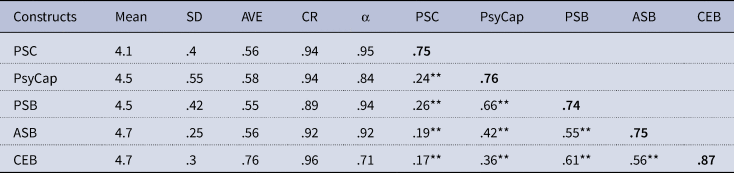
Validity of the measures has been examined with respect to convergent and discriminant validity. All constructs have an average variance extracted (AVE) greater than .50 and construct reliability estimates all exceeded .70 suggested by Fornell and Larcker (Reference Fornell and Larcker1981) (see Table 1) thus the convergent validity of the constructs are achieved.
Convergent and discriminant validity and correlations

SD, standard deviation; AVE, average variance extracted; α, Cronbach's alpha; CR, composite reliability, square roots of AVEs are reported in bold in the diagonal.
**p < .01.
Construct correlations which are shown in Table 1 are compared to the square roots of AVEs. The square roots of AVEs were higher than their respective correlations for each construct indicating an adequate discriminant validity of the constructs
Aggregation of variables to the branch level
This study examined the impact of branch-level PSC on individual-level ASB and PSB and the impact of branch-level ASB and PSB on CEB. Given this objective, it was needed to investigate whether individual assessments of PSC, ASB, and CEB can be aggregated to the branch level.
A within-group agreement index (r wg(j)) (Bliese, Reference Bliese, Klein and Kozlowski2000) of the scores from the individual level was calculated to represent within-group consensus and justify aggregation of the constructs to the branch level. Intra-class correlations (ICCs), including ICC(1) comparing the variance between units of analysis to the variance within units of analysis and ICC(2) assessing the relative status of between and within variability, was also computed. Lebreton and Senter's (Reference Lebreton and Senter2008) syntaxes for SPSSFootnote 1 were employed to calculate r wg(j) and ICCs.
Homogeneity of PSC was assessed with r wg(j) (Bliese, Reference Bliese, Klein and Kozlowski2000), resulting in median r wg(j) = .78 (range = .61–.85). For PSB, the median r wg(j) value was .75 (range = .39–.96) and for ASB the median r wg(j) value was .91 (range = .82–.96). In addition, for CEB the median r wg(j) value was .86 (range = .80–.91).
ICC(1), and reliability of the mean ICC(2) (Bliese, Reference Bliese, Klein and Kozlowski2000) for the respective constructs were as follows: ICC(1) = .10 and ICC(2) = .53 for PSC; ICC(1) = .25 and ICC(2) = .77 for ASB; ICC(1) = .46 and ICC(2) = .90 for PSB; for CEB ICC(1) = .06 and ICC(2) = .41. These values compare convincingly to the accepted r wg(j) and ICC cut-off values (Schneider, White, & Paul, Reference Schneider, White and Paul1998), except for the ICCs of CEB.
One-way analysis of variance was conducted to test between-units variance. This analysis was conducted, using branch affiliation of each respondent as the independent variable. Results indicated that PSC, ASB, PSB, and CEB showed significant between-units variance, PSC: F(55, 483) = 2.114, p < .001; ASB: F(55, 482) = 4.373, p < .001; PSB: F(55, 488) = 9.585, p < .001; and CEB: F(55, 499) = 1.695, p < .01. All together, these statistics suggest acceptably high within-group homogeneity and between groups variance and lead to the conclusion that aggregation of individually rated measures of PSC, ASB, and PSB to the branch level was warranted. Although ICC(1) tends to be low in organizational studies (Mathieu, Aguinis, Culpepper, & Chen, Reference Mathieu, Aguinis, Culpepper and Chen2012), there are evidence of high ICC(1) values in marketing and management studies (e.g., Chan et al., Reference Chan, Gong, Zhang and Zhou2017; Chang, Reference Chang2016; Liao & Chuang, Reference Liao and Chuang2004). Lebreton and Senter (Reference Lebreton and Senter2008) also suggested high ICC values for climate studies. In addition, given the appropriate r wg(j) and within-group homogeneity and between group variance and also similar ICC values in other studies (Raub & Liao, Reference Raub and Liao2012; Schneider, White, & Paul, Reference Schneider, White and Paul1998), ICC values of CEB can be considered as moderate values for these statistics and do not seem low enough to prohibit aggregation.
HLM approach for ASB and PSB models
A hierarchical linear modeling (HLM) (Bryk & Raudenbush, Reference Bryk and Raudenbush1992) approach was adopted because of the hierarchical nature of data (the service employees and customers were nested in branches of insurance companies). In addition, the ASB and PSB models to be tested were mixed levels (see Fig. 1).
A staged approach to the HLM analysis was adopted for the models of ASB and PSB. First, two null models with no predictors at either level-1 (the individual level) or level-2 (the branch level) was estimated to split the ASB and PSB variances into within- and between-branch components. The null model provides a basis for calculating the ICC coefficient to show whether multilevel modeling is needed as well as the deviance statistic and other coefficients used as a baseline for comparing the null model with more complex models (Garson, Reference Garson2013). Second, two random coefficient regression models of ASB and PSB were regressed on individual level variables including PsyCap and control variables in estimating model 2 of both ASB and PSB. The random coefficient regression models included predictors at level-1 without any predictors at level-2 although the grouping variable remained a random factor. The intercepts of ASB and PSB and β coefficient of PsyCap at level-1 were modeled as random effects of branch as a grouping variable. In the third step, a full random coefficient model was estimated for both ASB and PSB. In this type of hierarchical model, which can be used to analyze level-2 and cross-level relationships, there are predictors at level-1 and level-2 and both level-1 intercepts and slopes are predicted as random effects. In this step, the intercept estimates obtained from level-1 were used as outcome variables and regressed on branch level (PSC) and slope estimates of the level-1 were regressed on PSC to assess cross-level effects.
HLM results for ASB and PSB
Null models
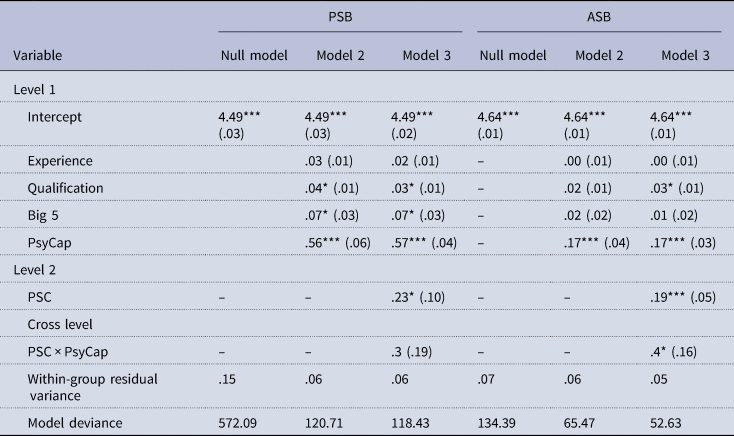
The results of ASB and PSB null models are shown in Table 2. The significant between-branch variances in ASB (τ = .006, p < .001) and PSB (τ = .03, p < .001) null models indicate that the intercepts of the outcome variables, ASB and PSB, are significantly affected by their predictors, which is the level-2 effect of branch (the grouping variable). The between-branch variances (the grouping variable effect) are smaller than the residual variance components (.07 for ASB null model and .15 for PSB null model), indicating that there is still residual variation in ASB and PSB to be explained and that models with additional predictors may be needed.
HLM results for PSB and ASB

*p < .05, ***p < .001. Values in parentheses are standard errors. Deviance is an indicator of model fit. Deviance = −2 × log-likelihood of the full maximum-likelihood estimate.
A significant intercept component implies that the ICC coefficient is also significant, indicating a multilevel model is appropriate. The ratio of between-branch to total variance produced an ICC coefficient of .75 for ASB and .83 for PSB, suggesting that 75 and 83% of the variance in ASB and PSB resides between groups. The significant between-store variance in ASB and PSB and ICCs support the hypotheses that predict both individual- and branch-level variables would be significantly related to ASB and PSB.
Random coefficient regression models
The level-1 models or the random coefficient regression models of ASB and PSB in Table 2 (model 2) were estimated including all individual control variables and PsyCap as the independent variable, with no predictors specified for level-2. The likelihood ratio test was used as a test of whether the level-1 model fit the data significantly better than the null models. Deviance dropped from 134.39 in the null model to 65.47 in the random coefficient regression model (level-1 model) in ASB models. For PSB models, deviance dropped from 572.09 in the null model to 120.71 in the random coefficient regression model (level-1 model) (see Table 2) indicating model fit. The likelihood ratio tests show the differences to be significant at better than the .001 level and .001 for ASB and PSB models respectively.
Hypotheses 1a and 1b predicted that individual-level PsyCap is associated with individual level ASB and PSB. The random error variance on the intercept was significant for both models (see Table 2). According to the results, none of the control variables was significant in level-1 model of ASB but service employees' qualification and personality were positively related to PSB; however, work experience was not significant. PsyCap was positively related to both individual ASB (ŷ = .17, p < .001) and PSB (ŷ = .56, p < .001). Therefore, both hypotheses 1a and 1b were supported.
Full random coefficients models
Hypotheses 2a and 2b predicted that PSC is positively associated with individual ASB and individual PSB. Hypotheses 3a and 3b suggest there is a cross-level interaction of PSC and PsyCap in affecting individual ASB and PSB. To test these hypotheses, two full random coefficients models of ASB and PSB were estimated (Table 2) including control variables and PsyCap at level-1 and PSC at level-2. In both models (model 3 for ASB and PSB), the level-1 intercepts and the level-1 slopes of PsyCap were predicted as random effects. Model deviance dropped from 65.47 in the random coefficient regression model to 52.63 in the full random coefficient regression model (level-1 model) of ASB. For PSB models, deviance dropped from 120.71 in the random coefficient regression model to 118.43 in the full random coefficient regression model indicating the model fit. The likelihood ratio tests show the differences to be significant at better than the .001 level for both ASB and PSB models.
According to the results shown in Table 2 when the level-2 variable (PSC) and the cross-level interaction of PSC and PsyCap were added to the model, only service employees' qualification was significantly associated with ASB. Service employees' qualification and personality showed a significant relationship with PSB. In both models, individual PsyCap demonstrated significant relationships with ASB (ŷ = .17, p < .001) and PSB (ŷ = .57, p < .001). At level-2, PSC was positively associated with both ASB (ŷ = .19, p < .001) and PSB (ŷ = .23, p < .05). Therefore, hypotheses 2a and 2b were supported.
To test the cross-level interaction of PsyCap and PSC in ASB and PSB full models, PSC was used to model the level-1 slope of PsyCap as well as the level-1 intercept. Table 2 shows the interaction between PsyCap and PSC was significant (ŷ = .4, p < .05) implying that PSC at level-2 accounted for a significant portion of the variance in the strength of the relation of PsyCap with ASB scores across branches. That is, the effect of the interaction between PsyCap and PSC on ASB was stronger than those of PsyCap at level-1 and PSC at level-2 on ASB. Thus, hypothesis 3a was supported. The interaction between PsyCap and PSC in the PSB full model shown in Table 2 was not significant meaning PSC at level-2 did not account for a significant portion of the variance in the strength of the relation of PsyCap with PSB scores across branches. Thus, hypothesis 3b was not supported.
Branch-level analyses
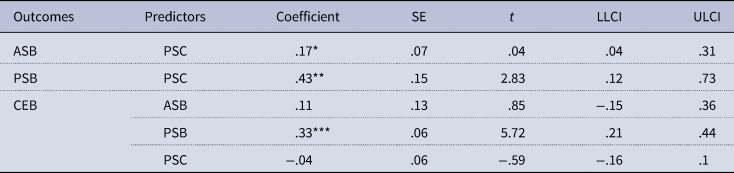
At the branch level, hypothesis 4 suggests that ASB and PSB are positively related to CEB at the branch level. To test this, a series of regression analyses were conducted. Regression model summaries are presented in Table 3. The overall CEB model at the branch level (F(3, 52) = 16.32, p < .001, R 2 = .48) was significant. The results, show that ASB (b = .11, p > .05) was not significantly related to CEB but PSB (b = .33, p < .001) was significantly positively related to CEB at the branch level. Therefore, hypothesis 4a was not supported but hypothesis 4b was supported.
Branch-level regression models

*p < .05, **p < .01, ***p < .001.
Hypothesis 5 predicted that the indirect positive effect of PSC on CEB will occur via ASB and PSB at the branch level. A parallel multiple mediator model was conducted with the bootstrapping method, using Hayes (Reference Hayes2013) PROCESS macro, to test hypothesis 5. The results in Table 3 reveal that PSC was positively associated with ASB (b = .17, p < .05) and PSB (b = .43, p < .01) and as mentioned above, the relationship between of ASB and CEB was not significant while PSB positively affected CEB at the branch level. The 95% confidence interval (CI) of the direct effect of PSC on CEB, [−.16, .1], included zero, suggesting non-significant direct effects of PSC in the CEB mediation model (see Table 3).
The findings of mediation hypotheses testing did not provide support for hypothesis 5a (β = .02), 95% CI [−.02, .08], as the mediated effect of PSC on CEB via ASB is not significantly different from zero. The mediated effects of PSC on CEB via PSB (β = .14) is significantly different from zero, 95% CI [.04, .28], supporting hypothesis 5b.
Discussion
In this study we proposed and tested a multilevel framework for service organizations and examined the effects of individual-level PsyCap and branch-level PSC as well as the impact of cross-level interactions on discretionary service behaviors. In addition, at the branch level, the mediating role of discretionary service behaviors in transmitting the effect of PSC to CEB was tested. Altogether, the results suggest five main conclusions.
First, the results showed that high PsyCap service employees are efficacious in being adaptive and proactive during service delivery. Higher levels of individual PsyCap may make service employees more flexible and optimistic, specifically when serving demanding customer needs or facing service failure. Generally, service employees who were more positive exhibited more ASB and PSB than their counterparts who tended to be more negative.
Second, PSC at the branch level was positively associated with ASB and PSB at the individual level. Service employees who perceive the organizational climate as a high PSC, perceive increased task-related resources and are be able to think ‘out of the box’ when serving customers and solving their problems. Third, this study demonstrated that the interaction between PsyCap at the individual level and PSC at the branch level positively affects ASB. The result implies that individual PsyCap and branch-level PSC interact in a synergic manner to affect service employees' engagement in ASB, beyond their positive direct effects. On the other hand, the research findings indicated that the interaction between PsyCap and PSC did not significantly affect PSB. Despite the significant positive direct effects of both PSC and PsyCap on PSB, PSC does not strengthen the positive effect of PsyCap on PSB.
Fourth, at the branch level, ASB is not significantly associated with CEB but PSB significantly positively associates with CEB. The insignificant relationship between ASB and CEB is particularly thought-provoking. A possible explanation might be that when service employees struggle to adjust their behavior or service offering to comply with customers' needs, customers maybe attribute the service or behavioral adaptation to the lack of appropriate procedures or service knowledge. This unexpected finding could also be due to the conceptualization and measurement of ASB in the literature being different from customers' perceptions of ASB (Hartline & Ferrell, Reference Hartline and Ferrell1996). Customers might not perceive ASB as a discretionary behavior that service employees do to satisfy them. The evidence of the positive relationship between PSB and CEB demonstrated that proactive service employees, who step forward to anticipate customer needs and future service issues and address the cause of the problems in advance, and who endeavor to find creative ways of service delivery and new opportunities to improve the quality of service, increase motivation of customers to positively engage with them and the branch. Fifth, at branch-level PSB mediated the relationship between PSC and CEB although ASB is not able to transfer the positive effect of PSC to CEB.
Research contributions and implications
This research contributes to the theories of occupational health, positive organizational behavior and adaptability and proactivity in service roles. First, the proposed model examines the effect of PSC on employees to customers in accordance with COR and SET. This study incorporates the contagious effects of intra-organizational climate (i.e., PSC) to an extra-organizational outcome (i.e., CEB) through a multi-level approach. Incorporating these theoretical foundations within a service context connects PSC and PsyCap to the service relationship. Second, an investigation of the mediating role of ASB and PSB as transmitters of individual PsyCap and psychosocial safety of the organization to customers at higher level of analysis is an important endeavor given effectiveness in service environments is due to the significant role of service employees in shaping customers' emotions and behaviors.
The model has practical implications for service managers. As it would not be practically possible to simply hire service employees who are inclined to be adaptive and proactive, service organizations, need to create an organizational climate which cares about all internal and external organizational members' psychosocial health and safety. This, in turn, will enable service employees to take more risks and spend more time and energy to be other-focused. To do so, senior service managers should embrace the philosophy of PSC, relying on a balance between efficiency and health, in the policies, procedures, and practices of the organization.
Similarly, service organizations can develop other indicators of a psychologically positive work environment such as PsyCap which is a valuable resource that service organizations can advance among their employees. Brief interventions to develop PsyCap show initial evidence of return on investment (Luthans, Avey, Avolio, & Peterson, Reference Luthans, Avey, Avolio and Peterson2010), and could be offered to employees as professional development.
Limitations and future research directions
Similar to any empirical study, the findings of this research should be considered in light of a few limitations. The sample for this study included the mangers, employees, and customers of insurance company branches. Although different insurance companies were involved, the nature of the service was similar, and one policy maker supervised the insurance market regulations. The compatibility across branches was an advantage because it prevented the external and confounding effects due to different organizational climate, proactive, and adaptive perception among employees. However, the homogeneity of the sample may limit the generalizability of the results. Nevertheless, the findings supported the hypotheses developed based on PSC, COR, and SET and thus might not be sample specific.
The cross-sectional design of the study made causal inferences difficult. Data that are used to analyze casual processes at only a single time frame is unable to explain significant long-term dynamic processes (Neuman, Reference Neuman2013). However, collecting data from different sources including managers, service employees, and customers decreased the chance of the same source bias (Podsakoff, MacKenzie, Lee, & Podsakoff, Reference Podsakoff, MacKenzie, Lee and Podsakoff2003). Also, to reduce the selection bias, researchers randomly invited customers to participate instead of asking service employees to choose them.
The multilevel model allows future research to apply this framework in service research. Researchers can consider the possibility of the return effect of customer engagement on psychosocial resources to incorporate the customers' role in organizational climate and in employees' psychological state. Other positive practices at the organizational and individual levels, such as notion of virtuous spiral, courageous action, mindfulness, emotional intelligence, can be linked to the model.
Conclusion
The proposed model in service organizations can have important practical and research implications. The model will help service organizations and their employees to flourish, and consequently encourage customers to engage positively. Positive psychosocial resources (i.e., the interaction of PsyCap and PSC) can have a significant positive effect on employees' attitude, behavior, and performance, especially in high customer contact environments such as sales and services. Thus, the theoretical extension and application of positive psychosocial resources, its antecedents and consequences, can be recognized and developed in future research.