INTRODUCTION
Political institutions that reflect the demographic diversity that is present in the broader society are valuable features of representative democracy. Measures designed to increase the presence of underrepresented and marginalized groups such as gender quotas in Western Europe and redistricting in the United States have enhanced the influence of women and minorities in the public policy making process, as well as improved the substantive representation of their interests in legislatures. Specifically, legislatures with higher proportions of women have responded by sponsoring and passing more legislation that is important to women (Bratton Reference Bratton2005; Bratton and Haynie, Reference Bratton and Haynie1999; Childs and Krook, Reference Childs and Krook2008; Swers Reference Swers2002; Thomas Reference Thomas1991, Reference Thomas1994) and by integrating women’s perspectives in legislative deliberations (Mansbridge Reference Mansbridge1999; Williams Reference Williams1998; Young Reference Young2000). Similarly, minority legislators are more likely than White legislators to advocate for the interests of minority constituents by sponsoring and voting for civil rights and social welfare legislation (Canon Reference Canon1999; Casellas Reference Casellas2010; Lublin Reference Lublin1997; Rouse Reference Rouse2013; Tate Reference Tate2003; Whitby Reference Whitby1997) obtaining more earmark projects for their districts (Grose Reference Grose2011), participating in committee mark-ups of legislation (Gamble Reference Gamble2007), and overseeing federal agencies’ efforts to implement civil rights and social welfare policies (Minta Reference Minta2011).
Despite evidence that descriptive representatives improve the substantive representation of their respective groups in the policy making process, critics have been skeptical on whether tokens or greater numbers of women and minorities significantly improve overall legislative responsiveness to women and minority issues. When women or minorities have token status in legislatures, marginalization by their White male colleagues limits the influence of women and minority legislators in public policymaking (Guinier Reference Guinier1995; Hawkesworth Reference Hawkesworth2003; Phillips Reference Phillips1995). Thus, the extent to which gender, racial, or ethnic diversity improves congressional attention to the interests of women and minorities is not settled.
Relying on existing empirical and normative studies to assess the impact of gender on the political representation of women’s interests provides an incomplete understanding of how race and gender enhance the substantive representation of women’s interests. Accounts relating to the political representation of women’s interests at the aggregate and individual level focus almost singularly on whether the presence of women in legislatures has an impact on women’s issues without examining the intersection that many women’s interests have with racial and ethnic minority interests (Bratton Reference Bratton2005; Crowley Reference Crowley2004; Dodson Reference Dodson1991; Grose Reference Grose2011; Osborn and Mendez, Reference Osborn and Mendez2010; Pearson and Dancey, Reference Pearson and Dancey2011; Sanbonmatsu Reference Sanbonmatsu2002; Swers Reference Swers2002; Weldon Reference Weldon2002). Although issues such as discrimination in employment, housing, and equal pay are women’s interest issues, these issues have long been linked with Blacks and Latinos (Dawson Reference Dawson1994; Leal Reference Leal, Espino, Leal and Meier2007; Rodrigues and Segura, Reference Rodrigues, Segura, Espino, Leal and Meier2007; Sanchez Reference Sanchez2006). Thus, many gender and political representation studies fail to theoretically and empirically integrate the presence of minorities in their accounts.Footnote 1 Similarly, scholars studying the impact of race and ethnicity have not, for the most part, sufficiently considered the impact that gender diversity may have on minority representation. As a result, the majority of empirical studies tend to conflate racial or ethnic minorities’ interests with those issues that are commonly associated with women and vice versa and miss the interaction and coalition formation that may occur between White women, and minority men and women with corresponding interests.Footnote 2 Paying attention to only singular axis issues or gender and/or racial/ethnic groups of legislators homogenizes both the legislators themselves and their groups’ interests. Recent scholarship by intersectionality scholars has questioned the normative and empirical tenets of researchers’ articulation of how one measures “women’s interests” or “minority interests” (Hancock Reference Hancock2007; Smooth Reference Smooth2011). Simplifying multifaceted issues into a catchall category of women’s issues fails to account for the complex, fluid, and varied interactions of race, class, and sexual identities that always accompany public policy.
Seeking to link these two important literatures that have developed in relative isolation of each other, a rich growing literature in women and gender politics uses intersectionality to explore how race, gender, and class interests intersect in the formulation of government policies and how those policies affect the representation of marginalized groups such as minorities and women (Brown Reference Brown2014; Cohen Reference Cohen1999; Garcia Bedolla and Scola, 2006; Hancock Reference Hancock2004; Hardy-Fanta et al., 2006; Simien Reference Simien and Crotty2009; Smooth Reference Smooth2001; Strolovitch Reference Strolovitch2007). Although these intersectional studies have done much to explore how minority women legislators play a vital role in improving the substantive representation of women’s interests, they do not pay sufficient attention to the role that minority men play in helping to advance women’s interests.
We argue that women’s interest policies have not been advanced solely by the presence of White and minority women only but that the presence of minority men with similar and overlapping interests in Congress has played a part in this advancement.Footnote 3 Advocacy efforts by racial minorities to obtain civil rights protection and eliminate economic disparities created political opportunities for White and minority women to have their issues addressed by Congress as well as advocacy efforts by women that have brought more attention to issues relating to minorities, particularly minority women. We examine the number of legislative hearings on issues that directly and indirectly affect women’s interests in the House and Senate from 1951 to 2004. We examine congressional hearings as a proxy measure for the congressional agenda. Hearings provide an effective way of drawing attention both to legislators and key issues and to gather information about federal agency performance (Baumgartner and Jones, Reference Baumgartner and Jones1993; Hall Reference Hall1996; Jones and Baumgartner, Reference Jones and Baumgartner2005; Minta Reference Minta2009; Schiller Reference Schiller1995; Sulkin Reference Sulkin2005; Wawro Reference Wawro2000). We find that the House is more attentive to women’s interests not solely due to the greater ideological liberalization of the membership, or presence of women, but particularly because of the presence of minority men in the chamber. Although diversity is important in the Senate in terms of bringing more attention to women’s interests, the level of attention is still less than in the House, perhaps reflecting the institutional constraints that the Senate presents in providing effective minority representation (Griffin Reference Griffin2006; Griffin and Newman, Reference Griffin and Newman2008; Lee and Oppenheimer, Reference Lee and Oppenheimer1999).
GENDER AND RACIAL DIVERSITY AND CONGRESSIONAL RESPONSIVENESS
One factor that poses a challenge to the representation of women’s interests is the underrepresentation of female legislators in majoritarian institutions. Drawing upon Rosabeth Kanter’s (Reference Kanter1977) research relating to the effect that women have in the corporate workplace, feminist scholars argued that women do not influence legislative outcomes until women move beyond mere token status and constitute a critical mass in governing bodies (Bratton et al., Reference Bratton, Haynie and Reingold2006; Dodson and Carroll, Reference Dodson and Carroll1991; Thomas Reference Thomas1994). When women reach a critical mass or threshold in legislatures, they are more likely to introduce women’s interest bills and get women’s interest legislation passed more than those legislatures without a critical mass of women legislators (Bratton Reference Bratton2005; Dodson Reference Dodson and Carroll2001). Despite the benefits that more women in legislatures have on women’s substantive representation, many have found that larger numbers of women do not result in policies more responsive to women’s interests (Celis et al., Reference Celis, Childs, Kantola and Krook2008; Kathlene Reference Kathlene1994; Reingold Reference Reingold2000; Weldon Reference Weldon2002). Studies have also found that the growing presence of female legislators can actually elicit a backlash reaction from male members causing them to become increasingly hostile toward their female colleagues (Crowley Reference Crowley2004; Heath et al., 2005; Kathlene Reference Kathlene1994). Scholars have argued that Congress is both a gendered (Duerst-Lahti Reference Duerst-Lahti and Rosenthal2002; Rosenthal Reference Rosenthal2002) and race-gendered (Brown Reference Brown2014; Hancock Reference Hancock2004; Hawkesworth Reference Hawkesworth2003; Reingold and Smith, Reference Reingold and Smith2012; Smooth Reference Smooth2001) institution. These institutional biases may push women to frequently work together, even across party lines, to sidestep backlash from congressmen. Women and politics scholars have recognized the limitations of critical mass theory in finding that women rarely, if ever, rise above token representation in legislatures, especially in the U.S. Congress. These scholars tend to focus on the role of critical actors instead of critical mass (Childs and Krook, Reference Childs and Krook2009). However, one of the limitations of critical mass and actors theories is that they assume that advocacy for women’s interests depends primarily on the efforts of women alone, and largely ignore cohesive minority groups advocating for similar interests. The combination of both groups can offset the need to reach a threshold or rely only on women in order for their advocacy to be successful.
In addition to aggregate level studies, individual level studies of political representation of women’s interests generally find that White and minority women legislators better represent the interests of women than their male counterparts. Not only do minority women provide better representation than White and minority men but they have distinctive political perspectives when compared to minority and White men (Fraga et al., Reference Fraga, Lopez, Martinez-Ebers, Ramirez and Hardy-Fanta2006; Hardy-Fanta Reference Hardy-Fanta1993; Orey et al., Reference Orey, Smooth, Adams and Harris-Clark2006; Pardo Reference Pardo1998; Taskash-Cruz 1993). In sum, this literature suggests that minority men may not represent the interests of women. However, the challenge with using individual level studies to assess effective representation of women’s interests is that most women in the U.S. Congress are more likely to be represented by a male than a female representative. Intersectionality studies that find that minority female legislators provide better representation than White women do not account for the fact that minority men and White women greatly outnumber minority women in both the House and Senate (see Figures 1 and 2). In fact, in the Senate, only two minority women have ever served in the chamber, Carol Moseley Braun and Maize Hirono.Footnote 4
Gender and Minority Diversity in the U.S. House of Representatives

Gender and Minority Diversity in the U.S. Senate
We argue that diversity is more than just having only descriptive group members such as women providing representation for their particular groups but changing a non-diverse environment to allow for other group members such as men to make similar demands. However, less attention is devoted to how groups’ individual efforts can increase attention to issues that relate to both groups. Although White and minority women are more likely to champion women’s issues, minority men can represent women’s interests (Dodson and Carroll, Reference Dodson and Carroll1991; Orey at el., 2006; Orey and Larimer, 2008; Philpot and Walton, Reference Philpot and Walton2007; Simien Reference Simien2006; Smooth Reference Smooth2006). Edith Barrett (Reference Barrett1995) found that Black legislators are more likely to introduce bills of interest to women. Similarly in a later study, Barrett (Reference Barrett and Carroll2001) found that Black men held similar support for women-oriented policies as White women. Luis Ricardo Fraga et al. (Reference Fraga, Lopez, Martinez-Ebers, Ramirez and Hardy-Fanta2006) documented that both Latina and Latino legislators prioritize the same type of issues, namely education and healthcare. This research illustrated that there may not be a gender difference in policy preferences for Latino legislators.
Much of the liberalization of minority men is due to existence of the interaction with minority women in caucuses. Organizations such as the Congressional Black Caucus (CBC), Congressional Hispanic Caucus (CHC), and Congressional Asian and Pacific Islander Caucus (CAPAC) were formed by minority men and women legislators not just to represent the interests of Blacks, Latinos, and Asian Americans, respectively, in their own districts, but to represent the interests of all Blacks, Latinos, and Asian Americans nationally (Clay Reference Clay1993; Minta Reference Minta2011). In 2005, minority legislators from the CBC, CHC, and CAPAC formed a separate caucus, the Congressional Tri-Caucus, to facilitate agenda coordination across minority groups. The impact minority women have on minority men is due in part because they are also members of the Congressional Caucus on Women’s Issues (CCWI). The CCWI was established in the 1970s to address the interests of all women and not just women in individual districts. Thus, the presence of minority women in minority organizations has liberalized views of African American men, thus Black men are likely to support many issues that take into account race and gender (Dodson and Carroll, Reference Dodson and Carroll1991; Orey at el., 2006; Philpot and Walton, Reference Philpot and Walton2007; Simien Reference Simien2006; Smooth Reference Smooth2006).
These caucuses are able to increase attention to their issues by sharing resources across legislative offices, enhancing communication and information sharing, and providing for the coordination of agendas and messages (Minta and Sinclair-Chapman, Reference Minta and Sinclair-Chapman2013). These caucuses utilize taskforces that work on specific issues that address minorities and women nationally. Legislators use data gained from task forces to assist in advocacy for women and minority interests in House committees that have jurisdiction over issues such as civil rights, social welfare, health, and education. Minority and women legislators then take the information from their respective caucuses to influence their colleagues and the congressional agenda. Thus, we expect that the presence of women in minority caucuses has a similar effect on the men in minority caucuses who become advocates for women’s issues. Therefore, despite the small number of minority women in the House and Senate, minority women are able to increase their overall influence in the legislative process.
Hypotheses
We expect the following:
H1: As the proportion of minority men increases in the House and Senate, both chambers will devote more attention to issues that directly impact women such as breast cancer treatment and crimes against women.
H2: As the proportion of minority men increases in the House and Senate, both chambers will devote more attention to issues that jointly affect women and minorities such as civil rights issues.
H3: As the proportion of minority men increases in the House and Senate, both chambers will devote more attention to issues that indirectly impact both groups such as aid to families for childcare and low-income family assistance.
Data and Methods
To determine the extent to which a gender, racially, and ethnically diverse Congress explains differences in attention to women and minority interests, we examine the number of legislative hearings on issues in the House and Senate that directly, jointly, and indirectly pertain to women and minorities. We use House and Senate hearings data from 1951–2004 from the Policy Agendas Project database to construct three policy dimensions.Footnote 5 The hearings in the Policy Agendas database are categorized into nineteen major and 225 minor topic policy content codes that range from macroeconomics to transportation.Footnote 6 Hearings are identified that fit into one of our three categories of dependent variables: direct women’s issues, direct joint issues, and indirect joint issues. Like others who have attempted to differentiate among women’s issues according to degrees of generality and directness (Osborn and Mendez, Reference Osborn and Mendez2010; Reingold Reference Reingold2000), our coding system is based on how relevant a given policy domain is to the specific group in question.Footnote 7
We employ two methodological approaches to examining the impact of women and racial/ethnic minorities within Congress. First, using an additive approach, which treats gender as a separate and distinct category in which one factor can and should supplant the other (King Reference King1988). This approach gauges the impact of Congresswomen, regardless of race and ethnicity, by controlling for the impact of racial and ethnic men legislators on indirect and direct women’s and minority issues. Next, we use an intersectional approach, which treats race/ethnicity and gender as mutually constitutive categories of analysis. Intersectionality avers that social identities have been forged via systematic social relations of oppression and privilege (Baca Zinn and Dill, 1996). Kimberlé Crenshaw (Reference Crenshaw1989, Reference Crenshaw1991) adds that identity is mutually reinforced by race, gender, and class. As such, we gauge the influence of single groups and combined groups to affect political representation surrounding issues that impact marginalized groups. We also demonstrate how an intersectional and additive approach can add both theoretical and empirical value to the study of political representation by demonstrating the impact of women and minorities in Congress. Building from Beth Reingold and Adrienne Smith’s (2012) work on intersectionality and welfare policy, our methodological approach provides a more nuanced understanding of gender, race/ethnicity, and political representation by disaggregating by race/ethnicity and gender.
While intersectionality scholars have long debated the methodological tenets of how to best measure the concept (Brown and Hudson Banks, 2013; Garcia Bedolla and Scola, 2006; Hancock Reference Hancock2007; Jordan-Zachery Reference Jordan-Zachery2007; Orey et al., Reference Orey, Smooth, Adams and Harris-Clark2006), this study contributes to the small but growing empirical studies that utilize an intersectional analysis using quantitative data. Indeed, this study illustrates that disaggregating by race/ethnicity and gender allows for scholars to uncover key differences within groups when using large databases. As such, an intersectional analysis allows us to directly pinpoint the ways in which distinct groups of legislators impact congressional hearings on women’s issues. By focusing on the differences among members of congress, namely by highlighting how race/ethnicity intersects with gender, this study advances that intersectionality informs the ways in which White women, minority women, and men of color chose to affect the number of congressional hearings on women’s interests.
The first category, direct women’s issues, focuses on issues that explicitly pertain to women. To construct this category, we use mostly hearings coded under the major topic “Civil Rights, Minority Issues, and Civil Liberties.” The civil rights category includes ten subtopics that address issues such as discrimination against minorities, the disabled and elderly, freedom of speech, the right to privacy, and access to government information. Because we are interested in assessing attention to issues that explicitly relate to women, we consider only those hearings coded under “General Civil Rights” and “Gender and Sexual Orientation Discrimination.” These topics include reproductive and other women’s health issues, violence against women, gender discrimination, and issues dealing with women in the workplace.Footnote 8 We also identified hearings that pertain mostly to women in the other eighteen major topic areas contained in the Policy Agendas database that were not included in the civil rights categories. Together, 550 direct women’s hearings were held or approximately 1.1% of the original database.
The next two categories, direct and indirect joint issues, depart from previous literature on the political representation of women and minority interests by recognizing the overlap in policy interests between women and minority groups. Direct joint issues are issues that directly and concurrently impact both women and racial minorities. Although we coded hearings from eighteen major topic areas in Policy Agendas, most of the hearings contained in the direct joint category come from the major topic area “Civil Rights, Minority Issues, and Civil Liberties” that focuses specifically on the subtopics of “General Civil Rights,” “Gender and Sexual Orientation Discrimination,” and “Ethnic Minority and Racial Group Discrimination.” The general civil rights category includes a combination of subtopics that addresses issues relevant to both women and minorities. For example, the 100th Congress (1987–1988) held a hearing that pertained to the underrepresentation of women, minorities, and the disabled in science and technology. If a hearing does not specifically reference both women and minorities, then it is not included in the categories. The ethnic and racial group discrimination subtopic includes hearings pertaining to issues such as discrimination in housing and employment, and minority and women affirmative action programs. Direct joint issues were the least frequent type of hearing, with 421 individual cases accounting for 0.84% of all hearings.
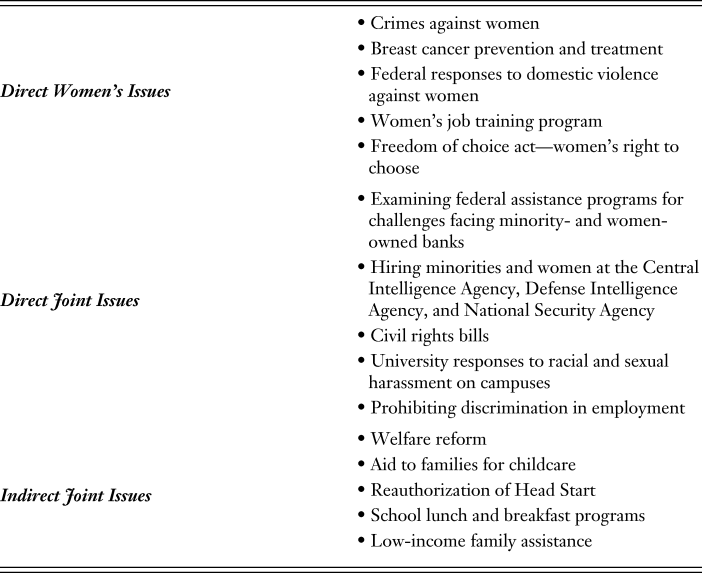
The final category, indirect joint issues, includes those hearings that do not pertain specifically to one race, ethnicity, or gender, but have a disproportionate impact on both women and racial minorities. These are hearings that directly address social inequality between racial/ethnic groups, such as anti-poverty programs, governmental assistance for childcare and education, and food stamps. The majority of the hearings come from the Policy Agenda’s major topic area “Social Welfare,” under the “General” and “Food Stamps, Food Assistance, and Nutritional Monitoring Programs” subtopics. Compared to direct and direct joint categories, indirect joint issues, however, were the most frequent with 1415 hearings, or 2.82% of the total. Table 1 displays sample hearings from each of the three categories.
Sample Hearings from the House and Senate, 82nd to 108th Congress (1951–2004)
The dependent variable is the number of women and minority interest hearings held in the House and Senate per two-year congressional terms respectively. To control for the greater number of hearings held in the House than in the Senate, on average 396 more per congressional term, we included a count of the total number of hearings held in each chamber.Footnote 9 Using this control assures that the difference between the two chambers on women and minority issues is not attributable to the greater number of hearings held in the House.
Our analysis begins in the 1950s, the decade marking the return of civil rights issues to the congressional agenda. This starting point also allows us to examine the influence of gender and minority diversity during a period when the Democratic Party, the party most associated with civil rights, controlled both chambers of Congress. The Democratic Party became increasingly liberal as southern conservative Democrats were replaced by Republicans. Because these data are a count of the number of hearings held by each chamber, we use a Poisson regression to estimate the likelihood of each chamber to hold hearings related to direct, direct joint, and indirect joint issues.
The primary variable of interest is the percentage of minority women, minority men, and White women legislators in the House. The intersectional approach treats race/ethnicity and gender as mutually constitutive categories of analysis. As such, we gauge the influence of single groups and combined groups to affect political representation surrounding issues that impact marginalized groups. Because there is only one minority woman that served in the Senate between 1951 and 2004, we use an additive approach and do not create separate categories for minority men and women but instead combine minority women with minority men using the percentage minority legislators. The additive approach treats gender as a separate and distinct category in which one factor can and should supplant the other. This approach gauges the impact of Congresswomen, regardless of race and ethnicity, by controlling for the impact of racial and ethnic men legislators on indirect and direct women’s and minority issues.
We also include several control variables in the model as alternative explanations for why the House may pay more attention to women’s interest issues than the Senate and why both chambers pay greater attention to women’s issues in general. To capture the overall decrease in conservative southern Democrats and the liberalization of the House and Senate, we use DW-NOMINATE Common Space scores to measure each chamber’s median ideological disposition over time.Footnote 10 When Democrats are in control of either the House or the Senate, the chamber median becomes more liberal than it was after the infusion of liberal northern Democrats in the 1960s when conservative southern Democrats constituted a larger proportion of the party. We also include a dummy variable to capture the party control of each chamber—GOP controlled House (Senate). The political party that has majority control of the chamber has the power to set the congressional agenda while the minority party has no significant agenda setting power. Presidential agenda setting may affect the number of hearings Congress holds on any issue. We account for the impact of the president on hearings activity with a measure of divided government. For observations in the dataset, divided government is measured as a Republican president with a Democratic Congress. Finally, to capture the degree of public attention to civil rights and social welfare policies, we use the Policy Agendas Project variable called the “Most Important Problem” (MIP). The MIP variable captures the individual responses to Gallup’s “most important problem facing the nation” question from 1946 to 2007, aggregated annually by proportions for each major topic area in the Policy Agendas Project.
Results
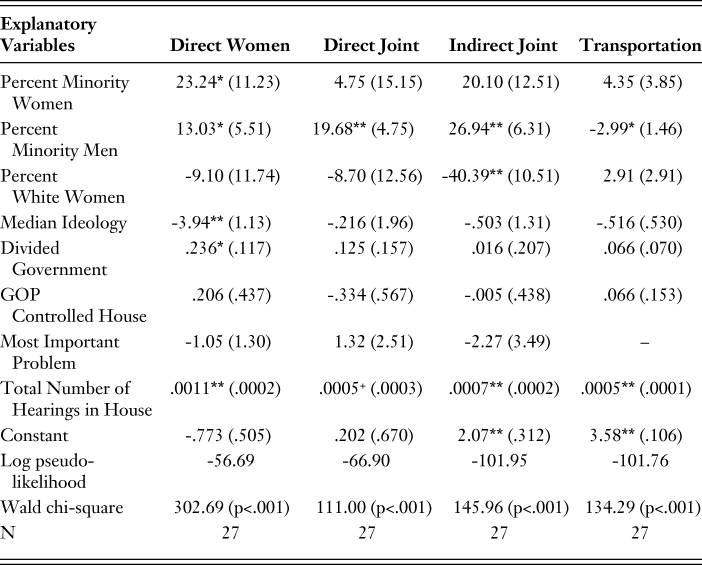
The results from the Poisson model shown in Table 2 demonstrate that the presence of minority men in the House is the main reason for greater attention to women’s interests. Specifically, the findings provide a new layer to the extant theories on critical mass and intersectionality by demonstrating that the presence of minority men is just as important as the presence of women, specifically minority women, in increasing attention to women’s issues in the House. The coefficients in our intersectional model are in the expected direction and robust across policy dimensions of interest.Footnote 11Figures 3 through 5 show the predicted number of hearings held in the House as the percentage of minority legislators increases in the House. Figure 3 shows that on direct women’s issues such as breast cancer research, sexual harassment in the workplace, and domestic violence, the House devotes only four hearings to these issues with little to no minority women in the House; however, when the percentage of minority women in the House rises to 5%, the chamber held fifteen hearings. Minority men had a similar impact on congressional attention to women’s issues. Specifically, when there were no minority men in the House, the chamber held only three hearings, but when the percentage of minority men increased to 12%, the House held fourteen hearings. We find similar support for advocacy efforts of minority men in increasing congressional attention to women’s issues in the direct joint policy dimension also. Although neither minority women nor White women have a direct effect on increasing overall attention to issues such as enforcement of antidiscrimination laws in employment and creating opportunities for women and minority business, the addition of minority men has an effect on increasing the attention to women’s issues. Figure 4 shows that the added presence of minority men increases overall attention to these issues with the chamber holding twenty-six hearings with diversity at its maximum and only three hearings when there were no minority men.
Attention to Policy Issues by the House, 82nd to 108th Congress (1951–2004)
*Statistically significant at .05 level, two-tailed test.
**Statistically significant at .01 level, two-tailed test.
+Statistically significant at .10 level, two-tailed test.
House Attention to Direct Women's Issues
House Attention to Direct Joint Women's Issues
House Attention to Indirect Joint Women's Issues
Although the increase in the proportion of minority men is significant in all three policy dimensions, the greatest impact is on the indirect joint issues. Figures 5 shows the predicted rate of hearings held as the percentage of minority women and men increased in each chamber. When there were no minority men in the House, the chamber held four hearings on indirect joint issues compared to 110 hearings when minority men reached a maximum of 12%. The increase in minority women is also important in increasing attention to these issues with the chamber holding twenty hearings when there were no minority women present compared to forty-seven hearings when minority women reached their maximum of 5% in the House. These findings add complexity to gender and critical mass theories, which do not use an intersectional approach to measuring women’s legislative influence. Again, the majority of previous research on women and minorities usually considers issues in this category such as childcare and assistance to low-income families to be women’s issues driven mainly by a larger proportion of women. Thus, the efforts of women and minority caucuses, particularly those of minority women who are members of both caucuses, complement each other in getting their issues on the policy agenda.
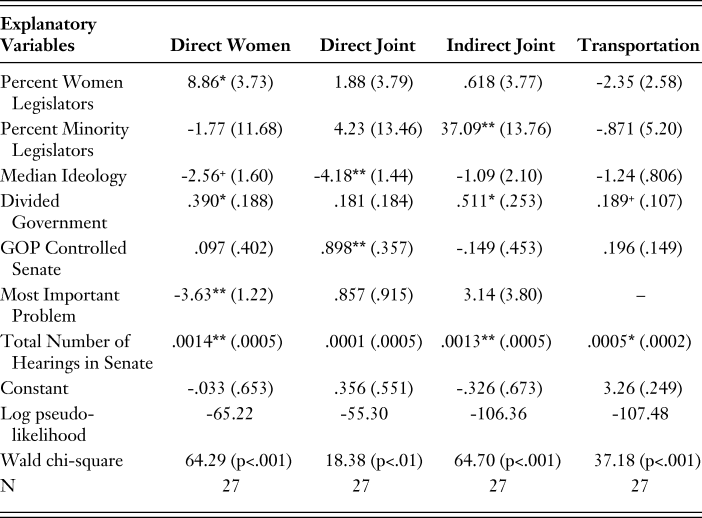
In the Senate our additive model found that the increase in the presence of minority men in Congress also works but to a lesser degree because there is less overall diversity in the Senate than the House. Instead, women and minority legislators usually focus on issues most salient to their respective groups. Although the proportion of women in the Senate has increased over time to match that of the House, the proportion of racial or ethnic minorities has not kept pace with the increase in the House. Table 3 shows the results from the Poisson model for the U.S. Senate. The greater presence of women in the Senate, primarily White women, drives the increased attention to direct women issues. Figures 6 and 7 show the predicted rate of hearings for the direct and indirect joint issues, respectively. Figure 6 shows that when no women were present in the Senate, the chamber conducted only five hearings on direct women issues compared to sixteen hearings when the proportion increased to 14% women. However, for the indirect joint issues, the proportion of women did not have a direct effect in predicting increase attention to these issues. In fact, for the indirect joint issues, Figure 7 demonstrates that it is the presence of racial or ethnic minorities that appears to increase the chamber’s attention to these issues pertaining mainly to social welfare issues. The issues in our indirect category are issues that have been identified by many scholars as pertaining specifically to all women. However, separating these issues reveals that, at least in the Senate, the presence of more women does not necessarily lead to more attention to these issues. Aid to families for childcare and reauthorization of the Head Start program is closely associated as liberal policy issues that are supported mainly by Black, Latino, and liberal Democrats. Several scholars have argued that women are not as active on social welfare issues because these issues are integrated in the congressional agenda and as a result face competition from other legislators who are usually more senior and hold leadership positions (Swers Reference Swers2002). The likely reason the percent of women legislators is not significant is that many social welfare issues in the indirect joint category may divide the Democrats and Republican members in the Congressional Caucus on Women’s Issues. Greater attention to women’s issues policy dimensions still increases because of the advocacy efforts on minorities with similar interests.
Attention to Policy Issues by the Senate, 82nd to 108th Congress (1951–2004)
*Statistically significant at .05 level, two-tailed test.
**Statistically significant at .01 level, two-tailed test.
+Statistically significant at .10 level, two-tailed test.
Senate Attention to Direct Women's Issues
Senate Attention to Indirect Joint Women's Issues
Advocacy efforts by minority men have served to make the House more attentive to women and minority interests than the Senate. The House devotes greater attention to issues in all of the respective policy dimensions. However, the lower number of minorities in the Senate than the House makes the Senate less responsive than the lower chamber. For issues that indirectly impact women and minorities, we find that the presence of women and minority legislators in the lower chamber results in the House spending more time holding hearings aimed at providing affordable childcare and healthcare than the Senate. Figure 5 shows that when the House had a membership of 12% minority men, the chamber held on average 110 hearings on indirect joint issues, while Figure 7 shows that the Senate, at its maximum of 4% minority men and women, held twenty-two hearings. Previous studies had found that the Senate was more responsive on many of the domestic welfare issues contained within the indirect category than the House (Grofman et al., Reference Grofman, Griffin and Glazer1991; Kernell Reference Kernell1973). Our analysis shows that the House has become more responsive than the Senate to minority and women interests because of the House’s greater diversity of minorities and women.
The Senate has been more willing to spend time addressing issues that directly affect women but less willing to address direct joint issues that apply both to women and racial/ethnic minorities, while the House has been more willing to address issues in all three policy dimensions. Since the percentage of women is not significant in predicting attention to direct women’s issues in the House and the percentage of minority legislators is not significant in the Senate, we compare the effect that the increase in the percentage of minority legislators in the House has on direct women’s issues against the effect of the increase in the percent of women legislators in the Senate on direct women’s issues. As shown in Figure 8, there is no appreciable across-chamber difference in the level of attention to direct women issues across this range. Even when the percentage of minority legislators is held at its maximum of 16% in the House and the Senate at its maximum of 14% women, there is no significant difference in the number of hearings held, with the House and Senate holding an average of sixteen hearings.
House and Senate Attention to Direct Women's Issues
Once the median chamber ideology is taken into account, party control of either chamber does not influence overall attention to issues that impact women and minorities. Michael Minta and Valeria Sinclair-Chapman (2013) found that the GOP control of the House and Senate reduced the total number of hearings devoted to explicitly racial and social welfare issues. The reason that there is no difference between the GOP and Democratic control on these issues is that women have more legislators who are in the GOP, while almost all minority legislators are Democrats. Thus, attention to issues where women and minorities share some commonality is likely to continue. The multivariate results in Table 2 show that when the GOP controls the House, the share of the congressional agenda devoted to direct and indirect issues in the House does not differ from that of the Senate.
CONCLUSION
Diversity is a key factor in driving overall attention to women interests but not in the common way that scholars usually think about diversity—as a one-to-one correspondence between descriptive representatives and groups they descriptively represent, e.g., women legislators only representing women’s interests. In fact in the House, having more women alone is not sufficient to provide substantive representation to women’s interests; rather, it is the collective commitment by minority men and women legislators to represent underrepresented constituencies and to cooperate to achieve those goals that make greater attention to women’s issues possible. Diversity infrastructures established by minority members of Congress are the main reason the Congress has become responsive to women’s interest issues over time (Minta and Sinclair-Chapman, Reference Minta and Sinclair-Chapman2013). This is true particularly in the House of Representatives, where the presence of both minority men and women legislators increased overall attention to issues that directly and indirectly pertain to women constituents. Numerical capacity along with information sharing and organized networks allows members of the minority and women caucuses to advocate for the interests of women and racial and ethnic minorities in individual districts as well as nationally. Much like the House, the Senate also benefits from the presence of both women and minorities in terms of increasing attention to women’s issues in the different policy dimensions. Specifically, our intersectional approach illustrated that the increase of White women in the Senate has led to more attention to direct women’s issue hearings but has not resulted in more attention to issues that jointly and indirectly benefit women. The increase in the number of minorities, mostly minority men, has resulted in more attention to issues that indirectly affect minorities such as social welfare but not on the direct joint or direct women’s issues.
Our findings expand our understanding of diversity and how it impacts representative bodies. Examining minority or women’s interests in a collective body needs to move beyond an exclusive focus on whether the presence of an individual group alone is the main reason for why institutions pay attention to the diverse interests of many groups. Instead diversity should be viewed as marginalized groups that come together, some with overlapping interests and some with competing interests that have formed a crucial mix that is necessary to increase congressional attention to a variety of issues. The intersectional approach revealed that minority men have pushed to increase congressional attention on women’s interests. As our results imply, the impact of minority men on women’s interests as well as joint interests is significant. Similarly, even though there are smaller proportions of women in the Senate, minorities, who have had relatively smaller numbers in the Senate than women, have benefited from the increased presence of White women especially as related to issues of gender equality.
Taking into account the intersecting gender and racial/ethnic identities of members of congress, our study moves beyond critical mass theory that usually focuses on whether the presence of women is solely responsible for the increased congressional attention to issues that affect women. Also, we broaden the perspective on minority representation and argue that it is not just the presence of minorities that is most responsible for impacting policies that provide substantive representation to minority constituents. The presence of White women and minority men plays a significant role in advancing the interests of minority women in the Senate given the small number of minority women that serve in the chamber.
The implications of our study demonstrate the utility of intersectionality as a methodological tool to examine the impact of groups on congressional hearings. Additionally, the use of the additive model demonstrates the unity of identity-based coalitions. Our study has shed light on the complex intersections of identity politics and how representation and policy-making can benefit from the creation of dynamic models.