Early in development, the negative consequences of having a parent with an affective disorder can be detected among their offspring. For example, children of mothers with depression exhibit more negative affect, less positive affect, fewer vocalizations, less motor activity, less secure attachment, lower social competence, more internalizing and externalizing behaviors, and abnormal brain asymmetry compared to children of healthy mothers (Field, Reference Field, Goodman and Gotlib2002; Jones, Field, Fox, Lundy, & Davalos, Reference Jones, Field, Fox, Lundy and Davalos1997; Murray, Fiori-Cowley, Hooper, & Cooper, Reference Murray, Fiori-Cowley, Hooper and Cooper1996; Radke-Yarrow, Nottelmann, Martinez, & Fox, Reference Radke-Yarrow, Nottelmann, Martinez and Fox1992). Through middle childhood and adolescence, the offspring of mothers with depression continue to exhibit elevated rates of internalizing and externalizing problems (Elgar, Mills, McGrath, Waschbusch, & Brownridge, Reference Elgar, Mills, McGrath, Waschbusch and Brownridge2007), abnormalities in emotional information processing (Joormann, Talbot, & Gotlib, Reference Joormann, Talbot and Gotlib2007), and elevated hypothalamic–pituitary–adrenal (HPA) functioning in the natural environment (Halligan, Herbert, Goodyer, & Murray, Reference Halligan, Herbert, Goodyer and Murray2004). Less is known about the offspring of parents with bipolar disorder (OBD) in childhood (LaRoche, Reference LaRoche1985), with one study suggesting lower rates of problem behaviors among OBD than among the offspring of parents with depression (Anderson & Hammen, Reference Anderson and Hammen1993). Studies have shown that OBD, compared to offspring of healthy parents, experience higher levels of episodic and chronic stress (Ostiguy et al., Reference Ostiguy, Ellenbogen, Linnen, Walker, Hammen and Hodgins2009), perform poorly on tests of executive function (Klimes-Dougan, Ronsaville, Wiggs, & Martinez, Reference Klimes-Dougan, Ronsaville, Wiggs and Martinez2006), exhibit attentional biases to emotional information (Gotlib, Traill, Montoya, Joormann, & Chang, Reference Gotlib, Traill, Montoya, Joormann and Chang2005), and show alterations in the functioning of the stress-sensitive HPA axis (Ellenbogen, Hodgins, Walker, Couture, & Adam, Reference Ellenbogen, Hodgins, Walker, Couture and Adam2006; Ellenbogen, Santo, Linnen, Walker, & Hodgins, Reference Ellenbogen, Santo, Linnen, Walker and Hodgins2010). Although these features distinguished OBD from offspring of parents with no mental disorder (ONMD) in cross-sectional studies, little is known about factors and mechanisms operating in the early life of the OBD that contribute to their vulnerability for mood disorders later in life.
Neuroticism is a personality trait characterized by a propensity to experience negative emotions such as anger, sadness, guilt, and irritability (Costa & McCrae, Reference Costa and McCrae1992a). Individuals high in neuroticism struggle with interpersonal and occupational problems, generate stressful life events, and use ineffective coping strategies (Belsky & Barends, Reference Belsky and Barends2002; DeLongis & Holtzman, Reference DeLongis and Holtzman2005; Ellenbogen & Hodgins, Reference Ellenbogen and Hodgins2004; Watson, Gamez, & Simms, Reference Watson, Gamez and Simms2005). The trait of neuroticism, like other personality traits, affects parenting practices, and may thereby impact offspring functioning, as initially proposed by Belsky (Reference Belsky1984) and subsequently supported by empirical findings (Prinzie, Stams, Dekovic, Reijntjes, & Belsky, Reference Prinzie, Stams, Dekovic, Reijntjes and Belsky2009). For example, parents high in neuroticism displayed lower levels of smiling, talking, and touching with their infant than parents low on neuroticism (Zaslow, Reference Zaslow1985). Similarly, mothers high in neuroticism exhibited a parenting style that was less warm, less responsive, and more intrusive than mothers low in neuroticism (Belsky, Crnic, & Woodworth, Reference Belsky, Crnic and Woodworth1995; Clark, Kochanska, & Ready, Reference Clark, Kochanska and Ready2000; Kochanska, Clark, & Goldman, Reference Kochanska, Clark and Goldman1997). High maternal neuroticism, assessed by self-report or observation, has been associated with defiance, anger, behavioral problems, and insecure attachment among offspring in early childhood (Kochanska et al., Reference Kochanska, Clark and Goldman1997). Moreover, adolescent and adult offspring of parents high, compared to those low in neuroticism, were found to have an increased sensitivity to stressful life events, poorer mental health, more antisocial behaviors, and more personal adjustment problems (Conger, Conger, Elder, & Lorenz, Reference Conger, Conger, Elder and Lorenz1992; Elder, Caspi, & Downey, Reference Elder, Caspi, Downey, Sørensen, Weinert and Sherrod1986; Van Os & Jones, Reference Van Os and Jones1999). Thus, evidence shows that high levels of neuroticism among parents are associated with nonoptimal parenting practices and a broad range of negative outcomes among their offspring from early childhood to early adulthood.
We have previously postulated a model to explain the association between parents' personality and vulnerability to psychopathology among offspring of parents with bipolar disorder (BD; Ellenbogen & Hodgins, Reference Ellenbogen and Hodgins2004), who are at high risk for the development of both major depression and BD (Birmaher et al., Reference Birmaher, Axelson, Monk, Kalas, Goldstein and Hickey2009; Hodgins, Faucher, Zarac, & Ellenbogen, Reference Hodgins, Faucher, Zarac and Ellenbogen2002; Lapalme, Hodgins, & LaRoche, Reference Lapalme, Hodgins and LaRoche1997). We hypothesized that one facet of the genetic vulnerability for mood disorders is expressed as the trait of neuroticism (Kendler, Gatz, Gardner, & Pedersen, Reference Kendler, Gatz, Gardner and Pedersen2006). That is, the child who inherits the genes associated with mood disorders inherits a tendency to react emotionally to stressors and daily hassles. This tendency is promoted by being raised by one or two parents with high levels of neuroticism who themselves display a pattern of overreactivity to daily life events and ineffective coping with stress. The parents' behavior creates a family environment that is stressful, chaotic, and unpredictable and that fails to teach the child appropriate skills for coping with stress (Chang, Blasey, Ketter, & Steiner, Reference Chang, Blasey, Ketter and Steiner2001; Ellenbogen & Hodgins, Reference Ellenbogen and Hodgins2004). In addition, these parents do not provide adequate support and structure for their children (Ellenbogen & Hodgins, Reference Ellenbogen and Hodgins2009). The family environment and parenting practices, we postulate, in interaction with a genetic vulnerability, lead to deficits in emotional, behavioral, and physiological regulation among the children (Derryberry & Rothbart, Reference Derryberry and Rothbart1997; Ellenbogen & Hodgins, Reference Ellenbogen and Hodgins2009). Thus, parents with BD may transmit genes to their offspring that make them vulnerable to major affective disorders and as well, by their behavior and parenting practices, create a family environment that enhances this genetic vulnerability. Similarly, the offspring who inherit a genetic vulnerability for affective disorders, as they grow up, may seek out environments that are consistent with their own inability to cope with daily life and stress (Rutter, Reference Rutter2007; Rutter, Moffitt, & Caspi, Reference Rutter, Moffitt and Caspi2006). In sum, the personality of parents is postulated to elicit a number of adverse environmental processes that have a negative impact on offspring directly and through gene–environment interplay.
We have previously examined the relationship between parents' neuroticism and functioning of OBD compared to ONMD. This cross-sectional investigation showed that among the parents, a high level of neuroticism was associated with a broad range of difficulties, including poor social and occupational functioning, lower educational attainment, problems in intimate relationships, low levels of social support, more negative life events that they caused themselves, ineffective strategies for coping with stress, and nonoptimal parenting practices (Ellenbogen & Hodgins, Reference Ellenbogen and Hodgins2004). After controlling for parents' mood disorders, psychosocial functioning, and parenting practices, high levels of neuroticism in the parents was a robust predictor of internalizing and externalizing problems among the offspring in childhood. The present study was designed to follow-up these findings, by examining the effects of parents' neuroticism on offspring's interpersonal functioning 10 years later. The study also aimed to determine if the internalizing and externalizing problems exhibited in middle childhood mediated the association between parents' neuroticism and offspring's interpersonal functioning in late adolescence–early adulthood. It is posited that both internalizing and externalizing problems in childhood are important markers of risk for future affective disorders. In addition to the link between childhood externalizing problems and later BD (Carlson, Bromet, & Sievers, Reference Carlson, Bromet and Sievers2000), there is recent prospective evidence that, among the OBD, childhood anxiety disorders double the risk of developing an affective disorder in late adolescence or early adulthood (Duffy, Alda, Hajek, Sherry, & Grof, Reference Duffy, Alda, Hajek, Sherry and Grof2010). Thus, internalizing and externalizing problems in childhood are expected to be part of the developmental trajectory leading to interpersonal problems in late adolescence–early adulthood and subsequently to affective disorders.
Poor interpersonal functioning, which reflects persistent difficulties in establishing and maintaining satisfying relationships with family members, peers, colleagues, and romantic partners, may represent a key link between early family risk factors and the development of an affective disorder (Hammen, Reference Hammen2005). For instance, in a sample of 800 mothers and their 15-year-old offspring, adolescents' interpersonal difficulties were strongly related to their own level of depression and the association was more pronounced among the offspring of mothers with, than without, a diagnosis of depression (Hammen, Shih, Altman, & Brennan, Reference Hammen, Shih, Altman and Brennan2003). Similarly, adult offspring of depressed parents were found to have poorer functioning at work, in their marriage, and with family members than the ONMD (Weissman, Warner, Wickramaratne, Moreau, & Olfson, Reference Weissman, Warner, Wickramaratne, Moreau and Olfson1997). Consequently, interpersonal functioning may play an important role in the transmission of depression from one generation to the next (Cicchetti & Toth, Reference Cicchetti and Toth1998; Goodman & Gotlib, Reference Goodman and Gotlib1999), through both genetic and environmental mechanisms.
The present study tested three hypotheses. First, based on our previous findings (Ellenbogen & Hodgins, Reference Ellenbogen and Hodgins2004), we hypothesized that high neuroticism in parents, assessed when offspring were children, would predict interpersonal dysfunction in the offspring in late adolescence–early adulthood. Interpersonal functioning in this developmental period may be particularly critical as it may influence several major life transitions, such as moving out of the parents' home, entering higher education or the work place, dating, sexual relationships, and so forth (Laursen & Collins, Reference Laursen and Collins1994; Newman, Caspi, Moffitt, & Silva, Reference Newman, Caspi, Moffitt and Silva1997).
Second, we hypothesized that the association between parents' neuroticism and offspring interpersonal functioning would be partly mediated by offspring internalizing and externalizing problems in middle childhood. Based on previous studies, we expected that there would be significant continuity between the offspring's levels of internalizing and externalizing problems in childhood and their interpersonal functioning in adulthood (e.g., Broidy et al., Reference Broidy, Nagin, Tremblay, Bates, Brame and Dodge2003; Goodwin, Fergusson, & Horwood, Reference Goodwin, Fergusson and Horwood2004; Rutter, Kim-Cohen, & Maughan, Reference Rutter, Kim-Cohen and Maughan2006).
Third, given that the negative consequences of high neuroticism in parents on offspring are purportedly amplified in families having a parent with BD (Ellenbogen & Hodgins, Reference Ellenbogen and Hodgins2004), and that there is a strong genetic association between mood disorders and neuroticism (Hettema, Neale, Myers, Prescott, & Kendler, Reference Hettema, Neale, Myers, Prescott and Kendler2006; Kendler et al., Reference Kendler, Gatz, Gardner and Pedersen2006), we hypothesized that the association between parents' neuroticism and offspring's functioning in late adolescence–early adulthood would be stronger among the OBD than the ONMD. In addition, in order to determine whether the association between parents' personality and offspring functioning was specific to the trait of neuroticism, we examined the associations between parents' traits of extraversion, agreeableness, conscientiousness, and openness to experience and offspring's interpersonal functioning.
Method
Participants
The sample included 62 male and 62 female offspring, from 78 families, who were participating in an ongoing prospective study of families with a parent diagnosed with BD or parents with no mental disorder. Of the original sample, 18% of the OBD and 17% of the ONMD have refused to participate or have not been located as of August 2009. When offspring were between 4 and 12 years old, parents had rated their behavior using the Child Behavior Checklist (CBCL; Achenbach, Reference Achenbach1991). The CBCL ratings for offspring who did and who did not participate in the present wave of data collection were similar among both the OBD and ONMD. At baseline, the inclusion criteria for the study were (a) adults raising at least one biological child aged between 4 and 14 years, (b) fluency in either English or French, and (c) being raised and educated in Canada. Families in which either a parent or child had a chronic physical disease or handicap and/or an IQ below 70 were excluded. Parents with a diagnosis of BD, their spouses, and children were recruited from psychiatric outpatient clinics and from patient advocacy and support groups. All parents completed an interview with the Structured Clinical Interview for DSM-III-R (SCID-I; Spitzer, Williams, Gibbon, & First, Reference Spitzer, Williams, Gibbon and First1992). Parents with BD reported, on average, symptoms 7.85 years (SD = 8.65 years) before the birth of the child included in the study. Families in which parents had no mental disorder were recruited in the same neighborhoods as the families with BD, through physicians' offices and community organizations. None had a current Axis I disorder. Five parents of ONMD met criteria for a past drug use or anxiety disorder (for more information regarding the original sample, see Ellenbogen & Hodgins, Reference Ellenbogen and Hodgins2004). Parents were mostly White, middle-class, and French speaking.
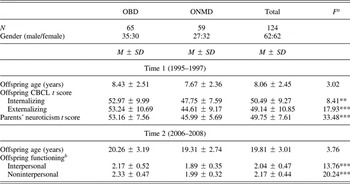
In the present follow-up study, the offspring ranged in age from 15 to 27 years (M = 19.81, SD = 3.01; see Table 1). Sixty-five offspring, from 44 families, had a parent with BD, and 59 offspring, from 34 families, had parents with no mental disorder. Of the 44 families with BD, 20 families had a mother with BD and 24 families had a father with BD. In addition, 14 families had both a parent with BD and a parent with major depression. At the time of the present data collection, 35% of the offspring were living with both biological parents (14 OBD, 29 ONMD), 14% were living with one biological parent (16 OBD, 2 ONMD), 4% were living with one biological parent and a stepparent (4 OBD, 1 ONMD), 47% were living either alone, with a roommate or a partner (31 OBD, 27 ONMD), 93% were in school (59 OBD, 56 ONMD), and 52% were working (33 OBD, 32 ONMD).
Parent and offspring variables

Note: OBD, offspring of parents with bipolar disorder; ONMD, offspring of parents with no mental disorder; CBCL, Child Behavior Checklist.
aMain effect of group (difference between the bipolar and no mental disorder families).
bHigher scores represent worse functioning in interpersonal and noninterpersonal domains, as rated on a 5-point scale.
**p < .01. ***p < .001.
Thirty-five offspring (22 OBD, 13 ONMD) met criteria for a current diagnosis according to DSM-IV (American Psychiatric Association, 1994). Current diagnoses included four mood disorders (3 OBD, 1 ONMD), 27 anxiety disorders (19 OBD, 8 ONMD), 15 substance-related disorders (10 OBD, 5 ONMD), and 5 other diagnoses (2 OBD with ADHD, 1 OBD with hypochondriasis, 1 ONMD with anorexia nervosa, and 1 ONMD with Tourette syndrome).
Measures
Time 1 (1995–1997; children aged 4–12 years old)
Revised NEO Personality Inventory (NEO-PI-R)
Parents completed this self-report questionnaire (Costa & McCrae, Reference Costa and McCrae1992) that includes 240 items assessing the traits of neuroticism, extraversion, agreeableness, openness, and conscientiousness. High internal consistency, with coefficients ranging from 0.89 to 0.95, and temporal stability over 6 years have been reported (Costa, Herbst, McCrae, & Siegler, Reference Costa, Herbst, McCrae and Siegler2000; Rolland, Parker, & Stumpf, Reference Rolland, Parker and Stumpf1998). Studies have also demonstrated convergent and discriminant validity of the NEO-PI-R (Costa & McCrae, Reference Costa and McCrae1992b). Excellent psychometric proprieties have been demonstrated with the French translation (Rolland et al., Reference Rolland, Parker and Stumpf1998). For 115 offspring, the mean of both parents' scores for each of the five traits was used in the analyses, and for 9 offspring, scores from one parent only were used.Footnote 1
CBCL
Parents completed the Parent Report Form (PRF) of the CBCL (Achenbach, Reference Achenbach1991) to assess internalizing and externalizing behaviors in their child. The CBCL PRF has good reliability and validity (Barkley, Reference Barkley, Rutter and Tuma1988). One-week and 3-month test–retest reliabilities for externalizing problems were reported to be 0.95 and 0.84, respectively (Barkley, Reference Barkley, Rutter and Tuma1988). Concurrent validity has been established between the CBCL and other parent-reported behavior scales and the Diagnostic Interview Schedule for Children (Barkley, Reference Barkley, Rutter and Tuma1988). CBCL scores were obtained for 103 offspring. For 95 offspring, the mean of ratings from two parents was used in the analyses, and for 8 offspring, ratings from one parent were used.
Time 2 (2006–2008; children aged 15–27 years old)
UCLA Life Stress Interview
This semistructured interview (Adrian & Hammen, Reference Adrian and Hammen1993; Hammen, Reference Hammen1991) was developed to assess interpersonal and noninterpersonal functioning in nine domains during the past 6 months. Functioning in each domain is coded on a 5-point scale, using specific behavioral anchor points. Higher scores reflect poorer functioning. For example, in the social life domain, a score of 1 is described as Exceptional social life—many good friends, very popular and engages in frequent social activities, gets along well with others, no conflict, and a 5 is described as Severe social problems with no friends, totally isolated from peers or frequent conflicts and fights, rejected by peers (Hammen et al., Reference Hammen, Shih, Altman and Brennan2003). Interpersonal functioning was defined as the sum of scores in the domains of close friends, social life, romantic relationships, and family relationships; noninterpersonal functioning was defined as the sum of scores in the domains of school, work, finances, health, and health of family members (Eberhart & Hammen, Reference Eberhart and Hammen2006; Hammen, Brennan, & Shih, Reference Hammen, Brennan and Shih2004; Rudolph et al., Reference Rudolph, Hammen, Burge, Lindberg, Herzberg and Daley2000). Audio and/or video digital recordings of 14 interviews were rated independently by a second interviewer to estimate interrater reliability. Intraclass correlation coefficients revealed high reliability for all domains, with a mean of 0.82, similar to coefficients obtained in previous studies (Eberhart & Hammen, Reference Eberhart and Hammen2006; Hammen, Shih, & Brennan, Reference Hammen, Shih and Brennan2004; Shih, Eberhart, Hammen, & Brennan, Reference Shih, Eberhart, Hammen and Brennan2006).
Diagnostic interviews
The SCID-I (First, Gibbon, Spitzer, & Williams, Reference First, Gibbon, Spitzer and Williams2002) is a semistructured diagnostic interview designed to assess mental disorders. Many studies have shown the SCID-I to be a reliable and valid diagnostic instrument (e.g., Ramirez-Basco et al., Reference Ramirez Basco, Bostic, Davies, Rush, Witte and Hendrickse2000; Zanarini & Frankenburg, Reference Zanarini and Frankenburg2001). The SCID-I was administered to offspring aged 19 or above (n = 77). For children aged 7 to 18 years old (n = 47), the Kiddie-Schedule for Affective Disorders and Schizophrenia—Present and Lifetime version (K-SADS-PL; Kaufman, Birmaher, Brent, & Rao, Reference Kaufman, Birmaher, Brent and Rao1997) was used. It is highly reliable in children and adolescents and considered to be an excellent interview for identifying affective disorders in youth (Kaufman et al., Reference Kaufman, Birmaher, Brent and Rao1997; Kaufman, Schweder, Hilsenroth, & Segal, Reference Kaufman, Schweder, Hilsenroth and Segal2004). In the current follow-up study, both the SCID-I and K-SADS-PL were administered by experienced clinicians. Using audio and/or video digital recordings, 15 interviews (6 SCID-I and 9 K-SADS) were rated independently by a second clinician. Interrater reliability for diagnoses was high: the κ coefficients were 0.82, 0.71, and 1.0 for affective, anxiety, and substance use disorders, respectively.
Procedure
At baseline, parents with BD and with no mental disorder were recruited in Montréal and surrounding regions. Following a telephone screening, parents completed the SCID-I interview, and a number of questionnaires including the NEO-PI-R and CBCL PRF at home or at the university (for full list of measures, see Ellenbogen & Hodgins, Reference Ellenbogen and Hodgins2004). Parents with BD were euthymic when completing questionnaires. Spouses were contacted and completed the same interviews and questionnaires, and offspring between the ages of 4 and 12 years were assessed.
When offspring reached late adolescence–early adulthood, they were contacted by telephone and invited to participate in the study. Offspring, and their guardian if they were 17 years or younger, provided written consent for participation in the study. They completed a diagnostic interview (SCID-I or K-SADS) and the UCLA Life Stress Interview conducted by a clinical psychologist. Offspring also completed questionnaires, underwent computer-based information processing tasks (data not reported here), and provided samples of saliva at home. Participants received an honorarium of $150 CAN for participating in the current wave of data collection. All procedures were approved by the Human Research Ethics Committee of Concordia University.
Data analysis
Data were screened for outliers, defined as scores at least 3 SD from the mean, and violations of normality. Scores for the nine domains of the chronic stress interview, as well as the aggregated mean scores, were positively skewed and therefore were log-10 transformed. All analyses were conducted on transformed data. However, to facilitate the interpretation of data, nontransformed data are presented in the text and tables.
Hierarchical multiple regressions were performed on the mean scores for interpersonal and noninterpersonal functioning separately. In both regressions, independent variables were entered in the following steps: (a) offspring age, offspring gender, and presence or absence of any current disorder in the offspring; (b) parents' neuroticism score. To determine whether the association between offspring functioning and parents' personality was specific to neuroticism, analyses examined parents' traits of extraversion, agreeableness, conscientiousness, and openness to experience as predictors of offspring interpersonal functioning.
Mediation analyses were conducted using Baron and Kenny's method (Reference Baron and Kenny1986), which recommends testing mediation using three regression models. In Step 1, the independent variable must predict the dependent variable. In Step 2, the mediator must predict the dependent variable. In Step 3, when both the mediator and the independent variable are in the regression equation, the initial association between the independent and dependent variables must be significantly reduced. These three steps were followed by the Sobel test, a more rigorous procedure to test for mediation (MacKinnon, Lockwood, Hoffman, West, & Sheets, Reference MacKinnon, Lockwood, Hoffman, West and Sheets2002). A significant Sobel test suggests that the indirect effect of the independent variable on the dependent variable through the mediator is different from zero, and thus, that mediation is present. Finally, in order to examine whether a parental diagnosis of BD or offspring gender moderated the strength of the mediations, we conducted moderated mediation analyses, following recommendations outlined in Muller, Judd, and Yzerbyt (Reference Muller, Judd and Yzerbyt2005).
All analyses except the moderated mediations were conducted with and without siblings (using random deletion) to determine if the inclusion of siblings (i.e., nonindependence) may have biased the results. Both sets of analyses yielded similar findings; we therefore included all participants in the analyses.
Results
Parents' neuroticism and offspring's functioning in late adolescence–early adulthood
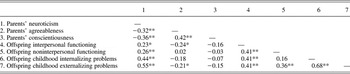
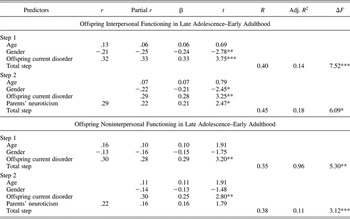
As presented in Table 1, the OBD reported poorer interpersonal and noninterpersonal functioning than the ONMD. Correlations between scores for parents' personality traits and offspring's functioning in late adolescence–early adulthood and in childhood are presented in Table 2. The hierarchical multiple regression equation predicting offspring's interpersonal functioning was significant, accounting for 20.2% (R 2) of the variance (see Table 3, top panel). Parents' neuroticism scores accounted for 4.2% (change in R 2) of the variance in interpersonal functioning in the offspring. In addition, the presence of a current mental disorder in the offspring was a significant predictor of interpersonal functioning, such that offspring with current mental disorders reported higher levels of interpersonal difficulties than those with no mental disorders. Gender was also a significant predictor, indicating that male offspring reported poorer interpersonal functioning than female offspring.
Correlations among parents' and offspring's variables
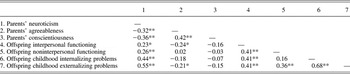
*p < .05. **p < .01.
Parents' level of neuroticism as predictor of offspring outcomes: Results of a hierarchical multiple regression analysis

Note: n = 122; adj. R 2, adjusted R 2; partial r, partial correlation.
*p < .05. **p < .01. ***p < .001.
The regression equation predicting noninterpersonal functioning among offspring was significant and accounted for 14.2% (R 2) of the variance (see Table 3, bottom panel). In contrast to the results for interpersonal functioning, parents' neuroticism scores were not predictive of offspring's functioning in noninterpersonal domains. The presence of a current mental disorder in the offspring was a significant predictor of noninterpersonal functioning, such that offspring with mental disorders reported poorer functioning in noninterpersonal domains than nondisordered offspring. These results indicate that having a parent with high neuroticism is predictive of higher levels of interpersonal, but not noninterpersonal, difficulties, and that this association is independent of the well-known effects of current psychopathology on functioning.
Each of the above analyses was repeated after the random deletion of siblings within each family, so that there was only one sibling per family. The hierarchical multiple regression equation predicting interpersonal functioning among offspring was significant: R = .51, F (4, 71) = 6.15, p < .001. Parents' neuroticism scores (b = 0.22, t = 2.09, p < .05) and gender (b = −0.26, t = −2.52, p < .05) were significant predictors of interpersonal functioning. The regression equation predicting noninterpersonal functioning among offspring was significant: R = .42, F (4, 71) = 3.80, p < 0.01; parents' neuroticism scores were not predictive of offspring functioning in noninterpersonal domains (b = 0.09, t = 0.81, ns). The results of these analyses indicate that the present findings were not influenced by the nonindependence of data from offspring within the same families.
Other personality traits of parents and offspring's functioning in late adolescence–early adulthood
To determine if offspring's functioning in interpersonal and noninterpersonal domains was associated with other personality traits of their parents, similar analyses were undertaken. Parents' extraversion and openness to experience were not significant predictors of offspring's interpersonal or noninterpersonal functioning. Parents' levels of agreeableness (b = −32, t = −3.54, p < .001) and conscientiousness (b = −0.23, t = −2.61, p < .01) were negatively associated with offspring's functioning in interpersonal, but not noninterpersonal, domains.
Is the association between parents' personality and offspring functioning in late adolescence–early adulthood mediated by the offspring's childhood problem behaviors?
A series of multiple regressions were conducted to determine whether scores for internalizing and externalizing problems, measured when the offspring were between 4 and 12 years of age, mediated the associations between parents' personality traits and offspring's interpersonal functioning in late adolescence–early adulthood. The analyses included 103 participants for whom CBCL scores were available.
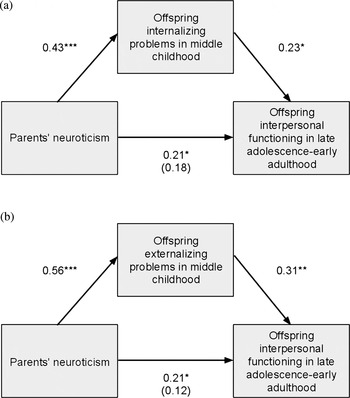
Parents' neuroticism was a significant predictor of offspring's interpersonal functioning (b = 0.21, t = 2.47, p < .05) and offspring's childhood internalizing scores (b = 0.43, t = 4.97, p < 0.001; see Figure 1a). When scores for parents' neuroticism and offspring's childhood internalizing problems were both entered together into the regression equation, childhood internalizing problems predicted offspring's interpersonal functioning later in life (b = 0.23, t = 2.29, p < .05), but parents' neuroticism was no longer a significant predictor of offspring's functioning (b = 0.18, t = 1.90, ns). According to Baron and Kenny (Reference Baron and Kenny1986), these results suggest partial mediation of the association between parents' neuroticism and offspring's functioning by childhood internalizing problems. The results of the Sobel test, estimating whether the indirect effect is significantly different from zero, supported this view, but fell short of conventional statistical significance (Z = 1.86, p = .063).
Standardized regression coefficients for the mediation models. (a) A partial mediation, with internalizing problems as the mediator and (b) a partial mediation through externalizing problems. The numbers in parentheses are the coefficients of the association between parents' neuroticism and offspring functioning when the mediator is in the regression equation. *p < .05. **p < .01. ***p < .001.

Next, we examined whether offspring childhood externalizing scores mediated the association between parents' neuroticism and offspring's interpersonal functioning later in life. Parents' neuroticism predicted offspring's interpersonal functioning (β = 0.21, t = 2.47, p < .05) and offspring's childhood externalizing problems (β = 0.56, t = 6.69, p < .001; see Figure 1b). When scores for parents' neuroticism and childhood externalizing problems were both entered into the regression equation, childhood externalizing problems predicted later offspring's interpersonal functioning (β = 0.31, t = 3.03, p < .01), while parents' neuroticism was no longer a significant predictor (β = 0.12, t = 1.13, ns). The Sobel test indicated that the mediation was significant (Z = 2.73, p < .01), meaning that the association between parents' neuroticism and offspring interpersonal functioning was partially mediated through childhood externalizing problems in offspring.
The statistical analyses were repeated after the random deletion of siblings within each family, so that there was only one sibling per family. Mediation analyses showed that parents' neuroticism was a significant predictor of offspring internalizing (β = 0.44, t = 4.26, p < .001) and externalizing scores (β = 0.55, t = 5.32, p < .001). When scores for parents' neuroticism and childhood internalizing/externalizing problems were entered together into the regression equation, childhood internalizing problems (β = 0.27, t = 2.12, p < .05) and externalizing problems (β = 0.27, t = 2.09, p < .05) predicted interpersonal functioning later in life but parents' neuroticism was no longer a significant predictor of functioning in offspring. The results of these analyses indicate that the present findings were not influenced by the nonindependence of data from offspring within the same families.
Because parents' traits of conscientiousness and agreeableness were negatively associated with offspring's interpersonal functioning, analyses were undertaken to determine if offspring's childhood problems mediated these associations. Parents' scores for conscientiousness did not predict childhood internalizing or externalizing scores (β = −0.07, t = −0.74, ns, and β = −0.16, t = −1.58, ns, respectively), indicating that the association between parents' conscientiousness and offspring's interpersonal functioning is not mediated through childhood internalizing or externalizing problems in offspring.
Parents' scores for agreeableness were associated with childhood internalizing (β = −0.30, t = −3.36, p < .001) and externalizing problems (β = −0.24, t = −2.36, p < .05) in offspring. When scores for parents' agreeableness and offspring's childhood internalizing problems were entered together into the regression equation, childhood internalizing problems predicted later interpersonal functioning in offspring (β = 0.35, t = 3.74, p < .001), but parents' agreeableness was no longer a significant predictor of interpersonal functioning in offspring (β = −0.16, t = −1.75, ns). The Sobel test indicated that the mediation was not significant (Z = −1.69, ns). Mediation analyses were then conducted for externalizing problems in childhood. When scores for parents' agreeableness and childhood externalizing problems in offspring were both entered into the regression equation, offspring's childhood externalizing problems predicted later interpersonal functioning in offspring (β = 0.36, t = 4.04, p < .001), but parents' agreeableness was no longer a significant predictor (β = −0.14, t = −1.54, ns). The Sobel test indicated that the mediation was significant (Z = −2.00, p < .05), meaning that the association between parents' agreeableness and offspring's interpersonal functioning was partially mediated through the offspring's externalizing behaviors in middle childhood.
Is the association between parents' personality and offspring functioning in late adolescence–early adulthood mediated by the offspring's childhood social competence?
In order to verify whether the association between parents' neuroticism and offspring's functioning in late adolescence–early adulthood was associated with the offspring's social competence in childhood, further mediation analyses were undertaken using the social relations competence scale of the CBCL's PRF. Parents' neuroticism was not a significant predictor of social competence assessed when the offspring were children (β = −0.01, t = −0.09, ns). When scores for parents' neuroticism and social competence were entered together into the regression equation, parents' neuroticism predicted offspring interpersonal functioning in late adolescence–early adulthood (β = 0.21, t = 2.46, p < .05), but social competence was not a significant predictor (β = −0.05; t = −0.55, ns). Overall, these analyses suggest that social competence in childhood does not mediate the association between parents' neuroticism and offspring interpersonal functioning in late adolescence-early adulthood.
Does parents' bipolar disorder moderate the observed mediations?
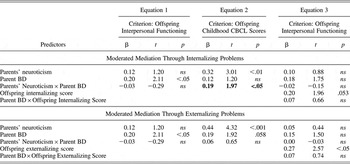
We examined whether a parental diagnosis of BD moderated the strength of the mediated associations that were found between parents' personality and offspring's interpersonal functioning in late adolescence–early adulthood. To accomplish this, we conducted exploratory regression analyses to test for moderated mediation (see Table 4). In the first step of the analyses, we included offspring's age, gender, and current diagnosis as control variables. In the second step, we included parents' neuroticism, parent BD (present or absent), and the mediator when appropriate. In the third step, we included the interaction terms.
Results of regression models estimating moderated mediation with internalizing problems and externalizing problems

Note: Multiplied terms represent interactions. CBCL, Child Behavior Checklist; BD, bipolar disorder diagnosis.
We first examined whether parents' BD moderated the mediation of offspring's childhood internalizing problems on the association between parents' neuroticism and offspring's interpersonal functioning in late adolescence–early adulthood. The first equation showed that the interaction between parents' neuroticism and parent BD did not predict offspring interpersonal functioning, suggesting that the effect of parents' neuroticism on later functioning in offspring is not moderated by the presence of BD in parents (see Table 4, top panel). The second equation showed that parents' BD was a significant moderator. The association between parents' neuroticism and offspring's internalizing problems in childhood was significantly stronger among the OBD than the ONMD. Childhood internalizing problems, however, predicted interpersonal functioning equally among all offspring. Given the small sample size and the absence of association between neuroticism and offspring's interpersonal functioning in the first set of equations, these results should be interpreted cautiously.
We then examined whether parents' BD moderated the mediation of offspring's childhood externalizing problems on the association between parents' neuroticism and offspring's interpersonal functioning in late adolescence–early adulthood. No moderation of the mediation by parents' BD was detected (see Table 4, bottom panel).
An analysis was undertaken to examine whether the presence of BD among the parents moderated the mediation by offspring's childhood externalizing problems of the association between parents' agreeableness and later interpersonal functioning in offspring. No interaction terms were significant, suggesting that parents' BD did not moderate the mediation.
Does offspring gender moderate the observed mediations?
Finally, we were interested in examining whether offspring gender moderated the strength of the mediated associations that were found between parents' personality traits and offspring's interpersonal functioning in late adolescence–early adulthood. We thus conducted exploratory regression analyses to test for moderated mediation, as described in the previous section. Overall, gender did not moderate any of the associations found between parental neuroticism, CBCL scores, and interpersonal functioning.
Discussion
In this prospective 10-year study of youth at high and low risk for affective disorders, we examined the associations between parents' personality traits, offspring's internalizing and externalizing problems in middle childhood, and offspring's interpersonal functioning in late adolescence–early adulthood. Three hypotheses were tested. The first hypothesis, that parents' neuroticism would predict interpersonal functioning in offspring, was supported, even after controlling for the offspring's age, gender, and current disorders. Although a few studies have examined the association between parents' neuroticism and child psychosocial outcomes (Degnan, Henderson, Fox, & Rubin, Reference Degnan, Henderson, Fox and Rubin2008; Kochanska et al., Reference Kochanska, Clark and Goldman1997; Sullivan, Reference Sullivan1997), the present investigation is the first, to our knowledge, to report that parents' personality may have a long-term influence on interpersonal functioning in offspring. Conversely, parents' neuroticism did not predict offspring's functioning in noninterpersonal domains such as school, work, finances, and health habits. Thus, parents' neuroticism specifically influenced offspring's functioning in interpersonal domains in late adolescence–early adulthood.
Our second hypothesis was that the association between parents' neuroticism and interpersonal functioning in offspring would be mediated in part by offspring's childhood internalizing and externalizing problems. Although the hypothesis was supported, the mediation through childhood internalizing problems was modest, whereas that of externalizing problems was stronger. The finding of an association between parents' neuroticism and childhood problems in offspring is consistent with results from our previous cross-sectional study undertaken when the offspring were children (Ellenbogen & Hodgins, Reference Ellenbogen and Hodgins2004) and from other studies (Kochanska et al., Reference Kochanska, Clark and Goldman1997; Kurdek, Reference Kurdek2003). The present study extends these previous findings by showing that offspring's problems in middle childhood are associated with poor interpersonal functioning 10 years later. These results are in line with evidence showing that internalizing and externalizing problems in childhood exhibit continuity over time and increase the risk of similar difficulties and mental disorders in early adulthood (Broidy et al., Reference Broidy, Nagin, Tremblay, Bates, Brame and Dodge2003; Caspi, Moffitt, Newman, & Silva, Reference Caspi, Moffitt, Newman and Silva1996; Goodwin et al., Reference Goodwin, Fergusson and Horwood2004; Shiner, Masten, & Roberts, Reference Shiner, Masten and Roberts2003). Thus, childhood problems in offspring mediated the association of parents' neuroticism and offspring's interpersonal functioning in late adolescence–early adulthood.
Our third hypothesis, that parents' neuroticism would be more strongly associated with interpersonal functioning among the OBD than the ONMD, and that the mediation of offspring childhood problems would be stronger in high-risk than low-risk families, was partially supported. Despite the small sample size, the diagnosis of BD in parents moderated the association between parents' neuroticism and childhood internalizing problems among offspring, but not the association between childhood internalizing problems and interpersonal functioning a decade later. In other words, offspring whose parents had both high neuroticism scores and a diagnosis of BD were more likely to have presented internalizing problems in middle childhood than the offspring of parents with either BD or high neuroticism alone. Internalizing problems in middle childhood increased the risk for poor interpersonal functioning 10 years later, regardless of the presence of BD among the parents. These data support recent evidence highlighting the importance of anxiety in childhood as a precursor to the development of an affective disorder among offspring of parents having BD (Duffy et al., Reference Duffy, Alda, Hajek, Sherry and Grof2010; Goldstein et al., Reference Goldstein, Shamseddeen, Axelson, Kalas, Monk and Brent2010). In sum, the results suggest a pattern of relative continuity across generations in families having a parent with BD, but not in nonaffected families, defined by a trajectory of high emotionality in parents, offspring internalizing problems in childhood, and interpersonal dysfunction in late adolescence and early adulthood.
Few studies have examined the association between parents' neuroticism and offspring outcomes among parents with a mental disorder. The few studies that have addressed this issue have, for the most part, been cross-sectional and focused on infancy and childhood (Brook, Whiteman, & Zheng, Reference Brook, Whiteman and Zheng2002; Ellenbogen & Hodgins, Reference Ellenbogen and Hodgins2004; Sullivan, Reference Sullivan1997). Furthermore, differences in the measures of parents' personality traits and outcomes among offspring make it difficult to compare the results of these studies. The paucity of research on offspring of parents with mental disorders might stem from the challenge of distinguishing personality and symptomatology. Several models have been posited to explain the associations between personality traits, especially neuroticism, and mood disorders (for a review, see Klein, Durbin, Shankman, & Santiago, Reference Klein, Durbin, Shankman, Santiago, Gotlib and Hammen2002). Overall, the extant literature suggests that neuroticism is a stable trait (Costa et al., Reference Costa, Herbst, McCrae and Siegler2000) that contributes to the development of affective disorders (Fanous, Neale, Aggen, & Kendler, Reference Fanous, Neale, Aggen and Kendler2007).
Although the present study focused on the trait of neuroticism because it is strongly associated with affective disorders (Bagby, Bindseil, Schuller, & Rector, Reference Bagby, Bindseil, Schuller and Rector1997; Kendler, Kuhn, & Prescott, Reference Kendler, Kuhn and Prescott2004; Widiger & Trull, Reference Widiger and Trull1992), analyses were conducted to determine if other personality traits of the parents were associated with functioning among offspring. Parents' traits of conscientiousness and agreeableness, but not extraversion and openness to experience, were both negatively associated with interpersonal difficulties among offspring in late adolescence–early adulthood. Agreeableness is the tendency to be compassionate, kind, and cooperative; conscientiousness is the tendency to aim for achievement and to be self-disciplined and hardworking (Costa & McCrae, Reference Costa and McCrae1992). Low agreeableness in parents, but not low conscientiousness, predicted more externalizing problems among the offspring in middle childhood, which in turn predicted poor interpersonal functioning 10 years later. Thus, parents' traits of agreeableness and neuroticism were associated with offspring externalizing problems in middle childhood and interpersonal functioning among offspring later in life. By contrast, only the parental trait of neuroticism was associated with internalizing behaviors among offspring in middle childhood. Given that the traits of neuroticism, agreeableness, and conscientiousness are independent of each other (Costa et al., Reference Costa, Herbst, McCrae and Siegler2000; Costa & McCrae, Reference Costa and McCrae1992), the associations between these traits in parents and their offspring's interpersonal functioning in late adolescence–early adulthood may reflect different developmental trajectories leading to the same outcome, a concept known as “equifinality” (Cicchetti & Toth, Reference Cicchetti, Toth, Cicchetti and Cohen1995). The association between high neuroticism in parents and offspring internalizing problems in middle childhood and poor interpersonal functioning in late adolescence–early adulthood is consistent with findings from studies of the offspring of parents with major depression, which show evidence of an intergenerational transmission of internalizing problems (Hammen, Shih et al., 2004; Rutter, Reference Rutter, Chase-Lansdale, Kiernan and Friedman2004; Weissman et al., Reference Weissman, Wickramaratne, Nomura, Warner, Pilowsky and Verdeli2006). Thus, poor interpersonal functioning among offspring in late adolescence–early adulthood may signal an increased risk for major depression. By contrast, the association between parents' high neuroticism and low agreeableness and offspring externalizing problems in middle childhood may represent a different pathway to poor interpersonal functioning among offspring in late adolescence–early adulthood. High neuroticism and low agreeableness both contribute to trait anger, with the former being associated with angry affect and the latter with the control of aggressive responses (Martin, Watson, & Wan, Reference Martin, Watson and Wan2000). Perhaps this developmental trajectory incorporates the transmission of anger and reactive aggression from parents to offspring, reflected in the externalizing problems in middle childhood and impaired interpersonal functioning in late adolescence–early adulthood. In a similar fashion, maternal negativity in childhood predicted poor executive functioning and the subsequent development of BD in young adulthood among the offspring of parents with an affective disorder (Meyer et al., Reference Meyer, Carlson, Wiggs, Ronsaville, Martinez and Klimes-Dougan2006). Thus, parental agreeableness may highlight a unique developmental trajectory to poor interpersonal functioning and psychopathology in late adolescence–early adulthood.
At least three, not mutually exclusive mechanisms of transmission could account for the associations observed between parents' personality traits and outcomes among offspring. First, genes may partly explain the observed associations. There is evidence that the big five personality traits are determined, in part, by genetic factors (Bouchard & Loehlin, Reference Bouchard and Loehlin2001; Loehlin, Reference Loehlin1992). In addition, levels of neuroticism are elevated in the healthy first-degree relatives of people with major depression (Maier, Minges, Lichtermann, Franke, & Gansicke, Reference Maier, Minges, Lichtermann, Franke and Gansicke1995), suggesting that one facet of the genetic vulnerability for affective disorders may be expressed as the trait of neuroticism. Indeed, biometric modelling studies of twin populations have suggested that the same genes contribute to neuroticism and depression (Fanous, Gardner, Prescott, Cancro, & Kendler, Reference Fanous, Gardner, Prescott, Cancro and Kendler2002; Hettema et al., Reference Hettema, Neale, Myers, Prescott and Kendler2006; Kendler et al., Reference Kendler, Gatz, Gardner and Pedersen2006). Therefore, a child who inherits the genes associated with affective disorders may also inherit a tendency to react emotionally to stressors and daily problems (Van Os & Jones, Reference Van Os and Jones1999), which in turn might impede the development of interpersonal skills and meaningful interpersonal relationships. Although less is known about the association between agreeableness and affective disorders (Meyer et al., Reference Meyer, Carlson, Wiggs, Ronsaville, Martinez and Klimes-Dougan2006), one study reported that patients with BD have low levels of this trait (Lozano & Johnson, Reference Lozano and Johnson2001) and other studies have shown that low levels of agreeableness in adolescents were associated with externalizing problems (Miller, Lynam, & Jones, Reference Miller, Lynam and Jones2008; Pursell, Laursen, Rubin, Booth-Laforce, & Rose-Krasnor, Reference Pursell, Laursen, Rubin, Booth-Laforce and Rose-Krasnor2008). Thus, the child who inherits genes associated with low agreeableness may exhibit externalizing problems that in turn would increase rejection by peers and social dysfunction.
Second, a mechanism by which parents' personality may affect offspring outcomes is modeling. Individuals high in neuroticism experience a host of negative emotions, generate stressful life events, and exhibit poor skills for coping with stress (Belsky & Barends, Reference Belsky and Barends2002; DeLongis & Holtzman, Reference DeLongis and Holtzman2005; Ellenbogen & Hodgins, Reference Ellenbogen and Hodgins2004; Watson et al., Reference Watson, Gamez and Simms2005). Likewise, individuals low on agreeableness tend to be angry, manipulative, and competitive, and to resolve conflicts using coercive tactics (Jensen-Campbell & Graziano, Reference Jensen-Campbell and Graziano2001; Kuppens, Reference Kuppens2005). Thus, parents with high levels of neuroticism and low levels of agreeableness may model maladaptive and dysfunctional behaviors that influence their offspring's social development and abilities for coping with stress (Brook et al., Reference Brook, Whiteman and Zheng2002; Compas, Connor-Smith, & Jaser, Reference Compas, Connor-Smith and Jaser2004; Degnan et al., Reference Degnan, Henderson, Fox and Rubin2008; Ellenbogen & Hodgins, Reference Ellenbogen and Hodgins2004). The offspring's difficulties may further enhance their vulnerability for affective disorders.
Third, as has been suggested in Belsky's (Reference Belsky1984) process model of parenting, the association between parents' personality and offspring outcomes may result from poor parenting practices and disruptions in the parent–child relationship. High neuroticism in parents, relative to low neuroticism, has been associated with a parenting style that is less warm and responsive, and more inconsistent, disorganized, and intrusive (Belsky et al., Reference Belsky, Crnic and Woodworth1995; Clark et al., Reference Clark, Kochanska and Ready2000; Ellenbogen & Hodgins, Reference Ellenbogen and Hodgins2004; Kochanska et al., Reference Kochanska, Clark and Goldman1997). Few studies have examined the association between agreeableness and parenting style, but those that have found high agreeableness to predict positive affect and less controlling behaviors (Belsky et al., Reference Belsky, Crnic and Woodworth1995; Losoya, Callor, Rowe, & Goldsmith, Reference Losoya, Callor, Rowe and Goldsmith1997), and low agreeableness to predict less responsive parenting (Clark et al., Reference Clark, Kochanska and Ready2000; Kochanska et al., Reference Kochanska, Clark and Goldman1997). Thus, parents' personality and the associated parenting behaviors may negatively affect family functioning and parent–child interactions, which in turn increase the likelihood of problem behaviors and poor interpersonal functioning in the offspring similar to those presented by their parents (Elder et al., Reference Elder, Caspi, Downey, Sørensen, Weinert and Sherrod1986).
Among adolescents and young adults, deficits in interpersonal functioning are associated with the development of major depression (Davila, Hammen, Burge, Paley, & Daley, Reference Davila, Hammen, Burge, Paley and Daley1995; Eberhart & Hammen, Reference Eberhart and Hammen2006; Hammen, Shih, et al., 2004). Consequently, understanding the mechanisms leading to poor psychosocial functioning will contribute to clarifying the etiology of depression. Individuals presenting poor interpersonal functioning have difficulty establishing and maintaining relationships with friends, colleagues, romantic partners, and family members. They often suffer from loneliness, lack social support, and demonstrate poor skills in resolving conflicts (Cacioppo et al., Reference Cacioppo, Hawkley, Kalil, Hughes, Waite, Thisted, Eid and Larsen2008; Cattan, Newell, Bond, & White, Reference Cattan, Newell, Bond and White2003; Eberhart & Hammen, Reference Eberhart and Hammen2006; Hammen, Shih et al., 2004; Heinrich & Gullone, Reference Heinrich and Gullone2006). An understanding of the mechanisms involved in the emergence of affective disorders is essential to establishing successful prevention programs, especially in children at elevated genetic risk for these disorders (Beardslee & Gladstone, Reference Beardslee and Gladstone2001; Garber et al., Reference Garber, Clarke, Weersing, Beardslee, Brent and Gladstone2009). Evidence from the present study suggests that interpersonal functioning may be a relevant target for such interventions among high-risk children before behavioral problems emerge.
The finding that parents' level of neuroticism was more strongly predictive of offspring internalizing problems in middle childhood among families with a parent having BD, relative to families with no affective disorders, suggests that the OBD are more sensitive to the consequences of their parents' high levels of neuroticism than the ONMD. It is reasonable to assume that the subgroup of OBD who will develop major affective disorders in adulthood will have inherited a tendency for high levels of neuroticism (Kendler et al., Reference Kendler, Kuhn and Prescott2004, Reference Kendler, Gatz, Gardner and Pedersen2006). This tendency to overreact behaviorally and emotionally would make these offspring more sensitive to the negative consequences of their parents' high levels of neuroticism such as creating a chaotic, unstructured, and stressful family environment (Chang et al., Reference Chang, Blasey, Ketter and Steiner2001; Ellenbogen & Hodgins, Reference Ellenbogen and Hodgins2004; Romero, Delbello, Soutullo, Stanford, & Strakowski, Reference Romero, Delbello, Soutullo, Stanford and Strakowski2005). This family environment, coupled with parental modeling of inadequate skills for coping with stress, may lead to the internalizing problems (Birmaher et al., Reference Birmaher, Axelson, Goldstein, Monk, Kalas and Obreja2010; Giles, DelBello, Stanford, & Strakowski, Reference Giles, DelBello, Stanford and Strakowski2007) and HPA hyperactivity (Ellenbogen & Hodgins, Reference Ellenbogen and Hodgins2009; Ellenbogen et al., Reference Ellenbogen, Santo, Linnen, Walker and Hodgins2010) that has been observed among the OBD in childhood and adolescence. Increased childhood internalizing problems, in turn, increase the risk of poor interpersonal functioning in late adolescence–early adulthood, which ultimately increases the risk of developing an affective disorder (Hammen et al., Reference Hammen, Shih, Altman and Brennan2003). Thus, these hypothesized environmental mechanisms, compounded by changes to the HPA axis, may enhance an inherited predisposition among the subgroup of offspring who will later develop affective disorders to react emotionally to stressors and daily hassles from an early age.
The strengths of this study include an intergenerational longitudinal design, a unique sample of parents with BD and their offspring, diagnostic interviews conducted on all parents and offspring, and high interrater reliability for diagnoses and for ratings of offspring functioning in late adolescence–early adulthood. Some limitations of the study warrant discussion. The sample may not have been large enough to detect effect sizes of small magnitude, and therefore, negative findings should be interpreted with caution. Caution should also be used when interpreting borderline significant results and the moderated mediation analyses. Moreover, the inclusion of siblings transgresses the independence of cases assumption. The findings were replicated, however, in a subsample that included only one child per family, suggesting that the present results are not due to alpha inflation associated with the nonindependent data. It is also possible that the results may be confounded by a reporting bias; parents reported on their own personality and offspring's behavioral problems. Studies of reporting biases associated with mood disorders have been inconclusive, with some studies showing bias (e.g., Weisz, Rudolph, Granger, & Sweeney, Reference Weisz, Rudolph, Granger and Sweeney1992) and others no bias (e.g., Richters, Reference Richters1992). To attempt to counter any such possible bias, parents completed both measures when euthymic and mean scores from two parents for both their own personality and their child's behavior were used in the majority of cases. No reporting bias was associated with the outcome measure, offspring's interpersonal functioning in late adolescence–early adulthood. It is also possible that a variable not measured in the study was responsible for the present results. As the study focused on the offspring of parents with BD, the extent to which the results generalize to other samples can only be determined by future research. Finally, the offspring ranged in age from 15 to 27 years old. Although there were no significant differences on scores for functioning in any of the interpersonal domains between the offspring aged 15 and 18 years (n = 47) and those aged 19 and 27 years (n = 77), the younger offspring presented more problems at school, F (1, 110) = 4.85, p < .05, and fewer financial problems, F (1, 122) = 8.48, p < .01, than the older offspring.
To conclude, the present study showed that parents' personality traits may be associated with the initiation of a maladaptive developmental trajectory toward affective disorders among some of their offspring. Future work in this area should focus on understanding the mechanisms at play, such as the role of specific genetic polymorphisms associated with affective disorders (Gotlib, Joormann, Minor, & Hallmayer, Reference Gotlib, Joormann, Minor and Hallmayer2008) and gene–environment interplay (Rutter, Moffitt, et al., 2006; Taylor et al., Reference Taylor, Way, Welch, Hilmert, Lehman and Eisenberger2006). In the meantime, the present study has shown that high levels of neuroticism and low levels of agreeableness among parents predict poor interpersonal functioning among their offspring in late adolescence–early adulthood, that these associations are mediated by offspring's internalizing and externalizing problems in middle childhood, and that the mediation may be stronger in families in which a parent has BD.