INTRODUCTION
Halidrys siliquosa (Linnaeus) Lyngbye is the only species of this genus that can be found on the European coast. It is a perennial macroalga (Cabioc'h et al., Reference Cabioc'h, Floc'h, Touquin, Boudouresque, Meinesz and Verlaque1992; Buschbaum et al., Reference Buschbaum, Chapman and Saier2006) with a life span of at least three years (Moss & Lacey, Reference Moss and Lacey1963). Data from northern England showed that this species displays reproductive seasonality: in the first year only vegetative growth occurs; reproductive organs develop during the late summer and autumn and gamete discharge occurs from winter to early spring (Moss & Lacey, Reference Moss and Lacey1963).
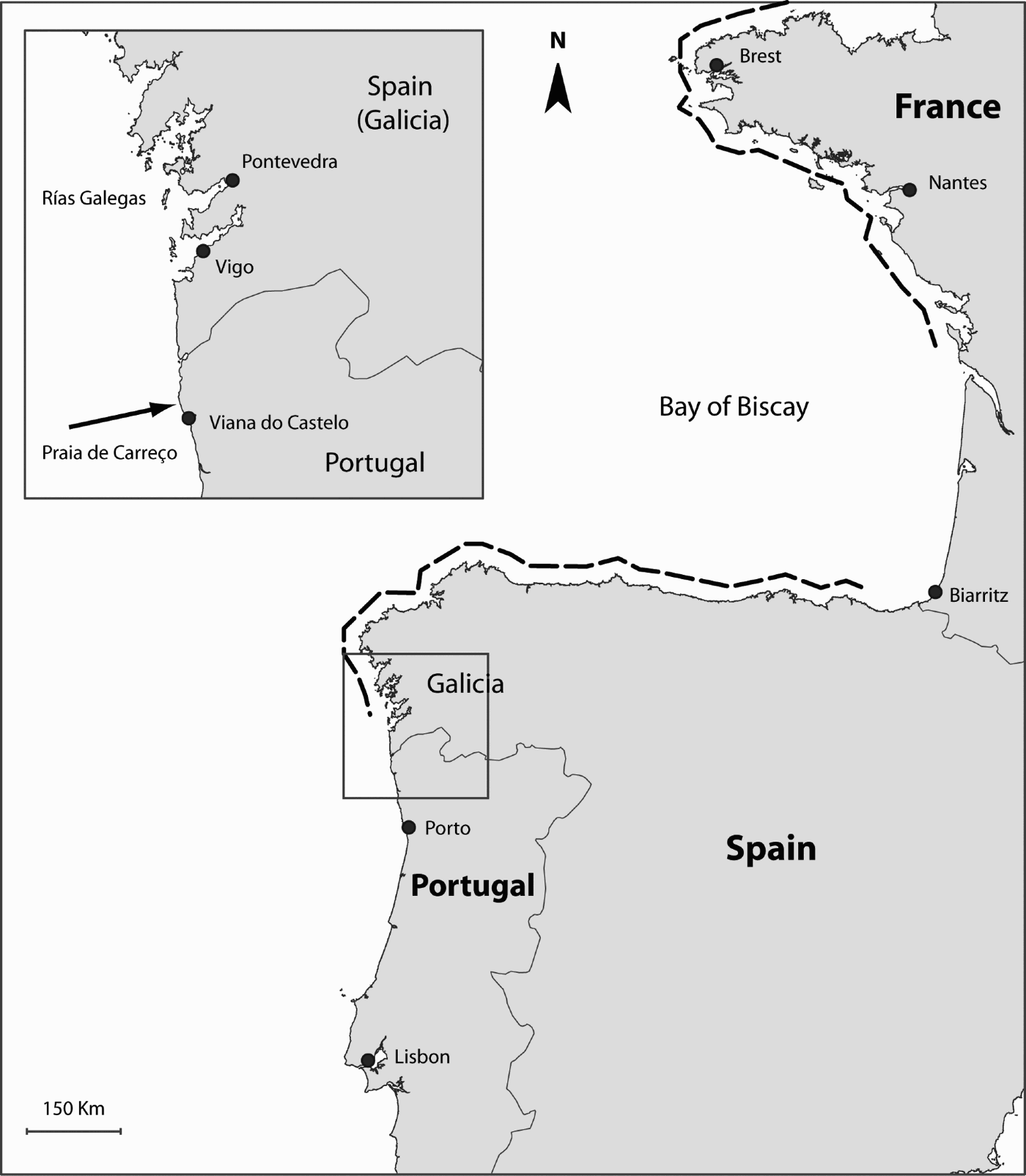
Halydris siliquosa has a wide vertical range from pools at high water spring tides (HWST) to below the sublittoral fringe. On the most sheltered locations it can be found in the sublittoral and in rock pools below low water neap tides (LWNT), while on exposed locations it frequently occurs in deep pools in the eulittoral (Moss & Lacey, Reference Moss and Lacey1963). Halydris siliquosa is a common species in the intertidal zone from the north of the Scandinavian Peninsula (Luning, Reference Luning1990) to Brittany, in north-west France (Crisp & Fischer-Piétte, Reference Crisp and Fischer-Piétte1959). Towards the south its density decreases progressively and this species is completely absent on the French Basque coast (Figure 1). Like many northern species, colonization of shores in this warmer region fails, even under a continuous supply of stranded fertile plants arriving from the north (Crisp & Fischer-Piétte, Reference Crisp and Fischer-Piétte1959). Throughout the northern Spanish coast, this species displays a scattered distribution (for a review, see Margalet & Navarro, Reference Margalet and Navarro1990). Its historical southern range limit is located at the Galician province, in the Rías Baixas region. Several authors confirmed the existence of H. siliquosa in this area, although most of the references are of isolated or stranded specimens (for example Hamel, Reference Hamel1928; Miranda, Reference Miranda1934; Fischer-Piétte, Reference Fischer-Piétte1955, Reference Fischer-Piétte1963). However, at least in the northern Rías of Coruña, Muros, Arosa and Pontevedra, some subtidal populations have been recorded (e.g. Bárbara & Cremades, Reference Bárbara and Cremades1996) in locations sheltered by the sinuous coastline and under strong upwelling influence (see Otero-Schmitt & Pérez-Cirera, Reference Otero-Schmitt and Pérez-Cirera2002). The southernmost individuals ever observed were found in the early 1930s inside the Ría of Pontevedra (Miranda, Reference Miranda1934).
Distribution range of Halidrys siliquosa in south-western Europe. Historical distribution is depicted by the dashed line. Inset figure represents a magnification of northern Portugal and southern Galicia. The new reported boundary is signalled with an arrow.

The Portuguese intertidal communities have been extensively surveyed since the mid 1950s (Fischer-Piétte, Reference Fischer-Piétte1958, Reference Fischer-Piétte1963; Ardré, Reference Ardré1970; Santos, Reference Santos1994, Reference Santos2000; Boaventura et al., Reference Boaventura, Ré, Fonseca and Hawkins2002; Araújo et al., Reference Araújo, Bárbara, Sousa-Pinto and Quintino2005, Reference Araújo, Sousa-Pinto, Bárbara and Quintino2006; Pereira et al., Reference Pereira, Lima, Queiroz, Ribeiro and Santos2006). Nonetheless, Halidrys siliquosa was never observed attached to rocky substrate. Some stranded specimens were found during the 1930s (Rodrigues, Reference Rodrigues1963; Ardré, Reference Ardré1970), but apparently populations never established successfully in northern Portugal.
MATERIALS AND METHODS
Sampling effort on the intertidal communities of northern Portugal has significantly increased in the last decade. Since the onset of a suite of monitoring studies started in the early 1990s (see Santos, Reference Santos1994, Reference Santos2000), extensive data on seaweed abundance and distribution has been obtained by the authors for this particular area. The majority of rocky shores, including Carreço, have been surveyed from two to four times per year, and in some years surveys were carried out monthly (1993–1996 and 2000–2002). Typical surveys included ad libitum transects and both fixed and haphazardly placed quadrats at several shore heights, covering the red and brown algal turfs, sabellarian reefs, pools, mussel and barnacle zones (see Stephenson & Stephenson, Reference Stephenson and Stephenson1949). However, Halidrys siliquosa was never observed, neither stranded nor attached to the substrate. Subtidal surveys in 2003 and 2004 confirmed the absence of the species in this area.
While some of the newly observed specimens were collected and preserved in herbarium for reference, others were left in situ and the reproductive cycle was re-assessed throughout the autumn and winter. The collected specimens are deposited at the marine reference collection of CIBIO, Centro de Investigação em Biodiversidade e Recursos Genéticos, University of Porto, Portugal.
RESULTS AND DISCUSSION
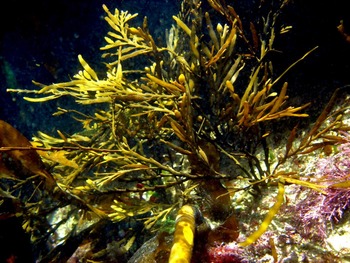
In the summer of 2006 several individuals were observed for the first time in Portugal, at Praia de Carreço (41º44′10″N 8º52′34″W), near Viana do Castelo. Specimens were firmly attached to the rock surface, in several deep pools in the lower eulittoral (Figure 2).
Halidrys siliquosa in a tide pool in the Praia de Carreço, northern Portugal.

Since Ardré (Reference Ardré1957) observed fruiting Halidrys siliquosa in the north-western Spanish coast during February in the early 1950s, this newly established population was monitored until the end of the winter of 2007. Although individuals survived at least until March 2007, none showed signs of reproductive development. This observation does not necessarily mean that the species is unable to reproduce at Praia do Carreço, since it is known that this algae only attains sexual maturity at the age of two years (Moss & Lacey, Reference Moss and Lacey1963).
Halidrys siliquosa produces large, rapidly sinking zygotes with restricted dispersal ability. Some may settle as far as 1 km from the parent algae, but probably most settle within a few metres (Norton, Reference Norton1992). Although detached, floating adults may offer another potential route for dispersal, this mechanism is thought to be ineffective for most species of macroalgae (van den Hoek, Reference van den Hoek1987). The highly regionalized distribution of Halidrys siliquosa has been attributed to lack of long-range dispersal success (Wernberg et al., Reference Wernberg, Thomsen, Staehr and Pedersen2001). The reduced dispersal ability may be slightly enhanced by a favourable hydrographic regime (Norton, Reference Norton1992). Unexpectedly, the fertile period of this algae occurs during the winter months (Ardré, Reference Ardré1957; Moss & Lacey, Reference Moss and Lacey1963), coinciding with a predominance of northward currents off north-western Iberia (Pingree & Le Cann, Reference Pingree and Le Cann1989; Garcia-Soto, Reference Garcia-Soto2004), which do not favour the observed range expansion.
The observation of Halidris siliquosa at Praia do Carreço is a clear shift (roughly 80 km) of the previous southern distributional boundary at Ría de Pontevedra (Miranda, Reference Miranda1934). Given that during the last decades an increase in temperature has been documented for this area (Lemos & Pires, Reference Lemos and Pires2004; Lemos & Sansó, Reference Lemos and Sansó2006; Lima et al., Reference Lima, Queiroz, Ribeiro, Hawkins and Santos2006), the observed shift is inconsistent with general predictions of species migrations under warming climate conditions, which anticipate poleward shifts rather than southern expansions (Hughes, Reference Hughes2000; Walther et al., Reference Walther, Post, Convey, Menzel, Parmesan, Beebee, Fromentin, Hoeg-Guldberg and Bairlein2002). Large brown macrophytes are sensitive indicators of climate change (see Helmuth et al., Reference Helmuth, Mieszkowska, Moore and Hawkins2006). Some of these species have their southern distributional limits in the northern Portuguese coast (Ardré, Reference Ardré1970), which have remained stable until present (Santos, Reference Santos1994, Reference Santos2000). However, a few species, such as Himanthalia elongata (Linnaeus) S.F. Gray and Pelvetia canaliculata (Linnaeus) Decaisne & Thuret, are known to be retreating northwards (Santos, Reference Santos2000), thus in agreement with current knowledge of species responses to climate change. It is possible that stronger equatorial winds originated by the warming process lead to an intensified upwelling, as already reported for the north-east Pacific (Snyder et al., Reference Snyder, Sloan, Diffenbaugh and Bell2003). That would cause a counter-intuitive expansion of cold-water low-shore and subtidal species. Nonetheless, this hypothesis lacks support since recent evidence suggests that upwelling has been decreasing in the Portuguese coast (Lemos & Pires, Reference Lemos and Pires2004). Another hypothesis is that the current shift is part of the natural variability of this species' range dynamics. Still, this new record is of paramount importance for the study of climatic-driven biogeographic changes, for instance, whenever bioclimatic envelope models are to be developed. Only this level of spatial detail enables the partition of climate effects from natural small-scale spatial variability.
The present results emphasize the importance of taking into account the synchrony between climatic oscillations and species' population dynamics (Zacherl et al., Reference Zacherl, Gaines and Lonhart2003) as well as accurate records of species distribution. Together with other species whose distributional limits are in a shifting process (see Lima et al., Reference Lima, Queiroz, Ribeiro, Hawkins and Santos2006), Halidrys siliquosa is ideal for a continuous study, which will definitely help to build more accurate predictive models on how species ranges are likely to shift in response to global climate change.
ACKNOWLEDGEMENTS
The authors wish to thank the Fundação para a Ciência e Tecnologia (FCT). F.P.L. and P.A.R. were funded by FCT grants SFRH/BD/8730/2002 and SFRH/BD/8232/2002, respectively. S.J.H. was funded by a NERC grant in aid to the MBA and the Marclim funding consortium (English Nature, Scottish Natural Heritage, Countryside Council for Wales, Environment Agency, Scottish Executive, Defra, WWF, Crown Estate).