


Introduction
United States Veterans are at elevated suicide risk relative to non-Veterans, and this risk has increased dramatically (Office of Suicide Prevention, 2016). Emotion dysregulation, or difficulty modulating emotions, has been associated with military suicidal ideation (Shelef et al., Reference Shelef, Fruchter, Hassidim and Zalsman2015). This manuscript presents a pilot trial investigating dialectical behaviour therapy skills groups (DBT-SG) among Veterans with emotion dysregulation and suicidal ideation at the Veterans Health Administration (VHA) healthcare system.
Dialectical behaviour therapy (DBT) is a complex treatment including: individual psychotherapy; a group (DBT-SG) teaching emotion regulation and other coping skills; between-session telephone coaching; case management; and therapist supervision. It is well supported for reducing suicidal ideation and behaviour (e.g. Linehan et al., Reference Linehan, Korslund, Harned, Gallop, Lungu and Neacsiu2015) in borderline personality disorder (BPD), a disorder characterized by emotion dysregulation. DBT skills use may be a mechanism of change for emotion dysregulation (Neacsiu et al., Reference Neacsiu, Eberle, Kramer, Wiesmann and Linehan2014).
DBT was associated with reduced suicidal ideation among women Veterans with BPD compared with treatment-as-usual (Koons et al., Reference Koons, Robins, Tweed, Lynch, Gonzalez and Morse2001), and in diagnostically heterogeneous male and female Veterans at risk for suicide, but not to a greater extent than high-risk treatment-as-usual (Goodman et al., Reference Goodman, Banthin, Blair, Mascitelli, Wilsnack and Chen2016). The DBT-SG focus on teaching emotion regulation skills lends its application beyond treatment of BPD (e.g. Neacsiu et al., Reference Neacsiu, Eberle, Kramer, Wiesmann and Linehan2014), and DBT-SG alone is less resource-intensive than comprehensive DBT. In controlled trials, DBT-SG alone has been associated with reduced suicide ideation and attempt (Linehan et al., Reference Linehan, Korslund, Harned, Gallop, Lungu and Neacsiu2015) and emotion dysregulation (Neacsiu et al., Reference Neacsiu, Eberle, Kramer, Wiesmann and Linehan2014). Compared with DBT individual therapy alone, DBT-SG alone and comprehensive DBT (DBT-SG and individual therapy) were both associated with reduced non-suicidal self-directed violence and more rapid improvement in anxiety and depression (Linehan et al., Reference Linehan, Korslund, Harned, Gallop, Lungu and Neacsiu2015), suggesting that DBT-SG improves outcomes in individuals with suicidal ideation and emotion dysregulation.
We evaluated DBT-SG’s feasibility and acceptability among Veterans with suicidal ideation and emotion dysregulation, hypothesizing that: (1) DBT-SG would be feasible, as indicated by mean attendance at over 50% of sessions; (2) DBT-SG would be acceptable to participants and their primary mental health providers as indicated by positive ratings of satisfaction and the group’s promotion of Veterans’ coping skills; and (3) Veterans would show reduced suicidal ideation and emotion dysregulation and increased coping skills at post-treatment.
Method
Design and participants
This study was a Stage 1A uncontrolled pilot of 26-week DBT-SG in Veterans with suicidal ideation and emotion dysregulation at an urban VHA outpatient facility in the northeastern United States. Intent-to-treat participants were 17 Veterans endorsing past-3-months suicidal ideation on the Suicidal Behaviors Questionnaire (SBQ). Other inclusion criteria were: (1) ages 18–65 years; (2) emotion dysregulation, operationalized as Difficulties in Emotion Regulation Scale (DERS) total score ≥ 105; (3) receiving outpatient mental health treatment; and (4) willingness to participate in safety planning, assessments, and recording of group sessions. Exclusion criteria were (1) inability to understand English; and (2) diagnoses of schizophrenia, schizoaffective disorder, bipolar I disorder, anti-social personality disorder, or thought disorder confirmed by the current mental health provider. The study was reviewed and approved by the local Institutional Review Board.
Recruitment, screening and assessment
Potential participants were recruited via clinician referral and flyers. Primary mental health providers confirmed exclusionary mental health diagnoses. Individuals who appeared eligible after telephone screening were invited to participate in in-person screening, informed consent, and individual assessmentFootnote 1 at baseline, mid-and post-treatment, and 3-month follow-up conducted by the primary author. Participants were offered a modest financial incentive for assessments; no financial incentive was offered for group attendance.
Measures
Demographic
Demographic variables and current mental health diagnoses were determined using chart review.
Feasibility and acceptability
Session attendance was monitored. Participant and primary treatment provider acceptability was assessed with self-report measures created for this study and administered at mid-, post- and follow-up points. Participants and primary mental health providers rated group acceptability with 11 items on a 7-point Likert-type scale (sample items for participants: how would you rate your overall satisfaction with DBT skills group?; since the start of DBT skills group, how would you rate your ability to understand and manage painful emotions?; Cronbach’s α = 0.78; for providers: how would you rate your satisfaction with having your client in DBT skills group?; since the start of DBT skills group, how would you rate your client’s ability to understand and manage painful emotions?; Cronbach’s α = 0.96).
Preliminary efficacy
Suicidal ideation was assessed with the SBQ and Beck Scale for Suicidal Ideation (BSSI). Emotion dysregulation was assessed with the DERS; coping was assessed with the DBT Ways of Coping Checklist (DBT-WCCL). All measures demonstrated acceptable internal consistency.
DBT-SG
Treatment was delivered in 2-hour weekly group sessions by two group co-leaders (the primary author and three advanced psychology trainees) following the DBT Skills Training manual. Sessions included review of past week skills use and homework, mindfulness practice, teaching new skills, and assigning homework. Telephone calls were placed to participants who did not attend group sessions to encourage attendance. Participants were discharged from the group if they missed three consecutive sessions.
Analyses
Descriptive statistics (mean, standard deviation, percentage) were used for demographic, attendance, and acceptability analyses. Dependent variables were checked for normality; all conformed to a normal distribution. For preliminary efficacy, paired-sample t-tests and Cohen’s d were used to compare baseline values with mid-, post- and follow-up points; statistical significance was set at p < .016 given the three t-tests. Clinically significant change (CSC) was defined as improvement of at least two standard deviations from the pre-treatment mean.
Results
Sample description
Participants were male (n = 11, 65%) and female (n = 6, 35%) Veterans representative of the facility [76% Caucasian, 18% African-American, 1% ‘other’; 94% (n = 16) self-identified as non-Hispanic; one (6%) declined to answer]. Veterans had been separated for 13.76 years (SD = 13.38) from the Army (n = 6, 35%), Navy (n = 5, 29%), Marine Corps (n = 2, 12%), Army National Guard (n = 2, 12%), Air Force or Army Reserve (each n = 1, 6%). At baseline, the majority reported being unemployed for the past 3 months (69%; n = 11 of 16 with missing data for one participant). Participants’ diagnoses included major depressive disorder (n = 12, 71%), post-traumatic stress disorder (PTSD; n = 8, 47%), substance use disorder (n = 5, 29%), and BPD, generalized anxiety disorder, attention deficit disorder, and gambling disorder (for each, n = 1, 6%). Participants reported a mean of 2.06 (SD = 1.29, range 0–4) lifetime suicide attempts.
Feasibility
Of 17 participants who started the 26-week intervention, four (23.5%) dropped out (missed three consecutive group sessionsFootnote 2 ) and 13 (76%) completed. The mean attendance rate was 66.4% (range 11.5–100.0%) sessions.
Acceptability
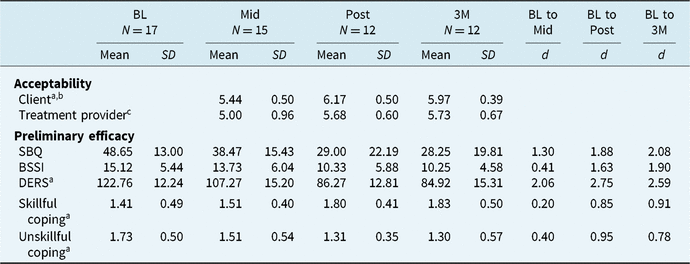
Mean DBT-SG acceptability ratings were positive (above 4.0 on a 7-point scale) for participants and primary mental health treatment providers (Table 1).
Descriptive statistics for acceptability and preliminary efficacy measures

Descriptives are presented from the intent-to-treat sample. Preliminary efficacy effect sizes are presented from the paired sample t-test samples. BL, baseline; Mid, mid-treatment; Post, post-treatment; 3M, 3-month follow-up; d, effect size difference from baseline; SBQ, Suicidal Behaviors Questionnaire; BSSI, Beck Scale for Suicidal Ideation; DERS, Difficulties in Emotion Regulation Scale. aPost N = 11 due to missing data; bfollow-up N = 11 due to missing data; cmid- and post-treatment N = 9 due to missing data from primary mental health treatment providers.
Preliminary efficacy
Suicidal ideation on the SBQ decreased from baseline at mid-treatment (t (14) = 2.58, 95% CI 1.60, 17.33), post-treatment (t (11) = 3.17, 95% CI 5.39, 29.94), and follow-up (t (11) = 3.36, 95% CI 6.24, 29.92), all p < .01; Table 1). The CSC criterion was met by two individuals (13%) at mid-treatment, seven (58%) at post-treatment, and four (33%) at 3-month follow-up. Suicidal ideation on the BSSI was unchanged at mid-treatment (t (14) = 0.93, p = .37, 95% CI −1.58, 3.99) but reduced at post-treatment (t (11) = 3.06, p = .01, 95% CI 1.22, 7.45) and follow-up (t (11) = 4.01, p < .01, 95% CI 2.11, 7.23). The CSC criterion was met by 0 individuals (0%) at mid-treatment, two (17%) at post-treatment, and one (8%) at follow-up. There were no suicide attempts or deaths during the study or follow-up. One participant who dropped out was later hospitalized for suicidal ideation.
Emotion dysregulation decreased from baseline at mid-treatment (t (14) = 3.01, 95% CI 3.90, 23.30), post-treatment (t (10) = 6.21, 95% CI 20.58, 43.60), and follow-up (t (11) = 7.90, 95% CI 25.06, 44.44, all p < .01; Table 1). The CSC criterion was met by five participants (33%) at mid-treatment, 10 (91%) at post-treatment, and 11 (92%) at follow-up.
DBT-WCCL skillful coping increased at post-treatment (t (10) = −2.89, p = .016, 95% CI −0.65, −0.08) and follow-up (t (11) = −4.82, p < .01, 95% CI −0.50, −0.18; Table 1). Unskillful coping was decreased at follow-up (t (11) = 2.74, p < .02, 95% CI 0.07, 0.67). No participants met the CSC criteria.
Discussion
This pilot demonstrates that DBT-SG is promising for Veterans who have emotion dysregulation and suicidal ideation. Rates of treatment completion (76%) compared favourably with previous DBT-SG studies (Linehan et al., Reference Linehan, Korslund, Harned, Gallop, Lungu and Neacsiu2015; Neacsiu et al., Reference Neacsiu, Eberle, Kramer, Wiesmann and Linehan2014). Participants and clinicians agreed that the group was helpful in promoting coping skills, and that they felt satisfied with the group, suggesting that DBT-SG was feasible and acceptable in Veterans with suicidal ideation and emotion dysregulation.
Consistent with prior trials of DBT (Goodman et al., Reference Goodman, Banthin, Blair, Mascitelli, Wilsnack and Chen2016; Koons et al., Reference Koons, Robins, Tweed, Lynch, Gonzalez and Morse2001) and DBT-SG (Linehan et al., Reference Linehan, Korslund, Harned, Gallop, Lungu and Neacsiu2015), suicidal ideation reduced from baseline. Pre–post effect sizes on the SBQ (d = 1.88) and BSSI (d = 1.63) were larger than those observed with comprehensive DBT among women Veterans (d = 0.98; Koons et al., Reference Koons, Robins, Tweed, Lynch, Gonzalez and Morse2001), and reductions in suicidal ideation were maintained at follow-up.
At 3-months follow-up, 92% of participants experienced clinically significant reduction in emotion dysregulation. These results provide preliminary support for offering DBT-SG to individuals with emotion dysregulation across diagnoses. Prior studies in Veterans indicated support for DBT in women Veterans with BPD (Koons et al., Reference Koons, Robins, Tweed, Lynch, Gonzalez and Morse2001), a diagnosis marked by high emotion dysregulation. In a mixed-gender sample of Veterans at high risk for suicide, not selected for high emotion dysregulation, DBT was associated with reduced suicidal ideation, but not to a greater extent than suicidal treatment-as-usual (Goodman et al., Reference Goodman, Banthin, Blair, Mascitelli, Wilsnack and Chen2016). One possible interpretation is that DBT may work better for individuals with high emotion dysregulation. Further study is needed to replicate the finding that DBT-SG was associated with reduced emotion dysregulation, and to determine if reduced emotion dysregulation may mediate reduction in Veteran suicidality. Skillful coping increased by post-treatment, and was maintained at follow-up, while unskillful coping did not decrease until follow-up, suggesting that individuals may need to practise replacing unhealthy coping skills with healthier ones.
Study limitations include: absence of a comparison group or fidelity coding; small sample that did not permit repeated measures analyses; some missing data; unblinded assessments; and a small sample from one facility that may not generalize to other settings. Despite limitations, data indicate that DBT-SG is promising as a feasible, acceptable and potentially efficacious treatment for Veterans at risk for suicide. Future randomized controlled trials are needed.
Supplementary material
To view supplementary material for this article, please visit https://doi.org/10.1017/S1352465819000122.
Acknowledgements
The authors greatly appreciate the contributions of Veterans who participated in this study, mental health treatment providers who shared their views, and funding and support from the New England Mental Illness Research, Education, and Clinical Center.
Conflicts of interest
Dr Decker is a trainer in training with Behavioral Tech, LLC, an organization providing training in evidence-based treatments including DBT, and works with VA to manage any potential conflict of interest. Behavioral Tech, LLC was not involved in the planning, funding, or execution of this project. No conflict of interest is reported.
Financial support
This study was funded by internal funds from the New England Mental Illness Research, Education, and Clinical Center (MIRECC). Dr Watkins and Dr Sippel were funded by the Advanced Fellowship in Mental Illness Research and Treatment at VA Connecticut Health Care System.
Ethical statement
The authors have abided by the Ethical Principles of Psychologists and Code of Conduct as set out by the American Psychological Association. Review and approval was required to conduct this study. This study was reviewed and approved by the Human Studies Subcommittee at VA Connecticut Health Care System (project number SD001).
Prior presentation
A prior presentation of baseline sample characteristics and some outcome data occurred at the International Society for the Improvement and Teaching of Dialectical Behavior Therapy annual meeting, October 30, 2016, New York, NY. As data were still accruing at that time, this manuscript includes new data that have not been previously presented. A prior presentation of some preliminary results occurred at the Strategic Planning Meeting for Dialectical Behavior Therapy, October 21, 2017, Seattle, WA. This manuscript includes data that were not presented at that meeting.




Comments
No Comments have been published for this article.