1. Introduction
The specialization inequality for curves [Reference BakerBak08] gives an upper bound for the dimension of a linear system on a curve in terms of a combinatorial invariant on the dual graph, known as the rank of a divisor. In this paper, we generalize this inequality to varieties of arbitrary dimension using tropical complexes. A tropical complex is an enrichment of the dual complex of a degeneration with intersection numbers coming from the degeneration. This additional data is essential for the definition of linear equivalence on tropical complexes, and thus for the bound on the complete linear series.
As in the case of curves, our specialization inequality applies to a regular, strictly semistable degeneration  $\mathfrak X$ over a discrete valuation ring, meaning that the special fiber of
 $\mathfrak X$ is a reduced union of smooth varieties, with simple normal crossings. From
 $\mathfrak X$, we construct the dual complex, which is a regular
 $\Delta$-complex recording how the components of the special fiber intersect. The tropical complex
 $\Delta$ consists of the dual complex of
 $\mathfrak X$, together with certain intersection numbers from
 $\mathfrak X$, the details of which are recalled in § 2. The tropical complex has a specialization map
 $\rho$ from divisors on the general fiber of
 $\mathfrak X$ to the tropical complex
 $\Delta$ and a compatible notion of linear equivalence for divisors on
 $\Delta$. We define
 $h^0$ of a divisor on
 $\Delta$ as the least number of rational points such that no linearly effective divisor contains all of these points (see Definition 3.1 for details).
Theorem 1.1 Let  $\mathfrak X$ be a regular strictly semistable degeneration of relative dimension
 $n$ over a discrete valuation ring. Suppose that the locally closed strata of dimension at most
 $n-2$ in
 $\mathfrak X$ are affine and that
 $\mathfrak X$ is robust in dimensions
 $n-1$ and
 $n$. If
 $D$ is any divisor on the general fiber
 $X$ of
 $\mathfrak X$, and
 $\Delta$ is the tropical complex of
 $\mathfrak X$, then we have the inequality
 \[ \dim H^0(X, \mathcal{O}(D)) \leq h^0(\Delta, \rho(D)). \]
We now explain the requirements on the degeneration appearing in the second sentence of Theorem 1.1. A closed stratum of dimension  $n-k$ is any connected component of the intersection of any
 $k+1$ irreducible components of the special fiber. Each closed stratum is a smooth irreducible variety. Each closed stratum contains a locally closed stratum formed by removing all lower-dimensional closed strata, and Theorem 1.1 requires this difference to be affine, when the dimension of the locally closed stratum is at most
 $n-2$. For the closed strata of dimensions
 $n-1$ and
 $n$, Theorem 1.1 puts a weaker condition of robustness, which means that the union of the lower-dimensional strata forms a big divisor on the closed stratum, in the sense of birational geometry. See Definition 2.2 for details on both of these definitions.
Although Theorem 1.1 does not apply directly to all regular semistable degenerations because of these hypotheses, projective degenerations can be modified to satisfy the hypotheses by a series of blow-ups.
Proposition 1.2 Suppose that  $\mathfrak X$ is a regular, strictly semistable degeneration, and all the components of the special fiber
 $\mathfrak X_0$ are projective. Then there exists a series of blow-ups, with centers contained in the special fiber, which results in a regular, strictly semistable degeneration
 $\mathfrak X'$ whose locally closed strata are all affine, and thus
 $\mathfrak X'$ is robust in all dimensions.
We now outline the structure of the proof of Theorem 1.1, which will help to explain the necessity of the robustness and affine hypotheses. We imitate the proof of the specialization inequality for curves [Reference BakerBak08, Lemma 2.8]. Since a restatement of the definition of  $h^0$ in an algebraic geometry setting is equivalent to the dimension of the space of global sections, the inequality follows from showing that the specialization map preserves linear equivalence, effectivity of divisors, and point containment. Preservation of linear equivalence was proved in [Reference CartwrightCar20]. However, for an effective divisor
 $D$, the specialization,
 $\rho (D)$, is not always effective, so we introduce a refined specialization in § 5, which is effective and is linearly equivalent to
 $\rho (D)$. Note that, unlike
 $\rho (D)$, the refined specialization is not necessarily supported on the
 $(n-1)$-dimensional simplices of
 $\Delta$, and so our specialization theorem necessarily requires a framework that includes divisors which intersect the interior of the
 $n$-dimensional simplices, as explained in § 2.
For point containment, we describe the issue in terms of the projection of  $D$ to the skeleton of the Berkovich analytification, even though the proof itself does not use that technology. More specifically, by results going back to Berkovich [Reference BerkovichBer90], the dual complex
 $\Delta$ embeds into, and is a strong deformation retract of, the analytification of the general fiber of
 $\mathfrak X$. Restricting to effective divisors in order to avoid cancellation, we have the following result.
Proposition 1.3 If  $D$ is an effective divisor on the general fiber of
 $\mathfrak X$, then the projection of the analytification of
 $D$ to the skeleton defined by
 $\mathfrak X$ is the union of the refined specialization of
 $D$ together with a finite set of polyhedra, all of dimensions at most
 $n-2$.
While the projection of the analytification always preserves point containment, Proposition 1.3 shows that the same can fail for the refined specialization whenever the projection has components of codimension 2 or greater. The purpose of the robustness and affine hypotheses in Theorem 1.1 is to guarantee that we can lift points from the tropical complex to the algebraic variety in such a way that containing divisors project to a set of codimension 1 on  $\Delta$. In the case of curves, a polyhedron of codimension 2, as in Proposition 1.3, is necessarily empty, which is why the specialization inequality for curves required no hypotheses beyond a strictly semistable degeneration.
As an application of Theorem 1.1, we give an example of a tropical complex which does not lift to any algebraic variety.
Theorem 1.4 There exists a two-dimensional tropical complex  $\Delta$ which is not the tropical complex of any regular semistable degeneration.
The underlying  $\Delta$-complex of the example in Theorem 1.4 is a triangulation of the product of a cycle and an interval. Therefore, the dual complex is realizable from a degeneration of an algebraic surface, such as the product of an elliptic curve with a projective line. However, the tropical complex structure is chosen in Theorem 1.4 so that for any divisor
 $D$,
 $h^0(\Delta , nD)$ grows at most linearly in
 $n$, which, combined with the existence of an ample divisor on any smooth, proper surface, shows that
 $\Delta$ cannot be the tropical complex of a projective surface.
An alternative approach to a specialization inequality has been developed in unpublished work of Eric Katz and June Huh. Instead of degenerations, they work with tropicalizations of surfaces embedded in  $\mathbb {G}_m^N$ over a field with trivial valuation. Moreover, their proof involves choosing linearly equivalent divisors passing through the lowest-dimensional toric strata, as opposed to the proof of Theorem 1.1 in which points are lifted from the
 $n$-dimensional locally closed strata. Therefore, the two approaches should give distinct and possibly complementary bounds on the dimension of linear series.
The rest of this paper is organized as follows. Section 2 recalls the definition of tropical complexes from [Reference CartwrightCar20] as well as their main properties. In § 3 we define the invariant  $h^0$ from Theorem 1.1 and look at some examples and applications. Section 4 proves compatibility of tropical complexes under ramified base changes followed by toroidal resolutions of singularities, which are the tools used to give a refined specialization in § 5. Section 6 contains the proof of the specialization inequality.
2. Tropical complexes
Let  $\mathfrak X$ be a regular, strictly semistable degeneration over a discrete valuation ring
 $R$. Specifically, we mean that
 $\mathfrak X$ is a regular scheme, flat and proper over
 $\operatorname {Spec} R$, and such that the fiber over the closed point of
 $\operatorname {Spec} R$ is a reduced, simple normal crossing divisor. The closed fiber is called the special fiber and denoted
 $\mathfrak X_0$. We also assume that the residue field of
 $R$ is algebraically closed. Under these assumptions, we will call
 $\mathfrak X$ a degeneration and we let
 $n$ denote the dimension of the general fiber of
 $\mathfrak X$, which is also the dimension of each component of the special fiber. The general fiber of
 $\mathfrak X$, denoted
 $X$, is the fiber over the generic point of
 $\operatorname {Spec} R$.
We first recall the construction of the dual complex of  $\mathfrak X$. The dual complex is a regular
 $\Delta$-complex (in the sense of [Reference HatcherHat02, § 2.1]) that consists of a vertex for each irreducible component of the special fiber
 $\mathfrak X_0$. In addition, for each set of
 $k+1$ of the irreducible components of
 $\mathfrak X_0$, their intersection is a disjoint union of smooth
 $(n-k)$-dimensional varieties, and we have a
 $k$-dimensional simplex for each of these components. We write
 $C_s$ for the smooth variety corresponding to a
 $(k+1)$-dimensional simplex
 $s$, and we have that the simplices are attached such that
 $C_s$ is a subvariety of
 $C_{s'}$ if and only if
 $s'$ is contained in
 $s$. See the beginning of [Reference CartwrightCar20, § 2] for full details.
The weak tropical complex of  $\mathfrak X$ is the pair of the dual complex and an integer-valued function
 $\alpha$ from the pairs of a vertex
 $v$ and a ridge
 $r$ which contains
 $v$. Here, by ridge, we mean an
 $(n-1)$-dimensional simplex of the dual complex of
 $\mathfrak X$. Thus, the corresponding component
 $C_r$ is a curve which is contained in
 $C_v$, which is a component of
 $\mathfrak X_0$ and a divisor on
 $\mathfrak X$. We define
 $\alpha (v,r) = - \operatorname {deg} C_v \cdot C_r$, where
 $\deg C_v \cdot C_r$ denotes the degree of the intersection product on
 $\mathfrak X$. Note that the intersection is necessarily non-transverse, because
 $v$ is a vertex of
 $r$. In the transverse case, the intersection number would be redundant because it would be number of points of
 $C_v \cap C_r$, which are in bijection with the
 $n$-dimensional simplices of the dual complex containing both
 $v$ and
 $r$. The weak tropical complex of a degeneration satisfies the following definition by [Reference CartwrightCar20, Proposition 2.6].
Definition 2.1 [Reference CartwrightCar20, Definition 2.5]
An  $n$-dimensional weak tropical complex
 $\Delta$ is a pair
 $(S,\alpha )$, where
 $S$ a finite, connected, regular
 $\Delta$-complex, whose simplices all have dimension at most
 $n$, and
 $\alpha$ is an integer-valued function from pairs of a vertex
 $v$ of
 $S$ and a ridge
 $r$ containing
 $v$ such that, for every ridge
 $r$,
 \begin{equation} \sum_{v \in r_0} \alpha(v,r) = \operatorname{deg} r, \end{equation}
where  $r_0$ denotes the vertices of
 $r$ and
 $\operatorname {deg} r$ is the number of
 $n$-dimensional simplices containing
 $r$. The values
 $\alpha (v,r)$ are sometimes referred to as the structure constants of the weak tropical complex. We refer to the
 $0$-,
 $1$-,
 $(n-1)$-, and
 $n$-dimensional simplices of
 $S$ as the vertices, edges, ridges, and facets, respectively, of
 $\Delta$.
Definition 2.1 is more restricted than the one in [Reference CartwrightCar20] in that we assume that the underlying  $\Delta$-complex is regular, meaning that distinct faces of a single simplex are not identified with each other. The dual complex of a simple normal crossing divisor, and thus of a degeneration, is always a regular
 $\Delta$-complex, and thus regular
 $\Delta$-complexes are sufficient for the weak tropical complexes which appear in this paper. Assuming that the
 $\Delta$-complex is regular simplifies the exposition at several points.
We now define locally closed strata and robustness, which appear in the statement of Theorem 1.1. Recall that a divisor  $D$ on a smooth variety is called big if the complete linear series on some multiple of
 $D$ defines a birational map onto its image in projective space [Reference LazarsfeldLaz04, § 2.2].
Definition 2.2 Let  $\mathfrak X$ be a degeneration and let
 $\Delta$ be its weak tropical complex. For any
 $(n-k)$-dimensional simplex
 $s$ of
 $\Delta$, let
 $D_s$ denote the union
 ${\bigcup} _{s'} C_{s'}$, where
 $s'$ ranges over
 $(n-k+1)$-dimensional simplices containing
 $s'$. We define
 $C_s \setminus D_s$ to be the locally closed stratum of dimension
 $k$, corresponding to
 $s$. We also consider
 $D_s$ as a reduced divisor on
 $C_s$, and we say that
 $\mathfrak X$ is robust in dimension
 $k$ if, for any
 $(n-k)$-dimensional simplex
 $s$,
 $D_s$ is a big divisor on
 $C_s$.
Proposition 2.3 Let  $\mathfrak X$ be a degeneration, and
 $\Delta$ its dual complex. Then the following assertions are equivalent.
(i)
 $\mathfrak X$ is robust in dimension $1$.
(ii) The locally closed strata of dimension
$1$ in $\mathfrak X$ are affine.(iii) Every
$(n-1)$-dimensional simplex of $\Delta$ is contained in some $n$-dimensional simplex.


Proof. Let  $r$ be an
 $(n-1)$-dimensional simplex of
 $\Delta$, and thus a ridge. Then
 $C_r$ is a curve, and
 $D_r$ is the union of points corresponding to facets containing
 $r$, and thus is non-trivial if and only if there are any such facets. If the divisor
 $D_r$ is non-empty, then it is ample, and so it is big and also
 $C_r \setminus D_r$ is affine. On the other hand, if
 $D_r$ is the trivial divisor, then it is clearly not big, and
 $C_r \setminus D_r$ is a projective curve and so not affine.
For  $k \geq 2$, if the
 $k$-dimensional locally closed strata are affine, then
 $\mathfrak X$ is robust in dimension
 $k$, but not conversely, and neither condition is determined by the dual complex. However, robustness in dimension
 $2$ is determined by its weak tropical complex, for which we need the following definition.
Definition 2.4 [Reference CartwrightCar20, Definition 2.8]
If  $q$ is an
 $(n-2)$-dimensional simplex, the local intersection matrix of
 $\Delta$ at
 $q$ is the symmetric matrix
 $M_q$ whose rows and columns are indexed by the ridges
 $r$ containing
 $q$, and such that the entry in row
 $r$ and column
 $r'$ is
 \[ (M_{q})_{r,r'} = \begin{cases} \#\{\mbox{facets containing } r \hbox{ and } r'\}& \mbox{if } r \neq r' \\ -\alpha(v, r) & \mbox{if } r = r', \end{cases} \]
where  $v$ refers to the vertex of
 $r$ not contained in
 $q$. A tropical complex is a weak tropical complex
 $\Delta$ such that the local intersection matrix
 $M_q$ has exactly one positive eigenvalue for each
 $(n-2)$-dimensional simplex
 $q$ of
 $\Delta$.
Proposition 2.5 [Reference CartwrightCar20, Proposition 2.10]
Let  $\mathfrak X$ be a degeneration and
 $\Delta$ its weak tropical complex. Then
 $\mathfrak X$ is robust in dimension
 $2$ if and only if
 $\Delta$ is a tropical complex.
We now prove Proposition 1.2, showing that any projective degeneration can be modified to one whose locally closed strata are affine, and thus is robust in all dimensions.
Proof of Proposition 1.2 We fix a component  $C_v$ of the special fiber
 $\mathfrak X_0$. By assumption,
 $C_v$ is projective, so, by Bertini's theorem, we can choose smooth and irreducible elements
 $H_1, \ldots , H_n$ from the linear system of a very ample divisor on
 $C_v$, such that the
 $H_i$ intersect both each other and
 $D_v$ transversely. We now blow up the points of the intersection
 $H_1 \cap \cdots \cap H_n$. Then, for each integer
 $k$ from
 $1$ to
 $n-1$, we blow up the strict transforms of the
 $k$-dimensional varieties in
 $H_{i_1} \cap \cdots \cap H_{i_{n-k}}$ for all tuples of indices
 $1 \leq i_1 < \cdots < i_{n-k} \leq n$. For each
 $k$, these strict transforms are disjoint and thus the order of the blow-ups within a fixed dimension does not matter.
We then repeat the above blow-ups at the strict transform of each component of  $\mathfrak X$ to obtain the degeneration
 $\mathfrak X'$ from the statement. Since
 $\mathfrak X'$ is the iterated blow-up of a regular degeneration at smooth subvarieties, it is also regular. The centers of the blow-ups intersect the singular locus of the special fiber transversely, so the special fiber
 $\mathfrak X'_0$ is also reduced and simple normal crossing. Thus,
 $\mathfrak X'$ is a strict degeneration.
In order to show that the locally closed strata of  $\mathfrak X'$ are all affine, we first consider the case of a stratum
 $C_s'$ of
 $\mathfrak X_0'$ which maps birationally onto its image in
 $\mathfrak X$. We let
 $C_s$ be its image in
 $\mathfrak X$, and then
 $C_s'$ is formed by blowing up
 $C_s$ at the restrictions of intersections of very ample divisors from a component
 $C_v$ for each vertex
 $v$ in
 $s$. Each of these blow-ups produces a new component for
 $\mathfrak X'$ and thus the difference
 $C_s' \setminus D_s'$ is an open subset of
 $C_s$ minus the very ample divisors. This containment may be proper because of the intersection of
 $C_s$ with other components of
 $\mathfrak X_0$. However, the complement of a very ample divisor is affine, and the complement of a Cartier divisor in an affine variety is affine, so
 $C_s' \setminus D_s'$ is affine, as desired.
Let us now consider the components introduced by the blow-ups. The center for such a blow-up is a variety  $Y$ within a single component
 $C_v$. Since we have blown up the intersection of
 $Y$ with very ample divisors in the previous step, the complement
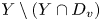 $Y \setminus (Y \cap D_v)$ is affine, as in the previous paragraph. The blow-up of
 $Y$ is a projective bundle over
 $Y$ which intersects
 $C_v$ along a section. Let
 $C_w$ denote this blow-up and then
 $C_w \setminus D_w$ is an affine space bundle over an affine variety
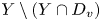 $Y \setminus (Y \cap D_v)$, and thus it is affine. Further blow-ups only intersect
 $C_w$ along
 $D_w$ and therefore do not affect the difference
 $C_w \setminus D_w$, which remains affine in
 $\mathfrak X'$. We conclude that the locally closed strata of
 $\mathfrak X'$ are all affine. As noted above, since the locally closed strata are affine,
 $\mathfrak X'$ is robust in all dimensions
We now come to divisors on  $X$ and their relationship to the combinatorics of the weak tropical complex
 $\Delta$. Let
 $D$ be any divisor on
 $X$, and let
 $\bar D$ denote its closure in
 $\mathfrak X$. Since
 $\mathfrak X$ is regular,
 $\bar D$ is a Cartier divisor on
 $\mathfrak X$, and we can define the following formal sum of ridges of
 $\Delta$:
 \begin{equation} \rho(D) = \sum_{r \in \Delta_{n-1}} (\operatorname{deg} \bar D \cdot C_r) [r], \end{equation}
which we call the coarse specialization of  $D$. In addition, there is a refined specialization, which will be constructed in § 4. We now describe the machinery of linear and piecewise linear functions on
 $\Delta$, which will be used to define divisors and linear equivalence.
We first need to generalize beyond just formal sums of the ridges to formal sums of  $(n-1)$-dimensional polyhedra, possibly contained in the interior of a facet. To be precise, we first identify a single facet
 $f$ of
 $\Delta$ with the standard simplex in
 $\mathbb {R}^n$, which is the convex hull of the origin together with the
 $n$ coordinate vectors. This identification is not unique, but a permutation of the vertices induces an affine linear automorphism of
 $f$, with integral coefficients, and so it does not affect the places where these coordinates are used. We define an
 $(n-1)$-dimensional polyhedron in
 $\Delta$ to be an
 $(n-1)$-dimensional polyhedron of a single facet
 $f$ of
 $\Delta$, which is defined by linear inequalities with rational coefficients and real constants, under the above identification.
By a formal sum of  $(n-1)$-dimensional polyhedra, we will mean a finite, integral sum of
 $(n-1)$-dimensional polyhedra. We will sometimes drop the dimension from our terminology, because the only formal sums of polyhedra in this paper will be
 $(n-1)$-dimensional. Two formal sums of polyhedra are equivalent if they differ by an element of the subgroup generated by the set of formal sums
 $[P] - [Q_1] - \cdots - [Q_r]$, where
 $P$ is any
 $(n-1)$-dimensional polyhedron, and
 $Q_1, \ldots , Q_r$ are polyhedra such that
 $P = Q_1 \cup \cdots \cup Q_r$ and
 $Q_i \cap Q_j$ is either empty or a proper face of both
 $Q_i$ and
 $Q_j$.
One can show that any formal sum of polyhedra is equivalent to one where the terms form the maximal cells of a polyhedral complex. While we will not use that result in this paper, it means in particular that, up to equivalence, we can assume that the intersection between any two terms in a formal sum of polyhedra is a face, and thus has dimension less than  $n-1$, as in part (i) of the following lemma.
Lemma 2.6 Let  $Z = \sum a_i [T_i]$ and
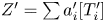 $Z' = \sum a_i' [T_i']$ be formal sums of polyhedra which are equivalent to each other on a weak tropical complex
 $\Delta$.
(i) If the intersection
$T_i \cap T_j$ of any two terms of $Z$ has dimension less than $n-1$, and the coefficients $a_i'$ of $Z'$ are positive, then the coefficients $a_i$ of $Z$ are non-negative.(ii) If both sets of coefficients
$a_i$ and $a_i'$ are positive, then ${\bigcup} P_i = {\bigcup} P_i'$.


Proof. We first assume that any two terms of  $Z$ intersect in dimension less than
 $n-1$ and that the coefficients of
 $Z'$ are positive. Let
 $p$ be a point of an arbitrary term
 $T_j$ of
 $Z$. By definition, the difference
 $Z - Z'$ is a finite sum of expressions of the form
 $[P] - [Q_1] - \cdots - [Q_r]$, where
 $P = Q_1 \cup \cdots \cup Q_r$, and the intersections
 $Q_i \cap Q_j$ are proper faces of each. We can assume that
 $p$ is not contained in any facet of the polyhedra appearing in these expressions or facet of the
 $T_i$. Therefore, if
 $p$ is in the polyhedron
 $P$ of one of these expressions, then
 $p$ is in exactly one of the corresponding
 $Q_i$. Thus, equivalence between
 $Z$ and
 $Z'$ does not change the sum of the coefficients of the polyhedra containing
 $p$, meaning that
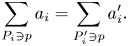 \begin{equation} \sum_{P_i \ni p} a_i =\sum_{P_i' \ni p} a_i'. \end{equation}
Since the coefficients  $a_i'$ are positive, the right-hand side of (3) is non-negative. By our assumption on
 $Z$, the left-hand side consists of just the coefficient
 $a_j$, which is therefore non-negative.
Second, we assume that the terms of  $Z$ and
 $Z'$ are arbitrary, but the coefficients
 $a_i$ and
 $a_i'$ are all positive. Again, let
 $p$ be a point in one term
 $T_j$ of
 $Z$, such that
 $p$ is not contained in any of the facets of the polyhedra appearing in the equivalence between
 $Z$ and
 $Z'$, and we again have equality (3). The left-hand side of (3) is positive since
 $p \in T_j$, so
 $p$ must also be contained in some term
 $T_k'$ of
 $Z'$. Since we were able to choose
 $p$ from a dense open subset of
 ${\bigcup} P_i$, and the union
 ${\bigcup} P_i'$ is closed, we have an inclusion
 ${\bigcup} P_i \subset {\bigcup} P_i'$. By symmetry, we have the reverse inclusion, and thus the desired equality.
Definition 2.7 An equivalence class of formal sums of polyhedra is called effective if it contains a formal sum with all coefficients positive.
The purpose of Lemma 2.6(i) is that it gives a criterion to check whether or not a given formal sum of polyhedra is effective, by using a representative such that the intersections between the terms all have dimension less than  $n-1$. Lemma 2.6(ii) shows that the following definition is independent of the representative chosen.
Definition 2.8 The support of an effective equivalence class of formal sums of polyhedra is the union of polyhedra in a representative with positive coefficients.
For example, if we take  $P$ to be an
 $(n-1)$-dimensional polyhedron, and
 $Q$ any
 $(n-1)$-dimensional polyhedron properly contained in
 $P$, then
 $[P]-[Q]$ is effective, even though it is not written with positive coefficients, and its support is
 $P \setminus Q^o$, where
 $Q^o$ denotes the relative interior of
 $Q$. We can find a subdivision
 $P = Q \cup Q_2 \cup \cdots \cup Q_r$, as in the equivalence relation, and then
 $[P] - [Q]$ is equivalent to
 $[Q_2] + \cdots + [Q_r]$, which has positive coefficients, thus showing that
 $[P]-[Q]$ is effective, and its support is
 $P \setminus Q^o$, as claimed.
We now define piecewise linear and linear functions. Linear functions will be used to define a balancing condition on equivalence classes of formal sums of polyhedra. Then piecewise linear functions will be used to define linear equivalence between divisors, and thus complete linear series.
Definition 2.9 [Reference CartwrightCar20, Definition 3.1]
A piecewise linear function or PL function on a weak tropical complex  $\Delta$ is a continuous function
 $\phi$ such that, restricted to each simplex of
 $\Delta$,
 $\phi$ is a piecewise linear function with integral slopes, under the identification of the simplex with a standard simplex in
 $\mathbb {R}^k$.
Definition 2.10 [Reference CartwrightCar20, Construction 3.2]
Let  $\Delta$ be an
 $n$-dimensional weak tropical complex. For any ridge
 $r$ of
 $\Delta$, we define the normalization of the star of
 $r$, denoted
 $N_r$, to be the simplicial complex which consists of a central
 $(n-1)$-dimensional simplex, together with one
 $n$-dimensional simplex for each facet containing
 $r$, and we let
 $d$ denote the number of such facets. Thus, if
 $N_r^o$ is the union of the interiors of the
 $n$-dimensional simplices and the central
 $(n-1)$-dimensional simplices, then
 $N_r^o$ is homeomorphic to a neighborhood of the interior of
 $r$.
We can embed  $N_r$ in the real vector space
 $\mathbb {R}^{d+n}$ by sending
 $w_i$ to the
 $i$th coordinate vector of
 $\mathbb {R}^{d+n}$ and
 $v_i$ to the
 $(d+i)$th coordinate vector, where
 $v_1, \ldots , v_n$ are the vertices of the central
 $(n-1)$-dimensional simplex, and
 $w_1, \ldots , w_d$ are the other vertices of
 $N_r$. Then we define
 $L_r$ to be the quotient of
 $\mathbb {R}^{d+n}$ by the one-dimensional vector space generated by
 $(1, \ldots , 1, -\alpha (v_1, r), \ldots , -\alpha (v_n,r))$. We define
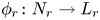 $\phi _r \colon N_r \rightarrow L_r$ to be the composition of the inclusion followed by the projection map.
A linear function  $\phi$ on an open subset
 $U$ of a weak tropical complex
 $\Delta$ is a PL function such that the following assertions hold.
(i) For any facet
$f$ of $\Delta$, the restriction $\phi \vert _{U \cap f}$ is the restriction of an affine linear function on $\mathbb {R}^d$, under the identification of $f$ with the standard unit simplex in $\mathbb {R}^d$.(ii) For any ridge
$r$ of $\Delta$, the restriction $\phi \vert _{U \cap N_r^o}$ is a composition $\ell \circ \phi _r$, where $\ell \colon L_r \rightarrow \mathbb {R}$ is a linear function.


Definition 2.11 [Reference CartwrightCar20, Constructions 3.5, 3.6 and Definition 3.7]
Let  $Z$ be a formal sum of
 $(n-1)$-dimensional polyhedra. Let
 $Q$ be an
 $(n-2)$-dimensional face of a term of
 $Z$ and assume that for every term
 $P_i$ of
 $Z$, if
 $P_i$ intersects Q, then Q is a face of
 $P_i$. Now let
 $\phi$ be a linear function on a neighborhood of the interior of
 $Q$, which is constant on
 $Q$.
For each term  $P_i$, use the coordinates in
 $\mathbb {R}^n$ coming from the identification of the facet
 $f \subset \Delta$ containing
 $P_i$ with the standard unit simplex. We let
 $\mathbf {w}_i \in \mathbb {Z}^n$ be a vector such that
 $\mathbf {w}_i \cdot x$ is constant for all
 $x$ in
 $P_i$. We assume that the entries of
 $\mathbf {w}_i$ are relatively prime, which uniquely determines
 $\mathbf {w}_i$ up to a sign. Then let
 $\mathbf {v}_i \in \mathbb {Z}^n$ be the normal vector of a supporting hyperplane of
 $Q$, meaning that, for some constant
 $c_i \in \mathbb {R}$,
 $\mathbf {v}_i \cdot x \geq c_i$ for all
 $x \in P_i$, and
 $Q$ is the set of
 $x$ such that
 $\mathbf {v}_i \cdot x = c_i$. In addition, we can assume that, for each integer
 $k$, the entries of
 $\mathbf {v}_i + k \mathbf {w}_i$ are relatively prime, which determines
 $\mathbf {v}_i$ up to a multiple of
 $\mathbf {w}_i$. Since
 $\phi$ is constant on
 $Q$,
 $\phi \vert _{P_i}$ can be written as
 $\phi \vert _{P_i} (x) = a_i \mathbf {v}_i \cdot x + t$, with
 $t \in \mathbb {R}$ and
 $a_i$ an integer by the assumption on
 $\mathbf {v}_i$ and the fact that
 $\phi$ has integral slopes. We refer to
 $a_i$ as the slope of
 $\phi$ along
 $P_i$. If
 $m_i$ is the coefficient of
 $P_i$ in
 $Z$, then we define the multiplicity of
 $\phi$ along
 $Q$ of
 $Z$ to be
 \[ \operatorname{mult}_{Z,Q}(\phi) = \sum a_i m_i. \]
We say that a formal sum of polyhedra  $Z$ is balanced if each
 $(n-2)$-dimensional face
 $Q$ of a term of
 $Z$ is a face of all the terms which contain it, and, for any such face
 $Q$ and any linear function
 $\phi$ on a neighborhood of the interior of
 $Q$, if
 $\phi$ is constant on
 $Q$, then
 $\operatorname {mult}_{Z,Q}(\phi ) = 0$.
Lemma 2.12 [Reference CartwrightCar20, Lemma 3.8]
Let  $Z$ and
 $Z'$ be equivalent formal sums of
 $(n-1)$-dimensional polyhedra such that any
 $(n-2)$-dimensional face of a term of
 $Z$ is a face of all terms of
 $Z$ which contain it, and similarly with
 $Z'$. Then
 $Z$ is balanced if and only if
 $Z'$ is balanced.
Definition 2.13 [Reference CartwrightCar20, Definition 3.9]
A (Weil) divisor on a weak tropical complex is an equivalence class of formal sums of  $(n-1)$-dimensional polyhedra such that some representative is balanced.
In [Reference CartwrightCar20], Cartier divisors on weak tropical complexes are also defined, which are the appropriate tool for intersection theory. With the exception of the Riemann–Roch conjecture at the end of § 3, we only use the definition of Weil divisors, which we usually refer to as divisors. In particular, divisors arise from the specialization of divisors.
Proposition 2.14 [Reference CartwrightCar20, Proposition 3.16]
Let  $\mathfrak X$ be a degeneration which is robust in dimension
 $2$ and let
 $\Delta$ be its tropical complex. If
 $D$ is a divisor on
 $X$, then
 $\rho (D)$ is a divisor on
 $\Delta$.
Linear equivalence between divisors on a weak tropical complex is analogous to linear equivalence on an algebraic variety, with PL functions taking the place of rational functions. The following proposition characterizes the divisor associated to a PL function, which closely links them to the linear functions from Definition 2.10.
Proposition 2.15 [Reference CartwrightCar20, Proposition 4.1]
Let  $\Delta$ be a weak tropical complex and assume that every ridge is contained in a facet. There is a unique function
 $\operatorname {div}$ from PL functions on an open subset
 $U \subset \Delta$ to equivalence classes of formal sums of polyhedra on
 $U$ such that the following assertions hold.
(i) For any PL functions
$\phi$ and $\phi '$ on $U$, $\operatorname {div}(\phi +\phi ') = \operatorname {div}(\phi ) + \operatorname {div}(\phi ')$.(ii) If
$V \subset U$ are open sets, and $\phi$ is a PL function on $U$, then $\operatorname {div}(\phi \vert _V) = \operatorname {div}(\phi )\vert _V$.(iii) A function
$\phi$ is linear if and only if $\operatorname {div}(\phi )$ is trivial.(iv) If
$\phi$ is identically zero outside of the intersection of $U$ with a single facet $f$ of $\Delta$, and, on $U \cap f$, $\phi$ is defined as
where\[ \phi(x) = \max\{ \lambda \cdot x, 0\}, \]$x$ is a coordinate vector, using the identification of $f$ with a standard unit simplex in $\mathbb {R}^n$, and $\lambda$ is an integral vector whose entries have no common divisor, then $\operatorname {div}(\phi ) = [H]$, where $H = \{x \in U \cap f \mid \lambda \cdot x = 0\}$, using the same coordinates.









In [Reference CartwrightCar20], Proposition 4.1 also has an additional normalization assumption in order to apply to ridges that are not contained in a facet. However, the degenerations of interest in this paper are robust in dimension 1, and thus, by Proposition 2.3, every ridge is contained in a facet.
Definition 2.16 [Reference CartwrightCar20, Definition 5.1]
Two divisors  $D$ and
 $D'$ on a weak tropical complex
 $\Delta$ are linearly equivalent if
 $D-D' = \operatorname {div}(\phi )$ for some PL function
 $\phi$ on
 $\Delta$.
Proposition 2.17 [Reference CartwrightCar20, Proposition 5.2]
Let  $\mathfrak X$ be a degeneration which is robust in dimension
 $2$, with
 $\Delta$ as its tropical complex. If
 $D$ and
 $D'$ are linearly equivalent divisors on
 $X$, then
 $\rho (D)$ is linearly equivalent to
 $\rho (D')$.
3. Linear series
A complete linear series of a divisor  $D$ on a weak tropical complex
 $\Delta$ is the set of all effective divisors linearly equivalent to
 $D$. The invariant
 $h^0(\Delta , D)$ appearing in Theorem 1.1 is a measure of how large the complete linear series of
 $D$ is, analogous to the dimension of the global sections of
 $\mathcal {O}(D)$ on an algebraic variety. In this section, we define
 $h^0(\Delta , D)$ and give some examples and applications.
Definition 3.1 We say that a point  $p \in \Delta$ is rational if its coordinates are rational when we identify a
 $k$-simplex containing
 $p$ with a standard unit simplex in
 $\mathbb {R}^k$. We define
 $h^0(\Delta , D)$ to be the cardinality
 $m$ of the smallest set of rational points
 $p_1, \ldots , p_m$ such that there is no effective divisor
 $D'$, linearly equivalent to
 $D$, such that
 $D'$ contains
 $p_1, \ldots , p_m$. If there is no such finite set of points, then
 $h^0(\Delta , D)$ is defined to be
 $\infty$.
The rationality condition on the points in Definition 3.1 is needed for technical reasons in the proof of Theorem 1.1 and we expect that it can be dropped without changing the definition.
Conjecture 3.2 The definition of  $h^0$ is equivalent to the variant definition where the
 $p_i$ are allowed to be arbitrary, not necessarily rational, points.
In the case of a one-dimensional tropical complex  $\Gamma$, the quantity
 $h^0(\Gamma , D)$ is very similar to the rank of the divisor as introduced by Baker and Norine [Reference Baker and NorineBN07], and extended to metric graphs in [Reference Gathmann and KerberGK08, Reference Mikhalkin and ZharkovMZ08], with one exception being that the convention for rank differs by
 $1$. In addition, we require the points to be rational, which does not change the rank on metric graphs, because the points can even be assumed to be vertices by Luo's theorem [Reference LuoLuo11, Theorem 1.6]. However, we also require that the points are distinct and do not have a way of incorporating multiplicities on those points. Therefore, a finite set of vertices is not sufficient to determine all ranks, but the set of all rational points is nonetheless equivalent to using all points, by the following proof of the one-dimensional case of Conjecture 3.2,
Proposition 3.3 If  $\Gamma$ is a one-dimensional tropical complex with at least one edge and
 $r(D)$ is the rank of a divisor
 $D$ as in [Reference Baker and NorineBN07], then
 $h^0(D) = r(D) + 1$.
Proof. Recall that the rank of  $D$ is the largest number
 $r$ such that, for any
 $r$ points
 $p_1, \ldots , p_r$ in
 $\Gamma$, the difference
 $D - [p_1] - \cdots - [p_r]$ is linearly equivalent to an effective divisor
 $D'$. Thus,
 $D' + [p_1] + \cdots + [p_r]$ is an effective divisor linearly equivalent to
 $D$ and it clearly contains the
 $p_i$, so
 $h^0(D) \geq r(D) + 1$. To show the reverse inequality, we assume that there exist points
 $p_1, \ldots , p_{r(D) + 1}$ such that
 $D$ is not linearly equivalent to
 $D' + [p_1] + \cdots + [p_{r(D) + 1}]$ for any effective divisor
 $D'$. In other words, if we write
 $\lvert D \rvert$ for the subset of
 $\Gamma ^d$ which are effective divisors linearly equivalent to
 $D$, then
 $\lvert D \rvert$ does not intersect the set
 \[ \{p_1\} \times \cdots \times \{p_{r(D) + 1}\} \times \Gamma \times \cdots \times \Gamma \subset \Gamma^d. \]
However,  $\lvert D \rvert$ is a closed subset [Reference Mikhalkin and ZharkovMZ08, Theorem 6.2]. Therefore, since
 $\Gamma$ is not a point, we can perturb the points
 $p_i$ slightly and the intersection with
 $\lvert D \rvert$ will still be empty. In particular, we can make the
 $p_i$ distinct and rational. Thus,
 $h^0(D) \leq r(D) + 1$, so we have proved the proposition.
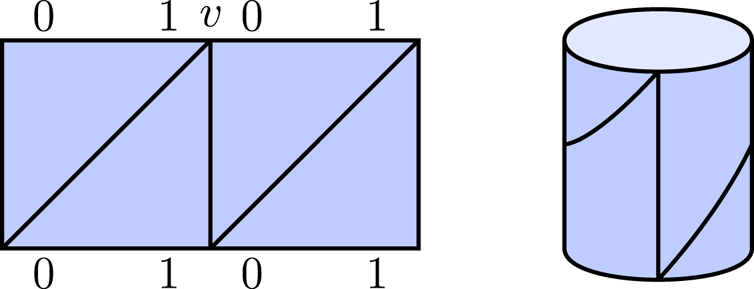
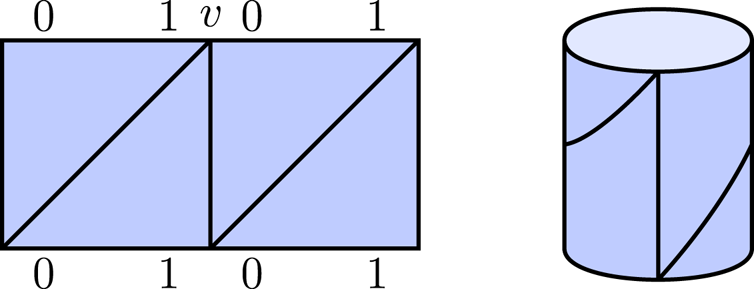
We now give some applications of Theorem 1.1 for two-dimensional tropical complexes, beginning with the proof of Theorem 1.4, that there exists a two-dimensional tropical complex which does not lift. Our example is the cylinder depicted in Figure 1, which is a variant of [Reference CartwrightCar15, Example 4.6], with the circumference of the cylinder increased to  $2$ so that the underlying complex is a regular
 $\Delta$-complex. This tropical complex is a tropical analogue of Hopf surfaces, which are non-algebraic complex surfaces. Tropical Hopf manifolds are explored at greater length, and in a different framework, in [Reference Ruggiero and ShawRS16].
Lemma 3.4 Let  $\Delta$ be the tropical complex in Figure 1 and let
 $D$ be the sum of the top two edges. Then any divisor linearly equivalent to
 $mD$ is the sum of
 $m$ copies of parallel circles, and thus
 $h^0(\Delta , mD) = m+1$.
The tropical complex  $\Delta$ used in Theorem 1.4 is formed by identifying the edges on the left and right from the triangulation on the left to form the cylinder shown on the right. For the edges forming the top and bottom circles, the structure constants are indicated by the numbers adjacent to each endpoint. The other edges all have degree
 $2$ and all structure constants on these edges are taken to be
 $1$.
Proof. Let  $\phi$ be a PL function on
 $\Delta$ such that
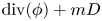 $\operatorname {div}(\phi ) + mD$ is effective. Let
 $C$ be a horizontal circle on the cylinder
 $\Delta$ parallel to
 $D$, but not equal to
 $D$ or the bottom of the cylinder. Let
 $p$ be a point of
 $C$ at which the restriction
 $\phi \vert _C$ achieves its maximum. The key point is that the linear functions on a neighborhood
 $U$ of
 $p$ embed
 $U$ in an open subset of
 $\mathbb {R}^2$ and
 $C$ remains a straight line in this embedding. Since the divisor of
 $\phi$ is effective in
 $U$,
 $\phi \vert _{U}$ is a convex function of
 $\mathbb {R}^2$. Thus, the restriction to
 $C$, which is a line segment, is also convex, but
 $\phi \vert _C$ achieves its maximum at
 $p$ and so
 $\phi \vert _{C \cap U}$ must be constant. Since
 $\phi$ is constant in any neighborhood of a point in
 $C$ where
 $\phi \vert _C$ achieves its maximum,
 $\phi$ is constant on
 $C$.
Thus,  $\phi$ is a function solely of the vertical coordinate on
 $\Delta$, and
 $\phi$ defines a linear equivalence between
 $mD$ and
 $m$ horizontal circles, possibly not distinct. For any
 $m$ points, these circles can be chosen to contain them, but for
 $m+1$ points chosen to have
 $m+1$ distinct heights, no sum of
 $m$ circles will contain all of the points. Therefore,
 $h^0(\Delta , mD) = m+1$, as claimed.
Proof Theorem 1.4 Suppose that  $\mathfrak X$ is a degeneration over a discrete valuation ring whose weak tropical complex is
 $\Delta$. Since all the maximal simplices of
 $\Delta$ are two-dimensional, and it can be checked that
 $\Delta$ is a tropical complex,
 $\mathfrak X$ must be robust in dimensions
 $1$ and
 $2$ by Propositions 2.3 and 2.5, respectively. The general fiber
 $X$ is a smooth proper surface and therefore projective. We let
 $A$ be an ample divisor on
 $X$. By Proposition 2.14,
 $\rho (A)$ is a divisor, and from the definition of the specialization (2), we know that
 $\rho (A)$ is a linear combination of the ridges of
 $\Delta$.
We now examine the possibilities for  $\rho (A)$. The set of all formal sums of the eight ridges of
 $\Delta$ forms a free Abelian group of rank 8, and those satisfying the balancing condition are a subgroup. In a neighborhood of each vertex
 $v$ of
 $\Delta$, the space of linear functions can be computed by considering functions which are linear on the interior of each two-dimensional simplex, and satisfy the condition in Definition 2.10 along each ridge containing
 $v$. In each case, the space of linear functions has only one parameter for the slopes. For example, let
 $v$ be the vertex indicated in Figure 1, and
 $e_1$,
 $e_2$,
 $e_3$, and
 $e_4$ be the edges incident to
 $v$, beginning with
 $e_1$ to the left and continuing counterclockwise. Then the linear functions are constant along the diagonal edge
 $e_2$, and affine linear under the embedding shown. Therefore, the slopes along
 $e_3$ and
 $e_4$ are equal, and are the negative of the slope along
 $e_1$. Therefore, if
 $c_1$,
 $c_3$, and
 $c_4$ are the coefficients of these three edges in a divisor, then
 $c_1 - c_3 -c_4 = 0$. Similarly, the other three vertices of
 $\Delta$ also give linear conditions on the coefficients of a divisor, and one can check that these are independent, so the group of formal sums of the ridges which are divisors is a free Abelian group of rank 4.
Next, one can compute the subgroup of divisors which are linearly equivalent to the trivial one by considering PL functions which are linear on the interior of each two-dimensional simplex. Using the properties in Proposition 2.15, one can then check that the group of divisor classes which are linearly equivalent to a formal sum of ridges is isomorphic to  $\mathbb {Z}$, with the divisor
 $D$ from Lemma 3.4 representing twice a generator.
Therefore,  $\rho (2A) = 2 \rho (A)$ is linearly equivalent to
 $lD$ for some integer
 $l$. Thus, by Theorem 1.1 and Lemma 3.4, we have the inequality
 \[ h^0(X, \mathcal{O}(2mA)) \leq h^0(\Delta, mlD) = ml + 1. \]
In particular,  $h^0(X, \mathcal {O}(2mA))$ grows at most linearly in
 $m$, which contradicts the fact that
 $A$ is an ample divisor on a surface, whose global sections should grow quadratically. Therefore, we conclude that no degeneration
 $\mathfrak X$ with weak tropical complex
 $\Delta$ can exist.
The following example shows one case where the inequality in Theorem 1.1 can be sharp for a divisor and all of its multiples.
Example 3.5 We consider a degeneration of a quartic surface which will yield a tetrahedron as its dual complex. We start with the variety  $\widetilde {\mathfrak {X}} \subset \mathbb {P}^3_R$, where
 $R = \mathbb {C}[[t]]$, which is defined by the determinant
 \begin{equation} \begin{vmatrix} xy & (3x^2 + 2 y^2 + z^2 - w^2) t \\ 3x^2 + y^2 + 2z^2 + w^2 & zw + t(x^2 + y^2 + z^2 + w^2) \end{vmatrix}. \end{equation}
The reason for this determinantal form is that we can immediately see that the general fiber  $X$ contains the scheme defined by the equations in the bottom row of the matrix (4), and one can check that this is a smooth complete intersection and therefore an elliptic curve
 $E$. The curve
 $E$ is part of a pencil interpolating between
 $E$ and the curve defined by the equations in the top row of (4). Thus, the complete linear series of
 $E$ defines a map to
 $\mathbb {P}^1_K$ with connected fibers, and so
 $h^0(\widetilde {\mathfrak X}_K, \mathcal {O}(mE)) = m+1$ for all
 $m \geq 0$.
Now we want to show how Theorem 1.1 gives a sharp bound for this value of 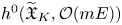 $h^0(\widetilde {\mathfrak X}_K, \mathcal {O}(mE))$. We can rewrite (4) as
 $xyzw + tf$, where
 \[ f = xy(x^2+y^2+z^2+w^2) - (3x^2+2y^2+z^2-w^2)(3x^2+y^2+2z^2+w^2), \]
to see that the special fiber of  $\widetilde X$ is the union of the four coordinate planes. However,
 $\widetilde X$ is not a regular degeneration, but has 24 ordinary double point singularities at the intersection of the quartic
 $f$ with the six coordinate lines in
 $\mathbb {P}^3$. We wish to resolve each singularity without introducing any new components in the special fibers, which can be done by blowing up one of the two planes containing the singularity.
As in [Reference CartwrightCar20, Example 2.10], we can obtain a symmetric tropical complex by blowing up one plane at two of the four singularities along each line and blowing up the other plane at the other two singularities, but we pay special attention to the four lines defined by the intersection of one of the planes  $x=0$ or
 $y=0$ with either
 $z=0$ or
 $w=0$. Note that when either
 $x$ or
 $y$ vanishes,
 $f$ factors as the product of two quadrics, which we write as
 \[ g = 3x^2 + 2y^2 + z^2 - w^2 \quad\mbox{and}\quad h = 3x^2 + y^2 + 2z^2 +w^2. \]
At each point of intersection of one of these four lines with  $g=0$, we blow up either the
 $x=0$ or
 $y=0$ plane, as appropriate, and at each point of intersection with
 $h=0$, we blow up either the
 $z = 0$ or
 $w=0$ plane. Along the other two coordinate lines, we blow up each containing plane at two of the singularities, but chosen arbitrarily.
After these blow-ups, the resulting scheme  $\mathfrak X$ is a regular, strictly semistable degeneration. The special fiber has four components, each of which is the blow-up of
 $\mathbb {P}^2$ at six points, two on each coordinate line. The one-dimensional strata in each component are the strict transforms of the coordinate lines, and one can check that the union of these lines is a big divisor, so
 $\mathfrak X$ is robust and thus we can apply the specialization inequality from Theorem 1.1. The tropical complex
 $\Delta$ is a tetrahedron with all structure constants
 $\alpha (v,e)$ equal to
 $1$, because the strict transform of each coordinate line has self-intersection
 $-1$.
We first calculate the specialization  $\rho ([E])$, where
 $E$ is the elliptic curve on
 $X$ defined above. In the original singular degeneration
 $\widetilde {\mathfrak X}$, the closure
 $\bar E$ of
 $E$ degenerates to the union of two conics, in the
 $z=0$ and
 $w=0$ planes, respectively, each defined by the restriction of the polynomial
 $h$. However, we chose to blow up the
 $z=0$ and
 $w=0$ planes at the intersections of
 $h$ with the
 $x=0$ and
 $y=0$ lines, which removes the intersections between
 $\bar E$ and those lines. Therefore, the only one-dimensional stratum of
 $\mathfrak X$ that
 $\bar E$ intersects is the
 $x=y=0$ line, which it does with multiplicity 2. Thus,
 $D = \rho (E)$ is twice one edge of the tetrahedron
 $\Delta$.
Finally, to justify our claim that the specialization inequality is sharp, we need to show that  $h^0(\Delta , mD) = m+1$ for all non-negative integers
 $m$. For this, we start with a PL function
 $\phi$ which is constant on the support of
 $D$ and increases with slope 1 on each of the two containing facets, which establishes a linear equivalence between
 $D$ and any cycle on the tetrahedron parallel to
 $D$. Moreover, if we ignore both the edge supporting
 $D$ and the edge opposite it in
 $\Delta$, we are left with an open cylinder, which has the same theory of linear equivalence as if we removed the top and bottom circles from the cylinder in Figure 1, used in the proof of Theorem 1.4. Therefore, Lemma 3.4 shows any divisor in the complete linear series of
 $mD$ consists of
 $kD + k'D'$ plus
 $l$ cycles parallel to
 $D$, where
 $D'$ is twice the edge opposite
 $D$ and
 $k + k' + l = m$. As in the proof of Lemma 3.4, such divisors can be chosen to contain any
 $m$ points, but not
 $m+1$ points at different distances from
 $D$, and so
 $h^0(\Delta , mD) = m+1$.
The sharpness of the inequality in Example 3.5 depended on our choice of blow-ups in constructing the resolution  $\mathfrak X$. For surfaces and higher-dimensional varieties, unlike the case of curves, there is no single minimal regular semistable degeneration, and the choice of the model can affect the bounds from Theorem 1.1.
We close this section by stating a conjectural form of Riemann–Roch for two-dimensional tropical complexes. Although we have no definition for higher cohomology, we can assume Serre duality to justify taking  $h^0(\Delta , K_\Delta - D)$ as a replacement for the top cohomology. Here, we take
 $K_\Delta$ of any tropical complex
 $\Delta$ to be the formal sum of polyhedra
 $K_\Delta = \sum _{r} (\operatorname {deg} r - 2)[r]$, where
 $r$ ranges over the ridges
 $r$ of
 $\Delta$, generalizing the definition for curves. In dimension 1, this approach yielded the Riemann–Roch theorems for graphs and tropical curves [Reference Baker and NorineBN07, Reference Gathmann and KerberGK08, Reference Mikhalkin and ZharkovMZ08].
In addition, we need two concepts on tropical complexes which were not defined in § 2 and are not needed in the rest of the paper. First, [Reference CartwrightCar20, Definition 4.2] defines Cartier divisors on a weak tropical complex, and every Cartier divisor on a two-dimensional weak tropical complex is a Weil divisor [Reference CartwrightCar15, Proposition 2.8]. Second, two-dimensional tropical complexes have a symmetric, bilinear pairing on divisors, denoted  $\deg$, which is integral on Cartier divisors ([Reference CartwrightCar20, Proposition 4.7] and [Reference CartwrightCar15, Proposition 2.9]). With these ingredients, we conjecture the following, which is a formal analogue to the Riemann–Roch theorem for algebraic surfaces, as it was understood before the introduction of cohomology,
Conjecture 3.6 (Riemann–Roch) Let  $D$ be a Cartier divisor on a two-dimensional tropical complex
 $\Delta$ and assume that
 $K_\Delta$ is also a Cartier divisor. Then
 \begin{equation} h^0(\Delta, D) + h^0(\Delta, K_\Delta - D) \geq \frac{\operatorname{deg} D \cdot (D - K_\Delta)}{2} + \chi(\Delta), \end{equation}
where  $\chi (\Delta )$ is the Euler characteristic of the underlying topological space of
 $\Delta$.
Sumi has proved Conjecture 3.6 for tropical Abelian surfaces [Reference SumiSum21, Theorem 1]. In addition, we verify this conjecture in the case of the tetrahedron from Example 3.5.
Example 3.7 We verify Conjecture 3.6 for the tetrahedron  $\Delta$ from Example 3.5 and for any multiple
 $mD$, where
 $D$ is twice an edge of the tetrahedron. Since every edge is contained in exactly two facets,
 $K_\Delta$ is trivial. Moreover, Example 3.5 showed that
 $D$ is linearly equivalent to a parallel circle, which is disjoint from
 $D$, and since linear equivalence preserves the intersection pairing [Reference CartwrightCar20, Proposition 5.5], it follows that
 $\deg D^2 = 0$. Therefore, the right-hand side of (5) is
 $\chi (\Delta ) = 2$ independent of the integer m.
Example 3.5 computed that  $h^0(\Delta , mD) = m+1$ for
 $m \geq 0$. The same method as in that example shows that if
 $m > 0$, then
 $h^0(\Delta , K_\Delta -mD) = h^0(\Delta , -mD) = 0$. (That the negative of an effective divisor is non-effective also holds for a broad class of two-dimensional tropical complexes, as a consequence of [Reference CartwrightCar15, Corollary 2.12].) Thus, for any integer
 $m$, the left-hand side of (5) is
 \[ h^0(\Delta, mD) + h^0(\Delta, -mD) = \begin{cases} m + 1 & \mbox{if } m \geq 1 \\ 2 & \mbox{if } m = 0 \\ -m + 1 & \mbox{if } m \leq{-}1, \end{cases} \]
and so the Riemann–Roch inequality is satisfied.
Note that  $\frac {1}{2}D$ still has integral coefficients and so is a Weil divisor. Moreover, one can check that
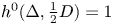 $h^0(\Delta , \frac {1}{2} D) = 1$ and
 $h^0(\Delta , -\frac {1}{2}D) = 0$ and thus the Riemann–Roch inequality is not satisfied for
 $D$, which does not contradict Conjecture 3.6 because
 $\frac {1}{2} D$ is not Cartier.
4. Subdivisions
In this section we study subdivisions of a weak tropical complex, which correspond to ramified extensions of the discrete valuation ring  $R$ followed by toroidal resolution of singularities. Here, the key technology is the relationship between toroidal maps and polyhedral subdivisions as in [Reference Kempf, Knudsen, Mumford and Saint-DonatKKMS73]. Combinatorially, passing to a degree
 $m$ totally ramified extension of the discrete valuation ring
 $R$ corresponds to scaling the simplices of
 $\Delta$ by a factor of
 $m$, and the toroidal resolution is given by a unimodular subdivision of the scaled simplices. The importance of subdivisions for us is as a tool when we define the refined specialization in the next section.
Construction 4.1 By an order  $m$ subdivision of a weak tropical complex
 $\Delta$, we mean a
 $\Delta$-complex which is formed by replacing each simplex of
 $\Delta$ by a unimodular integral subdivision of the standard simplex scaled by
 $m$, together with the structure constants obtained as follows.
First suppose that  $r'$ is a ridge of
 $\Delta '$ meeting the interior of a facet of
 $\Delta$. In particular, if
 $v_1', \ldots , v_n'$ are the vertices of
 $r'$, and
 $w_1$ and
 $w_2$ are contained in the two facets containing
 $r'$, then the midpoint
 $(w_1 + w_2) / 2$ is contained in the plane spanned by
 $r'$. Thus, we can write
 \begin{equation} (w_1 + w_2) / 2 = c_1 v_1' + \cdots + c_n v_n' \end{equation}
for some coefficients  $c_1, \ldots c_n$ with
 $c_1 + \cdots + c_n = 1$. We set
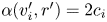 $\alpha (v_i', r') = 2 c_i$.
On the other hand, suppose that  $r'$ is a ridge of
 $\Delta '$ which is contained in a ridge
 $r$ of
 $\Delta$, and
 $r$ has degree
 $d$. We represent the points of each facet of
 $\Delta$ which contains
 $r$ by
 $(n+1)$ non-negative coordinates with total sum equal to
 $m$. In the
 $i$th such facet, the unique facet of the subdivision
 $\Delta '$ containing
 $r'$ is the convex hull of
 $r'$ and a unique point, whose coordinate is
 $(x_{i,1}, \ldots , x_{i,n}, 1)$, by unimodularity. Likewise, the points of
 $r$ can be given coordinates consisting of
 $n$ non-negative real numbers, also summing to
 $m$. In such coordinates, we represent the
 $i$th vertex
 $v_i$ of
 $r'$ by the vector
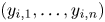 $(y_{i,1}, \ldots , y_{i,n})$. Finally, if
 $v_1, \ldots , v_n$ are the vertices of
 $r$, we determine the structure constants of
 $r'$ by the equation
 \begin{equation} \begin{pmatrix} \alpha(v_1', r') \\ \vdots \\ \alpha(v_n', r') \end{pmatrix} = \begin{pmatrix} y_{1,1} & \cdots & y_{n, 1} \\ \vdots & & \vdots \\ y_{1,n} & \cdots & y_{n,n} \end{pmatrix}^{{-}1} \! \begin{pmatrix} \alpha(v_1, r) + x_{1,1} + \cdots + x_{d,1} \\ \vdots \\ \alpha(v_n, r) + x_{1, n} + \cdots + x_{d,n} \end{pmatrix}\!. \end{equation}
That these structure constants form a weak tropical complex is verified in Proposition 4.3, after the following example.
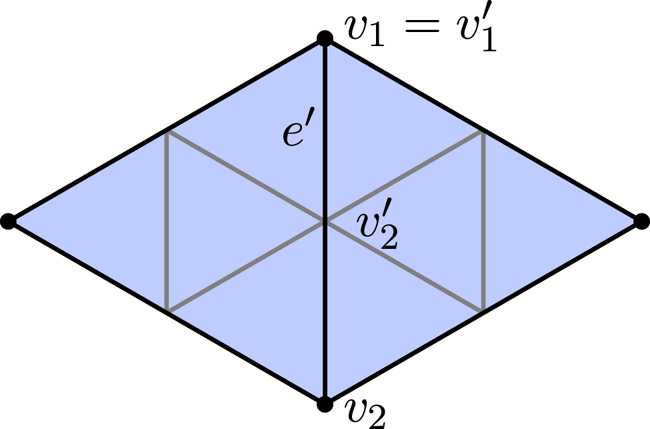
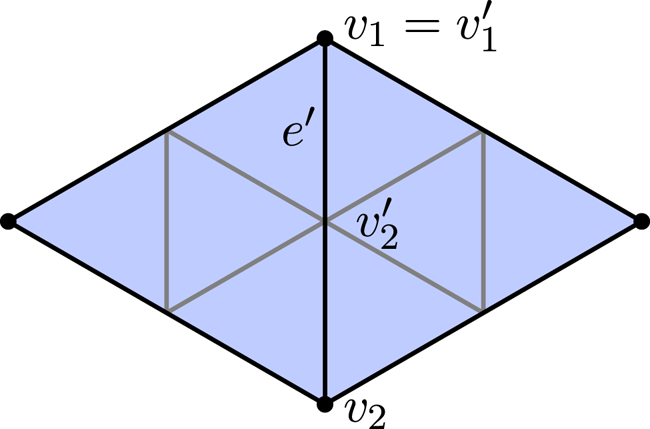
Example 4.2 Consider the order  $2$ subdivision of the complex
 $\Delta$ shown in Figure 2. Let
 $e'$ be the upper segment of the central edge, with
 $v_1'$ the top vertex and
 $v_2'$ the middle vertex of the edge. If
 $v_1$ is also the top vertex and
 $v_2$ is the bottom vertex, then
 $(y_{1,1}, y_{1,2}) = (2,0)$ and
 $(y_{2,1}, y_{2,2}) = (1,1)$. The vertices adjacent to
 $e'$ both have coordinate
 $(1, 0, 1)$. Thus, applying (7), we get
 \[ \begin{pmatrix} \alpha(v_1', e') \\ \alpha(v_2', e') \end{pmatrix} = \begin{pmatrix} 2 & 1 \\ 0 & 1 \end{pmatrix}^{{-}1} \begin{pmatrix} 1 + 1 + 1 \\ 1 + 0 + 0 \end{pmatrix} =\begin{pmatrix} {\textstyle\frac{1}{2}} & {\textstyle - \frac{1}{2}} \\ 0 & 1 \end{pmatrix} \begin{pmatrix} 3 \\ 1 \end{pmatrix} = \begin{pmatrix} 1 \\ 1 \end{pmatrix} \]
More generally, we have  $\alpha (v,e) = 1$ for every internal edge in the subdivided complex
 $\Delta '$.
Proposition 4.3 The subdivision in Construction 4.1 results in a weak tropical complex.
Proof. We need to show that the  $\alpha (v', r')$ from Construction 4.1 are integral and that they satisfy the required identity (1) for each ridge. We retain the same notation as in Construction 4.1 and we first consider a ridge
 $r'$ meeting the interior of a facet of
 $\Delta$. Then, because of the unimodularity, the coordinates of
 $(w_1 + w_2)/2$ will be half-integers, and so the
 $c_i$ are also half-integers, and
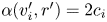 $\alpha (v_i', r') = 2c_i$ is an integer. Moreover, the sum of the
 $\alpha (v_i', r')$ will equal
 $2$, which is the degree of
 $r'$ in
 $\Delta '$.
The gray lines show an order  $2$ subdivision of two triangles glued along a common edge. In both the original and subdivided complex,
 $\alpha (v,r) = 1$ for all ridges
 $r$ which are contained in two facets.
Now consider a ridge  $r'$ of the subdivision
 $\Delta '$ contained in a ridge
 $r$ of
 $\Delta$. The fact that the vectors
 $v_1', \ldots , v_n'$ form the vertices of one simplex of a unimodular triangulation implies that the differences between pairs of the vectors
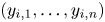 $(y_{i,1}, \ldots , y_{i,n})$ span the integral vectors
 $\mathbb {Z}^{n}$ whose sum is
 $0$. Moreover, each vector satisfies the affine linear equation
 $y_{i,1} + \cdots + y_{i,n} = m$, so the span of these vectors includes all vectors in
 $\mathbb {Z}^{n}$ whose sum is a multiple of
 $m$. Thus, to check that the coefficients defined in (7) are integral, it is sufficient to check that the sum of the entries of the vector from the right-hand side of (7) is a multiple of
 $m$. Indeed, we know that
 $\alpha (v_1, r) + \cdots + \alpha (v_n, r) = d$ and that
 $x_{i, 1} + \cdots + x_{i,n} = m-1$, so the total sum is
 $dm$. Moreover, this implies that
 $\alpha (v_1', r') + \cdots + \alpha (v_n', r') = d$, which completes the proof that the subdivision is a weak tropical complex.
It is immediate from the definition that a subdivision of a weak tropical complex is homeomorphic to the original complex. In addition, we now show that the subdivision behaves almost identically with the properties of weak tropical complexes introduced in § 2, namely linear functions and divisors.
Lemma 4.4 Let  $\Delta '$ be an order
 $m$ subdivision of a weak tropical complex
 $\Delta$, and we identify the realizations of
 $\Delta '$ and
 $\Delta$ via the natural homeomorphism. Then a function
 $\phi$ on
 $\Delta$ is linear (respectively, PL) if and only if
 $m\phi$ is linear (respectively, PL) on
 $\Delta '$.
Proof. The agreement of PL functions is clear, so long as the scaled function  $m\phi$ on
 $\Delta '$ has integral slopes on its domains of linearity. However, each facet
 $f'$ of
 $\Delta '$ is identified with a
 $(1/m)$-scaled copy of the standard unit simplex. If we instead identify
 $f'$ with the standard unit simplex, then the slopes of
 $\phi$ will be scaled by
 $1/m$, and so the slopes of
 $m\phi$ will all be integers.
For linear functions, we let  $r'$ be a ridge of
 $\Delta '$ and we need to show that linear functions on a neighborhood of
 $r'$ in
 $\Delta$, scaled by
 $m$, agree with linear functions defined by the map
 $\phi _{r'} \colon N_{r'} \rightarrow L_r \cong \mathbb {R}^{d+n-1}$ from Definition 2.10. First suppose that
 $r'$ intersects the interior of a facet
 $f$ of
 $\Delta$. Then
 $N_{r'}$ is the union of the two facets containing
 $r'$, and naturally embeds in
 $\mathbb {R}^{2+n}$ by sending each vertex to a coordinate vector, as in Definition 2.10. The inclusion of
 $N_{r'}$ into
 $f \subset \mathbb {R}^n$ factors through a linear map from
 $\mathbb {R}^{2+n}$ to
 $\mathbb {R}^n$, whose kernel contains
 $(1, 1, -\alpha (v_1', r'), \ldots , -\alpha (v_n', r'))$ by the choice of those structure constants in Construction 4.1. Therefore, the inclusion of
 $N_{r'}$ into
 $\mathbb {R}^n$ factors through the map
 $\phi _{r'} \colon N_{r'} \rightarrow L_{r'}$, defining linear functions on the open subset
 $N_{r'}^o$, and so the linear functions on
 $\Delta$ and
 $\Delta '$ agree.
Now suppose that  $r'$ is contained in a ridge
 $r$ of
 $\Delta$, and we let
 $v_i$,
 $v_i'$,
 $x_{i,j}$ and
 $y_{i,j}$ be as in Construction 4.1, and
 $\phi _r$ as in Definition 2.10. Then, using the fact that
 $\phi _r$ is affine linear on each facet of
 $\Delta$, we can evaluate
 \begin{align*} \sum_{i=1}^d \phi_r(w_i') &= \sum_{i=1}^d \frac{1}{m} \bigg (\phi_r(w_i) + \sum_{j = 0}^n x_{i,j} \phi_r(v_j)\bigg) \\ &= \frac{1}{m}\sum_{j=0}^n \alpha(v_j, r) \phi_r(v_j) + \frac{1}{m}\sum_{i=1}^d\sum_{j=0}^n x_{i,j}\phi_r(v_j) \\ &= \frac{1}{m} \sum_{j=0}^n \bigg (\alpha(v_j, r) + \sum_{i=1}^d x_{i,j} \bigg)\phi_r(v_j) \\ &= \sum_{j=0}^n \alpha(v_j', r') \phi_r(v_{j}'), \end{align*}
where the last step is by the change of variables in (7), together with the linearity of  $\phi _r$ on
 $r$. Thus,
 $\phi _r$ satisfies the defining linear relation of
 $\phi _{r'}$, and so
 $\phi _{r'}$ is isomorphic to the restriction of
 $\phi _r$, as in the previous paragraph.
If  $\Delta '$ is a subdivision of a weak tropical complex
 $\Delta$, then any formal sum of polyhedra on
 $\Delta '$ is also a formal sum of polyhedra on
 $\Delta$. Conversely, for any formal sum of polyhedra on
 $\Delta$, we can intersect with all the facets of
 $\Delta '$ to obtain an equivalent formal sum of polyhedra, all of whose terms are contained in a single facet of
 $\Delta '$, and thus can be considered as a formal sum of polyhedra on
 $\Delta '$. Moreover, this correspondence passes to equivalence classes of formal sums of polyhedra, so we can identify the equivalence classes on
 $\Delta$ with those on
 $\Delta '$, and by the following lemma, we can also identify divisors on
 $\Delta$ with those on
 $\Delta '$.
Lemma 4.5 Let  $\Delta '$ be an order
 $m$ subdivision of a weak tropical complex
 $\Delta$. Then a formal sum of polyhedra is a divisor on
 $\Delta$ if and only if it is a divisor on
 $\Delta '$.
Proof. By Lemma 2.12, passing to equivalent formal sums of polyhedra does not change whether or not the formal sum is balanced, so we can assume that the terms of the formal sum of polyhedra are each contained in the facets of  $\Delta '$. Then Lemma 4.4 shows the linear functions on
 $\Delta$ and
 $\Delta '$ are the same, up to multiplication by
 $m$, so we just need to check that the multiplicity
 $\operatorname {mult}_{Z,Q}(\phi )$ of a linear function along
 $Q$ of a formal sum of polyhedra
 $Z$ vanishes in
 $\Delta$ if and only if it vanishes in
 $\Delta '$.
Here, the key difference is between two different embeddings of a single facet  $f'$ of
 $\Delta '$ into
 $\mathbb {R}^n$. First, we can identify
 $f'$ with a standard unit simplex in
 $\mathbb {R}^n$. Second, we identify
 $f'$ with a simplex contained in a facet
 $f$ of
 $\Delta$, and
 $f$ is identified with a standard unit simplex in
 $\mathbb {R}^n$. Because the subdivision of
 $\Delta$ is assumed to be unimodular in Construction 4.1, in the latter identification,
 $f'$ is a standard unit simplex scaled by
 $1/m$. Thus, if we transform the vectors
 $\mathbf {w}_i$ and
 $\mathbf {v}_i$ used to compute the multiplicity in
 $\Delta$ into the coordinates where
 $f$ is identified with a standard unit simplex, then the transformed vectors have a common multiple of
 $m$ in their coordinates. Scaling these vectors by
 $1/m$ gives suitable vectors for computing the multiplicity in
 $\Delta '$, and so the multiplicity of a given linear function along
 $Q$ of
 $Z$ in
 $\Delta '$ is
 $1/m$ times the multiplicity in
 $\Delta$, which completes the proof.
Lemma 4.6 Let  $\Delta '$ be an order
 $m$ subdivision of a weak tropical complex
 $\Delta$, and further assume that every ridge of
 $\Delta$ is contained in a facet. Then divisors on
 $\Delta$ are linearly equivalent if and only if they are linearly equivalent on
 $\Delta '$
Proof. To show that linear equivalence on  $\Delta$ agrees with that on
 $\Delta '$, we need to show that, if
 $\phi$ is a PL function on
 $\Delta$, then
 $\operatorname {div}(\phi ) = \operatorname {div}'(m \phi )$, where
 $\operatorname {div}$ and
 $\operatorname {div}'$ are the divisor functions from Proposition 2.15 on
 $\Delta$ and
 $\Delta '$, respectively. Since Proposition 2.15 uniquely characterizes
 $\operatorname {div}$ and
 $\operatorname {div}'$ in terms of four properties, we need to check that those properties coincide for
 $\Delta$ and
 $\Delta '$. The first two properties are that the divisor is linear in the PL function and local, which are independent of the subdivision. Moreover, the third property is that linear functions are characterized by having trivial divisor, and by Lemma 4.4, the linear functions on
 $\Delta$ and
 $\Delta '$ agree, up to scaling. The fourth property normalizes the divisor function via a PL function supported on a single facet, which also agrees, because when passing to
 $\Delta '$ we scale both the coordinates on the complex and the PL function by the same factor of
 $m$.
On the other hand, the subdivisions of Construction 4.1 mirror what happens for toroidal resolutions of ramified base changes. Specifically, if  $R'$ is a totally ramified degree
 $m$ extension of
 $R$, then the fiber product
 $\mathfrak X \times _{\operatorname {Spec} R} \operatorname {Spec} R'$ is a toroidal scheme with same dual complex
 $\Delta$ and with integral structure such that each simplex is identified with
 $m$ times a unimodular simplex [Reference Kempf, Knudsen, Mumford and Saint-DonatKKMS73, p. 107]. Then the order
 $m$ subdivision of
 $\Delta$ defines a modification
 $\mathfrak X' \rightarrow \mathfrak X \times _{\operatorname {Spec} R} \operatorname {Spec} R'$ according to the bijection in [Reference Kempf, Knudsen, Mumford and Saint-DonatKKMS73, Chapter II, Theorem 6*] and we let
 $\psi \colon \mathfrak X' \rightarrow \mathfrak X$ denote the composition of the modification and the base change.
We want to show that  $\mathfrak X'$ is a regular semistable degeneration with weak tropical complex
 $\Delta '$. As a first step, we want to describe the pullback of a divisor
 $C_v$ from
 $\mathfrak X$ to
 $\mathfrak X'$ as a sum of the components of the special fiber of
 $\mathfrak X'$. The coefficient of a divisor
 $C_{v'}$ in
 $\psi ^*(C_v)$ will be zero unless
 $\psi (C_{v'})$ is contained in
 $C_{v}$. Since
 $\psi (C_{v'})$ is the stratum corresponding to the smallest simplex of
 $\Delta$ containing
 $v'$, it is sufficient to consider the case when there exists a simple
 $s$ of
 $\Delta$ containing both
 $v$ and
 $v'$.
Lemma 4.7 Let  $\mathfrak X$ be a regular, semistable degeneration with weak tropical complex
 $\Delta$ and let
 $\Delta '$ be an order
 $m$ subdivision of
 $\Delta$ and
 $R'$ a totally ramified degree
 $m$ extension of
 $R$. Let
 $v$ be a vertex of
 $\Delta$ and let
 $v'$ be a vertex of
 $\Delta '$ which is contained in a
 $k$-dimensional simplex
 $s$. Take coordinates on
 $s$ consisting of
 $(k+1)$-tuples of non-negative numbers summing to
 $m$ such that
 $v$ has coordinate
 $(m, 0, \ldots , 0)$ and let
 $(x_0, \ldots , x_k)$ denote the coordinate of
 $v'$. Then the coefficient of
 $C_{v'}$ in
 $\psi ^{-1}(C_v)$ is
 $x_0$.
Proof. In a neighborhood of any point of  $C_s$ not in a smaller stratum,
 $\mathfrak X$ is étale over
 \[ \operatorname{Spec} R[t_0, \ldots, t_m, t_{m+1}^{{\pm}}, \ldots, t_{n}^{{\pm}}]/\langle t_0 \cdots t_m - \pi \rangle, \]
with the divisor  $C_v$ defined by the element
 $t_0$. Then, the open stratum of
 $C_{v'}$ is defined by the fiber product with the spectrum of
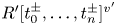 $R'[t_0^{\pm }, \ldots , t_n^{\pm }]^{v'}$, which is defined to be the
 $R'$-algebra generated by
 \[ \{a t_0^{u_0} \cdots t_n^{u_n} \mid a \in R', \operatorname{val}(a) + x_0 u_0 + \cdots + x_k u_k \geq 0\}, \]
where  $\operatorname {val}$ is the discrete valuation on
 $R'$, by the display equation on [Reference Kempf, Knudsen, Mumford and Saint-DonatKKMS73, p. 76]. The ideal of the component
 $C_{v'}$ is generated by any
 $a t_0^{u_0} \cdots t_n^{u_n}$ such that
 $\operatorname {val}(a) + x_0 u_0 + \cdots + x_k u_k = 1$ and the valuation of
 $a t_0^{u_0} \cdots t_n^{u_n}$ along
 $C_{v'}$ is
 $\operatorname {val}(a) + x_0 u_0 + \cdots + x_k u_k$. In particular, the valuation of
 $t_0$ is
 $x_0$ and so the multiplicity of
 $C_{v'}$ in
 $\pi ^*(C_v)$ is
 $x_0$.
Lemma 4.8 Let  $\mathfrak X$ be a regular, semistable degeneration with weak tropical complex
 $\Delta$. Let
 $\Delta '$ be an order
 $m$ subdivision of
 $\Delta$ and
 $R'$ a totally ramified degree
 $m$ extension of
 $R$. Then the corresponding toroidal modification
 $\mathfrak X'$ of
 $\mathfrak X \times _{\operatorname {Spec} R} \operatorname {Spec} R'$ is a regular, semistable degeneration over
 $\operatorname {Spec} R'$ with
 $\Delta '$ as its weak tropical complex.
Proof. By [Reference Kempf, Knudsen, Mumford and Saint-DonatKKMS73, Chapter II, Theorem 8*],  $\mathfrak X' \rightarrow \mathfrak X \times _{\operatorname {Spec} R} \operatorname {Spec} R'$ is proper, so
 $\mathfrak X'$ is a proper scheme over
 $\operatorname {Spec} R'$. In addition,
 $\mathfrak X'$ is regular by [Reference Kempf, Knudsen, Mumford and Saint-DonatKKMS73, Chapter II, Theorem 4*] and because each simplex in the order
 $m$ subdivision
 $\Delta '$ is unimodular. Since each vertex is integral, each component of the special fiber of
 $\mathfrak X'$ is reduced [Reference Kempf, Knudsen, Mumford and Saint-DonatKKMS73, Chapter II, Theorem 1*], and the special fiber is simple normal crossing because
 $\Delta '$ consists of simplices. Therefore,
 $\mathfrak X'$ is a regular, semistable degeneration, with dual complex
 $\Delta '$ and it remains to show that its weak tropical complex is as given in Construction 4.1.
Now let  $r'$ be any facet of
 $\Delta '$ with vertices
 $v_1', \ldots , v_n'$. First suppose that
 $r'$ is a ridge of
 $\Delta '$ meeting the interior of a facet
 $f$ of
 $\Delta$. Let
 $v_0, \ldots , v_n$ be the vertices of
 $f$. As in Lemma 4.7, use coordinates on
 $f$ consisting of non-negative integers summing to
 $m$ such that
 $v_0$ is
 $(m,0,\ldots ,0)$,
 $v_1$ is
 $(0,m,0,\ldots , 0)$, and so on. Let
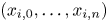 $(x_{i,0}, \ldots , x_{i,n})$ be the coordinates of
 $v_i'$ and let
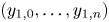 $(y_{1,0}, \ldots , y_{1,n})$ and
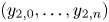 $(y_{2,0}, \ldots , y_{2,n})$ be the coordinates of the vertices
 $w_1'$ and
 $w_2'$ in the facets on either side of
 $r'$. Then we compute the structure constants
 $\alpha (v_i', r') = C_{v_i'} \cdot C_{r'}$ of
 $\mathfrak X'$ by computing
 $\psi ^*(C_{v_i}) \cdot C_{r'}$ in two different ways, where
 $\psi$ is the map
 $\psi \colon \mathfrak X' \rightarrow \mathfrak X$. First, by Lemma 4.7, the coefficient of
 $C_{v_i'}$ in
 $\psi ^*(C_{v_j})$ is
 $x_{i, j}$ and the coefficient of
 $C_{w_i'}$ is
 $y_{i,j}$. Since these are the only components of the special fiber of
 $\mathfrak X'$ meeting
 $C_{r'}$,
 \begin{equation} \psi^*(C_{v_j}) \cdot C_{r'} = y_{1,j} + y_{2,j} - \alpha(v_1', r')x_{1,j} - \cdots - \alpha(v_n, r')x_{n,j}. \end{equation}
On the other hand,  $\psi (C_{r'})$ is the point
 $C_{f}$ and so its pushforward is trivial. Therefore, by the projection formula,
 \begin{equation} \psi^*(C_{v_j}) \cdot C_{r'} = C_{v_j} \cdot \psi_*(C_r') = 0. \end{equation}
Combining (8) and (9) for all the different indices  $j$, we get the vector equation
 \[ 0 = w_1 + w_2 - \alpha(v_1', r')v_1' - \cdots - \alpha(v_n', r')v_n'. \]
Rearranging and dividing by  $2$,
 \[ \frac{w_1 + w_2}{2} = \frac{\alpha(v_1', r')}{2} v_1' + \cdots + \frac{\alpha(v_n', r')}{2} v_n', \]
which shows that the  $\alpha (v_i', r')$ are the same in the definition of the structure constants on the subdivision
 $\Delta '$ in (6).
Second, we consider the case when  $r'$ is contained in a ridge
 $r$ of
 $\Delta$. We adopt the notation of Construction 4.1, so that
 $v_1, \ldots , v_n$ are the vertices of
 $r$. We use coordinates similar to those above and let
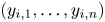 $(y_{i,1}, \ldots , y_{i,n})$ denote the coordinates of
 $v_i$ and
 $(x_{i,1}, \ldots , x_{i,n},1)$ denote the coordinates of the vertices of
 $\Delta '$ in facets containing
 $r'$, where the last coordinate is
 $1$ because the vertex is a distance
 $1$ from
 $r'$ by unimodularity. Again, we compute the intersection number
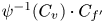 $\psi ^{-1}(C_{v}) \cdot C_{f'}$ in two different ways. First, using the Lemma 4.7, we can represent
 $\psi ^{-1}(C_{v})$ as a linear combination of divisors in
 $\mathfrak X'$. The ones which intersect
 $C_{r'}$ correspond to the vertices
 $v_i$ of
 $r'$, together with the other vertices of facets of
 $\Delta '$ containing
 $r'$. All together, these give
 \[ \psi^*(C_v) \cdot C_{r'} = x_{1,i} + \cdots + x_{d,i} - \alpha(v_0', f') y_{0,i} - \cdots - \alpha(v_n', f') y_{n,i}. \]
On the other hand, using the projection formula,  $\psi ^{-1}(C_{v_i}) \cdot C_{r'} = C_{v_i} \cdot \psi (C_{r'})$, and we know that
 $\psi *(C_{r'})$ is
 $C_r$, so the intersection number is
 $-\alpha (v_i, r)$. Putting these equations together for all
 $i$, we get a matrix equation
 \[ \begin{pmatrix} y_{0,0} & \cdots & y_{n,0} \\ \vdots & & \vdots \\ y_{0,n} & \cdots & y_{n,n} \end{pmatrix} \begin{pmatrix} -\alpha(v_0', F') \\ \vdots \\ -\alpha(v_n', F') \end{pmatrix} + \begin{pmatrix} x_{1,0} + \cdots + x_{d,0} \\ \vdots \\ x_{1,n} + \cdots + x_{d,n} \end{pmatrix} =\begin{pmatrix} -\alpha(v_0, F) \\ \vdots \\ -\alpha(v_n, F) \end{pmatrix}. \]
We can solve for the  $\alpha (v_i', F')$ and we get (7). We conclude that the structure constants of the weak tropical complex of
 $\mathfrak X'$ are those given in Construction 4.1.
5. Refined specialization
In this section we define a refined specialization map from divisors on the general fiber of  $\mathfrak X$ to divisors on the weak tropical complex
 $\Delta$. Given a divisor
 $D$, we first choose a ramified extension of the discrete valuation ring
 $R$, followed by a toroidal resolution of singularities
 $\mathfrak X'$ such that if
 $D'$ is the pullback of
 $D$ to the general fiber of
 $\mathfrak X'$, the closure
 $\bar D'$ does not contain any strata of the special fiber of
 $\mathfrak X'$. Then the refined specialization of
 $D$ is
 $\rho (D')$, which can be considered as a divisor either on the subdivision
 $\Delta '$ or on
 $\Delta$ by the results in the previous section. The refined specialization is the higher-dimensional analogue of the map
 $\tau _*$ from [Reference BakerBak08, § 2C]. As stated in the introduction, the purpose of the refined specialization is that the refined specialization of an effective divisor is always effective, which is not necessarily true for the coarse specialization
 $\rho$.
Example 5.1 We construct our example as a toric degeneration. In particular, we take the three-dimensional fan whose support is  $\mathbb {R}^2 \times \mathbb {R}_{\geq 0}$ and intersection with the plane
 $\mathbb {R}^2 \times \{1\}$ is the configuration in Figure 3. Projection to the last factor defines a toric morphism from a three-dimensional toric variety
 $\mathfrak X$ to
 $\mathbb {A}^1$, whose fibers are isomorphic to
 $\mathbb {P}^1 \times \mathbb {P}^1$, except over the origin. The fiber of the origin consists of four components, corresponding to the four rays generated by the four vertices in Figure 3. The intersections between these components correspond to the cones they have in common, such that the dual complex of
 $\mathfrak X$ is the triangulation of a square, making up the bounded cells in Figure 3.
The solid black lines give a subdivision of the plane giving a semistable family whose general fiber is  $\mathbb {P}^1 \times \mathbb {P}^1$. The dashed line is the tropicalization of a line in one of the rulings whose specialization to the tropical complex consists of the sum of the outside edges of the square minus the diagonal edge. In particular, the specialization is not effective.
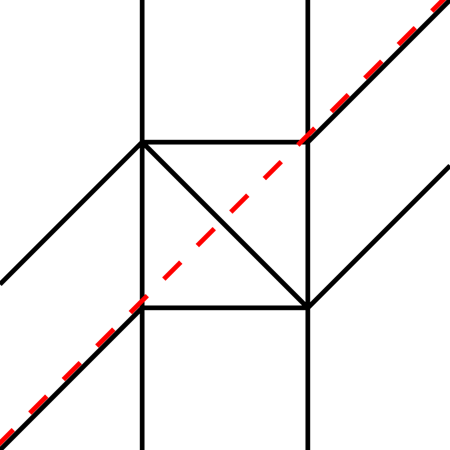
By Proposition 2.3, the locally closed strata of dimension 1 in  $\mathfrak X$ are affine and we claim that the same is true in dimension 2. Each of the four components is isomorphic to the toric variety corresponding to the star of the corresponding vertex
 $v$, with the divisor
 $D_v$ equal to the union of the rays corresponding to the bounded edges. Therefore, in each case, the locally closed stratum
 $C_v \setminus D_v$ is isomorphic to
 $\mathbb {A}^2$.
Now consider a line in one of the rulings of  $\mathbb {P}^1 \times \mathbb {P}^1$ whose tropicalization is the dotted line in Figure 3. The specialization of this line to
 $\Delta$ is the sum of four outside edges of the square minus the inner diagonal. In particular, this specialization is not effective and it does not agree with the tropicalization. However, the specialization is linearly equivalent to an effective divisor, namely the intersection of the dotted-line tropicalization with
 $\Delta$.
In Example 5.1, it was easy to guess the refined tropicalization. In general, we need to show that there exists a subdivision of the weak tropical complex  $\Delta$ which will give the refined specialization according to the definition at the beginning of this section, which is the content of the following lemma. The construction is essentially a toroidal version of the partial resolution of a hypersurface singularity coming from its Newton polyhedron.
Lemma 5.2 Let  $D$ be an effective divisor on the general fiber
 $X$ of a degeneration
 $\mathfrak X$. Then there exist a finite ramified extension
 $R'$ of
 $R$ and a toroidal resolution of singularities
 $\mathfrak X'$ of
 $\mathfrak X \otimes _R R'$ such that
 $\bar D'$ does not contain any of the strata of
 $\mathfrak X'$, where
 $\bar D'$ is the closure in
 $\mathfrak X'$ of the pullback of
 $D$ to the general fiber
 $X'$.
Proof. Our strategy for constructing  $\mathfrak X'$ is to first associate a Newton polyhedron to the local equation of
 $D$ near each stratum of
 $\mathfrak X$. These Newton polyhedra define a polyhedral subdivision of
 $\Delta$, which can be further subdivided to a unimodular simplicial subdivision, which then gives a regular semistable degeneration
 $\mathfrak X'$ by Lemma 4.8. We then check that
 $\mathfrak X'$ satisfies the desired properties.
In order to define a local Newton polyhedron, we let  $s$ be any simplex of
 $\Delta$, and let
 $k$ be the dimension of
 $s$. Let
 $A_s$ be the local ring of
 $\mathfrak X$ at the generic point of
 $C_s$. By assumption,
 $\mathfrak X$ is regular, so
 $A_s$ is a regular local ring, and because
 $\mathfrak X_0$ is a simple normal crossing divisor, the maximal ideal of
 $A_s$ is generated by
 $x_0, \ldots , x_k$, each of which is the local equation of one of the components of
 $\mathfrak X_0$. The completion
 $\widehat A_s$ of
 $A_s$ is isomorphic to
 $S[[x_0, \ldots , x_k]]/\langle x_0 \cdots x_k - \pi \rangle$, where
 $S$ is a complete, discretely valued extension of
 $R$ and
 $\pi$ is a uniformizer in
 $S$. We let
 $f \in A_s \subset \widehat A_s$ be the local equation of the closure
 $\bar D$. Using the isomorphism above, we can write
 \[ f = \sum_{a \in I} s_a x_0^{a_0} \cdots x_k^{a_k} \in \widehat R[[x_0, \ldots, x_k]] / \langle x_0 \cdots x_k - \pi \rangle, \]
where  $I \subset \mathbb {Z}_{\geq 0}^{k+1}$ is a set of exponent vectors, and we can assume that each coefficient
 $s_a$ is non-zero. Moreover, by the relation
 $x_0 \cdots x_k = \pi$, we can rewrite the expression for
 $f$ so that each coefficient
 $s_a$ is a unit in
 $R$, and then this representation is unique. We define the Newton polyhedron of
 $f$ to be the union of translated orthants,
 \[ \operatorname{Newt}_s(f) = \operatorname{conv} \bigg( \bigcup_{a \in I} (a_0, \ldots, a_k) + \mathbb{R}_{{\geq} 0}^{k+1} \bigg)\subset \mathbb{R}_{{\geq} 0}^{k+1}, \]
where  $\operatorname {conv}$ denotes the convex hull. Note that the vertices of
 $\operatorname {Newt}(f)$ are all non-negative integer vectors which are pairwise incomparable, and therefore the set of vectors is finite for the same reason that monomial ideals are finitely generated.
Next, we define the dual subdivision of the  $k$-dimensional
 $s$, which we identify with the convex hull of unit coordinate vectors in
 $\mathbb {R}^{k+1}$. For any face
 $Q$ of
 $\operatorname {Newt}_s(f)$, we define
 \begin{equation} Q^* = \Big\{u \in s \subset \mathbb{R}^{k+1}_{{\geq} 0} \mid \mbox{for all } a \in Q,\ a \cdot u = \min_{a' \in \operatorname{Newt}(f)} a' \cdot u \Big\}. \end{equation}
Then  $Q^*$ is a rational polytope and, as
 $Q$ ranges over the faces of
 $\operatorname {Newt}(f)$, the
 $Q^*$ form a polyhedral subdivision of
 $s$, because every point of
 $s$ defines a linear functional which is minimized on some face of
 $\operatorname {Newt}(f)$.
In order to build a toroidal modification out of this subdivision, we need to show that the subdivisions of different simplices are compatible. It suffices to show that the subdivision of a simplex  $s$ is compatible with that of one of its faces
 $s'$, which we can take to be the face indexed by
 $k$. Thus, in the local ring
 $A_s$, the component
 $C_{s'}$ is defined by the ideal
 $\langle x_0, \ldots , x_{k-1}\rangle$, and so
 $A_{s'}$, the local ring of
 $C_{s'}$, is the localization of
 $A_s$ at this ideal. We consider the image of
 $f$, the local equation of
 $D$ in the tensor product
 $\widehat A_s \otimes _{A_s} (A_{s})_{\langle x_0, \ldots , x_{k-1}\rangle }$. We can now regroup the terms of
 $f$ as
 \begin{equation} \sum_{(a_0, \ldots, a_{k-1}) \in I'} \bigg(\sum_{a_k \in I_{(a_0, \ldots, a_{k-1})}} s_ax_k^{a_k} \bigg) x_0^{a_0} \cdots x_{k-1}^{a_{k-1}}, \end{equation}
where  $I'$ is the projection of the index set
 $I$ onto the first
 $k$ coordinates and
 $I_{(a_0, \ldots , a_{k-1})}$ is the preimage of
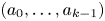 $(a_0, \ldots , a_{k-1})$ in this projection. Expression (11) also holds in the completion of the local ring
 $A_{s'}$ of
 $C_{s'}$. Since each
 $s_a$ is not divisible by
 $\pi$ and
 $x_k$ is transcendental over
 $\widehat R$, it follows that
 $\sum _{a_k} s_{a} x_k^{a^k}$ is not divisible by
 $\pi$ and so
 \[ \operatorname{Newt}_{s'}(f) = \operatorname{conv} \bigg( \bigcup_{(a_0, \ldots, a_{k-1}) \in I'} (a_0, \ldots, a_{k-1}) + \mathbb{R}_{{\geq} 0}^k \bigg), \]
which is the projection of the Newton polyhedron  $\operatorname {Newt}_s(f)$ to the first
 $k$ coordinates. Therefore, a linear functional on
 $\operatorname {Newt}_{s'}(f)$ is the same as a linear functional on
 $\operatorname {Newt}_s(f)$ with the last coordinate equal to zero, and so the dual subdivision of
 $s$ defined by
 $\operatorname {Newt}_s(f)$ restricted to its face
 $s'$ agrees with the dual subdivision defined by
 $\operatorname {Newt}_{s'}(f)$.
Now we have a polyhedral subdivision of  $\Delta$. If
 $m$ is the least common multiple of the denominators of the vertices of the subdivision, then it corresponds to a ramified degree
 $m$ extension
 $R'' \supset R$ followed by a toroidal map
 $\mathfrak X'' \rightarrow \mathfrak X \times _R R''$. Although
 $\mathfrak X''$ is not semistable, we claim that the closure
 $\bar D''$ of the pullback of
 $D$ to
 $\mathfrak X''$ does not contain any of the strata. Fix a polytope
 $Q^*$ in the subdivision of
 $\Delta$, which is dual to a face
 $Q$ of the Newton polygon
 $\operatorname {Newt}_s(f)$ of the local equation
 $f$ of
 $\bar D$ on a stratum
 $C_s$ of
 $\mathfrak X$. Let
 $a$ be an integer point in
 $Q$ such that
 $s_a t_0^{a_0} \ldots t_k^{a_k}$ is a term in
 $f$. Then an open neighborhood of
 $\mathfrak X''$ corresponding to
 $Q^*$ is étale over
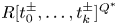 $R[t_0^\pm , \ldots , t_k^\pm ]^{Q^*}$, which is the
 $R$-algebra generated by
 \[ \{s t_0^{a_0} \cdots t_k^{a_k} \mid \operatorname{val}(s) + u \cdot a \geq 0 \mbox{ for all } u \in Q^*\}. \]
If  $a'$ is an integer point in
 $\operatorname {Newt}_s(f)$, then, by the definition of
 $Q^*$ in (10),
 $a' \cdot u \geq a \cdot u$ for all
 $u \in Q^*$ and so
 $s_{a'} x^{a' - a}$ is in
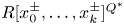 $R[x_0^\pm , \ldots , x_k^\pm ]^{Q^*}$ for any
 $s_{a'} \in R$. Thus,
 $f / x^{a}$ is contained in
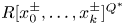 $R[x_0^\pm , \ldots , x_k^\pm ]^{Q^*}$, and it is the local equation of
 $\bar D''$. The intersection of
 $\bar D''$ with the closed stratum is defined by an equation including the term
 $s_a x^a$ and thus non-zero, so
 $\bar D''$ does not contain the stratum corresponding to
 $Q$.
Since  $\mathfrak X''$ is not regular, we use [Reference Kempf, Knudsen, Mumford and Saint-DonatKKMS73, Theorem III.4.1], which shows that there exists a further extension and toroidal map
 $\mathfrak X' \rightarrow \mathfrak X'' \times _{R''} R'$ such that
 $\mathfrak X'$ is semistable. Since each stratum of
 $\mathfrak X'$ maps to a stratum of
 $\mathfrak X''$, the pullback of
 $\bar D''$ to
 $\mathfrak X'$ does not contain any strata of the special fiber either. This implies that the pullback of
 $\bar D''$ is equal to the closure of the pullback of
 $D$, which is the property claimed in the statement.
After the subdivision given by Lemma 5.2, the specialization of  $D$ will be effective, because all of the intersections between
 $\bar D$ and curves
 $C_r$ will be proper, and thus the coefficients making up the definition of the specialization will all be non-negative. In addition to the above construction, the refined specialization has a more intrinsic interpretation, at least set-theoretically, as the projection of the Berkovich analytification of the divisor to the skeleton defined by the degeneration. Here, we are using the deformation retract from the Berkovich analytification
 $X^{\operatorname {an}}$ to the dual complex of
 $\mathfrak X$, which was defined in a more general setting in [Reference BerkovichBer99] and in the specific case of regular semistable degenerations in [Reference NicaiseNic11, § 3.3].
Proof of Proposition 1.3 By Lemma 5.2, we can assume that our degeneration  $\mathfrak X$ is chosen such that
 $\bar D$ does not contain any of the closed strata of
 $\mathfrak X$. Because projection of
 $X^{\operatorname {an}}$ to the skeleton is compatible with the specialization map, we know that the image of
 $D^{\operatorname {an}}$ is contained in those simplices
 $s$ such that
 $\bar D$ intersects
 $C_s$. By hypothesis,
 $\bar D$ does not intersect any zero-dimensional strata
 $C_f$, and whenever it intersects a curve
 $C_r$ for some ridge
 $r$, it does so properly and thus
 $r$ has positive coefficient in the specialization of
 $D$. Therefore, the projection of the analytification is contained in the union of the support of the refined specialization of
 $D$, together with some simplices of dimension
 $0 \leq n-2$.
It now only remains to show that the projection map is surjective onto the ridges  $r$ in the support of the specialization. For this we suppose that
 $r$ is a ridge such that
 $\bar D$ intersects
 $C_r$ and let
 $x$ be a point in the intersection. In a neighborhood of
 $x$, we can take local defining equations for the divisors containing
 $C_r$ and use them to define a map to
 $\operatorname {Spec} S$ where
 $S = R[x_1, \ldots , x_{n}] / \langle x_1 \cdots x_{n} - \pi \rangle$. As in [Reference NicaiseNic11, § 3.3, Case 1], the
 $(n-1)$-dimensional simplex, which we identify with
 $r$, embeds in the analytification of
 $\operatorname {Spec} S$ as the skeleton. Since the fiber over
 $x_1 = \cdots = x_n = 0$ is finite, the map from
 $\bar D$ to
 $\operatorname {Spec} S$ is dominant and so by Proposition 3.4.6(7) of [Reference BerkovichBer90], we can lift any norm corresponding to a point in this skeleton to a point in the analytification of
 $D$. Since the projection onto the skeleton of
 $X$ is defined in terms of the norms of the
 $x_i$, we have produced a norm in the analytification of
 $\bar D$ which projects onto any point of
 $r$.
The image of the projection in Proposition 1.3 is larger than the refined specialization whenever  $\bar D$ meets a component
 $C_v$, but not any curves
 $C_r$ contained in
 $C_v$.
Example 5.3 Suppose  $\mathfrak X$ is any degeneration of dimension at least
 $2$ and
 $x$ is a point of
 $X$ whose closure in
 $\mathfrak X$ is contained in
 $C_v \setminus D_v$ for some vertex
 $v$. Then the blow-up
 $\mathfrak X'$ of
 $\mathfrak X$ at the closure of
 $x$ is a regular semistable degeneration, and the specialization of the exceptional divisor
 $E$ of the blow-up is trivial because its closure does not intersect any curve
 $C_r$ in
 $X$. However, the analytification of
 $E$ is not empty and, by the compatibility with specialization noted in the proof of Proposition 1.3, its projection to
 $\Delta$ must be the single point
 $v$, which has codimension
 $n \geq 2$.
6. Proof of the specialization inequality
In this section we finish the proof of Theorem 1.1. The main remaining ingredient is to show that the refined specialization always preserves point containment, at least for appropriately chosen points. Example 5.3 shows that even for robust degenerations, the specialization of a non-trivial divisor can be trivial, which shows that specialization does not need to preserve all point containments. Nonetheless, we have the following result when the locally closed strata are affine.
Proposition 6.1 Suppose that  $\mathfrak X$ is a degeneration whose locally closed strata of dimension
 $m$ are affine for all
 $2 \leq k \leq m$. If
 $E$ is a divisor in
 $X$ and its closure
 $\bar E$ intersects some stratum
 $C_s$ of the special fiber of
 $\mathfrak X$ and
 $C_s$ has dimension
 $m$, then
 $\bar E$ intersects a curve
 $C_r$ for some ridge
 $r$ containing
 $s$.
Proof. The proof is by induction the dimension  $m$. If
 $m = 1$, then
 $s$ is a ridge and we are done. Otherwise, by assumption,
 $C_s \setminus D_s$ is affine, and affine varieties contain no complete subvarieties of positive dimension. However,
 $\bar E \cap C_s$ is a divisor in
 $C_s$ and so of dimension
 $m - 1 \geq 1$. Thus,
 $\bar E$ must intersect
 $D_s$ and thus
 $C_{s'}$ for some
 $(n-m+1)$-simplex
 $s'$ containing
 $s$. Applying the inductive hypothesis, we get that
 $\bar E$ intersects
 $C_r$ for some ridge
 $r$.
Proposition 6.1 gives us a tool for proving that the refined specialization contains a given vertex of the dual complex, and, together with Lemma 6.5 below, it can be used to give a proof of Theorem 1.1 for degenerations whose locally closed strata are affine. However, Theorem 1.1 applies not only to degenerations where the locally closed strata are affine, but also to those which are only robust in the top two dimensions. In such cases, the conclusion of Proposition 6.1 does not necessarily hold, as shown by Example 5.3. However, we can still ensure that the refined specialization preserves point containment, so long as the point is chosen sufficiently generically.
Lemma 6.2 Assume that  $R$ is complete, with fraction field
 $K$, that
 $\mathfrak X$ is robust in dimension
 $n-1$ and
 $n$, and that the locally closed strata of dimension at most
 $n-2$ are affine. Then, for any vertex
 $v$ in
 $\Delta$, there exists a
 $K$-point
 $x$ in
 $X$ such that, for any effective divisor
 $E \subset X$ containing
 $x$, the refined specialization of
 $E$ contains
 $v$.
Since the crux of this lemma is using the robustness hypothesis, we first prove a couple of results about big divisors. We begin with an application of Bertini's theorem to the connectedness of big divisors.
Lemma 6.3 Any big Cartier divisor has a unique connected component which is itself a big Cartier divisor.
Proof. Suppose that  $E$ is a big divisor on a variety
 $X$. Then we let
 $\widetilde X$ be the blow-up of the base locus and let
 $\mathcal {O}_{\widetilde X}(1)$ be the relative ample divisor. Let
 $\widetilde E$ be the pullback of
 $E$ and then
 $\widetilde E(-1)$ defines a regular morphism from
 $\widetilde X$ to
 $\mathbb {P}^N$. By Bertini's theorem [Reference JouanolouJou83, Theorem 7.1], the support of
 $\widetilde E(-1)$ is connected. Therefore, the base locus of
 $E$ contains all but one connected component of
 $E$. By taking just that connected component, we have only removed fixed divisors, and so we still have a big divisor, which is the desired statement.
Lemma 6.4 Suppose that  $E$ is a big Cartier divisor on a variety
 $X$. If
 $\phi$ is any morphism from
 $X$ to
 $\mathbb {P}^N$, then either
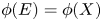 $\phi (E) = \phi (X)$ or
 $\phi$ is generically finite on some irreducible component of
 $E$.
Proof. Suppose, for contradiction, that  $E$ is a big divisor on
 $X$ and
 $\phi \colon X \rightarrow \mathbb {P}^N$ is a morphism which is not generically finite on any component of
 $E$ and such that
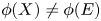 $\phi (X) \neq \phi (E)$. We first consider the case that
 $\phi$ is generically finite on
 $X$. Then
 $\dim (X) = \dim \phi (X) \geq \dim \phi (E) + 2$, so for any point in
 $\phi (X) \setminus \phi (E)$, we can take an intersection with a general linear space to obtain a curve through
 $\phi (X)$ which doesn't intersect
 $\phi (E)$. By taking the preimage, we get a curve passing through any sufficiently general point in
 $X$, which does not intersect
 $E$. Since
 $E$ is big, such curves cannot exist, and so we get a contradiction.
Second, we suppose that  $\phi$ is not generically finite on
 $X$, but still that
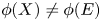 $\phi (X) \neq \phi (E)$. Then for any point in
 $\phi (X) \setminus \phi (E)$, the fiber of
 $\phi$ is at least one-dimensional and we can choose a curve in this fiber. Again, we have constructed curves in
 $X$ which pass through sufficiently general points, and which do not intersect
 $E$, so we have again contradicted our assumption that
 $E$ is big.
Proof of Lemma 6.2 Because  $R/\mathfrak m$ is algebraically closed, we can choose a general point
 $x_0$ in
 $C_v \setminus D_v$. By general we mean that it lies outside of finitely many closed subvarieties, which do not depend on
 $E$ and will be made explicit in the course of the proof. By Hensel's lemma, we can lift the point
 $x_0$ to an
 $R$-point of
 $\mathfrak X$, which will give the desired
 $K$-point
 $x$.
Now let  $E$ be any divisor of
 $X$ containing
 $x$, and we first want to show that its closure
 $\bar E$ in
 $\mathfrak X$ intersects a one-dimensional stratum
 $C_r$ for some ridge
 $r$ containing
 $v$. If the dimension
 $n$ is
 $1$, then this is immediate, so we assume that
 $n \geq 2$. By assumption, some multiple of
 $D_v$ defines a rational map
 $\phi _v \colon C_v \dashrightarrow \mathbb {P}^N$ which is birational onto its image. We can assume that our choice of
 $x_0$ was in the locus where
 $\phi _v$ defines an isomorphism onto its image. Since
 $\bar E$ contains
 $x_0$, the restriction of
 $\phi _v$ to
 $E_0 = \bar E \cap C_v$ must also be birational onto its image. Since this restriction is defined by the pullback of the same multiple of
 $D_v$, we see that
 $D_v \cap E_0$ is a big divisor on
 $E_0$.
By Lemma 6.3, we can take  $B$ to be a connected component of
 $D_v \cap E_0$ which is a big divisor on
 $E_0$. Since
 $B$ is connected, it is either contained in a single stratum
 $C_e$ for some edge
 $e$ or it meets some
 $C_t$, where
 $t$ is a
 $2$-simplex of
 $\Delta$. If
 $n=2$, then
 $C_e$ is a one-dimensional stratum intersecting
 $\bar E$, which is what we wanted to show. So, we assume that
 $n \geq 3$ and, for the moment, we also assume that
 $B$ is contained in a single
 $C_e$.
By assumption,  $D_e$ is a big divisor in
 $C_e$, so some multiple of
 $D_e$ defines a map
 $\phi _e \colon C_e \dashrightarrow \mathbb {P}^M$, birational onto its image. Since this morphism is just defined by a collection of rational functions on
 $C_e$, we can extend it to a rational map from
 $C_v$ to
 $\mathbb {P}^M$, also denoted by
 $\phi _e$. The image
 $\phi _e(C_v)$ contains the image of
 $C_e$, so it is at least
 $(n-1)$-dimensional. Therefore, a general fiber of
 $\phi _e$ is at most one-dimensional, so we can assume that
 $\phi _e^{-1}(\phi _e(x_0))$, the fiber containing
 $x_0$, has dimension at most
 $1$. Thus,
 $\phi _e(E_0)$ must be at least
 $(n-2)$-dimensional. We apply Lemma 6.4 to the restriction
 $\phi _e\vert _{E_0}$, and in either of that lemma's two cases,
 $\phi _e(B)$ is also at least
 $(n-2)$-dimensional. Since
 $\phi _e(B)$ is positive-dimensional, it intersects any hyperplane in
 $\mathbb {P}^M$, which shows that
 $B$ must intersect
 $D_e$, and thus
 $C_t$ for some
 $2$-simplex
 $t$.
At this point, we have shown that if  $n \leq 3$, then
 $\bar E$ intersects
 $C_r$ for some ridge
 $r$ containing
 $v$. If
 $n > 3$, then
 $\bar E$ at least intersects
 $C_t$ for some
 $2$-simplex
 $t$ containing
 $v$, but we can then apply Proposition 6.1 to show that
 $\bar E$ intersects some
 $C_r$ for some ridge containing
 $v$ in this case as well.
We now consider the resolution of the base change  $\psi \colon \mathfrak X' \rightarrow \mathfrak X$ produced by Lemma 5.2. There are two cases, depending on whether or not there exists a facet
 $f$ containing
 $r$ such that
 $\bar E$ contains the point
 $C_f$. If there does, then we consider the component
 $C_v'$ in
 $\mathfrak X'$ corresponding to
 $v$, which maps birationally onto
 $C_v$. By the properness of the resolution, there must be a point in
 $C_v' \cap \bar E'$ mapping to the point
 $C_f$, where
 $\bar E'$ is the closure of
 $E$ in
 $\mathfrak X'$. However, the fiber of
 $C_f$ in the resolution
 $\mathfrak X'$ is a union of toric varieties intersecting along their toric boundaries, and so, by Proposition 6.1,
 $\bar E'$ must intersect one of the one-dimensional strata in this fiber. By Lemma 5.2, this intersection is proper, so it gives a positive coefficient to some ridge containing
 $v$.
On the other hand, suppose that  $\bar E$ does not intersect
 $C_f$ for any facet
 $f$ containing
 $r$. We have assumed that
 $D_r$ is a big divisor on
 $C_r$, so it is a non-trivial divisor. In other words, there is at least one stratum
 $C_f$ properly contained in
 $C_r$. Since
 $\bar E$ does not contain any
 $C_f$, it must intersect
 $C_r$ properly, and thus with positive intersection number. Now we choose a ridge
 $r'$ containing
 $v$ in the subdivision of
 $r$ and then the corresponding stratum
 $C_{r'}'$ of
 $\mathfrak X'$ maps surjectively onto
 $C_r$. By the projection formula, this implies that the intersection number of
 $\psi ^{-1}(\bar E)$ with
 $C_{r'}'$ is positive, where
 $\pi$ is the map from
 $\mathfrak X'$ to
 $\mathfrak X$. Of course,
 $\pi ^{-1}(\bar E)$ is not the same as
 $\bar E'$, but also includes any components of the special fiber whose image is contained in
 $\bar E$. However, the only such components which affect the intersection number will be those which meet
 $C_{r'}'$, in which case the projection of the component onto
 $\mathfrak X$ must be either
 $C_r$ or a point
 $C_f$ contained in
 $C_r$. However, we have assumed that neither of these can be contained in
 $\bar E$, so
 $\bar E' \cdot C_{r'}' = \pi ^{-1}(\bar E) \cdot C_{r'}'$ is positive, which shows that the ridge
 $r'$ containing
 $v$ occurs with positive coefficient in the refined specialization, as desired.
We now have one lemma remaining before finishing the proof of Theorem 1.1. While Lemma 6.2 shows how to find a divisor whose refined specialization contains a given vertex, our definition of  $h^0$ allowed arbitrary rational points. We can turn arbitrary rational points into vertices by choosing an appropriate subdivision, but we need to check that such a subdivision preserves the robustness and affine properties of the degeneration.
Lemma 6.5 Let  $\mathfrak X$ be a tropical complex and let
 $\mathfrak X'$ be any toroidal resolution of a base change of
 $\mathfrak X$ to a totally ramified extension of
 $R$. Let
 $m$ be an integer. If the
 $k$-dimensional locally closed strata of
 $\mathfrak X$ are affine for all
 $k \leq m$, then the same is true for the
 $k$-dimensional locally closed strata in
 $\mathfrak X'$ when
 $k \leq m$. If the
 $\mathfrak X$ is robust in dimension
 $k$ for all
 $k \leq m$, then
 $\mathfrak X'$ is also robust in dimensions
 $k \leq m$.
Proof. Let  $\mathfrak X'$ be a toroidal resolution of a ramified extension of
 $\mathfrak X$. We first suppose that the
 $k$-dimensional locally closed strata of
 $\mathfrak X$ are affine for
 $k \leq m$. Suppose that
 $C_{s'}$ is a stratum of
 $\mathfrak X'$ which has dimension
 $k' \leq m$. Then the image of
 $C_{s'}$ in
 $\mathfrak X$ is the stratum
 $C_s$, where
 $s$ is the minimal simplex of
 $\Delta$ which contains
 $s'$. Therefore,
 $k$, the dimension of
 $C_s$, satisfies
 $k \leq k' \leq m$, and so
 $C_s \setminus D_s$ is affine by assumption. From the construction of the toroidal resolution, we know that
 $C_{s'}$ will be a toric variety bundle over
 $C_s$ and
 $C_{s'} \setminus D_{s'}$ will be a
 $\mathbb {G}_m^{k' - k}$-bundle over
 $C_s \setminus D_s$. Therefore, the map from
 $C_{s'} \setminus D_{s'}$ to
 $C_s \setminus D_s$ is affine and so
 $C_{s'} \setminus D_{s'}$ is affine as well. We conclude that the
 $k$-dimensional locally closed strata of
 $\mathfrak X'$ are affine for
 $k \leq m$.
We now suppose that  $\mathfrak X$ is robust in dimension
 $k$ for
 $k \leq m$. Let
 $C_{s'}$ and
 $C_s$ be strata of
 $\mathfrak X'$ and
 $\mathfrak X$ of dimensions
 $k'$ and
 $k$, respectively, as in the previous paragraph. By assumption, some multiple of the divisor
 $D_s$ defines a birational map
 $\phi$ from an open subset of
 $C_s$ to
 $\mathbb {P}^N$. We let
 $\overline {\phi (C_s)}$ denote the closure of the image of this map and let
 $Y$ denote the image of
 $C_s \setminus D_s$. Since
 $Y$ is the complement of a hyperplane section in a projective variety,
 $Y$ is affine.
Now, we consider  $C_{s'}$, which, as above, is a toric variety bundle over
 $C_s$, and the toric variety is described by the star of
 $s'$ in
 $s$. We can choose some positive multiple of the boundary of this toric variety which contains a spanning set of the characters of the torus, that is, defines a birational map to projective space. Let
 $\mathcal {L}$ be the corresponding line bundle on
 $C_{s'}$. Explicitly,
 $\mathcal {L}$ is the line bundle associated to a multiple of the sum of the divisors corresponding to the simplices of
 $\Delta '$ containing
 $s'$, which are also contained in
 $s$. We consider the coherent sheaf on
 $Y$,
 $(\phi \circ \pi )_* (\mathcal {L})$, where
 $\pi \colon C_{s'} \rightarrow C_s$ is the restriction of the map from
 $\mathfrak X'$ to
 $\mathfrak X$.
We can find an open set  $U$ of
 $Y$ such that
 $\phi$ is an isomorphism on
 $Y$ and
 $(\phi \circ \pi )^{-1}(U)$ is the trivial toric variety bundle over
 $\phi ^{-1}(U) \cong U$. Furthermore, we can assume that
 $U$ is the complement of the variety defined by some element
 $f$ of the global sections of
 $Y$, since
 $Y$ is affine. On
 $U$, the push-forward
 $(\phi \circ \pi )_*(\mathcal {L})$ is a free sheaf whose generators can be identified with the sections on the toric variety. In particular, these sections define a rational map from
 $(\phi \circ \pi )^{-1}(U)$ to projective space which is birational on each fiber of
 $\pi$. Since
 $Y$ is affine, we lift these sections from
 $U$ to
 $Y$ after multiplying by a sufficiently large power of
 $f$. If we regard
 $f$ as a section of
 $\mathcal {O}(\ell D_s)$ for sufficiently large
 $\ell$, then what we have found are sections of
 $\mathcal {L} \otimes \pi ^{-1}(\mathcal {O}(\ell D_s))$ which define an embedding of the torus for a generic fiber of
 $\pi$. Combining these with the pullbacks of the sections defining
 $\phi$, we get a birational map from
 $C_{s'}$, and therefore
 $D_{s'}$ is a big divisor and
 $\mathfrak X'$ is robust in dimensions
 $k \leq m$.
Proof of Theorem 1.1 By base-changing, we can assume that  $R$ is complete without changing
 $h^0(X, D)$ or
 $\Delta$. Let
 $r$ be an integer less than
 $\dim H^0(X, \mathcal {O}(D))$ and let
 $p_1, \ldots , p_r$ be any
 $r$ rational points in
 $\Delta$. We want to show that there exists an effective divisor linearly equivalent to
 $\rho (D)$ containing these points.
We first make a subdivision of  $\Delta$ as follows. Let
 $m$ be the least common denominator of all the coordinates of the points
 $p_i$. We rescale the simplices by
 $m$ and subdivide them using the ‘regular subdivision’ of [Reference Kempf, Knudsen, Mumford and Saint-DonatKKMS73, Theorem III.2.22], and now the points
 $p_i$ are vertices. We let
 $\mathfrak X'$ be the corresponding toroidal resolution of a ramified extension of
 $R$. By Lemma 6.5, the locally closed strata of
 $\mathfrak X'$ of dimension at most
 $n-2$ are affine, and it is robust in dimensions
 $n$ and
 $n-1$. By Lemma 4.8, the tropical complex of
 $\mathfrak X'$ is the subdivision of
 $\Delta$ as in Construction 4.1. Finally, by Lemmas 4.5 and 4.6, if we can find a divisor linearly equivalent to
 $\rho (D)$ on
 $\Delta '$, then it will also be a divisor linearly equivalent to
 $\rho (D)$ on
 $\Delta$. Therefore, we replace
 $\mathfrak X$ and
 $\Delta$ with
 $\mathfrak X'$ and
 $\Delta '$ for the rest of the proof.
Using Lemma 6.2, we can choose points  $x_1, \ldots , x_r$ in
 $X$ corresponding to
 $p_1, \ldots , p_r$ respectively. Since each
 $x_i$ is rational over the fraction field of
 $R$, vanishing on
 $x_i$ imposes one linear condition on the sections
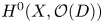 $H^0(X, \mathcal {O}(D))$. We have assumed that
 $r$ is less than the dimension of this vector space, so there exists a non-zero section of
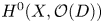 $H^0(X, \mathcal {O}(D))$ defining a divisor
 $D'$ which contains all of the
 $x_i$. Let
 $D''$ be the refined specialization of
 $D'$. Then
 $D''$ is effective by Lemma 5.2 and contains the points
 $p_1, \ldots , p_r$ by Lemma 6.2. By Proposition 2.17,
 $D''$ is linearly equivalent to
 $\rho (D)$. Therefore,
 $h^0(\Delta , \rho (D))$ is greater than
 $r$, which establishes the desired inequality.
Acknowledgements
Throughout this project, I have benefited from my conversations with Matt Baker, Spencer Backman, Alex Fink, Christian Haase, Paul Hacking, June Huh, Eric Katz, Madhusudan Manjunath, Farbod Shokrieh, Bernd Sturmfels, Yu-jong Tzeng, and Josephine Yu. I would especially like to thank Sam Payne for his many insightful suggestions and thoughtful comments on an earlier draft of this paper.