1. Introduction
The distribution and function of spoken German presentational and existential es gibt and SEIN structures have not been investigated comprehensively. Previous accounts make very little mention of differences between written and spoken data. Yet spoken language deserves to be studied in its own right, given that it is prior and primary in human communication and, crucially, since a range of fundamental differences between the structures of spontaneous talk and most written texts have been demonstrated across languages (Miller & Weinert 2009[1998]). This article provides overall frequencies for spoken and written data and some comparative discussion. The main qualitative analysis focuses on a corpus of spontaneous spoken data. In particular, the use of da SEIN has been underestimated in previous work. This is surprising given the ubiquity of da in spoken German (Weinert 2007). In addition, the relationship between the various SEIN structures, especially in spoken German, remains to be fully explored. The corpus-based analysis does not answer all the questions, but it is an essential step in ensuring that the linguistic data under investigation are adequate.
The analysis is embedded in the wider theoretical context of presentationals and existentials, including selective comparison with English there BE, which has been studied extensively (Lakoff 1987, Lumsden 1988, Firbas 1992, Lambrecht 1994, McNally 1998, Biber et al. 1999). The present article assumes, in line with previous accounts based on information structure, that presentational and existential structures serve a pragmatic function of introducing or focusing on entities and events (whatever else they may do). In addition, the semantics of existentials involves asserting existence or presence—typically of entities referred to by indefinite NPs. Lambrecht (1994) distinguishes between those structures that present entities and those that present events.
The examples in 1 contain existentials that introduce an entity (or a class of entities) into the discourse by means of an NP and assert its existence per se. The examples in 2 introduce an entity and assert its presence in a location: The existence of cats is presupposed. The examples in 3 introduce an entire event and could answer the question what happened or what occurred. The examples in 4 predicate the activity expressed by the main verb of the entity referred to by the subject noun phrase and could answer the question what did Max do. The examples in 5 present and draw attention to an event. Small capitals indicate word stress. An English example is always listed first and can be taken as a translation of the non-English examples.
(1)

(2)
(3)
(4)
(5)

In 3a,b, German and English syntax and prosody do not distinguish between a contrastive predicational reading used to identify Max (Max called, not Karl) and a presentational reading whereby the whole event—Max called—is presented. In contrast, Italian does distinguish the two readings syntactically by subject-verb inversion, as in 3c (see Lambrecht 1994:181). English and German use there-clauses and da-clauses, respectively, to draw attention to (more or less dynamic) events, as in 5a,b, or (more or less static) occurrences, as in 5c,d.
The range of presentational and existential structures and verbs is potentially rather wide. This article concentrates on es gibt and SEIN structures involving entities referred to by indefinite NPs, illustrated again in more detail by examples 6–10. Some da-clauses that are used to present events and occurrences are also considered. They are exemplified by 11–12.Footnote 1
(6)
In terms of structure, es gibt consists of the impersonal subject es + 3rd person singular gibt; in spoken German, es can be cliticized, as in sgibt or gibts when inversion is required. Otherwise, gibt follows the patterns for the full verb geben, that is, it is tensed and requires an accusative complement. In SEIN structures, SEIN is a full verb, exhibiting obligatory agreement with the nominative NP complement. In the present analysis, a distinction is made between da SEIN, locative SEIN, es SEIN, and zero-locative SEIN exemplified in 7–10. The label locative SEIN is restricted to structures that contain a lexical locative expression exemplified by 8. The position of lexical locative expressions and their cooccurrence with da is discussed later.
(7)
(8)
(9)
(10)
In terms of function, example 6a asserts existence per se, while examples 6b and 7–10 assert existence or presence in a location (with an implicit location (a camera) in 10). This distinction is a recurring theme in studies. For example, Milsark (1974) talks of ONTOLOGICAL versus LOCATIONAL existential sentences. These issues are elucidated in section 2.
In addition, this article briefly considers da-clauses with other verbs used to present entities, as in 11, or whole events/occurrences, as in 12. Since da is frequent in spoken German, this part of the analysis serves to clarify some functional boundaries:
(11)
(12)
The article is structured as follows. Section 2 provides some theoretical background and section 3 presents an overview of previous work on German. Section 4 describes the corpus data and section 5 provides an overview of the quantitative findings. Sections 6 and 7 present the analysis of es gibt NP and SEIN NP, respectively. Section 7 also comments on the use of da-clauses with other verbs used to introduce entities and events, and addresses the wider issue of da-usage in spoken German. This is followed by a short comparison of es gibt and SEIN in section 8 and conclusion in section 9. Much of the discussion centers around da SEIN since it is frequent in spoken German yet has received relatively little systematic attention. The discussion of es gibt is detailed up to a point, but its main purpose is to serve as a background to the study of spoken presentational/existential SEIN structures.
2. Theoretical Background, Terminology, and Analytic Categories
2.1. Linguistic Approach
The present study works with background principles common to usage-based approaches and earlier perceptions of grammar maintaining that linguistic structures cannot be studied in isolation from meaning, function, context, use, and users (Barlow & Kemmer 2000, Halliday 1985, Langacker 1987, Palmer 1968). The term structure has been used above as a theory-neutral, general term to refer to form. CONSTRUCTIONS are considered theoretical primitives and conceived of as form-function pairings, that is, different syntactic constructions enable language users to perform different communicative acts. Carving out constructions involves complex decisions on the basis of structure and function and raises the question of linguistic gradience (Aarts 2004, 2007; Miller 2010). These issues surface throughout the discussion, but the main aim is to provide a description of observable linguistic facts. While such description necessarily involves theory (general as outlined above and specific in relation to the linguistic phenomena under investigation), I do not adopt or develop a particular framework in this article.Footnote 2 Since spoken language is not analyzed in terms of sentences, which is a unit relevant for written language, the term clause is used instead, which can be applied to both the spoken and written structures in question (see chapter 2 of Miller & Weinert 2009 for a full discussion).
2.2. Presentation versus Predication
A detailed typology of the pragmatics and semantics of presentational structures is beyond the scope of this article, but a brief outline is needed to clarify how terms are used in the analysis of German.Footnote 3 As stated in the introduction, the purpose of presentationals and existentials is not to predicate something of an entity; instead, they are devices that introduce or focus on entities or events.Footnote 4 Existential constructions are considered presentational in this pragmatic sense since they introduce or focus on new entities (Lumsden 1988). Other types of presentationals include situationally/exophorically used clauses with proximal deictics (hier ist ein Schirm/here's an umbrella) and constructions with definite NPs (da ist dein Papa/there's your dad), each with their own specific function. In terms of semantics, existentials can be said to assert existence per se, and they can assert existence or presence in a location.
2.3. Existence versus Location
This section goes to the heart of the characterization of es gibt and SEIN constructions. One of the main issues to be clarified is the distinction between existence and location, especially in da SEIN. While languages need to be analyzed on their own terms, it is nevertheless instructive to take into account work on English there BE. Lakoff (1987) distinguishes between deictic there, which is locative, and existential there, arguing that deictic there is prototypical and that existential there is based on deictic there.Footnote 5 He also suggests that speakers may use distinguishing properties of the two types directly, without using prototype structures. Lakoff (1987) and Biber et al. (1999) adopt similar criteria for distinguishing existential there from deictic/locative there. Deictic there refers to real or abstract locations. Existential there is typically unstressed; it has no locative meaning and it functions as a subject. It can cooccur with locative there, as in there's still no water there.
Lambrecht (1994:179) argues that “mere assertion of the existence of some entity” is a relatively rare communicative act, and that asserting presence in a location is more common. By “mere existence” Lambrecht means ontological existence. His example is there are cockroaches, and such bare existential statements may indeed be rare. However, the assertion in example 6a—there are blue-eyed cats—is more noteworthy and hence communicatively useful. This applies to kinds of concrete entities, but also to unique concrete entities, as, for example, in 13. Indeed, in Weinert 2004, existentials feature prominently in constructions with relative clauses that describe unique entities, and while Biber et al. (1999) do not give a breakdown of there-constructions, they note that in conversation, 40% of there-constructions are postmodified.
- (13)
a. is there a tool for taking the core out of a pineapple
b. there is a lift powered by water
Example 13a queries the existence of a special tool, and example 13b can be used to focus on the fact that such a thing as a lift which is powered by water is technically possible. Abstract entities in particular are asserted to exist or not, for example, there are two possibilities, there is a solution, there is no alternative. While such uses may not be strictly ontological (that is, it is not a question of whether the concept solution etc., exists), they are effectively existential, with the entities in question being specific, rather than generic or conceptual. In other words, existential constructions are motivated from a semantic point of view, not only in terms of the information structure of clauses as part of coherent or interpretable discourse.Footnote 6
Nevertheless, the question still remains whether existential there BE is devoid of locative meaning. Lumsden (1988) argues that it does exhibit locative adverbial properties. For example, a there BE-clause may be interpreted as asserting existence in a location through the prior discourse (what can you tell me about the zoo? there are giraffes). Even ontological existential there can be seen to express location somewhere. As evidence, Lumsden compares there BE with the verb exist, arguing that the occurrence of exist with locative adverbials is severely restricted, as in ?tigers exist in India, whereas it is not with there. In contrast, temporal adverbials are compatible with exist, as in computers did not exist in those days.
This view seems to be at odds with the one expressed by Lyons (1975), Lakoff (1987), and Biber et al. (1999), who see the cooccurrence of locative and existential there as evidence that existential there has lost its locative meaning. Bolinger (1977) and Halliday & Hasan (1976) also argue against the locative semantics of existential there. Lakoff, who distinguishes deictic (locative) there from existential there and analyzes each in terms of prototypicality, conceives of a locative-nonlocative continuum. Pfenninger (2009:303) comments that with SEIN and da-constructions “we are confronted with the existential nature of the locative and the locative nature of the existential.”
2.4. Analytic Framework
The present study sees the es gibt- and SEIN-constructions under investigation as manifesting existential and locative meaning to different degrees, both across and within classes. When location is backgrounded, existence may be foregrounded; when location is foregrounded, presence may be foregrounded (but not exclusively). When location is backgrounded in da SEIN, da is nevertheless considered to be deictic. If abstraction away from the concrete, physical, and situationally present is conceived of as opening the potential for existential meaning, then a range of factors become relevant to the existential-locative dimension: whether entities are situationally or textually evoked and whether they are concrete versus abstract; whether locations are explicit versus implicit, specific versus vague, and physical versus metaphorical. This framework is elucidated and illustrated in full throughout the analysis.
2.5. Enumeratives
Existentials are associated with indefinite NPs since they introduce new entities. Lumsden (1988) refers to existentials which contain definite NPs as enumerative and argues for a pragmatic account in terms of implicature: The speaker reminds the hearer of the existence of an entity in order to indicate its relevance in a given discourse context, as shown in 14a from Lumsden (1988:224). Enumeratives also occur in German, as in 14b,c.
- (14)
a. what could I give my sister for her birthday there's john's book on birdwatching
b.
Enumeratives are included in the present study in order to provide an indication of frequency, but they are not studied in detail.
3. Background to German Es Gibt- and SEIN-Constructions
The German Duden 2005 reference grammar does not single out the es gibt- and SEIN-constructions; Weinrich's text grammar (2005) only has a section on es gibt, and Durrell (2002), who specifically looks at the translation of there BE, does not discuss da SEIN in its own right. Weinrich (2005) considers es gibt to have a presentational function, serving to introduce and draw attention to nouns. Durrell (2002:372–373) observes that “es gibt indicates existence in general” and “es ist/sind indicates the presence of something at a particular place and time.” Furthermore, he claims that es ist/sind refers to permanent or temporary presence in a definite, limited place or temporary presence in a large area, and to record events and weather conditions. He adds that these can also be expressed using es gibt, which usually indicates emphasis on the thing, rather than the place, marks the event as exceptional, or points to the future. Durrell also states that sentences with es ist/es sind require an indication of place, which is often provided by da.Footnote 7
Research on the whole does not distinguish systematically between spoken and written language (for instance, Czinglar 1998, 2002), and work on da SEIN is sparse. Lambrecht (1994) only mentions da SEIN in a short footnote. Erdmann (1979) provides a taxonomic overview of there-clauses and corresponding German structures (see also Zydatiß 1978, 1981 for a language learning perspective). His contrastive analysis does not make use of supporting text or corpus analysis, however. Erdman notes that da can be an alternative to es but considers this use infrequent. He furthermore suggests that in certain contexts, German uses haben, as in dein Strumpf hat ein großes Loch ‘your sock has a big hole’ versus es ist ein großes Loch in deinem Strumpf, lit. ‘it is a big hole in your sock’.Footnote 8 He does not consider da ist ein großes Loch in deinem Strumpf, ‘there is a big hole in your sock’ as a viable alternative. Weinert 2007 has a section that argues for existential da, as part of a wider study of da in spoken German.
The most comprehensive recent analysis of written English and German existential constructions is provided by Pfenninger (2009), who examines examples from contemporary English fiction and their German translations as well as their elicited translation.Footnote 9 Pfenninger argues that High German does not feature a prototypical existential construction equivalent in syntactic and pragmatic function and semantics to the English existential there-construction. Pfenninger considers SEIN as a verb of location that requires a locative complement since her data contain only three counter-examples (that is, where an existential meaning resides in SEIN). Pfenninger reports the regular occurrence of the existential da-construction. She suggests that it has a locative flavor and assigns the locative function to the whole construction, not to adverbial da, which often does not provide a specific location. Furthermore, she sees no clear dividing line between existential and locative meanings in SEIN-constructions, and between the existential es gibt and the existential da-constructions.
Some functional differences between es gibt and SEIN-constructions are to be expected, however, given their lexical make-up and origins. Previous work lends support to the view that es gibt is not historically associated with presence in a location (in contrast to there and da). The existential meaning can be conceived of as an extension of giving, that is, the result of giving is the manifestation or provision of an object (Joseph 2000; Newman 1996, 1997; Pfenninger 2009). This extension may have been from the sense of yield attested in late Middle High German and providence that gives, provides, and produces (Newman 1996). It is not clear whether give itself may have developed from have, hold, or take. The origins of es gibt account for what Pfenninger terms its dynamic force, exemplified by 15.
(15)
Pfenninger argues that such cases involve actions and processes leading to the coming into existence of an entity. They are associated with cause and consequence, related to the providential meaning of geben. Pfenninger considers this phenomenon a case of persistence in grammaticalization (Hopper & Traugott 2003). In the present article, the term contingent is used since existence is seen as sourced. I proceed now to a corpus analysis of spoken and written German, with a focus on spoken language.
4. The Data
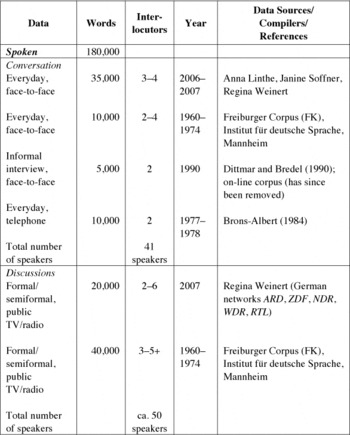
The main corpus data represent the German spoken in Germany, including over 140 speakers from a variety of regions and social backgrounds. The corpus contains ca. 180,000 words: 60,000 from informal conversations, 60,000 from semiformal and formal television and radio discussions, 30,000 from formal academic supervision sessions, and 30,000 from map task data, that is, informal goal-oriented dialogues involving a spatial task. The length of the spoken language transcriptions ranges from 500–5000 words. All of the data sets involve spontaneously produced spoken language of entire conversations or dialogues. Of parti-cular interest is informal, everyday conversation, which is the form of spoken language common to all unimpaired humans; da is especially frequent in this type of data (Weinert 2007). At the same time, the issue of formality may be relevant with respect to abstract entities and the expression of ontological existence, hence the inclusion of semiformal and more formal spoken data. The map task allows for a more detailed investigation of the relevance of concrete entities and explicit locations. In the task, one speaker instructs the other on how to draw a route around various landmarks. They each have a map, screened from each other's view. The speakers are aware that their maps may be different. While the map task data are produced in the context of a set task, they are never-theless spontaneous.
In order to provide overall frequency comparison with relatively formal written language, ca. 100,000 words from various written sources were also examined: 30,000 words from broadsheet newspapers and leisure magazines, 30,000 words from fiction, 30,000 words from academic and scholarly texts, and 10,000 words from travel guides. The latter were chosen since they involve locations and landmarks as well as some route descriptions. The texts are between 500 and 3000 words long. In the case of novels and book-length academic texts, only the first 2000 words were examined in order to ensure representativeness. Beyond genre, dates, and topics, specific texts were selected randomly.
Table 1 provides an overview of both the spoken and the written data sources. For the spoken data, the column Interlocutors gives the number of speakers per individual conversation/discussion, etc., and the total number of speakers for each entire data set is listed underneath (hence the figures do not add up). Since the written corpora include over 50 texts, full sources and references are not provided. The sports commentaries are only referred to in section 8.
Spoken and written data sources.


5. Overview of Results
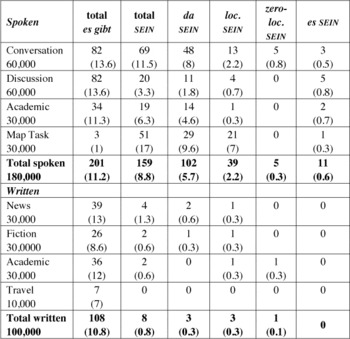
Table 2 provides an overview of the frequency of German presentational/ existential es gibt, da SEIN, locative SEIN, zero-locative SEIN, and es SEIN involving entities. The table presents raw figures and figures per 10,000 words in brackets. The entire corpus was analyzed manually, with the aid of some word searches, but ensuring that the data were read and coded as running text. The study comments on major trends but does not aim to differentiate statistically among genres with respect to the various constructions.
Presentational/existential constructions in German.

Overall, es gibt appears with more or less equal frequency in the spoken and written data, that is, 11.2 versus 10.8 per 10,000 words.Footnote 10 In contrast, SEIN-constructions are typical of the spoken data only, outnumbering written instances by a factor of eleven. The picture for the spoken data is intriguing. Es gibt and the combined SEIN-constructions are fairly close in frequency, with 11.2 versus 8.8 per 10,000 words. Da SEIN reaches almost 6 per 10,000 words and is the most frequent SEIN-construction in all spoken data sets. It may not be so surprising that in the context of concrete route descriptions required by the map task, locative SEIN and da SEIN-constructions are used. Yet da SEIN is also well represented in the academic supervision sessions and particularly common in everyday, informal conversation. Es SEIN is rare, with a higher number in formal discussions. SEIN-constructions without a locative are also rare, with only 11 cases, including six es SEIN-constructions. While the figures need to be interpreted with caution, they suggest that es gibt may be distributed fairly evenly in spoken genres (excluding the specialized map task). In contrast, da SEIN and locative SEIN, and even zero-locative SEIN, are more prominent in conversation, where es gibt- and SEIN-constructions are close in frequency. This would appear to be an important finding, given the status of everyday, informal spoken language as the predominant means of linguistic communication. The findings with respect to the conversation data did not suggest that da SEIN has become more frequent or es gibt less frequent over the last forty years, although the corpus data are too stratified for quantitative/ statistical comparison of two points in time.
6. Analysis: Es Gibt NP
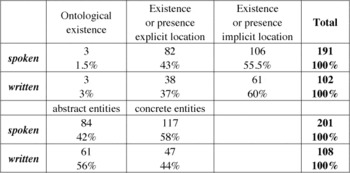
This analysis is based on the 201 spoken and 108 written es gibt-clauses. Most NPs in the spoken data are indefinite, with 35, or 17%, being definite (compared with 5, or 4.6%, in the written data). Definites are used for the enumerative function as in 14b above. The spoken data contain 10, or 5%, contingent instances, and for the written data the figure is 6, or 5.5%. Table 3 provides an overview of three main functions/features of es gibt-clauses relating to existence and location (excluding contingent case; they all involve implicit locations in the data). The labels explicit and implicit refer to the presence or absence, respectively, of an expression of location (physical or metaphorical) within the es gibt-clause itself. The table also shows the distribution of abstract and concrete entities for all clauses. The percentages out of the total have been calculated separately for the spoken and written data and should therefore be read from left to right.
Es gibt NP in German.

In the spoken data, concrete entities are slightly more frequent overall than abstract ones, 117 (58%) versus 84 (42%), but both are well represented. Not surprisingly, the picture is reversed for the more formal discussions (50 versus 32 cases). In the written data, 47 entities, or 44%, are concrete and 61, or 56%, are abstract. Ontological es gibt is rare in both the spoken and written data, while implicit locations are slightly less frequent in the spoken than in the written data, with 55.5% versus 60%. The figures do not suggest very pronounced differences between spoken and written German in terms of the examined features. The various es gibt-clauses are illustrated with examples from the spoken data below.
6.1. Asserting Ontological Existence
Es gibt is used only three times to assert ontological existence—or indeed nonexistence—in the universe, as in 16 and 17. The utterances are contextualized, however, rather than coming “out of the blue.”
(16)
The speaker of 16a was completing a crossword and already had the letter a in third position of the required three-letter word. Example 16b was used by a mother talking to her young son who was scared of sleeping on his own because the night bird might harm him.
Example 17 can also be considered as asserting (the necessity for) ontological existence. It was uttered as part of a discussion about the difficulties of being a teacher and the suggestion that few people are suited to the job.
(17)
While ontological cases are rare in usage, there is no question that they are acceptable. Furthermore, their use is semantically motivated.
6.2. Asserting Existence/Presence in a Location
The large majority of es gibt-constructions assert existence or presence in a location, although there are no cases of situationally evoked entities in the data. The examples in 18 below illustrate the range of es gibt instances. Abstract entities are typically associated with metaphorical locations.
(18)
While temporal expressions can be considered as denoting metaphorical locations, they have not been counted as explicit locations (see example 19). The reason is that temporal expressions can and do cooccur with explicit locations.
(19)
The interaction of spatial and temporal expressions in presentationals/ existentials is left to a separate study.
6.3. Asserting Contingent Existence/Presence
Although the proportion of contingent es gibt is low in the data, it is not negligible (around 5%). This function of es gibt is shown in 20.
(20)
Note that 20a could mean either ‘there is still some dessert left' (that is, dessert is existent or present) or ‘there will be dessert’ (that is, dessert will be provided). The latter meaning was intended by the speaker and cook of a family meal, advising the others not to eat too much and to leave room for dessert. Example 20b was uttered jokingly while the speaker gave the addressee some money as a present. The contingent function is not be analyzed further in this paper.
To summarize, es gibt involves a fairly even proportion of concrete and abstract entities and slightly more implicit than explicit locations in both the spoken and written data. This suggests that within the construction, location is regularly backgrounded and existence/presence—foregrounded.
7. Analysis: SEIN-Constructions in Spoken German
SEIN-constructions are a feature of the spoken as opposed to the written data and are especially frequent in everyday conversation. Es SEIN and zero-locative SEIN are rare, accounting for 7% of SEIN-constructions each (recall that some zero-locative SEIN are, in fact, instances of es SEIN). While locative SEIN is certainly not marginal—it accounts for ca. 25% of the SEIN-constructions—da SEIN is most frequent overall with ca. 64% of the total. Although da SEIN is found in all data types, it occurs most frequently in informal conversation and the map task, and least frequently in more formal discussions. It is also well represented in the academic supervision sessions. In the following section, I proceed from the least frequent to the most frequent construction to allow for a coherent later discussion.
7.1. Es SEIN
The data contain only 11 cases of es SEIN. Both concrete and abstract entities are involved (five versus six). Six examples do not include a location, as in 21–23. Example 21, from a formal discussion, refers to a time in the past when people experienced a greater sense of security.
(21)
In 22, from an informal conversation, the previous discourse makes it clear that a specific railway station is implied and that the wo-clause is a restrictive relative clause.
(22)
A few cases include metaphorical locations, as in 23 from a formal discussion, but none involves an explicit physical location.
(23)
Es SEIN is rare, but possibly varied. It is used with both concrete and abstract entities, both explicit and implicit, as well as metaphorical and physical locations.
7.2. Zero-Locative SEIN
In addition to the six cases of es SEIN that do not involve a location, there are five other instances of zero-locative SEIN. In two cases, the clauSEINitial position is filled by a temporal deictic, as in 24a. In three cases, this position is empty, as in 24b.
(24)
Pfenninger (2009) considers examples without an additional constituent inside the VP ungrammatical. She sees this ungrammaticality as the historical result of the emergence of the existential es gibt-construction and the grammaticalization process of SEIN. Recall that Pfenninger's study is based on written language and does not specifically consider potential differences between spoken and written data. Although such constructions are clearly marginal in the spoken data of the present study, they do occur (see 10 and 22 above). Further investigation of the factors contributing to the acceptability of such structures and of the contexts favoring their use is desirable.
7.3. Locative SEIN
There are 39 instances of locative SEIN, which, by definition, contain an explicit location. The discussion data yield the only case of a metaphorical location, which occurs with an abstract entity. Not surprisingly, all 21 cases in the map task involve physical locations. Speakers often verify their landmarks, as in 25a. Example 25b comes from the conversation data.
(25)
The relatively low number of locative SEIN may seem surprising. There are two likely reasons, which are related. First, in presentational/ existential constructions, the NPs which refer to the entities in question typically do not occur in clause-initial position. Second, there is evidence that in spoken German, by far the most common elements in clause-initial position in main clauses are pronouns, deictic adverbs, or other cohesive devices (Weinert 2007, 2010).Footnote 11 There are, then, two opposing forces at work in locative SEIN-clauses. On the one hand, the locative should appear in clause-initial position, which happens in 32 out of 39 cases. On the other hand, lexical locatives should be less frequent than deictic adverbs since proforms are preferred in clause-initial position in main clauses. Indeed, da SEIN occurs over two-and-a-half times more frequently than locative SEIN.
The occurrence of four temporal deictics and two discourse connectors in initial position of main clauses with locative SEIN is also consistent with this preference. (One locative occurs postverbally, with the NP complement in clause-initial position. One locative occurs in a verb-final complement clause). I can only suggest, tentatively, that the construction largely involves concrete entities in physical locations (but the data contain no examples of situationally evoked entities). These features can be considered to strengthen the locative nature of locative SEIN, and hence the presence of entities.
7.4. Da SEIN
Da SEIN is the most frequent of the existential/presentational SEIN-constructions overall and in each data set. Only those cases are included where da is either in clause-initial position or in the nearest to it available slot. With da in final position the clause is not presentational (as in gestern war jemand da, lit. ‘yesterday was someone there’). In this case, da has what I call “attendant” meaning, denoting presence versus absence. The data include a few cases where da follows a locative expression (as in im kühlschrank da is saft ‘in the fridge there is juice’). These clauses are classed as locative SEIN, and da can be considered to have a focusing function.Footnote 12
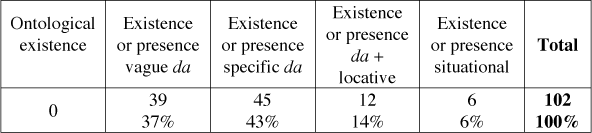
The data mostly contain cases where da appears in initial position of a declarative main clause, as in da ist ein berg ‘there is a mountain’ (76 out of 102 instances, or 75%). This position is not always available syn-tactically. Therefore I also include cases where da immediately follows the finite verb of a main clause that requires subject-verb inversion, as in dann ist da ein berg ‘then is there a mountain’ and ist da ein berg ‘is there a mountain’. There are six declarative clauses and 11 yes/no questions. In eight cases, da immediately follows the conjunction in a verb-final clause, as in ob da ein berg ist ‘whether there a mountain is’. In one clause, the NP complement is in initial position. Three cases of da are stressed—they are used to clarify a previously mentioned location—and the rest are unstressed. Recordings were not available for the data from Brons-Albert 1984, which contain thirteen cases of da SEIN. The transcriptions and content suggest that these cases are not stressed, though this cannot be guaranteed. Table 4 presents an overview of the main functions and features of da SEIN-constructions.
Da SEIN NP in spoken German.
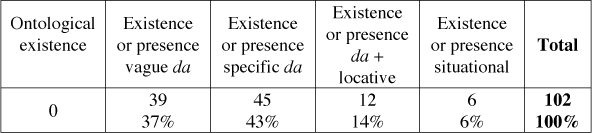
Only two enumerative cases occur; in all other cases, the NPs are indefinite. Although almost 75% of entities are concrete, the 25% made up by abstract entities are not negligible. In the case of es gibt—which does not in itself carry a locative element—I distinguish between explicit and implicit locations on the basis of the presence or absence of a locative expression within the es gibt-clause. Since da can function as a locative adverb, its reference to location is classed as (more or less) vague or (more or less) specific. Vague uses can be seen to background location whereas specific uses foreground location.Footnote 13 This is illustrated shortly. Eighty percent of specific locations are physical, while 20% are metaphorical (vague locations are difficult to classify, although there are some clear cases, exemplified below). Importantly, while concrete entities and physical locations predominate, ca. 37% of da SEIN-clauses do not involve a specific location. As suggested in section 2, any abstraction away from specific locative meaning can be considered to open up the potential for existential meaning. There are no cases of ontological existence, however.
Fifteen da SEIN-clauses contain an additional expression of location: eight are lexical expressions, five are prepositional deictics (dabei ‘with it’, drin ‘in it’, etc.), and one clause contains one of each. There is also one case of da cooccurring with hier ‘here’. These expressions of location appear within the clause in postverbal position, that is, where the locative expression is intonationally integrated into the clause and da is unstressed.
The various cases are illustrated in 26–33, including the important distinction between vague reference and metaphorical location. Further discussion in relation to the backgrounding of location is also provided. The data include only four cases of situationally evoked entities, as in 26, uttered in the addressee's home.
(26)
In the map task data, 22 instances of da SEIN refer to a previously mentioned location involving concrete entities, as in 27: Although unten rechts refers to an area rather than a point, it nevertheless indicates a specific location.
(27)
The locations are varied in type, ranging from landmarks, to areas on the map, and to the end points of movement in a particular direction, as in du gehst zwei zentimeter nach rechts ‘you go two centimeters to the right’. Constituents expressing such locations typically occur immediately prior to da. Example 28 comes from a conversation—da refers to im westteil (of Berlin) and the entity is abstract.
(28)
Example 29 illustrates the combination of an abstract entity (erscheinung) and a metaphorical location (the age range von zwölf bis zwanzig). Speakers are discussing the fact that children are physically very active until they reach puberty. Only translations are provided since the example is long. Glosses would obscure the main point of the analysis. In A1, | marks the boundaries of a comment which splits a main clause.
(29)
While da SEIN is certainly used for asserting existence and presence in specific locations, da regularly has a vague locative function. This occurs even in the map task, when participants discover a mismatch between their landmarks, as in 30. Again, only translations are provided in this long example.
(30)
In 30, A5, da ist noch n anderer aussichtspunkt ‘there is another view point’, foregrounds the existence/presence of the entity. The hearer can assume that the entity in question is located on the map, but the precise location is specified following the assertion in A8 as to the existence of an additional view point.
In example 31, A1 is a conversation opener, with speaker A just having returned to B's flat from shopping. On the basis of the intonation (as well as local knowledge), A2 is to be interpreted as ‘on the right—next to the café' (not ‘to the right of the café’), indicated by the marker |.
(31)
It is the existence of a new greengrocer which is news, and the location is vague. The speaker may or may not be thinking about the precise location while uttering A1, depending on what she might have said next had speaker B not asked her to specify the location. The location is not accessible to B, although he may assume a location in the vicinity of the flat where A has been shopping. In other words, the role location plays is highly context-dependent.
The bulk of evidence for presentational/existential da SEIN in the data comes in the form of examples such as 30 and 31, where da is vague and the clause does not contain any other locative expressions. The analysis of examples that contain an additional locative expression is somewhat complex. I confine myself to two cases. In most clauses in the data, da could be considered to refer to a previously mentioned location, as in 32. The speaker has been looking up book titles by a particular author on the web pages of an online shop, and da refers to this shop.
(32)
At the same time, in 32, da is separate from the prepositional drin, which is a common feature of spoken German.Footnote 14 The alternative order, as in dadrin sind jede menge, is more like locative SEIN, albeit that it is partly deictic. The separation of da from the preposition, which has semantic content, allows da SEIN to focus on the entity (via the NP) without intervening material.
The next question is how to analyze clauses which have an additional lexical expression of location, as in 33.
(33)
In 33, da can only be considered to have specific locative reference if it is analyzed as cataphorically referring to auf der karte ‘on the card’. However, auf der karte is intonationally integrated into the clause and is therefore not an afterthought used in order to clarify the reference of da. Even if a coreference relation obtains, this does not explain why auf der karte is not placed clause-initially. Again, as in 32, placing da clause-initially allows the focus to fall directly on the entity. In fact, the cataphoric analysis is compatible with the attention-drawing one since da is considered vague in both. At this point it is worth noting that examples such as 32 and 33 might be considered variants of es SEIN, according to previous work on German cited in section 3. In order to examine the spoken examples in their own right, comparison of da with es has been avoided until now. This point is taken up again in sections 7.5 and 7.6.
The above discussion has clarified that the use of da to refer to a metaphorical location is not the same as the vague use of da. The distinction between vague and specific uses is equally relevant for physical locations (for instance, 27 versus 30). The specificity of a location can be highly context-dependent so that da is considered vague in 30 even though the location is limited to the map. When a location is vague it becomes backgrounded, whereas existence becomes foregrounded. Vague da is nevertheless considered deictic, that is, it points, in the most basic sense, to the introduced entities, and this use can therefore be considered metonymic. In contrast, metaphorical locations can be seen as extensions of the physical spatial domain to other domains, such as time or discourse/text (see Weinert 2007 for further discussion). The fact that metaphorical locations may lend themselves to vagueness is a separate issue. This point surfaces again in the next section, where da is considered in combination with other verbs.
7.5. Da with Other Verbs and the Wider Context of Da-Usage
This section discusses the use of da with main verbs to present entities referred to by indefinite NPs on the one hand, and events or occurrences on the other. It also comments on es. A discussion of the wider use of da in spoken German is useful for contextualizing the analysis of presentational/existential da. It is neither necessary nor even possible to provide a complete analysis of the entire spoken and written corpus—even of one subgenre—given that informal conversations contain well over 100 instances of da per 10,000. This section then only gives an overview, citing supporting evidence from some subcorpora: 30,000 words from the informal conversation, 30,000 words from the academic supervision sessions, an additional 10,000 words from sports commentaries (since they report events), and 30,000 words from news and academic writing (all dating from 1990–2012), plus some additional examples.
First, I discuss the presentation of entities. As noted in the introduction, the range of presentationally or existentially used clauses and verbs is potentially wide. This includes existential verbs such as existieren ‘exist’, locative verbs such as sich befinden ‘be situated’, possessive haben ‘have’, evidentials such as kennen ‘know’, and verbs of perception such as sehen ‘see’ and hören ‘hear’. Many other verbs are closely linked to the introduction of entities and are consistent with presentational interpretations. Most of these verbs are nonagentive (for example, kommen ‘come/appear/arrive’).Footnote 15 Within certain structural constraints, both dummy subject es and da feature in clause-initial or preverbal position as illustrated in 34a and 34b, respectively.
(34)
Example 34a comes from an academic supervision session. A lecturer explains that quite a number of students had shown up at earlier sessions to discuss some literary works, but failed to come to subsequent ones. Example 34b was uttered during a football commentary, drawing attention to the fact that England still had to play in their round of the European Championships.
The data contain some relatively clear cases, such as 34, but the distinction between presentation and predication is not always so clear-cut. Extensive analysis of the discourse context is often required, as well as an assessment of the semantic contribution of the verbs. For instance, sich zeigen ‘show up’ in 34a contrasts with the later information that the students were absent; in 34b, kommen indicates with certainty that England are still to play. Nevertheless, the semantics of certain verbs is compatible with the introduction of entities. The subcorpus does not contain many clear examples of such es- or da-clauses. There are three candidates with es in the academic supervision sessions and none in the written data; seven candidates with da occurred, with five in the spoken academic data. The figures are small, but a potentially interesting observation is that da features in the spoken data, yet es does not occur in the written data.
In addition to clauses introducing entities, da features in clauses that introduce or focus on whole events or occurrences, as illustrated by 35.
(35)
Example 35a reports on the Tour de France. Example 35b comes from the map task. Example 35c is an out-of-the-blue utterance, collected informally. The example was a conversation opener and there was furthermore no clue for the hearer in the situational context as to the possible reference of da. This means that the reference of da is at most vague, and hence its locative meaning is backgrounded.
A brief comparison with English helps to tease out the issues that arise in the analysis of German. English there BE can also introduce events, as in 36–40.Footnote 16 The German da- and es-clauses in 36–40 are functionally equivalent to the English there-clause (at least up to a point and not exclusively so).
- (36)
a. There was singing in the street.
b. Da wurde auf den Straßen gesungen.
c. Es wurde auf den Straßen gesungen.
- (37)
a. There's Max talking to Lisa.
b. Da redet Max gerade mit Lisa.
c. Es redet Max gerade mit Lisa.
- (38)
a. There was a new mosque built.
b. Da wurde eine neue Moschee gebaut.
c. Es wurde eine neue Moschee gebaut.
- (39)
a. There's a thunderstorm on the way.
b. Da ist ein Gewitter im Anmarsch.
c. Es ist ein Gewitter im Anmarsch.
- (40)
a. There emerged a series of errors.
b. Da tauchten eine Reihe von Fehlern auf.
c. Es tauchten eine Reihe von Fehlern auf.
In English, the complements of there BE retain the quality of nominals, either through the use of V-ing forms or through structures that resemble postmodification, as in 38a. The structure of 40a involves inversion, and the verb emerge is associated with the presentation of entities. Inversion is obligatory in comparable German clauses, and the presentational function cannot be made explicit by syntactic means. German readily places nonsubjects in clause-initial position, especially deictics, and da is frequent in this position. This opens up the possibility of presenting events with da, allowing the nominal element to recede further than is possible in English there-clauses, as in 35 above. None of the German examples under 35—which are neither nominal in structure, nor predicational—can be translated into grammatical English there-clauses (for instance, 35c: *there they've robbed a bank again). This section is not intended as a full comparison with English, however.
While da and es can occupy the same position, the two are not structurally interchangeable. In addition, the use of da brings in its potential locative meaning, even if it is backgrounded. Such backgrounding is consistent with the wider use of da in spoken German. Weinert (2007) shows that da is frequently used clause-initially as a focusing and cohesive device in reference to vague contexts or situations and argues that it conveys immediacy.Footnote 17 With respect to event-presenting clauses, there is a range of other functions of clause-initial/preverbal da and es; therefore figures are not provided.
Establishing whether a da-clause is used to present an event/ occurrence is not straightforward and this issue requires a separate study. Yet considering da with main verbs has provided a context for da SEIN and has shown that it fits into the wider picture of the frequent use of nonspecific and only vaguely locative da in spoken German as a textual/ discourse device. While it is important not to confound such vague referential and cohesive uses with presentational/ existential uses of da, they share their essential deictic, attention-drawing nature. Based on usage, it would appear that the opposition is neither between spoken presentational/existential da SEIN and written es SEIN, nor between spoken da- and written es-clauses with other verbs. Instead, the spoken language makes use of presentational/existential da SEIN, while the written language may feature other verbs and introduce entities through differently structured discourse.
7.6. Summary: SEIN-Constructions
Es SEIN- and zero-locative SEIN-constructions are marginal in the spoken data. Es SEIN is, therefore, not simply the structure with a dummy subject needed when there is no other constituent in clause-initial position. Although in such cases es SEIN is required by syntax, the need rarely arises in usage. Es SEIN may have a particular discourse and/or pragmatic function, especially given that it does not require a locative expression, or it may be disappearing, or both. Zero-locative SEIN is acceptable partly through the presence of locative expressions in prior discourse; further research is needed to determine the type of contextualization it requires.
Most common in the data is da SEIN: It occurs over two-and-a-half times more frequently than locative SEIN. This is consistent with the strong tendency in spoken German to have proforms in initial position of main clauses. However, there is an indication that da SEIN is not merely a proform variant of locative SEIN. It involves more abstract entities (20% versus 0%) and more metaphorical locations (20% versus 0.5% of the specific locations) than locative SEIN; ca. 37% of da cases are vague, which the locative in locative SEIN cannot be by virtue of being a lexical expression (see section 8 below for further discussion). Locative SEIN is more likely to be linked to physical presence, although overall numbers are too small to furnish conclusive evidence. Da SEIN has the potential for more abstract uses, which means that it can be associated with existence as much as with presence in a location. This brings the discussion to its final point, that is, the difference between es gibt, da SEIN, and locative SEIN.
8. Es Gibt versus Da SEIN versus Locative SEIN in Spoken German
Es gibt and da SEIN are both viable presentational/existential constructions in spoken German; in fact, in everyday conversation they are close to being equally frequent. What distinguishes them? Is there any indication, beyond their lexical make-up, that es gibt is “more” existential in nature, while da SEIN is “more” locative? The data provide some indications of such a bias, at least in spoken German. Fifty five percent of es gibt-clauses do not contain an explicit expression of location. This compares with the lower 37% of da SEIN-clauses where the locative meaning of da is backgrounded (that is, where da is vague) and where no additional locative is present in the clause. Furthermore, the proportion of abstract entities is 42% with es gibt and 20% with da SEIN. Footnote 18 Taken together, these observed tendencies provide some evidence for an existential versus locative bias of es gibt versus da SEIN.
Additional evidence comes from (system) acceptability judgments relating to the extremes of the existential-locative continuum. Only a few examples are given since this is a data-driven study. Although ontological instances are rare in the data (the spoken and the written data each contain three cases of es gibt), it would not be too controversial to suggest that es gibt can assert ontological existence, while da SEIN can probably not, as in the constructed example 41.
- (41)
a. Es gibt blauäugige Katzen.
b. *Da sind blauäugige Katzen.
‘There are blue-eyed cats.’
Expression of ontological existence by da SEIN may be marginally possible. For instance, 42b could be expanded along the lines of I can feel it or I can feel his presence, that is, when (omni)presence and hence location is implied.
- (42)
a. Es gibt einen Gott.
b. ?Da ist ein Gott.
‘There is a god.’
In contrast, es gibt is questionable when used to focus on entities that are situationally present, as shown by the constructed example in 43a. Such uses are naturally the province of da SEIN since da is deictic, as in 43b. The spoken data contain six da SEIN instances (nearly 6% of the total) and no instances of es gibt.
(43)
In addition, da SEIN is compatible with the “attendant” meaning of da, as in 44a where the second da is stressed. In contrast, es gibt is incompatible with this meaning, as shown in 44b.
- (44)
a. Da war keiner da. [auf dem Empfang/bei der Vorlesung etc.]
b. *Es gab keinen da.
‘there was no one there/present [at the reception/at the lecture etc.]’
In terms of these extreme points, locative SEIN is aligned with da SEIN, while it would appear not to have the potential for asserting ontological existence since it cannot be vaguely locative. It is virtually impossible to construct an example where the lexical locative can be interpreted as vague in a way that da can. Even irgendwo ist ein Gott/ein neues Museum ‘somewhere is a God/a new museum’ imply that Gott/ein neues Museum are to be found in a specific location. This supports the analysis of vague da as essentially a nonlocative deictic, used metonymically to draw attention.
There is then an indication of some semantic differences between es gibt and da SEIN in terms of (system) acceptability and usage. The differences are also likely to be reflected in pragmatic and/or discourse function, given the role of da as a cohesive and contextualizing device in spoken German. Interestingly, a preliminary analysis of the conversation data shows that only 50% of clauses have es gibt in clause-initial position of the main clause (excluding contingent cases). Twenty three percent have clause-initial locative expressions (12% da), and 12% even have the NP complement in this slot. This could mean that, even though es gibt is a presentational construction, its use is affected by the semantic content of the verb, whereas the use of da SEIN is more pragmatically motivated, on account of the deictic. In other words, es gibt could be seen as an existential presentational and da SEIN as a presentational existential. In turn, each construction may then contribute differently to topic and interactional development. These suggestions deserve further study.
9. Conclusion
The main purpose of this article has been to demonstrate that informal spoken language has a different set of presentational/existential constructions from formal written language. The results of this corpus study show that the spoken German data feature presentational/ existential SEIN-constructions in addition to es gibt, in contrast to written German where there is little evidence of the former. In spoken German, da SEIN is the most frequent SEIN-construction in all data sets. It is a viable presentational/existential construction and not merely a variant of es SEIN or a SEIN-construction with a locative adverb. While a locative element is certainly often present in da SEIN, it is frequently backgrounded. Overall, da SEIN appears to be positioned somewhere between es gibt and locative SEIN along the existential-locative/presence continuum. Da also features in clauses with main verbs that introduce entities and events or occurrences. This can be related to the wider usage of da as an attention-drawing deictic in spoken language with the proviso that more specific functions can be and have been established and should not be conflated. In other words, not all vague instances of da are alike. The discussion has shown that there is some justification for treating the various SEIN-structures as constructions, given their distribution and function. The precise categorization has to be left to a separate argument and would need to address the contribution of specific lexis and deixis to the nature of constructions and vice versa, as well as the related issue of linguistic gradience.
Further corpus-based work on spoken German is needed, especially on situationally evoked entities, since these are not well represented in the data sets overall. The context-dependence of zero-locative SEIN also deserves more attention, as well as the status and function of es SEIN. Some targeted corpus and experimental studies are required to establish when es gibt can be used to assert the presence of entities and to what extent da SEIN can be used to assert ontological existence. Also needed is work that taps into specific discourse-pragmatic differences between these two constructions. Comparison of written and spoken es gibt might reveal the effect of clausal position and structural complexity on the discourse-pragmatic function of the construction.
On a larger scale, further examination is needed as to how the global discourse structures of spoken and written German affect the way in which entities are introduced. An even larger project would consider the relation between es and da, as well as their distinctiveness across speaking and writing. Distinguishing between the spoken and written mode and paying attention to spoken language is not only essential for obtaining adequate data; such an approach might provide alternative starting points for future investigation, both theoretical and empirical.
APPENDIX

Transcription markers are excluded where they are not relevant to the discussion. Where necessary, decisions regarding clause boundaries were taken on the basis of auditory judgments on intonation and pausing, with the exception of the data from Brons-Albert (10,000 words) for which recordings were not available.