Scholars of European states have long recognized the importance of information gathering and communications for understanding daily life, economic development, and state formation. In the late twentieth century, new research looked beyond Europe to consider the importance of intelligence in empire-making in the non-Western world. Christopher Bayly led the way by exploring how British colonial administrators relied on a host of local spies, informers, and couriers to tap into indigenous networks and gain information essential to their ability to “know the country” and run it. Martin Thomas has analyzed how the British and the French relied upon their intelligence services to preserve their colonial states in the Middle East, and Daqing Yang published an exemplary study of technology's role in the building of the Japanese Empire. More research is now running in this direction.Footnote 1
Scholars have also started to investigate how the colonized tapped into technologies introduced by the colonizers. In a study of colonial Vietnam, Shawn McHale examined Vietnamese uses of new forms of print culture to transform Confucianism, Buddhism, nationalism, and communism. Rudolf Mrazek analyzed how Indonesians latched on to Dutch-introduced communications technology, particularly the radio, in order to rethink time, space, and national consciousness. A study by Rebecca Scales looks at how the Front de Libération Nationale used radio broadcasts against the French during the Algerian War. And in an incisive essay, James Smith explains how Mau Mau insurgents in colonial Kenya borrowed colonial literacy and bureaucratic commodities—typewriters, paper, pens, and record books—and turned them against the British; by appropriating these bureaucratic tools, nationalists were able to project a counter-state in the jungle.Footnote 2
Another striking case in point is that of the Vietnamese anti-colonialists who fought the French between 1945 and 1954, the subject of this essay. Their collection, circulation, and transmission of information were essential to the consolidation and operation of their fledgling state and the projection of its national sovereignty, and to creating a remarkably modern army. Radios, telephones, and postal liaisons allowed the Vietnamese leadership to administer civil servants, oversee economic exchanges, keep abreast of local and international affairs, and coordinate tens of thousands of troops and porters moving across long distances. As in the Mau Mau case, controlling and circulating information allowed Vietnamese to manipulate time and space to their advantage, “to forge a counter-state in the forest which they imagined would serve as a bridge to the production of a post-colonial state.”Footnote 3 Radio transmissions permitted embattled nationalists to connect and administer through the “air” what was on the ground a disjointed, archipelago state.
Technology also allowed them to field an increasingly conventional army, which by 1954 counted seven divisions and a modern general staff—this was not guerilla warfare. During the epic 1954 showdown between the colonizer and the colonized at Dien Bien Phu, Vietnamese communications specialists had so effectively wired their side that General Vo Nguyen Giap could rely on hundreds of meters of secure telephone lines to issue orders down to his company commanders in real time, all the while receiving wireless radio reports on operations across the entire Indochinese theatre. Though technology alone cannot explain the victory at Dien Bien Phu, the Vietnamese in charge of that extremely complex battle had wired their state and the army driving it, to a degree arguably unmatched in the history of twentieth-century wars of decolonization.
WIRING THE POSTCOLONIAL STATE
Turning Colonial Modernity against the Colonizer
Postcolonial Vietnam's communications network did not emerge ex nihilo in 1945. Anti-colonialists of all political stripes were well aware of the power of modern communications and the place they would have in building a new Vietnam. Well-off urban Vietnamese had long grown accustomed to tuning in to the radio, picking up the telephone, or sending letters from one end of colonial Indochina to the other.Footnote 4 Since conquering Vietnam in the nineteenth century, the French had established a network of radios, telephones, telegraphs, roads, and postal services. Before World War II, thousands of kilometers of telephone and telegraph wires traversed the colony. The Postes, Télégraphes et Téléphones (PTT), based in Hanoi, provided services linking towns and villages to the main cities and its broadcasting stations connected the colony to the metropole and the rest of the world. The French operated two major centres d’émission, in Saigon and Hanoi, that were in charge of all of Indochina and in communication with Paris. Meanwhile, thanks to the PTT's fleet of bikes, trucks, boxcars, and boats, several thousand mainly Vietnamese civil servants circulated mail from remote villages to Indochinese urban centers and on to foreign destinations. Vietnamese staffed the local offices, dispatched telegrams, and repaired equipment, and many of them possessed some of the best technical educations then available.Footnote 5
All of this technology and personnel were in high demand when the French colonial state collapsed under the weight of Japanese occupation in March 1945, when Tokyo capitulated to the Allies a few months later, and when the Viet Minh nationalist front led by the communist party then seized power. Despite the shrill anti-colonial discourse that top-ranking Viet Minh leaders maintained in their public pronouncements during the heady days of the August Revolution, they recognized the importance of the colonial-built communications systems and French-trained personnel. Modern communications had served the colonial cause well by helping the French to consolidate their power temporally and spatially, and now this technology could do the same for Vietnamese determined to establish the Democratic Republic of Vietnam (DRV). Having been cut off from “the people” for so long by the colonial police, nationalists understood that radios, broadcasting centers, and printing presses could help them communicate and spread the national gospel free of colonial interference. Few held any reservations about turning colonial modernity against the colonizer, even if it meant plugging the new nation-state into the existing colonial grid.Footnote 6
Other factors were in play. Nationalists had been tracked since the early twentieth century across the country, the region, and indeed much of the world by the French Sûreté's agents with their modern surveillance techniques and so they were attuned to the importance of “liaisons and communications” (thong tin lien lac). Access to communications and the circulation of information and people had always been essential to their ability to operate. Prior to 1945, the leaders of the Indochinese Communist Party (ICP) had relied on a coterie of street-wise messengers, informants, and modern (and not so modern) technologies to convey directives, information, propaganda, and personnel throughout Vietnam and Asia. The Comintern, a transnational organization par excellence, relied on sailors, dock workers, and encrypted radio transmissions to move information and agents across the globe. Ho Chi Minh had been a Comintern agent in Asia and knew from first-hand experience the import of gathering and circulating information.Footnote 7
Information and the “Propitious Moment”
None of this was lost upon the communist core of the Viet Minh when strategists met in Tan Trao to prepare to seize power. From this isolated camp in the northern hills, Ho's inner circle monitored international and regional events via a wireless radio set provided by the Allies in southern China. Due to their opposition to the Japanese during World War II, Vietnamese communists had gained Allied support, and with it access to communications equipment and training. Although the quantity of this aid was miniscule, its effects were sometimes significant. When Britain's MI6 parachuted the future head of the DRV police, Le Gian, into northern Vietnam with orders to report back on Japanese troop movements, he brought with him an MK2 radio transceiverFootnote 8 which the ICP kept and subsequently used during the Indochina conflict. Two of the Viet Minh's first five radio operators had been trained by Allied instructors. The party also secretly extricated two wireless sets from colonial Hanoi and placed them in the hands of trustworthy technicians, and smuggled out the leading scoutmaster of colonial Indochina, Hoang Dao Thuy, who ended up running Viet Minh communications right through the battle of Dien Bien Phu.Footnote 9
Equally important was the training of technological specialists loyal to the nationalist cause. In June 1945, Vo Nguyen Giap opened at Tan Trao the Viet Minh's first training class for radio operators. Though quite limited at first, radio communications and specialists provided the Viet Minh with liaisons and access to information essential to narrowing down the parameters of what Ho famously called the thoi co—the “favorable moment” for taking action. In the race for power, radios provided the communists with a significant advantage over their non-communist nationalist competitors.
Until World War II ended, Vietnamese nationalists of all stripes had been very much on the outside looking in. As long as the French and the Japanese remained at the helm with their transmissions and intelligence services intact, anti-colonialists were in no position to take over colonial radios and telephones, the postal system, or broadcasting stations. That began to change subtly in March 1945 when the Japanese finally ousted the French from power in Indochina, including two hundred who worked in the PTT. Vietnamese civil servants within the service suddenly found themselves replacing their bosses in charge of Indochina's communications systems. The Japanese badly needed them to maintain day-to-day operations so that they could devote their undivided attention to fighting the Allies.
Vietnamese communists understood better than their non-communist competitors the significance of this Vietnamization and decolonization of Indochinese communications. Working clandestinely inside Hanoi, ICP agents infiltrated the central post office in mid-1945 to win over postal clerks and technicians. At the propitious time, the Viet Minh leadership would count on them to take control of Vietnam's telegraph, telephone, and postal services. Shortly after the Japanese coup, the communists successfully placed into the post office an effective mole named Nguyen Thi Bich Thuan. She helped the Viet Minh take command of the Hanoi postal headquarters on 19 August 1945. Tran Quoc Hoan, the future minister of the security services and a powerful communist in charge of (underground) Hanoi during the Indochina conflict, carefully maneuvered behind the scenes to keep the post office in the Viet Minh's sights. All of this was in line with an ICP resolution instructing agents that taking control of the colony's communications system was imperative to seizing power. Tran Quoc Hoan gained the support and technical know-how of Hoang Dao Thuy as well as many of his fellow scouts.Footnote 10
Such moves were well calculated. What had been unthinkable during decades of foreign rule suddenly became a reality when the Japanese capitulated. With French troops and authorities languishing in jail, Vietnamese nationalists utilized colonial telephones, telegraphs, radios, lines, and airwaves to expand and consolidate their national revolution. Thanks to the colonial post office and the wireless radio station at Bach Mai, south of Hanoi, the Viet Minh telephoned, cabled, and radioed instructions to civil servants in most of Vietnam's provincial and district towns. By late August, the main post office switchboard in Hanoi buzzed with news arriving from around the country. Nationalists hit the airwaves on 31 August when the Bach Mai centre d’émission began broadcasting the Voice of Vietnam. The government issued orders requiring those with radios to turn up their volume so that all could hear, since few people actually owned sets. As one Vietnamese in Hanoi reported the Viet Minh's activities to the French, “They got the Bach Mai radio station running. At every street corner, they installed speakers and ordered all those with radios to make them available to the public.”Footnote 11
Over the following weeks the provisional government named loyal partisans recruited from patriotic youth groups to run the main communications offices. On 23 September 1945, the day war broke out in Saigon, Ho Chi Minh used the former colonial radio station to send a message in the clear (dispatched uncoded or unencrypted) to Josef Stalin pleading for assistance and announcing the birth of the DRV. This was the first of a multitude of messages that American cryptological services would eventually intercept.Footnote 12 Thousands of colonially trained Vietnamese bureaucrats stayed on in their jobs at the PTT, now renamed the Buu Chinh, dispatching and receiving cables for the new nation-state as if, in terms of technology, nothing all that revolutionary had really happened. Indeed, metropolitan authorities “continued to send telegrams, instructions, and so forth using the old codes without realizing that the Viet Minh's agents were receiving the telegrams and instructions in Hanoi. This apparently lasted until late September 1945.”Footnote 13 In a reversal of roles, the colonized were listening in on the colonizer.
More than anything else, colonial radios, telegraphs, and telephones provided unprecedented communicative power to nationalists who had long been out of touch. Upon coming to power in central and southern Vietnam, Viet Minh loyalists took over local radio and postal services and entered into contact with the Hanoi-operated networks. On 25 August 1945, northerners received a cable from the Saigon post office indicating that the Vietnamese were in charge. Groups loyal to the Viet Minh took control of Radio Saigon and created the Service for Wireless Communications for the South. To serve as director, the government appointed Nguyen Van Tinh, one of only three fully trained radio engineers.Footnote 14
Viet Minh partisans now began confiscating colonial printing presses and buying up private ones. By the end of the year, hundreds of Vietnamese-language papers were rolling off former colonial presses, most of them authorized by and supportive of the DRV and/or Viet Minh. The government acquired the famous Northern Central News and the prominent Taupin and Imprimerie d'Extrême-Orient colonial presses. The Dan Quoc Bao (National gazette) seamlessly replaced the Journal officiel de l'Indochine, issuing DRV decrees and providing needed information and statistics for operating the new state. Vietnamese postmen and mail trucks delivered to provincial and district towns papers and documents that spread the nationalist message and asserted sovereignty. Having been dismantled by the Japanese, the Sûreté could do nothing to stop this rapid circulation of information, instructions, and ideas. No one could have imagined a few months earlier that newspapers with front-page portraits of Ho would soon be spreading revolutionary news across the nation via the network the colonists built.Footnote 15
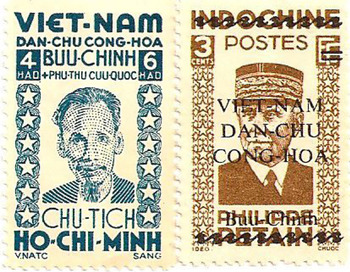
The process of publishing the first national stamps was more awkward. At first, rather than creating fully new stamps, the DRV post office superimposed its own designs, words, and pictures over colonial ones that still bore portraits of Marshall Pétain, Admiral Francis Garnier, and Bishop Pigneau de Béhaine. As Figure 2 shows, national leaders simply printed the words “Democratic Republic of Vietnam” over the old designs. By mid-1946, however, the government had started printing a new series of revolutionary stamps hailing the birth of the DRV. The first ones carried president Ho's portrait. Throughout the rest of the Indochina War, the DRV published its own stamps (and also issued bank notes). Not only did these circulate information, letters, and packages, and generate funds, but the stamps also served as the bureaucratic markers of national sovereignty in what rapidly became a highly contested Vietnam.Footnote 16
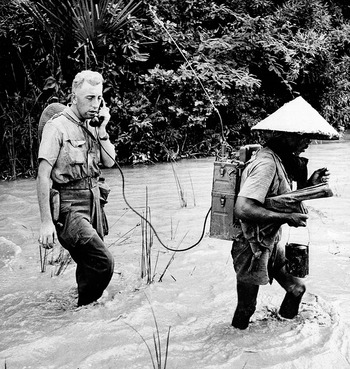
A Vietnamese radioman carries a portable radio set while Sgt.-Major Poncelet signals his position, in Viet Minh-held territory, 12 August 1951 (courtesy Associated Press).

Contesting sovereignties: DRV overlay on a Vichy stamp, and an early DRV stamp.

The French understood perfectly well the dangers of letting the colonized monopolize the communications systems and circulate information along national lines. In early September 1945, a handful of French commandos dressed in British uniforms tried unsuccessfully to retake Saigon's central broadcasting station. The new French government also hustled some of its best code breakers to Indochina in hopes of regaining some of its prewar edge in surveillance and information gathering. They thought this would give them the upper hand in delicate negotiations designed to reestablish colonial control. When colonial administrators were returned to Saigon by force in late September they began to elaborate programs to develop and disseminate propaganda, create cultural and information centers, back newspapers that favored the colonial right to rule, and reinstitute censorship.Footnote 17
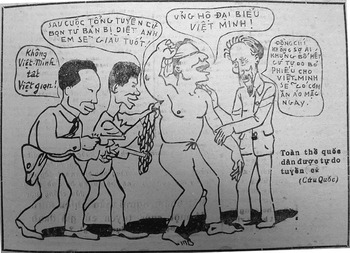
The French were not the only ones to contest the Viet Minh's monopoly over technology and information. Anti-communist and anti-colonial Vietnamese nationalist groups also tried to dislodge the Viet Minh from post offices and colonial broadcast centers and, failing that, to sabotage them.Footnote 18 Thanks to Chinese Republican protection, from September 1945 to mid-1946 opposition groups were able to operate their own independent papers in the battle for Vietnamese hearts and minds. Led by prewar cultural luminaries such as Nhat Linh, the Vietnamese Nationalist Party's paper Viet Nam was particularly active in painting the Viet Minh as a band of ruthless communists bent on selling out the nation to the French. Figure 3 shows a cartoon from that paper's front page depicting Ho Chi Minh “enslaving” the people. When communist leaders in the DRV moved against their non-communist adversaries in mid-1946, one of the first things they did was to shut down their printing presses. For all sides, broadcasting stations, radios, telephones, and papers were vital means of communication in the struggle for power and national legitimacy.
“If you are not Viet Minh, then you must be a Vietnamese Traitor.” Ho Chi Minh sending away a shackled opposition member (Viet Nam, Dec. 1945).

Wiring the Postcolonial State and the Army
Technology was essential to building the state as well as the military force to protect it. On 2 September 1945, the day Ho officially proclaimed the birth of the DRV in Hanoi, Vo Nguyen Giap met with Hoang Dao Thuy about the need to create a national communications service for the budding army. Giap explained that such a network would be of critical importance to the general staff's ability to direct and coordinate military operations if hostilities broke out. And in fact, despite the independence festivities that same day, things did not look good: Chinese troops were preparing to move into northern Indochina and British ones were about to debark below the 16th parallel as stipulated by the Potsdam Accords. Vietnamese competitors were already challenging the Viet Minh's fragile hold on power in the south and would do so above the 16th parallel once the Chinese arrived to back them. All of this was happening as the French positioned themselves to retake their lost colony.
Above all else, DRV military leaders needed up-to-date intelligence on adversary movements, and the technical ability to command troops and militias efficiently from north to south in real time. As Giap told Thuy that afternoon, “While we have many troops, we must rapidly coordinate the different units from Lao Cai (in the north) to Ca Mau (in the south).” He argued that this could only be accomplished with a functional radio and telephone network. The post office had been doing its best to oversee transmissions from within the Ministry of Communications and Public Works, but now the military stepped in. In mid-September, a week before hostilities erupted with the French in Saigon, the Ministry of Defense assumed control of the central post office's wireless radio network in Hanoi and assigned its operation to the Communications and Liaisons Office. This entity, created on 12 September, served as the main clearing-house for circulating orders, information, and intelligence for the Ministry of Defense. It also circulated information and instructions for the government and perhaps, to some extent, the party—there was much overlap in the early years.Footnote 19
In charge of the office was the aforementioned Hoang Dao Thuy, a French-trained radio technician who had become involved in nationalist politics as a journalist during the liberal Popular Front period (1936–1939) in Indochina. He had also been a strident promoter of the Vietnamese romanized national writing script, quoc ngu, and had served as the general commissioner of colonial Vietnam's scouting movement. His politics were such that by the end of the Pacific War he was working clandestinely in the Hanoi area to rally scouts to the Viet Minh. He reported secretly to Truong Chinh, the ICP's interim general secretary. The general staff, impressed by Hoang Dao Thuy's contacts, patriotism, and radio experience and reassured by his work with the ICP, entrusted to him the task of operating the Wireless Radio Service within the Communications and Liaison Office. He also directed the DRV's first ciphering bureau, which was in charge of encrypting and decrypting.Footnote 20
Although Thuy could ground much of his work in the extant infrastructure and recruit from colonial personnel who had become nationalists (or were just carrying on), the general staff's radio transmissions were nevertheless in an embryonic state. Fortunately for them, the Chinese decision not to overthrow the DRV allowed northern and central Vietnamese technicians to develop their operations largely free from enemy interference for well over a year. During this period Thuy recruited a handful of reliable radio specialists and scouts—most possessing good math skills and the basics of Morse code—to help him build an operational radio and telephone transmissions network. The ICP transferred to him two Allied-trained radio operators and donated a 20-watt wireless radio transmitter and an MK2 transceiver, powerful enough to communicate with sets across upper Vietnam. Thuy literally could have the ear of the leadership at almost any time during the Indochina war.
Colonial connections continued to guide early nationalist communications. Until the outbreak of full-scale war in late 1946, the Hanoi central post office's phone network provided Thuy with the fastest and safest mode of communication from the Sino-Vietnamese border at Cao Bang to the 16th parallel. By late 1945, Thuy's team had established a special telephone line, wired through the post office's main switchboard, to communicate with military leaders in most of the central and northern provinces. Of equal importance was the operation of a “wireless radio liaison network” based on its main MK2 transmitter. Located in central Vietnam, this VTG (“Vietnamese intermediary”) transmitter bridged radio communications between the north and the south until at least 1950.Footnote 21
Things were always much more difficult in the south due to the early French return, the weakness of the ICP/DRV, and civil war. On 23 September, as the French ousted the Viet Minh from Saigon, with a British go-ahead, and took over provincial towns and roads, southern Vietnamese relinquished control over urban-based communications. The rapid French return left the southern Viet Minh no time to evacuate equipment. The most they could do before leaving was to transform as many radios and telephones as possible into portable ones and move their main transmitter to a secret location in My Tho province. At 4:00 a.m. on 23 September 1945, the ICP's southern leadership reopened the channel to Hanoi to report that the French were attacking and to request immediate instructions. A few hours later, as colonial troops fanned out across the city, southerners cabled again to indicate that they had no choice but to take up arms. Fifteen minutes later, the leaders of the general staff, government, and the ICP standing committee had all received the message and in less than an hour the party approved the decision to adopt an armed line below the 16th parallel. They insisted that the radio channel remain open.Footnote 22
The importance of real-time radio communications must have been clear to those reading the copy that Thuy's team was feeding to them. The lack of communications that had separated northern and southern communists during World War II could not be allowed to recur in a time of violent decolonization—the stakes were too high. The ICP immediately ordered more wireless sets and field telephones dispatched to the south. Radio contact alone would not turn the tide against the French military onslaught; northerners could do little more than approve southern actions. However, although these sets were rudimentary, the My Tho transmitter and a dozen others operating in the south by late 1945 provided southerners with links to the party and government leadership, and to the general staff in Hanoi and a key source of information. By year's end southerners had received two more transmitters. When Nguyen Binh arrived to take command of southern forces in November, he opened a channel to the general staff and commanders in neighboring zones.
Southerners never had time to evacuate Radio Saigon to safety in the countryside, and this denied them an important means of combating the French on the airwaves and reaching a wider Vietnamese audience. Northerners learned from this example and made a point of not leaving the Voice of Vietnam behind in Hanoi. As war appeared increasingly likely in late 1946, the northerners carefully evacuated the most valuable equipment and technicians from upper Vietnamese cities. What was left of the colonial broadcasting station they wired with explosives.Footnote 23
Given its importance, quickly training a new generation of communications specialists became and would remain a priority. Technicians were desperately needed to man the radios, telephones, and equipment as well as to cipher and decipher codes. At its start, the Communications and Liaisons Office relied on a core group of about a dozen people to dispense crash courses in radio transmissions and ciphering when they were not manning their own posts. In November 1945, Hoang Dao Thuy's team organized the DRV's first formal training class, for twenty-three new recruits. After four months of intensive training, these students left the capital to operate radio sets in provinces, war zones, and combat units located mainly above the 16th parallel. Southerners were left largely to their own devices. Throughout the conflict Thuy's office trained the hundreds of specialists essential to ensuring military and bureaucratic communications among DRV's combat units and the territories under its control.Footnote 24
Most communications personnel were fluent in Vietnamese and in using the romanized national alphabet, quoc ngu. There was never a need to “Vietnamize” the communications service since that had to a large extent already been achieved during the colonial period. The overwhelming majority of Vietnamese civil servants had long used quoc ngu in transmitting telegrams and sending copy via the colonial grid. By the time the Japanese overthrew the French, most radio and telegraph operators had already switched over to Vietnamese in their cables and messages, which they continued to send as if nothing had changed. The necessities of war and wartime state-building only reinforced this linguistic turn, especially since few Vietnamese living outside the colonial cities had ever been fully at ease speaking French, much less writing in it. Furthermore, the DRV was recruiting more and more of its new communications cadets from the countryside and found it easier to train them in Vietnamese.Footnote 25
By taking over the Bach Mai broadcasting station in mid-1945, the DRV acquired an unprecedented technical means for reaching the Vietnamese people in Vietnamese. In a series of decrees issued in late 1945, the government transformed the colonial Radio Hanoi service into the Voice of Vietnam. On 7 September, at 1:30 p.m., Mme Duong Thi Ngan announced via the airways the transition from one sovereignty to another: “This is the Voice of Vietnam, broadcasting from Hanoi, the capital of the Democratic Republic of Vietnam.” Hoang Dao Thuy's Communications and Liaisons Office oversaw the station and brought Nguyen Van Tinh up from the south to run it. Until December 1946, the Voice of Vietnam broadcasted across the country in Vietnamese, communicating government news, opinions, and instructions to its listeners.
The station also broadcast in French and English in order to counter colonial propaganda; it put the DRV's point of view to the international community in English, the leading international language after World War II. In addition, the Vietnam News Agency (VNA) transmitted in English, French, and Vietnamese Morse. A transmitter beamed press material on local, regional, and world affairs to designated recipients. In 1950, the CIA reported that the quality of filed copy coming out of the VNA had “improved so greatly in journalistic aspects as to overtake and perhaps surpass that of the AFP (Agence France-Presse) file out of Saigon.”Footnote 26 While this was an exaggeration, the Voice of Vietnam did ensure that—unlike the nineteenth-century colonial conquest of Vietnam, when no radios or broadcasting centers existed to disseminate the Vietnamese case—this second conquest would be covered and challenged on the airwaves, in the print media, and in world opinion (itself a product of global wiring). The VNA opened a branch in Bangkok in late 1945 to communicate to the world and especially to its newly decolonizing parts. It distributed pamphlets, documents, and dossiers about the DRV, its achievements, and its indictments of French colonialism. Many of the key interviews that foreign correspondents secured with Ho were arranged via Bangkok (including the famous Expressen interview in late 1953).
The government used voice broadcasting to exhort the population to support the independence cause and oppose efforts to restore French rule. But we must ask how many Vietnamese actually had radios during the Indochina War. Although we know that the majority had none, we lack hard data. Based on circumstantial evidence, David Marr estimates there were two to three thousand receivers in Vietnam in September 1945.Footnote 27 An early-1951 CIA study of the question concluded, “Most of the Vietnamese in the French controlled cities have radios, but there are very few among the people in the countryside.” This was likely true, since radios were relatively expensive and the French tightly controlled their sale. The DRV probably enjoyed the largest Vietnamese audience between September 1945 and December 1946, when it operated independently from the cities above the 16th parallel. Following the outbreak of full-scale war and the transfer of the central government to the countryside, the Voice of Vietnam concentrated less on mobilizing a national audience and more on communicating non-secret but still essential information to radio-equipped bureaucrats scattered across the country. The DRV also focused its voice broadcasts on propaganda drives against the French and their Vietnamese allies. Sino-Soviet material and training assistance led to improvements in broadcasting in 1950.
The French badly wanted to terminate this technological challenge. They tried to locate source points through triangulation, and asked the United States for the latest scientific tools to jam the broadcasts. It is unclear whether the Americans obliged, and in any case the French ultimately failed to knock out the DRV's voice broadcasting centers.Footnote 28
Wiring Diplomacy and Information Gathering
The French also failed to prevent the DRV from harnessing the radio waves to its diplomatic agenda. However primitive their communications most certainly were, they allowed the DRV leadership to stay abreast of changes taking place at the national, regional, and international levels, and their ability to collect and transmit information was important for formulating diplomacy. From 1945–1947, in particular, the Vietnamese leadership required daily updates of any decisions or concessions made by its diplomats who were negotiating with the French, Chinese, British, Soviets, or Americans, all of which could directly affect the young state's national interests. Diplomats stationed in Bangkok from 1946 onward were ordered to provide the leadership with information and analysis of changes occurring in Thailand, Southeast Asia, and the world. Diplomatic delegations in Bangkok and Rangoon reported on their meetings with Western and Asian officials. Diplomats also helped to organize the government's participation in the 1947 Asian Relations Conference in New Delhi, and visits by Ho's representatives to capitals across the region.Footnote 29
The way in which communications were mobilized for diplomatic ends in 1946 is particularly revealing. During negotiations with the French at Dalat in April, for example, the Vietnamese government directed the communications office to provide the DRV's diplomatic team with a wireless radio set so they could keep the leadership in Hanoi abreast of discussions in real time. (The French controlled Dalat's phone system.) Nguyen Van Tinh took on this important task. When he joined the delegation he brought along the MK2 transmitter and a team of signal and cipher specialists, most of them colonially trained. Thanks to this transmitter, the delegation was able to both provide daily reports to Hanoi and receive instructions from there as to how best to proceed in the tense talks. The DRV also attached a special communications team to its delegation at the Fontainebleau conference in France a few months later. With the help of the French Communist Party and sympathetic overseas Vietnamese, the team apparently opened radio contact with Hanoi from a secret location outside of Paris. (Two decades later they would do the same thing during negotiations with the Americans.)Footnote 30
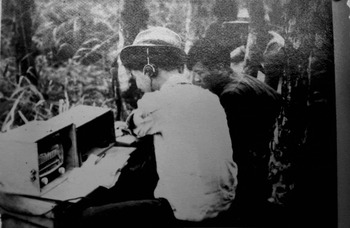
Assuring real-time diplomatic communications via wireless radios was important. In April, the central government was able to dispatch a cable to the commander in chief of the south, Nguyen Binh, ordering him to cease immediately his urban war in Saigon in light of the signing of the 6 March Accords between the French and the Vietnamese. A few months later, Nguyen Binh followed orders he received by radio for his southern forces to implement the ceasefire Ho had just brokered in the modus vivendi in France. To the consternation of French authorities, it was clear that the central government was successfully commanding its troops in the south, and implicitly affirming its national sovereignty, thanks in no small part to a primitive but effective transmissions network (see figure 4).Footnote 31
Viet Minh radio operator (courtesy Service historique de la Défense).

Reliance on radio communications also carried serious risks. The French had already sent some of their best code breakers to Indochina so they could inform local and metropolitan French leaders what the other side was saying behind closed doors. Vietnamese efforts at modern diplomacy were hampered on the technological front by their lack of sufficient encryption techniques, equipment, or training. This was particularly true at the beginning of the war, when Vietnamese encryption methods and tables were crude, and inexperienced radio operators too often grew frustrated and simply sent their messages un-coded. As a result, the French were able to read much of the DRV's cable traffic during the Dalat conference and also, it seems, during the one at Fontainebleau. The Vietnamese knew something was wrong at Dalat and Vo Nguyen Giap personally ordered the MK2's dispatches terminated.Footnote 32
In the crucial early days of its consolidation, the DRV's monopoly over radio and telephone networks above the 16th parallel helped its communist core to monitor and sideline its anti-communist detractors—the Vietnamese Nationalist Party and the Greater Vietnam (or Dai Viet) Party. Viet Minh moles working in Hanoi's central post office, such as Nguyen Thi Bich Thuan, maintained a watchful eye for enemy saboteurs. She and a select group of trusted employees who manned the main telephone switchboard discreetly monitored conversations between the two political parties in both the cities and countryside and conveyed any troublesome details to their superiors. Others secretly read mail and reported anything suspicious.Footnote 33 Like the colonial state before it, the revolutionary one reserved the right to intercept letters in order to identify those who could threaten the powers that be.
Most important to the Viet Minh was to blind its Vietnamese adversaries by denying them the technical means to coordinate their own attempts to gather information, communicate, and subvert, especially in a few northern provinces where the Chinese occupation had allowed the Vietnamese Nationalist Party to administer power locally. The failure of the non-communist parties to confiscate the colonial communication systems placed them at a considerable disadvantage, since the Viet Minh could follow, report, and react quickly to their moves. The DRV received a steady flow of information on their movements and intentions in Hanoi and the northern provinces. When the Chinese withdrew most of their troops in mid-1946, the DRV attacked its rivals and thereby consolidated its grip on communications above the 16th parallel. In sum, collecting information on internal enemies was vital to the DRV's ability to secure power in what was both a colonial and civil war.Footnote 34
Wiring the Urban Battlefield for War
Having helped to eliminate the opposition parties, Hoang Dao Thuy's communications office turned its full attention to the French as the two sides slid toward full-scale war in the last months of 1946. The Communications and Liaisons Office provided the latest information on French military movements in such hot spots as Haiphong, Langson, and Hanoi; the 6 March Accords had allowed the French to post fifteen thousand troops above the 16th parallel. With the withdrawal of the last Chinese soldiers in September tensions quickly mounted as local French authorities began to challenge Vietnamese sovereignty. In October, the communications office organized a meeting of its delegates from most of Vietnam above the 16th parallel, and all agreed that it was imperative to consolidate and increase the effectiveness of radio and telephone transmissions. The Ministry of Defense directly assumed control of the phone system for all of upper Vietnam, which was considered to be the fastest and most reliable means of communication. Evacuation of valuable electronic and radiophonic equipment from the cities began in earnest. By early December the Viet Minh had emptied Bach Mai of its transmitters, spare parts, and telephone lines and transferred them to safe places outside of town. Elsewhere they stripped colonial offices and businesses of transmitters, wireless radios, and phones, while technicians set themselves to making mobile radios that could operate from the jungles. The southern experience had shown that if there were a full-scale war then radio liaisons would have to be maintained at all costs.Footnote 35
In December 1946 the Vietnamese, unlike in Saigon in September 1945, decided to take a stand in Hanoi. In order to direct what promised to be the first major urban battle of the Indochina War, the general staff instructed the communications bureau to use radios so that the leadership could command what turned out to be a two-month bloody street battle. Thuy's team created a special Communications Service for the Hanoi Battlefront, which allowed Giap and his staff to communicate with militia and troop leaders via radio and telephone. The general staff maintained radio contact with Vuong Thua Vu, who commanded the Capital Regiment charged with making the French pay dearly for Hanoi as the government headed for the hills. We know about Vietnamese communications during the battle because French military intelligence intercepted many of their wireless radio transmissions, copies of which are held in French military and colonial archives.
On 17 December, two days before the war started, the Ministry of Defense created the Special Communications Committee under Giap's supervision. It was charged with transmitting critical information on the enemy's movements via telephone, radio, and telegraph directly to the general staff as well as to the central government, the party, war zones, and provinces. This committee transmitted the “ultra urgent” cable ordering troops in Hanoi to attack the French at 8:01 p.m. on 19 December. Significantly, Giap not only instructed his men to attack the French in Hanoi, but also ordered his commanders across the country to launch simultaneous attacks so as to prevent the French from concentrating their strength on Hanoi. Nguyen Binh, commanding the southern forces located in the faraway Mekong Delta, received a cable telling him to go on the offensive. At this time also the central post office fired off telegrams to provincial ones located above the 16th parallel informing their staffs that the order had been given to fight and that they should be prepared to attack or be attacked.Footnote 36
The use of technology against France never worked as smoothly as official accounts would have us believe. For example, the military leadership was badly informed of events in Haiphong during the French reoccupation in November 1946 because they had no telephone connections.Footnote 37 Similar communication breakdowns occurred in the hours following the eruption of hostilities in Hanoi. Nevertheless, that the Vietnamese went to such lengths to use radios during the battle of Hanoi made clear that they had every intention of deploying technology as a fundamental part of their armed struggle. The battle of the airwaves was now underway and would continue throughout the conflict.
Wiring a War State (1947–1950)
Communications played an important role in helping the embattled Vietnamese state to survive the French onslaught, hold itself together, and consolidate itself in the countryside. Forced out of the cities and under constant attack by land, air, and sea, the DRV was now operating in a profoundly rural and often inhospitable milieu. Leaving the cities meant giving up easy access to modern transport and communications systems, and leaders now traveled by foot or by horse instead of cars or trams. Boats were essential to movement in the Mekong Delta. Nationalist leaders no longer controlled the colonial post office's fleet of autos and boxcars, or its mail carriers, and now had to build a new system largely from scratch. Moreover, many highly trained postal and communications civil servants chose to stay in the city rather than undertake a life of immense hardship in the maquis. And of course the French were doing everything in their power to dislocate, divide, and sever the DRV's “head” from its regional parts and its access to the cities and the world outside.
Indeed, for all of 1947, if not 1948 as well, the French army had the DRV's general staff, central government, and communist party on the run. While the famous French paratrooper raid on Bac Kan in October 1947 failed to capture the leadership, it and others like it that year caused the DRV enormous hardships, forcing its authorities to go into hiding for extended periods and dispersing its people across swaths of difficult territory where they suffered materially, physically, and no doubt emotionally. The situation was no better in southern Vietnam, where the French continued to force people to operate from some of the harshest and least accessible parts of the Mekong Delta. Only one wide stretch of rural central Vietnam—zones IV and V—remained largely free of French occupation, which allowed authorities there to consolidate their military and state-building activities. The DRV bureaucracy operated more like an archipelago state than any sort of unified or coherent peacetime national body.Footnote 38 Consisting as it did of scattered pockets or streams of sovereignty, it is little wonder that the radio played such an important role in holding the DRV together.
French intelligence services knew what was going on; thanks to their impressive decryption system, they monitored their adversary's efforts to import essential equipment and parts from abroad. The Sûreté also sectored off the major cities and established careful lists of radio stores and technicians. Despite these efforts, the colonial city and the region remained linked. Professor Le Van Huan, who had stayed behind in Saigon in 1945, helped to export critical electronics equipment to the DRV and even trained resistance technicians secretly in the city before sending them to the delta. In fact, Huan knew and had trained the core leaders of the southern communications office. Thanks to these personal ties, on 1 December 1947 The Voice of the Southern Resistance began broadcasting from the jungle.Footnote 39
At war, the DRV leadership needed to be apprised of enemy movements and the status of its own operations across all of Vietnam. The communications office and the Special Communications Committee remained in charge of running the general staff's network. The MK2 transceiver continued to handle communications with central and southern Vietnam.Footnote 40 In March 1947 the Ministry of Defense, on the run, instructed the commanders of every zone to maintain wireless radio communications at all costs—each had to have at least one radio at his disposal. Copy was to remain short and to the point. As Giap explained it a few weeks later, effective military leadership depended largely on keeping radio communications operational: “Radio communications are always important and serve as the arteries of our military system. If transmissions shut down or are delayed, the entire system can stagnate, causing us to lose favorable opportunities or even turning them into defeats. At a time when the situation is changing and the enemy is attacking violently, the need for communications is urgent.”Footnote 41
With this in mind, in May 1947 the general staff created the special Wireless Radio Communications Unit 59 to ensure the security of military communications from “interzone IV” northward. This unit's main purpose was to alert the general staff and commanders across upper Vietnam of French military operations and imminent attacks. While it is hard to know just how important such communications were, we do know that between the first of the year and September 1947, when the central government was fighting for its life, the DRV's cryptographic bureau registered twenty-seven hundred incoming and outgoing official messages, including “regular” exchanges with the south.Footnote 42 Wireless radio transmissions clearly helped the embattled state to keep its head and remain in touch with its widely dispersed parts. A French intelligence officer described the system's importance in September 1947: “In the current circumstances, wireless radio constitutes the surest and most rapid method of command. It seems obvious that without it the Viet Minh government and command would rapidly lose all authority, all prestige, and all its coordinating powers. Overland and maritime liaisons are slow and hardly safe…. Wireless transmissions remain the most efficient and rapid [method of communications], and this explains the considerable effort the [DRV] authorities exert to conceive and operate this important organization.”Footnote 43
Recent Vietnamese publications have detailed the extraordinary lengths to which the DRV went to open and maintain communications channels between the central government ministries located in the northern hills and the thousands of subalterns working in the various district, provincial, and regional offices. In 1948 the DRV divided its territory into interzones, and from that time onward each interzone administrative committee operated a radio to communicate with the central government, with representatives in Thailand, Laos, and Cambodia, and above all with neighboring zones and lower levels of the administration that also had radios. While the wireless copy rarely exceeded a few short paragraphs and never transmitted lengthy reports, it did contribute to the running of the state, party, and army. Besides dealing with crisis situations, radios allowed DRV administrators to tend to mundane but necessary activities such as ordering medicines, electrical equipment, batteries, books, and manuals from the Bangkok delegation. They made it possible for each zone to circulate orders and instructions vertically to subalterns and horizontally to contiguous administrative offices. The DRV radioed orders to transfer civil servants and agents within the zonal administration or on to neighboring ones, and to organize the scores of meetings essential to the everyday functioning of the state, the party, and the army. Financial and agricultural officials used radios to order and transfer foodstuffs from one zone to another. This was especially important when French blockades led to famine in parts of southern Vietnam in the late 1940s and threatened to do so in the north in the early 1950s. In short, radio communications allowed the leadership to maintain a degree of local coherence and administrative functionality, and a virtual national unity that would otherwise have been impossible. The French were, of course, eavesdropping on many of the lower-level exchanges, but most of the time it did not matter.Footnote 44
While details of the communist party's wireless transmissions are unobtainable, we know that the ICP operated its own communications channel with cadres located across the entire country, including in the south, and in Thailand and Burma. The party periodically ran a clandestine radio in “occupied” Saigon. The ICP confined its radio communications to the Secure Zone Committee of Communications located in Thai Nguyen province where the party, government, and general staff were based. The secure zone wireless transmitted party and government communications with the interzones, and apparently handled transmissions for the Ministry of Interior, the Ministry of Economics, the police, and the Prime Minister's Office. We have seen that radios also kept the north in touch with the faraway south. For example, the party's powerful Central Committee Bureau for the South (known to the Americans during the Vietnam War as COSVN) operated two MK2 transmitters from its creation in 1951 until the end of the Indochina War. In all of these ways and more, then, the party, state, and army relied heavily on wireless radio communications to remain interconnected.Footnote 45
Once full-scale war started, the communications bureau took on the important task of keeping the Voice of Vietnam and the Voice of Southern Vietnam on the air. Both disseminated non-sensitive yet important information concerning the everyday functioning of the state. Via such broadcasts the DRV transmitted in real time and across great distances instructions, decrees, and announcements that were essential to the state's continuing operation and survival. Administrators across the country tuned in to its daily broadcasts for guidance. Again, the French were never able to block this flow of information; the most they could do was carefully monitor the daily broadcasts, which they published internally as Le bulletin des écoutes Viet Minh.Footnote 46
Significantly, Vietnamese communists wanted not only to wire Vietnam, but also to extend their transmissions throughout Indochina. From 1948, as Vietnamese communists redoubled their efforts to expand the revolution to all of the former French colonial state, the DRV dispatched agents to Laos and Cambodia to install wireless radio sets and cryptographic sections there. This was partly a matter of security and military strategy; Vietnam was vulnerable to French attack from the west and any Vietnamese military operations into either country, especially Laos, had to be coordinated using the general staff's communications network. This was certainly the case during the spectacular invasions of Laos in 1953 and 1954.
The Vietnamese also installed secret radios in Laos and Cambodia to help their western Indochinese allies to build political, economic, and communist organizations. The Office of External Affairs in southern Vietnam, for example, was closely involved in creating, leading, and coordinating the development of communist and administrative groups in Cambodia. Led by veteran ICP member Nguyen Thanh Son, this office was in direct wireless radio communication with the different zones into which the ICP divided Cambodia, most of which were equipped with a radio and Vietnamese operators. From central and northern Vietnam radios were dispatched to the Lao zones, as were technicians to install them and run transmissions. All communicated directly with their “mother” radios located in corresponding interzones in western Vietnam. In 1950, the Vietnamese cryptographic section created “Group 100” to help the Pathet Lao organize its nascent communication system. They were routed through the DRV's Indochinese “grid,” whose working language was not Lao, Khmer, or even French, but Vietnamese.Footnote 47 Far from breaking with the French colonial model of Indochina, the Vietnamese made it their own, and wireless communications contributed to their ability to operate concretely and think spatially in distinctly Indochinese ways.
Ban Giao Thong
As I have said, there were many more difficulties than official Vietnamese accounts acknowledge. As impressive as the DRV's radio communications were in collecting information, transmitting instructions, and connecting the army and the state, they could not transmit lengthy documents from the north to the south. Moreover, the Vietnamese were perfectly aware that the French could decrypt many of their communications. They therefore had to find other ways to transmit both voluminous and top-secret information, and the party, the state, and the army all turned to trusted couriers to circulate sensitive information and instructions, lengthy internal reports, vital statistics, financial reports, and a burgeoning flow of administrative papers. Couriers also carried newspapers, journals, books, propaganda, and photographs, and escorted personnel. The two main institutions the DRV relied upon to deliver materials were the post office and the Ministry of Communications and Public Works. The main offices of both were evacuated to Bac Kan when the war began. Once the DRV lost control of the colonial postal service based in Hanoi and, by extension, access to most of its infrastructure, its post office and communications ministry remained inactive well into 1948. Only in central, French-free zones did local authorities continue to use the former colonial system to deliver letters, documents, and papers.Footnote 48
During wartime, the DRV state could no longer construct itself by simply grafting onto the extant colonial infrastructure. To serve as a new mail distribution center and to dispatch of important correspondence, the ICP created a special unit known as the Ban giao thong khang chien trung uong quan ly, or the Central Administrative Section for Resistance Communications, Ban giao thong, for short. Some seventy cadres worked away diligently in this party-controlled unit located in the northern hills. They prepared mailbags and pouches containing secret instructions, orders, telegrams, documents, papers, journals, propaganda, and photos, and assigned them to vetted couriers. The Ban giao thong also organized and administered the mail routes used to move information from zone to zone, with its operations monitored by the ICP's wireless radio system.Footnote 49
To circulate the mail, the Ban giao thong recruited a new type of Vietnamese mail carrier quite different from their colonial predecessors or peacetime avatars. The wartime leadership turned to men and women who were young and reliable. Most were or soon became communist party members. One concern in their selection was of course the sensitive nature of the correspondence they would carry. On a more abstract level, the nature of this war of decolonization to form a new nation-state meant that these young couriers would serve as symbolic manifestations of the DRV's claim to sovereignty. They had to be willing to undertake dangerous travel between political territories that were being violently contested. The French Sûreté, Deuxième Bureau, and the Associated State of Vietnam (ASV) did their best to intercept them to prevent their penetrating colonial territory or, from 1949, that of the ASV, and more generally to weaken the national coherence they provided the DRV. In this battle of sovereignties, DRV authorities likewise tried to stop enemy couriers (see figure 1).Footnote 50
To persevere, the DRV needed to recruit healthy young people who could endure the rugged mail routes. On average, each carried around fifteen to twenty-five kilograms of mail daily over distances of from 20 to 30 kilometers by foot, or 100 to 160 kilometers by bike. Distances varied depending on whether the route traversed the flat ground of the delta or the rougher, steeper terrain of the highlands, but most resistance mail carriers moved in difficult territory because that is where the war state operated. A carrier's route ran between two way stations (tram) normally located within an interzone. Upon arrival at their destination, someone from the Ban giao thong would take and empty their pouch, verify that everything was there, and then turn it over to another courier who would move it further down the line.
In addition to the physically demanding nature of this work couriers had to contend with enemy surveillance along their routes, which could be nerve-wracking. They had to be able to conceal both their parcels and, when going through enemy checkpoints, their true identities. This was sometimes difficult because the French and their Vietnamese allies had used surveillance and informers to build an impressive intelligence archive. When there was trouble, DRV agents had to be able to escape into the bush and mail carriers had to know by heart the topography of their regions. A final set of dangers in the rugged zones, especially the highlands, was sickness and disease—malaria, cholera, and typhoid—and carriers often fell victim to them. In fact, diseases probably incapacitated more Ban giao thong personnel than did the French army or their secret services.Footnote 51
In 1948, the DRV resurrected the postal service by combining it with the Ban giao thong to form the Vietnamese Postal Service (Nha Buu Dien Viet Nam). This decision was clearly linked to the administrative division of the DRV into interzones, each of which held the relevant party, administrative, and army units. Provinces in each interzone administered a postal service that circulated mainly the party's and the state's correspondence.Footnote 52 The resurrection of the postal system was also an expression of the DRV's renewed attempts to reestablish its territorial form after more than a year of chaos. We have no statistics for the period from 1945 through 1949 period, and do not know if the postal service really functioned during those years. We do know that between 1950 and 1953 the postal service in central and northern Vietnam operated forty provincial branches in charge of 370 district-level post offices and 2,657 way stations, which circulated 15,239,000 documents, letters, and telegrams over an area of about 13,500 square kilometers. The service exploited 7,654 kilometers of telegraph and telephone lines and operated twenty-one wireless radios. Each year liaison agents covered some 6,000 kilometers in the delta and 5,000 in the highlands.Footnote 53
Postal liaisons with and within southern Vietnam were “extremely difficult” to operate during the nine years of war, although the Ban giao thong had been working at them since 1947.Footnote 54 In October of that year, for example, as the French attacked above the 16th parallel, the army and the party dispatched a high-level party delegation to the south with instructions to deliver secret documents to officials along the way and to discuss ways of improving north-south communications. The delegation was also told to begin selecting trustworthy personnel and opening way stations and safe houses in order to build a secret north-south overland link for transmitting sensitive information, papers, and things that could not be sent over the heavily monitored airwaves. On this matter the delegation received support from the party's two most important officials stationed in central and southern Vietnam to administer regional affairs: Pham Van Dong, the foreign minister during the Geneva conference, and Le Duan, the future head of the party.
By year's end the Vietnamese were operating a perilous north-south overland route that carried mail and personnel to the south. In September 1948, high-ranking leaders Le Duc Tho and Pham Ngoc Thach led a party delegation to the south that carried top-secret instructions and documentation regarding changes occurring within the party. It took them three months to reach the Mekong Delta.Footnote 55 When it came to important, sensitive governmental, military, or party matters southerners often had no idea what was happening in the north, and vice versa—such information rarely moved in real time. The archipelagic nature of the DRV imposed real limits on its communicative modernity, and on the state's ability to hold itself together.
TECHNOLOGY AND THE Shift to CONVENTIONAL WARFARE (1950–1954)
The shift to modern warfare in 1950 changed everything in the upper half of the DRV. Emboldened by the Chinese communist victory in 1949, the ICP's decision to take the battle to the French meant that the army, especially, had to be rewired. The change from low-intensity hit-and-run guerilla tactics to intense, sophisticated, conventional warfare made radio communications absolutely essential to gathering information, transmitting it vertically and horizontally, and coordinating complex military operations in real time across great distances. The decision in 1950 to adopt a strategy of modern warfare launched an unprecedented drive for technological modernization, sophistication, and consolidation.
The party had anticipated this shift; a year before Chinese advisors and assistance reached the northern border, technicians received instructions to professionalize the army's wireless communications. In June 1949, the government once again chose Hoang Dao Thuy to lead the improved Communications and Liaisons Office. It operated a transmission network for the general staff, a special central liaison committee, an internal communications section for the minister of defense, and an internal telephone service, and also continued to operate the Vietnamese wireless radio office.Footnote 56 This office also stepped up the training of military liaison specialists in radio and telephone transmissions for areas running northward from central Vietnam. These specialists would be needed to run radio and telephone transmissions at the different levels of the army as it professionalized and grew, and transformed itself into platoons, battalions, regiments and, eventually, seven divisions. Without competent operators and staff the army would be unable to master the complicated battle operations they were now planning.
Beginning in July 1949, Thuy and other communications veterans organized intensive courses to train hundreds or possibly even thousands of recruits in battle transmission and communication. To facilitate the learning process, Hoang Dao Thuy authored a ten-chapter textbook on the basics of modern military radio transmissions, entitled Theory and Fundamentals of Military Communications and Liaisons. The Communications and Liaisons Office translated relevant Russian, French, and Chinese texts into Vietnamese. The cryptographic branch organized similar courses in encryption and decryption techniques, since the shift to modern war would require more sophisticated technical methods and encryption tables in order to avoid French detection. The former colonial scoutmaster was now deeply involved in building the postcolonial state's first operational military transmissions network and cryptographic service for making modern war.Footnote 57
Hoang Dao Thuy's team began by wiring the DRV's first division, the famous 308th. By mid-1950, radio operators had taken up positions in its platoons, battalions, and regiments. The general staff was soon busy assembling other divisions.Footnote 58 Radio transmissions were indispensable to the high command's ability to operate and coordinate large-scale troop movements, which would have to be coordinated closely with the logistics, supply, medical, and military intelligence branches. The general staff relied on radio, phone, and telegraph communications to provide up-to-the-minute intelligence on the enemy's movements, strength, and intentions. Moreover, the general staff, commander in chief, and the Politburo had to be kept informed in real time of what was occurring during the main battles and in other parts of the conflict. Communications had to be able to keep pace with the increasingly sophisticated and modern warfare the DRV general staff was determined to fight across all of Indochina.
None of these things occurred in southern Vietnam, where no divisions were ever established during the Indochina War. However, southerners replaced the old MK2 transceiver with a more powerful one that allowed for direct liaisons between the north and the south without having to go through the Vietnamese intermediary in central Vietnam. General Vo Nguyen Giap could now use radio to communicate quickly with the far southern front and also with his commanders in western Indochina. From this point on, the entire Indochinese battlefield was effectively connected via the airwaves.Footnote 59
Cao Bang and the Coordination of Modern Battle
The battle of Cao Bang was the first test for Hoang Dao Thuy's team. Giap and the Politburo counted on them to wire the battlefield for this initial attempt at conventional warfare. The stakes were enormous. The Vietnamese badly needed to liberate the border area so that internationalist aid could flow freely into DRV territories. In mid-September 1950, Thuy and his team of some fifty technicians arrived in safe areas in Cao Bang province. Thanks to Chinese aid and their own stockpiles, the Vietnamese mobilized their best equipment for this battle, including nine mobile telephone sets of French, Japanese, and German makes, one French six-line switchboard, two old-style radio sets, and one radio transceiver. These would allow Thuy's “nerve center”—known as the “Third Section” (Ban Ban 3), or transmissions section—to communicate by phone and radio with the general staff, the Politburo, and the Central Committee, and with the central supply directorate, the interzones, the Voice of Vietnam, and even Hanoi's underground police. With help from the Cao Bang post office, Thuy's team brought in some forty kilometers of telephone lines to wire the Third Section and connect it by phone to the commander in chief's entourage. The Third Section worked closely with the first and second sections, in charge of battle tactics and military intelligence, respectively; all three were essential to supplying and relaying information and analysis to the leadership during the battle.Footnote 60
Thuy's team was also attentive to the radio chatter among increasingly nervous French commanders located in the provincial capitals of Cao Bang and Lang Son. In the weeks leading up to the battle, the Third Section zeroed in on radio messages sent in the clear by French officers discussing how and when to evacuate Cao Bang along Route 4 and where they would link up. On 26 September, Thuy's team of listeners picked up French commanders talking about the need to organize a secret withdrawal from the border so as to avoid drawing a Vietnamese attack. On 1 October, the Third Section reported that recent intercepts indicated that such a withdrawal was imminent, and Thuy personally telephoned Giap to tell him. Based in part on this intelligence, Giap, backed by the Chinese, gave the go-ahead to wipe out the French contingent as it retreated.Footnote 61
While the DRV's transmission service was only one factor in the Vietnamese victory, the Third Section had proved itself as the battle's nerve center, coordinating DRV communications and monitoring enemy ones, and transmitting information. Chinese assistance and training was invaluable, but the Vietnamese ran the technical show on the ground and in the “air.” This owed much to the colonial connection, but also important was that the DRV had been able to train technicians in complex scientific concepts and deploy this knowledge and specialists in rational, organized, and effective ways. On 15 October 1950, Vietnamese radio specialists intercepted a radio message from the head of the French army for the Far East that read as follows: “We are now confronted with an enemy whose army is much larger, firepower is stronger and which possesses a radio transmissions and wireless radio system that operates in a coordinated, secret, and effective manner.”Footnote 62 A ranking French intelligence officer warned his colleagues: “For some time now the [French] high command has taken notice of the importance of the intelligence the enemy acquires by listening in to our radio networks.”Footnote 63 Thanks to the DRV's increasing mastery and mobilization of technology, the Indochina conflict was no longer so asymmetrical as many had expected it would be.
Turning Technology against the Colonizer: Dien Bien Phu
Technology was fundamental to the DRV's ability to take the battle to and defeat the French at Dien Bien Phu in 1954. At the head of the Communications and Liaisons Office for this historic encounter was Hoang Dao Thuy. The DRV placed him in charge of all the communications operations for this audacious and sophisticated battle, once again in command of the Third Section. Thanks to aid from the communist bloc and equipment captured from the French in 1950, the DRV fielded sufficient radios, telephones, and telephone lines to wire this battle like none before it. The Third Section laid down kilometers of telephone lines to connect the general staff to its major fighting units. General Giap maintained direct phone and wireless contact with his artillery and antiaircraft units. Radio communications from faraway central Vietnam kept Giap abreast of Henri Navarre's launch of operation Atlante against the coast there. Giap also relied upon Thuy's team to follow and direct complex Vietnamese military operations in Laos, northeast Cambodia, and the central highlands, all of which were part of the Vietnamese strategy of drawing as many French troops as possible away from Dien Bien Phu before attacking the entrenched camp there.Footnote 64
Communications helped the general staff avoid disaster when Giap decided to postpone the first attack on Dien Bien Phu, initially planned for 25 January 1954. In the days leading up to that day, Thuy was still receiving radio reports from the 351st division indicating that artillery had not yet arrived in place—the head of the Third Section provided Giap numerous updates regarding the difficulties that logistics crews were encountering in delivering the guns in time for the attack. Meanwhile, military intelligence reported that the French had further strengthened their presence on the valley floor. Ho Chi Minh and the Politburo telegrammed their approval of Giap's decision to cancel the attack at 3:45 p.m., a mere fifteen minutes before it was scheduled to begin, and he ordered his commanders by telephone to stand down.Footnote 65
Giap used his radio transmissions service to operate troops across almost all of Indochina as part of the strategy of drawing away French troops. Thanks to Thuy's team, Giap received a steady stream of reports on troop movements deep into Laos, northeastern Cambodia, and the highlands to engage Navarre's troops in operation Atlante. On 12 March, just as Giap had hoped, his commander in central Vietnam sent him a wireless report informing him, “Navarre had begun to land his army by sea at Qui Nhon.” General Giap exclaimed: “This is very good news; we are now certain to win.”Footnote 66 Having received this news in real time, Giap could now concentrate his troops on wiping out Dien Bien Phu with the knowledge that he would tie Navarre down in faraway central Vietnam.
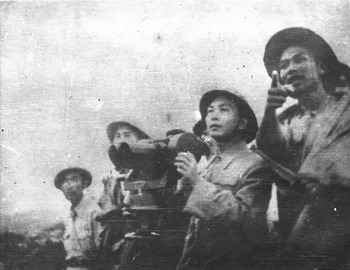
The next day, at 1:00 p.m., General Giap picked up his phone and ordered his officers to begin shelling Him La (Béatrice) and the Muong Thanh airbase. One of the historic battles of the twentieth century was now underway. Thanks to the 1,500 kilometers of telephone line, Giap was in direct telephone contact with the commanders of the attacking divisions and their corresponding battalions. Like his adversary at Dien Bien Phu, General Christian de Castries, Giap spent this battle holding a phone and binoculars rather than a gun. Moreover, Thuy's team had equipped the battlefield with wireless radios that were activated once the fighting began; they would still be there if ever the Third Section's telephone lines went dead (see figure 5).
General Giap observes Dien Bien Phu through powerful field binoculars (courtesy Revolutionary Museum of Viet Nam).

Throughout the two-month battle the Third Section kept the general staff and the high command connected to divisional, regimental, and battalion leaders as well as to the Politburo, all the while maintaining horizontal liaisons with the logistics, intelligence, and medical services. Two hundred and fifty thousand porters supplied the battlefield from central and northern DRV territories. Thuy's communications both provided real-time information and intelligence on the battle and dispatched orders laterally for more food, porters, weapons, medics, and medicines to be sent to the front. At the same time, Thuy ensured that the leadership had wireless radio contact so that it could communicate with commanders leading troops in the central highlands, Laos, and Cambodia.Footnote 67
Following the fall of Dien Bien Phu on 7 May 1954, Vietnamese intelligence officers asked General de Castries for his thoughts on the battle. Little did he know that the Vietnamese had intercepted his final radio communications with Hanoi before the French camp went down. As the Vietnamese recorded it:
He replied in the quiet voice of a member of the French aristocracy: “Did you know that in French ‘Dien Bien Phu’ is pronounced “Devienfou,” which means “I have gone mad”? We all laughed out loud, because before de Castries surrendered, our technical reconnaissance [radio intercept] element had recorded the following radio conversation between Cogny, the Commander of French forces in Tonkin, and de Castries:
Cogny: “Tiens bien.” (“Do your best” or “Hang on”; which sounds like dien bien.)
De Castries: “Fou!”Footnote 68 (“It is mad,” or “Are you Crazy?”; which, in French, sounds like phu; so, Dien bien phu, “I'm going crazy.”)
CONCLUSION
It is clear that the DRV did not just overwhelm the French with big guns and waves of attacking men; a key reason for the victory was their success in organizing and executing a highly complex battle, which in turn relied on their ability to control space and time via the airwaves. Nowhere in the twentieth-century history of the wars of decolonization in the non-Western world has the technological organization of such a modern battle been duplicated. Neither the Front de libération nationale (FLN) fighting the French for Algeria nor the Republicans battling the Dutch for Indonesia ever used communications so intensely to both drive state-making and take the fight to the colonizer on the modern battlefield.
It was clear from their technological accomplishments that the DRV was by the end of the conflict no longer a ragtag team of guerrillas, running low-intensity, haphazard hit-and-run operations, at least not in the north. Nor was the DRV state acephalous and disconnected; though the DRV state was in many ways still rough, erratic, and fragmented, communications gave it form both militarily and institutionally. The French broke scores of Vietnamese codes and arrested thousands of couriers, but they were never able to stop their adversary from communicating vertically and horizontally. This study of the DRV's communication and information networks has offered a unique take on how this state forged in war linked itself and its army across time and space by circulating information essential to its survival, institutionalization, national legitimacy, and hold on power.
The study of technology and communications in times of violent decolonization opens up the possibility of comparative analysis across the postcolonial “South,” and suggests new ways of studying wars of “national liberation” and the states emerging from them. Does the Vietnamese case have parallels in Indonesia, Algeria, or Kenya? We can also think about other non-Western states that transitioned to conventional armies, such as Japan—the Vietnamese victory at Dien Bien Phu has echoes of the Japanese defeat of the Russians at Tsushima in 1905. We should also consider the nature of communications in states and armies run by communist parties such as in China, North Korea, Cuba, or the Soviet Union, and non-communist ones such as the Republic of China and the Republic of Vietnam.Footnote 69 I have argued here that the Vietnamese case was exceptional in the history of twentieth-century wars of decolonization. But might I be wrong? Only further research will allow us to undertake productive comparative studies of the sort that will answer such questions.
Much of the recent and exciting work on information gathering has focused on the colonial, mainly European side of the equation, but it is time to look also at the other side, at how states emerging from empires went about gathering information, using technology, and building intelligence services, and created states and armies accordingly (or failed to do so). Comparative study of this question will allow us to understand the phenomenon of decolonization and non-Western state-making in ways that transcend simplistic analytical binaries that pit “colonialists” against “anti-colonialists,” or “nationalists” against “communists.” Decolonization was much more complicated than that.