Introduction
Carolina redroot [Lachnanthes caroliniana (Lam.) Dandy] has been known for a long time to be a problematic weed of New Jersey cranberry (Vaccinium macrocarpon Aiton) bogs (Besançon Reference Besançon2019a; Majek and Ayeni Reference Majek and Ayeni2004; Welker Reference Welker1979). Because of the cranberry requirement for sandy acidic soil (pH 4 to 5), good drainage, and abundant rainfall, New Jersey commercial production is located in the Pine Barrens area, which offers optimal cranberry growth conditions (Applegate et al. Reference Applegate, Little, Marucci and Forman2012). Limited herbicide options and the lack of soil cultivation associated with cranberry cropping foster the development of perennial weed species. Lachnanthes caroliniana is the only species within the monocotyledonous family Haemodoraceae to occur in North America, where it frequently grows in acidic sandy soils of coastal plains from the Gulf Coast to New Jersey (USDA-NRCS 2018). Further north, L. caroliniana has a more sporadic distribution and is listed as an endangered species in New York, Connecticut, and Massachusetts where it is not a considered a troublesome weed species for cranberry production (Sandler et al. Reference Sandler, Dalbec and Ghantous2015; USDA-NRCS 2018). This species often forms monoculture patches in New Jersey cranberry beds, where its development is associated with cranberry vine death caused by fairy ring (Thanatophytum sp.) disease (Oudemans et al. Reference Oudemans, Polashock and Vinyard2008) as well as other “stand opening” conditions of natural and anthropic origin that damage the cranberry canopy. Lachnanthes caroliniana can rapidly colonize open patches because of its rhizome sprouting capacity and abundant seed production, with 2,500 seeds produced on average per inflorescence, despite a germination rate not exceeding 0.5% (Boughton et al. Reference Boughton, Boughton, Griffith and Bernath-Plaisted2016). Previous ecological studies indicate that this species can replace native grass species in Florida because of soil disturbance caused by feral swine (Sus scrofa L.) feeding on L. caroliniana rhizomes (Bankovich et al. Reference Bankovich, Boughton, Boughton, Avery and Wisely2016; Boughton and Boughton Reference Boughton and Boughton2014). Waterfowl feeding on L. caroliniana rhizomes when cranberry beds are flooded in winter for freezing damage protection produces similar disturbance by uprooting cranberry vines, creating open areas that will ultimately cause important production and economic losses (D Schiffhauer, personal communication). Additionally, recent field data suggest that L. caroliniana directly affects cranberry production, causing the number of cranberry fruit per square meter and yield to drop on average by 7% and 3,900 kg ha−1, respectively, when L. caroliniana density increases by 50 plants m−2 (Besançon Reference Besançon2019b).
Knowledge of weed propagation mechanisms and how environmental factors may affect these mechanisms remains a critical aspect of any integrated weed management program (Bhowmik Reference Bhowmik1997; Norsworthy et al. Reference Norsworthy, Ward, Shaw, Llewellyn, Nichols, Webster, Bradley, Frisvold, Powles, Burgos, Witt and Barrett2012). This is especially true for cranberry production, which relies on specific cultural practices that may have a suppressive effect on weed development, such as sanding or flooding. A 1- to 5-cm layer of sand is periodically applied over cranberry vines during the dormant season to promote new shoot development and rooting (DeMoranville and Sandler Reference DeMoranville and Sandler2000). This technique reduced swamp dodder (Cuscuta gronovii Willd. ex Schult.) seedling emergence by at least 67% with 2.5 cm of sand applied over C. gronovii seeds (Sandler et al. Reference Sandler, Else and Sutherland1997). As a species that originates in wetland habitats, cranberry can tolerate extended periods of flooding without damage. This characteristic was exploited in the mid-20th century before the advent of pesticides to manage pests in cranberry beds (Sandler Reference Sandler2010). Summer flooding for a 10-d period was shown to significantly reduce Shannon diversity index and species richness of various broadleaf weed species by 40% and 44%, respectively (Sandler and Mason Reference Sandler and Mason2010). Fall flooding of cranberry beds in Massachusetts for 3 to 4 wk to control bristly dewberry (Rubus hispidus L.) provided mixed results, with up to 30% lower R. hispidus crown density compared with an unflooded check in some bogs, whereas R. hispidus density remained unchanged in other fields (DeMoranville et al. Reference DeMoranville, Sandler, Shumaker, Averill, Caruso, Sylvia and Pober2005). In rice (Oryza sativa L.), Gealy (Reference Gealy1998) studied the effect of flooding depth and timing after weed emergence on 1- to 4-cm-tall palmleaf morningglory (Ipomoea wrightii A. Gray) and pitted morningglory (Ipomoea lacunosa L.) seedlings. Survival of both species increased with delayed flooding relative to the timing of weed emergence, with I. wrightii showing greater tolerance of early flooding or low flood depth (5 cm) than I. lacunosa. However, both species did not survive a 13-cm flooding depth.
Little is known about the impact of various environmental factors on L. caroliniana growth and reproduction. Because knowledge of how these factors will affect this species is important to establish effective management techniques and develop practical recommendations, repeated greenhouse studies were conducted in 2018 to address the need for information on L. caroliniana response to environmental factors. Objectives of this research were to evaluate L. caroliniana shoot emergence, development, and new rhizome production in response to changes in light, planting depth, soil moisture, rhizome water content, and flooding conditions.
Materials and Methods
Studies were conducted in a greenhouse at the Rutgers University Philip E. Marucci Center for Blueberry and Cranberry Research in Chatsworth, NJ (39.71°N, 74.51°W), in 2018. Rhizomes of L. caroliniana were collected from a natural population in a commercial cranberry bog in Chatsworth, NJ (39.73°N, 74.54°W) in August 2017. The rhizomes were then cut into 3-cm sections with a nodal bud located at the center of each section. Rhizome pieces were subsequently wrapped in moistened peat moss, placed into a freezer bag, and stored at 4 C until planting.
For all experiments, rhizomes were transplanted into a sterilized 1:1 (v/v) mix of Sun Gro® Canadian sphagnum peat moss (Sun Gro Horticulture Distribution, Agawam, MA) and presieved Woodmansie sand (coarse-loamy, siliceous, semiactive, mesic Typic Hapludults) obtained from a local gravel pit and used for sanding cranberry beds. Organic matter content (3.9%) and pH (4.4) of the potting mix were adjusted to be representative of typical New Jersey cranberry soils, based on soil analysis conducted by Ocean Spray Cranberries, Inc., cooperative over multiple years in local commercial cranberry bogs (D Schiffhauer, personal communication). A high-pressure sodium 2,000-K lamp was placed above each bench to provide a 12-h light period with a photosynthetic photon flux density of 640 µmol m−2 s−1 followed by a 12-h dark period. The greenhouse temperature fluctuated between a minimum of 15 C and a maximum of 30 C during the duration of the experiments. With the exception of the soil moisture experiment, all pots were initially subirrigated to bring soil to field capacity (FC) and later surface irrigated twice per day with a garden spray hose to provide adequate soil moisture to emerging plants.
Experimental Setup
A preliminary study was conducted in the greenhouse in January 2018 under the same conditions described in the previous section to evaluate L. caroliniana emergence in response to planting depth and soil water stress. Treatments included five planting depths (0.5, 1, 2, 4, and 8 cm) and seven soil moisture levels (5%, 10%, 20%, 30%, 40%, 50%, and 60% of the FC); each was replicated three times in a randomized complete block design. To determine FC, a volume of 1,500 cm3 of the growing mix was measured in a graduated cylinder, placed in a paper bag, and dried at 65 C for 96 h. Soil was then transferred into plastic pots that were weighed to determine individual pot dry weight. Ten individual rhizome sections were planted at a 2-cm depth, and pots were saturated with water immediately after planting. Each pot was weighed 24 h after saturation. The dry weight was then subtracted from the wet weight to determine FC (Boyd and Van Acker Reference Boyd and Van Acker2003; Shen et al. Reference Shen, Shen, Wang and Lu2005). Plant emergence was recorded on a 2-d interval for 45 d after planting (DAP). Preliminary results indicated no significant difference of cumulative emergence between planting depths and a lack of emergence for the rhizomes subjected to 5% of the FC (data not shown). Consequently, the 0.5-cm and 1-cm planting depths as well as the 5% of the FC treatment were dropped from further experimentation, and two supplemental planting depths were added (12 and 16 cm) to the present study.
Two separate experimental runs were conducted for each environmental condition between May and July 2018. The statistical design for each of the environmental factors tested in this study was a randomized complete block with four replications. Each pot was considered a single replication unit. Treatments were selected based on results of the preliminary study and on data available from the literature (Boyd and Van Acker Reference Boyd and Van Acker2003; Chauhan Reference Chauhan2013; Godara et al. Reference Godara, Williams and Webster2011; Shen et al. Reference Shen, Shen, Wang and Lu2005; Webster and Grey Reference Webster and Grey2008).
Planting Depth
The effect of rhizome planting depth on L. caroliniana shoot emergence was evaluated by transplanting individual rhizome sections at various depths in 6-L plastic pots. Depths of 2, 4, 8, 12, and 16 cm from the base of the pot ring were marked inside. Each pot was then filled up to a specific depth with the previously described mix. Ten rhizomes were then equidistantly placed on the soil surface at the required depth before being covered with the same soil. Pots contained 5,000 cm3 of soil.
Rhizome Water Content
Following the method described by Shen et al. (Reference Shen, Shen, Wang and Lu2005), the impact of L. caroliniana rhizome water content on shoot emergence was assessed by initially drying 20 individual rhizomes for 96 h at 65 C to determine the average rhizome dry weight. A set of 40 rhizomes was submersed in water for 48 h to reach complete water saturation of the tissues. Following this step, 10 rhizomes were directly planted 2-cm deep in a pot filled with 1,500 cm3 of the potting mix brought to FC before planting. The remaining 30 rhizomes were divided in three sets that were air-dried at 40 C until rhizomes reach 75%, 50%, and 30% of the water content measured at saturation. Rhizomes were then transferred to pots according to the methodology used in the preliminary study.
Degree of Water Stress
The effect of soil moisture conditions on L. caroliniana development was investigated by transplanting individual rhizome sections in 1.8-L plastic pots following the technique previously described. Treatments varied by maintaining soil moisture at 10%, 20%, 30%, 40%, or 60% of the FC determined at the beginning of the study. Pots were weighed twice per day, and water was added accordingly to maintain the desired FC. Rhizome sections in pots with no shoot emergence were collected at 45 DAP and transferred to pots maintained at 60% of the FC to evaluate their ability to withstand drought conditions.
Rhizome Tolerance to Flooding
Rhizome flooding tolerance was determined by submersing individual sets of 30 rhizomes each into water for 15, 30, 60, and 120 d. Following the submersion period, rhizomes were planted in pots following the methodology described for the preliminary study.
Lighting Conditions
To evaluate the effect of light conditions on L. caroliniana shoot emergence, 10 individual rhizome sections were planted at a 2-cm depth in pots filled with 1,500 cm3 of the potting mix and brought to FC before planting. Pots exposed to light received 12 h of light at a photosynthetic photon flux density of 640 µmol m−2 s−1 during the day, whereas the effect of shade was evaluated by keeping pots covered with a black plastic cap, except for a few minutes when plants were irrigated.
Data Collection
The number of emerged shoots was assessed at 2-d intervals until no new shoot emergence was recorded for 20 consecutive days. Final observations were made at 45 DAP for the rhizome water content, soil water stress, flooding tolerance, and lighting conditions experiments and at 100 DAP for the planting depth trial. Cumulative emergence of L. caroliniana was calculated based on the number of rhizomes planted. Plant height was measured at the end of each experiment, and all plants were subsequently harvested by carefully removing them from the pots, washing soil residues under tap water, and separating the aboveground shoots from the rhizomes and roots at the soil level. The number of secondary rhizomes per plant was counted. Aboveground and belowground L. caroliniana parts were collected, placed into paper bags, and dried at 65 C for 96 h. Dry biomass was then measured on a precision scale (model ER-180A, A&D, San Jose, CA).
Statistical Analysis
Plant height, number of rhizomes per plant, timing of emergence, and biomass data were subjected to ANOVA in SAS v. 9.4 (SAS Institute, Cary, NC) using PROC GLM. Plant height and timing of emergence were left untransformed, whereas biomass and rhizome production data were subject to a logarithm transformation to achieve normality assumptions. All data were subsequently back-transformed for presentation purposes. Planting depth, soil and rhizome water content, lighting conditions, and flooding duration were considered fixed variables, whereas replications, experimental runs, and their interaction were considered random effects (Carmer et al. Reference Carmer, Nyquist and Walker1989). The treatment by run interaction was not significant; therefore, data were pooled across experimental runs. Mean comparisons were performed using Fisher’s protected LSD test when F-values were statistically significant (P ≤ 0.05).
Lachnanthes caroliniana emergence in response to planting depth, soil and rhizome water content, and flooding duration was modeled with PROC MIXED and PROC NLMIXED using a four-parameter Gompertz model (Knezevic et al. Reference Knezevic, Evans, Blankenship, Van Acker and Lindquist2002):
 $$Y = c + \left\{ {a\ ex{p^{\left[ {{{ - \left( {x - {i_{50}}} \right)} \over b}} \right]}}} \right\}$$
where Y is the cumulative emergence at time x (DAP); c is the lower limit, considered as 0; a is the maximum cumulative emergence (%); i 50 is the inflection point or time to reach 50% of the final cumulative emergence (DAP); and b is the relative slope around parameter i 50. Data were plotted in SigmaPlot v. 12.0 (Systat Software, San Jose, CA).
Model fit was evaluated using the root mean-square error (RMSE) and modeling coefficient efficiency (EF) (Heneghan and Johnson Reference Heneghan and Johnson2017; Sarangi et al. Reference Sarangi, Irmak, Lindquist, Knezevic and Jhala2016). RMSE values were computed using the following equation:
 $$RMSE = {\left[ {{1 \over n}\sum\limits_{i = 1}^n {{{({P_i} - {O_i})}^2}} } \right]^{{1 \over 2}}}$$
where P i is the value predicted by the Gompertz model, O i is the observed value, and n is the total number of observations. A smaller RMSE value indicates a better fit to the model (McMaster et al. Reference McMaster, Wilhelm and Morgan1992). EF was used instead of R2, because the R2 computation is very biased to highly parameterized models and therefore provides an inadequate evaluation of the goodness of fit (Sarangi et al. Reference Sarangi, Irmak, Lindquist, Knezevic and Jhala2016; Spiess and Neumeyer Reference Spiess and Neumeyer2010). EF values were calculated based on the following equation:
 $$EF = 1 - \left[ {\sum\limits_{i = 1}^n {{{\left( {{O_i} - {P_i}} \right)}^2}} \bigg/\sum\limits_{i = 1}^n {{{\left( {{O_i} - {{\overline O }_i}} \right)}^2}} } \right]$$
where O i is the observed value, P i is the value predicted by the Gompertz model, Ō i is the mean observed value, and n is the number of observations. EF values can range from −∞ to 1, with values closer to 1 demonstrating a better goodness of fit of the model.
Results and Discussion
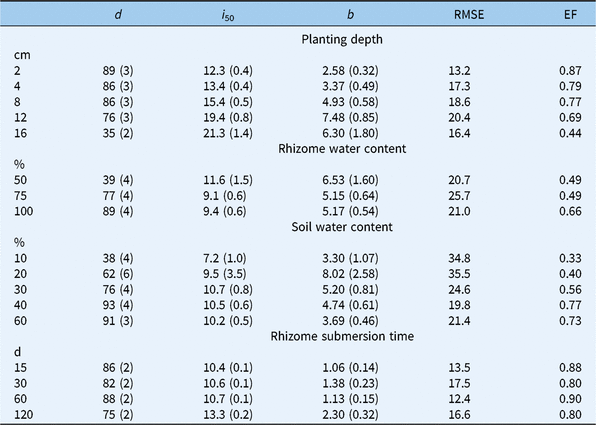
In the absence of significant interaction between runs and treatments, data were combined across runs for L. caroliniana emergence, plant height, and biomass response to the various environmental conditions tested in this study. RMSE values for L. caroliniana emergence rate in response to the various environmental factors tested in this study ranged from 12.4 to 35.5 and EF values from 0.33 to 0.90, suggesting a good fit of the Gompertz model used in this study (Table 1). Roman et al. (Reference Roman, Murphy and Swanton2000) reported RMSE value between 6.5 and 37.1 using a modified Weibull function during the validation phase of a common lambsquarters (Chenopodium album L.) emergence model. Sarangi et al. (Reference Sarangi, Irmak, Lindquist, Knezevic and Jhala2016) reported good fit of the log-logistic model for modeling common waterhemp (Amaranthus rudis J.D. Sauer) response to water stress, with RMSE values ranging from 7.2 to 31.5 and EF values from 0.43 to 0.90 for plant height and number of leaves per plant.
Parameter estimates and goodness of fit (RMSE and EF) a for the four-parameter Gompertz model b fit to Lachnanthes caroliniana cumulative emergence under different environmental stress treatments for two greenhouse studies conducted in 2018 (Chatsworth, NJ). c

a Abbreviations: RMSE, root mean-square error; EF, modeling efficiency coefficient.
b
 $(Y = c + \left\{ {a\;ex{p^{\left[ {{{ - \left( {x - {i_{50}}} \right)} \over b}} \right]}}} \right\})$
, where Y is the cumulative emergence at time x (days after planting); c the lower limit considered at time 0; d is the estimated maximum L. caroliniana emergence; i
50 is the time required to reach 50% L. caroliniana emergence (days after planting); and b is the relative slope around i
50.
c Values presented are parameter estimates from data pooled across two experiments. Values in parentheses are standard error of mean.
Planting Depth
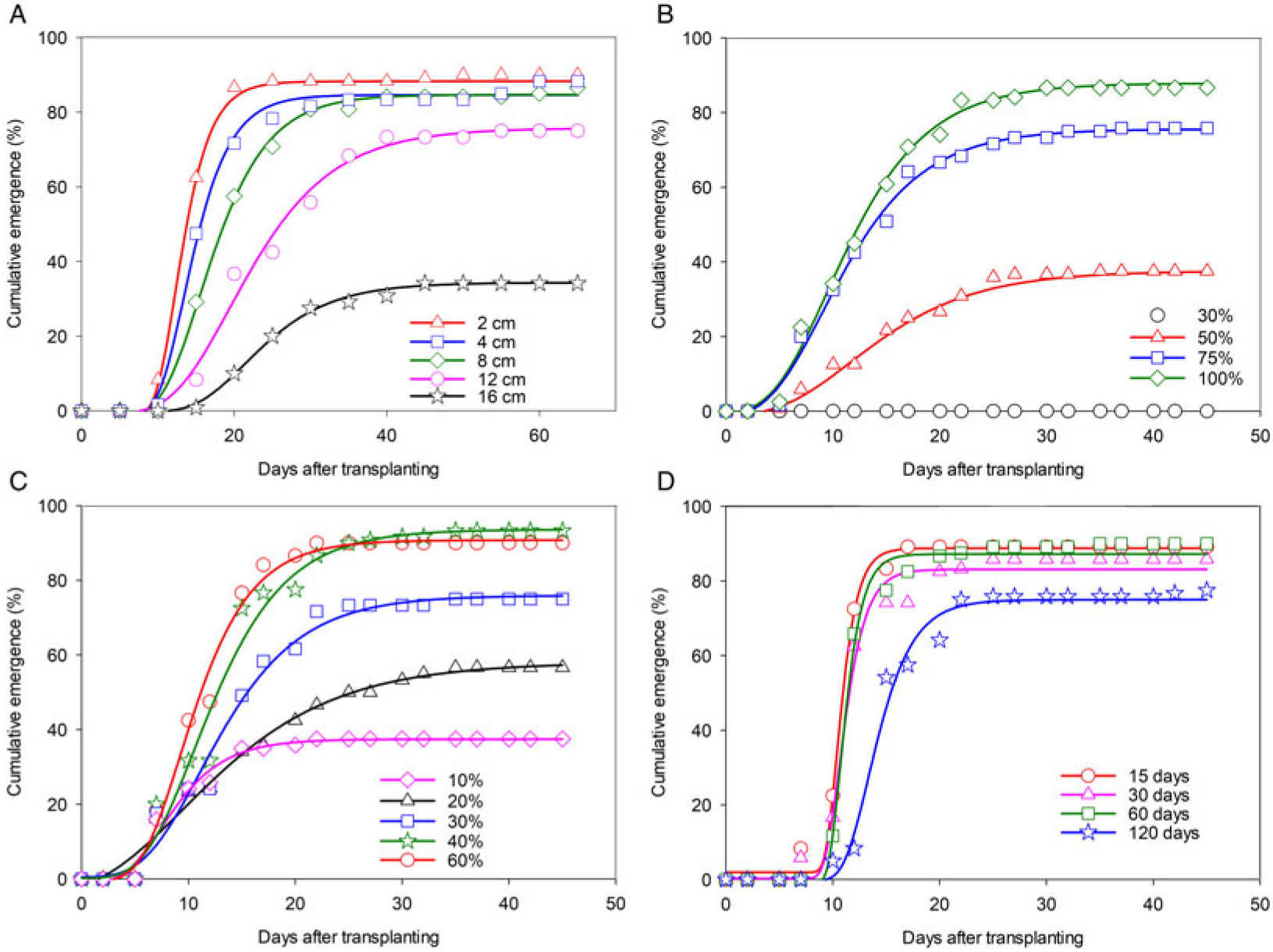
If the estimated maximum rate of emergence (d) was above 75% for planting depth between 2 and 12 cm, it sharply decreased to 35% when L. caroliniana rhizomes were planted 16-cm deep (Figure 1A; Table 1). Increasing rhizome planting depth from 2 cm to 16 cm resulted in a delay of 9 d to reach 50% shoot emergence (i 50) and 10.4 d for the time of first shoot emergence (Table 2). Lachnanthes caroliniana vegetative growth was significantly reduced at the 16-cm planting depth, with plant height, shoot, and root biomass of 8.1 cm (−57%), 147 mg (−27%), and 72 mg (−65%), respectively, compared with the 2-cm depth. The number of newly formed rhizomes was unaffected as planting depth increased from 2 to 12 cm, but decreased to only 0.5 rhizome per plant (−60%) for 16-cm-deep planting compared with an average of 1.2 rhizomes per plant at shallower planting depths. Whereas other studies demonstrated significant reduction of shoot emergence for perennial weeds such as buffalograss [Bouteloua dactyloides (Nutt.) Columbus] (Heckman et al. Reference Heckman, Horst and Gaussoin2002), perennial sowthistle (Sonchus arvensis L.) (Boyd and Van Acker Reference Boyd and Van Acker2003), or alligatorweed [Alternanthera philoxeroides (Mart.) Griseb] (Shen et al. Reference Shen, Shen, Wang and Lu2005) when planted at depths between 5 and 10 cm, L. caroliniana appears to be more tolerant to increased planting depth with no significant reduction of emergence or biomass production in the top 10 cm of soil.
Effect on cumulative Lachnanthes caroliniana shoot emergence from (A) rhizomes planted at various soil depths (B) rhizome moisture content (C) field capacity, and (D) duration of rhizome submersion under water for two greenhouse studies conducted in 2018 (Chatsworth, NJ). The lines represent a four-parameter Gompertz model
 $(Y = c + \left\{ {a\;ex{p^{\left[ {{{ - \left( {x - {i_{50}}} \right)} \over b}} \right]}}} \right\})$
fit to the data. Parameters estimates are shown in Table 1. Values presented are the means of two experiments.

Effect of rhizome planting depth on Lachnanthes caroliniana development at 100 d after planting for two greenhouse studies conducted in 2018 (Chatsworth, NJ). a

a Means presented are pooled across two experiments. Means within a column followed by the same letter are not different according to Fisher’s protected LSD (P ≤ 0.05).
Rhizome Water Content
Reducing rhizome water content from 100% to 50% decreased maximum shoot emergence (d) by 50% (Table 1), and further desiccation of the rhizome to 30% water content totally inhibited shoot emergence (Figure 1B). Similarly, Shen et al. (Reference Shen, Shen, Wang and Lu2005) noted the absence of shoot emergence from A. philoxeroides rhizomes when rhizome water content was less than 20%. Compared with rhizomes that were fully water saturated at time of planting, rhizomes with 50% water content saw increases of 2.3 d and 1.9 d, respectively, in estimated time to reach 50% total emergence (i 50) (Table 1) and observed time of first emergence (Table 3). Reduction of the rhizome water content also significantly affected L. caroliniana vegetative growth. Plant height was 9.1 cm for 75% water content and 6.6 cm for 50% water content, corresponding to 22% and 44% declines, respectively, when compared with 100% water content (Table 3). Reducing rhizome water content to 50% had more effect on shoot (31 mg) than belowground biomass (47 mg), which decreased by 48% and 21%, respectively, compared with the 100% water content treatment. Dropping rhizome water content to 75% did not affect the development of new rhizomes compared with the 100% treatment, but further reducing rhizome water content to 50% resulted in only 0.1 newly formed rhizome per plant. Rhizome water content of 30% resulted in complete inhibition of new rhizome formation. Limited data are available on the effect of reduced rhizome water content simulating drought conditions for perennial weeds. Shen et al. (Reference Shen, Shen, Wang and Lu2005) reported similar reduction of shoot emergence (50%), plant height (42%), and aboveground biomass (50%) when rhizome water content of A. philoxeroides dropped from 100% to 50%. However, A. philoxeroides belowground biomass decreased by more than 50% compared with only 21% for L. caroliniana. While drought can severely affect the development and propagation of L. caroliniana, our results suggest that this species has the capacity to survive such conditions, thus limiting the effectiveness of cultivation for bringing rhizomes to the soil surface as a L. caroliniana control option during the renovation process of cranberry beds.
Effect of rhizome water content on Lachnanthes caroliniana development 45 d after planting for two greenhouse studies conducted in 2018 (Chatsworth, NJ). a

a Means presented are pooled across two experiments. Means within a column followed by the same letter are not different according to Fisher’s protected LSD (P ≤ 0.05).
Degree of Water Stress
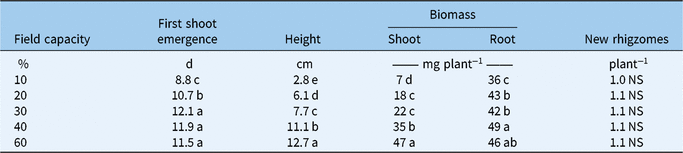
Increasing water stress caused L. caroliniana emergence to drop significantly (Figure 1C). Maximum emergence (d) estimated by the model was greater than 90% when soil moisture was equal or above 40% of the FC (moderate water stress) and decreased to 76% for 30% of the FC (Table 1). Further reduction of soil moisture contributed to reduction of the estimated maximum emergence rate. However, 38% of the buried rhizomes still produced a shoot when soil moisture was as low as 10% of the FC (severe water stress). No shoot emergence was noted when the soil moisture was 5% of the FC (data not shown). Shen et al. (Reference Shen, Shen, Wang and Lu2005) reported no shoot emergence from A. philoxeroides rhizomes grown at 5% or 60% of the FC, and observed a maximum of 93% shoot emergence at 30% of the FC. In comparison, soil moisture above 30% did not negatively affect L. caroliniana shoot emergence. Estimated time to reach 50% shoot emergence (i 50) decreased on average by 3 d when rhizomes were subjected to severe water stress (10% of the FC) compared with the moderate water stress treatment (above 30% of the FC). Under severe water stress, shoots tended to emerge 3 d earlier than for moderate water stress (above 30% of the FC) (Table 4). The highest plant height (12.7 cm) and aboveground biomass (47 mg) were observed for plants subjected to the 60% FC treatment (low water stress). Plant size and shoot biomass decreased as the level of water stress increased. Plants under severe water stress (10% of the FC) were only 2.8-cm tall and had a shoot biomass of 7 mg, equivalent to 78% and 85% drops, respectively, compared with the 60% FC treatment. A similar response to water stress was noted for A. rudis, giant ragweed (Ambrosia trifida L.), spiny amaranth (Amaranthus spinosus L.), and itchgrass [Rottboellia cochinchinensis (Lour.) Clayton] (Chauhan Reference Chauhan2013; Chauhan and Abugho Reference Chauhan and Abugho2013; Kaur et al. Reference Kaur, Aulakh and Jhala2016; Sarangi et al. Reference Sarangi, Irmak, Lindquist, Knezevic and Jhala2016). The effect of water stress was less pronounced on L. caroliniana belowground biomass, which decreased from 46 to 36 mg (−22%) when soil water content dropped from 60% to 10%. The fleshy rhizome of L. caroliniana can retain a large amount of water in response to the highly fluctuating soil water content of sandy soils in which this weed thrives. Thus, belowground biomass is probably less sensitive to water stress because of the water-storing ability of the rhizomes. The degree of water stress had no effect on the quantity of newly formed rhizomes, with an average of one new rhizome produced per plant. Transferring some of the rhizomes that did not produce shoots under 10%, 20%, and 30% soil water content into pots maintained at 60% soil water content highlighted the capacity of L. caroliniana to withstand drought conditions. An average of 67% of these rhizomes produced shoots by 10 DAP. Similarly, Shen et al. (Reference Shen, Shen, Wang and Lu2005) reported 70% A. philoxeroides shoot emergence from rhizomes exposed to severe water stress before being planted under optimal soil water conditions.
Effect of degree of soil water stress on Lachnanthes caroliniana development 45 d after planting for two greenhouse studies conducted in 2018 (Chatsworth, NJ). a

a Means presented are pooled across two experiments. Means within a column followed by the same letter are not different according to Fisher’s protected LSD (P ≤ 0.05).
Flooding Tolerance
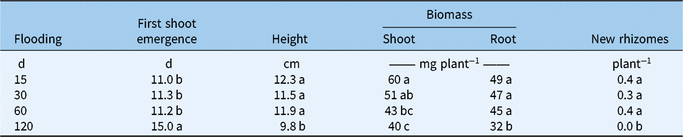
Maintaining L. caroliniana rhizome under water for up to 60 d did not influence cumulative shoot emergence (Figure 1D), maximum shoot emergence (d), or timing to reach 50% emergence (i 50) (Table 1). Submersion of the rhizomes for 120 d slightly decreased d by 10% and increased i 50 by 2.7 d. Plant growth and biomass data confirmed that only extended duration of flooding could negatively influence L. caroliniana development. Plant height, aboveground biomass, and belowground biomass were 9.8 cm, 40 mg, and 32 mg, respectively, when rhizomes were kept under water for 120 d (Table 5). This relates to reduction by 18%, 28%, and 33%, respectively, whereas the development of new rhizomes was totally inhibited and timing of first shoot emergence increased by 3.8 d in comparison to submersion of 30 d or fewer. These data demonstrate that L. caroliniana rhizomes can survive extended periods of flooding without losing their capacity to produce new plants. Thus, incorporating temporary flooding in fall for 3 to 4 wk as proposed by DeMoranville et al. (Reference DeMoranville, Sandler, Shumaker, Averill, Caruso, Sylvia and Pober2005) for managing cranberry fruitworm (Acrobasis vaccinii Riley) and R. hispidus will not substantially suppress the development of L. caroliniana clonal populations in cranberry beds.
Effect of rhizome flooding duration on Lachnanthes caroliniana development 45 d after planting for two greenhouse studies conducted in 2018 (Chatsworth, NJ). a

a Means presented are pooled across two experiments. Means within a column followed by the same letter are not different according to Fisher’s protected LSD (P ≤ 0.05).
Lighting Conditions
Shade significantly affected L. caroliniana development after shoots emerged. Modeling of shoot emergence under complete darkness and 12-h photoperiod produced similar responses with no difference between treatment for maximum shoot emergence (d) or timing to reach 50% emergence (i 50) (data not shown). Shoots emerged 2.2 d earlier, plants were 2.5 cm smaller, and aboveground and belowground biomass were reduced by 42 mg (−75%) and 30 mg (−53%), respectively, when pots were kept in full darkness compared with a 12-h photoperiod (Table 6). These results agree with previous findings by Dall’Armellina and Zimdahl (Reference Dall’Armellina and Zimdahl1988), who reported that decreasing light intensity from 525 to 236 µmol m−2 s−1 caused significant reduction of shoot and root biomass production of two rhizome-grown perennial weed species, field bindweed (Convolvulus arvensis L.) and Russian knapweed [Rhaponticum repens (L.) Hidalgo]. In contrast, A. philoxeroides shoot emergence rate and biomass production did not differ for plants exposed to 8 h of light or placed in complete darkness (Shen et al. Reference Shen, Shen, Wang and Lu2005), illustrating that degree of shade tolerance varies between weed species. No new L. caroliniana rhizomes developed by 45 DAP for plants maintained in the dark. Other studies have also shown that shade can prevent rhizome development in various perennial weed species such as Canada thistle [Cirsium arvense (L.) Scop.], yellow nutsedge (Cyperus esculentus L.), R. repens, and C. arvensis (Dall’Armellina and Zimdahl Reference Dall’Armellina and Zimdahl1988; Li et al. Reference Li, Shibuya, Yogo, Hara and Matsuo2001; Zimdahl et al. Reference Zimdahl, Lin and Dall’Armellina1991). Results from this greenhouse study demonstrate that L. caroliniana has low tolerance for shaded environments and corroborate field observations of L. caroliniana growing preferentially in cranberry bed areas where canopy openings occur because of diseases, wildlife damage, or poor vine growth.
Effect of light conditions on Lachnanthes caroliniana development 45 d after planting and timing of emergence for two greenhouse studies conducted in 2018 (Chatsworth, NJ). a

a Means presented are pooled across two experiments. Means within a column followed by the same letter are not different according to Fisher’s protected LSD (P ≤ 0.05).
No variations in the phenology or growth habits of L. caroliniana have been reported over the 1,200 ha of New Jersey cranberry bogs where this species is virtually present (D Schiffhauer, personal communication). Despite the fact that rhizomes used for this study were collected in a single bog, we are thus confident that our results can be extrapolated to the entire New Jersey L. caroliniana population. This research provides new information on L. caroliniana response to drought conditions as well as rhizome planting depth and light conditions. Lachnanthes caroliniana is well adapted to both flooding and drought conditions, thus limiting the interest of temporary in-season flooding or decreased irrigation frequency and volume for controlling this weed. Cranberry growers typically apply a 1- to 5-cm layer of sand every 2 to 5 yr to bogs during the winter or early spring. In addition to stimulating rooting of cranberry stolons, this practice is part of cranberry integrated pest and weed management programs. Sanding will help in decreasing seedling emergence of C. gronovii, burying cranberry girdler (Chrysoteuchia topiaria Zeller) pupae, and reducing the inoculum survival of fruit rot, a disease complex caused by more than 15 different fungal species (Oudemans et al. Reference Oudemans, Caruso and Stretch1998; Tomlinson Reference Tomlinson1937). Lachnanthes caroliniana emergence and growth was unaffected by rhizome planting depth, at least at soil depths of 10 cm or less. Based on this information, sanding of cranberry bogs is not a viable option for suppressing L. caroliniana development.
Complete shading of L. caroliniana resulted in reduced growth and the absence of new rhizome development. Therefore, similar to many other crops (Holt Reference Holt1995), encouraging the rapid development and closing of a dense cranberry canopy should be considered an important tool for managing L. caroliniana, because any light penetrating gaps in the canopy will cause L. caroliniana rapid growth and propagation. Furthermore, artificially shading areas where large openings of the crop canopy occur may provide additional control of L. caroliniana, especially during the initial stages of weed infestation in cranberry beds. The efficacy of tarping for controlling perennial weeds has been demonstrated on perennial pepperweed (Lepidium latifolium L.), with 94% stem density reduction after a black plastic mulch was deployed during two growing seasons and preceded by mowing and tilling of infested areas (Hutchinson and Viers Reference Hutchinson and Viers2011). A constraint of tarping for controlling rhizome-spreading perennial weeds is that the surface covered by the tarp should include areas colonized by rhizomes where shoots have not yet emerged. This technique would be best suited for early infestations when area of L. caroliniana patches and population density is limited. Tarping could also be used within an integrated approach of L. caroliniana management to complement PRE and POST herbicides that are effective at controlling this weed species (Carr et al. Reference Carr, Besançon and Schiffhauer2017). Because our trials were carried out in a greenhouse setting in the absence of a cranberry crop, future research should strive to evaluate the impact of tarping on cranberry vine growth and production as well as the potential benefit of stimulating development of cranberry canopy to increase natural shading of L. caroliniana.
Acknowledgments
The author acknowledges the technical support of Pine Island Cranberry Company Inc. and Cesar Rodriguez-Saona for the use of L. caroliniana plants and greenhouse space required for this research. Additional technical support by Baylee Carr is also greatly appreciated. This research was funded by the New Jersey Blueberry and Cranberry Research Council. No conflicts of interest have been declared.