Introduction
The Center for Disease Control and Prevention reports that between 1999 and 2019, opioid overdoses in the United States have caused nearly 500,000 deaths. 1 They describe the epidemic as having three waves, with the initial wave beginning in the 1990s after the American Pain Society instituted pain as the fifth vital sign in an effort to recognise patient comfort as a part of their overall well-being. 1,Reference Levy, Sturgess and Mills2 There was an associated increase in the usage of opioids, and in particular, increased number of opioid prescriptions. Subsequent waves have been multifactorial, but there is ongoing recognition that many overdoses and addiction disorders have roots that begin with initial prescription misuse and specifically overprescribing of opioids. Reference Stoicea, Costa, Periel, Uribe, Weaver and Bergese3,Reference Calderon, Hedges, Livingston, Gitzelmann, Pegoli and Wakeman4 In 2019 alone, 10.1 million people misused prescription opioids. 5 Adult care providers have focused their efforts in combatting the opioid crisis through modifications of chronic and postoperative pain management regimens. The majority of adolescents who misuse opioids obtain them from friends and relatives (56%) or from the healthcare system (25%). Reference Lavingia, Mondragon, McFarlane-Johansson and Shenoi6 Paediatric providers have acknowledged the risk of leftover opioid prescriptions and the risk of excessive acute use of opioids for pain management. Reference Yaster, McNaull and Davis7
Pain management in the perioperative period is recognised as fundamental in decreasing suffering and improving patient satisfaction; however, opioid prescriptions for paediatric surgical patients at discharge after surgery often exceed inpatient opioid usage, which can result in excess unused opioids in the home that are not properly disposed of. Reference Caldeira-Kulbakas, Stratton, Roy, Bordman and Mc Donnell8,Reference Grace, Choo, Patterson, Khanna, Feeley and Zhang9 An expert panel including prescribers created guidelines for opioid prescribing in postoperative paediatric patients and highlighted three primary themes, the need for healthcare professionals caring for postoperative patients to recognise the risks of misuse of opioid prescriptions, the optimisation of nonopioid analgesics, and patient and family education regarding pain management. Reference Yaster, McNaull and Davis7,Reference Kelley-Quon, Kirkpatrick and Ricca10 In 2017, an opioid reduction quality improvement project in orthopaedic surgery at this institution led to a call for all surgical specialties to evaluate their opioid prescribing practices for opportunities to standardise and decrease unnecessary opioid prescriptions at discharge. Reference Jones, Engler, Fonte, Farid and Bigham11 Data regarding opioid prescriptions at discharge after paediatric cardiac surgery are limited. Reference Calderon, Hedges, Livingston, Gitzelmann, Pegoli and Wakeman4 Individualised pain management strategies, with a focus on tailoring strategies to both type of operation and individual patients have the potential to significantly reduce, if not nearly eliminate the use of opioids at discharge for a large proportion of postoperative patients. Reference Calderon, Hedges, Livingston, Gitzelmann, Pegoli and Wakeman4
In the local cardiac surgery population, postoperative opioid prescribing patterns were variable and offered an opportunity for care standardisation. The improvement team sought to standardise discharge prescribing practices amongst providers, with a focus on improving appropriate doses for non-prescription pain management, creating standardised dose and duration of opioids, and increasing patient and family education.
Methods
Setting and baseline care
This improvement project was undertaken at a large midwestern freestanding academic children’s hospital with over 400 beds. The cardiac program is a comprehensive medical/surgical program with 15,000 annual visits and approximately 90 bypass cases and 120 total operative cases annually. Cardiac surgery patients are admitted to the 26 bed Paediatric ICU postoperatively, with co-management by the PICU, Cardiac Surgery and Cardiology teams. In the PICU, initial pain management is prescribed by the cardiac surgery team, and any acute analgesia changes are subsequently prescribed by the PICU team. After transfer to the Cardiology service on the general care floor, their pain management is prescribed by the resident team under the direction of the attending cardiologist. Discharge pain medication recommendations are made by the cardiothoracic advanced practice providers in a non-structured fashion and are variably implemented. Inconsistencies in the recommendations made by the advanced practice provider team are rooted in anecdotal experience and individual practice patterns. The unintended variation in opioid prescribing and the local surgical subspecialty quality improvement focus on reducing opioid prescriptions created a focused attention on improvements in opioid prescribing for cardiothoracic surgery patients.
Improvement methods
A multidisciplinary improvement team was formed consisting of a cardiac surgeon, advanced practice providers, a clinical pharmacist, a quality improvement specialist, and an information service specialist. The improvement work was guided by the model for improvement . Reference Kiskaddon, Stock, Fierstein, Miller, Quintessenza and Goldenberg12 The improvement team established a specific aim to increase compliance with standardised postoperative pain management guidelines from 24 to 85% by December 31, 2021. To better understand the process and to inform the key drivers, a process map was developed and key failure modes were identified using a simplified failure mode analysis. A key driver diagram was subsequently developed to enumerate key drivers and interventions (Figure 1). For select interventions, Plan-Do-Study-Act ramps were used, and ultimately the decision to adapt, adopt or abandon each test of change was made. The most significant interventions and improvements are outlined below.
Key driver diagram.

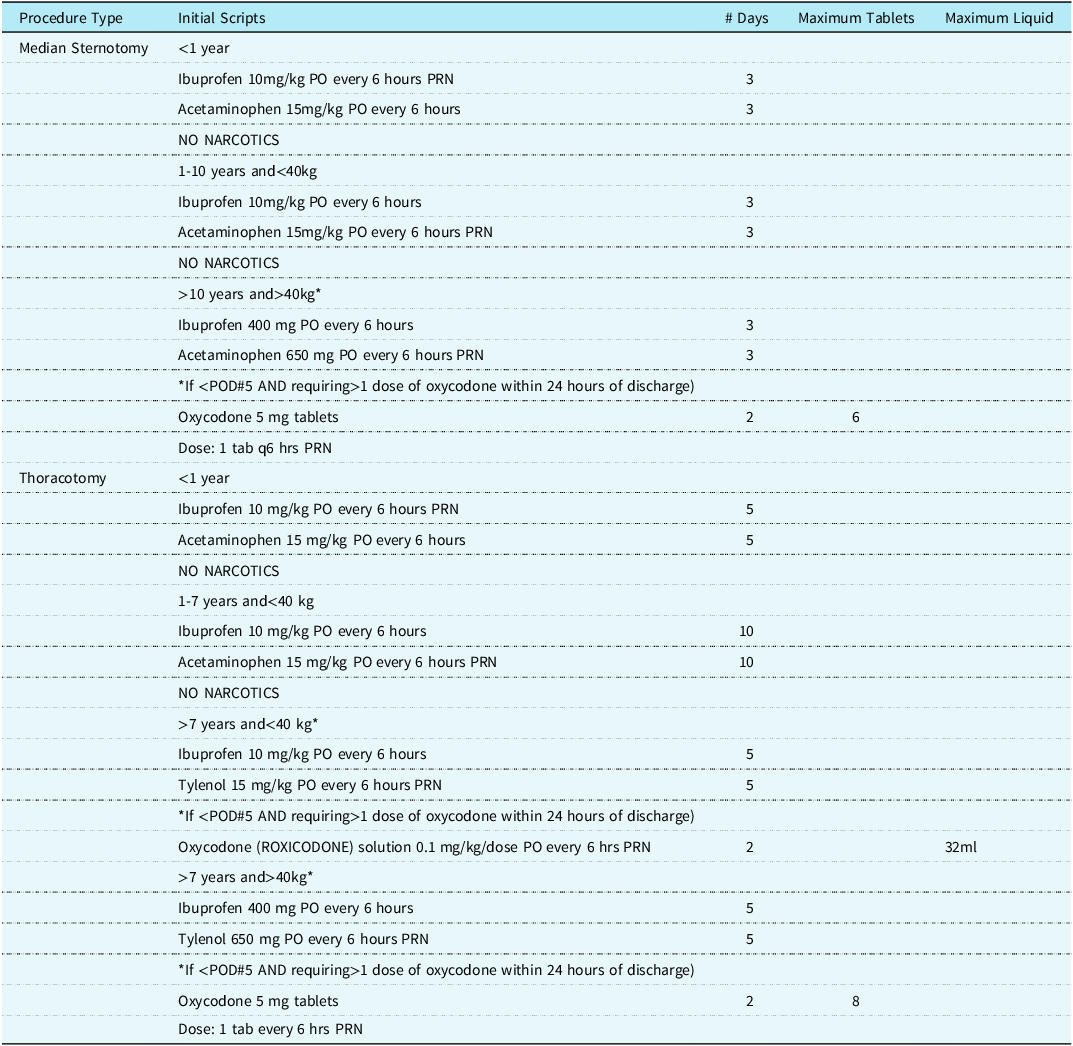
The team prioritised the need to create standardised prescribing guidelines at discharge for all patients to decrease individual variation. Initially, the total number of opioids and non-opioids prescribed were reviewed from a convenient sample to understand the current state. The team subsequently sought input from each cardiac surgery advanced practice provider on their individual approaches to prescribing. A review of relevant paediatric cardiothoracic surgical and other surgical literature was performed. Amongst advanced practice providers and the surgeons, agreement was first achieved for standardised post-procedure discharge pain medication regimen based on the surgical approach and the patient’s age (Table 1). These were initially shared amongst the advanced practice providers. These were then published on our hospital’s guidelines page.
Demographic and surgical approach data for the improvement population

Despite creation of these guidelines, prescribing variation remained at discharge, and upon further investigation, the team recognised that this was related to ongoing variation in advanced practice provider recommendations regarding transition from newly standardised intravenous analgesia guidelines to oral pain regimens. As a second intervention, the team standardised the transition from intravenous to oral pain regimens, with a focus on increased duration of non-opioid medications and non-pharmacological comfort measures. The postoperative non-opioid intravenous medications end times were extended and standard discussion on rounds was adopted to determine if transition to an oral regimen was indicated. Routine implementation of scheduled intravenous or oral acetaminophen alternating with scheduled intravenous ketorolac or oral ibuprofen through a minimum of postoperative day two was standardised. The team began routine recommendations to discontinue all opioids, including as needed medications, after chest tubes were removed. If no opioids were administered for more than 18 hours, and the patient’s pain was well controlled based on documented pain scores and patient and family report, acetaminophen was transitioned to as needed, and ibuprofen continued around the clock.
The team recognised clinical education gaps or communication failures amongst multiple providers were contributors to failure of guideline adherence, so multiple interventions were aimed at consistent communication. The advanced practice provider team provided just-in-time education as part of multidisciplinary rounds with the PICU team. Education was completed regarding the use of non-pharmacological comfort measures to manage pain, as well as the team availability to re-order opioids if other measures were not effective. Advanced practice providers directly communicated with the attending cardiologist and resident teams when patients transferred to the general care floor to reinforce pain management strategies.
The team identified patient/family education on pain management as another key driver to discharging patients home early in their postoperative course without opioids. Education to decrease anxiety at discharge was initiated at the preoperative consult with the cardiac surgeon to discuss the risks and benefits of opioids in postoperative pain management, as well as the data to support the use of non-opioid medications. Reference Kiskaddon, Stock, Fierstein, Miller, Quintessenza and Goldenberg12 As part of the organisational efforts to decrease postoperative opioid usage for all surgical patients, the Comfort Control Clock™ was created for management of alternating doses of acetaminophen and ibuprofen (Alternate My Meds, LLC, Cleveland, Ohio). This was incorporated into the education at the preoperative consult with the surgeon and postoperatively at discharge. Discussion of pain control at home was included in routine phone calls the day after discharge, and advanced practice providers reinforced the safety and importance of ongoing use of non-opioid medications.
The team created discharge order sets to increase compliance and usability of the published guidelines. The first phase included utilisation of the pain guidelines on paper and usage of dot phrases in the discharge instructions. Edits were made to these for clarity, and a standardised order set was then created in the electronic health record with a link to the guidelines to ensure both opioid and non-opioid analgesia dosing was explicitly included in the discharge instructions.
Measurements
Primary
Data were extracted from the electronic medical record and tracked on a monthly basis beginning in January 2018 through December 2021. Our primary outcome measure was compliance with the postoperative guidelines. The numerator was the number of patients undergoing cardiac surgery who had all appropriate pain medications prescribed at discharge (consistent with discharge guidelines), and the denominator was the total number of patients less than 18 years of age who underwent cardiac surgery and were discharged within 14 days of initial operation. Compliance specifically included compliance with opioid prescription guidelines and inclusion of acetaminophen and ibuprofen prescriptions at discharge. Any discharge with opioids prescribed outside of the guidelines or not including acetaminophen or ibuprofen were considered non-compliant.
Secondary
Secondary outcome measures were decrease in discharge morphine equivalent dosing, rate of opioid free discharge, and total hospital length of stay. Sustainability of morphine equivalent dosing and opioid free discharge was additionally tracked December 2023.
Balancing
A balancing metric was percent of patients who required an opioid re-prescription after discharge. This measure was designed to ensure patients’ pain was not inadequately treated. Pain-related readmissions were also tracked.
Results
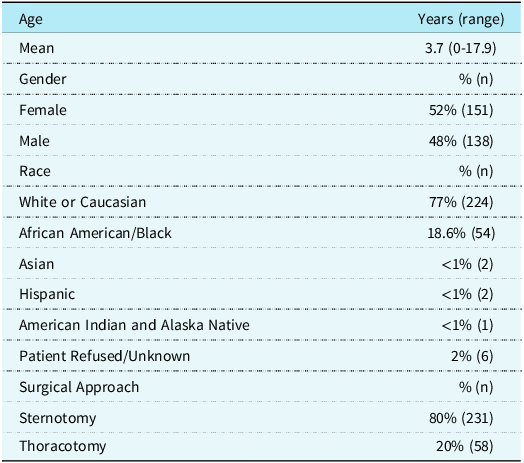
During the improvement period, there were 289 operations performed with length of stay less than 14 days. Patient demographic data are included in Table 2.
Demographic and surgical approach data for the improvement population

An annotated control chart demonstrates compliance with the guidelines, as well as key improvement interventions (Figure 2). Baseline data prior to guideline implementation showed 24% of patients were discharged with the pain regimen ultimately established by the discharge guidelines. An initial improvement shift to 50% compliance was seen after the post-procedure discharge pain medication guidelines were introduced. The addition of the Comfort Control Clock™ and just in time bedside clinical team education occurred subsequently but did not impact guideline compliance. Introduction of the electronic order set resulted in additional and sustained improvement of 86% compliance with discharge pain medication guidelines. With no additional interventions, but with ongoing experience and socialisation of the guidelines and order set, 100% compliance was achieved.
Control chart (LOR = level of reliability).

Opioid prescribing decreased during the improvement project both in number of patients discharged on opioids and the morphine equivalent dose per patient. In 2019, 6/76 (8%) patients were prescribed opioids at discharge, with an average total morphine equivalent dosing of 36.25. In 2020, 4/65 (6%) patients received opioids at discharge, with an average total morphine equivalent dosing of 29.25. In 2021, 1/68 (1.5%) patient received an opioid prescription at discharge, with a total morphine equivalent dosing of 22.5. Opioid-free discharge rate was maintained in 2022 at 0/80 (0%) with a total morphine equivalent dosing of 0.
Mean length of stay during the study period decreased from baseline of 4.64 days to a mean of 3.69 days at end of the measurement period.
There were no opioid re-prescriptions or pain-related readmissions after discharge during the improvement period.
Discussion
The goal of this quality improvement project was to increase care standardisation and decrease overall opioid prescriptions at discharge. The primary aim of care standardisation around postoperative pain was accomplished with 100% of patients undergoing surgical interventions receiving guideline-based care for pain management upon discharge. Guideline-based care is a proven strategy to successfully standardise and improve both paediatric medical and surgical care. Reference Slusher, Bates, Johnson, Williams, Dasgupta and Von Allmen13,Reference Johnson, Arnold and Gay14 Additionally, guideline-based care leveraging the electronic health record to standardise perioperative care and improve outcomes is similarly achievable. Reference Karas, Upadhyayula, Love and Bigham15 This improvement work was inspired by opioid reduction in paediatric orthopaedic surgery, and it subsequently became a broad surgical initiative based on the idea that if it could be done in orthopaedic surgery, it could be done in all surgical specialties. Reference Jones, Engler, Fonte, Farid and Bigham11
The overall success of the project is attributable to four key areas in the immediate perioperative period based on published findings. First, patient and family education and expectation setting initiated at preoperative appoints and reinforced through the inpatient stay, which has been identified as a foundational piece of opioid prescribing guidelines in paediatrics. Reference Kelley-Quon, Kirkpatrick and Ricca10 The improvement team found that family education was typically easier than expected as many families were aware of the opioid epidemic and easily accepted the goal of minimal narcotic usage. Second, optimising non-opioid pain medications in the immediate postoperative period. Reference Ochroch, Usman and Kiefer16 The clinical teams have been aware of the local opioid epidemic, the opportunity for the healthcare system to reduce the risk to our patients, and the successful opioid reduction efforts through care standardisation by other surgical subspecialities within the same organisation. The barriers to change were lowered, which we believe accelerated the adoption of these care standards. Third, creation of standardised postoperative narcotic management that focused on quickly reducing or eliminating opioids. Reference Frankel, Maul and Chrysostomou17 The addition of acetaminophen and nonsteroidal anti-inflammatory drugs was accelerated by sharing published data demonstrating reduced narcotic needs and no increased risk of bleeding. Reference Van Driest, Jooste and Shi18,Reference Gupta, Daggett, Drant, Rivero and Lewis19 Finally, early transition to oral analgesics and a standardised discharge plan that focused on non-opioid pain control and dosing standards. Reference Roy, Parra and Brown20
While the goal of the improvement project to standardise discharge prescribing was achieved, it is theorised that the overall project impact was much broader. Standardisation of decreased use of intravenous pain medications and decreased duration of higher dose opioids occurred concurrently with an overall decrease in length of stay. While we did not specifically study this, and it should be noted that during the improvement period, multiple efforts based on published guidelines were undertaken to decrease the average length of stay in postoperative patients it is notable that despite this decrease in length of stay, opioid prescriptions did not increase. Reference Roy, Parra and Brown20,Reference Beamer, Ferns, Edwards, Gunther and Nelson21
As with any improvement, there were some barriers that were successfully managed to create sustained improvement. First was the resistance to constraints of care standardisation, and the second is the culture of not wanting to undertreat pain. While it is generally accepted that care standardisation is important and improves outcomes, caregivers still value their autonomy and may overestimate the need to create unique care management plans versus implement standardised plans. We did not anticipate the effort necessary to overcome the strong culture of aggressive pain management. This culture is likely well intentioned, rooted in recognising pain as a vital sign and staff perception that patients would do worse postoperatively due to inadequately controlled pain with reduced opioid usage. Reference Charles, Abouhassan, McFarland and Pronovost22 Alignment between care standardisation and staff engagement around pain management was achieved only when we shared in the agreement that we were still adequately treating pain, only with a different combination of medications.
Limitations
There were some limitations to this improvement project. First, we did not directly measure postoperative or post-discharge pain. Second, we did not measure amount of pain medication consumed prior to or after this improvement project, so even though prescribed dosing may have changed, opioid consumption may not have changed. Third, we did not measure any medication compliance, either opioid or non-opioid after discharge. Fourth, this study was a single site with strong cardiac surgical, cardiology, paediatric ICU, and inpatient floor alignment, which may not be replicable at all organisations wishing to achieve similar improvement. Fifth, this study does not quantify the use of regional anaesthesia as a pain control regimen, though since the conclusion of this study we have incorporated this strategy into our perioperative management as another means of reducing total postoperative opioid usage.
Conclusion
This improvement project yielded a sustained improvement in postoperative cardiac surgical discharge pain prescribing guidelines, resulting in decreases in morphine equivalent dosing and a concomitant decrease hospital length of stay.
Acknowledgements
None.
Competing interests
The authors declare none.