In December 2005, the Movimiento al Socialismo (Movement Toward Socialism, MAS hereafter) won the presidential and legislative elections in the first round with almost 54 percent of the vote, and its leader, Evo Morales, became president of Bolivia. Since then, the MAS has turned into a predominant party by winning a majority in three consecutive national elections. Once in office, Morales carried out a profound transformation of Bolivian politics and economy, while at the same time he promoted important institutional reforms. The rapid electoral growth of the MAS raises the question of the determinants of its electoral success, especially given its origin as a small, indigenous, and peasant-based party. How did the MAS obtain majoritarian electoral support among Bolivian voters? How was it able to overcome the dilemmas of collective action that in the past had prevented a mostly indigenous electorate from concentrating their votes on a candidate of their own ethnic condition?
Bolivia constitutes one of the most salient cases of the “left turn” in Latin America (Panizza Reference Panizza2005; Castañeda Reference Castañeda2006; Arditi Reference Arditi2008; Cameron Reference Cameron2009; Weyland et al. Reference Weyland, Madrid and Hunter2010; Levitsky and Roberts Reference Levitsky and Roberts2011; Queirolo Reference Queirolo2013). Despite the use of the term left, ideology has not been the main explanatory factor, according to most of this literature, which has been fundamentally based on socioeconomic or international factors. Focusing on Bolivia, this article aims to contribute to a broader discussion, stressing the importance of ideology—narrowly understood as the classic left-right opposition—in accounting for the wave of leftist governments in Latin America.
While ideological orientations constitute one of the central factors in explaining voting behavior across advanced and industrialized democracies (Dalton Reference Dalton2011; Franklin et al. Reference Franklin, Mackie and Valen1992; Lachat Reference Lachat2008), little is known about ideological voting in developing democracies. Nonetheless, evidence shows that in some Latin American countries, the political space is structured by the classic left-right continuum (Ruth Reference Ruth2016; Colomer and Escatel Reference Colomer and Escatel2005; Zechmeister Reference Zechmeister, Kitschelt, Hawkins, Luna and Rosas2010). Moreover, in countries like Bolivia or El Salvador, which have experienced a rise in ideological polarization during the last two decades, the impact of ideological voting is presumed to increase as well, since some studies have shown that the impact of left-right orientations increases with party system polarization (Lachat Reference Lachat2008).
This article argues that ideological voting was a key factor behind the electoral rise of the Bolivian MAS, particularly during the three elections held between 2005 and 2014, coinciding with a marked increase in ideological polarization at the party system level. To do so, the article evaluates the effect of the ideological vote on the electoral performance of the MAS between 2002 and 2014, arguing that ideological location decisions served as a signaling device that helped to solve the coordination dilemma faced by voters in a context characterized by deep ethnic and regional divisions.1 Ethnic identification alone had proved insufficient to facilitate the coordination of indigenous movements until the emergence of a programmatically oriented actor (Loayza Reference Loayza2011), whose ideological signals allowed the formation of a focal point that led to the electoral success of the MAS and the marginalization of electoral support to other indigenous candidacies. Paradoxically, the coordination of the ethnic vote was possible thanks to a signaling device that was based not primarily on ethnicity but on ideology.
Extant explanations of the electoral success of the MAS have largely focused on institutional (Van Cott Reference Van Cott2005; Muñoz-Pogossian Reference Muñoz-Pogossian2008; Centellas Reference Centellas2008a, Reference Centellas2009) or sociostructural factors that led to the ethnic vote (Klein Reference Klein2011; Madrid Reference Madrid, Levitsky and Roberts2011; Guzmán Prudencio and Rodríguez López 2018). Other scholars emphasize the type of leadership exercised by Evo Morales (Madrid Reference Madrid2008, Reference Madrid, Levitsky, Loxton, Van Dyck and Domínguez2016), as well as the role played by social movements (Anria Reference Anria2013, Reference Anria2016), especially in the presence of profound regional cleavages (Centellas Reference Centellas2009; Eaton Reference Eaton2014, Reference Eaton, Levitsky, Loxton, Van Dyck and Domínguez2016). In some cases, these factors complement each other, giving rise to mixed explanations that combine different doses of these factors. This article intends to analyze specifically the impact of the ideological vote on the electoral performance of the MAS. This does not mean discarding other explanatory factors that undoubtedly influenced the result. However, available explanations have not paid enough attention to ideology as a signaling device that politicians can use for the purposes of electoral mobilization and persuasion.
The rest of the article is organized as follows. The next section briefly reviews the origin of the MAS and the main explanations available for its electoral success.
The following section presents the theoretical argument, emphasizing the role of ideology as a predictor of the MAS vote. The data and hypothesis tests are presented and the results discussed. The concluding section evaluates the main implications of the study.
The Movement Toward Socialism: Ethnic Origin and Ideological Mobilization
The MAS originated as a result of the collective action of coca leaf producers in the Bolivian region of Chapare, located in the Department of Cochabamba, who created the Assembly for the Sovereignty of the Peoples (ASP) in 1995. This organization was conceived as the political instrument of the indigenous and peasant movement and became the first political party to emerge from that movement (Van Cott Reference Van Cott2005; Albó Reference Albó, Crabtree, Molina and Whitehead2009; Anria Reference Anria2013; Madrid Reference Madrid, Levitsky, Loxton, Van Dyck and Domínguez2016).
The creation of the ASP reflected a coordination effort that included two indigenous peoples, the Quechua and the Aymara, who had traditionally followed divergent paths. Over time, the ASP led to the Political Instrument for the Sovereignty of the Peoples (IPSP), a political organization to compete at the national level, which finally, and after the elections of 2002, would be renamed MAS, adopting the label of an old party that was not active in elections (Van Cott Reference Van Cott2005; Harten Reference Harten2011; Madrid Reference Madrid, Levitsky and Roberts2011).
Based on its origin, the MAS can be characterized as an ethnic party (Van Cott Reference Van Cott2005; Madrid Reference Madrid2008, Reference Madrid, Levitsky, Loxton, Van Dyck and Domínguez2016; Albó Reference Albó, Crabtree, Molina and Whitehead2009), since its original mobilization capacity was oriented almost exclusively to the indigenous population.2 However, the party gradually began to transcend its ethnic base, and as of 2002, the ethnic appeal had become only one of the sources of its electoral success. According to some scholars, the MAS exceeds the features of the typical ethnic party, which is why they prefer to frame it mainly as a leftist party, based on the content of its programmatic positions and ideological profile (Madrid Reference Madrid, Levitsky and Roberts2011, Reference Madrid, Levitsky, Loxton, Van Dyck and Domínguez2016; Anria Reference Anria2013).
The rise of the MAS implied the reconfiguration of the Bolivian party system, as it was accompanied by a higher prevalence of programmatic links and clear and differentiable ideological stances (Van Cott Reference Van Cott2005). Thus, programmatic appeals partially replaced the clientelist and personalistic linkages that had characterized Bolivian politics for more than five decades (Gamarra and Malloy Reference Gamarra, Malloy, Mainwaring and Scully1995; Grindle Reference Grindle2000), resulting in a more complex mix of linkage mechanisms (Kitschelt Reference Kitschelt2000). What factors, and to what extent, led to the electoral success of the MAS? Given the ethnic origin of the party and its subsequent evolution, what was the specific weight of ethnic and ideological factors in its electoral performance?
This article focuses on the effect of ideological differentiation on the individual level; that is, on the behavior of Bolivian voters. Unlike other available explanations, the argument holds that ideology must be considered as a central part of the explanation of the MAS’s electoral rise. For this purpose, the article follows an additive criterion, seeking to put ideology in a more general explanatory framework, which draws on other available explanations that emphasize the role of other causal factors.
Explanations for the Electoral Rise of the MAS
Several studies address the MAS electoral success from different theoretical perspectives. Among the explanations based on institutional factors, Van Cott (Reference Van Cott2000, Reference Van Cott2005) analyzes the performance of the MAS as part of a more general phenomenon of ethnic parties in Latin America and argues that its success was motivated by the permissiveness of the institutional reforms carried out during the 1990s. In the same vein, other scholars argue that the mixed electoral system and the administrative decentralization allowed ethnic parties to take advantage of the new opportunities to get legislative representation (Grindle Reference Grindle2000; Eaton Reference Eaton2007; Muñoz-Poggosian 2008; Centellas Reference Centellas2009). From these perspectives, the ethnic factor allowed the level of mobilization necessary for the emergence of new parties, and institutional incentives were the facilitating condition that allowed these new ethnic parties to benefit from the opportunities created by the new institutional setting, particularly when their voters were geographically concentrated. Consequently, two factors converge to explain the electoral rise of the MAS: the political activation of social cleavages, and political institutions that allowed their transfer to the electoral market.
Madrid (Reference Madrid2008) argues that the MAS is an instance of a more comprehensive phenomenon of “ethnopopulism,” which describes a party that, despite having an ethnic base, appeals to a broader audience anyway, through inclusive messages, unlike other ethnic parties, which use exclusive rhetoric. This difference was the fundamental feature that allowed the electoral success of the MAS. Anria (Reference Anria2013, Reference Anria2016) also finds that the ethnic vote largely explains the results favorable to the MAS and the consolidation of Morales’ leadership, but stresses the role played by social movements and civil society. Other explanations have focused on the leadership of Evo Morales (Crabtree Reference Crabtree2011) or on citizens’ disenchantment with the neoliberal policies of the 1980s and 1990s, during the period of “pacted democracy” (Crabtree Reference Crabtree2011; Madrid Reference Madrid, Levitsky and Roberts2011; Romero Ballivián 2016).
Beyond their emphasis, several of these approaches take into account a combination of explanatory factors. Many of them consider that the structure of opportunities opened by institutional reforms, particularly decentralization and the mixed electoral system, led to the creation and promotion of local and ethnic-based parties, as mentioned above. In the same way, some of the approaches based on Morales’ leadership also consider that citizen disaffection with traditional parties was a factor that helped this process. All these explanations identify important factors that facilitated the electoral success of the MAS, providing valuable parts of a general explanation. That said, they hardly consider ideology as a systematic factor in their explanations. This absence is curious, since the rise of the Bolivian MAS is one of the paradigmatic examples of the so-called left turn in Latin America (Panizza Reference Panizza2005; Castañeda Reference Castañeda2006; Arditi Reference Arditi2008; Cameron Reference Cameron2009; Weyland et al. Reference Weyland, Madrid and Hunter2010; Levitsky and Roberts Reference Levitsky and Roberts2011; Queirolo Reference Queirolo2013).
In this article’s argument, ideology played a crucial role in the MAS’s ability to transcend its original, ethnically based and geographically concentrated electorate.
Taking into account the contributions of the abovementioned studies, this work aims to complement the available explanations of the success of the MAS, showing that ideology operated as a coordinating device at the individual level, even in the presence of politically activated ethnic and regional cleavages. It proposes an explanation that combines different factors suggested by previous research but assigns a relevant role to the ideological factor behind the rise of the MAS.
The Effect of the Ideological Vote
The existing explanations help answer some questions, but at the same time, they leave others open. An examination of the explanations centered on institutional factors reveals that while they offer a good explanation for the incentives that new small, ethnically based or geographically concentrated parties could have to compete in elections, they cannot explain why some parties were able to successfully seize those opportunities while others could not. Additionally, although the most important reforms were implemented in the mid-1990s, it was not until 2005 that the MAS managed to become an electorally successful party, obtaining the presidency without needing a second round.
Moreover, most of the institutional changes introduced facilitated fragmentation by increasing the incentives for new parties, so they had an effect that hindered the existence of a predominant party like the MAS. Why did the institutional reforms favor the MAS but not other challenging parties, among them some indigenous or peasant-based, such as the Pachakuti Indigenous Movement (MIP)? Why did the reforms pave the way for the MAS and not for other challenging parties? In fact, the institutional reforms took place during the 1990s, a period in which the electoral performance of the MAS (under its original name, ASP, and then IPSP) was meager. Furthermore, if the electoral success of the MAS is explained only by institutional factors, why, once in office, did Morales’ government obstinately seek to amend the constitution and the electoral system?
The explanations focused on the ethnic vote also leave some questions unanswered. The explanatory role played by the indigenous vote in the success of the MAS is indisputable. However, the activation of ethnic cleavage took place in successive stages, which began with the nationalist revolution of 1952 and reached the years before the rise of Evo Morales’ party (Klein Reference Klein2011). Therefore, why was it necessary to wait more than 50 years for the victory of a candidate of an ethnic-based party? Moreover, in the short term, this approach cannot explain why the activation of ethnic cleavage had such diverse consequences in 2002 (when the MAS obtained 20 percent of the vote), compared with 2005 (when the MAS obtained almost 54 percent). In addition, for what reason did the activation of ethnic cleavage allow the MAS an exceptional electoral performance while other indigenous parties, like the MIP, obtained a meager 2 percent in the presidential elections of 2005?
Something similar can be said of explanations based on the characteristics of Evo Morales’ leadership. Other charismatic leaders who mobilized their electorate based on personalist appeals have not been able to attract the electoral support that the MAS has achieved under the leadership of Morales. Some party leaders, such as Manfred Reyes Villa, had a strong personalist and charismatic appeal (Centellas Reference Centellas2008b), and the same can be said of Felipe Quispe and Alejo Véliz (Kohl and Farthing Reference Kohl and Farthing2006). However, none of these leaders who could be classified as populist achieved the electoral success of Morales and his party. Likewise, the previous populist experiences of CONDEPA and UCS showed the electoral limits of charismatic leadership, such as that of Carlos Palenque or Max Fernández, based mainly on their personal reputation and their capacity to distribute material benefits (Romero Ballivian 2003; Mayorga Reference Mayorga2003; Mayorga Reference Mayorga2004). Surely, Morales’ leadership had a charismatic component, but the fact that other leaders have also had that attribute and did not achieve such electoral success requires a reconsideration of this factor as a sufficient explanation.
In the same way, the popular disenchantment with the traditional parties, and more broadly, with a political class stigmatized by the “pacted democracy” and the neoliberal reforms, which emerged in the conjunctures of the “water war” and the “gas war” that precipitated the end of the Sánchez de Lozada presidency, is not enough to explain the electoral success of the MAS. Why this disenchantment positively affected the performance of the MAS but did not do the same with other challenging parties, which were not “contaminated” by traditional politics, is an important question. How did the failure of the neoliberal program summarized in the Pact for Democracy, and the resulting citizen dissatisfaction, lead to the electoral success of the MAS, in the presence of other nontraditional parties and candidates?
Combining Explanatory Factors: The Role of Ideology
This article’s argument seeks to locate ideology within a combination of explanatory factors, emphasizing its impact on the individual decisions of Bolivian voters. In this way, the argument stresses the importance of several of the preceding explanations while arguing that the factors they identify are facilitating or even necessary conditions, but not sufficient to explain the electoral success of the MAS.
Those accounts emphasizing the importance of the ethnic vote undoubtedly have good arguments, both theoretically and empirically, in their favor. Guzmán Prudencio and Rodríguez López (2018) base their explanation on the ethnic vote, but they find that its effect was only partial, and that electoral support for the MAS was guided by both the ethnic vote and the party’s leftist political positions, which is compatible with the results reported here. At the same time, the changes registered by Anria (Reference Anria2013) in the MAS mobilization strategy, based on social movements, are well documented, but they were the result of a deliberate political action that allowed the MAS and its main leaders to mobilize adherents on the basis of programmatic and ideological appeals. After the “gas war,” the MAS was able to transcend its original support base, mobilizing and persuading voters on the basis of classic redistributive claims, such as the nationalization of natural resources or the redistribution of wealth. This strategy was based mainly on consistent and sufficiently differentiated ideological signals for the electorate. The reduction of the dimensionality of political conflict based on ideological signals facilitated the electoral success of the MAS.
Although it is undeniable that since its origin, the MAS has been closely linked to a logic of organization and protest characteristic of social movements (Van Cott Reference Van Cott2005; Anria Reference Anria2013, Reference Anria2016), there is a risk of overestimating the role of this factor in its electoral rise. In fact, while the demands of the indigenous peoples were framed solely in the logic of the indigenous movements, they failed to capitalize their own organizational power and translate it into votes, which shows their inability to expand as a national political party. They could only turn their demands into collective action, and votes, when they managed to articulate clear and differentiated ideological and programmatic signals.
Anria (Reference Anria2013), Madrid (Reference Madrid, Levitsky and Roberts2011), and Harten (Reference Harten2011) describe the process by which the MAS managed to attract support from different social organizations that grouped artisans, microentrepreneurs, pensioners, and cooperative members in the form of “co-optation.” This process can be seen as the result of a deliberate strategy of electoral coordination that led to the construction of a focal point. In this process, ideology played a key role as a facilitating device by which different social forces were able to coordinate on a single candidacy through clearly identifiable ideological signals. This implies that ideology played not only an activating role, based on the complaint against neoliberal policies and the exclusion of indigenous peoples, but also a coordinating role for all the social groups that formed the electoral base of the MAS.
In the same vein, the inclusiveness of the MAS discourse stressed by Madrid (Reference Madrid2008) is a central piece of the explanation. But the discourse is inclusive precisely because it contains elements and claims that transcend the ethnic factor in favor of more general appeals containing strong ideological content, such as the nationalization of natural resources, the hostility to the capitalist model and neoliberal reforms, and the emphasis on the redistribution of wealth. These are the elements that provide the inclusive nature of the MAS appeals, differentiating them from those of other ethnic parties that did not get the electoral support that the MAS achieved, and facilitating the coordination around Morales’ candidacy.
Crabtree (Reference Crabtree2011) points out Morales’ charismatic leadership as one of the causes of the electoral success of the MAS.3 Yet recent Bolivian political history, as noted, has seen different charismatic leaders who have not achieved comparable electoral support. Additionally, although Morales’s leadership has a component of charisma, that should not be overestimated. Madrid (Reference Madrid, Levitsky and Roberts2011) argues that despite the personalistic character of Morales’ leadership, this factor is strongly limited by the weight that the grassroots organizations and social movements carry in the party. For this reason, authors like Roberts (Reference Roberts2007) and Levitsky and Roberts (Reference Levitsky and Roberts2011) do not classify Evo Morales as a populist leader.
Departing from extant explanations, this article argues that the main device the MAS used to transcend its ethnic base was the signaling strategy of its ideological positions. This allowed the MAS to become a focal point, helping to solve the collective action dilemmas of the indigenous peoples, who had not been able to coordinate on a single candidacy during the previous period, in the absence of an external device, such as ideological signaling.
In fact, the ideological positioning of the MAS was always the most extreme of the Bolivian party system, and particularly in comparison with another ethnic party, such as the MIP. According to data from the Parliamentary Elites Program of Latin America (PELA) of the University of Salamanca, in 2005 the MAS was perceived at an average position of 2.47 on a ten-point ideological scale, and the MIP at 3.22. Meanwhile, Morales was also perceived, on average, at a position of 2.47, while Felipe Quispe (the MIP’s leader) was perceived at 3.17. This shows that despite having similar ethnic appeals and personal characteristics (charismatic leadership), the MAS and Evo Morales were perceived as more extremist than the MIP and its leader, Quispe. The relatively extremist ideological signals of Morales and his party helped to build a focal point, allowing the coordination of ethnic and regional cleavages, which had not been possible under the ideological undifferentiation that characterized the period of “pacted democracy.”4
To estimate the positions in the classic state-market dimension, in turn, the same PELA data can be used. In the period 2002–6, the MAS had an average position of 4.42 on the scale of ten points (1 = statism, 10 = market), while the MIP had a position of 5, on average. During the following period, the MAS was located, on average, at 4.54, which shows how stable the party’s position was in the main dimension that defines the ideological position in classic redistribution terms. Furthermore, during the period 2010–14, the MAS presented an average position of 2.95, which shows that the MAS not only did not moderate its positioning but became more extreme.5
In sum, it is unquestionable that the MAS has benefited from the ethnic vote, regionally concentrated in the Highlands. Likewise, in its origin, it has been favored by the institutional reforms that made it viable at the subnational and legislative levels. Additionally, citizen disenchantment with traditional parties (responsible for the results of the market reforms) played an important role in leaving a large part of the electorate without solid party ties (Lupu Reference Lupu2014, Reference Lupu and Mainwaring2018). Furthermore, the charismatic character of Morales’ leadership and his “ethnopopulist” appeals allowed the party to send nonexclusionary messages that broadened its electorate. However, these factors alone do not explain why some parties benefited from institutional reforms while others did not, nor can they explain why citizen disenchantment disproportionately affected the MAS, in the presence of other parties and leaders that were not contaminated by “traditional politics” and presented charismatic leadership and ethnic appeals like those of Evo Morales. Nor can they account for why only the MAS benefited from the collapse of party brands that took place after 2002 (Lupu Reference Lupu2014, Reference Lupu and Mainwaring2018). The factor that helps to complete the explanatory framework is the ideological signaling strategy followed by the MAS; that is, its ability to communicate a position that was extreme enough to clearly differentiate itself from the rest of the competitors, even from nontraditional parties.
Data and Methods
To test the argument about the role of ideology in the electoral performance of the MAS, this section relies on data from the Latin American Public Opinion Project (LAPOP) of Vanderbilt University. While the use of public opinion data to estimate individual variations over time requires certain precautions, LAPOP data are increasingly used by academics and researchers interested in a wide range of phenomena. For the purpose of this article, a series of variables measured by LAPOP allow estimating the variation at the individual level of Bolivian voters over time; and in fact, they are almost the only source available for this purpose.
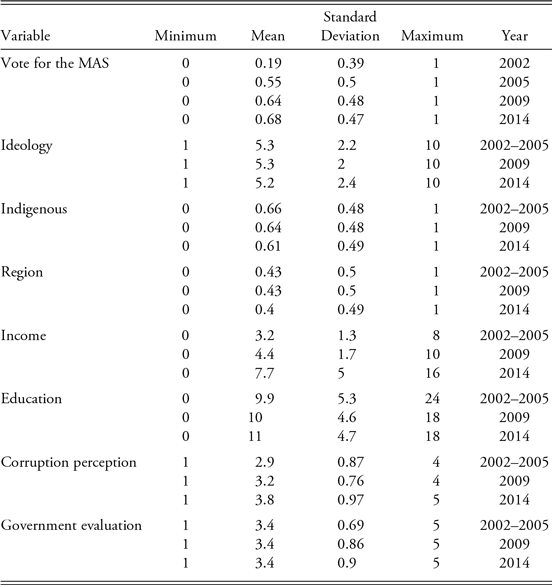
Based on these data, several logit models were estimated to test the impact of different variables on the decision to vote for the MAS in the four national elections held between 2002 and 2014. Table 1 presents the descriptive statistics of the variables included in the models. Given that this study is primarily interested in the effective vote for the MAS and not in vote intention (which, depending on the moment the survey was conducted, may be more volatile and less reliable data), the polls after the election were used to build the dummy variable Vote for the MAS. In all cases, the proportion of votes declared for the MAS was very close to the actual vote obtained by that party in the national elections (see mean values of the variable in table 1).6
Descriptive Statistics

Four logit models were estimated for the dependent variable Vote for MAS, and the main independent variable, Ideological self-identification (measured on a tenpoint scale, from left to right). After two decades of pacted democracy, which inhibited the development of ideological and programmatic linkages, Bolivian politics experienced a marked rise in ideological polarization after events like the gas and water wars. Coinciding with the ascent of Evo Morales, the increase in ideological polarization and the development of programmatic linkages helped Bolivian voters to clearly identify left and right positions and to place themselves on the ideological spectrum. In line with extant studies on ideological structuration of Latin American countries (Colomer and Escatel Reference Colomer and Escatel2005; Zeichmeister 2010; Ruth Reference Ruth2016; Singer Reference Singer2016), evidence shows that most Bolivian voters were able to place themselves on the left-right continuum at a magnitude very similar to that of European voters. Specifically, according to LAPOP, for the 2002 election, 79 percent of Bolivian respondents were able to place themselves on the left-right continuum, and this proportion reached 73 percent for 2005, 79 percent for 2009, and 89 percent for the 2014 election. These percentages are very similar to those reported in comparative studies among advanced and developing democracies.
At the same time, several control variables were included. First, to account for the impact of the ethnic vote, the dummy variable Indigenous was included. It takes the value of 1 if the respondent identified him- or herself as Quechua, Aymara, Guaraní, Chiquitano, Mojeño, or other native, and 0 otherwise. Second, a dummy variable Region was included, coded 1 if respondents resided in the Half-Moon (Media Luna, a region composed by the departments of Santa Cruz, Tarija, Beni, and Pando) or 0 if they did not. These two variables represent alternative explanations for the electoral success of the MAS, to the extent that they measure the impact of ethnic and regional cleavages on the decision to vote for the MAS.
In addition, several other controls were included to account for sociological and attitudinal factors that might be associated with the vote for the MAS. Among these controls are Income (measured as an ordinal variable across 11 ranges of monetary household income) and Education (measuring the educational level of respondents as completed years of formal education). Reported models also include other controls to account for the role played by valence issues, like perception of Corruption among respondents (1 = not generalized; 2 = some generalized; 3 = generalized; 4 = very generalized) and “Government evaluation” (1= very bad, 2 = bad, 3 = neither good nor bad, 4 = good, 5 = very good).7
Results and Discussion
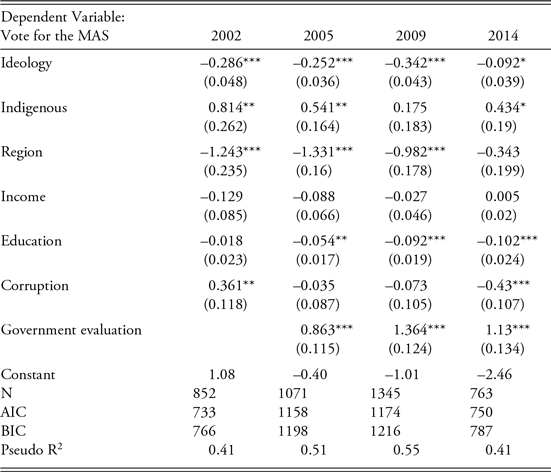
Table 2 displays the results of logit models to evaluate the impact of ideology on the vote for the MAS in national elections of 2002, 2005, 2009, and 2014. As we can observe, the impact of ideology is statistically significant and presents the expected sign for all the elections under analysis. Leftist voters were more prone to vote for the MAS, and the size of this effect is stable between the 2002 and 2005 elections and increases between 2005 and 2009. In 2014, both the size and statistical significance of ideology decrease but keep the expected sign.
Determinants of the Vote for the MAS, 2002–2014, logit models

+ Significant at 0.1; * 0.05; ** 0.01; *** 0.001
Robust standard errors in parentheses
In turn, indigenous condition exhibits the expected sign, as those respondents who identified themselves as indigenous showed a higher probability of voting for the MAS. This variable shows a decreasing impact for the first three elections, and for 2009 it does not achieve statistical significance. For 2014 its impact increases, although at a 90 percent confidence level. Regional cleavage is statistically significant for the first three elections but not for 2014. The negative sign is also consistent with our expectation: voters from the Half-Moon departments were less prone to vote for the MAS in the elections of 2002, 2005, and 2009. In 2014 this effect vanished, showing that the MAS was able to break the regional cleavage, gathering support independently of the territorial concentration of voters, reflecting the process of party nationalization (Morgenstern Reference Morgenstern2017).
Among control variables, income does not seem to be a good predictor of the vote for the MAS, to the extent that it does not achieve statistical significance in any of the elections included in the study. In turn, education increased its impact (in terms of magnitude and statistical significance) in every election after 2005, showing that the most educated voters exhibited a lower probability of voting for the MAS. Regarding valence factors, the perception of corruption was significant in both the first and the last election, although with a different sign. In 2002, those who had a higher perception of the prevalence of corruption were more likely to vote for the MAS, which at that time was a challenging party while the traditional parties had a negative image in the public opinion. Instead, in 2014, those with a higher perception of corruption were less likely to vote for the MAS, which had been in office since 2006. Furthermore, government evaluation achieves statistical significance in the three elections for which the variable is included. As expected, the sign is positive, reflecting the result that those respondents who positively evaluated Morales’ government were more likely to vote for the MAS.
Taken together, these results suggest some conclusions concerning the determinants of the electoral rise of the MAS. First, both ideological positioning and sociostructural variables (ethnic and regional cleavages) had a significant impact on the voting decisions of Bolivian citizens. The stability shown by ideology (size of the coefficient, standard error, and statistical significance) throughout the four elections demonstrates that one of the main factors behind the electoral performance of the MAS (especially during the first three elections) was its ability to attract voters based on ideological signals among voters located at the center and center-left of the ideological scale, regardless of their ethnic condition or region of residence.
According to the results reported in table 2, it is not possible to affirm that the electoral performance of the MAS was based exclusively (or even mainly) on the capacity of Morales and his party to mobilize the indigenous electorate. Instead, the effect of the indigenous vote decreases between 2002 and 2009. That is, the crucial moment of the electoral rise of the MAS coincides with the decline of the ethnic factor and with an increase in the impact of ideology as the main device of mobilization and persuasion.
A second conclusion is that the results show that ideology reduced its impact by the end of the period, as did ethnic and regional cleavages, while the effect of valence issues, such as the perception of corruption and government evaluation, increased. Therefore, it is convenient to analytically distinguish the factors that led to the electoral success of the MAS from those that favored its continuity.
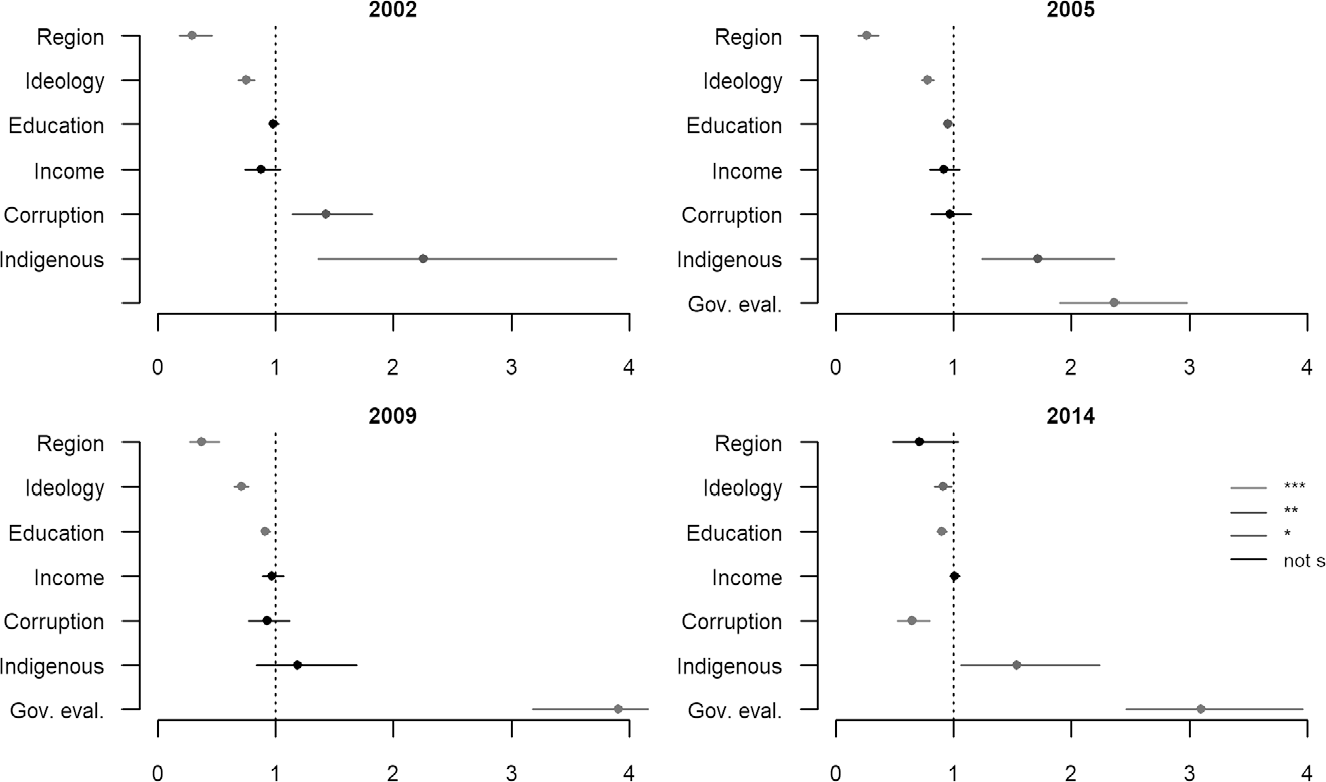
In order to compare the relative impact of different explanatory variables within models, and the marginal impact of the same variable between models, the odds ratios and their 95 percent confidence intervals are presented graphically in figure 1. As the figure shows, the impact of ideology is stable across models, and its confidence interval is small compared to the indigenous condition. Given that ideology is measured on a ten-point scale, its net marginal effect depends on the magnitude of the movement along the scale. Depending on this, the impact of ideology can be even greater than that of the indigenous condition. The region of residence also has a considerable and stable effect, except for the 2014 election, as already indicated. Furthermore, government evaluation exhibits the greatest impact among the control variables for the last three elections, but the precision of the point estimator is lower compared to ideology and region variables.
Odds Ratios and 95% Confidence Intervals of Logit Models Reported in Table 2

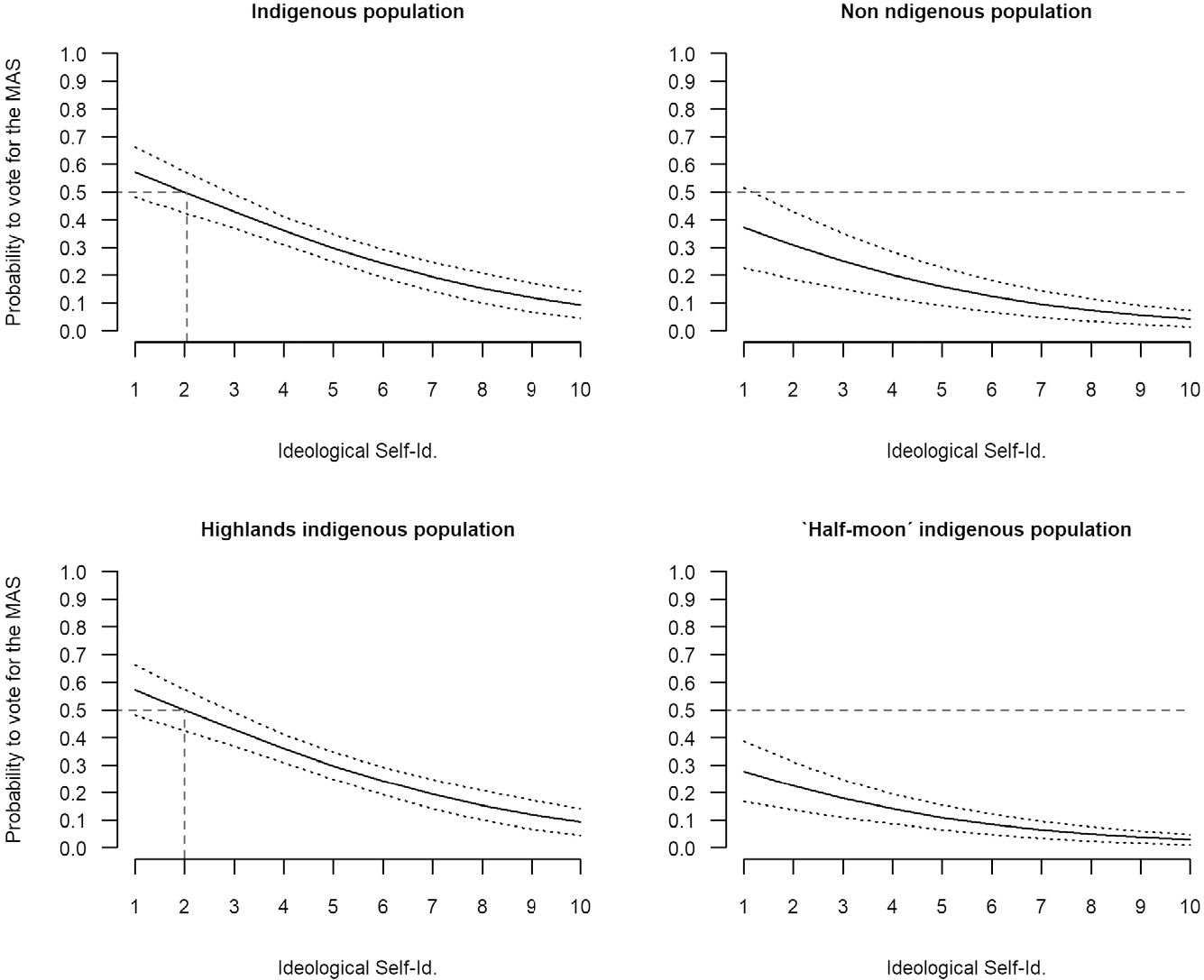
Alternatively, predicted probabilities help to evaluate the impact of ideology and ethnic condition on the vote for the MAS. Figure 2 shows the marginal effect of ideology on the probability of voting for the MAS in 2002, conditional on indigenous self-identification and region of residence. For instance, an indigenous and far-left-wing respondent (indigenous = 1, ideological self-i.d. = 1) had a probability of 0.57 of voting for the MAS. Meanwhile, for an indigenous far-right-wing respondent, this probability dropped to 0.09. The effect of ideology is sizable, holding constant the rest of the independent variables of the model. Alternatively, an ideologically median indigenous respondent presented a probability to vote for the MAS equal to 0.3 and a nonindigenous respondent 0.16.
Vote for the MAS 2002 Marginal effect of ideology, conditional on ethnic and regional cleavages

Within the indigenous population, the effect of ideology, conditional on the region of residence (Highlands or Half-Moon departments), is shown in the lower part of figure 2. The effect of ideology is considerable, even though by 2002 the MAS still did not attract a majority among indigenous voters either from the Highlands or from the Half-Moon departments. Only those who identified themselves at a maximum of 2 on the ideological scale and resided in the Highlands had a greater probability of voting for the MAS. Meanwhile, those who resided in the Half-Moon, still self-identifying as indigenous, had a lower probability of voting for the MAS, for any value of ideological self-identification.
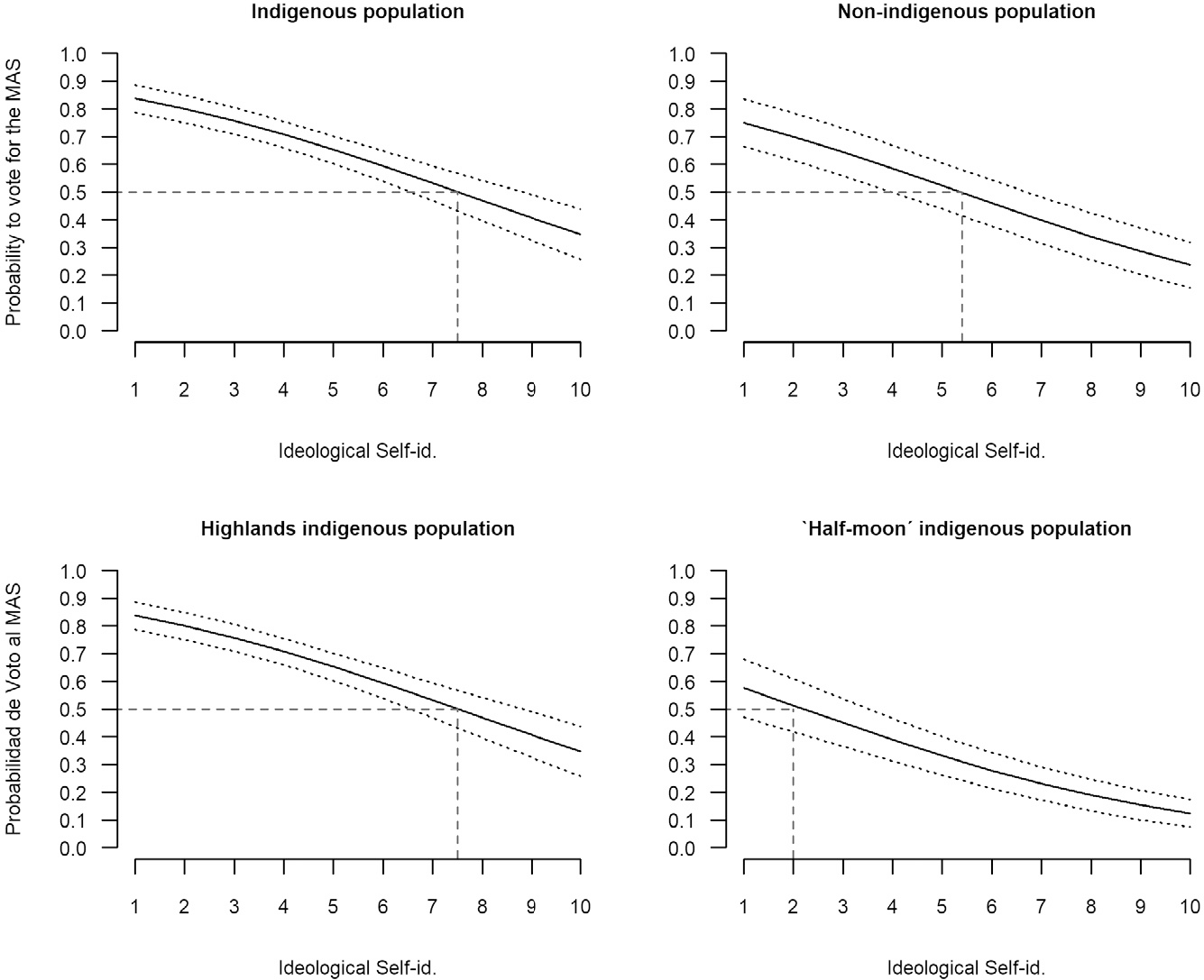
For the 2005 election, figure 3 shows that for an extreme left indigenous voter, the probability of voting for the MAS was 0.84, while for an extreme right voter it was 0.35, which implies a decrease of about 60 percent. This can only be attributed to the effect of ideology. While an ideologically median indigenous voter had a 0.65 probability of voting for the MAS, a nonindigenous had a probability of 0.52. As we can see in figure 3, the probability of voting for the MAS decreases monotonously as the ideological self-identification of the voter moves to the right, and this effect is present in both the indigenous and nonindigenous population (albeit at a different exchange rate). It is very useful to compare the values of the ideological scale for which voting and not voting for the MAS are equiprobable. While for the indigenous population this value is located almost at 7.5, for the nonindigenous population it is located next to 5 on the ideological scale. In 2005, as seen in the lower part of figure 3, for an indigenous respondent resident in the Highlands, the probability of voting for the MAS is almost always greater than not voting, even for those who identify themselves as right-wing voters (the point of equiprobability is located almost in the 7.5 value of the scale). The regional vote was still strong but conditioned by the ideology of voters.
Vote for the MAS 2005 Marginal effect of ideology, conditional on ethnic and regional cleavages

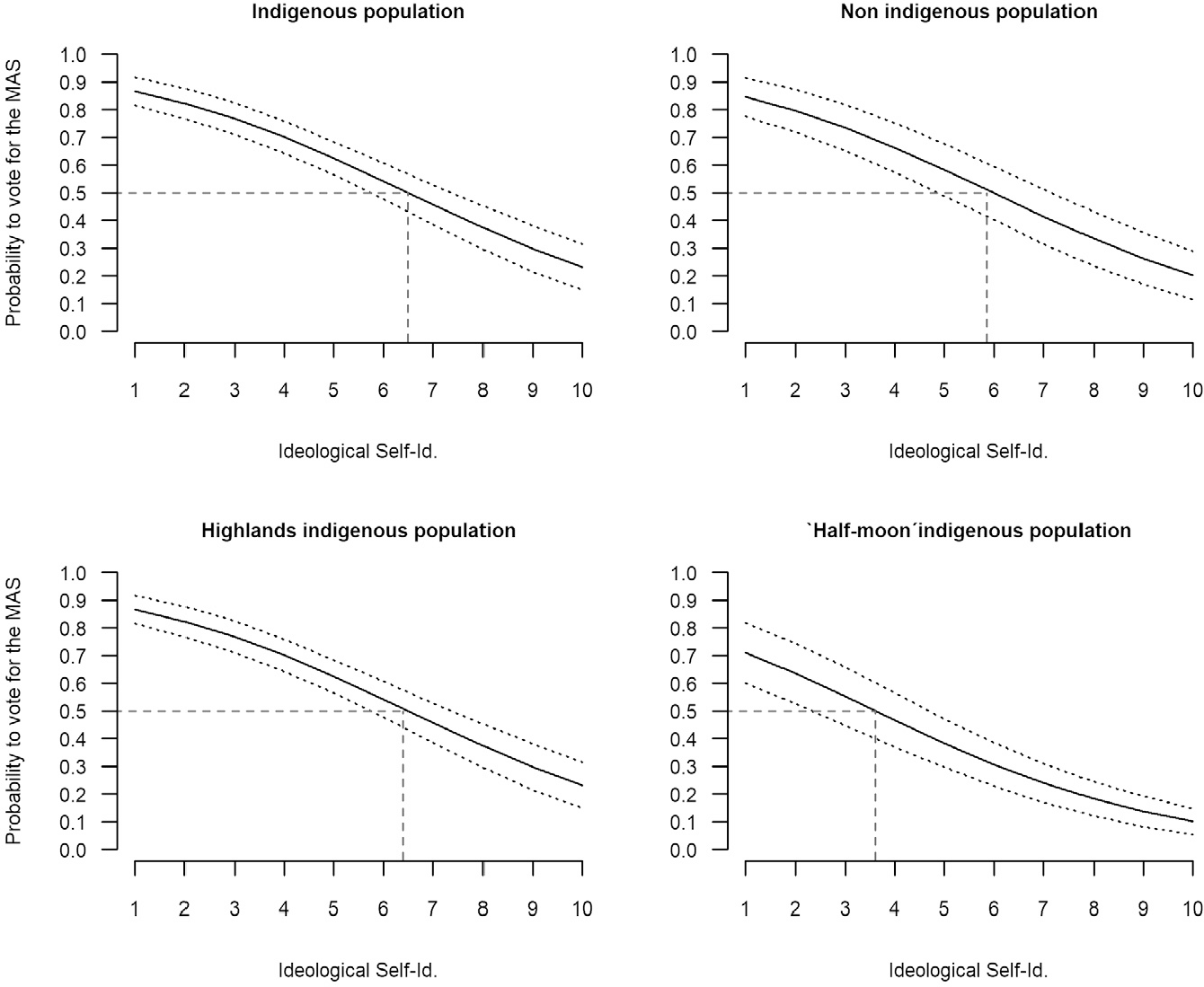
For the 2009 election, figure 4 shows that the effect of ethnic condition decreases compared to the two previous elections, as shown in the results reported in table 2. Figure 4 shows that the behavior of indigenous and nonindigenous respondents was quite similar (upper part of the figure). Ideology affected the probability of voting for the MAS equally among indigenous and nonindigenous voters. Additionally, the marginal effect of ideology on the probability of voting for the MAS was greater than in the 2002 and 2005 elections, showing that this factor increased its impact during the process of MAS takeoff and consolidation. Also, the probability of voting for the MAS was similar in both regions of residence (Highlands and Half-Moon), but the points of equiprobability are closer to each other compared with the 2005 election; this means that by 2009, the MAS was consolidating its electoral power across all departments in the country.
Vote for the MAS 2009 Marginal effect of ideology, conditional on ethnic and regional cleavages

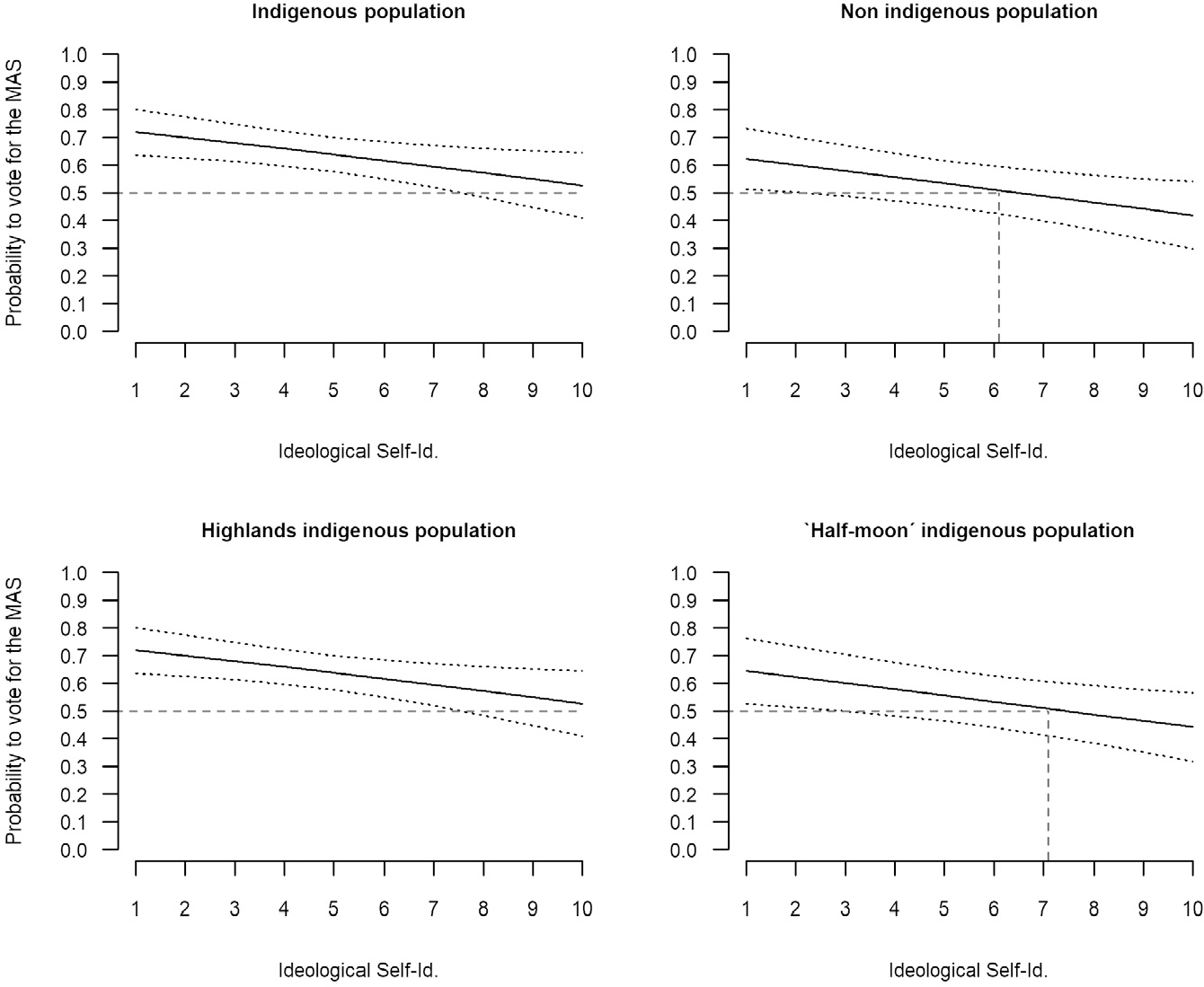
For the last election, 2014, figure 5 shows that indigenous voters were relatively inelastic to the ideology, as they voted mainly for the MAS, although the probability of doing so decreases as the individual moves farther to the right. Among the nonindigenous population, however, the value of equiprobability was about 6 on the ideological scale. Also, for the election of 2014, the effect of the regional vote is completely diluted, since the indigenous population of both regions showed similar distributions. In other words, by 2014 the process of nationalization of the MAS reached a point that broke the regional cleavage.8
Vote for the MAS 2014 Marginal effect of ideology, conditional on ethnic and regional cleavages

Conclusions
This article argues that ideology played a key role in the decisions of Bolivian voters between 2002 and 2014, and by doing so, it complements extant explanations of the electoral rise of the MAS, which have focused mainly on other explanatory factors. The Bolivian case is particularly valuable to carry out an analysis of this sort, since it presents ethnic and regional fragmentation conditions that work as alternative explanations to the one offered here. Thus, the analysis of the individual behavior can help to identify marginal effects and to attribute explanatory power to each one of them.
This article makes two contributions to the literature on electoral behavior in one of the paradigmatic cases of the “left turn” in Latin America. First, it shows that the main explanatory factor of the electoral success of the MAS was its ability to use its location decisions as ideological or programmatic signals that allowed mobilization and persuasion, facilitating the coordination of voters. Unlike other Bolivian parties, which had ambiguous and inconsistent ideological positions, as they privileged personalist or particularistic appeals (in part inherited from the preceding period of “pacted democracy”), the MAS was able to send clear programmatic signals that allowed the emergence of a focal point that attracted not only indigenous voters but also (and increasingly) mestizo and white voters. In that sense, the argument of this study complements the explanations of the electoral success of the MAS mainly based on institutional factors, ethnicity, and charismatic leadership, or on citizen disenchantment produced by the failure of the neoliberal reforms.
Given that other Latin American democracies are affected by ethnic and regional conflicts, personalist leaders, and citizen disenchantment, the Bolivian case can be extended to understand why other parties and candidates succeeded in adopting left-wing appeals to a wider electorate. The ideological vote may have played an important role in countries such as Brazil, Chile, or El Salvador, among others, where leftist candidates have followed strategies that included clear and prominent ideological content. This, in turn, could contribute to explaining why, even though the Latin American median voter is located at the center of the ideological spectrum (Baker and Greene Reference Baker and Greene2011; Carlin et al. Reference Carlin, Singer and Zechmeister2015), leftist candidates managed to win elections based on relatively extreme ideological appeals.
Second, the results here allow attributing different weights to each one of the explanatory factors considered, both for a particular election and throughout the four elections under analysis. Thus, although ethnicity has had an appreciable effect, its impact has decreased precisely during the crucial period of the electoral growth of the MAS. The same can be said of regional cleavage, whose effect fades toward the 2014 election. Ideology, instead, exhibits a more stable effect throughout the four elections under analysis, and its magnitude and statistical significance are robust over time. In substantive terms, ideology allows explaining the rise of the MAS, to the extent that its weight increased during the first three elections, coinciding with the time of its electoral takeoff. The electoral success of the MAS was sustained by the party’s ability to transcend the borders of the ethnic vote, reaching a wider and socially heterogeneous audience, which helped to achieve the absolute majority of the votes in three consecutive elections.
As noted, although the effect of ideology exhibits explanatory capacity during the complete period analyzed, in 2014 its marginal effect decreased. This means that the explanation for the rise of the MAS may not necessarily be the same as for its consolidation. Toward the end of the period considered in this article, the MAS based its electoral predominance increasingly on the entire Bolivian territory, breaking the regional cleavage marked by the Highlands and the Half-Moon departments. Additionally, in this last stage, valence issues like the perception of corruption and government evaluation increased in impact. Also, institutional factors that were not present in the early period of MAS electoral growth also helped its consolidation, such as the possibility of presidential re-election, included in the constitutional reform of 2009. The presence of an incumbent usually has the effect of reducing fragmentation (Jones Reference Jones1995, Reference Jones, Herron, Pekkanen and Shugart2018).
Morales managed to stay in power also thanks to his particular style of government, which concentrated power in the executive branch and in his own person, reducing the balance of powers of presidential democracy (Komadina Reference Komadina2008). Moreover, some scholars argue that the economic policies pursued by Morales’ governments have been pragmatic, contributing to keeping relatively unchanged the basic traits of Bolivian political economy. Therefore, although it escapes the scope and aim of this study, it could be that ideological differentiation is particularly important to facilitate voters’ coordination at the first stages of the process and that such effect can be maintained over time thanks to the joint action of nonideological factors.
Events such as the “gas war” allowed the MAS to mobilize adherents on the basis of a program broader than the demands of the indigenous peoples (Loayza Reference Loayza2011). In fact, that turning point marked the passage from an ethnic party (electorally limited by the ability of traditional parties to co-opt and infiltrate indigenous movements, limiting their capacity for collective action) to a more programmatic one, whose ability to mobilize was basically given by redistributive claims in the classical sense, like the nationalization of natural resources and state intervention in the economy. The programmatic linking strategy was based on the signaling of salient and coherent positions on the ideological space, which allowed for the collective action of the indigenous population. Ideological location decisions as an electoral competition strategy allowed the MAS to transcend its original base and to capture the support of the middle class and urban voters that led Morales to win the first- round election in 2005. Then, in the subsequent electoral victories, ideology continued operating in the same direction, although there were changes in the combination of factors that allowed its continuity.
Notes
I am grateful to Lucas González, Scott Morgenstern, Carlos Varetto, María Laura Tagina, Juan Andrés Moraes, Nicolás Schmidt, and participants of the internal seminar of the Instituto de Ciencia Política at the Universidad de la República for their helpful comments on earlier versions of the manuscript. Comments and suggestions from anonymous LAPS reviewers were extremely helpful to improve this article. I also thank the Latin American Public Opinion Project (LAPOP) for making the data available. Of course, errors and omissions remain my own.
1.Coming from spatial analysis, ideological locations are positions occupied by an agent (voter, party, candidate) on the ideological space represented by the left-right continuum. Parties and candidates frequently use these location decisions as signals for mobilization and persuasion purposes.
2.According to Gunther and Diamond (Reference Gunther and Diamond2003), what characterizes an ethnic party is that it does not promote a program for the whole society, but its objectives and strategies consist of promoting the interests of a specific ethnic group or a coalition of such groups. Instead of raising autonomous claims (such as nationalist parties), these parties intend to act within the state structure to channel benefits toward their particular electoral base.
3.Despite this, Crabtree (Reference Crabtree2011) points out that it is not possible to reduce the explanation of the electoral success of the MAS to the personalist component of Morales’ leadership. He highlights, in consequence, the ideological component of the MAS, which managed to fill the political vacuum opened by the crisis of the previous party system. However, Crabtree is not explicit about how it was possible for the MAS to occupy that void. Precisely one of the contributions that this article intends to make is to explain this ability, based on the location decisions that the party and its leaders made to compete in elections.
4.For the following period (2006–10), data coming from PELA show that legislators perceived the MAS at an average position of 2.76, which implies a slight shift, but within values clearly to the left of the scale. Unfortunately, there is no measurement for the MIP. Meanwhile, Evo Morales was perceived at 2.22, which implies a shift toward the left in relation to the previous period, and Quispe was perceived at 2.96, which also was to the right of Morales. In the following period, Evo Morales is, on average, at 2.28 and MAS at 2.97, and there are no measurements for Quispe or for MIP because they practically disappear from the political map, precisely because the MAS managed to coordinate almost the entire ethnic cleavage on ideological bases.
5.The first two periods (2002–6 and 2006–10) were measured by a five-point scale, while the third (2010–14) was measured by a ten-point scale. To make the three periods comparable, the scales of the first two periods were transformed so that they measured on a tenpoint scale.
6.The vote for the MAS in the 2002 election was estimated based on the 2006 survey, which contains a question about the vote decision in the 2002 election, because the 2004 LAPOP survey severely underestimates the vote for the MAS. While this decision entails a loss of observations, 852 complete cases remain in the sample. According to the 2006 survey, the MAS had the support of 19 percent of respondents when it obtained 20.9 percent in the election, which implies a slight underestimation compared to the 2004 survey (which reports a 9.85 percent of the vote to the MAS). Furthermore, the analysis of descriptive statistics and distributions shows that the loss of cases does not introduce bias on the variables included in the models reported in table 2 (see appendix).
7.In the 2017 survey, the corruption question was changed to “Thinking about the politicians of Bolivia, how many of them do you think are involved in corruption?” and the categories were (1) None; (2) Less than half, (3) Half of politicians, (4) More than half, (5) All.
8.Morgenstern (Reference Morgenstern2017, 216–19) analyzes Bolivia’s 2009 election and finds results that are consistent with those reported here. Although Morgenstern is interested in the nationalization of the parties and the Bolivian party system, he finds a strong influence of regional cleavage, which conditions the effect of ethnic cleavage and even of the economic vote (retrospective and prospective). Morgenstern does not incorporate an ideological vote hypothesis and therefore does not include this variable in his estimates. In that sense, the present work provides evidence that even controlling for the presence of regional and ethnic vote, ideology was a determining factor of support for the MAS, not only in 2009 but throughout the period analyzed in this article.
Supporting Information
Additional supporting materials may be found with the online version of this article at the publisher’s website: Appendix.