They shall not build and another inhabit; they shall not plant and another eat; for like the days of a tree shall the days of my people be, and my chosen shall long enjoy the work of their hands.
———Isaiah 65:22Generally, however, the clumps of trees are the holy places.
———Allan W. Cardinall, Reference Cardinall1920Mosuor's grave, marked by an irregular flat heap of large stones, lies under an enormous old baobab tree which the people of Tongo say is Mosuor.
———Meyer Fortes, Reference Fortes1945Following a chieftaincy dispute in the Mamprusi Kingdom, two brothers came to the place now known as Nangodi, associated with the Nabdam people in northeastern Ghana.Footnote 1 The Mamprusi invaders first stayed in the area known as Soliga and then moved to Yakoti because of internal disputes.Footnote 2 They finally settled in Kalini, the easternmost section of Nangodi, where they established the kingdom of Nangodi (figure 1). They brought with them the chiefly title, Nangonwuse, meaning the place of the “Chief of the Thorn Trees,” from which the name, Nangodi, derives.Footnote 3 Indeed, there are numerous varieties of thorn trees—(Acacia spp., gon in the local language, Nabt) in Nangodi,Footnote 4 which include the white thorn tree (gon pelug); red thorn tree (gon wuraze'ah), and other types of thorn trees (gon wurik and mahta rok).Footnote 5 Their forbidding and distinctive thorns complement the prickly disposition of the arid, stony land and the difficulties of extracting a livelihood in such an environment. Yet there are many trees found in Nangodi besides thorn trees, which include stately baobab (to'o; Adansonia digitata) trees, resplendent mahogany (kok; Khaya senegalensis) trees, bountiful shea nut (tahn; Vitellaria paradoxa) trees, and the dangerous ebony (ga; Diospyros mespiliformis) and African nettle tree (samparin; Celtis integrifolia), among many named others. These five, however, are associated with the several sacred groves (earth shrines; tengbahn) that remain in the area, described by Cardinall almost one hundred years ago.
Map showing selected sections of Nangodi and the Red Volta West Forest Reserve ca. 1960, adapted from Hunter (Reference Hunter1968: 386), courtesy of Cambridge University Press.

In other times and places, people's relationships with and thinking about trees reflect histories associated with particular forms of political and religious authority and with the moral imaginings of people in relation to their environment. Schama, referring to the significance of trees in Polish history, notes that “the truly heroic historians of the drama are trees. Their great antiquity gives them an authority which spans generations…,”Footnote 6 while Stafford, in her discussion of British oak trees, observes the flexibility of their interpretations: “The outstretched arms of the oak offer a congenial symbol to even its deadliest opponents—and make the complicated story of its political exploitation a telling example of how different notions of nationhood can be cultivated, felled, grafted or replanted.”Footnote 7
In the African context, Feeley-Harnik considers the ways that thinking about trees in Madagascar is related to the “growing, grafting, and chopping [of] ancestries,” which legitimates competing claims to land and labor, witnessed in the ritual associations of trees in the construction of the tombs of royal bodies.Footnote 8 Turner also discusses the importance of trees in social life, as when the different layers of meaning of the mudyi (milk) tree in Ndembu ritual performances represent both generational descent from mother to daughter (i.e., matriliny) and Ndembu cultural unity as well as social divisions.Footnote 9 However, more recent environmental concerns regarding trees and deforestation have led to studies which examine colonial impositions of forest reserves in AfricaFootnote 10 and critically consider contemporary efforts to protect and maintain so-called pristine forest stands.Footnote 11 These efforts, which envision forests as sylvan places of beauty, refuges for wildlife, or “carbon banks,” may overlook local forest histories and economic uses of specific trees—as sources of timber, firewood, food, and oil—as opposed to their role in conservation strategies.
Nangodi is a useful site for considering these intersecting ways of thinking about trees, society, and history as certain spiritual and social relations between people and trees have been maintained in the presence of an accretion of distinctive forms of political authority—earth priests, chiefs, and colonial officials as well as federal, state, and district authorities.Footnote 12 Sacred groves coexist with the colonial Red Volta West Forest Reserve and, since independence in 1957, with a succession of tree-related development initiatives.Footnote 13 This coexistence underscores the connections between practices relating to and thinking about trees that are often considered separately, for example, either as Western scientific forestry or as spiritual relations between people and trees. While the former Red Volta West Forest Reserve guard, Osman Kolbil, described his work with the Department of Forestry in building a fire-belt around the reserve and keeping people from coming in to cut trees to make charcoal, he also noted the spontaneous growth of a flake rubber tree (nkansauk, Ficus platyphylla) at his family compound: “The nkansauk is an honorable tree. Chief Azure II (Langhil), he enskinned my grandfather as a chief. The nkansauk came to my grandfather to honor him for becoming a chief (“like an umbrella for him”). Later the fruit bats came to honor my grandfather [who was then known as Inzana Bagnaba—Chief of the Bats], although later the tree died; the bats moved away although a few stayed in the nearby baobab tree” (interview, 31 May 2015).
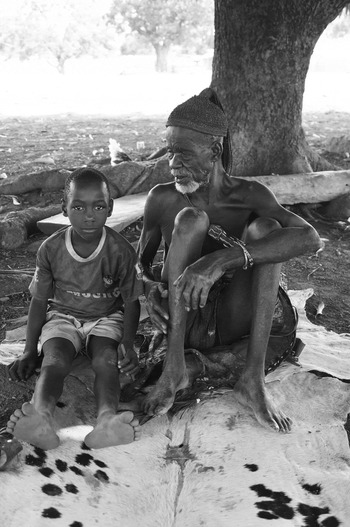
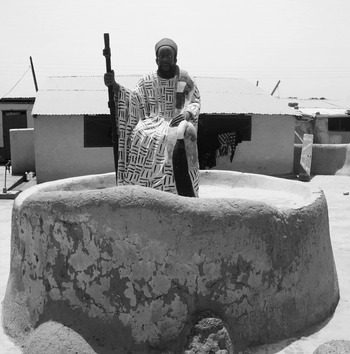
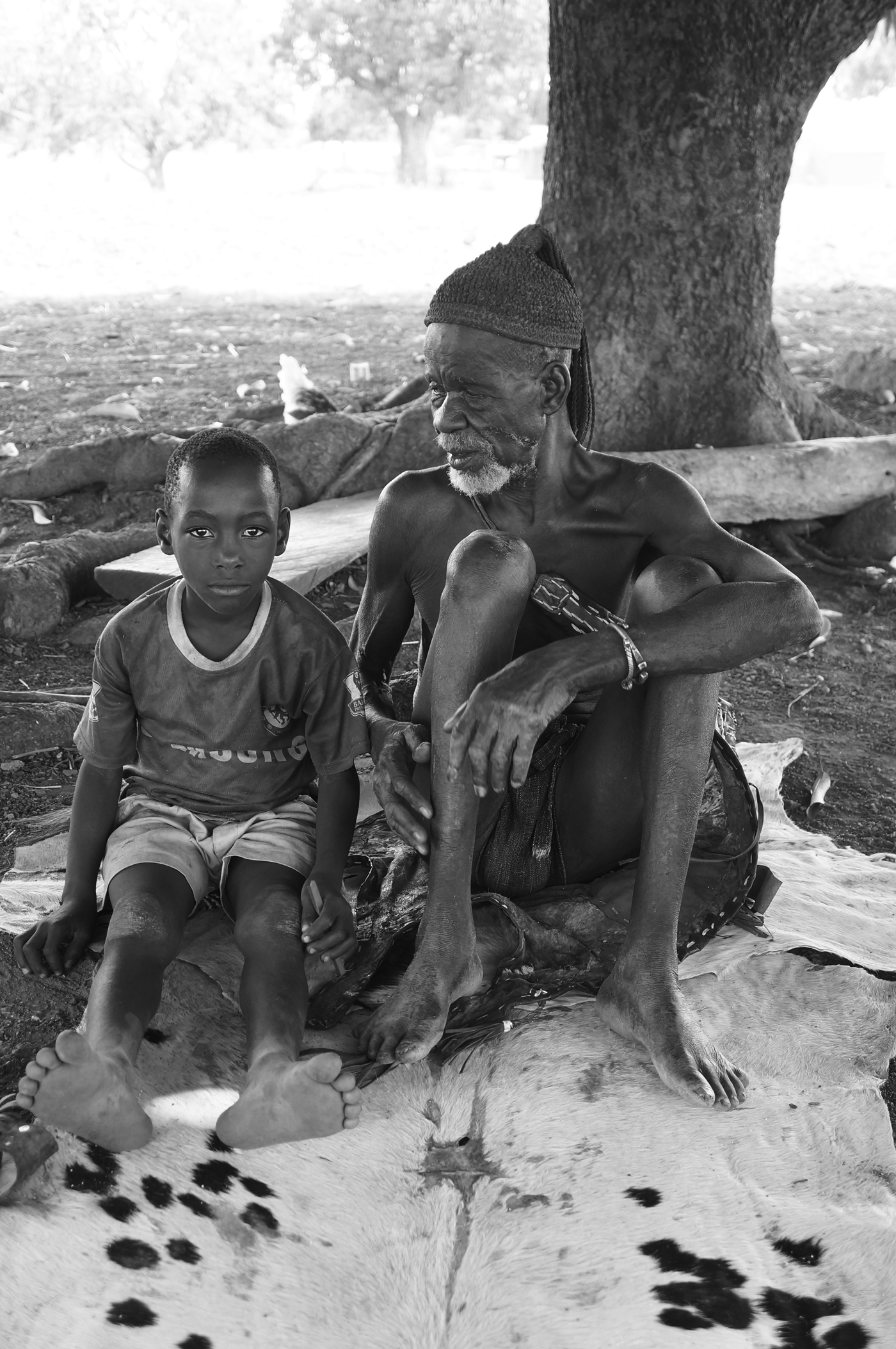
Thus, in Nangodi, trees may be viewed in various ways: as forest commodities to be protected, utilized, or exploited; as spiritual beings which may honor, watch over, or even harm people; as authentication of political authority; and as markers of social relations and property rights between individuals, families, and communities. Yet these distinctive representations of trees do not represent a succession of arboreal chronologies leading to a contemporary perception of trees as commodities and as objects for environmental research and preservation, distinct from the intimacies of social life. Rather, they are better conceptualized as historical accumulations of trees (tii) and earth shrine stones (kugri) and intersecting forms of authority and political rule over space continuing more or less into the present.Footnote 14 Sitting on a skin associated with his office as an earth priest (tendaana) and his authority over several sacred groves (figure 2),Footnote 15 Ndaan Nyaak observed the enormous baobab tree next to his compound that spontaneously appeared upon his grandfather's death:
Baobab is our grandfather—when he died the baobab came…. The name of my grandfather is Getu, from Getouk, which means “he is annoyed.” When he refused to go to war, the whites arrested him and cut off his hands so he had to use bangles and a spoon to eat. He turned into this tree (tii), our ancestral father…. This baobab helps us a lot … it keeps our home for us, for our people to be well and to gain prosperity. We give birth and then give children the name of this tree—Tii is what we name our children, although we know them as Getu among ourselves (Nyaak interview).
Earth priest tendaana Nyaak sitting with his grandson on a skin in front of his family compound. They are facing the enormous baobab tree associated with his grandfather, Getu (photograph by E. P. Renne, Nangodi, 27 May 2014).
TREES, TIME, AND INTIMATE IMMENSITY
The historical interconnections of this tree and the ancestral spirit of the tendaana’s grandfather as well as with extant members of his family are expressed through memories of the colonial past (“the whites arrested him and cut off his hands”), through sacrifices to their tree-grandfather for present-day security (“it keeps us well”), and through giving the name of their grandfather, Getu, and the baobab tree he now embodies, to future generations of children.Footnote 16 As a living thing that eludes time in the sense that it long outlives its human neighbors and also suddenly appeared upon the death of its ancestral double, the baobab's longevity makes it a particularly appropriate symbol for representing Ndaan Nyaak's family lineage.Footnote 17
Such continuing practices associated with respect for particular trees and their spirits, expressed in the offerings and sacrifices made at earth shrines that include sacred groves, tend to obscure concurrent, contested aspects of Nangodi sociocultural, political, and historical identity. Indeed, the political authority of spiritual leaders (earth priests, tendaam, pl.), each associated with their oversight of a particular sacred grove (an earth shrine, tengbahn, literally translated as land skin),Footnote 18 has changed over time. Even as the early twentieth-century presence of British colonial authorities promoted pax colonia through their support of the overrule of Mamprusi chiefs in areas previously overseen by these earth-priests and associated clans, oscillating shifts in the basis of political authority nonetheless continued control of some, but not all, sacred groves and earth shrines by associated clan earth priests (tendaam), as the verse from Isaiah suggests. Particular trees have been incorporated into this process. Despite the growth of mainline and Pentecostal Christian churches and Islam in the area, ideally if not always in practice, “people respect the groves as the spiritual hub of these communities, which safeguards the groves from destruction.”Footnote 19 This situation distinguishes Nangodi from the neighboring town to the immediate west, Kongo, which is dominated by the Catholic White Fathers mission, with its Spiritual Revival Centre, that is, nonetheless, surrounded by a grove of fenced trees, which itself signifies a different cultural conception of trees.Footnote 20
Sunseri has suggested that the local preservation of trees and forests in Africa has been served by “a local long term historical identification [as well as a collective memory] of people with forests”Footnote 21 rather than by government and NGO projects for their preservation. While the economic uses of trees have long been part of Nangodi history, their spiritual connections with human well-being and suffering have also continued. The colonial establishment of the Gold Coast Department of Forestry in 1909 and the Forestry Commission in 1993,Footnote 22 as well as the official gazetting of the Red Volta West Forest Reserve in 1950,Footnote 23 introduced a distinctive commercial and “scientific” interpretation of trees and forests that continued after Ghanaian independence in 1957. As Dei notes, “Rural communities have been drastically transformed as a result of the expansion and contraction of the world economic system” in Ghana.Footnote 24 However, recent reconsideration of the continuation of forestry practices in the Red Volta West Forest Reserve—the exclusive planting and harvesting of teak treesFootnote 25—in favor of mixed land use also suggests a change in government-sponsored forestry in northeastern Ghana. Ironically, this reconsideration may also be seen in the ways that Nabdam and German forestry workers think about trees. For example, the German forester Peter Wohlleben writes of trees as having “hidden lives” and the ability to communicate: “Trees, it turns out, have a completely different way of communicating: they use scent.” In his example of giraffes’ eating umbrella thorn acacias in Africa: “The trees didn't like it one bit. It took the acacias mere minutes to start pumping toxic substances into their leaves to rid themselves of the large herbivores.… The acacia trees that were being eaten gave off a warning gas (specifically, ethylene) that signaled to neighboring trees of the same species that a crisis was at hand. Right away, all the forewarned trees also pumped toxins into their leaves to prepare themselves.”Footnote 26 The retired Nangodi forestry worker, Daabokit Tenga, provides another example of the communication and (at times, dangerous) agency of trees:
Trees communicate by speech but we don't hear them. Yes, trees talk. For example, one day, one of a family's cows went missing, it didn't come home. So, the herder-son went to find the cow and he decided to sleep in the top of a tree. Around midnight, a neighbor-tree called to the tree where the boy was staying to go with it to get water, but the tree said that it couldn't go because it had a stranger sitting on it. The next day when the boy went back home, he told his family about the trees talking and then he suddenly became very ill and couldn't walk. He recovered but his leg was still paralyzed. He later died (Tenga interview).
While Tenga's and Wohlleben's observations are not quite the same in their meaning, these two foresters’ examples of tree communication are similar in their personification of trees.
As Wohlleben notes, his earlier relationship with trees as a German forestry worker was grounded in standard Western forestry practices: “When I began my professional career as a forester, I knew about as much about the hidden life of trees as a butcher knows about the emotional life of animals. The modern forestry industry produces lumber. That is to say, it fells trees and then plants new seedling…. Because it was my job to look at hundreds of trees everyday—spruce, beeches, oaks, and pines—to assess their suitability for the lumber mill and their market value, my appreciation of trees was restricted to this narrow point of view.”Footnote 27
However, Wohlleben developed a more personal understanding of trees as he began “to pay attention to more than just the quality of the trees’ trunk.” He started to consider not only trees’ intimate forms of communication but also their internal means of measuring time associated with recurring processes of renewal, such as the appearance of new leaves in springtime. Gaston Bachelard's poetic consideration of trees as encompassing what he calls “intimate immensity” is useful for understanding this shift in thinking as well as Nangodi residents’ relations with trees.
For Bachelard, a tree such as the baobab, with its enormous trunk and outstretched branches, “like every genuine living thing, is taken in its being that ‘knows no bounds.’ Its limits [in space] are mere accidents.”Footnote 28 The outward immensity associated with baobab trees, which spontaneously appear near family compounds after the death of an important lineage elder, captures this sense of a being without limits in space as well as being outside of time (i.e., the sequence of growth from seed to tree). As in the case of the baobab tree growing in front of tendaana Nyaak's compound, it is both a tree and the spirit of the family's grandfather, Getouk, whose life, like the tree's, “knows no bounds” and will continually be present for future generations of this family.
Yet there is another aspect of the baobab tree, which reflects the intimate relationship between an individual family member and this person's guardian spirit (known as segere), often the spirit of a tree such as the baobab. As will be discussed, this segere spirit protects its human charge, who receives the name Tii (tree) in reference to this guardian. “We give birth and then give children the name of this tree—Tii what we name our children…,” as Ndaan Nyaak said. In a sense, then, the immensity of the baobab tree (for whom many children have been named in Nangodi), is internalized in the individual: “The two kinds of space, intimate space and exterior space, keep encouraging each other, as it were, in their growth.”Footnote 29 In making this observation, Bachelard is thinking about a poem by Rainer Maria Rilke,Footnote 30 which advises, “If you want to achieve the existence of a tree, invest it with inner space, this space which has its being in you.” This sentiment resonates with some Nangodi residents’ explanations of the relationships of people, their spirits, and guardian spirits associated with particular trees as well as with Wohlleben's support for human appreciation of the intimate, hidden lives of trees.
Considering the social histories of local places such as Nangodi, and specifically examining the relations of people and trees, can serve as a means to rethink apparent dichotomies—between intimate inner and immense outer states, between spiritual connections with and commercial detachment from the environment, and between political authority over land by representatives of local institutions (earth priests, chiefs) and those of the state (district and federal officials).
PRECOLONIAL MEMORIES OF PEOPLE AND TREES
When Captain R. S. Rattray of the Gold Coast Political Service conducted research in the Nabdam area, he interviewed the Nangodi chief, Naba Azure II (1903–1942),Footnote 31 who provided him with a history of the origins of Nangodi chieftaincy:
Our first ancestors were called Loro and Zan. Zan is the name of a tree which was the ancestor's segere [“guardian spirit”]…. When we came here, we found a people who had not any Chiefs, only Ten'danam (Ten'dama). They spoke the language Nabte. Our people followed Loro, and Zan became the first Chief. He died and is buried here. The people whom we overtook here, we called Namnam. We became their Chiefs. We own the people, the Ten'danam own the land. The present Ten'dan’ is called Biriwanab, his grove (tengwan) is known as Dakyirig. The Ten'dan’ makes sacrifices to the land.Footnote 32
Following the establishment of the British Protectorate of the Northern Territories of the Gold Coast in 1903, the Nangodi chief, Naba Tii,Footnote 33 was asked by British officers to build a road between Navrongo and Bawku.Footnote 34 Although he is said to have refused, he was killed by Nabdam villagers who, according to Naba Azure II, saw Tii as a European collaborator.Footnote 35 Naba Azure II told Rattray that he then traveled to Gambaga, the capital of the Mamprusi Kingdom, and returned with military support from Captain William Wheeler of the Gold Coast Constabulary. Some Nabt villagers were killed, while others fled after their houses were burnt and their livestock seized. From 1903 onward, a line of chiefs from the Biam (Azure) clan has ruled in Nangodi, although a member of the Zoot clan was appointed Naba Nangodi in 2006.Footnote 36 The political-religious relationships between the chiefs (naba) of the conquering Azure clan and earth priests (tendaam) of the indigenous Nabdam villagers have frequently been expressed in their historical associations with trees and sacred groves.
Dakiriq Grove, Zoog, Nabdam District
Rattray also interviewed the earth priest, tendaana Biriwanaab, mentioned by Naba Azure II, who was the religious leader responsible for Dakiriq, the sacred grove in the section of Nangodi known as Zoog (see figure 1). Interviewed in 1929, he had a somewhat different perspective on the situation of chiefs and earth priests regarding ownership of the land at that time: “My ancestor owned the land. I was head (Ten'dan kpwε m; senior earth priest). The Europeans have given power to the Chiefs who now own the land. My ancestors owned dawa treesFootnote 37 and lost beasts….Footnote 38 When someone wanted to build a new house, he would ask the Ten'dan’ and be given a place to build, or a place to farm. After the harvest of the early millet, they would send millet to give “water” to the groves….”Footnote 39
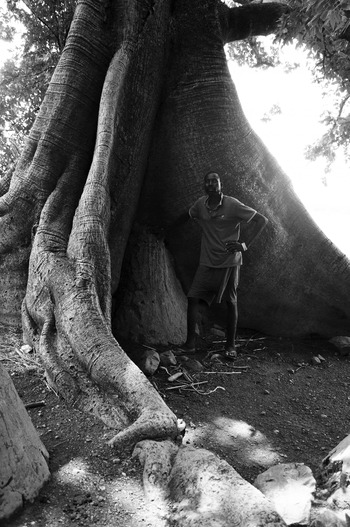
Despite the ascendancy of Nangodi chiefs, then colonial officers, and later Ghanaian government officials, the Dakiriq sacred grove remains important. It is considered to be the oldest sacred grove in the area, followed by the Yakoti sacred grove known as Bala Klolook. The earthen mounds (baga) for deceased earth priests for Dakiriq, located near the regent earth priest's compound in Zoog, surround the base of an enormous silk cotton (gung; Ceiba pentandra) tree, with one mound built inside the crevice formed by the tree's large buttresses (figure 3). There is a list of the ten named earth priests buried there,Footnote 40 which suggests that the grove is at least over two hundred years old. In 2014, the earth priest tendaana Piyag had recently died and the regent earth priest, tendaana To'o, spoke about the Dakiriq grove: “This grove is a gift given by the Gods, it wasn't established by man. There is a particular tree associated with this grove, it is the ebony tree. Before you can enter this grove, you will need to remove your shirt and shoes. People come here with many requests—for money, for health…. The appreciation of this grove has increased. Because of the efficacy of the Gods, more people are coming here” (To'o interview).
Silk cotton tree (gung; Ceiba pentandra) associated with the cemetery (wurt) for Dakiriq earth priests (tendaam), with earth mound burial markers (baga), each of which is identified with a particular earth priest by name. The mound for the third Dakiriq earth priest, tendaana Bire, was placed within two buttresses of the silk cotton tree, which is said to have appeared three days after he died (photograph by E. P. Renne, Nangodi, 4 June 2014).

Certain practices, such as the earth priest's ownership of dawa dawa (locust bean; Parkia biglobosa) trees and lost animals have continued in Zoog and Nakpaliga sections, but not in others where the authority of chiefs predominates. For, as earth priest tendaana Biriwanaab noted, “the Chiefs now own the land.” Following the establishment of the British Protectorate of the Northern Territories of the Gold Coast, the colonial state was the ultimate arbiter of land use. Nonetheless, initial permission to use land for mining and forestry during the colonial era was given by the chiefs (nanam), and at times by earth priests (tendaam).
COLONIAL RESHAPINGS OF THE LANDSCAPE
Establishing the Nangodi Gold Mine
The spot they were occupying [in Nangodi] was in the very thickly populated granite hill country, which is quite delightful particularly in the early rains, when the rolling countryside is green with the growing millet. Dotted around, as in a park, are the da-dawa [locust bean] trees. Every inch of ground is cultivated but for bits set aside for cattle and the farmer's compounds….
———A. C. Spooner, District Commissioner, Gambaga, 1935The period of the British Protectorate of the Northern Territories of the Gold Coast (1903–1957) was characterized by oscillations between the destruction and planting of trees, which varied with the building of government structures, chiefs’ activities, and expatriate initiatives. During the first years of colonial rule, there was relatively little evidence of the official British presence since the enormous area of the Protectorate was administered from Tamale, in the present-day Northern Region.Footnote 41 However, the road between Navrongo and Bawku facilitated the oversight of colonial officials such as Captain A. C. Spooner. Spooner was District Commissioner in Gambaga in 1935, with control over Navrongo, Zuarungu, and Bawku; he later moved to Navrongo as District Commissioner in 1937.Footnote 42 Having met the gold miners Australian Buck McGuiness and the British Jock Reid while stationed in the Ashanti-Akim Region in 1932, he later learned of their plan to build a gold mine in Nangodi. McGuiness had based his decision “on the geological fact that the gold bearing rocks of Ashanti and the Western Gold Coast dipped under the Volta to reappear along the northern border…. Investigations [in Nangodi] revealed a reef worth working.” Spooner described some of the obstacles facing them:
Water they had from wells which are easy to make in this granite country, but how could they manage for fuel in a county where every tree is owned and is of value? Buck had thought of this before they started and had bought some machinery in French Territory. With this they set up a producer gas plant. This contraption, a bit like an old traction engine was fed with dry millet stalks which they bought from the people. It proved very useful as the by-product of treacly tar mixed with swish provided an excellent plaster for the mud buildings which suffered so much in the rains.Footnote 43
Spooner helped compensate farmers in the Nakpaliga section whose land was used for the mine: “The negotiations with the help of Nangodi Na did not prove difficult, and each dispossessed family was to receive so much money and also so much millet per annum on certain dates.” McGuiness and Reid continued mining until 1937, when gold returns dwindled: “The reef petered out and rather than undertake the chancy business of underground prospecting they sold to Gold Coast Selection Trust on an agreement whereby if mining did not continue the property reverted to them so that they could recover the gold in the shaft lining before the mine [was] finally abandoned.”Footnote 44
Soon after the mine's concession was taken over by the Gold Coast Selection Trust Ltd., Spooner complained in a letter to his mother about the new management. As millet stalks proved to be an insufficient source of fuel, mining company workers had taken to scouring the surrounding countryside for firewood, infuriating Spooner: “At the moment I am having a war with the Nangodi Mine people. The new staff of the mine are very different people to the old lot and I am fed up with fınding that nearly every statement they make is a cunning lie. The trouble at the moment is that they are illegally decimating the country of wood. They have fooled me properly and then of course, that always makes one angry.”Footnote 45 Later, in December 1937, the dispute was settled and the mine continued to operate for another three years.Footnote 46 By 1941, with declining gold returns and war imminent, the mine was closed, ending the destruction of local trees which included the cutting of African birch (se'e; Anogeissus leiocarpa) trees for mineshaft reinforcement.Footnote 47 Yet the African birch (se'e) tree played a role in another colonial economic initiative since it was one of the trees planted in the newly established Red Volta West Forest Reserve, which was organized by officials from the colonial state's Gold Coast Department of Forestry.
Red Volta West Forest Reserve
In 1943, the government Department of Forestry officials finished demarcating the perimeters of the Red Volta West Forest Reserve on the western bank of the Red Volta River.Footnote 48 Prior to its establishment, the area contained many local tree species,—for example, ebony (ga), shea (tahn), black plum (ahrik; Vitex doniana), rosewood (nalak; Pterocarpus erinaceus), and nsabik (Lannea acida), as well as African birch (se'e)—and also served as an animal corridor: “Villagers used it as a hunting ground, every three years to expel animals, they also used bush fires to control wild animals, some of which were treacherous animals” (Amoore interview). Indeed, elephants continued to visit the area, as one forestry official observed in 1951: “Branchwood from felled trees was piled on 3 sides of the Nangodi and Sekoti 1951 coupes to discourage elephants. They have, however, discovered the unprotected side and 3 elephants now carry out morning and evening inspections in Nangodi. It would appear that they are uncertain of the date on which planting will commence.”Footnote 49 Based on the principle of forest reserves as a balance between economic and environmental conservation, colonial officials hired forest workers to plant trees, water seedlings, and work as forest guards who prevented people from taking wood for charcoal. They also built and maintained fire-belts to prevent the spread of bush fires. The trees planted were primarily whitemen's trees (nasar tiis), mainly teak (atick; Tectona grandis) and neem (Azadirachta indica),Footnote 50 as well as local trees such as African birch (se'e) and mahogany (kok). “Some were planted from seeds here and if they didn't have them in town, they brought the seeds from outside. They would grow the seedlings in containers first and then plant them” (Kolbil interview, 5 Jan. 2017). Initially, there was a house in the reserve where guards and workers stayed which prevented people from cutting down trees to make charcoal. They had a tiwo [technical officer] who was above all the others—the first was in 1952, who was called Agwalah—“something that is not straight”Footnote 51 (Kolbil interview, 1 Mar. 2015).
During the same period in the early 1950s, the Department of Forestry sponsored other tree-planting projects in Nangodi referred to as “amenity plantings.”Footnote 52 For instance, people recalled that during the reign of Naba Kaumda Azure (1943–1955) an avenue of mahogany (kok) trees was planted to line either side of the main road through Nangodi (the present-day Bolga-Bawku Road): “The head was a European, but he had a Ghanaian working under him.… They brought small seedlings and laborers planted them during the rainy season” (Azure interview). Mahogany trees were also planted around the newly constructed Shari'a Court House in 1952. Around the same time, neem seedlings were planted around the Nangodi primary school, built in 1945, to serve as windbreaks and students were recruited to water them as they grew. Some of these trees can still be seen in Nangodi.
TREES IN THE INDEPENDENCE ERA
Tree planting and the management of the Red Volta West Forest Reserve continued after independence in 1957. In the early 1960s, several government offices were built in Nangodi and silk cotton trees were planted to mark the way for visiting officials; again, school children were engaged to plant and water young trees. Pairs of enormous silk cotton trees still line the roads to the District Commissioner's bungalow (now occupied by the district's medical officer) in the section of Nangodi known as Nakpaliga. They were also planted along the road to the compound of Naba Amoore Azure IV (1956–1965) in Kalini.
At the Red Volta West Forest Reserve, several technical officers were in charge of the forestry guards; Daabokit Tenga recalled, “There was Dome [Domenick], a Talensi man from the Garese/Tongo area; others were Ashanti, but I don't remember their names because they were difficult to pronounce…. People were not allowed to cut trees in the Red Volta Forest Reserve, a tree was never harmed by anyone then” (Tenga interview). The large-leafed teak (atick) trees continued to grow along with other trees planted in the reserve. However, many Ghanaians suffered from the economic decline that followed the implementation of the Structural Adjustment Programme in 1984.Footnote 53 In March 2001, President John Kufuor announced Ghana's participation in a World Bank, IMF-sponsored HIPC program that restricted government spending. Funding for the Department of Forestry dwindled and many forestry workers were retrenched: “The government said they didn't have money to manage the Red Volta Forest Reserve because they were bankrupt so they were going to give it to nasara [whites] to manage; this was under the Rawlings administration [sic]. The government gave workers some small amount of money for compensation but they were not given their pensions” (Tenga interview).
Daabokit Tenga here refers to the 2006 contract made between an Indian company and the Forestry Commission and Talensi-Nabdam District Assembly to cut teak trees in the Red Volta West Forest Reserves. In addition, a private Chinese firm was said to have also hired local woodcutters to harvest rosewood (nalak) at that time (Nangodi interview). Of the proceeds from these contracts, 7 percent went to the Nangodi regent chief, Naba Pukpeok [Kofi] Naamsakiya Azure, whose family had initially given the land for a portion of the Red Volta Forestry Reserve, while a percentage also went to the District Assembly and to the Forestry Commission.Footnote 54 According to one man who was involved in cutting and loading teak trees: “There wasn't any problem with cutting teak because it was a foreign tree (nasar tii), without any local value…. The Indians came three times to get teak, they stayed in Bolgatanga, but they didn't hide themselves because they had a contract with the Forestry Commission” (Kparib interview). Between the cutting of teak and rosewood trees and those cut by local residents to make charcoal,Footnote 55 the Red Volta West Forest Reserve was stripped of its largest trees.
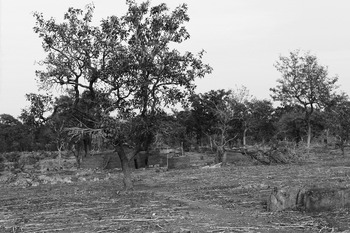
This situation continued until early 2015, when the Department of Forestry announced that reforestation efforts were to begin. However, in the nine-year interval during which forest reserve guards had been dismissed, a small number of people came to fish in the Red Volta River.Footnote 56 Initially they built huts but later built houses and began planting small farms. The government told them that they could go to the Reserve and farm and plant trees there since they were serving as informal guards for the forest. Later, as the farming and the house-building expanded, officials from the Department of Forestry and the Nabdam District Assembly warned them to leave. In January 2015, those who remained had their crops sprayed with chemicals that killed them and their houses were burned down (Kolbil interview, 1 Mar. 2015; figure 4.). Several months later, a community meeting was held on the grounds near the District Assembly in Nangodi in March 2015 to discuss the situation of people living and farming in the Reserve and the Reserve's future. Forestry officials insisted that the land should not be used for farming and houses, while several community members who were farmers insisted that the land should be used for farming rather than the replanting of trees. This issue was not resolved and as there were no reforestation efforts made in 2016, they were told to leave. Although some cut teak trees showed evidence of second growth, a few people came back and began farming in the reserve, and by 2017 one small house had appeared.
An abandoned hut and remaining trees in a section of the Red Volta West Forest Reserve (photograph by E. P. Renne, Nangodi, 23 May 2015).

TREES IN NANGODI: GLOBAL AND LOCAL PERSPECTIVES
The distinctive perspectives of Western-educated Forestry Commission officials and Nabdam District officers ideally favor Western forestry practices: planting trees with economic value, monitoring their growth, and harvesting them for sale, although the politics and economic incentives of illegal logging at times have undermined the genuineness of this perspective.Footnote 57 Alternately, while local Nangodi residents also cut trees for economic purposes, particularly for house-building, firewood, and making charcoal, certain named trees embody continuing relationships between chiefs, ancestors, and families, as well as between earth priests and trees in the area's many sacred groves.
Permutations of Political Hierarchies: Trees and Chiefs, Trees and Earth Priests
Three sections of Nangodi—Soliga, Yakoti, and Kalini—have been closely linked with migrations of Mamprusi invaders who finally settled in Kalini, although the current Naba, who comes from a different clan, resides in Soliga. Two of these sections, Soliga and Kalini, have no earth priests to tend to their sacred groves, reinforcing the ascendancy of chiefs; the two groves in these sections are attended to by caretakers (gool) who perform sacrifices for chiefs. As is the case with political leadership in Nangodi, sacred groves have a hierarchy of trees, with the head tree receiving sacrifices and offerings. The head trees in both Soliga and Kalini groves are the frightening ebony;Footnote 58 women avoid collecting firewood even from ebony trees outside of the groves because the smoke is said to cause madness.Footnote 59 Of the two groves in the Yakoti section, one has an earth priest, tendaana Bugre Nafo, who attends to the Bala Klolook grove, with a kumbangire tree as its head. The earth priest, tendaana Kugibila Wobome, attends to the other sacred grove in Yakoti known as Pakure, which has a baobab tree as its head. This earth priest, who is related to the chief of Yakoti, Naba Beleagnamalting Wonab II, whose father, the first chief of Yakoti who was enskinned in 1973, was a close friend of Naba Amoore Azure IV.Footnote 60 Thus, in Yakoti, the presence of two earth priests and their separate groves reflects another permutation of the relationship between control of sacred groves and the respective political authority of chiefs (na) and of earth priests (tendaam).
This contested configuration of political authority over land and trees can more clearly be seen in the section known as Nakpaliga, where there are six groves, which are overseen by Nabdam earth priests (tendaam) who are unrelated to Nangodi chiefs. A shea tree is the head tree in two of these groves, the ebony tree is head in two others, while imkparik and impung trees head the other two. The most senior sacred grove in Nakpaliga, Sataluk-Teng, was controlled by the earth priest, tendaana Ba Malik, during the early colonial period. This grove, headed by a shea tree, is overseen by Ba Malik's descendant, the earth priest, tendaana Nyagimbe Babil; his junior brother, ‘Kurug Bahn, is responsible for the “junior” grove known as Bugr Zoor. When a cow is sacrificed for the head tree in the Bugr Zoor grove (also a shea tree), he must give a hind and front leg to his senior brother, Nyagimbe Babil, for an offering to the Sataluk-Teng, the senior grove in Nakpaliga. In this way, the hierarchy of earth priests (tendaam) and sacred groves is maintained. There is also a relationship between earth-stone shrines on the land in Nakpaliga and the sacred groves there.Footnote 61 According to ‘Kurug Bahn, the earth priest for the Bugr Zoor sacred grove, “…initially [the grove] was a rock [kugri] with a tree [tii]—eventually the grove became a forest” (interview, 30 May 2014). This relationship between stone shrines and sacred groves was made clearer to me when, in January 2017, I was asked to make an offering to facilitate a project with which I was involved. Wearing his chieftaincy smock, tendaana Nyagimbe Babil explained that by making a sacrifice to one earth-stone shrine, a message was conveyed to the sacred grove, Sataluk-Teng, seeking its approval.
The continuing assertion of spiritual authority by Nyagimbe Babil over land in the Nakpaliga section of Nangodi is legitimated by his ownership of earth shrines and his headship of the senior sacred grove. However, he also asserts his political authority over the residents of Nakpaliga by his dress: he wears a Mamprusi-style smock associated with chieftaincy rather than a skin.Footnote 62 This distinction was supported by his comment about earth priest (tendaana) dress. When I showed him a photograph, simply identified as “A Nangodi Tendaana” taken by Rattray,Footnote 63 and asked him if he knew the man's name (which was later confirmed as Biriwanaab), he mistakenly identified him as his grandfather, Ba Malik. However, a photograph of Towyen Baa (who was a tendaana in Nakpaliga and a brother of Ba Malik) was taken by Jock Reid in 1935 and he was wearing a skin, as Nyagimbe Babil remembered. This identification was based on the fact that the tendaana depicted was wearing a skin. “He was not allowed to wear a smock as I do because Naba Azure II was annoyed that he had given permission to the nasara gold miners [Europeans, McGuiness and Reid]. Many men came to the mine to work and were flirting with Azure's wives (Babil interview). By his wearing a smock, Nyagimbe Babil is asserting a claim to be both earth priest and chief for the Nakpaliga section of Nangodi. While Ibrahim Amoore (a son of Naba Amoore Azure IV) disputes this claim, insisting that it was Naba Azure II who gave McGuiness and Reid permission to use the land in Nakpaliga for their gold mine, it is certainly possible that the miners first sought permission from the earth priest, tendaana Ba Malik, and then discussed the situation with District Commissioner Spooner and with the reigning Nangodi chief, Naba Azure II. Whichever was the case, these arguments over the interpretation of political authority and access to land continue, complicated further by state control over areas of Nangodi associated with mining,Footnote 64 government buildings, and schools, as well as the Red Volta West Forest Reserve.”
Relationships of People and Trees
In the Nabdam District, the connections between people and the environment are evidenced in their relationships with trees and with different sacred groves, each with its particular tree heads that are related to the distinctive histories and identities of associated section clans with their variations of chiefs and earth priests as political leaders. These groves are themselves headed by a sacred grove that consists of one very large mahogany (kok) tree, known as Zebure Kok.Footnote 65 This tree is considered to be so powerful that some people will avoid walking near it for fear of offending it and suffering its retribution. The Zebure Kok is located in a section known as Logri (see figure 1) near the Yakoti section of Nangodi: “In the whole of Nangodi, everyone knows this tree.… There is a person in my family house who is named for this tree—Zebure; he is a district assemblyman and school teacher. Five towns are paying tribute to this tree, people go there to make offerings and requests and if granted they will have to pay it back, otherwise the spirit of the tree will destroy them and their entire family” (Amoore interview, May 2015).
While certain powerful trees (such as ebony and the mahogany tree, Zebure Kok) that head sacred groves are feared, other more quotidian trees that grow along the roadside and in fields are viewed as helpful, though at times they are idiosyncratic. For example, the thorny za'ang (Acacia spp.) tree distinguishes itself during the rainy season by its leafless stance along roads and interspersed among fields of millet and maize:
The small tree, za'ang, it loses its leaves when it rains, but has leaves during the dry season. Why does it do this? To show the other trees that it doesn't need rain to survive, that during a drought it will have its leaves, whereas other trees will be dying from thirst (Amoore interview, 8 Jan. 2017).
It is a very good tree, when it is around your farm, during the dry season it has leaves and the animals will come to eat its fruits. When the animals eat the fruit, they will defecate and urinate and help fertilize and water the farm. The za'ang tree is as good as the mango tree for humans and animals and plants (Tenga interview).Footnote 66
Other beneficial trees are appreciated as well: “I think that we are very fortunate to have the nsabik, shea (tahn), locust bean (dawa) trees—their bark, roots, [and fruits]. To me, I am very grateful for the trees we have,” tendaana Ndaam Nyaak, the earth priest living in Kalini, noted (Nyaak interview).
The baobab tree is particularly valued for its many uses. For example, its leaves are consumed in a soup known as tokara and its fruit (to'ot) is used in making tuwo zafi (tz, pounded corn flour balls) and to thicken porridge.Footnote 67 Reflecting its role in maintaining spiritual connections between people and trees, family members of the earth priest tendaana Nyaak show their respect for the baobab tree that embodies the spirit of their grandfather by not eating its leaves.
Alternatively, a person may have a spiritual relationship with a baobab tree through its “guardian spirit”—segere—as has been mentioned. The meaning of this Nabt word was described by Rattray over eighty years ago: “The almost exact equivalent of this word [segere (pl. sega)] in England is ‘guardian spirit’, with its reciprocal ‘ward.’ The desire of a spirit to adopt a child, or children—for one spirit may have several children under its charge—is made manifest through the soothsayer [diviner]…. The range of spirits from which these guardians are drawn appears to be almost without limit and to cover the whole spirit world, but they are normally drawn from the circle of the child's own ancestors, on both the father's and mother's side.”Footnote 68
These “guardian spirits” segere may also be the spirits of particular trees, often the baobab and silk cotton, although most commonly the spirit is referred to simply as tree (tii), as the elderly Nangodi farmer, Tibila, explained:
When a child is born, it has a temporary name, for example, Sampana, this name means a stranger has come; it is a temporary name. Later you go to the diviner (bakaloko) to give a name to the child. If a name is not given by a diviner, you need to keep the name initially given; that is, Sampana. In my case, they went to a diviner to ask for the name, they asked if the baobab tree—would it care for me and protect me? Then my father's name, Tibila, came up—he would protect and care for me, so I got my father's name. They give them the names of trees and the dead because they [their segere spirits] will take care of them, that bad things will not affect their lives (Tibila interview).Footnote 69
Although a person may go by the name Tii (tree) or Tibila (junior tree), it is usually in reference to a particular tree.Footnote 70 When I asked the Yakoti earth priest, who had the name Tii, which tree he was named for, he smiled and said, “To'o.” Actually, some people are reluctant to reveal the specific tree that is their guardian spirit (segere) for fear that someone with evil intentions might make an offering to the tree that would harm its namesake (Amoore interview, 21 July 2017).
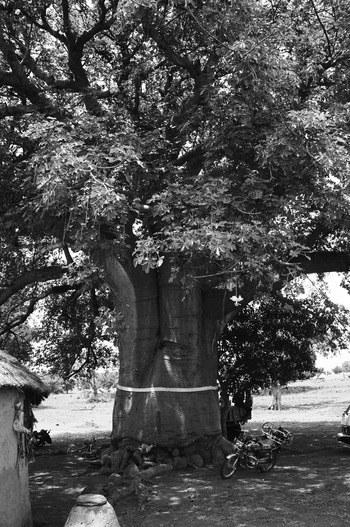
While baobab trees are often determined by a diviner to be the guardian segere of a child in Nangodi, they are also associated with the spirit of a deceased person, as was mentioned by the Kalini earth priest, Ndaam Nyaak, whose grandfather's spirit is believed to be the baobab tree that appeared next to his family compound. These trees are also said to be the spirits of specific deceased Nangodi chiefs. Several large baobab trees may be seen near or within the compounds of chiefs in Kalini as well as in Soliga (figure 5).Footnote 71 While a statue of a departed Azure chief may be placed over his grave (figure 6), when sufficient resources are available his body will be moved to a cemetery specifically for Azure chiefs in Soliga, which consists of large circle of earthen mounds adjacent to an African nettle tree (samparin; Celtis integrifolia). The cemetery is named for the tree—Samparisin. Other Azure family members are buried in a cemetery known as Dabure (“where someone ever lived”), with earth mounds surrounding a baobab (the head tree)Footnote 72 and an ebony tree in Yakoti.
Baobab tree associated with the compound of the current Naba Nangodi, Joseph Azuma Asaga, in Soliga. The white cloth strip was tied around the trunk to acknowledge a request that was made and granted, a practice known as fuk (photograph by E. P. Renne, Nangodi, 27 May 2014).

Burial sculpture of Naba Azure Naamsakiya V (1989–2003) in the family compound. A baobab tree grows just outside the entrance (photograph by E. P. Renne, Nangodi, 23 May 2014).

Cemeteries, Trees, and Political Leadership in Nangodi
In Zoog and in one of the Yakoti cemeteries for tendaam earth priests, these cemeteries are located separately from the graves of other community members. In Zoog, these graves surround ebony and silk cotton trees (see figure 3), while the cemetery in Yakoti is located near the house of the earth priest, tendaana Bugre Nafo.Footnote 73 With the exception of the platform grave of the grove founder tendaana, Ngarik, the earthen mounds graves of the five tendaam who succeeded him surround an nsabik (Lannea acida) tree, which is said to embody the spirit of the mother of Bugre Nafo's father. Similarly, for those living in the Nakpaliga section, their small family cemetery surrounds a nkan (Ficus spp.) tree, which is also believed to be a woman's spirit: “The tree came up after they buried my mother there. So the tree has the spirit of my mother. Other family members have been buried there, and I will be buried there when I die (Bahn interview, 15 July 2017).Footnote 74 A portion of this cemetery is reserved for the burial of Nakpaliga earth priests.”
As with the sacred groves in Soliga and Kalini, these two cemeteries exemplify the continuing permutations of authority of Nangodi between the descendants of Mamprusi chiefs and indigenous Nabt tendaam. These cemeteries, which consist of earth mounds surrounding particular trees, also indicate the continuing connection between people and trees that is materially represented in various sections of Nangodi. Yet this form of cemetery, which was once common in other areas of Ghana, has in more urbanized areas been replaced with cemeteries with concrete slabs and tombstones. Berry discusses the disagreement between residents of a suburb of Kumasi and their chief over the type of cemetery to be used there.Footnote 75 The chief argued for a return to the older form with earthen mounds for the deceased as an appropriate use of space and as more environmentally sound. Yet with conversion to Christianity and increased migration, many wanted to expand the cemeteries with concrete graves, marked with the names and achievements of their occupants. The chief subsequently acceded to this request. It is also possible that those demanding concrete graves wanted to use “modern” burial practices to distinguish themselves from the “backward” rural residents of places like Nangodi who, with few exceptions, continue to use earthen mounds for graves.Footnote 76
CONCLUSION
I planted an atick [teak] near my house to show that I was a forestry worker. I later cut it down to make rafters for my roof.
———Abambiri Mba, Nangodi, 8 Jan. 2017As the forestry worker Abambiri Mba observed, he used his knowledge of the benefits of teak tree wood to reinforce the support of his house's roof. Other residents of Nangodi view teak trees as foreign interlopers, with large leaves that enable the breeding of troublesome black flies that transmit river blindness.
In Nangodi more generally, people have relationships with trees on several different levels—as individuals, as families, as clans, and as section residents as well as institutionally, as district officials, federal forestry officers and local forestry workers, chiefs, and earth priests. For individuals, these relationships emerge over time, beginning when they are infants conferred with “guardian spirit” segere names that indicate their connection with a particular tree that will protect them throughout their lives. When they die, their bodies may be buried in a cemetery associated with a particular tree, while their spirits may also be embodied as a tree. Nangodi chiefs control sacred groves in areas of Nangodi where they have historically asserted exclusive authority, as in the sections of Kalini and Soliga. In Soliga, the final resting place of the line of Azure chiefs is the cemetery, Samparisin, where bodies are reburied under earthen mounds next to the African nettle tree, samparin. Tendaam earth priests of Nakpaliga and Yakoti control groves in these sections. Tendaana ‘Kurug Bahn, the earth priest for the Bugr Noor sacred grove in Nakpaliga, described the grove as a unique, named entity: “We humans are made unique by our names—just so, sacred groves are made unique by their names” (Bahn interview, 30 May 2014). This sacred grove of trees (tii), which originated with the earth spirit-stone (kugri), grew into an earth shrine—tengbahn “earth skin”—with a particular name and clan association and cemetery. In Yakoti, the two groves reflect the oscillating authority over them, with one grove (Bala Klolook) controlled by a line of tendaam while the other (Pakure) is controlled by tendaam who are related to Yakoti chiefs. Furthermore, throughout Nangodi, individuals and families, chiefs (na) and earth priests (tendaam), have had shifting relations with state officials, first of the colonial Gold Coast and after 1957 of the independent Government of Ghana. As government officers of the Department of Forestry, they have controlled the land for the Red Volta West Forest Reserve, with authority to plant and harvest teak trees and to restrict farming there. As an individual, former forestry worker, Abambiri Mba took pride in his work and used the teak tree both to represent his identity and as a utilitarian resource for roof-building.
In other words, there is a range of personal, social, and institutional relationships with trees in Nangodi. Lentz has noted regarding studies of sacred earth shrines, which have examined them either as means for asserting (and disputing) land and property rights or as spaces with spiritual meaning, that these perspectives should be combined.Footnote 77 This observation may also be applied to state claims of ownership of forest reserves and to the religious meanings of trees and sacred groves. Indeed, Sheridan argues that sacred groves are hardly places of “ahistorical cultural and ecological equilibria,” but rather are forests (or even single trees) that encompass complex political, cultural, and ecological dynamics.Footnote 78 In Nangodi, these groves, as well as the Red Volta West Forest Reserve, cemeteries, tree guardian spirits, and ancestral trees display the persistence as well as shifting permutations of governmental and spiritual interconnected relationships between people, land, sacred groves, forest reserves, and individual trees.
By taking this perspective, I do not mean to idealize relations between people and trees in sacred groves, on family land, or in forest reserves, or to suggest that these relationships are economically disinterested. For example, earth priests receive gifts, either in cash or kind, for their services in preparing sacrifices to trees in sacred groves, while their family members may benefit from receiving stray, unclaimed livestock. Benefits also accrue to Nangodi chiefs, as was the case with the regent chief Naba Pukpeok [Kofi] Naamsakiya Azure, whose family had given land for a portion of the Red Volta Forestry Reserve. He later received a percentage of proceeds from contracts with foreign buyers of teak trees. And as the recent cases of illegal logging of rosewood in Upper East Region forest reserves suggest,Footnote 79 “the rent of non-enforcement”Footnote 80 has encouraged district assembly members, chiefs, and Forestry Commission officials to look the other way.Footnote 81 I was told that some rosewood trees (nalak) were cut even in sacred groves (“but away from the place where they give offerings”) by appeasing the trees through offerings to the earth priest tendaana (JN interview). In the case of rosewood, rather than attributing destructive forestry practices to the usual suspects—illegal small-scale gold miners (known as galamsey) and local people who fell trees for firewood and charcoalFootnote 82—the illegal logging of large numbers of trees facilitated by politically connected people who collude with foreign buyers may be equally or even more destructive.Footnote 83 Thus, it is not simply a matter of whether individuals, groups, and institutions take a global environmental forestry view or have local relations with the trees in their environment, or whether focusing on the longevity and the intimate immensity of trees romanticizes these views and historical relationships, but rather how the social histories of people and particular, named trees and cemeteries, sacred groves, and forest reserves are both contested and persist.
***** When I read a portion of Peter Wohlleben's book, The Hidden Lives of Trees, to Ibrahim Amoore in Nangodi, he was very surprised to hear that Wohlleben had organized “a place in the forest where people can be buried as an alternative to traditional graveyards.”Footnote 84 “So they are following our practice!” he exclaimed. Yet he was curious as to why German people would want to do this. When I suggested that they wanted to be buried not only in a way that expanded the forest environment, but also to be remembered in association with the long life of a particular tree, he understood.