Introduction
Much has been written by the participants and by others about the Imperial Trans-Antarctic Expedition (ITAE) of 1914 to 1917 conceived and led by Sir Ernest Shackleton. Much less is known of the lengths to which the British, Australian and New Zealand Governments were prepared to go in financing and organising rescues midway through the Great War. Shackleton in his narrative, South (Shackleton Reference Shackleton1999) is silent on the matter, merely mentioning that Discovery had been dispatched from England and would arrive in the Falklands in September, and that he was content to accept the arrangements put in place by the New Zealand Government to send Aurora under the command of John King Davis to rescue the Ross Sea party. Roland Huntford makes a brief mention of the approach by Shackleton's solicitor in April 1916 to the Prime Minister and of the appointment of an Admiralty relief committee (Huntford Reference Huntford1985: 542–545). Huntford also relates the conflicts that arose between Shackleton and the three governments over who should have command of Aurora for the Ross Sea relief. Stephen Haddelsey, in his recent biography of Joseph Stenhouse (Haddelsey Reference Haddelsey2008: 77–84) has written similarly of the governments’ involvement and the ill-feelings that were generated between Shackleton and others as a consequence. We use, for the purpose of this paper, the records of the Admiralty, Colonial Office, Foreign Office and Treasury to provide a more detailed picture of the lengths that the British Government in particular was prepared to go, why Shackleton reacted as he did in his attempts to rescue the party on Elephant Island, and a government perspective of the controversy over the leadership of the Aurora relief expedition.
In setting the scene, it is important to note that the British Government was no more enthusiastic in supporting a first crossing of the Antarctic than it had been of the race to the South Pole. Sir Thomas Heath (the Joint Permanent Secretary of the Treasury) minuted, on 1 December 1913, that ‘we have already spent large sums from public funds for Antarctic Expeditions’, namely £45,000 upon Scott's National Antarctic Expedition of 1903–1904, and £20,000 accorded to both Shackleton's previous expedition and Scott's last expedition. Heath noted that beyond scientific goals, the main motive was ‘the patriotic one of forestalling other nations in further exploration’ (Heath Reference Heath1913). David Lloyd George (the Chancellor of the Exchequer) wrote nevertheless personally to Shackleton the next day, offering the Imperial Trans-Antarctic Expedition £10,000, on condition that ‘you personally undertake to find the balance of the cost from other sources’ (Lloyd George 1913). Shackleton had thereupon applied for three naval officers and up to 20 men, the naval fitting out of one of his ships, and loan of equipment (Shackleton Reference Shackleton1914). Winston Churchill, as First Lord of the Admiralty, found himself to have been compromised by Lloyd George, and protested, on 23 January 1914, that ‘enough life and money has been spent on this sterile quest. The pole has already been discovered. What is the use of another expedition?’ (Churchill Reference Churchill1914a). However much ‘these polar expeditions are becoming an industry’, he conceded, on 31 March 1914, ‘the loan of the services of Captain Orde-Lees subject to the condition that he receives no pay from naval funds and also to the loan of the hydrographic instruments’ (Churchill Reference Churchill1914b,c). The Australian Government went no further than to provide essential funding for the Ross Sea element of the expedition.
The alarm is raised
Had Shackleton's plan to cross Antarctica been realised he would have returned either in the spring 1915 or more probably in March/April 1916. The first indication that all was not well came on 23 March 1916, when Joseph Stenhouse, acting captain of Aurora, managed to make radio contact to report that the Ross Sea party was stranded. He succeeded in bringing the badly damaged Aurora into port in New Zealand on 3 April (Haddelsey Reference Haddelsey2008: 69–70) Shackleton had appointed the London solicitors, Hutchison and Cuff, as his Honorary Advisory Attorneys. They had become sufficiently concerned at the news of the Aurora and the non-appearance of Endurance at Buenos Aires from the Weddell Sea, to write to John King Davis in March 1916 (Davis Reference Davis1962: 247). Davis had been first officer on the Nimrod for Shackleton's 1907–1909 Antarctic expedition and had commanded Aurora for Mawson's expedition of 1911–1914, but had turned down Shackleton's offer of captaincy of Aurora for the ITAE. He was very well qualified as an Antarctic ice navigator. He had just arrived into Marseilles in command of His Majesty's Australian Transport, SS Boonah when he received the solicitors’ letter which invited him to ‘take command of an expedition to search for Shackleton in the Weddell Sea, if such an expedition could be sent out’. As he wrote later, ‘This was a summons that one could not refuse’(Davis Reference Davis1962: 247). The Times reported on 28 March 1916 that ‘A meeting of the official representatives of Sir Ernest Shackleton's expedition was held in London yesterday at the offices of Messres Hutchison and Cuff. . .. Lady Shackleton was present’ (The Times (London) 28 March Reference Chalmers1916; Huntford Reference Huntford1985:489). ‘A former Royal Naval officer’ had meanwhile approached the Admiralty offering his services in any rescue mission that might be being contemplated. That person, whose identity is unknown, was re-directed to the Royal Geographical Society (RGS) as the principal patron of the expedition (Hinds Reference Hinds1916). The society's secretary informed the Admiralty Hydrographer, Captain John F Parry, on 30 March 1916 that
It may save misconception if I say that the Royal Geographical Society is not responsible for the equipment of any Relief Expedition. Doubtless we shall be able to help representatives of Sir Ernest Shackleton with advice. Perhaps you would be so good as to show this letter to whoever in the Admiralty is responsible for answering such applications (Hinds Reference Hinds1916)
Davis had meanwhile become so seriously concerned at the expedition's fate that, with Hutchinson and Cuff's offer in mind, he also approached the RGS (Huntford Reference Huntford1985: 542). He was presumably also directed to the Admiralty because, at a meeting with Parry on 12 April, he informally offered his services for any rescue expedition that might be launched (Parry Reference Parry1916a). A formal written offer followed on 20 April (Parry Reference Parry1916a).
Hutchison and Cuff now wrote directly to the Prime Minister, Herbert H. Asquith in a letter dated 14 April 1916 to ‘beg to appeal to you for Government assistance in the distressing circumstances that have arisen’, both as to Aurora, and lack of any news of Endurance pointing out that ‘She is much overdue and grave fears are entertained concerning her’. They reminded Asquith of the Government contribution of £10,000 to the costs of the expedition, and of how King George V and the Lords Commissioner of the Admiralty had insisted that the expedition should proceed despite the outbreak of war, and Shackleton's offer to place ship, staff and stores at the disposal of the Admiralty. They pointed out that:
It will be necessary to send a relief ship to the Ross Sea to bring off Captain Mackintosh and the nine other men known to be stranded there, and unless the ‘Endurance’ arrives at port during the next few days, we are advised that arrangements should at once be commenced for the organisation of a relief expedition to the Weddell Sea to search for Sir Ernest Shackleton and his comrades.
The letter concluded by emphasising the lack of funds even to continue the dependents’ allowances (Perris and Hutchison Reference Perris and Hutchison1916a). It is of note that the letter was jointly signed by Alfred Hutchison (for the Solicitors) and E A Perris, who was news editor of the Daily Chronicle at the time. The Daily Chronicle had an exclusive publication contract with Shackleton, and it appears that the editor was involved from the beginning in urging the Government to mount a rescue. Although there is no direct evidence, Perris may have been present at the meeting held at the solicitors, and reported upon by The Times.
Lady Shackleton made her own personal appeal on 16 April, clearly aware of the contents of the solicitors’ letter. In pressing Asquith, she wrote
The world is so full of tragedy that the fate of my husband and his comrades, whatever it may be, will leave many people untouched. The times have sadly changed since Captain Scott wrote in his last wonderful letter of his belief in a great, rich country like ours. But England has never allowed her explorers to perish for lack of effort to save them, and it is because they cannot speak for themselves that I have gathered courage to write and beg you to listen to their silent appeal (Shackleton, Emily Reference Shackleton1916).
There is a note written in the letter's margin to the effect that the ‘PM replied that he had read her letter with great sympathy in her anxiety but would say no more at present than that he had consulted the RGS and referenced the issue to the Treasury for comment.’
The combination of the letters from the solicitors and from Emily Shackleton certainly caught the Prime Minister's attention, and even though Parry was simultaneously starting to think about the practicalities, these letters appear to have provided the catalyst for prompt action authorised from the top of government. Emily Shackleton's letter moved Asquith sufficiently for him to reply immediately and to start action at the Treasury.
The president of the RGS further distanced the society from any responsibility for the ITAE, whilst emphasising the urgency of the position, his letter of 18 April enclosing a resolution passed by his Council the previous day:
That the Council consider that the immediate organisation of the expeditions for the relief of Sir Ernest Shackleton and his companions is necessary and, while it is unable to offer any financial assistance or accept any responsibility, it is prepared to give its advice to any responsible body which may be appointed to control the expeditions (Freshfield Reference Freshfield1916a).
The letter recommended Mawson and Davis as the best persons to provide relevant advice.
The Treasury forwarded copies of the letters from Shackleton's solicitors, and the RGS, to the Admiralty on 24 April asking ‘for observations and expert advice’ before deciding on a course of action (Heath Reference Heath1916a). Parry had already drafted within the Admiralty what became the rudiments of a Government rescue-plan, and had written on 15 April to Rear-Admiral Sir Lewis Beaumont, whom he described as a leading authority on Antarctica, having been a member of the British Arctic expedition of 1875. On the basis of their meeting two days later, Parry strongly recommended that the British government should take the lead, supported by the Australian and New Zealand governments. There should be two expeditions, one to relieve the Ross Sea party with its cost falling to the dominion governments. The other would search for any evidence of Shackleton and Endurance in the Weddell Sea. Parry pressed for the urgent establishment of a broad based ‘rescue committee’ to take forward the detailed planning and liaison, chaired by Beaumont. Membership should include Dr William Speirs Bruce, Mawson and Davis (in the event he does not appear to have been an active member), with the latter being put in overall command of the Weddell Sea expedition. The committee should otherwise comprise representatives of the Admiralty, the Board of Trade, Treasury, RGS and Shackleton's solicitors (Parry Reference Parry1916a).
Parry's memorandum formed the basis of the Admiralty's advice to the Treasury, of 1 May. Sceptical of whether the RGS or any other body could raise sufficient moneys quickly enough, and fearful of the effect upon the charities directed towards the war effort, Alfred W. Hurst (a First Class Clerk within the Treasury) conceded, on 3 May 1916, the Government must assume financial responsibility, or risk ‘serious delays leading to a public scandal’. Although the Government might offer only a portion of the moneys, there was much to be said ‘for the Government taking the heroic course of shouldering the full responsibility from the start, ie so far as the Australasian Governments do not take it, and adopting the Admiralty proposals’ (Hurst Reference Hurst1916). The Principal Clerk, Roderick S. Meiklejohn, agreed, remarking that
if the Government pay the bill, they will be in complete control whereas if they only contribute, we may have difficulties with the R.G.S., the body presumably which would invite subscriptions from the public . . . (e.g. the infinite trouble Sir C Markham caused some years ago in a similar case) (Meiklejohn Reference Meiklejohn1916a)
The Lords Commissioners of the Treasury gave formal authority, on 6 May, for the government meeting the cost of the expeditions, subject to such assistance as might be given by the governments of Australia and New Zealand, and that the Admiralty should appoint what became the Shackleton Relief Advisory Committee (Chalmers Reference Chalmers1916). The Admiralty had already sought an indication from the Colonial Office, on 1 May, of a contribution by the two dominion governments toward the costs of relieving the Ross Sea party, and more particularly an indication of the condition of Aurora and the possibility of refitting/repairing her in time.
Others, unaware of these nascent moves, continued to lobby the government. The president of the RGS wrote to Asquith on 5 May, reminding him of the urgency of the matter and pointing out
the Admiralty having let Shackleton go when after the declaration of war he offered his crew, his ship and all his equipment for the King's service, it cannot be held to be without responsibility in the present dilemma, one which all who know anything about the Antarctic foresaw to be only too probable (Freshfield Reference Freshfield1916b).
Hutchison and Cuff also wrote to Asquith the same day, acknowledging his sympathetic reply to Lady Shackleton and urging that the matter of a relief expedition be dealt with urgently. They pointed out that the funds available would only provide support to the dependents for one more week (Perris and Hutchison Reference Perris and Hutchison1916b). Note that this letter was again signed by both Perris and Hutchison, but the editor of the Daily Chronicle also wrote to the Treasury separately on behalf of the dependents (Donald Reference Donald1916). Within the Treasury Meiklejohn minuted rather damningly
I have seen Sir Douglas Mawson, the Polar explorer who tells me that he has grave suspicions as to the Shackleton Expedition finances and has no high opinion of his Attorneys. The Daily Chronicle is behind the venture (sic) no proper balance sheet has, he believes, ever been produced and the Expedition ought still to have un-liquidated assets in the shape of book and film rights and the value of the ships (or ship) when the Expedition is concluded. Sir Douglas is convinced that the Government ought to confine its responsibility entirely to the sending out of a relief expedition and to leave the Daily Chronicle and the other backers of the original expedition to look after the dependents (Meiklejohn Reference Meiklejohn1916b)
The Daily Chronicle was informed by Meiklejohn on 17 May that no Government money would be forthcoming to support the dependents of ITAE (Meiklejohn Reference Meiklejohn1916c).
The Shackleton Relief Advisory Committee
The Admiralty moved quickly to appoint the committee, formally inviting Beaumont to become chairman on 8 May (Green Reference Green1916a). There followed two days later ‘instructions for the guidance of the committee of relief’, drafted by Parry (Anon. 1916a) proposing two separate rescue expeditions. One would (probably) use Aurora to collect the Ross Sea party, and the other, possibly using the Fram (which Fridtjof Nansen had offered for the purpose) to search for Shackleton and Endurance in the Weddell Sea. Neither relief expedition was to be in anyway exploratory. Given the existing war conditions staffing would have to be drawn exclusively from the Merchant Marine, but the committee would be able to call upon and if necessary co-opt any experts they needed. Finally,
The Committee, after making full enquiries and obtaining any necessary expert advice, (was) to submit, with the least possible delay, Complete proposals as to:- General Programme, Vessels and their fitting out, crew, provisioning, etc, Officers, Full details of anticipated cost (Anon. 1916a).
The committee's first meeting on 12 May, at the Admiralty, quickly rejected Fram as unsuitable (Parry Reference Parry1916b) and approached C. T. Bowring and Co, with a view to purchasing Terra Nova. But the proposed price together with the costs for replacement vessels at government expense amounted to around £100,000, causing the Director of Transport to reply that ‘I can hardly believe that you intend this proposal seriously’ (Thomson Reference Thomson1916). The Admiralty then turned to the Hudson's Bay Company, owners of Discovery, which on 17 May offered to sell the ship outright for £20,000 (Anon. 1916b). This was seen as a very reasonable offer, and was accepted within the Admiralty by 19 May on Beaumont's advice (Beaumont Reference Beaumont1916a). The committee also quickly recommended Davis, then en route to New York as captain of SS Boonah, as commander of the Weddell Sea expedition, to be put in charge of the necessary preparations as soon as possible (Beaumont Reference Beaumont1916a). He received the invitation by cable on docking in New York on 25 May (Davis Reference Davis1962: 247).
Beaumont presented to the Admiralty, with the least possible delay, a seven page report covering the committee's deliberations on 19 May. The expedition to Weddell Sea should comprise 35 men, including one scientist with specialist knowledge of ice and meteorological conditions in the Weddell Sea, and a doctor. The ship should be provisioned for two years. If nothing was found during the summer season of 1916–1917 a small wintering party should be established on the Weddell Sea coast, under the scientist's command, tasked to search up to 400 miles each way along the coast. A hut, plus sledges, tents and dogs would be needed. Meanwhile, the ship would leave for refit and return the following season to collect the wintering party and any survivors discovered. Both the ship and the shore party would be equipped with transmitting and receiving equipment. Portable radios would be provided for the sledge parties. It was recommended a total of 40 dogs should be included. The report also recommended that messages should straight away be transmitted blind in an effort to reassure the Weddell Sea party that a rescue was being organised, since it was known that Shackleton had taken a radio receiver with him. The committee believed that the rescue mission should leave England no later than the first week of August, aiming to reach Laurie Island about 10 November in order to take advantage of any early opening of the Weddell Sea. The total cost was estimated to be in the region of £65000 including purchase of Discovery. (Beaumont Reference Beaumont1916b). Depending on how the calculation is done, this is probably equivalent to £30 million today. A very telling recommendation, and one that reared its head later in the efforts to recover the men from Elephant Island, was that:
Steps should be taken to secure that no account or narrative of the Search Expedition should be published without the consent of H. M.'s Government. The right of publication and the copyrights of all matters which result from the Relief Expedition are clearly vested in His Majesty's Government (Beaumont Reference Beaumont1916b).
Nowhere in the documentation is the identity revealed of the ‘scientist’ whom the committee might have had in mind, or indeed from where the idea of needing one had come. Taken together, the explicit mention of Laurie Island (where the Scottish National Antarctic Expedition, SNAE, wintered under the command of Bruce, in 1903), and the specialist requirement for knowledge of the ice and meteorological conditions in the Weddell Sea (where the SNAE ship, Scotia, had spent two summer seasons), bring to mind one obvious candidate, a committee member and man desperate to get back to Antarctica, Bruce himself! He would have undoubtedly been a wise choice.
Within the Admiralty, Parry briefly commended the committee's report on 21 May to the Lords Commissioners of the Admiralty for transmission to the Treasury. He also pointed out that the Advisory Committee was so large that a small independent Executive Committee comprising of himself, Beaumont and Mawson should be appointed, taking advice from the main committee as necessary. This was accepted. Representatives from Australia and New Zealand should also be added to the main committee to facilitate the coordination of the two expeditions (Parry Reference Parry1916c). The Admiralty forwarded the Advisory Committee's report a week later (27 May) to the Treasury for its approval of the expenditure. On the same day it wrote (Murray Reference Murray1916). to the Colonial Office seeking confirmation that the Australian and New Zealand governments would bear the full cost of the Ross Sea rescue, and suggesting they should be invited to nominate representatives to the committee. On this day also Discovery arrived at Devonport and action was immediately taken for docking and survey so a final decision could be made on purchase. There was a short internal discussion in the Treasury on the modalities of the funding and then on 31 May the Treasury replied (Heath Reference Heath1916b) to the Admiralty confirming approval.
The date 31 May 1916, proved momentous in marking Shackleton's reappearance. Having already made one attempt at reaching Elephant Island on a borrowed whaler (owned by the Southern Whaling and Sealing Company, the Southern Sky), he landed at Port Stanley plainly intending to keep his identity secret until he had provided the Daily Chronicle with the news scoop (Huntford Reference Huntford1985: 616). His telegram, outlining what had happened in the Weddell Sea was published the next day (Daily Chronicle (London) 1 June 1916). The governor had meanwhile, telegraphed the Colonial Office from Port Stanley, that:
Shackleton left 22 men in hole in ice cliff Elephant Island and proceeded with five men in boat to South Georgia. Immediate assistance required to save lives party left on Elephant Island whose supplies nearly exhausted Shackleton says easy matter for any armoured vessel to do this in?3 [sic] days from Falkland Islands (Young Reference Young1916a)
The British Government's effort now focussed on the task of rescuing the men marooned on that inhospitable little beach backed by unyielding cliffs and forbidding glaciers, and battered by the Southern Ocean, that is Point Wild.
The Rescue of the Elephant Island party
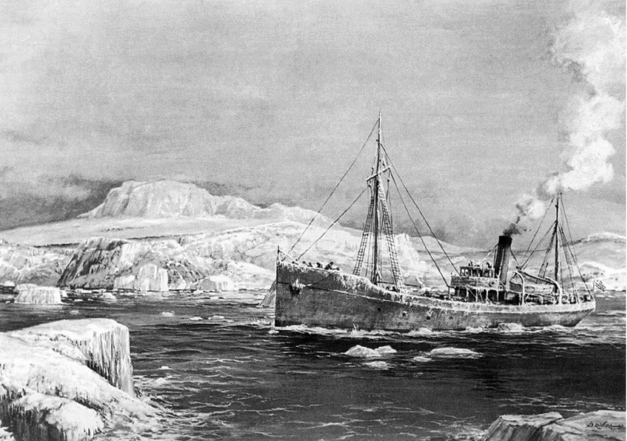
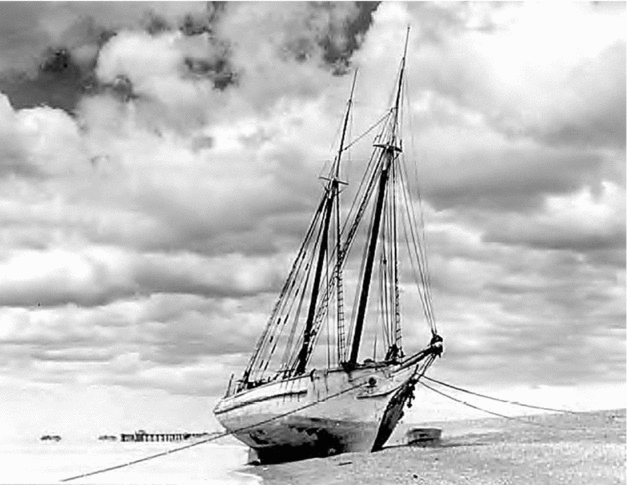
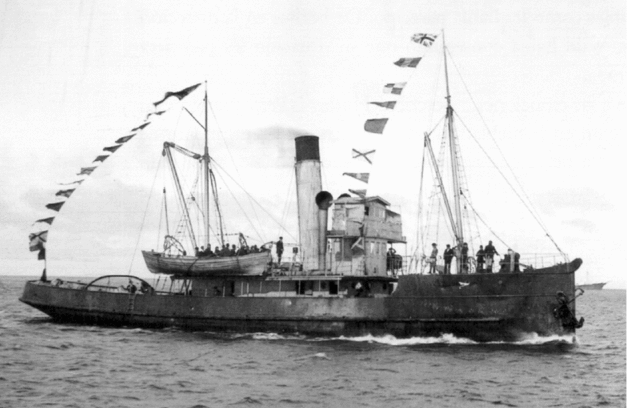
The bare facts of the rescue are simple and quick to relate. Shackleton made two further unsuccessful attempts to reach Elephant Island, the first in June using, Instituto de Pesca No1 (Fig. 1), a vessel provided by the Uruguayan government and captained by Lieutenant Don Ruperto Elichirebehety of the Uruguayan Navy, and the second in July aboard a chartered schooner, Emma (Fig. 2), before recovering his men using the Chilean tug, Yelcho (Fig. 3), on 30 August. But behind these bare facts there is a complex story, much of it already well aired in the literature. The British Government's perspective is much less well known
The trawler Instituto de Pesca No. 1, owned by the Uruguayan Government, built in 1906 of steel construction. Her tonnage was 339 tons, displacement unknown, length 43 m and power 480 hp.
Source of information: http://www.shipstamps.co.uk/forum/viewtopic.php?f=2&t=13672.
Picture courtesy of Fundacion Histarmar, Historia y Arquelogía Maritíma (http://www.histarmar.com.ar/)

The sailing schooner Emma, privately owned, built in 1883 of wooden construction. Her tonnage was 108 tons, displacement unknown, length 22 m. She had an auxiliary diesel engine of unknown power.
Picture courtesy of INACH and C S Fugellie)
The cutter Yelcho, owned by the Chilean Government, built in 1906 of steel construction. Her tonnage was 219 tons, displacement 467 tons, length 37 m and power 350 hp.
Source of information and picture: http://en.wikipedia.org/wiki/Yelcho_%281906%29).
Most importantly, and despite its endeavour to regulate the Southern Ocean's whaling industry, the British Government had no vessel appropriate for administering the Falkland Islands Dependencies, let alone mounting a rescue mission to the Weddell Sea. An internal memorandum by Parry, of 1 June, pointed out that
the dispatch of a man-of-war, even if available, appears to be impractical, for many reasons, eg want of bow protection, the presence of twin propellers which cannot be effectively used in pack-ice, etc (Parry Reference Parry1916d).
The Advisory Committee had no alternative but to recommend on 1 June that the Foreign Office should immediately cable its ministers in Argentina, Chile and Uruguay asking them to investigate the availability of suitable ships (Parry Reference Parry1916d). This cable was despatched on 2 June, including an instruction for the individual ministers to consult one another (Anon. 1916c). The minister in Buenos Aires, Reginald Tower, replied immediately that the Argentine government had no suitable vessels (Tower Reference Tower1916a). In fact the Argentine navy did have a suitable vessel, the steam-sloop Uruguay; which had rescued the Swedish Antarctic expedition stranded on the northern end of the Antarctic Peninsula in 1904. The governor of the Falklands had, on the same day, suggested to the Colonial Office that
failing a warship for the relief of Shackleton party application be made to Argentine Republic for immediate despatch Steam-Sloop Uruguay to Elephant Island, calling at Falkland Islands for Shackleton (Young Reference Young1916b)
The Advisory Committee urged through Parry that HMS Glasgow be immediately dispatched from Port Stanley to Buenos Aires to enable the Senior Military Officer (Commodore Luce) to negotiate for the use of Uruguay Not only could the Glasgow not be spared for such a purpose, but the Argentine Government indicated that Uruguay was not seaworthy having been damaged in a collision two months before (Parry Reference Parry1916e). Use of this naval ship would in any case have proved politically embarrassing to the Colonial Office, given the sensitivities over sovereignty of the South Orkneys. As a Colonial Office official minuted on 5 June: ‘No further Action I think, the Uruguay used to visit the South Orkneys’ (Green, J. 1916).
Sir Francis Stronge (the Resident Minister at Santiago) had meanwhile proposed using a mail ship, the Oronsa (Stronge Reference Stronge1916a), and when this was ruled out by the Admiralty (Anderson Reference Anderson1916) offered a whaler presently in Punta Arenas, provided the Norwegian owners were indemnified (Stronge Reference Stronge1916b). Tower telegraphed on 3 June that Compania Argentina de Pesca was prepared to offer the sailing vessel Tijuca (Tower Reference Tower1916b). To add to the confusion, Shackleton had by 6 June negotiated through the British Minister at Montevideo the free use of an Uruguayan trawler (Instituto de Pesca no. 1) (Shackleton Reference Shackleton1916). The Foreign Office quickly became alarmed at how the cable had generated more heat than light, with little coordination between the various legations, an official minuting how, through lack of coordination, the resident ministers at Montevideo, Santiago and Buenos Aires were respectively:
(1) sending a steam trawler from Montevideo at the expense of the Uruguayan Govt (2) sending a whaler from Punta Arenas (3) consulting Shackleton as to sending the Tijuca from Argentina. We can only wait and see which course the Admiralty prefer (Sperling Reference Sperling1916)
In the event Shackleton opted to make the attempt at rescue using the Uruguayan trawler.
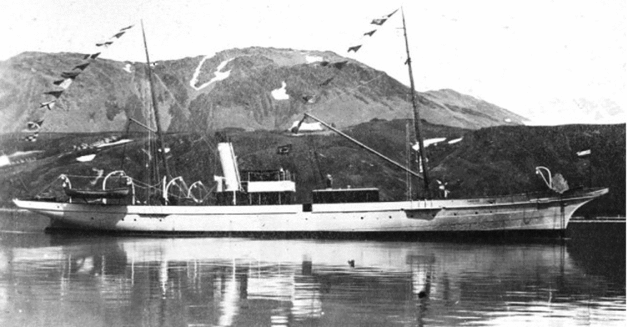
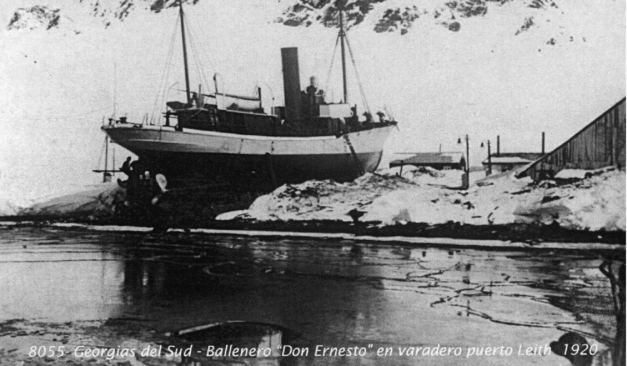
Despite this attempt failing the episode merits further comment. Foreign Office criticism of its Legations, for their lack of consultation prompted Tower to write a long dispatch, of 6 June, justifying his actions (Tower Reference Tower1916c). It provides valuable historical detail of the offer made by Compania Argentina de Pesca, an offer that arguably would have had a much better chance of success than the Uruguayan vessel. It happened that Captain Carl A Larsen had been in Buenos Aires and personally visited Tower at the beginning of June offering to lead a rescue mission from the Company's shore station at South Georgia, using his own vessel the S.S. Undine (Fig. 4) and a powerful whaler, the Don Ernesto. To do this he would sail in Tujica from Buenos Aires by the 11 or 12 June, to be able to depart from South Georgia before the end of the month. The company was prepared to do this as a humanitarian gesture at no cost to the British Government or to Shackleton. The Don Ernesto (Fig. 5) was the largest and most powerful whale catcher built to that date, 38 m long with twin engines driving twin screws, delivering a total power of 700 horsepower and a service speed of 13.7 knots (Hart Reference Hart2001: 147; Harland Reference Harland1992). But perhaps most important she was ice-strengthened with heavier plates fitted below the waterline. It was a remarkable gesture, but Shackleton rejected it on 3 June, through the governor of the Falklands, on the basis that he had already attempted to reach Elephant Island in a whaler and that Undine ‘was not suitable for winter conditions’ This was a curiously brusque and puzzling rejection, the more so as when he left Elephant Island it seems that Shackleton's intention was to commission Undine (Dixon and Lee Reference Dixon and Lee2011: 46). Larsen was uniquely placed, being a highly regarded sea captain, ice navigator and polar explorer, particularly in dependency waters, where his experience spanned more than 20 years. In as much as Shackleton had never commanded a ship himself, he might well have been expected to defer to Larsen, or at least to have sought further information. If Larsen thought a rescue using these ships was a real possibility then in all probability it was. Perhaps the key to the rejection was that the governor had pointed out that ‘it was vital for the relief expedition to call at Port Stanley for Sir E Shackleton on its way south (Dixon and Lee Reference Dixon and Lee2011: 46). The Company felt this would not be possible because of a lack of coal capacity. Although understandable that Shackleton wanted to be on board, it is hard to see that his presence would be ‘vital’, other than that he was totally dependent on making as much money as possible from what we would now call the media opportunities accruing from the expedition
The steam yacht Undine, owned by Compania Argentina de Pesca, built in 1884 of iron construction. Her tonnage was 338 tons, displacement unknown, length 50 m and power 400 hp.
Picture courtesy of Fundacion Histarmar, Historia y Arquelogía Maritíma (http://www.histarmar.com.ar/).
The whale catcher Don Ernesto, owned by Compania Argentina de Pesca, built in 1910 of steel construction with an ice-strengthened hull. Her tonnage was 221 tons, displacement unknown, length 38 m and combined power from two engines of 700 hp.
Source of information: http://en.wikipedia.org/wiki/List_of_ships_built_at_Framn%C3%A6s_shipyard, Hart (Reference Hart2001), Harland (Reference Harland1992).
The directors of Compania Argentina de Pesca were so convinced of the strength of their offer, and no doubt the publicity attendant upon success, that they passed a resolution to proceed anyway, pointing out in a letter to Tower on 5 June that:
This resolution has been adopted in the desire to relieve as quickly as possible the distressing situation of the 22 men who have been cast on Elephant Island, and in view of the fact that at our whaling station at Grytviken, South Georgia, we have experienced men who are thoroughly acquainted with those latitudes and ice navigation, while our boats are much better adapted than any others which could be obtained here, which leads us to consider that their chances of success are favourable (Tower Reference Tower1916c)
In view of Shackleton's unequivocal opinion as to the inadequacy of the whaling company's vessels Tower had no option but to discourage the company in their generous offer. An attempt by the Foreign Office (Anon. 1916d) to have Larsen appointed as captain of the Instituto de Pesca No 1, was rejected by the company (Tower Reference Tower1916d)
However much Shackleton claimed that ‘no whaler could combat the stream ice in heavy swell’ (Tower Reference Tower1916c) none of the vessels he actually used could have done so, or been classed as suitable for winter conditions. Indeed none of them would have routinely been operated into Antarctic waters even in summer, whereas, Undine had been chartered for several annual relief-expeditions of the Argentine Station on Laurie Island in the South Orkneys. Also, the company described the Don Ernesto as exceptionally powerful, and she was certainly much more powerful than was Instituto de Pesca No 1 (at 700 hp compared with 480 hp (see caption to Fig. 1))
Shackleton cabled the Admiralty on his return to Port Stanley that the ice conditions were so bad that only a wooden steam vessel fitted to penetrate pack ice would be able to carry out the rescue. In urging immediate action to find one, he also advised that the food supply, if supplemented with penguins, would be sufficient for the marooned men to survive long enough for such a vessel to be obtained from the UK or elsewhere (Parry Reference Parry1916f). Beaumont hence urged on 26 July, on the Advisory Committee's behalf, that the New Zealand government be immediately asked when Aurora might reach Port Stanley for such a purpose (Parry Reference Parry1916f). The response from the Governor of New Zealand on 3 July was not promising, no departure date could yet be given, and even when ready, Aurora would take 40 days to reach the Falklands at her best speed (Foljambe Reference Foljambe1916). Whilst still keeping Aurora in the frame, the Admiralty sought Treasury approval the next day for Shackleton to be authorised to engage any suitable vessel that could be found in South America, albeit that no such vessel had yet been identified (Anon. 1916e). Although the Treasury gave its approval on 6 July Beaumont relayed the committee's view on 10 March that there was no suitable vessel in South America and that Aurora was very unlikely to be ready in time, nor would it be desirable to compromise the Ross Sea mission by hasty work upon her. The committee noted that Shackleton was planning to sail from Punta Arenas in the paraffin powered auxiliary sealing schooner, Emma, offered free by British community in Punta Arenas, but regarded the ship as unsuitable. They therefore now urged the charter for six months of a suitable wooden ship from the northern hemisphere mentioning as possibilities: Porquoi Pas, Nimrod, Balena or Discovery (Beaumont Reference Beaumont1916c)
By 15 July the committee had decided that Discovery should be sent as quickly as possible under the command of James Fairweather RNVR, an experienced whaling captain and ice-master. Beaumont reported that she was fitted out as a collier with no square sails. A refit would therefore be required but she should not be delayed to replace the square sails if she could be towed to the Falklands. The Hudson's Bay Company offered her free of cost, so the additional funds needed for the voyage out and back plus any repairs on return was estimated at £8700. In anticipation of agreement, Beaumont had already started the necessary preparatory work (Beaumont Reference Beaumont1916d). The Chancellor of the Exchequer, Reginald McKenna, approved an overall contingency figure of £20,000 against the Scientific Investigation Vote (as opposed to the Admiralty vote), following the precedent of the relief expedition for Scott's Discovery (Treasury 1916).
Shackleton had already sailed from Punta Arena aboard Emma on 13 July, as Beaumont sought approval to publish a press notice of the government plan to send Discovery, which appeared almost in verbatim in The Times (The Times (London) 24 July 1916). Under the heading ‘The Marooned Explorers’ the first paragraph recorded
In view of the possibility of the failure of the third attempt now being carried out by Sir Ernest Shackleton, in a small vessel, to rescue the 22 men of his party left on Elephant Island, South Shetlands, and at his most urgent request, the Government have now decided to dispatch a vessel from England as soon as she can be fitted out, no suitable wooden vessel being available in any South American port.
As the committee had feared, Emma, was not up to the task, so Shackleton was back in Port Stanley on 3 August. It seems that Compania Argentina de Pesca were still very willing to put all their significant resources into a rescue attempt and ironically it was only the press release announcing that Discovery would be on her way that caused them to abandon their plan with the recognition of ‘the rapidity and efficiency with which Discovery can carry out the object in view’ (Pasman Reference Pasman1916).
As far as the British Government were concerned rescue now depended on getting Discovery to Port Stanley as quickly as possible, so it was decided that she should be towed by a collier, S.S. Polesley, that was about to set off. There was discussion within the Admiralty as to the authority under which the ship would be sailing. Parry was firm that the voyage was ‘being conducted by the Admiralty for the Treasury’ (Parry Reference Parry1916g), thereby implying the authority of the Prime Minister, as First Lord of the Treasury. The fundamental issue at stake was whether the Hague Convention XI (1907, Article 4) would protect the ship from German submarine attack as she was engaged on a ‘scientific or philanthropic mission’? Discussion focussed on the choice of ensign the ship would fly, should it be red or blue? The conclusion was that she would fly the red ensign, and ‘that it will be impracticable to rely on the Convention and notify the German Government, so the vessel will in any case be taking her chance’ (Anon. 1916f). The files are silent as to whether the publication of the press release was in part intended to alert the German Admiralty to the mission. In the event, Discovery sailed protected by two armed trawlers for the first hundred miles of the voyage (Savours Reference Savours2001: 151).
Close thought was also given to what we would now call the media plan for the rescue mission. Parry laid out a detailed proposal on 2 August in which the ship's doctor would write a narrative and be provided with a still camera, whilst still and movie pictures would be taken of Discovery’s departure by the International Film Service (IFS). An operator from IFS would join the ship in the Falklands for filming on the journey to, at, and from Elephant Island. All rights would be retained by the Admiralty, with the exception of distribution within the USA and Canada where they would be ceded to IFS (Parry Reference Parry1916h). These proposals were immediately approved within the Admiralty and were dispatched, along with Fairweather's sailing orders to the Governor of the Falkland Islands for information and for copying to Shackleton, with a covering letter, the same day (Green Reference Green1916b). They were sent separately to Fairweather in Devonport on 3 August, where he was in final preparations for sailing (Anon. 1916g). Discovery was actually ready to leave on 5 August but was delayed until 10 August waiting for the collier to be available (Beaumont Reference Beaumont1916e).
The foregoing sets the scene for the final act in the Elephant Island drama. The ground rules for Shackleton's involvement in the Discovery rescue mission were explicit. On arrival in the Falklands
Lieutenant Commander Fairweather will at once confer with you as to the steps to be taken to effect the rescue of the party on Elephant Island. He has been directed to take you on board and carry out your wishes as far as possible in regard to all measures you may advise to effect the rescue of your men, but the command of the ship and all who may be on board, as well as the responsibility for the action he takes, must remain in his hands (Green Reference Green1916c).
There was appended to the letter what would have been a very unwelcome statement for Shackleton given his exclusive contract with the Daily Chronicle and his financial problems
No account or narrative, or photographs or sketches of any description, relating to the Search Expedition as conducted by the ‘Discovery’ is to be published, or communicated to anyone in such a manner that it may lead to its publication, without the written consent of the Secretary of the Admiralty as representing H.M's Government. The rights of publication and the copyrights of all matters which result from the Relief Expedition are vested in His Majesty's Government (Green Reference Green1916c)
Although the Colonial Office received the documents for dispatch to the Falklands on 2 August, it is not clear from the record, when, or indeed whether, Shackleton received them as intended. A draft reply to the Admiralty indicates that the documents had missed a mail opportunity that sailed from Liverpool on that day, so would be sent by ‘a special supplementary mail via Lisbon’. The response went on to advise that since the supplementary mail via Lisbon was not considered reliable a copy ought to be sent with Discovery (Anon. 1916h). However it is certain that he was aware of the contents in general terms because there was an exchange of cables between Shackleton and Perris of the Daily Chronicle during August on the subject, with Perris in direct contact with the Admiralty. Perris sought to obtain a copy of the documents so he could cable them to Shackleton, but the Government Censor was cautious about this (Brownrigg Reference Brownrigg1916). Even so Parris cabled Shackleton on 20 August that
Everything explained in letters which ‘Discovery’ is bringing; impossible to reply to your question except to say unsympathetic attitude your material welfare on part of Mawson and Beaumont and customary attitude of Navy to Mercantile Marine which it seems resulted from desire of Admiralty to boom its own Relief Expedition and realise all money possible from it; strongly advise patience until you know details, then exercise skill and tact in getting round difficult but not insuperable position; earnestly hope Hurley has pictures scenes of life on Elephant Island (Perris Reference Perris1916a).
This can only be referring to who has the media rights. The censor had intercepted the cablegram, and the Admiralty thought the tone ‘very unfair’, but Perris was unrepentant in a meeting at the Admiralty (Perris Reference Perris1916b).
The final report of the work of the Advisory Committee, which Beaumont produced in October 1916, contains the following telling statement concerning Shackleton
The purport of the replies he received was so contrary to his desires that he must have then decided to make a fourth attempt at rescue in a local vessel, but as no more communications passed between him and the Admiralty, the circumstances and details of this expedition can only be gathered from what has appeared in the press (Beaumont Reference Beaumont1916f).
Huntford provides a detailed account of what passed between Shackleton and London (Huntford Reference Huntford1985: 614–616).
What is definitely known is that Shackleton left Stanley for Punta Arenas on 16 August and that the Admiralty copied cables to him there (Beaumont Reference Beaumont1916f). He was not prepared to wait for what he himself referred to as the ‘main relief’(Beaumont Reference Beaumont1916f). Instead, he took up the Chilean Government's offer of Yelcho, and in this vessel he was successful in rescuing his men on 30 August. Yelcho did not however meet Shackleton's strongly stated requirement of a wooden steam vessel fitted to penetrate pack ice, or an ice-breaker. Quite the contrary, she was a small (37 m, 467 ton displacement) steel steam ship described variously as a cutter, a tug or a lighthouse tender. She had a 350 hp engine and was capable of 10 knots. She had no ice protection, and was hardly suitable to sail safely across Drake's Passage in winter, let alone attempt to penetrate the ice that Shackleton knew to be blocking access to Elephant Island just a few weeks before. Given that Shackleton was on record in July of stating that with a supplement of penguins the Elephant Island party could survive until a ship arrived from England, why his sudden haste, given that Discovery, ‘the main relief’, was on her way? Was it a desperate move to protect his media rights? Whatever it was, his luck came to the fore, as two days before he arrived off the island there was a storm that dispersed the pack, allowing him to make the rescue. As we now know this was actually not a moment too soon because the castaways had not seen fit to build up a stock of penguins or seals so their food was almost exhausted. The Government learnt of the success, not from Shackleton himself, but from an intercepted radio message passed on by the Governor of the Falklands on 4 September (Young Reference Young1916c).
It was ironical that, rather than political capital being made from the respective governments’ despatch of Discovery and Aurora, it was Shackleton's rapturous welcome by the crowds at Santiago which caused Sir Francis Stronge (the British Minister) to write of how Shackleton had ‘left an excellent impression’. . .. ‘and it has undoubtedly confirmed the predominant sentiment of sympathy with England and the cause of the allies’ (Stronge Reference Stronge1916c)
The Ross Sea rescue
The rescue of the Ross sea survivors (three had perished) is simply told. The British, Australian and New Zealand Governments jointly funded (Law Reference Law1916) the repair and fitting out of Aurora and she sailed from New Zealand on 20 December 1916 under the command of John King Davis. Shackleton was signed on to the ship's company as a supernumerary. The survivors were picked up on 10 January 1917, and Aurora arrived back in New Zealand on 9 February 1917. But behind those bare facts is a complex and rancorous story. As the details of this are very well covered in Huntford's biography (Huntford Reference Huntford1985: 626–648), we will limit our analysis to what extra can be gleaned from the British official record.
The advisory committee had recommended in late June that Shackleton must be put in charge of the Aurora expedition (Heath Reference Heath1916c). However, by September, that viewpoint had changed. Mawson wrote to the Secretary of State for the Colonies on 14 September, intimating that the Australian Relief Committee had sought his advice as to who should command the expedition. Mawson had assumed it would be Shackleton, with Stenhouse as his first officer. Mawson personally thought Davis should take the place of Stenhouse, who had shown himself to be ‘at least unbusiness-like’, but he knew Davis would insist upon being completely in charge, which meant Shackleton was unlikely to accompany him. Mawson thought Davis would do all that Shackleton could do to relieve the survivors, believing him to be ‘the best man in the world for this specific work’. Shackleton would however be better placed if a land expedition were required to discover what had happened to the sledging party, absent when Aurora was swept from its moorings. It would be better in this contingency that Shackleton took responsibility of deciding whether any search should be undertaken, particularly as he knew the route the party should have taken.
Mawson insisted, on a point of general principle, that it should be a government relief expedition, as opposed to a Shackleton expedition, particularly in view of ‘the extremely small sum contributed by the Shackleton Expedition to the Ross Sea enterprise’. There was strong feeling in Australia, leading the Australian Government rightly to agree only ‘to bring the men back and not to take part in an expedition’. To have made the rescue mission part of the Shackleton expedition would have encouraged all explorers thereafter to raise ‘enough money to get away to where they want to do their work (and) then call out to the Government to complete the job’ (Mawson Reference Mawson1916). Parry entirely agreed, minuting, on 21 September 1916, that the Australian authorities did not trust Stenhouse, and wanted Davis to be in ‘supreme command of this Expedition’ (Parry Reference Parry1916i). It is probable that the official disapproval of Stenhouse resulted from his loyalty to Shackleton in the face of strong bitterness on the part of Joseph Kinsey. Kinsey had acted as Shackleton's agent in New Zealand since his expedition in 1907, but had lost faith in his competence. Kinsey had been appointed by the New Zealand Relief Committee to oversee the preparations for the rescue. When he made disparaging remarks in front of Stenhouse ‘naturally I could not listen to these and from that time forward I noticed a marked difference in his attitude towards me (Haddelsey Reference Haddelsey2008: 78).
Shackleton was however, intent on assuming command and had telegraphed the Australian and New Zealand Prime Ministers, on 3 October, that he intended to leave Santiago, in Chile, so as to arrive in Sydney about 25 November. Shackleton's message had continued:
understand your Government kindly lent Davis services for relief but as can now personally conduct rescue and consider my duty do so will be able to relieve Davis on arrival at Sydney deeply grateful Australia's help and feel preparations being made will be adequate (Ferguson Reference Ferguson1916).
However, the Australian Prime Minister's Office informed Shackleton, on 12 October 1916, that the ‘three governments financing relief expedition have made full arrangements and appointed Captain Davis in full command’ (Ferguson Reference Ferguson1916). Tyler-Lewis quotes Shackleton as cabling Perris in London, ‘all my fighting blood and spirit of endurance is alive at this last damned impertinence from Australia and the cheek of Davis and that bloody other fool Kinsey’ (Tyler-Lewis Reference Tyler–Lewis2006: 229)
The Governor-General of Australia, Munro Ferguson, cabled the Colonial Office, on 13 October 1916, informing them of the contents of Shackleton's cable, but made plain that
Australian and Government of New Zealand decided in view of large sum of public money expended by governments responsible for Relief Expedition a man independent of Shackleton's Expedition should be appointed to command and selected Davis therefore (?) no reason for Shackleton come to Australia. Please advise Shackleton (Ferguson Reference Ferguson1916)
Shackleton took no notice and reached Wellington on 2 December. In principle as the ship's owner, he could have enforced his legal position. But that would have been possible only by meeting his creditors and financing the relief expedition, neither of which he could do. He had therefore little choice but to agree to Davis being in command and Stenhouse being excluded. There then remained the issue of whether Shackleton himself would sail.
The Australian and British governments rejected the compromise negotiated by Robert McNab, the New Zealand Minister for Marine, under which Shackleton would retain Aurora, but outstanding debts and the cost of the relief expedition would be waived, for his agreement that Davis should command that expedition. With Aurora at last ready to sail, McNab secured the New Zealand Prime Minister agreement to a side deal, whereby that Government met both Shackleton's debts and assured his retention of Aurora. Shackleton was finally persuaded to journey south under Davis’ command (McElrea and Harrowfield Reference McElrea and Harrowfield2004: 222–226; Tyler-Lewis Reference Tyler–Lewis2006: 229–231).
Discussion
Shackleton has been applauded for his commitment to the rescue of the Elephant Island party, and the tenacity with which he ultimately succeeded on Yelcho under the command of Lt Luis Pardo Villalón (popularly known as Piloto Pardo) of the Chilean Navy. Yet his choice of such generally inadequate ships suggests a more negative side to his decision making. Without any funds of his own, he was severely constrained by what ships were immediately available to him, and yet he did not choose to use the best on offer. Shackleton was so deeply in debt that he had to milk the media story for all it was worth. That meant he had to be both personally present, and in charge of any rescue effort, whatever the immediate consequences for the marooned parties. Why otherwise did he not accept Larsen's offer? Larsen was a very capable and highly experienced ice master and explorer who knew the region better than Shackleton did. He judged that he had a good chance of effecting a rescue with Undine and Don Ernesto. He was certainly better placed than Shackleton was on Instituto de Pesca No1, particularly given the power and ice strengthening of Don Ernesto. But Shackleton would not have been on board.
What are we to make of Shackleton's decision to set off in Yelcho, when he knew that Discovery would shortly arrive, and he was on record as saying that an ice strengthened wooden ship or an ice-breaker was required? Yelcho was totally ill matched to the job and Shackleton was very lucky that a storm had dispersed the ice from Elephant Island two days before. Also, as two of the authors know from personal experience, Point Wild is not an easy place on which to make a landing from a small boat, being completely open to the Southern Ocean, so he was doubly lucky that the ice having dispersed, there was not a large sea running when he arrived. Again the decision seems have been driven in part by the need to retain command and control of the media rights. Yet, as it turned out, there was little media interest in the rescue with brief stories on 5 September 1916 in most papers after which the war news took precedence again. Shackleton's reappearance coincided with the Battle of Jutland. Whilst the death of Scott was used to motivate troops in the war as an example of supreme sacrifice for the country, Shackleton's heroic and successful fight to stay alive did not suit the propaganda line in which glorious death was the order of the day and he was effectively ignored (Barczewski Reference Barczewski2007: 115–117).
The mind of the British government might therefore similarly be probed. Why were the Admiralty and Treasury so responsive to what Beaumont recalled as Shackleton's numerous telegrams, in which he ‘begged for the continued preparation of the “Main Relief”, meaning the ship from England which he had asked to be sent out’ (Beaumont Reference Beaumont1916f)? Winston Churchill and officials generally, had been against supporting the expedition in the first place, so why was there such investment of moneys and effort in effecting rescue missions in the late spring of 1916. It seems all the more remarkable that in the depths of an unprecedented global conflict where both combatant and civilian lives were being lost on such a scale, the fate of 38 non-combatant adventurers evoked such a response. It may however be relevant to recall an exchange between officials, following Churchill's protest and his enquiry of his officials as to why Lloyd George had granted £10,000, without which the Shackleton's expedition could never have proceeded. George Barstow (a Principal Clerk) minuted,
I can only say that the grant was promised personally by Mr Lloyd George after consultation with the Prime Minister. Sir E Shackleton's request for it seems to have been based upon the grounds of ‘the additions to scientific knowledge . . . and on the patriotic ground of enhancing British prestige in the field of Polar exploration’, and I suppose we may assume that the grant was promised for these reasons (Barstow Reference Barstow1914).
However overwhelming the military commitment to the Great War, and the Government investment of all available resources to that end, there was also a political timeliness in the humane underpinning of such acts of patriotism. Emily Shackleton's letter to the Prime Minister might well have caught the political mood in recalling how ‘England has never allowed her explorers to perish for lack of effort to save them’ (Shackleton, Emily 1916). It was paradoxically in the thick of war, that recollection of the positive reasons for such military sacrifice becomes so relevant.
Acknowledgements
This work has been funded in part by the Polar Regions Department of the Foreign and Commonwealth Office of the United Kingdom as part of our continuing research into British history in Antarctica. The guidance and support of The National Archives are gratefully acknowledged. We are grateful to R Burton and Dr R Lewis-Smith, and to E B Cornejo, Head of Publications at the Instituto Antartico Chileno (INACH), for assistance in locating photographs of Don Ernesto and Emma respectively.