Introduction
The action of a high-power ion beam (HPIB) of nanosecond duration on metals and alloys can lead to a significant improvement in their properties which cannot be achieved by traditional processing methods (Remnev et al., Reference Remnev, Isakov, Opekounov, Matvienko, Ryzhkov, Struts, Grushin, Zakoutayev, Potyomkin, Tarbokov, Pushkaryov, Kutuzov and Ovsyannikov1999; Uglov et al., Reference Uglov, Remnev, Kuleshov, Astashinski and Saltymakov2010). The residual stresses (tensile or compressive) which have a significant effect on the performance characteristics of the modified layers are formed after the HPIB action in the near-surface layers of the material (Korotaev et al., Reference Korotaev, Tyumentsev, Pinzhin and Remnev2004). Tensile stresses that have a critical value lead to the fracture of materials, and compressive stresses reduce sensitivity to stress concentrators and increase the fatigue strength of the material. The formation of tensile stresses is particularly important when HPIB is used to modify the critical parts of various aggregates (e.g., compressor blades of a gas turbine engine). Currently, the fracture of various materials during HPIB irradiation has not been sufficiently investigated (Kovivchak et al., Reference Kovivchak, Panova and Burlakov2008; Reference Kovivchak, Panova, Krivozubov, Davletkil'deev and Knyazev2012; Kovivchak and Panova, Reference Kovivchak and Panova2017; Liang et al., Reference Liang, Shen, Zhang, Zhong, Cui, Yan, Zhang, Yu and Le2017; Shen et al., Reference Shen, Shahid, Yu, Zhang, Zhong, Cui, Liang, Yu, Huang, Yan, Zhang, Zhang and Le2017). It is convenient to conduct the investigation of surface and volume fractures caused by pulsed irradiation on model materials (optically transparent brittle materials that have a low fracture threshold), which include glass (Kanemitsu and Tanaka, Reference Kanemitsu and Tanaka1987; Gogoll et al., Reference Gogoll, Stenzel, Reichling, Johansen and Matthias1996; Wang et al., Reference Wang, Kimberlin, Chengyu, Ying, Lin, Aimin and Jun2005; Kovivchak and Panova, Reference Kovivchak and Panova2017; Rastogi et al., Reference Rastogi, Chaurasia and Munda2017).
The purpose of this work is to establish the time characteristics of the fracture of a model material (soda-lime glass) after HPIB irradiation.
Experimental
Samples of soda-lime glass having the composition (wt%): 71.7–72.8% SiO2, 13.4–14.6% Na2O, 6.7–8.6% CaO, 3.5–4.1% MgO, 1.5–2% Al2O3, and 0.1–1.3% K2O were used in the study. The samples were of a size up to 24 × 20 × 1.5 mm3. Before irradiation, the samples were cleaned ultrasonically with acetone, deionized water, blown dry with nitrogen, and subjected to heat treatment for 1 h at a temperature of 250° C (heating rate: 10° C/min, cooling rate: 3° C/min) to reduce mechanical stresses. The irradiation of glass samples was carried out on the “Temp” accelerator (Dostoevsky Omsk State University) with an ion beam (70% C + 30% H) with an energy of E ~ 200 keV, a duration of τ = 60 ns, and a current density in the range of 30–150 A/cm2. The pulse repetition frequency is not more than 0.2 Hz. The experiments were performed under vacuum at about 5 × 10⁻⁵ Torr during irradiation. The irradiation of the samples was carried out at room temperature or at 250° C. The nonuniformity of the beam current density over the cross-section of the sample (~24 × 20 mm2) was 20–45% (for different irradiation regimes). At the boundaries of the sample, the current density is less than at the center of the sample, which allows one to reduce the effect of edge cracks on the initiation of the surface glass fracture. Irradiated samples were stored under an air atmosphere at room temperature and relative humidity 46–54% (50 ± 8%). Samples were examined on optical (Neophot-2) and scanning electron (JSM-6610LV, JEOL with an energy-dispersive analyzer Inca-350) microscopes.
Results and discussion
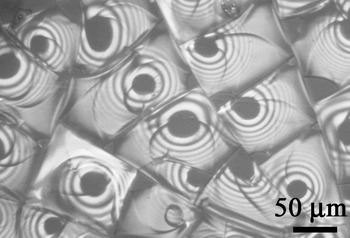
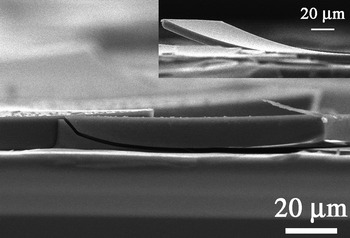
The action of HPIB with a beam current density exceeding 50 A/cm2 on soda-lime glass leads to the fracture of the near-surface layer of glass (Kovivchak and Panova, Reference Kovivchak and Panova2017). Two types of cracks are formed in the glass after the HPIB action – perpendicular and approximately parallel irradiated surfaces. When the surface of irradiated glass is observed in an optical microscope, an interference pattern (Newton's rings) is observed in the reflected light (Fig. 1). These patterns are caused by the appearance of an air gap due to the formation of a cracks parallel and perpendicular to the glass surface (Fig. 2) and the bent fragment still partly attached to the glass (inset in Fig. 2). The formation of a similar interference pattern was previously observed on the single crystal of CaF2 (111), K9 glass, soda-lime glass, and borosilicate crown glass (BK7) under the action of pulsed laser radiation (Kanemitsu and Tanaka, Reference Kanemitsu and Tanaka1987; Gogoll et al., Reference Gogoll, Stenzel, Reichling, Johansen and Matthias1996; Wang and Fang, Reference Wang and Fang2015) and soda-lime glass under pulsed high-current electron radiation (Wang et al., Reference Wang, Kimberlin, Chengyu, Ying, Lin, Aimin and Jun2005). However, the fracture surfaces and the time dependence of the fracture in these studies have not been studied. The analysis of the cross-section of HPIB irradiated glass showed that in most cases the thickness of the peeling fragments decreased from the center to the periphery of the fragment (Fig. 2). We assume that the change of the fragment thickness is due both to the inhomogeneous distribution of mechanical stresses over the area of the sample and the inhomogeneity of the mechanical properties of the surface layer of glass which has a high concentration of defects. The thickness of fragments is 10 ± 2 µm under a single action by HPIB with a beam current density of 100 A/cm2. Under single HPIB irradiation with the beam current density of 150 A/cm2, melting of a thin-surface layer of the glass is observed. In this irradiation mode the thickness of fragments decreases to 8 ± 3 µm.
Optical microscopy image of the surface of soda-lime glass after single HPIB irradiation with a current density of 100 А/cm2.

Cross-section of the surface layer of soda-lime glass irradiated with a current density of 100 А/cm2. Inset – Bent fragment still partly attached to the glass.

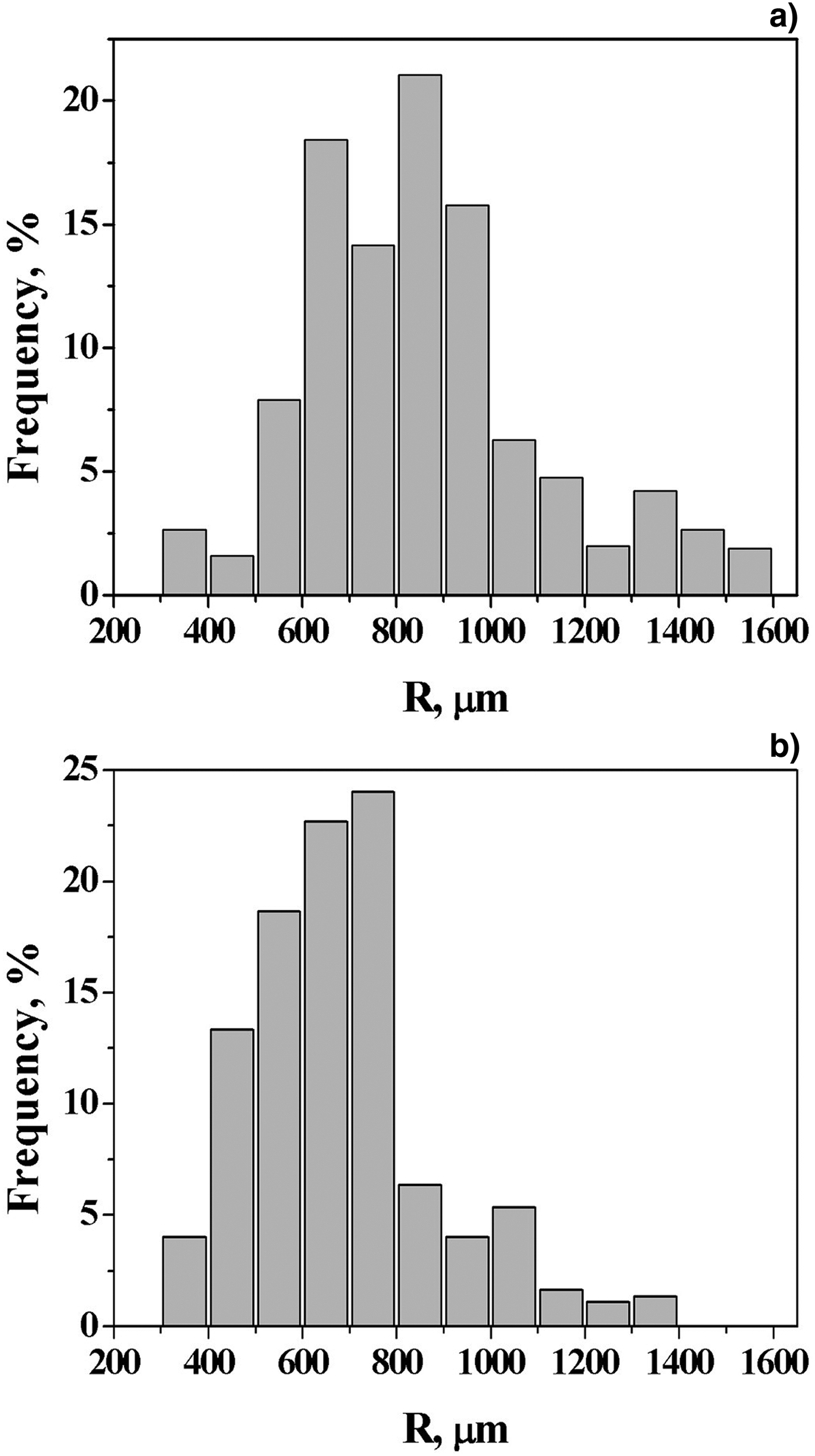
The curvature radius of the fragment (R) can be calculated from the wavelength of the light used for observation and the measured radii of the interference rings (Gogoll et al., Reference Gogoll, Stenzel, Reichling, Johansen and Matthias1996). In the present study white light was utilized (to increase the brightness of the interference pattern). Therefore, the average wavelength λ = 580 nm was used for calculations. The magnitude of the curvature radius depends on the level of mechanical stresses that arise in the surface layer of glass under HPIB action. The distribution of the curvature radii of the fragments for irradiation HPIB with beam current densities of 50 and 150 A/cm2 is shown in Figure 3. It is seen that an increase of the beam current density leads to a shift of the maximum of the distribution in the direction of smaller values of the curvature radius. This is probably due to the large temperature gradients in the near-surface layer of glass and consequently the generation of the higher mechanical stresses (including the stresses associated with the solidification of the molten surface layer) leading to an increase in the bending of the fragments. The distribution width decreases for the beam current density of 150 A/cm2. With the increasing irradiation pulse number (N), the curvature radius of the fragments decreases. The strongest change in the radius is observed for glass irradiated with a high-current density. This fact can be explained as follows. The energy release of the ion beam occurs in a thin layer of glass with a thickness of ~0.5 µm. However, because of the thermal conductivity of the glass the thermal front propagates to a depth of 1–2 µm from the surface during the action of the ion-irradiation pulse. A thin-surface layer of the glass melts under such irradiation mode. After the first irradiation pulse the fragment with a thickness of ~10 µm is formed. Strong heating of the irradiated surface of the fragment and solidification of the molten surface layer of the fragment leads to additional mechanical stresses and even greater bending of the fragments. Subsequent irradiation pulses increase these stresses and a decrease in the radius of curvature (increasing the bending) of the fragment. The multiple (N ≥ 2) HPIB irradiation with a beam current density of at least 100 A/cm2 also leads to intense melting and local boiling of the surface layer of the fracture fragment (Kovivchak and Panova, Reference Kovivchak and Panova2017).
Curvature radius (R) distribution of the fracture fragments for a current density: 50 A/cm2 (a) and 150 A/cm2 (b).

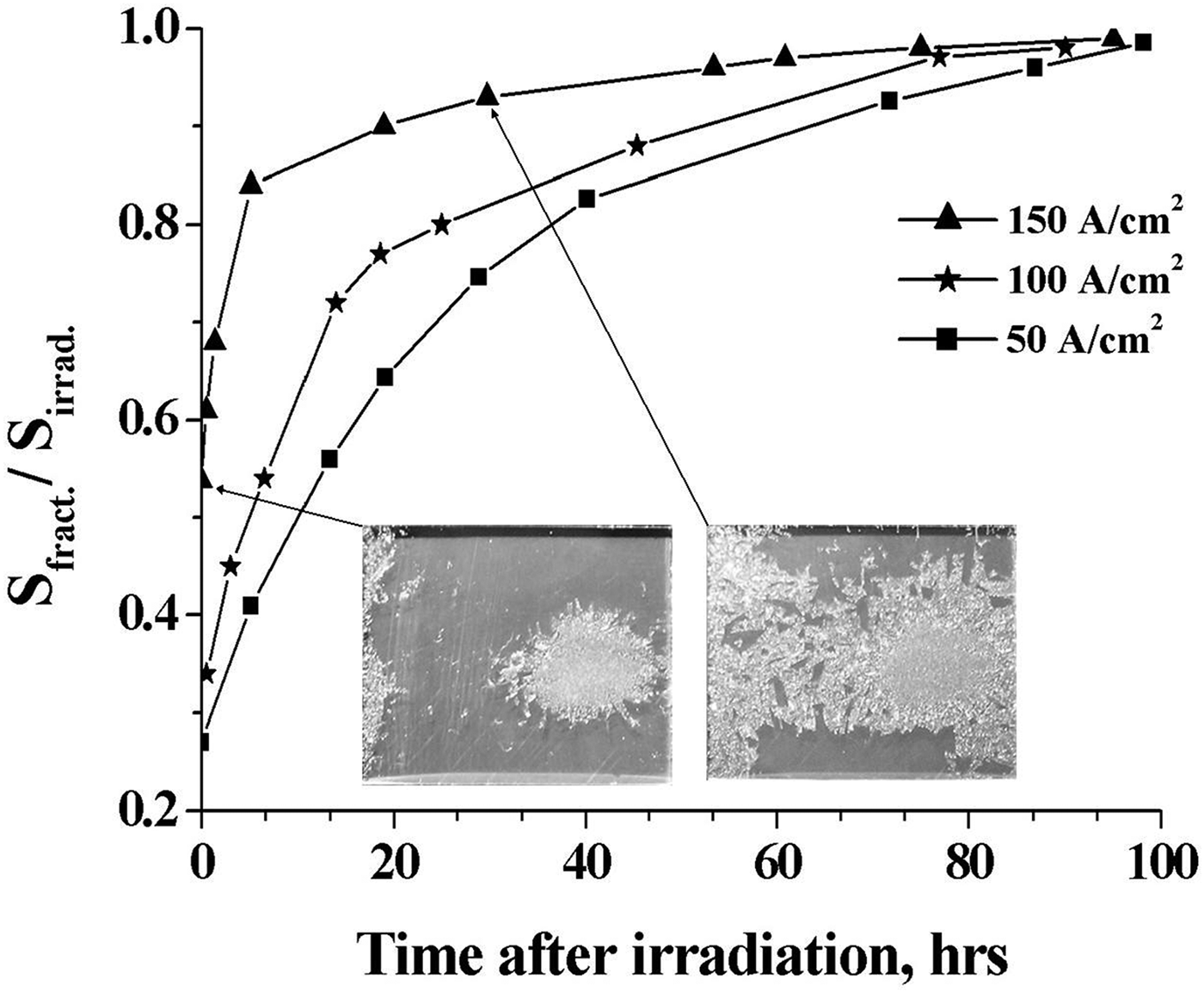
It was determined that at the HPIB action on soda-lime glass the cracks are formed both during irradiation pulse (a crack perpendicular and approximately parallel to the surface) and for a long time after irradiation (a crack approximately parallel to the surface). Cracks perpendicular to the surface begin to form at a beam current density exceeding 30 A/cm2. The formation of new cracks approximately parallel to the surface in irradiated glass was observed during 170 h after irradiation when the sample is under the air atmosphere (relative air humidity ~ 50 ± 8%). These cracks form on those parts of the sample, where cracks perpendicular to the surface already exist. The images of the irradiated surface of the soda-lime glass sample after various time intervals after irradiation are shown in the inserts of Figure 4. The fracture area looks bright due to the diffuse scattering of light on the cracks. The change of the relative fracture area of soda-lime glass (the ratio of the area of the fracture region (light region in the image, S fract.) to the total irradiation area of sample (S irrad.) versus time after a single HPIB action with different beam current densities is shown in Figure 4. The minimum time between the moment of irradiation and photographic registration of the surface of the irradiated sample is ~1.5 min. This time is required to remove the sample from the vacuum chamber of the accelerator. It is seen that an increase of the beam current density leads to an increase of the initial fracture rate (i.e., at short times after irradiation) which is due to higher initial values of the residual mechanical stresses. The formation of a fracture surface leads to an increase of surface energy which causes the decrease in elastic energy and the reduction of mechanical stresses in the near-surface layer. This leads to a significant reduction of the fracture rate and a slight increase of the relative fracture area later ~100 h after irradiation. After ~40 h, most of the formed fracture fragments have a curvature radius of at least 1000 µm.
Relative fracture area (S fract./S irrad.) of soda-lime glass as a function of time after HPIB irradiation for different current densities. Inset – Images of the irradiated surface of the glass sample after various time intervals after irradiation.

The formation of new cracks approximately parallel to the surface is significantly reduced while the samples are in a vacuum (~10−1 Torr). So the fracture area of sample increases by no more than 5% via 330 h after a single HPIB irradiation with a beam current density of 150 A/cm2. However, intensive formation of new cracks is observed when these samples are extracted into air (in accordance with Fig. 4). These facts indicate that the long-range growth of cracks is caused by chemical interactions of the components of the soda-lime glass with atmospheric water vapor at surface microcracks induced by HPIB irradiation. Under these conditions, residual stresses cause the growth of microcracks. The water vapors penetrate to microcracks parallel to the surface through cracks perpendicular to the irradiated surface. Earlier, a similar effect was observed with pulsed laser action on various glasses (Kanemitsu and Tanaka, Reference Kanemitsu and Tanaka1987). It should be noted that such surface cracking of soda lime glass was also observed under pulsed high-current electron radiation (Wang et al., Reference Wang, Kimberlin, Chengyu, Ying, Lin, Aimin and Jun2005). The authors explained the formation of cracks in terms of radiation-induced thermal stress and high local electric field induced by deposited charges from pulsed electrons.
As noted above a soda-lime glass is a good model material for studying of the fracture action of HPIB. At the same time the use of X-ray structure analysis to estimate the quantitative changes in residual stresses of the glass is problematic due to the X-ray amorphous of the glass. We used the X-ray method to roughly estimate the change of residual stresses in irradiated glass containing nano-sized crystalline inclusions (Kovivchak and Panova, Reference Kovivchak and Panova2017). The reduction of average residual stresses caused both by microcracks growth and by heat treatment of irradiated glass was established.
For comparison HPIB irradiation of fused silica which has a small coefficient of thermal expansion was investigated. In this case, small mechanical stresses arise in the surface layer. In addition, fused silica is strong against chemical interactions because fused silica does not contain alkalies. The above-described fractures were not observed on a fused silica even after irradiation by 20 HPIB pulses with a beam current density of 150/cm2, when intensive melting and local boiling of the surface layer of fused silica occur.
We found that the HPIB irradiation of soda-lime glass (with a beam current density of <100 A/cm2), which at the time of irradiation is heated to a temperature of 250 °C didn't cause the surface fracture of the glass. The heat treatment of the irradiated glass for 10 min at a temperature of 250 °C started no later than 2–3 min after irradiation leads to the partial relaxation of residual stresses and decrease of the crack formation in the surface layer despite the presence of water vapor under the air atmosphere. Thus the decrease of residual stresses leads to a decrease of the effect of atmospheric water vapor on fracture of glass. In this case, the most significant reduction of fracture is observed for HPIB irradiation with a beam current density of 50 A/cm2. Simulation of mechanical stresses in HPIB irradiated glass could be useful for interpretation of the received results. However, glass is a dielectric and the charge accumulated in the glass upon HPIB irradiation creates considerable electric fields in the near-surface region. These fields cause the deceleration or deflection of the beam ions and affect energy deposit in the glass. The radiation conductivity of HPIB-irradiated glass which reduces the charge accumulated is unknown at present. Therefore, we cannot calculate the profile of energy liberated in irradiated glass and simulate the temperature distribution in the glass target and the arising mechanical stresses. The nonuniform formation of cracks on the surface of the irradiated glass sample (the inset of Fig. 4) can be caused by charge accumulation in glass and its influence on the ion beam.
The surface cracking of HPIB irradiated materials can be observed not only for glass, but probably for alloys subjected to tensile stresses in a corrosive environment. It should be noted that HPIB irradiation of a glass sample can be used as an express method for determination of surface uniformity of energy deposit in the glass.
Conclusion
The long-term fracture of the surface layer of soda-lime glass (up to ~170 h) after HPIB irradiation indicates a predominant role of residual tensile stresses and water vapor under the air atmosphere in the fracture of glass under such action. An increase of the beam current density and the number of irradiation pulses leads to an increase in the number of microcracks in a highly defective surface layer of soda-lime glass and an increase in their interaction with water vapor under the air atmosphere. It was found that the characteristic depth of crack localization in glass was 10 ± 2 µm under a single HPIB irradiation with a beam current density of 100 A/cm2. It is shown that irradiation of heated glass or heating of glass started no later than 2–3 min after irradiation can suppress or substantially reduce surface fracture of glass due to rapid partial relaxation of the resulting residual stresses despite the presence of water vapor under the air atmosphere. This indicates that the effect of atmospheric water vapor on the fracture of glass decreases with decreasing residual stresses.
Acknowledgments
This study was carried out with the partial financial support of the RFBR and the Government of the Omsk Region in the context of the scientific project no. 15-48-04410 p_sibir_a.