Introduction
In many archaeological sites, the near absence of reliable archaeological dating material, such as diagnostic ceramics and well-preserved organic material, hinders the accurate dating of the associated sedimentary deposits and archaeological structures. In particular, small-sized charcoals, which though often present, are not always taxonomically identifiable, can suffer from an “old wood effect” or even be intrusive, i.e. potentially yield biased ages (Carcaillet Reference Carcaillet2001a; Carcaillet and Talon Reference Carcaillet and Talon1996; Chrzavzez Reference Chrzavzez2013; Gavin Reference Gavin2001; Robin et al. Reference Robin, Nelle, Talon, Poschlod, Schwartz, Bal, Allée, Vernet and Dutoit2018; Théry-Parisot et al. Reference Théry-Parisot, Chabal and Chrzavzez2010); as a result the selection of very small charcoals for radiocarbon dating can be problematic (Bird Reference Bird2013; Carcaillet Reference Carcaillet2001b). However, deposits from calcareous sedimentary contexts generally include abundant molluscan assemblages, which can comprise between several hundred to several thousand land snail shells per 10 L of sediment (Davies Reference Davies2008; Evans Reference Evans1972). The shells are largely composed of calcium carbonate (CaCO3) in the form of aragonite and about 12% of their mass consists of carbon (Pigati et al. Reference Pigati, Rech and Nekola2010). Therefore, they theoretically constitute a windfall for radiocarbon dating (e.g. Goodfriend Reference Goodfriend1992a; Pigati et al. Reference Pigati, Rech and Nekola2010; Pluckhahn Reference Pluckhahn, Rogers, Hadden, Jackson, Thompson and Garland2024; Rech et al. Reference Rech, Pigati, Lehmann, McGimpsey, Grimley and Nekola2011; Yates Reference Yates1986).
Nevertheless, using terrestrial gastropods for dating has long been avoided due to a poor understanding of the carbon sources involved in the formation of shell carbonate (Romaniello et al. Reference Romaniello, Quarta, Mastronuzzi, D’Elia and Calcagnile2008). For example, some snail species, like Cepaea nemoralis, Cernuella virgata and Theba pisana, were known to ingest geological limestone to produce the shell carbonate and thus incorporate dead carbon, which is deficient in 14C (Evin et al. Reference Evin, Marechal, Pachiaudi and Puisségur1980; Goodfriend Reference Goodfriend1987; Quarta et al. Reference Quarta, Romaniello, D’Elia, Mastronuzzi and Calcagnile2007; Romaniello et al. Reference Romaniello, Quarta, Mastronuzzi, D’Elia and Calcagnile2008). This “limestone effect” produced significant anomalies in 14C dating, notably ageing (Burleigh and Kerney Reference Burleigh and Kerney1982; Forman et al. Reference Forman, Hockaday, Liang and Ramsey2021; Gu et al. Reference Gu, Lu, Hajdas, Haghipour, Zhang, Wu and Shao2023; Goodfriend Reference Goodfriend1987; Goodfriend et al. Reference Goodfriend, Ellis and Toolin1999; Goodfriend and Hood Reference Goodfriend and Hood1983; Goodfriend and Stipp Reference Goodfriend and Stipp1983; Hertelendi et al. Reference Hertelendi, Sümegi and Szöör1992; Quarta et al. Reference Quarta, Romaniello, D’Elia, Mastronuzzi and Calcagnile2007; Rakovan et al. Reference Rakovan, Rech, Pigati, Nekola and Wiles2013; Romaniello et al. Reference Romaniello, Quarta, Mastronuzzi, D’Elia and Calcagnile2008; Xu et al. Reference Xu, Gu, Han, Hao, Lu, Wang, Wu and Peng2011). The correction of the old carbon effect is sometimes possible, but it requires preliminary analyses coupling radiocarbon and stable carbon isotopes of body and shells of the same species (Xu et al. Reference Xu, Gu, Han, Liu, Pei, Lu, Wu and Chen2010) or shells from fossils and living individuals of the same species (Hill Reference Hill2015; Hill et al. Reference Hill, Hunt, Prendergast and Barker2017; Padgett et al. Reference Padgett, Yanes, Lubell and Faber2019; Zhou et al. Reference Zhou, Head, Wang, Donahue and Jull1999). Unfortunately, such corrective methods appear to be case dependent and not replicable for other species or other regions (Hill et al. Reference Hill, Hunt, Prendergast and Barker2017). In the same way, the new methods of carbonate-target radiocarbon dating (Bush et al. Reference Bush, Santos, Xu, Southon, Thiagarajan, Hines and Adkins2013; Hua et al. Reference Hua, Levchenko and Kosnik2019) are currently being tested on marine shells (e.g. Dominguez et al. Reference Dominguez, Kosnik, Allen, Hua, Jacob, Kaufman and Whitacre2016; Kowalewski et al. Reference Kowalewski, Casebolt, Hua, Whitacre, Kaufman and Kosnik2018; Parker et al. Reference Parker, Yanes, Mesa Hernández, Hernández Marrero, Pais and Surge2020; Ritter et al. Reference Ritter, Erthal, Kosnik, Coimbra and Kaufman2017). This method consists of direct analysis of carbonate samples without prior conversion to graphite, with a significant reduction in pretreatments; results may be less precise but are fast and inexpensive. Concerning terrestrial snails, only an endemic species from the Madeira Archipelago is being considered: this method may be effective when coupled with amino acid racemization analyses (New et al. Reference New, Yanes, Cameron, Miller, Teixeira and Kaufman2019).
Relatively recent studies in North America (Nash et al. Reference Nash, Conroy, Grimley, Guenthner and Curry2018; Pigati et al. Reference Pigati, Quade, Shahanan and Haynes2004, Reference Pigati, Rech and Nekola2010, Reference Pigati, McGeehin, Muhs and Bettis2013; Rech et al. Reference Rech, Pigati, Lehmann, McGimpsey, Grimley and Nekola2011), dealing with the problem of how to date terrestrial snail shells, have demonstrated that some small species produce carbonate by almost exclusively ingesting carbon from plants, thus in equilibrium with atmospheric carbon. These small gastropod species, with maximum dimensions of the adult shells between 2 and 8 mm, such as Punctum minutissimum, Euconulus fulvus, Vertigo modesta, live on the stems of vegetation or in plant litter. Reliable radiocarbon dates can be expected, if secondary carbonate accumulations are carefully removed and that selection of species only includes those that produce carbonate mainly from vegetation (Grimley et al. Reference Grimley, Counts, Conroy, Wang, Dendy and Nield2020, Reference Grimley, Loope, Jacobs, Nash, Dendy, Conroy and Curry2024; Nash et al. Reference Nash, Conroy, Grimley, Guenthner and Curry2018; Rech et al. Reference Rech, Pigati, Lehmann, McGimpsey, Grimley and Nekola2011). North American experiments have also shown that terrestrial gastropod shells function as closed systems provided that they have been buried less than 25,000 years (Pigati et al. Reference Pigati, Rech and Nekola2010); beyond this age, contamination by recent 14C atoms becomes significantly influential, as is the case for most other buried biological materials. However, recrystallisation can also occur at the surface or in the inner structure of the shells, particularly in loess; this would lead to the incorporation of soil carbonates and cause anomalies in 14C levels (Gu Reference Gu, Lu, Hajdas, Haghipour, Zhang, Wu and Shao2023; Rech et al. Reference Rech, Pigati, Lehmann, McGimpsey, Grimley and Nekola2011; Yates Reference Yates1986; Zamanian et al. Reference Zamanian, Pustovoytov and Kuzyakov2016).
Nevertheless, radiocarbon dating of minute shells has shown consistent results for Late Pleistocene loess deposits (Grimley et al. Reference Grimley, Counts, Conroy, Wang, Dendy and Nield2020, Reference Grimley, Loope, Jacobs, Nash, Dendy, Conroy and Curry2024; Molnár et al. Reference Molnár, Sümegi, Fekete, Makó and Sümegi2019; Nash et al. Reference Nash, Conroy, Grimley, Guenthner and Curry2018; Pigati et al. Reference Pigati, McGeehin, Muhs and Bettis2013, Reference Pigati, McGeehin, Muhs, Grimley and Nekola2015; Rech et al. Reference Rech, Nekola and Pigati2012; Újvári et al. Reference Újvári, Molnár, Novothny, Páll-Gergely, Kovács and Várhegyi2014, Reference Újvári, Molnár and Páll-Gergely2016, Reference Újvári, Stevens, Molnár, Demény, Lambert, Varga, Jull, Páll-Gergely, Buylaert and Kovács2017). For the Holocene, a few loessic contexts from similarly cold regions and tufa sequences have yielded convincing, but sometimes poorly supported, results (Juřičková et al. Reference Juřičková, Horsák, Horáčková, Abraham and Ložek2014; Pigati et al. Reference Pigati, McGeehin, Muhs and Bettis2013; Wackenheim et al. Reference Wackenheim, Richter, Limondin-Lozouet, Wolf, García-Tortosa, Marzin, Hofmann, Dabkowski and Faust2023). Isolated dates from the shells of less suitable terrestrial gastropod species, without exclusive pathways for synthesizing carbonate from plant material, have also provided satisfactory results in Lateglacial and Pleniglacial sequences, when high precision was not required (Alexandrowicz Reference Alexandrowicz2022; Brennan and Quade Reference Brennan and Quade1997; Bruxelles et al. Reference Bruxelles, Pons, Magnin and Bertrand2010; Magnin and Bonnet Reference Magnin and Bonnet2014; Wackenheim et al. Reference Wackenheim, Limondin-Lozouet, Boudad and Berger2020). For the Holocene, some dates appear to be correct, but in general neither the choice of species (regarding their ecology) nor the composition of the samples (number of dated shells, single or mixed species etc.) are sufficiently explained; above all, the reliability of the results is not discussed (e.g. Allen et al. Reference Allen, Jones and Walker2020; Hamilton Reference Hamilton2020; Horáčková et al. Reference Horáčková, Podroužková and Juřičková2024; Horsáková et al. Reference Horsáková, Divíšek, Líznarová, Kubíková, Juřičková and Horsák2024; Limondin-Lozouet and Preece Reference Limondin-Lozouet and Preece2004; Magnin et al. Reference Magnin, Bonnet and Cenzon-Salvayre2022; Wackenheim et al. Reference Wackenheim, Limondin-Lozouet, Boudad and Berger2020). Moreover, for the Holocene and more particularly for archaeological sites, it is necessary to obtain greater reliability with radiocarbon dating.
Based on these principles, we tested the possibility of accurately dating archaeological sequences, particularly those difficult to date by other means, using an ecology-based selection of widely distributed snails.
Materials and methods
Study sites and associated problematics
Sedimentary sequences and archaeological structures were investigated at six sites, which were being excavated in the framework of preventive archaeology by the Institut national de recherches archéologiques préventives (Inrap). Five are located in the Languedoc region of southern France, with the exception of one in the Burgundy region of east-central France (Figure 1). All the sites studied stand on a substrate composed of marl-carbonate series, Jurassic and Oligocene in the case of Burgundy, Mio-Pliocene in the Languedoc. They included archaeological artifacts or botanical remains that allowed chronological control. For selected levels, the lack of such dateable materials is palliated by the sedimentary or archaeological contexts. They provide an independent chronological control to be compared with the dates obtained from the terrestrial gastropods. Essential elements for understanding the dates are given below for each site and level. Thorough archaeological, geomorphological or malacological results can be found in other publications (e.g. Longepierre and Lardé press; Mazière et al. Reference Mazière, Martin, Jorda, Sendra and Pallier2012; Perrin et al. Reference Perrin, Manen and Séjalon2014). The chronology of cultural periods covered by the studies is given in Table 1.
Location map of the archaeological sites mentioned in the text (R. Fritz, Inrap).

Chronology of cultural periods of investigated sites

The Étang de Pézenas
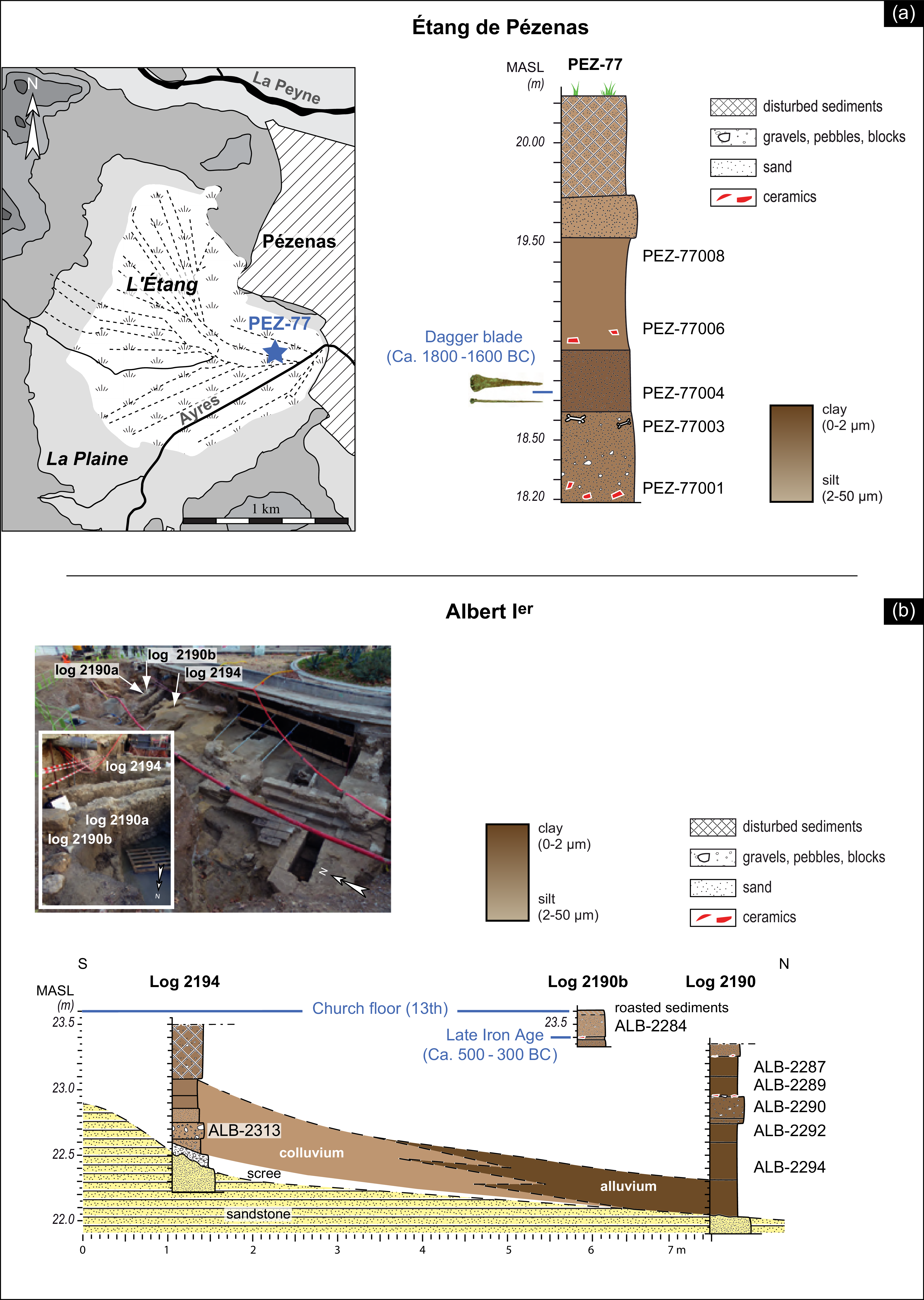
The sequence from Étang de Pézenas (PEZ), is located in an infilled lake belonging to a series of inland Languedoc lakes (Hérault, southern France) and is considered to have been drained in the Middle Ages by the Templar Knights, during the late 12th century (Abbé Reference Abbé2006). The history of hydromorphic processes, i.e. identifying the nature of the sediments, whether they remained wet, preferably anaerobic, or not, is crucial to understand this site, supposedly an important water resource. Understanding this wetland environment is also important to explain the dynamics of human settlements throughout the Holocene, in particular during the Iron Age (ca. 800–100 BC); its advantages and drawbacks could be decisive for those populations (Abbé Reference Abbé2006; Mazière et al. Reference Mazière, Martin, Jorda, Sendra and Pallier2012). The sedimentary deposits studied consist mainly of colluvial silts, with traces of marked soil alteration throughout the stratigraphy, which indicates that this sedimentary facies was not compatible with an aquatic environment (Figure 2a). This sedimentary sequence yielded a dagger blade from the end of the Early Bronze Age/beginning of the Middle Bronze Age (ca. 1800–1600 BC), which provides chronological control. Molluscan assemblages indicate exclusively terrestrial environments, reflecting wet meadows and shrubland. It is likely that the “lake” would have been seasonally flooded and used for pastoral practices. The dating of this sequence is therefore essential for matching this new perception of local environments with surrounding archaeological occupations.
Sequences and archaeological sites selected for dating: a) Étang de Pézenas, b) Albert Ier (Graphics: R. Fritz, S. Barbey, C. Jorda, Inrap).

Albert Ier
The analysis of the sequences from Albert Ist/Albert Ier (ALB) allowed the reconstruction of the palaeoenvironmental conditions in a central area of Montpellier (Hérault), based on excavations at a Medieval religious establishment, i.e. the Carmelite church and convent (13th–16th centuries) (Longepierre and Lardé Reference Longepierre and Lardé2017; Longepierre and Lardé in press). The urban context, filled with Medieval installations and modern networks (gas, water, electricity pipes), truncating the older deposits, represented a challenging setting for the excavation; the sediments preserved in very restricted areas correspond to a silt and clay floodplain, associated with fine colluvium resulting from soil erosion from the slopes. These slowly deposited sediments were pedogenized from the bottom to the top (Figure 2b) and record the vagaries of the Verdanson, a small tributary of the coastal river Lez. As the landscape evolution of Montpellier is poorly known, for periods prior to the Middle Ages, dating the sequences from Albert Ier was essential, even though their bad preservation did not appear favorable to obtaining suitable material. The palaeoenvironmental and geomorphological context, the dating of plant remains, the archaeological horizon detected in the sequences and the construction of the church serve as chronological controls.
Le Pouget
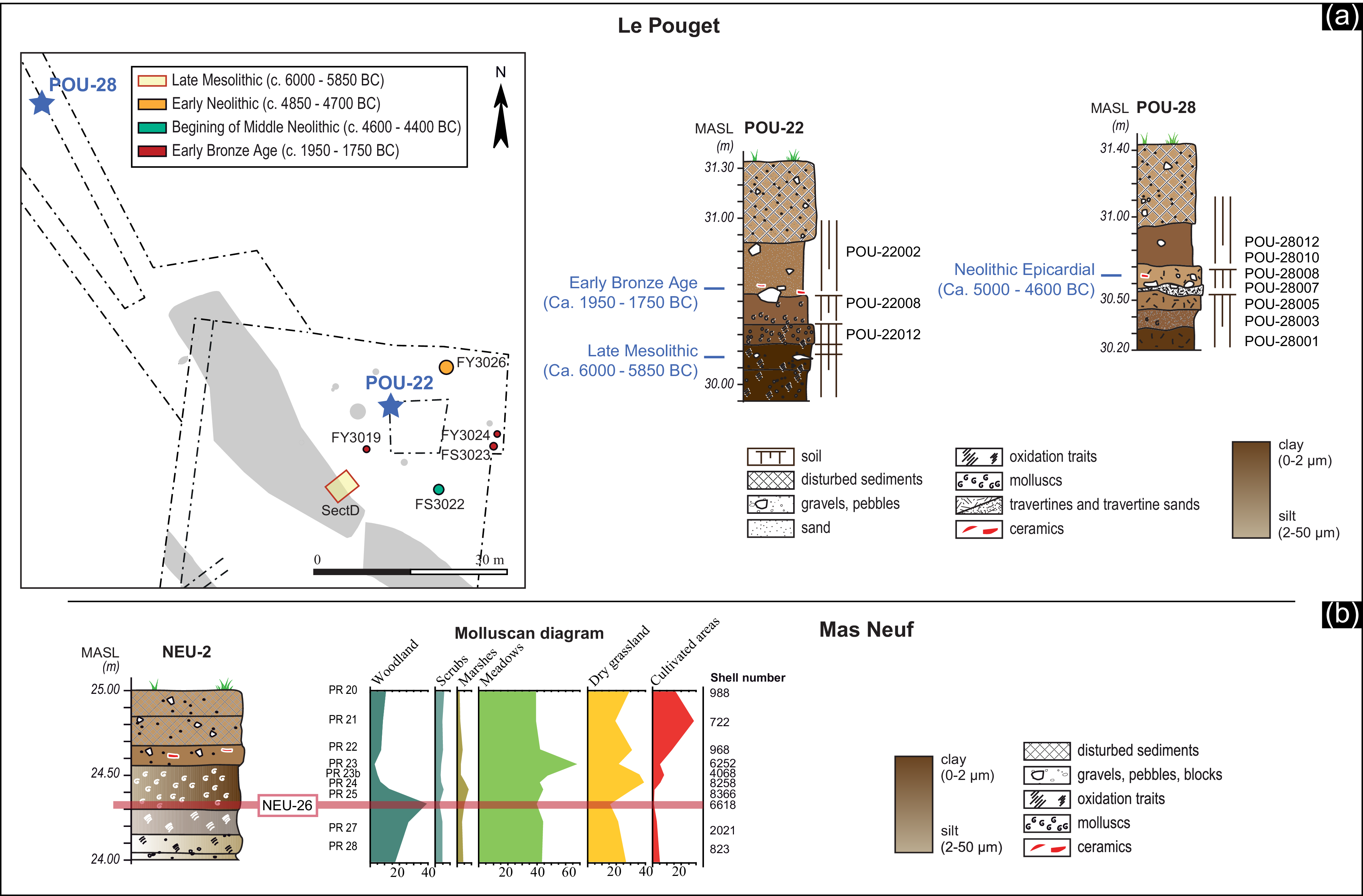
The Castelnovian (Late Mesolithic: 6100–5700 BC) site of Le Pouget (POU) (Lavérune, Hérault, southern France) consists of several marine shell middens. Continually occupied during the Holocene, the site also revealed more modest remains from the Early Neolithic Epicardial (ca. 5000–4600 BC), the beginning of the Middle Neolithic (ca. 4600–4400 BC), the beginning of the Late Neolithic (ca. 3500–3200 BC), Early Bronze Age (ca. 1950–1750 BC) and Late Antiquity (3rd–5th centuries). These features are characterized by hollow structures, such as pits or hearths, no habitat levels being detected (Rémy 2019). The sedimentary sequences are located on the edge of the alluvial plain of the river Mosson and correspond to overflow deposits mixed with colluvium. Composed of fine sediments (silts and clays), the sequences have been progressively deposited during the millennia by floods and slope runoff (Figure 3a), and although not very thick, they have been subject to significant bioturbation due to old root networks. Dating these deposits is essential for reconstructing the evolution of past environments linked to archaeological occupations. Two sequences were selected: one at the heart of the archaeological occupations at the foot of the slope (stratigraphic profile POU-22); the other at the margin of the site on the river floodplain (stratigraphic profile POU-28) (Figure 3a). They include different occupations dated by the charcoal material from the nearby archaeological structures (hearths and pits). These sedimentary levels and archaeological structures provide a chronological control for the dates obtained based on snails.
Sequences and archaeological sites selected for dating: a) Le Pouget, b) Mas Neuf (Graphics: R. Fritz, S. Barbey, C. Jorda, P. Chevillot, Inrap).

Mas Neuf
The archaeological site of Mas Neuf (NEU) (Nîmes, Gard) revealed important Neolithic occupations, including a village from the Early Neolithic Epicardial (dated here ca. 5000–4800 BC) (Séjalon et al. Reference Séjalon, Noret and Chevillot2014). These occupations are located on the top of a brown soil observed throughout the alluvial plain of Nîmes (Figure 3b). The base of this level corresponds to the maximum development of forest vegetation in the area, as revealed by previous molluscan studies (Martin Reference Martin2014). Its dating therefore was of significance for understanding vegetation development and the establishment of forests in the Holocene.
Mas de Mayan
The site of Mas de Mayan (MAY) (Nîmes, Gard) is located very close to Mas Neuf, around two kilometres to the south-west. Excavations have led to major discoveries concerning an important Azilian Epipalaeolithic occupation (ca. 12000–11000 BC). The site also revealed structures from the beginning of the Middle Neolithic (ca. 4600–4400 BC), the beginning of the Late Neolithic (ca. 3500–3200 BC) and the transition between the Late Neolithic and the Early Bronze Age, i.e. the Epicampaniform period (ca. 2200–1900 BC), as well as some vestiges of Roman centuriation (ca. 150 BC-50 AD) and modern administrative land division (Vergély 2020). The prehistoric occupations were organized around an old humid depression (Figure 4a), as testified by the sediments, which display oxidation-reduction characteristics, typical of hydromorphic environments. Investigation using snails has made it possible to determine the hydrological features of this depression, its evolution and type of bank vegetation (Martin Reference Martin2020). Therefore, dating is fundamental for clearly understanding the periodic succession of wet and dry conditions, and for verifying contemporaneous changes with the different human groups represented at the site. These archaeological occupations and the paleoenvironnemental context serve as a chronological control for the dating of shells. Furthermore, we have also selected shells to date an archaeological structure devoid of artifacts.
Sequences and archaeological sites selected for dating: a) Mas de Mayan (Nîmes), b) Tombs of Lux (Photography: Com’Air). (Graphics: R. Fritz, S. Barbey, P. Chevillot, Inrap).

Tombs of Lux
The last example is located outside the Mediterranean region and is included in this study because it allowed precise dating of otherwise undated occupations. The site of the Tombs of Lux (LUX) (Côte d’Or, Burgundy) is a major site for the Metal Ages of eastern France, with an essentially funerary assignment: three monumental tumuli were erected during the Late Bronze Age (type IIIb, ca. 950–800 BC), being used throughout the Iron Age, during the Hallstatt culture (ca. 800–500 BC) until the Middle La Tène culture (until ca. 200–160 BC) (Fossurier Reference Fossurier2018) (Figure 4b). Two of the archaeological structures were dated. Both snail shells and charcoal were dated in one of them; in the other structure, only the snail shells were carbon dated, the archaeological context being used as a chronological control.
Terrestrial gastropods
Mollusk species ecology
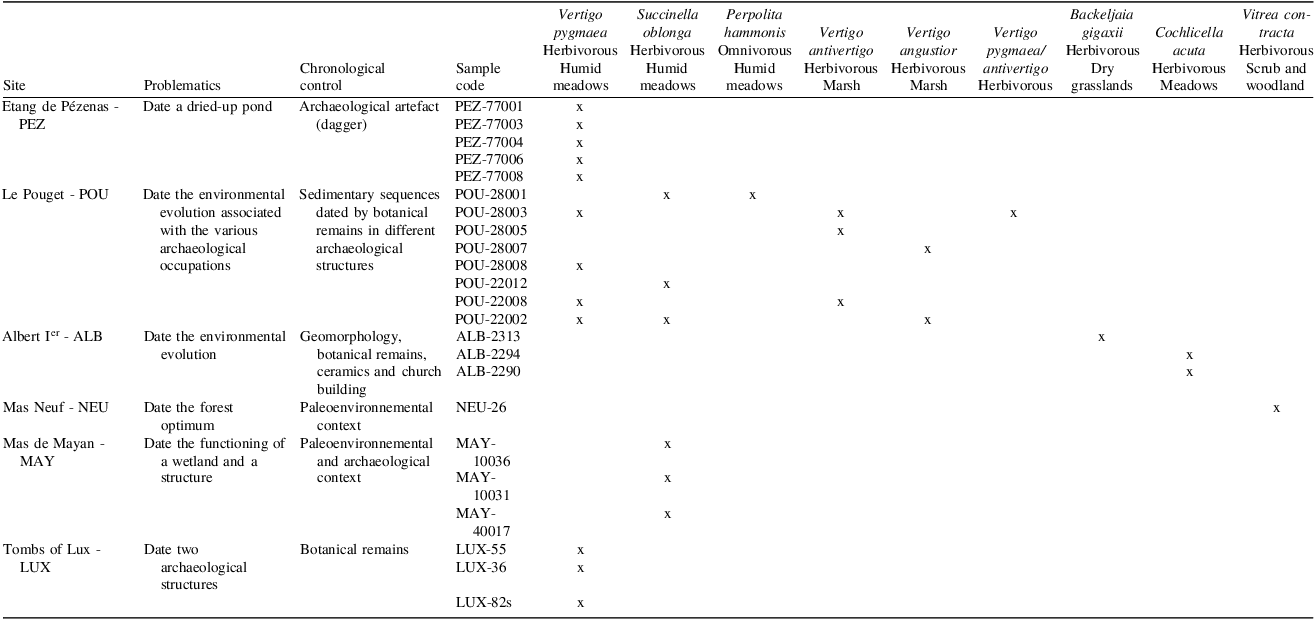
As many European species are different from the North American ones, the European species selected were those belonging to the most relevant genera identified in the American investigations (Nash et al. Reference Nash, Conroy, Grimley, Guenthner and Curry2018; Pigati et al. Reference Pigati, Rech and Nekola2010): Succinella oblonga, Vertigo pygmaea, Vertigo antivertigo, Vertigo angustior, Perpolita hammonis and Vitrea contracta (Figure 5). All these species were common in temperate environments during the Holocene. S. oblonga has been validated in Europe for cold periods, by studies on late Quaternary loess from Hungary, whereas the reliability of P. hammonis is less certain (Újvári et al. Reference Újvári, Molnár and Páll-Gergely2016). These species are mainly hygrophilous (S. oblonga, V. pygmaea and P. hammonis), marshy (V. antivertigo and V. angustior) or shade-demanding species (V. contracta). In most cases, snails are rather opportunistic in their diet (Speiser Reference Speiser2001). The selected species are mainly herbivorous: they feed on minute cryptogams or decaying vegetation (e.g. Cameron et al. Reference Cameron, Colville, Falkner, Holyoak, Hornung, Killeen, Moorkens, Pokryszko, Von Proschwitz and Tattersfield2003; Welter-Shultes Reference Welter-Schultes2012). P. hammonis, on the other hand, is more omnivorous and can feed on live prey (insects or snails) in addition to leaf litter (Barker and Efford Reference Barker, Efford and Barker2004). Overall, the species studied present a minimal risk of consuming limestone themselves or eating species that frequently digest limestone, thus representing the best option for radiocarbon dating (Hamilton Reference Hamilton2020). With the exception of V. contracta, which shelters in the soil at the base of plants, the other minute land snail species, like those of the Vertigo genus, live in the midst of vegetation that provides shelter during resting and hibernation periods. This is also the case for S. oblonga, which retracts into the shell and attaches itself to the plants during resting periods (Barker Reference Barker2001). As many snail species lay their eggs in the soil, fossil carbon could be incorporated during embryonic life. However, the species selected generally lay their eggs on plants, all depending on an opportunistic behaviour (Barker Reference Barker2001). P. hammonis drops its eggs singly in the middle of moss or grass (Heller Reference Heller and Barker2001); Vertigo and Succineidae tend to lay their eggs on the leaves and stems of plants and some cover the eggs with faeces or detritus to protect against drying out and for camouflage (e.g. V. pygmaea, S. oblonga) (Myzyk Reference Myzyk2011; Welter-Shultes Reference Welter-Schultes2012). These life traits suggest that the risk of incorporating fossil carbon during embryonic life would be minimal.
Photographs of selected land snail species dated in this study (1 mm bar in each panel for scale): (a) Succinella oblonga, (b) Vertigo pygmaea, (c) Vertigo augustior, (d) Vertigo antivertigo, (e) Perpolita hammonis, (f) Vitrea contracta, (g) Cochlicella acuta, (h) Backeljaia gigaxii. (Photography: P. Druelle©Druelle. Pascal; graphics: R. Fritz).

Backeljaia gigaxii and Cochlicella acuta do not meet the criteria for the North American investigations because their shells are larger. However, in the absence of very small species, these larger shells were selected for dating at Albert Ier as they have a similar ecology, being herbivorous and always living in the midst of the vegetation cover. In Great Britain, C. acuta has also provided satisfactory results in recent dune sequences (Allen et al. Reference Allen, Jones and Walker2020).
Material selection
The dated snail shells come from samples taken and analysed according to the standards of molluscan analysis (Evans Reference Evans1972; Puisségur Reference Puisségur1976; Spark Reference Sparks1961). Each sample of about 10 L of sediment is sieved by water, using a 0.5 mm mesh; afterwards the terrestrial gastropod shells are sorted and quantified. Taxonomic identification is carried out under a low power binocular microscope, by comparison with a modern reference collection and using specialized atlases (Kerney et al. Reference Kerney, Cameron and Bertrand2006; Welter-Schultes Reference Welter-Schultes2012). The systematic nomenclature used in this paper is based on (MolluscaBase eds. 2025).
For small species, the amount of carbon dioxide required for radiocarbon dating by AMS necessitates the selection of several individuals or shell fragments per sample. Indeed, to obtain at least 1 mg of carbon dioxide, which is the average size for AMS dating, between 10 and 20 mg of shells are needed, according to the condition of the shell wall. It was thus sometimes necessary to group the species together to obtain a sufficient quantity of carbon dioxide; in this case, all species selected theoretically ingest carbon from plants only.
Indeed, at Le Pouget, the sedimentary sequences revealed significant bioturbations; as a result, to limit the risks of contamination between sedimentary layers, different terrestrial gastropod species, characteristic of each level, were chosen. For example, marshy species were very abundant in the lower parts of the sequences and were selectively prioritized for these levels (V. angustior and V. antivertigo); meadow species were selected for other levels (S. oblonga and V. pygmaea). Nevertheless, for the most ancient levels, it was necessary to group the species together to obtain a sufficient amount of carbon dioxide. This grouping was carried out using species ingesting almost exclusively carbon from plants only and representing similar environmental characteristics: S. oblonga + P. hammonis, V. pygmaea + V. antivertigo + V. pygmaea/antivertigo, V. pygmaea + V. antivertigo and S. oblonga + V. pygmaea + V. angustior. In this set, V. pygmaea/antivertigo correspond to dextral Vertigo specimens impossible to identify to species level due to the absence of the shell aperture.
Finally, gastropod species were selected, site by site, according to ecological and taphonomic criteria (preservation and abundance) and post-depositional processes (disturbance by bioturbation or ploughing, erosion or palimpsest of archaeological deposits) (Table 2).
Gastropod species selected in each sample according to the problematics at study sites

Radiocarbon dating
Prior to being sent to the radiocarbon laboratories, the snail shells selected were manually broken to check for residues and washed ultrasonically with distilled water, in order to eliminate as much sediment residue and secondary calcite as possible (due to diagenesis), following the protocol of Pigati et al. (Reference Pigati, Rech and Nekola2010) and Rech et al. (Reference Rech, Pigati, Lehmann, McGimpsey, Grimley and Nekola2011).
Samples were submitted to different laboratories depending on the studied site: Beta Analytic Radiocarbon Dating Laboratory (Beta), Poznan Radiocarbon Laboratory (Poz), Erlangen AMS Group (Erl) and Centre for Isotope Research in Groningen (GrA); this last laboratory dated one sample pretreated by the Centre de Datation par le RadioCarbone in Lyon (Ly). AMS radiocarbon dating was undertaken using standard methods for carbonate materials, adapted according to the protocols of each laboratory (mainly Brock et al. Reference Brock, Higham, Ditchfield and Bronk Ramsey2010; Wood et al. Reference Wood, Esmay, Usher and Fallon2023).
For snails in particular, the focus is on pretreatments to eliminate or reduce, as much as possible, intrusive contaminants and secondary carbon components. These pretreatments (which followed the first cleaning carried out by us) consist of mechanical cleaning (if necessary), followed by chemical purification. For the Beta Analytic Radiocarbon Dating Laboratory, the sample material was etched in a solution of ±10% hydrochloric acid (±1.22N HCl) at room temperature. The time, number and concentrations of the applications were determined according to the shape, thickness, structure, size and degree of weathering of each sample. After rinsing with deionized water to remove eventual organic coating, the sample was dried in a vacuum oven and then examined under a microscope for any fragments, which do not appear uniformly clean. In the case of the Poznan Radiocarbon Laboratory, the chemical protocol consisted of washing with 0.1M HCl for 12 s, the dissolution of shells with HCl being monitored under binoculars and interrupted after the dissolving of 10–20% of material. This was followed by a wash with 10% H2O2 again for 12 s remove any eventual organic coating. Finally, the Centre de Datation par le RadioCarbone in Lyon, cleaned the shells by rinsing them several times with ultrapure water in an ultrasonic bath and then dried.
In all laboratories, after pretreatment, only the shells that appear to be well preserved and free of any contamination are analysed. Cleaned shells are converted into carbon dioxide (CO2), through acid hydrolysis with pure ortho-phosphoric acid (H3PO4).
The laboratories involved in the dating of the plant remains (charcoal) are the same, with the addition of Laboratoire de Mesure du Carbone 14 (SacA) for samples pretreated by the Centre de Datation par le RadioCarbone in Lyon (Ly). Each sample underwent a sequential acid-base-acid (ABA) pretreatment. After crushing and dispersing in deionised water, the charcoal was washed with hot HCl acid to eliminate carbonates, followed by an alkaline wash (NaOH) to remove secondary organic acids. This alkaline wash is followed by a final acid rinse to neutralise the solution before drying. Each sample was then oxidised to CO2 either by combustion in an oxygen stream (O2) or by direct reaction with reduced cupric oxide (CuO).
The CO2, resulting either from carbonate hydrolysis or plant remains combustion, was cryogenically purified by removing water vapor and any non-combustible/condensable gases by passing through a series of passive traps. The CO2 generated was converted to graphite to obtain pure carbon by catalytic reduction of CO, according to Vogel et al. (Reference Vogel, Southon, Nelson and Brown1984), Dee and Bronk Ramsey (Reference Dee and Bronk Ramsey2000), Czernik and Goslar (Reference Czernik and Goslar2001) and Dee et al. (Reference Dee, Palstra, Aerts-Bijma, Bleeker, de Bruijn, Ghebru, Jansen, Kuitems, Paul and Richie2020).
Finally, each sample was submitted to Accelerator Mass Spectrometry, the graphite target being placed into the AMS along with the necessary Modern Standards (Oxalic Acid I and/or Oxalic Acid II) and sufficient blind quality assurance samples. At the far end of the accelerator, sensitive instruments detect the arrival of the 14C, 13C and 12C ions, allowing the estimation of the 14C/13C and 14C/12C ratios.
Conventional radiocarbon ages were calibrated with the IntCal20 dataset (Reimer et al. Reference Reimer, Austin, Bard, Bayliss, Blackwell, Bronk Ramsey, Butzin, Cheng, Edwards and Friedrich2020) and converted to calendar ages using OxCal online, version 4.4 © Christopher Bronk Ramsey 2024: the probability value associated with the ages is a probability of 95.4% (2σ), using the interval of the highest posterior density (HPD) (Bronk Ramsey Reference Bronk Ramsey2009).
Results
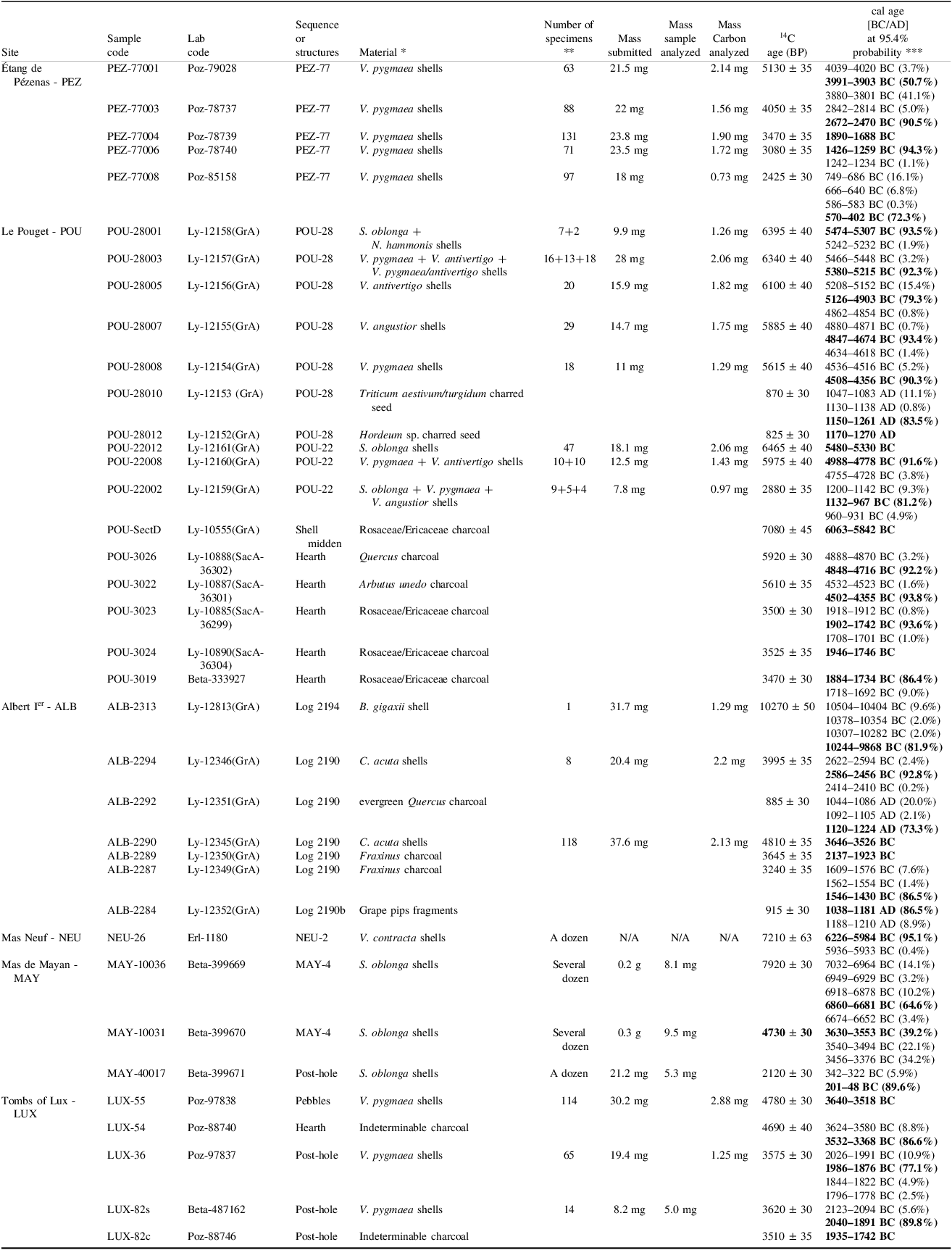
Dates obtained using both malacological and botanical remains cited in this article, are presented in Table 3.
Radiocarbon results of terrestrial snails and botanical remains for study sites

OxCal v4.4 version 174 © Christopher Bronk Ramsey 2024 (Bronk Ramsey Reference Bronk Ramsey2009); IntCal20 atmospheric curve (Reimer et al. Reference Reimer, Austin, Bard, Bayliss, Blackwell, Bronk Ramsey, Butzin, Cheng, Edwards and Friedrich2020)
N/A: not available
* Refer to Figure 5 for full species names
** Fragments or whole shells
*** Best probabilities in bold
Étang de Pézenas
Five levels were dated using shells from the wet meadow species, Vertigo pygmaea, which is abundant in the sequence. The radiocarbon dating results (Table 3) are organised in a chronological order of the deposits, without dating reversals (Figure 6). The oldest level is dated to the Middle Neolithic (PEZ-77001: ca. 4000–3800 cal BC) and followed by a Late Neolithic level (PEZ-77003: ca. 2650–2450 cal BC). As mentioned before one of the archaeological levels (PEZ-77004) yielded a dagger blade, a close-combat weapon (Compan Reference Compan2006; Mazière and Compan Reference Mazière and Compan2010); it belongs to a typological group that places it between 1800 and 1600 BC, at the transition between the Early Bronze Age and the Middle Bronze Age (Briard and Mohen Reference Briard and Mohen1983; Guilaine Reference Guilaine1972; Gabillot Reference Gabillot2003). The date obtained on the snails is consistent with the archaeological chronology (PEZ-77004: 1890–1688 cal BC). The level above is dated to the Late Bronze Age (PEZ-77006: ca. 1400–1250 cal BC). Finally, the topmost sample dates to the Iron Age; it is not very precise because of the Hallstatt plateau, as is the case for all other biological materials for this period (PEZ-77008: ca. 750–700 cal BC at 16.1% probability and ca. 570-400 BC at 72.3% probability).
Radiocarbon dating results from the Étang de Pézenas sequence. For the details of profile, refer to the legend of Figure 2a. OxCal v4.4 version 174 © Bronk Ramsey 2024.

This study makes it possible to confirm that the “Étang de Pézenas” has been largely dry since the Neolithic and in fact was not drained by the Templar Knights in the Middle Ages. Nevertheless, due to the occasional presence of water, it was probably a vital resource for earlier populations, such as pastoralists. The hypotheses considering either the attractiveness of water availability or, conversely, the repulsion associated with a marshy area can therefore be ruled out in the interpretation of the dynamics of local settlement during Protohistory.
Albert Ier
To date Albert Ier highly disturbed sequences, seven radiocarbon dates were carried out: three dates relate to snails (one from Backeljaia gigaxii and the other two from Cochlicella acuta), and four to charcoal.
According to the geomorphological context, the base of the sequence was expected to correspond to the end of the Late Glacial or Early Holocene. The most recent levels were dated by archaeological material (Massalian amphorae) to the beginning of Late Iron Age (ca. 500–300 BC), with the Medieval convent built in the 13th century defining the top of the sequence.
For the base of the sequence, Backeljaia gigaxii was chosen for dating, because of the absence of the most suitable snails. This thermophilic species, characteristic of Mediterranean dry grasslands, forms typical assemblages during the Early Holocene in the south of France, when open vegetation became established due to warmer conditions (Magnin Reference Magnin1991). The dating confirms the base of the sequence being from the very end of the Late Glacial/early Holocene (ALB-2313: ca. 10250–9850 cal BC). This result is not totally precise due to the limited biological material, but it approximately corresponds with what was expected.
The dates of the more recent levels correspond to the stratigraphic order, namely the Middle/Late Neolithic/Neolithic transition (ALB-2290, Cochlicella acuta shells: ca. 3650–3500 cal BC), followed by the Early Bronze Age (ALB-2289, Fraxinus charcoal: ca. 2100–1900 cal BC), and finally the Middle Bronze Age (ALB-2287, Fraxinus charcoal: ca. 1550–1450 cal BC). The occupation of the beginning of Late Iron Age level (ca. 500–300 BC), above ALB-2287, provides the upper limit. The level just prior to the medieval church (built in the 13th century) gives a chronological attribution of the 11th-12th centuries based on grape pip fragments (ALB-2284: ca. 1050–1150 cal AD).
However, two further dates had to be discarded, one using charcoal, the other obtained from snails, as they did not agree with the stratigraphic sequence order. The expected dates were Early Holocene, but the radiocarbon results gave Late Neolithic for one (ALB-2294: Cochlicella acuta shells, ca. 2600–2400 BC) and Middle Ages for the other (ALB-2292: evergreen Quercus charcoal, ca. 1050–1200 AD). The inconsistency of these results can be explained by the importance of bioturbation phenomena in the sedimentary sequence.
To summarize, of the seven radiocarbon dates carried out, five were retained, i.e. two of the shells (of the three attempted), two of the charcoal (of the three attempted) and one using a seed. This result clearly demonstrates the problems raised by disturbance of sedimentary sequences, particularly in urban areas. Despite the mixed results it is encouraging to realise that even when only the “second best choice” is available, and in very limited amounts, snail shells can still provide a reliable approximate date, as testified by the Lateglacial/Early Holocene result.
Le Pouget
Eight samples of snail shells, either assembling individuals of a single species or individuals of several species, were radiocarbon dated (Table 2). All the dates obtained respect the stratigraphic and chronological order, without inversions (Figure 7).
Radiocarbon dating results from the sequences at Le Pouget. For the details of profiles, refer to the legend of Figure 3a. OxCal v4.4 version 174 © Bronk Ramsey 2024.

The age of the base of the sedimentological sequences is obtained based on two dates, which both give a result of around 5500–5300 cal BC (POU-22012 and POU-28001). These dates lie above the last phase of Late Mesolithic Castelnovian occupation, around 6000–5850 BC, which constitutes the older limit (POU-SectD and occupation level in POU-22 profile).
Between the Mesolithic (ca. 6000–5850 BC) and the Neolithic Epicardial (ca. 5000–4600 BC) occupations, the stratigraphic profile POU-28 includes two other dates perfectly intercalated chronologically (POU-28003: ca. 5400–5200 cal BC; POU-28005: ca. 5100–4900 cal BC). The chronology of the Epicardial occupation is supported by the dating of snails in the two stratigraphic profiles (POU-28007: ca. 4850–4650 cal BC; POU-22008: ca. 5000–4800 cal BC), which are consistent with the dating of the archaeological structures from charcoal, particularly that located near profile POU-22 (hearth POU-3026: ca. 4850–4700 cal BC). Also, the date from the following level in profile POU-28 (POU-28008: ca. 4500–4350 cal BC) is synchronous with the beginning of the Middle Neolithic occupation attested in the vicinity (hearth POU-3022: ca. 4500–4350 cal BC, based on charcoal).
The chronology of these levels is coherent with the level just above (the upper limit), which contains Early Bronze Age ceramics and is carbon dated using charcoal from three nearby hearths (POU-3023 and POU-3019: ca. 1900–1750 cal BC; POU-3024: ca. 1950–1750 cal BC).
Carbon dating using snails recovered from the last stratigraphic level, just before the modern ploughing level, gives a result corresponding to the Late Bronze Age (POU-22002: ca. 1150–950 cal BC), in the profile POU-22 (Figure 7). However, this level is also identified and dated in the stratigraphic profile POU-28 using charred cereal seeds and the date obtained corresponds to the Medieval Period (POU-28010 and POU-28012: ca. 1150–1250 cal AD). According to the macro- and micro-morphological observations (Jorda et al. Reference Jorda, Martin and Wattez2019), this level could have recorded old ploughing. Thus, the Late Bronze Age date, POU-22002, should be rejected: inaccuracies detected are most probably due to agricultural reworking of older sediments.
Finally, from the eight dates carried out on snails, seven can be selected and only one discarded for taphonomic reasons. These dates allowed identifying sedimentary levels contemporary with the archaeological structures.
Mas Neuf
The date expected should correspond to the maximum development of the forest before the first local Neolithic impacts, i.e. the Early Atlantic, taking into account the regional palaeobotanical data (Andrieu-Ponel et al. Reference Andrieu-Ponel, Ponel, Bruneton, Leveau and de Beaulieu2000; Heinz and Thiébault Reference Heinz and Thiébault1998; Thiébault and Vernet Reference Thiébault and Vernet1992). Due to the lack of suitable charcoal, the snail Vitrea contracta was chosen for dating: this species is exclusively present in the level to be dated and its absence in the younger levels removes the risk of contamination by more recent elements. The result obtained (NEU-26: ca. 6200–6000 cal BC) was perfectly consistent with the expected result and regional vegetation development.
Mas de Mayan
The MAY-4 sedimentary sequence, considered to best reflect the wet depression, has been dated using Succinella oblonga shells, once at the base (PRL10036) and once at the top (PRL10031).
According to the general molluscan data, at the beginning of its activity the “pond” was surrounded by an open riparian forest. This degree of openness suggested that the level was deposited during the beginning of the Early Atlantic, in agreement with the regional botanical data seen previously for Mas Neuf (located 2 km away): MAY-4 was expected to be older than NEU-26, which represents the maximum development of the Atlantic forest. The date obtained corresponds well to the Early Atlantic (MAY-10036: ca. 6850–6700 cal BC) and is older than that of Mas Neuf (NEU-26: ca. 6200–6000 cal BC), which confirms the palaeoenvironmental hypothesis.
The drying out of the depression is recorded in a sedimentary level, which was deposited after a Middle Neolithic occupation level (around 4600–4400 BC, according to the ceramic study), and which serves as the older chronological limit (Figure 4a). The date obtained for this drying out level (MAY-10031: ca. 3600–3400 cal BC) is a thousand years more recent, just prior to the beginning of the Late Neolithic (3500–3200 BC), a period very much represented on the site and whose structures are still clearly organized around the depression by now drained.
In the northeast part of the site, an alignment of posts constituting a palisade (Figure 4a) has remained enigmatic: in the absence of typical ceramics, its chronological attribution was unknown, and its form did not allow any attachment to a particular period. Given the interest in the palisade for the full understanding of the site, dating was carried out using Succinella oblonga shells recovered from the infilling of a post-hole. The date obtained (MAY-40017: ca. 200–50 cal BC) indicates the Roman Republic period, which might appear surprising in an overall Neolithic context. However, this date corresponds exactly to the Roman centuriation ditch located less than 20 m from the structure, dated from the Roman period (ca. 150 BC–50 AD) by the ceramics (Noret et al. Reference Noret, Aurand, Farge, Guerre, Plassot and Recolin2010; Vergély 2020).
Tombs of Lux
Three dates were carried out using the wet meadow species, Vertigo pygmaea. The first date was obtained from a “heated pebbles” hearth (in French “pierres chauffées”), associated with a stored pile of stones. The charcoal of the hearth was dated to the end of the local Middle Neolithic/beginning of Late Neolithic (LUX-54: 3532–3368 cal BC at 86.6% probability). The Vertigo pygmaea shells from the level just below the pile of stones provide a perfectly synchronous (LUX-55: 3640–3518 cal BC) (Figure 8a).
Radiocarbon dating results from the archaeological site of the Tombs of Lux: (a) heated pebble hearth (b) funerary building. OxCal v4.4 version 174 © Bronk Ramsey 2024.

The last two dates from snails were carried out as the dates obtained from charcoal did not correspond to our first expectations. A funerary build on poles was discovered in the center of one of the Late Bronze Age mounds (Figure 4b) and was supposed to be much more recent than the tumulus (founded around 900 BC), probably from the Early Middle Ages (ca. 450–700 AD), because the site was briefly reused for funerary purposes at that time. However, the first date, on charcoal, proposed a date from the Early Bronze Age (LUX-82c: 1935–1742 cal BC). The second, using V. pygmaea shells, supports this date (LUX-82s: 2040–1891 cal BC at 89.8% probability). For independent verification, it was even decided to change the radiocarbon laboratory in order to carry out dating for the third time, also using V. pygmaea shells. This date was undertaken from the same structure as for the charcoal and was found to further validate the other two dates (LUX-36: 1986–1876 cal BC at 77.1% probability). Nevertheless, the two dates for the snails are slightly older than for the charcoal (Figure 8b) and could be explained by the sampling context: the infilling of the post-holes generally corresponds to the previous sediments reworked during digging. Thus, the terrestrial gastropod assemblage is probably linked to the environment immediately prior to building, while the charcoal could correspond to the cremated residues associated with the building (Fossurier Reference Fossurier2018).
Due to these additional dates, the archaeological interpretation finally proposed considers that the Late Bronze Age mound (ca. 900 BC) would have been erected on a first funerary complex from the Early Bronze Age (ca. 1900 BC). This indicates that the site retained its funerary assignment after several centuries of abandonment (i.e. around 1000 years).
Discussion
Dates retained, dates discarded
Figure 9 summarizes the results presented above. The majority of the radiocarbon dates tested on snail shells are considered as correct as they are in agreement with the stratigraphy, the archaeological and botanical controls or with the interpretations suggested by the regional palaeoecology or the local geomorphology. In view of the many examples of problematic dating of terrestrial mollusks in archaeological contexts (e.g. Burleigh and Kerney Reference Burleigh and Kerney1982; Evin et al Reference Evin, Marechal, Pachiaudi and Puisségur1980; Granai and Wackenheim Reference Granai and Wackenheim2022; Richard Reference Richard, Achard-Corompt, Ghesquière and Riquier2017), many of which have probably never been published, it is rather encouraging that the dates in the sequences are all in chronostratigraphic order, without inversion. Similarly, the results obtained are almost all in line with what was expected, even if the target interval is rather wide for some of these attempts. Whenever the chronostratigraphical control is more precise, such as the Tombs of Lux (LUX-55, LUX36 and LUX-82s) or the Étang de Pézenas (PEZ-77004), the results are very positive and in synchrony with the botanical and archaeological data.
Summary of the terrestrial snail dating results of the study. OxCal v4.4 version 174 © Bronk Ramsey 2024.

Finally, only two dates (POU-22002 and ALB-2294) were rejected of the twenty-three dates carried out using terrestrial snails. In these cases, rejection was not due to the methodology or the choice of snail species selected, but to taphonomic problems: either because of old ploughing causing reworking, or excessive bioturbation, which also led to the rejection of a charcoal date (ALB-2192).
Shell selection and dating accuracy
Size of snail species
Due to the selection of small-sized species, little carbon dioxide is recovered per shell and a large number of specimens must be recovered for AMS 14C dates (Table 3), whereas a single shell of a larger and thick-walled species may suffice (for example, Backeljaia gigaxii for ALB-2313).
The risk of “old carbon effect” could be increased by these large species, which do not live under the best conditions for the formation of their calcium carbonate. In this study, this was a risk worth taking, as some lack of precision in the dates was preferable to a complete lack of chronological information. However, our examples do not provide clear indications on this problem. At Albert Ier, the date based on large shells (ALB-2294: Cochlicella acuta) was rejected but not because any old-carbon effect was detected. In fact, the date was actually more recent than expected due to bioturbation. Concerning the two remaining and “acceptable” dates (ALB-2313: B. gigaxii; ALB-2290: C. acuta), an old carbon effect can neither be confirmed nor completely refuted, since the results are generally in line with expectations.
In addition, a few attempts with larger species provided encouraging results (e.g. Arianta arbustorum in Preece and Bridgland Reference Preece and Bridgland1999), suggesting that the ecology of snails may actually be more important than their size. In future work, it would be interesting to date different sized species on the same archaeological level, giving priority to those that always live in the midst of the vegetation cover.
Quantity of shells
For these small terrestrial gastropod species, the risk associated with dating several individuals to obtain the required mass may affect the reliability of the measurements. As small terrestrial snail species have relatively short lifespans (one or two years, for the species considered) (Heller Reference Heller and Barker2001), the assemblage will theoretically represent a very limited time, even if it includes several generations. Indeed, according to Rick et al. (Reference Rick, Vellanoweth and Erlandson2005), terrestrial snails are considered as short-lived material, thus avoiding the problems of the “old wood effect” which can affect the accuracy of charcoal (e.g. Gavin Reference Gavin2001; Robin et al. Reference Robin, Rickert, Nadeau and Nelle2012). However, the sediment samples from which the molluscan assemblages are collected represent a “slice of time,” which may include several successive generations (Limondin Reference Limondin1990; Martin et al. Reference Martin, Magnin and Kiss2003). A few generations can eventually be considered as representing a rather short time period, but these assemblages could also correspond to an amalgam of several successive communities, deposited over a more or less long time period (Davies Reference Davies2008). The temporal resolution, difficult to define for each sample, depends largely on sedimentary processes and the mechanisms by which shells are incorporated into the sediment (Dincauze Reference Dincauze1987; Evans Reference Evans1969). Very rich assemblages may reflect sedimentary pauses accompanied by pedogenesis phenomena, which would imply a long period of time and possible problems of mixing of molluscan horizons as a result of soil formation. Conversely, poorer assemblages may reflect high sedimentation rates over a shorter period. This could be more favorable for the choice of material to be dated, avoiding the extreme cases of erosive crises that could mobilise mollusks inherited from previous periods. Therefore, it is necessary to find a compromise between a sufficient quantity in order to have good precision and too many snails, which also increase the risk of contamination by reworking of younger snails and reduce the accuracy of dating. Advances in laboratory dating techniques resulted in smaller sample weight and higher precision. It is now possible to obtain reliable dates from a very small number of snails, even from the smallest of them. The results from the Lux site are a good example, with the dating of a dozen fragments of Vertigo pygmaea, one of the smallest land snails (adult shell no more than 2 mm long). Succinella oblonga, the biggest of the little snails, is also a suitable choice, limiting the risk of bioturbation and the number of specimens needed to obtain sufficient carbon. With the MICADAS technique, it is now possible to date just one of these little snails, but this method applied to mollusks still needs to be tested in different contexts. Its application may also increase the risk of dating the “wrong snail” rather than the actual average age of the level. Finally, in the light of the experiments carried out, the best choice still seems to be to date, if possible, the shell or shells of a species that is only present in the level to be dated, such as at Mas Neuf with Vitrea contracta.
Mixing of species
When the amount of carbon dioxide extracted was insufficient, the remains of different species were assembled and dated together (Table 2). The results suggest that mixing suitable species does not hinder the reliability of dating.
In the case of Le Pouget using a two-taxa assemblage can be considered as satisfactory. The first sample tested, POU-22008, contained two species of the same genus, Vertigo pygmaea and Vertigo antivertigo. However, and although their ecology is very similar, on the whole, a rather dense herbaceous plant cover, V. antivertigo is clearly more of a marshy species. The composition of sample POU-28003 is very similar. It contains the two previous species, Vertigo pygmaea and Vertigo antivertigo, in association with specimens of the same genus that could not be specifically assigned. In sample POU-28001, the good results obtained combining species of two different genera, Succinella oblonga and Perpolita hammonis are even more interesting as, although having compatible ecology (meadows), they have very different behaviours. In fact, P. hammonis is predacious and omnivorous (Badie and Rondelaud Reference Badie and Rondelaud1985), whereas S. oblonga only ingests vegetal matter. At first sight, the combination of two taxa of such different trophic levels, seemed less than ideal. Chosen by default, the combination proved satisfactory.
Finally, the date obtained using the combination of three species, including two of the same genus, S. oblonga + V. pygmaea + V. angustior (POU-22002) had to be rejected. However, it is not clear whether the problem resides on the mixture of snails or on exterior factors, such as soil disturbance following agrarian activities. More tests are required.
Despite these problems, results have shown that a mix of two species together is possible when they are known to get their source of C not from calcareous rocks or soil but the vegetation they eat, even if their ecological and relationship characteristics are not totally similar. In contrast, elsewhere, species taken at random for dating without prior taxonomic investigation have given poor or even anomalous results (e.g. Richard Reference Richard, Achard-Corompt, Ghesquière and Riquier2017).
Chronological and biogeographical contexts
We have seen that the accuracy of snail dating depends largely on the quality of selected material. Clearly, the selection of less “appropriate” snail species may be sufficient when high chronological resolution is not required. Besides, we must consider that in the case of short chronological/cultural periods (ex: Antiquity), well documented by material remains, dating based on ceramic typochronology is more accurate than on biomaterial, malacological or botanical. However, when no other material is available, it can be interesting to try to date snails. This was the case at Mayan (MAY-40017: S. oblonga shells ca. 200–50 cal BC), where certain archaeological structures yielded no dating artifacts.
Geographical and environmental contexts may influence the choice of species. The best species are those that live on stems and in litter, as they are most likely to produce calcium carbonate exclusively from vegetation. Consequently, meadow and forest malacological assemblages include the most favorable species (Granai and Wackenheim Reference Granai and Wackenheim2022). Conversely, rock snails or snails living in sparsely vegetated areas are more likely to extract carbon from rocks and soil, thereby increasing the risk of an old carbon effect.
As a result, areas with dry climates, especially Mediterranean, are theoretically less favorable for a successful species selection. Also, species most characteristic of areas highly influenced by agriculture and other synanthropic vegetation are also less favorable for dating (Hill et al. Reference Hill, Hunt, Prendergast and Barker2017). These species tend to be rather large s (e.g. Cernuella virgata or Theba pisana) and known for their “limestone effect” (Goodfriend Reference Goodfriend1987; Romaniello et al. Reference Romaniello, Quarta, Mastronuzzi, D’Elia and Calcagnile2008); however, experiments with other large species have given acceptable results in more temperate climates (Preece and Day Reference Preece and Day1994). All this can therefore be problematic for a method aiming to rapidly date archaeological contexts, in particular in the Mediterranean region.
In theory, most of the examples chosen for this study represent the worst-case scenario, since they concern Mediterranean areas and archaeological sites with strong human influence. The risk was reduced by working on the alluvial sequences contemporary with the archaeological occupation (e.g. Étang de Pézenas, Le Pouget or Mas de Mayan), which contain wetter and less degraded environments, and are potentially more favorable for collecting suitable species. The data obtained could afterwards be correlated to the archaeological levels, with drier and more degraded vegetation and less favorable for malacological dating.
Conclusions
This study demonstrates that radiocarbon dating based on terrestrial snail shells could be particularly useful and effective and could provide a reliable and alternative means of dating sediments. The results discussed in relation to the sampling context and biostratigraphy confirm the selected methodological approaches and a selection of suitable European snail species for radiocarbon dating of these archaeological contexts is proposed. The mixture of well-chosen species does not seem to have negative consequences on the reliability of dating. For two sites, the results from the snail dates even made it possible to question the archaeological interpretations. This method could thus offer the possibility of dating archaeological contexts without other dating elements, or as an additional control, or with complex stratigraphies.
Although not absolutely perfect, this method is quick to implement and seems a good alternative to other less direct and more complex dating methods, for example, U-Th dating (problematic for terrestrial shells) (Goodfriend Reference Goodfriend1992a; Li et al. Reference Li, Chen, Robinson, Wang, Li, Liu and Knowles2023), ESR dating (Schellmann et al. Reference Schellmann, Schielein, Burow and Radtke2020), the AMS carbonate-target method currently being tested (Hua et al. Reference Hua, Levchenko and Kosnik2019; New et al. Reference New, Yanes, Cameron, Miller, Teixeira and Kaufman2019) or even amino acid racemization (e.g. Baldreki et al. Reference Baldreki, Burnham, Conti, Wheeler, Simms, Barham, White and Penkman2024; Goodfriend Reference Goodfriend1992a, Reference Goodfriend1992b; Hearty and Kaufman Reference Hearty and Kaufman2009; New et al. Reference New, Yanes, Cameron, Miller, Teixeira and Kaufman2019; Ortiz et al. Reference Ortiz, Torres, Yanes, Castillo, Nuez, Ibáñez and Alonso2006; Rakovan et al. Reference Rakovan, Rech, Pigati, Nekola and Wiles2013).
The tests carried out during this initial experiment were conducted opportunistically, as archaeological finds and material became available. As previous studies have shown that the reliability of radiocarbon dates on terrestrial mollusks varies according to local environmental conditions (Hill et al. Reference Hill, Hunt, Prendergast and Barker2017; Pluckhahn et al. Reference Pluckhahn, Rogers, Hadden, Jackson, Thompson and Garland2024), it seems necessary to continue experiments in order to confirm these first encouraging results for France. A series of tests could be carried out in the near future including larger numbers of double-blind samples between charcoal/seeds and molluscan material in the same archaeological context and dating present-day specimens of the selected species. This will allow us to check whether the data are in agreement with the atmospheric carbon of today.
Acknowledgments
This research was carried out in the framework of the scientific programmes: PCR Espace rural et occupation du sol de la région nîmoise, de la Préhistoire à l’époque moderne and ARC Paysages et organisation socio-économique des campagnes du Lodévois et du Biterrois (Languedoc central) de la Protohistoire au Moyen Âge. This project is supported by Inrap (Institut National de Recherches Archéologiques Préventives) and LabEx ARCHIMEDE from the “Investissement d’Avenir” programme ANR-11-LABX-0032-01, Université de Montpellier Paul Valéry. The authors thank the scientists responsible for the archaeological excavations connected with this study: Michel Compan, Carole Fossurier, Muriel Gandelin, Sophie Lardé, Samuel Longepierre, Isabelle Rémy, Pierre Séjalon and Hélène Vergély, and those responsible for the scientific programmes that support the project: Jean-Yves Breuil, Cécile Jung, David Lefèvre, Hervé Pomarèdes and in particular Hervé Petitot. Finally, the authors gratefully acknowledge Rebecca Fritz and Stéphane Barbey (Inrap) for graphic assistance and Alex Chepstow-Lusty for scientific technical editing.
We are grateful to the Associate Editor, Christine Hatté and the two anonymous reviewers, for the many helpful comments and suggestions. We would like to thank Dr. A.J.T Jull for editing this paper.
Declaration of competing interests
The authors declare no conflicts or competing interests.