Introduction
The severity of disaster events is commonly categorized by the number of human injuries and fatalities and their socio-economic, infrastructural, and environmental impact. While the impact of disasters is strongly felt by those directly affected, they also have significant impacts on rescue/relief workers and volunteers.Reference Costa, Oberholzer-Riss, Hatz, Steffen, Puhan and Schlagenhauf1 Response and recovery processes after a disaster make up crucial phases of disaster management where risk reduction strategies are essential to protect workers and volunteers from apparent physical and mental health hazards.Reference Sim2 Variations in the nature and scale of disasters necessitates remarkably different approaches to response systems and operations, and also requires different types of professional expertise.Reference Eiser, Bostorm and Burton3, Reference Eriksson, Cardozo and Foy4
This literature review explores and summarizes the physical and mental health risks and injuries (minor and major) encountered by disaster relief workers and volunteers, and also examines the specific perils related to geography and extreme-climatic conditions. Through this process, a thematic framework is developed that illustrates the hazard and risk factors affecting this group and outlines distinct hazard mitigation approaches that may be utilized by response and recovery agencies in the recruitment, deployment, and post-deployment systems and management.
Method
Search Strategy
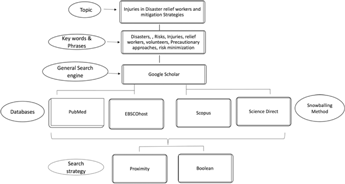
Internationally published literature was reviewed to explore what is currently known and reported about injuries and mental health issues suffered by disaster relief workers and volunteers. Articles published between 2010 and 2017 in peer-reviewed journals were included that related to natural disasters, injury types, responders, and volunteers. These were sourced using journal databases: Google Scholar (Google Inc.; Mountain View, California USA); PubMed (National Center for Biotechnology Information, National Institutes of Health; Bethesda, Maryland USA); Science Direct (Elsevier; Amsterdam, Netherlands); EBSCOhost (EBSCO Information Services; Ipswich, Massachusetts USA); Scopus (Elsevier; Amsterdam, Netherlands); and QUT Library (Queensland University of Technology; Brisbane, Australia), and by applying a snowballing technique. The final list of articles was refined by sequential examination of the titles, abstracts, and full-text to identify their relevance, significance, and impact. A summary of the search process and outcomes is outlined in Figure 1.
Literature Search Strategies.

Articles Screening and Selection Criteria
Literature published in languages other than English, duplicates, newspaper articles, opinion-based articles, and research relating to extra-terrestrial disasters were excluded. Taking into account the number and frequency of natural disasters occurring around the world due to climate change and the secondary disasters triggered by them,5 the search was confined to literature relating to natural disasters (geophysical and meteorological disasters) rather than man-made disasters. The health risks associated with man-made disasters such as war and armed conflict are unique and complex in ways different than natural disasters. An example is the possible restraint of participation by humanitarian workers due to threats of kidnapping, intentional violence, and attack.Reference Garbern, Ebbeling and Bartels6 Analysis of these types of disasters and their impact was beyond the scope of this review.
The literature included in the review was examined in the context of the following research questions:
1. What are the injuries encountered by disaster relief workers and volunteers?
2. What are the factors that influence the rate of injury and mental health issues? And,
3. What are the risk minimization approaches for the identified risks?
Using the aforementioned criteria, the literature findings were critically analyzed and synthesized to construct a thematic framework that illustrates the hazards and risk factors affecting those involved in response and recovery efforts and outlines distinct hazard mitigation approaches.
Result
A total of 162 articles were retrieved. Of these, 71 met the inclusion criteria and were used for the review. The articles were analyzed and categorized according to their focus and scope. The categories included studies on: general disaster concepts (n = 19), mental health (n = 34), physical health (n = 7), and those examining a combination of mental and physical health (n = 11).
The literature scrutinized a range of professional workers and volunteers, including police, fire fighters, government officials, medical personnel, and administrative and utility workers, including lay and professional humanitarian aid workers.
The majority of the selected articles were cross-sectional in design, four were longitudinal-cohort studies, and two were systematic reviews. The method of data collection for most of the studies scrutinized involved questionnaires, while studies investigating mental health issues utilized specific standardized instrument ranging from: Impact on Event Scale, Likert scale, Clinician-Administered Posttraumatic Stress Disorder (PTSD) scale, and the Center for Epidemiologic Studies (National Institute of Mental Health; Bethesda, Maryland USA) Depression Scale. The literature findings were analyzed and synthesized under three major topics, namely: injuries and mental health impact, factors influencing physical and mental health hazards, and risk minimization approaches. The results of literature review identified common physical and mental health problems encountered in relief and recovery operations, the relationship of physical and mental health deterioration, and several general and location-specific, pre- and post-disaster risk minimization strategies for workers and volunteers.
Discussion
Topic I: Injuries and Mental Health Impact
Analysis of the literature showed an array of physical and mental health problems experienced by persons involved in disaster recovery and response settings. These ranged from minor cuts and wounds to severe and life-threatening conditions and death. The injuries are mostly minor and self-limiting, including cuts and wounds. Some immediate effects were sustained and developed into chronic conditions such as hypertension and PTSD. Infectious diseases were considered short-term health hazards. Some of the literature identified the association between physical and mental health outcomes.
Physical Injuries
Among the stages of the disaster response, the rescue phase is most critical and frantic and poses risks of minor to life-threatening physical injuries to responders.Reference Newman7
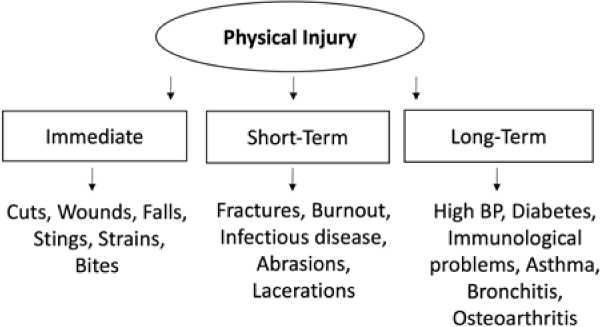
The most common physical injuries reported during this phase are related to immediate risks,Reference Ocak, Duran and Ozdes8 and included cuts, wounds, falls, strains, sprains, stings, and bites,Reference Zhang, Liu and Sun9 as well as nausea, cough, sinusitis, fever, headache, abrasions, and lacerations.Reference Subra10 Some cases of fractures resulting in death were reported as a result of activities involving demolition and debris removal.Reference Pearson and Weinstock11 Altitude sickness, heat stress, and infectious diseases emerged as location-specific risks.Reference Lee, Lee and Park12
Reported short-term injuries and conditions, defined as those lasting beyond the rescue stage, included water-borne and zoonotic diseases such as gastrointestinal infections. These resulted mainly because of inappropriate living and working conditions.Reference Holcer, Jeličić and Bujević13 Urinary tract infections were recorded by Zhang, et al amongst soldiers working in the 2008 Wenchuan Earthquake.Reference Subra10 In the aftermath of Hurricane Katrina (2005) and Hurricane Rita (2005), high rates of asthma, chronic bronchitis, osteoarthritis, and immunological problems were observed in relief and reconstruction workers.Reference Garbern, Ebbeling and Bartels6, Reference Johanning, Auger and Morey14, Reference Rusiecki, Thomas and Chen15 The various physical injuries and conditions identified from the literature review are summarized in Figure 2.
Physical Injury.

Mental Trauma
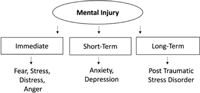
The mental health issues experienced by disaster response and recovery workers and volunteers are summarized in Figure 3. In the immediate stage, a trivial fear or anxiety is commonly seen due to the struggle of adjusting to a new environment, led by stressful working conditions. Minor depression and anxiety can account for short-term mental health problems that are likely to develop into chronic forms, such as PTSD, in later stages.Reference Eriksson, Cardozo and Foy4, Reference Sone, Nakaya and Sugawara16–Reference Xu, Dai and Rao18
Mental Injury.

Medical personnelReference Kang, Lv and Hao19 and professional disaster workersReference Nagamine, Harada and Shigemura20 in particular were reported as being more exposed to emotionally traumatic events during disaster response, such as injuries, losses incurred by disaster victims, violence, deaths, separation, and grief. Relating to this, PTSD emerged amongst the literature as a common long-term outcome of trauma exposure.Reference Connorton, Perry and Hemenway21 Dobashi, et al identified some minor cases of distress to severe psychological illnesses in responders of the 2011 Great East Japan Earthquake due to their exposure to dead bodies,Reference Dobashi, Nagamine and Shigemura22 and Schenk, et al reported approximately 17% of Chinese medical rescue personnel who responded to 2008 Wenchuan Earthquake suffered PTSD due to low social support and distanceing.Reference Schenk, Yuan and Martel23 Various categories of mental health outcomes are illustrated in Figure 3.
Relationship between Physical and Mental Health
Physical and mental health in many conditions are inter-related and are reported in some literatures. Suzuki, Fukasawa, Obara, and Kim noted the deterioration of physical health due to mental distress in prefectural public servants working in major affected sites during the Great East Japan Earthquake.Reference Suzuki, Fukasawa and Obara24 For the same event, the authors postulated workers’ protection and safety being compromised to enhance professional efficacy. Likewise, Guan, Xiaerfuding, Li, Lian, and Jiang noted that job strains associated with disaster relief work, characterized by isolation from family, coping to a new environment, and the complexity of job roles and responsibilities, may induce both chronic physical and mental illnesses such as hypertension, diabetes, depression, and PTSD.Reference Guan, Xiaerfuding and Li25
Topic II: Factors Influencing Physical and Mental Health Hazards
Analysis of the literature revealed a number of factors that can influence the rate of physical injury. These centered on the type of responders responding to event, the type of disaster, living and working environments, and socio-economic and cultural barriers.
Type of Responder
Zhang, et al, in their study of soldiers deployed on the 2008 Wenchuan Earthquake, reported that almost one-half experienced PTSD, and also stated soldiers were trained for life-saving and fighting skills but were endangered to other health issues such as respiratory, digestive, and nervous systems.Reference Subra10 Increased systolic blood pressure and serum total cholesterol were reported in government staffs responding to the Mid-Niigata Earthquake in Japan in 2004, explained by inappropriate diet and high-level of stress.Reference Azuma, Seki and Tanabe26 Additionally, Fukasawa, Suzuki, Obara, and Kim identified a high-risk of mental distress in public servants who worked in the aftermath of Great East Japan Earthquake in 2011, in which the staffs were subjected to long working hours and suffered burnout.Reference Fukasawa, Suzuki and Obara27 The health risks were further aggravated by exposure to the pain, grief, and hardship of dealing with the families of the missing and dead. Medical staffs responding to 2015 Nepal Earthquake suffered frustration and anxiety due to ethical and resource constrains.Reference RajBhandari, Dhital and Pradhan28 A sense of powerlessness to help all the needy was also reported among the medical personnel serving in 2011 Haiti Earthquake.Reference Durocher, Chung and Rochon29, Reference Remington and Ganapati30
Type of Disasters
There is much variability in disasters, each presenting a unique combination of hazards and risks for response teams and requiring incident-specific processes. With geophysical or meteorological disasters, a chain of secondary disasters may follow that impose additional risk to the relief and rescue workers.Reference Jia and Pan31, Reference Shepherd, McBride and Lovelock32 Regarding the 2011 Great East Japan Earthquake, Nagamine, et al observed that aftershocks lead to a high-incidence of psychological distress in the Japan Ground Self-Defence Force.Reference Nagamine, Harada and Shigemura20 Lee, Lee, Park, and Lee reported a similar effect on the Korean Disaster Relief Team responding to Nepal Earthquake 2015, who were also exposed to the risk of hand-wrist and foot-ankle fractures due to trapping and falling objects or secondary collapse.Reference Lee, Lee and Park12 The physically demanding and arduous work involved in demolition and reconstruction activities after earthquakes can also exhaust workers and volunteers and affect their mental and physical health.Reference Haraldsdottir, Gudmundsdottir and Romano33 In pandemic disasters, Godderis and Rossiter stated emergency medical teams assisting in the response phase are more susceptible to influenza.Reference Godderis and Rossiter34 Catastrophes such as a tornado may induce a sequel of powerful thunderstorm and hailstorms creating an unstable working environment.Reference Lyu, Wang and Cheng35 Meteorological disasters provide an ambient environment for molds that cause allergies and immunological issues including endocrine and cognitive changes.Reference Garbern, Ebbeling and Bartels6
Living and Working Environment
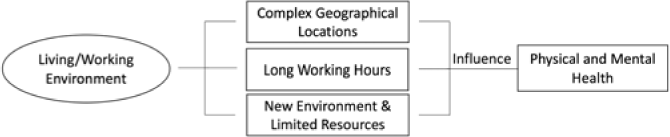
An emerging theme in the literature was that risks to the health and well-being of responders increase if the relief/recovery process involves working in complex geography with unpredictable climatic conditions and limited resources. Klappa, Audette, and Do found this can lead to unexpected injuries such as motor vehicle accidents and drowning.Reference Klappa, Audette and Do36 Lee, et al cited working in an elevated altitude and low temperatures as leading to pulmonary edema and cerebral complications in persons in Korean Disaster Relief Team responding to the 2015 mega earthquake in Nepal.Reference Lee, Lee and Park12 Matsuoka, et al observed heightened psychological distress in disaster medical assistant workers responding to the 2011 Great East Japan Earthquake due to their perceived risk of radiation exposure from the fractured Fukushima Daiichi Plant, something they were not adequately briefed on prior to deployment.Reference Matsuoka, Nishi and Nakaya37
Demanding and unpredictable changes in working conditions during the response phase were also cited as negatively impacting the health of workers. Ocak, et al found that relief personnel in the aftermath of the 2011 earthquake in Van, Turkey who learned about their task after arrival or had previously described roles altered were potentially susceptible to injuries and physiological distress.Reference Ocak, Duran and Ozdes8 Allowing responders time to prepare and ready themselves is crucial for them to learn of possible risks and develop emotional resilience.Reference Fukasawa, Suzuki and Obara27, Reference Soliman and Gillespie38 Several studies investigated the effect of long working hours for prolonged periods found this was significantly associated with mental stress in clean-up workers,Reference Pearson and Weinstock11 defense personnel,Reference Nagamine, Harada and Shigemura20 and medical professionals and health care volunteers.Reference Matsuoka, Nishi and Nakaya37, Reference Sato, Atogami and Nakamura39, Reference Springgate, Wennerstorm and Carriere40 Sleep deprivation and improper eating schedule and diet were also found to have an adverse effect on responders’ health.Reference Azuma, Seki and Tanabe26 The literature findings on the association between the surroundings and health are illustrated in Figure 4.
Health Outcomes and Living and Working Environment.

Socio-Economic and Cultural Factors
Socio-economic and cultural factors can impact the affected and also to those assisting.Reference Hauswald41 For instance, in the aftermath of Hurricane Katrina, immigrant non-English speaking laborers hired were economically vulnerable and less informed about safety and protective means to hazardous sites and experienced high-rates of injuries and delays in medical treatment.Reference Pearson and Weinstock11
Disaster situations are often complicated for nations struggling with internal conflicts and political instability. The lack of access to sufficient protective means and appropriate awareness and education about their use can be critical safety barriers for nations with weak socio-economic standing.Reference Jobe42 According to Quevillon, et al, poor environmental and infrastructure conditions contributed to cases of respiratory congestion and infectious diseases in local and international aid workers engaged in clean-up works in the 2010 earthquake in Haiti.Reference Quevillon, Gray and Erickson43 For foreign aid workers, stress in the immediate phase resulting from distancing, isolation, coping in a new environment, and low social and moral support (including language and cultural barriers) may subsequently lead to depression and PTSD post-hoc.Reference Sone, Nakaya and Sugawara16, Reference Guan, Xiaerfuding and Li25, Reference Fukasawa, Suzuki and Obara27 Figure 5 illustrates the association of socio-economic conditions and health outcomes of responders.
Association between Nature of Injury with Socio-Cultural Status of Nation.

Topic III: Risk Minimization Approaches
Modern international disaster management approaches recognize the need for action throughout the prevention, preparedness, response, and recovery phases. This framework is important for understanding the variable impact that disasters have on relief workers and volunteers.Reference FitzGerald, Tarrant and Aitken44
Pre-Disaster Strategies
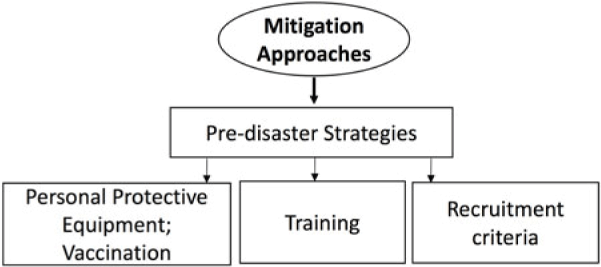
Pre-disaster approaches are the precautionary measures implemented as a means of disaster preparedness. The literature was consistent in emphasizing the importance of quality and consistent training as part of this stage. As Jiang, et al states, specific hazards are associated with particular types of disasters, making training on site-specific hazards and circumstantial skill development on operational procedures before recruitment paramount.Reference Jiang, He and Zhou45 Training delivered to relief workers needs to be tailored according to the level of literacy, age, language, and cultural context.Reference Jobe42 Majority of literatures suggested the need of capacity building through community training programs on the physical and mental health for community workers, reporting that trained rescuers are better prepared for consequences, and are more adaptive with higher coping capacity.Reference Kang, Lv and Hao19, Reference Springgate, Wennerstorm and Carriere40, Reference Ager, Pasha, Yu, Duke, Eriksson and Cardozo46, Reference Agarawal and Buzzanell47
With regard to mental trauma, alignment of spiritual narration and stress management training prior to deployment were recommended by Agarawal and Buzzanell.Reference Agarawal and Buzzanell47 Similarly, Pearson and Weinstock highlighted the importance of training on conflict resolution, media handling, cross-cultural adaptability, and tolerance considering the congregation of multiple locals and nationals at chaotic environment.Reference Pearson and Weinstock11 For the humanitarian aid workers to be deployed at high altitude disaster sites, acclimatization and appropriate therapies should be made available to prevent severe to life-threatening risks.Reference Bayer48 The authors also put forward the necessity of increasing the number of mental health professionals through education and other strategic action of encouragement. Vaccination against water-borne and zoonotic diseases can be an effective precautionary measure to protect the responders from infections.Reference Costa, Oberholzer-Riss, Hatz, Steffen, Puhan and Schlagenhauf1
Another emerging theme in the literature was that of the need for rigorous recruitment criteria and processes for expatriate volunteers and professionals who seek to serve in austere environments. These should take into account technical skills and prior experience, physical and mental agility, and ability to perform under pressure,Reference Costa, Oberholzer-Riss, Hatz, Steffen, Puhan and Schlagenhauf1, Reference Haraldsdottir, Gudmundsdottir and Romano33, 49 as well as accommodate a means of identifying recruits who are more at-risk and may require additional support.Reference Schenk, Yuan and Martel23 Personal traits like self-care, realization, and personal attitudes towards work and selfReference Yan, Turale and Stone50 should also be taken into account as they can be predictors of competence and play a vital role in self-management and regulation of emotions.Reference Lu, Yang and Ye51, Reference Luong, Laopaiboon and Koh52 Additionally, humanitarian aid workers who have sought medical help in their past should be granted considerable recovery time based on their physical and mental health status, and re-defining their role should be considered.Reference Jobe42 Some of these pre-disaster strategies identified from literature are illustrated in Figure 6.
Pre-Disaster Strategies.

Post-Disaster Strategies
Post-disaster management strategies are effective during the response and reconstruction phases to curtail minor to lethal injuries and adverse mental health impacts in relief/recovery workers and volunteers. An emerging theme in the literature was how ensuring disaster site workers are fully equipped with safety and protection means before travelling to the incident site, and are trained in their use, can positively effect injury rates. This included personal protective clothing and respiratory protection equipment, including its safe removal and frequent replacement of filters and timely maintenance.Reference Luong, Laopaiboon and Koh52–Reference Gushulak54
Also highlighted was the importance of supervisorial support, management practices, and quality leadership in minimizing physical and mental health risks in relief workers. Positive relationships among team members and supervisors were observed as effective in lowering psychological stress.Reference Brooks, Dunn and Sage55, Reference Velden, Loon and Benight56 According to Fukasawa, et al, poor workplace communication may induce distress in workers, which could be overcome through transparency, frequent communication, and flow of information among the team and supervisors/commanders.Reference Fukasawa, Suzuki and Obara27
Positive workplace culture around emotional and mental health was also shown to strongly contribute to fostering high morale and resilience amongst response and recovery workers.Reference Agarawal and Buzzanell47, Reference Cardozo, Crawford and Eriksson57, Reference Noguchi, Inoue and Shimanoe58 In particular, counselling during the rebuilding process,Reference Jobe42 a culture of appreciation,Reference Soliman and Gillespie38 and debriefing on accomplishment and fulfilment of mission were vital in reducing distress and anxiety. More specifically, a reduction in workload and time-off at regular intervals helped in lowering the burden of stress in workers that indirectly prevents stress-related physical and mental health illnesses.Reference Cianelli, Wilkinson and Mitchell59
Another frequently discussed issue in the literature was the lack of post-disaster health care for those who engaged in response activities. According to Lucchini, et al, the spectrum of health consequences sustained by a cohort of both skilled and unskilled workers, engaged in response and restoration works, can only be derived from post-deployment health assessment.Reference Lucchini, Hashim and Acquilla60 Echoing this, Stein, et al and North and Pfefferbaum highlighted the necessity of post-recovery health monitoring for illnesses with long latency or physical and mental health conditions not readily identified in the initial phases after exposure.Reference Stein, Wallenstein and Shapiro61, Reference North and Pfefferbaum62 A sophisticated surveillance system for recording, monitoring, and addressing these outcomes and their associated exposures is needed.Reference Stein, Wallenstein and Shapiro61 Garbern, Ebbeling, and Bartels highlight the issue of poor health monitoring and under-reporting of health issues, especially by unaffiliated volunteers, affecting the epidemiological data for physical and mental health outcomes.Reference Garbern, Ebbeling and Bartels6 Post-deployment follow-up and health monitoring of workers aids in assessing the level of difficulty of the deployed operation, and deficiencies and inadequacies related to training and support.Reference Pearson and Weinstock11, Reference Noguchi, Inoue and Shimanoe58 Garbern, Ebbeling, and Bartels suggest utilizing tools such as the significant event/acute exposure tracking tool, as used in Hurricanes Katrina and Rita, to identify adverse exposures experienced by the responders and their respective effect on health.Reference Garbern, Ebbeling and Bartels6 The necessity of comparative studies between baseline surveys and post-mission to assess accurate health outcomes was suggested by Haraldsdotir et al.Reference Haraldsdottir, Gudmundsdottir and Romano33
Also discussed in the literature was the role of spontaneous volunteers often being overlooked.Reference Wang, Chan and Shi63 In most disasters, volunteers arrive at the scene immediately,Reference Kleim and Westphal64 and even prior to a hazard assessment being done.Reference Hugelius, Adolfsson and Örtenwall65 Some researchersReference Lee, Lee and Park12, Reference Sato, Atogami and Nakamura39, Reference Sartori and Fave66 shared concern about the high-degree of susceptibility for spontaneous disaster responders to vicarious mental trauma due to their conflicting roles of victims and relief workers. Local community volunteers often lack appropriate training, skills, and protection compared to professional and affiliated volunteers.Reference Holcer, Jeličić and Bujević13 Recognition of local volunteers in post-disaster relief and recovery work is essential for making their role more inclusive, efficient, and timely.Reference Whittaker, McLennan and Handmer67, Reference Paul, Acharya and Ghimire68 The post-disaster strategies for risk minimization cited in the literature are illustrated in Figure 7.
Post-Disaster Strategies.

Conceptual Thematic Framework
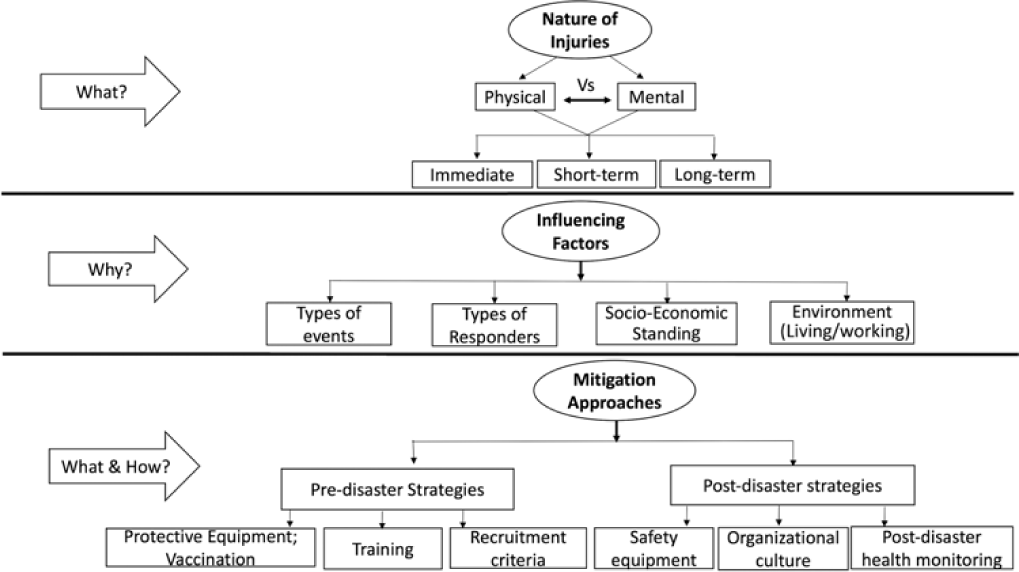
The literature findings identified a range of hazards, causes, and mitigation strategies at different disaster settings that accounted for a variety of responders. To minimize and avert the identified injuries and mental health outcomes and to protect workers’ safety, it is imperative to plan, prepare, successfully implement, and evaluate precautionary and response efforts. Figure 8 illustrates the conceptual framework derived from the literature review.
Conceptual Thematic Framework Developed from Literature Analysis.

The identified themes from the literature review were used to construct a conceptual thematic framework for better understanding the risks, contextual stressors, and relationships among the variables. Outlined in Figure 8, the combined thematic framework illustrates the hazards, various factors, and associated hazard mitigation approaches. As seen in the figure, injuries identified in the literature are categorized as physical and mental and are broken down into immediate, short-term, and chronic conditions. Some of the factors that were identified in the literature as influencing these injuries are classified into concepts including disaster type, types of responders, living and working environments, and socio-economic standing. The final key element of the framework is the mitigation approaches as they relate to these injuries and contributing factors, which are broken down into strategies to be used in pre- and post-disaster settings.
Limitations
Disasters are not simply the geophysical or climatological hazards, they can also be consequences of wars, armed conflicts, pandemic outbreak, or any sort of industrial mishaps. A limitation of this report is the inability of this research to incorporate literature relating to these man-made hazards into the review. The intention of this research and framework is, however, to develop an understanding of the hazards and variables contributing to injuries and the appropriate solutions, as well as to minimize responders’ vulnerability. While it also offers a conceptual understanding of injury rates, types, and mitigation strategies, further research is, however, necessary to help enrich possible solutions and to ascertain its applicability.
Conclusion
Physical and mental health risks are common not only among volunteers and by-standers, but equally likely in trained and professional disaster relief and response workers. Several factors that critically influence the health risks, ranging from minor to lethal, were identified as the type of responders responding to a particular disaster type, living, and working conditions during the relief process, including how well-equipped the responding teams are depending upon the economic standing of the affected nation. Pre-disaster and post-disaster approaches help to eliminate and lower the perils, including deaths.