Making rights to land more secure when that land is in transition between customary tenure and formal registration is an issue of global significance, affecting shelter and the economic well-being of vulnerable groups. Right holders typically achieve security for transitional land rights in two ways, first in comparatively new devices such as ad hoc written agreements and sketch plans (Cotula Reference Cotula2006), and second by employing and where necessary adapting aspects of custom. This article focuses on the latter strategy, addressing the central question of how land right security is bolstered by investment in social ties and by the pragmatic adaptation of land-related ceremonies and practices to suit contemporary contexts and contemporary beliefs. The research for the article was undertaken in 2005 and comprised 88 interviews divided between New Zealand and Zimbabwe, as part of a broader study of persisting land tenure custom. For the purposes of this article, the international scope is narrowed to focus on the emerging land market in Zimbabwe's communal areas.
THE COMMUNAL AREAS
The communal areas (CAs) date from 1894, when the British South Africa Company (BSAC) set up a Land Commission to assign land to the Ndebele (Yudelman Reference Yudelman1964: 62). In 1895 the Land Commission created the first communal areas, the Gwaai and Shangani reserves, which occupied roughly 2 per cent of the country (Stigger Reference Stigger1980). Neither was particularly inviting, being described by the Ndebele as waterless and unhealthy respectively (Blake Reference Blake1977: 116). Most Ndebele stayed where they were, as squatters or tenants or else in servants’ quarters (‘boys’ kias’) and farm compounds where living rights were tied prebendally to employment. Indeed, this seems to have been the initial intention of Cecil Rhodes who, in 1894, made a speech advising the Ndebele ‘to live as much as possible on the farms of Europeans’, with reserves only for those Africans unwilling to come to terms with the settlers (Stigger Reference Stigger1980: 22). Outside of the CAs (then reserves), land purchase was effectively denied to Africans. Although in theory what was known as the ‘Cape Clause’ permitted Africans and non-Africans to hold land on the same terms, in practice the BSAC and most European farmers made a point of not selling land to Africans (Palmer Reference Palmer1977: 135).
Communal Area land was increased from 2 per cent of the country in 1895 to just over 20 per cent – around 21 million acres – in 1902 (Yudelman Reference Yudelman1964: 65). However, the enlarged reserves were incapable of supporting the rapid growth of the post-conquest African population. Compounding the demographic increase, changes in legislation early in the twentieth century created a population shift towards the reserves, beginning with the Private Locations Ordinance in 1908, which made it less viable for absentee landowners to rent land to Africans or have labour living on farms (Palmer Reference Palmer1977: 96). This movement further swelled the population density of the reserves and necessitated a series of readjustments to their size. From the 1930s the creation of African Purchase Areas eased the situation slightly, and from the 1950s title began to be offered in urban areas, beginning with Bulawayo. At independence, in 1980, CAs occupied 42 per cent of the land area of the country, and following independence new opportunities were created for crowded communal land right holders when land was made available for resettlement. Resettlement effectively expanded the area of the CAs to about 66 per cent of Zimbabwe (Chimhowu and Woodhouse Reference Chimhowu and Woodhouse2010), and there were also new access opportunities to commercial farmland. A variety of links between CA land and urban centres and farms have ensured that no one can remain unaware of the ‘Western’ tenure model with its individualized, exclusionary land rights and land market, a factor that has no doubt contributed to the land market emerging in CAs today.
COMMUNAL LAND RIGHTS AS SECURITY
An important feature of the CAs from their inception, and a consideration in any discussion on securing land rights, has been the way the communal areas offered baseline security if shaky land rights on farms or in towns were withdrawn. This is still a factor today because independence – which should have marked a positive shift in land right security for Africans outside of the CAs – was slow to reconfigure the position of CA land in the security equation. Resettlement of people from crowded CAs following independence rapidly became politicized and farmland purchased under the Lancaster House agreementFootnote 1 began to be transferred not to the poor but to the ruling elite (Human Rights Watch Reference Watch2002: 2, 14). Other farms were sold on the free market, but experiences of new commercial farmers were not always positive, with over 80 per cent of the 1,200 indigenous commercial farmers throughout the country facing, in 1999, ‘foreclosures from the Agricultural Finance Corporation due to outstanding loans, with some of the farms having already been auctioned at far below market prices’ (Takaoma Reference Takaoma1999; Ezigbalike and Selebalo Reference Ezigbalike and Selebalo1999). Those farming resettlement land did so under use permit rather than ownership, and security continued to be derived from communal land rights, from ties between members of extended families and wider community groups (cf. Berry Reference Berry1989 and Reference Berry1993), from children and from cattle (Palmer and Parsons Reference Palmer and Parsons1977: 7–8).
For many, CA land is viewed as having value comparable with remaining Māori land in New Zealand, which is turangawaewae, ‘a standing place for the feet’ (Metge Reference Metge1976: 109). Communal land is perceived by many to have value as a safety net against age, unemployment or illness, and some urban dwellers and farm workers make ongoing investments in order to retain links with communal land and communities. This investment takes the form of remittances, hospitality, traditional ceremonies to reinforce land rights and the maintenance of a presence of family members or sometimes hired labour working on the land (Goodwin Reference Goodwin2008). In particular, when use rights to communal land are bought and sold in contravention of custom, traditional ceremonies are employed and sometimes adapted to bolster rights to this land, and how this is attempted forms the central question of this article.
METHODS AND REFERENCING
Cousins (Reference Cousins1993: 36–7), in posing the question of what views are held by communal area residents themselves, replies that the answer is ‘necessarily speculative, since channels for making their voices directly heard are few, and in any case they are likely to hold a variety of opinions’. Nonetheless, residents’ opinions are valuable, and my research, forming part of a case study comparison with persisting land tenure custom among Māori in New Zealand, explores how CA right holders in Zimbabwe attempt to add security to land rights.
With regard to the referencing of interviews, Nyambara (Reference Nyambara2001a: 266) notes an unwillingness of informants to provide full information about cash transactions in land, and in my own research a reticence and fear of reprisals was evident, and information generally only vouchsafed following an assurance of confidentiality. This dovetailed with university ethics requirements, and consequently no names and no detailed locations are given in this article. Where possible, I have tried to ‘let people speak for themselves’ and to preserve nuances by giving verbatim excerpts of local narratives. Interviews all took place in July–September 2005, and are referenced by the number of the Zimbabwe interview and the page of the transcript (for example, Z20: 5).
POLITICAL AND ECONOMIC CONTEXT
At the time of the research, Zimbabwe was embroiled in a chaotic land reform process sometimes known as jambanja. This ‘state-sponsored lawlessness’ (Chaumba et al. Reference Chaumba, Scoones and Wolmer2003: 8), involving land occupation, often accompanied by force, exerted a ripple effect on land availability in the CAs because one strategy adopted by dispossessed farm workers has been to return to communal area homes (kumusha, in Mashonaland; ekhaya, in Matabeleland). The same can be said for urban dwellers made homeless in the murambatsvina campaignFootnote 2 (Potts Reference Potts2006; Fontein Reference Fontein2009). Although taking up latent rights in CA land has long been possible in theory, through the years from 1894 instances of people actually claiming land were moderated by a pull factor from urban centres, farms and mines, and a push factor from crowded and degraded communal land. The political shenanigans since 2000 and the widespread economic malaise have changed the weighting, driving some to claim latent rights in communal land and others to acquire ‘some other pieces of (CA) land and do some farming to supplement their salary’ (Z9: 2).
Where communal land is plentiful it may still be allocated as of traditional right, but where land is scarce those returning may be told there is no room. This has given impetus to a land market in which rights are leased, bought and sold, and also to a labour market as paid employees work the land in order to retain occupancy rights for those who hire them. Such changes had already been occurring for some years (see, for example, Bourdillon Reference Bourdillon1987: 67; Cousins Reference Cousins1993: 35; Törhönen and Goodwin Reference Törhönen and Goodwin1998), but have been accelerated by the confused land reforms of the past decade (Chaumba et al. Reference Chaumba, Scoones and Wolmer2003).
The research also needs to be viewed against a backdrop of hyperinflation, which influenced the sale price of land and improvements. Inflation during the months of the interviews was probably approaching 900 per cent,Footnote 3 and graphing sale prices of land against time and testing for correlation with ‘parallel market’ rates produced inconclusive results. Part of the problem was that those who had bought land only gave the sale date to the nearest year, at a time when prices could double in a single month. Another area of uncertainty was that of land size. It was not possible to visit and pace out all of the land parcels, and some informants had no idea what numerical area of land they had bought, and could only guess. Yet another variable that could not be verified in all cases was the level of improvements to the land. The best that can be said was that, of the ten parcels on which I could collect specific data, the earliest purchase date was 1990 and the latest 2004, with prices ranging from Z$750 in 1993 up to Z$1 million in 2003.
‘CUSTOM’
In stating that customary mechanisms are one avenue used for securing land rights in CAs, at least a mention should be made of what is understood by ‘custom’. One avenue of scholarship has noted a propensity for colonial authorities to interpret custom expediently (Mamdani Reference Mamdani1996; Ranger Reference Ranger, Hobsbawm and Ranger1983; Cousins Reference Cousins1990, 2007), and to put traditional authorities on the payroll in order to pre-empt opposition or to facilitate the collection of taxes (Alexander Reference Alexander1994: 328; Cousins Reference Cousins1993: 34–5). Alternatively, a narrow interpretation of custom has been perpetuated in order to justify increased state control over land (Nyambara Reference Nyambara2001a: 254). Berry, in contrast, suggests a more dynamic picture, where ‘property rights and labour relations were neither transformed according to the English model nor frozen in anachronistic “communal” forms, but instead became subjects of perpetual contest’ (1993: 40), while May points to ‘a number of interlocking “external” processes or interventions’ (May Reference May1987: 29), and Bruce to the wide degree of ‘situational give-and-take’ in African tenure rules (Bruce Reference Bruce, Downs and Reyna1988: 30). In the narrower Zimbabwe-specific context there is no shortage of writing about normative Shona and Ndebele land tenure custom (Beach Reference Beach1994; Bourdillon Reference Bourdillon1987; Bullock Reference Bullock1950; Cheater Reference Cheater1990; Kileff and Kileff Reference Kileff and Kileff1970; Nyathi Reference Nyathi2001; Holleman Reference Holleman1952; Thomas Reference Thomas1872; Moyana Reference Moyana1984; Ranger Reference Ranger and Kaarsholm1991; O'Flaherty Reference O'Flaherty1998; Yudelman Reference Yudelman1964; Fontein Reference Fontein2006; Nyambara Reference Nyambara2001b, et cetera).
For my own research, I have attempted to observe living custom empirically and, in this way, to some extent to circumvent questions about the exact nature of original ‘custom’ and historical distortions of this. By focusing on ways people act now, the anthropological and historical literature is in a sense updated to what custom is current today. In interpreting interview responses, as a cardinal rule I accorded most weight to what people do without duress or gain. By this standard, the value of a ‘traditional’ tourist village in providing an authentic picture of living custom needs to be viewed with caution since financial gain is involved, whereas actions taken against opposition or involving difficulty or sacrifice are seen as particularly significant. For example, where the very poor save up for years to hold a party to mark the purchase of communal land, I had to conclude that such parties and related ceremonies are more than merely a pretext for a ‘booze up’ and are in fact a requirement of right holding.
BUYING AND SELLING RIGHTS IN COMMUNAL LAND
Today the CAs are administered under the Communal Land Act (Zimbabwe Government 1996). CA land vests in the President (Zimbabwe Government 1996: Section 4), and for such land to be sold it should strictly first be converted to state land (Section 6 (3)). However, what happens on the ground avoids rigid circumscription by law via Section 8 (2) (b) of the Act, which states that Rural District Councils (RDCs) must ‘where appropriate … have regard to customary law relating to the allocation, occupation and use of land’. Thus, where custom has veered to permit a land market or has merely turned a blind eye to the existence of such a market, this has become the de facto law. A growing body of literature points to the buying and selling of communal land having become an established fact (see Chimhowu and Woodhouse Reference Chimhowu and Woodhouse2006, Reference Chimhowu and Woodhouse2010; Cousins Reference Cousins1993: 35; Nyambara, Reference Nyambara2001a: 260, 265). Reasons for selling land include the untimely death of siblings (which may, for example, give a surviving son surplus fields, allowing him to sell one or more); right holders moving permanently to urban centres; resettlement land becoming available; and daughters gaining land through marriage and selling off family homesteads (Goodwin Reference Goodwin2008). Traditional authorities are less involved in apportioning use rights to land today than in the past, and it is not uncommon for right holders to present traditional authorities with a fait accompli: they are moving away and have appointed a replacement. The only assurance needed by the sabhuku (headman) is that no money has changed hands other than for improvements.
The research for this article is based on a range of interviews with people who had bought or sold communal land or were at least conversant with the process. Selection of informants was opportunistic owing to constraints of time, cost and political risk, leading to conclusions that are indicative rather than statistically rigorous. A rough balance was achieved of parcels close to and remote from urban centres.
Sales close to cities and at a distance
Not unexpectedly, communal land situated near urban centres was found to have a particularly high incidence of land sales, typically comprising parcels of approximately an acre supplemented by areas of common grazing. In Chinamora, bordering Harare, sales accelerated from the early 1990s and today are sufficiently common for nicknames to have emerged for different classes of right holder. Original right holders are termed ‘citizens’; those who buy stands are ‘foreigners’; and those renting have ‘embassy’ status – because ‘any time you can move’ (Z39: 4, 16). Foreigners typically invest in improvements (constructing polythene tunnels for vegetables or hot-house flowers, for example), which suggests a reasonable level of perceived tenure security.
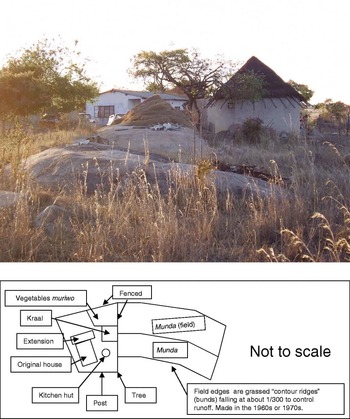
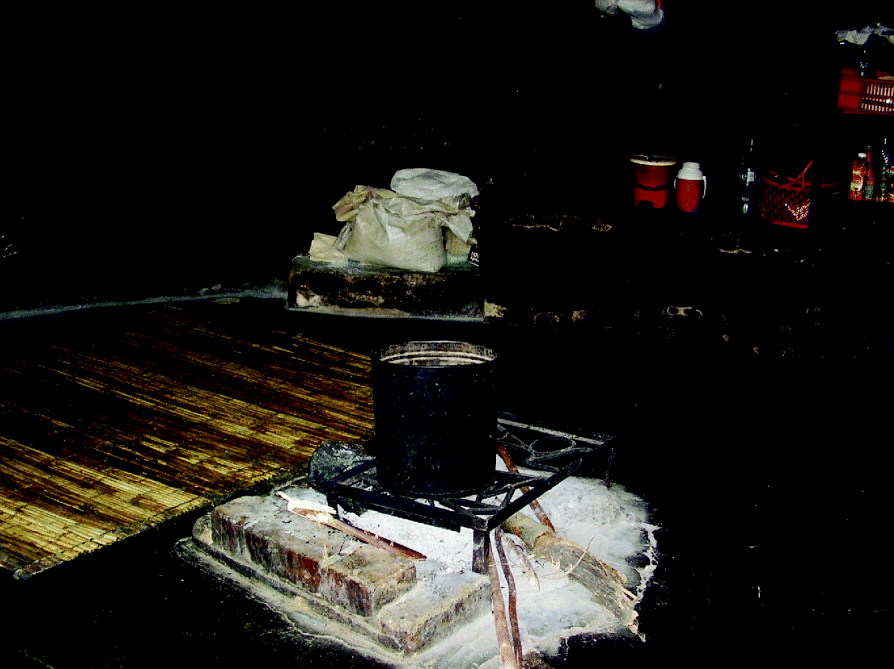
Sales at a distance from cities usually involve fields (minda pl., munda sing.) as well as homesteads. Typically, land will total three or four acres and be used less intensively than peri-urban land. Figure 1 shows a purchase in a communal area remote from the cities, comprising two fields, a vegetable garden, a night kraal for cattle grazed by day on common land, and a homestead with a Western-style house (of cement blocks, with steel windows) subsequently extended by the new owner. Of particular note is the external kitchen hut, of thatched pole-and-daga (discussed further below: daga is the mud that is worked into the pole-based structure to form the circular wall). The purchaser enjoys rights identical to those who enjoy traditionally allocated rights, including a potential right to a vegetable garden near the river and rights in a common grazing area (for which cattle numbers are not limited).
A rural land purchase

In common with peri-urban sales, transactions in rural areas are spoken of as ‘illegal’ and cash payments are generally concealed from headmen. However, even when a cash price is concealed, the headman needs to be informed that the land has a new occupier: ‘You would have to tell him. Otherwise there's no way you could stay in that place’ (Z40: 9).
Sale price
It is beyond the scope of this article to comment in depth on the sale price of land which, as has already been mentioned, is complicated by a backdrop of hyperinflation in Zimbabwe during the research period. However, two points of interest emerged. First, as might be expected, an inverse relationship was observed between land availability and sale price: ‘it is the shortage of land that makes them charge that absorbent [sic] price’ (Z37: 9). Second, it is possibly significant that all sales were paid for in cash not kind. Given the state of the economy, even wages are now sometimes paid in kind, and bride-price and old age pensions are generally saved for in cattle and goats. ‘Cattle are our bank’ for many still sums up the security offered by cattle keeping (Palmer and Parsons Reference Palmer and Parsons1977: 7, 8). It might therefore be expected that some land transactions would be settled in cattle or in goods. Although not enough cases were investigated to assert this with confidence, payment for land sale in cash may reflect a tacit recognition of Western coin as being appropriate for Western tenure forms.
For clandestine sales there is widespread consensus that ‘improvements’ should be paid for at a current market value, including buildings using cement in construction, those with steel window frames and/or pine-batten doors, those with asbestos or corrugated iron roofs, land with a planted woodlot (e.g. eucalyptus) and fences made with wire rather than thorn branches. Labour constructing traditional huts does not appear to generate a cash value, with possible reasons being threefold. First, where there are both good tree cover and water, huts are constructed from freely available products of the land. Second, assistance in the work of building may be given by friends and family, and their labour should not be ‘sold on’. Third, huts need frequent maintenance (left alone, roofs soon leak and walls disintegrate) and are possibly viewed as perishables rather than permanent assets.
In theory, land sales are final: ‘once you have sold it you cannot claim it. There is no linkage [remaining]. … It's now like you have sold your title deed’ (Z6: 5). However, the next section will show that many sales are not final at all.
COMPLICATIONS WHEN TRANSACTING COMMUNAL LAND RIGHTS
Those purchasing communal land demonstrate a hope that the sale is final, but this is not always borne out in reality. Sales of communal land may be threatened in a variety of ways, with a significant percentage of land being wrested back again by vendors. Part of the problem is that the sales lack transparency, generally being covert or veiled by a disclaimer that improvements and not land are changing hands. Land sales may be risky in a number of ways. For example, an illegal occupier of a commercial farm may sell communal land rights, thinking never to return, but subsequently be ejected to make room for ruling-party favourites: ‘they evict them and stuff like that’ (Z32: 7–8; cf. Spierenburg Reference Spierenburg2005: 198). Even for an offence such as illegal vending someone may be sent back to their home area by government authorities, and it is simple to identify an individual's home district by characters on the national ID card, which must be carried by law. These individuals, returning to communal land, may be viewed as group members – prodigal, but nonetheless still able to draw on family and community support – and assisted in ousting the purchasers of their communal land rights.
Even where a vendor does not return and attempt to reverse a sale, extended families and/or communities, sometimes responding to population pressure, may attempt to retrieve land sold by group members. In one instance, dependants of the original right holders, no longer having anywhere to stay, ‘chased away [the purchaser] saying “you are not from our tribe, so you have to make way for one of our sons for that place”’ (Z29: 3, 4). In another case, relatives of the vendor argued: ‘This is our traditional home, we want it back. We will give you back your money’ (Z30: 5). The purchaser resisted but was finally overwhelmed by united family pressure, and without the purchase price being adjusted for inflation. ‘[He was] … given somewhat useless currency. After some time. Because you notice, [in] rural areas we normally don't take into account the time-value of the money.’ Yet another family actively pursued a policy of getting back all land sold during the administration of a previous chief: ‘when someone we consider a foreigner buys a piece of land, we do the best we can to take it back’ (Z40: 9). For this extended family, repossessing land was part of a broad survival strategy to strengthen the family power base: ‘We are all linked up. Closely related. … We find it very important to continue to live close together.’
Women's rights are particularly insecure. For example, in one case (Z35: 2) a man wanted to sell traditionally allocated land when his parents offered him their farm (following the death of all three of his elder brothers). When his wife tried to veto the sale, her husband's will prevailed and the land was sold.
Land sales are also vulnerable to the whims of headmen and chiefs. For example, a sale may have been condoned by a former office bearer but an incoming sabhuku or chief initiates a different ethos, inimical to sales: ‘It's mainly the attitude of the village, which emanates from the sabhuku … just across the road you would find a change in attitude towards land. … [It varies with] the culture of the area, the subculture of the area’ (Z40: 9,12). When this happens, those who have had second thoughts about selling might capitalize on the changed climate and try to get their land back. Corrupt headmen may even sell land. For example, Andersson (Reference Andersson1999: 554) gives an example of the sabhuku ‘who allocates fallow land that is already claimed’, and one informant stated: ‘Some sabhukus are becoming corrupt. When there is a vacant land [sic], under the carpet they will charge a fee to someone who is coming in who wants to come and occupy that’ (Z35: 2) Another said:
[At] the kraal next to me, the head there is actually giving out land to foreigners, and he's receiving money, ja. But he's actually giving them land that belongs to the locals by tradition. … Everybody doesn't like it; I tell you, very soon there will be like an uproar. Because people are now disgruntled. You know the situation … this murambatsvina situation, where a lot of guys have now gone back and found that – hah! – their former father's land has now been allocated to someone else! There's a lot of talk now. Because usually it is not allowed. Even the law is saying these kraal heads do not have the responsibility to allocate land. … They should have gone to the council offices. (Z6: 7)
The policies of headman and chief may not agree. Accepting someone into an area should be ratified by the chief, and where this does not occur the village elders may raise the matter – whereupon the chief may upbraid the headman and reverse the sale: ‘“How did you accept this person without my approval?” The chief has to approve …’ (Z37: 7). In another instance: ‘They sell the land, but now the Chief discovers that, and then there's a problem … the man who came in was removed from the land and then the land was returned to the custodian[ship] of the headman’ (Z10: 4).
In the above examples, we see an incipient land market that is sometimes at variance with family and tribal authority structures. Where such structures are strong, securing land rights is problematic. One option for those buying land is to secure their rights using traditional mechanisms, sometimes with adaptation, and this forms the subject of the following section.
CUSTOMARY WAYS OF BOLSTERING SECURITY OF LAND RIGHTS
Ways in which CA right holders attempt to secure their rights in the absence of formal registration are not well covered in the literature. New right holders attempt to bolster their tenure security in two principal ways. The first avenue for increasing security of transacted CA land is that of quasi-legal means, which range from the use of ad hoc diagrams and ‘deeds’Footnote 4 through to the entering of names in a non-title register such as a Rural District Council (RDC) rates register as a calculated strategy to secure land rights. The second avenue is to employ customary mechanisms to boost land-right security and to adapt these pragmatically to suit contemporary contexts (including rights in urban land that has links with CA land). While the first avenue is no less important in achieving a balanced picture of land right security, the second avenue will be the focus of this article. My research showed that those buying land rights strategize first by investing in interpersonal links (both with the living and the dead), and second by the pragmatic adaptation of land-related ceremonies and practices to suit contemporary contexts (including that of urban land linked to rural land) and contemporary beliefs (for example, the Christianizing of ceremonies). The research also suggested that increased mobility of people and residence remote from rural homes has led to a degree of abstraction of ceremonies, as detailed below.
In custom, land rights are secured by two main strands; first the thread of interpersonal ties within communities (which include the dead); and second by a variety of land links. These two strands apply equally to securing new land rights and to ‘keeping a back foot’ in communal land where latent rights are held (via remittances, for example). This section, while drawing on supporting literature, is primarily concerned with the question of what practices are current today, in other words, with ‘the actualities of individual interaction within society’ (Ranger Reference Ranger and Kaarsholm1991: 149).
Buying into a community
African land tenure is still to a large degree socially based (Augustinus et al. Reference Augustinus, Lemmen and van Oosterom2006; Berry Reference Berry1993: 17). Cousins et al. write that ‘individualized property rights are still hedged in by a wide-ranging set of social obligations in which the interests of the group are articulated. Individual ownership is embedded in a larger “communal” tenure system in which rules governing access to and use of the commons are still important’ (1992: 17). Berry goes further, to write of agricultural surplus being used ‘to establish or strengthen the social identities and relationships through which people entered or influenced negotiations over access and control of resources’ (Berry Reference Berry1993: 15). Even where legal possibilities for title exist, people may not avail themselves of these, preferring options that keep potential allies and supporters on side (ibid.: 14).
My own research showed that newcomers to communities, aware of the potential for rejection, typically begin building social connections even before land connections are forged. Newcomers work hard to prove themselves desirable additions to the community, not trouble makers, and they solicit recommendations from friends, family members or contacts from a church. In the words of one informant: ‘It's not normally easy for the headman to just give [land to] a person, a complete stranger. No, he needs at least someone he knows, a connection’ (Z10: 1). Marriage can also smooth the way for acceptance into an area (Berry Reference Berry1989: 42). For example, where a woman's daughter married a ‘citizen’, both she and her mother automatically ceased being ‘foreigners’ and also became ‘citizens’ (Z39).
Where an arrangement can be made to purchase land, sales are made as high-profile as possible so as to keep the chief, headman, family elders and ancestors fully in the picture. One strategy is to enlist witnesses to perambulate boundaries of land: ‘You can invite the chief and whoever is the headman and a few elders, older people, and say “This is my boundary, my land ends here, down this way”, and then you have some sort of ceremony to inform the ancestors’ (Z20: 5). The purchaser might also give a gift to the chief: ‘Together with the sabhuku, you go to the chief. We say to [him] “Hail the chief”; to “greet”. Then you pay a certain fee to the chief, maybe two, three, ten thousand. … Then the chief says, “Okay, I now know you are in my area”’ (Z37: 7).Footnote 5
Sales are still routinely brought to the knowledge of the dead as well as the living members of a community. Mhondoro spirits are often seen as the real owners of the land (see Holleman Reference Holleman1969: 9, for example), and their wishes are communicated through spirit mediums (Spierenburg Reference Spierenburg2005, for example). Often, a ceremony will be held to tell the ancestors and spirits about a newcomer, and piggybacked onto this ceremony may be a party to ingratiate the newcomer with the community: ‘You want the people in the community to know that you are the owner of that particular land. So you slaughter a cow, you slaughter a goat, you buy meat, you invite people to come and celebrate. It is in the process of celebration that people will say, “This is so-and-so's home”’ (Z35: 5). Vijfhuizen calls the occasion a chiutsi or mabiko party. Chiutsi means smoke, and it is seen as important to make a public announcement so that people are not surprised to see smoke rising from the new homestead. Mabiko is from the word kubika (to cook/brew) (Vijfhuizen Reference Vijfhuizen2002: 73). The following example (for purchased land, not land allocated by custom) emphasizes the importance of community in the survival equation:
And for the party, I would do it. I believe in that. Because people in the community must know that I am the one who is staying there now. I'm the owner of the homestead. Any property that's there belongs to me now. You shouldn't come and cut trees…. And also they must know that I have a homestead. I've done it. I've had a party. I've called the villagers, the people: ‘Come drink, eat together. …’ People come and their coming is saying, ‘We are accepting you as one of us. We are committing ourselves to assisting you in whatever ways we can. When you scream we will come over and aid you.’ So [a party] you must do. Remember, from an African point of view, if you build a homestead and no one comes in, that homestead is cursed. So, you must build a homestead and people must come in and eat and drink and enjoy, that's it. So I had to do that. I had to open doors to say ‘You are welcome to come and talk to me.’ (Z35: 6–7)
Traditionally, relationships thus seeded have been nurtured by activities such as work parties, nhimbe (Holleman Reference Holleman1958: 212–13; Andersson Reference Andersson1999: 557). Berry (Reference Berry1989: 48–9) also notes that work parties, although more expensive and less productive, have a place in maintaining group cohesion.
The kitchen in land holding
In addition to ‘buying in’ to the community, a number of customs are significant in boosting the security of land holding. The first involves the use of a kitchen, which emerged as still being a factor in the nexus with traditional land. In the words of one interviewee, when a child is born it is important that they be linked to the homestead, and the very essence and ‘symbol of linkage to that homestead is the kitchen hut, a round hut thatched with grass, with a low door entrance’ (Z6: 1–2). On marrying, a man will usually build a sleeping hut and a kitchen hut for his bride, with further sleeping and kitchen huts being added if more wives are married in the future.Footnote 6 Wives preside over their own kitchen hut, their children's umbilical cords are often buried in the kitchen step or the floor inside the threshold, and when they leave home offspring will continue to talk of ‘my mother's kitchen’ and to make sure they spend time there whenever they return kumusha. In a polygamous marriage, each wife's kitchen is the hub for her own offspring, where they can interact before retiring to the bedroom huts: ‘all the social communication happens in this kitchen’ (Z1: 3–4).
The most significant place is the … kitchen. Each wife has got that kitchen. To the extent that, if you've got one or several wives and you don't build her that kitchen, when she passes on you'll have to pay a beast; because you did not build her a home. (Z7: 3)
Field visits showed that, even where a Western-style house is built, a circular thatched kitchen may be set apart from the house (see Figure 1). One reason could be that thatch permits smoke from a cooking fire to filter through, but another reason is the link that such kitchens are perceived to forge with land and with people connected with that specific land. Kitchens are the place for birth (either on one of the benches or else simply on the floor) and for death, with corpses being laid out on one of the benches.
Spirit beliefs are still pervasive in Zimbabwe (Ranger Reference Ranger and Kaarsholm1991) and kitchens are strongly connected with the numinous. Their doorways are sometimes made intentionally low: ‘the set-up of that kitchen environment was so spiritual! … It was necessary that the door would be very low … the reason being that when you enter that doorway you should bow your head. A form of homage’ (Z6: 4). A kitchen will also normally contain different-sized benches built in a curve against the outer walls (see Figure 2). Etymologically, these benches share a root with the words grave or tomb (-uva), and they hold spiritual and ritual significance:
The spirit is said to be residing in that bench. The structure of that bench was such that, you know, there's a hole in the wall … and then you build in, say, like this compartment, where it's … hollow inside. So it's sealed everywhere else, but it's hollow inside. The reason being that it's resembling the grave. So this, in Shona, is … chiguva [or chikuva]. Which means, ‘small grave’. So, virtually it's saying, ‘we moved the man or the woman from the grave outside, and we have given them residence in the home in this small grave’. That's why it's left hollow inside … whenever they are talking to the spirit they believe that the spirit is there in that small hole. And it becomes receptive. So they will even use this tobacco snuff in water, and everything; now they are saying ‘Here's your food’ … that is now what they will do.Footnote 7 (Z6: 4–5)
Even today, an important ceremony involving the kitchen is to ‘tell the ancestors you are here’:
When for example you build that home for the first time, you brew beer, and you call in the elders. … So you brew beer, call in those who are mediums, and then you now say okay, this small bench at the far end [of the kitchen] now, you are saying even before anyone is born in the home, in that new home, before any child is born in that home, that you are dedicating the home to the spirits, the spirit is said to be residing in that bench. (Z6: 4)
Kitchen hut, showing fireplace and bench (chiguva)
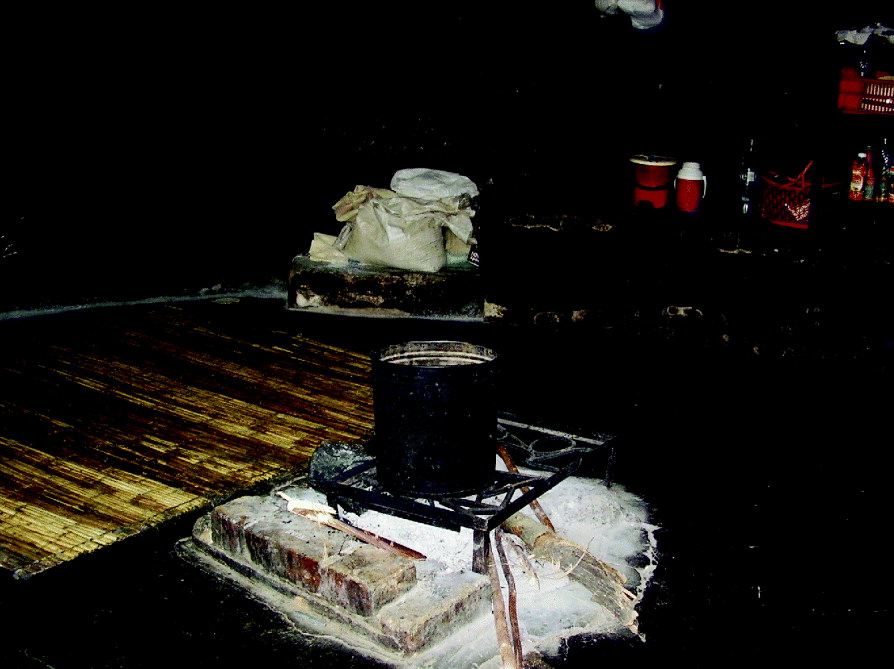
An obvious question is: what happens when a kitchen hut, with all its associated symbolism, is sold? In answer: certain things cannot be done in a kitchen built by someone else, and it may be necessary for the purchasers to build their own kitchen:
If you are not the one who built it you cannot use it for any … [ceremonial purposes] … in our tradition you put someone onto the bench if they die. But you cannot put someone onto the bench unless you built it. Like that one … if I die, in our tradition I must be put there. I must lie onto that bench. But if I didn't build it, if someone [else] did it, I can't. (Z37: 2)
However, as well as the obvious possibility of building a new kitchen hut, pragmatic expedients are sometimes employed such as using the floor of the kitchen rather than the hallowed benches, or even using a floor in the house: ‘They would either lie me on the floor here, or inside the house’ (Z37: 3).
Another solution is to hire someone else's kitchen:
If I die today and they decide that I'm going to be buried at home, they will have to find a kitchen to place me in there. But, before they can do that, that kitchen, the person who owned that kitchen, the lady who owned that kitchen, would have to be asked to provide that kitchen; if she says ‘yes’, they have to pay a beast. That's how significant that hut is. (Z7: 3)
Burial of the rukuvute/inkaba
One of the most potent and enduring links between people and land is the tradition of burying the rukuvute (or rukuvhute, Shona for umbilical cord) or inkaba (SiNdebele). Strictly, the rukuvute refers to the part of the umbilical cord that remains attached to the baby and dries and drops off. The placenta and other part of the umbilical cord attached to the placenta are referred to as the chavakuru.Footnote 8 This is ‘either burnt or buried just as waste (without any traditional meaning or weight)’ (Ndambakuwa Reference Ndambakuwa2006). There are frequent references to the practice in the literature; for example, Pathisa Nyathi writes that the placenta is put in a hole in the hut floor, which is left uncovered until the baby's cord falls off, and water from washing the new born baby poured into the same hole. Only after the inkaba has fallen ‘can the villagers come to congratulate the woman, ukwenza amhlope’ (Nyathi Reference Nyathi2001: 94–5). Holleman writes of burying infants in wet soil while older children are buried under rocks in the hills (Holleman Reference Holleman1958: 61), and Bozongwana gives permutations of burial in anthills, ash-heaps and ‘the centre of the maternity hut’ (1983: 3).
In general the specific site where the rukuvute is buried is viewed as less important than the district:
It wasn't a question of like, say, in the European way of, ‘holding land’ and staying there. It's – the relationship with the land – is like, ‘the son of the soil’ [mwana wevhu]. That is, you know, the thinking or the theories behind it so that, as long as you're moving with the soil … it's part of your ancestral land, which is large, probably vast; if you can take it, they probably thought they owned the whole world! … And if you were in the, on the soil, you were home. Because this is your ancestral land. (Z1: 2)
Interviews showed that the practice is still current today. It is still common for a person to say: ‘I'm going home where inkaba yami [my birth cord] is’ (Z32: 2), or to ask the cord's whereabouts: ‘Let's say, my son has a girl friend … the girl friend bears a baby, the first thing we'll want to find out is what did you do with that umbilical cord? We'd ask very, very serious[ly]. What did she do [with it]?’ (Z28: 7). Many accounts adhered closely to the anthropological literature. For example, burying a navel cord in a kitchen step or in a hole in the polished earth floor of the kitchen: ‘For the inkaba, the umgodi [hole] they dig anywhere in the kitchen; [you] can't show the specific place’ (Z24: 11; Z17: 2).
And:
When you get born, your navel cord would be cut, and then they would dig a hole in this [kitchen step] and put the navel cord in it. So you are now linked to the soil. … So that is now the physical linkage that has now been made between the child and the soil. And by virtue of that linkage you have the right to inherit that soil. So, depending on whether you have decided to move away or not, but you now have the right, you are now entitled to that soil. …
Apart from linking you to the soil by virtue of the physical … symbol, they would also link you spiritually … there's a bench that would be built in the kitchen where normally they would put … daga pots … they would now call upon their spirits which is starting from your grandfather who is the earliest late [died most recently] and they would now tell them that here is where we have laid the lineage of your new birth born baby, now it can look after the baby … now you are responsible for that. So, that was it, now you are fully linked spiritually and … physically. (Z6: 2)
A wide variety of pragmatic variations exist about exactly where, how and why the cord is buried today, some of which are detailed here. The principal challenge facing birth cord ceremonies is the fact that birth now often takes place at hospitals and clinics that are remote from land, and logistical difficulties are entailed in getting the cord home: ‘you find now that the majority … are giving birth at hospitals. So, by the time they come back, the rukuvute would have been thrown in the bin. But, I remember some people who actually bring their rukuvute wrapped in a piece of cloth’ (Z6: 8). Ndambakuwa (Reference Ndambakuwa2006) confirms that, when a child is born away from home, the cord (once it drops off) is sometimes sewn into ‘a piece of cloth that is made into or tied to a sling that in turn is tied around the child's waist until the child gets to the proper place of origin where [the cord] is then buried according to the area's tradition’.Footnote 9 Another interviewee said a plastic bag was used (Z10: 3). Still another, although his firstborn was delivered in a hospital and the cord discarded, nonetheless reported doing the spiritual side of the rukuvute ceremony on returning kumusha, to tell the ancestors that the child had arrived. One informant (Matabeleland) said blood was important, and that for some an animal had to be slaughtered to mark a birth:
That shedding of blood, that blood spilling to the ground has that attachment of that land. Ja. So that's how it is done, some are throwing the umbilical cord there, so that you think about it. (Z35: 5)
For some, a degree of abstraction has crept in, and establishing a physical and symbolic link between a child and the soil can be satisfied even by smearing mud on the cord when it is cut. One reason given was that this is to ‘help it to close properly’ (Z22: 11), but it is likely that there is also deeper significance in linking the child with the soil, since another informant spoke of mud being brought from the rural home (by the child's grandmother) and rubbed on the navel to link an urban-born child with the communal land home (Z32: 4).
For others, practices surrounding the birth cord are viewed partly as a protective mechanism:
After a few weeks [it] dries up and drops. Okay? Generally the child is not supposed to get in touch with the outside world per se until that happens. Okay? It's a protective mechanism, right? (Z7: 2)
Another protective practice is that of rubbing muti Footnote 10 on the inkanda (fontanel) of a newborn child to ‘strengthen the brain’. Babies are not meant to mingle with others until the soft spot has become firmer (Z32: 2).
Damp places were frequently mentioned in interviews, in connection with the birth cord. One informant said that all cords in an area were disposed of in a ‘muddy’ or ‘marshy’ place (Z9: 5),Footnote 11 and several others (informants in both Mashonaland and Matabeleland) said dampness played a part but gave widely varying details, for example:
The umbilical cord is used in different ways, depending who you are. If the Sibandas’ grandfathers, or great-great-grandfathers, used to put it in a pool of water, then they throw it in a pool of water. If they used to throw it in a flowing river, or in an ash [sic], they put it like that, or in a pit, or in a toilet, the system now differs. Ja, with the original, it differs. But it has to be kept. (Z28: 7)
Another informant said that both umbilical cord and placenta are buried somewhere near the river where it is ‘damp a little bit, not too wet’. They are buried separately but in the same area ‘near the river … where it's a bit wet’. The placenta is ‘put on its own, then the rukuvute on its own’ (Z14: 8 and Z36: 3).Footnote 12
Other links with the soil
Burying the rukuvute is not the only link between people and soil. In strict tradition, samples of all that comes from the soil should be offered to the spirits through a spirit medium (nganga):
Like, before you start eating your greens … in the fields … you are to take samples. From vegetables, maize, whatever. Take it to the medium, and then it's cooked [mixed for young children who don't have teeth]. They eat and then after that everybody is now free to go and eat vegetables from their fields. So that means they are saying, even the fields, everything that is coming from the soil is not ours until we are authorized to take by the spirit. So that's how everything is linked to the soil. (Z6: 3)
The perceived status of the dead made graves important: ‘You see we still have a mentality that people don't die but they sleep. Hence we call them the living dead, you see?’ (Z35: 8). Burial also creates links with land, and ideally a corpse should be transported back to the family home: ‘To us, in as much as it is a home for us to live but it is also a sort of home for us [to die] … it's a burial ground for us. Ja? So we treat it with so much respect and … with so much honour’ (Z10: 3).Footnote 13 Care of graveyards is important, and is sometimes viewed as the special responsibility of daughters-in-law. Differing views emerged, even in adjoining villages, on whether land with graves can be sold: ‘[Here] that sort of taboo has been cut off. Ja. Somebody would be buying a piece of land where there were someone's ancestors’ graves. Right? But just across the road as you come this side they still take it as a very important custom whereby you can not’ (Z40: 12).
How are these links modified when land rights are purchased rather than obtained through customary allocation or inheritance? In short, people are pragmatic, and new connections are soon forged with purchased land: ‘It doesn't take long. It's mine now. That's where my roots, I call my roots, are now’ (Z35: 3). This interviewee envisaged his children visiting his grave (at the purchased land) in years to come (‘my children will be going there to see our grave’) just as he visits his parents’ grave:
My mother and father, were buried out wamusha. I just enjoy going down there to think about the old days we were together. We can't do that at the cemeteries here in town. You see that? I can't go there and put some flowers. I can't go there and cut the grass and the trees growing on those graves. But you see, there [i.e. at the rural home] is something? … I would want to go and just be there. (Z35: 8)
When moving areas, a number of ways are found to appease the ancestors:
In all these exchanges the ancestors in fact are told, maybe privately. There are usually some small ceremonies that are conducted to inform the ancestors that this individual, who was utilizing your land, is moving away, yes. So it is now vacant, and may I have permission to let someone else use that land? Yes. There's always some sort of ceremony. In fact it is that ceremony which gives you ‘title deeds’, as it were, to that land, because a ceremony was held, and nobody can take it away from you. It's the title deed. (Z20: 2)
Another way of forging ties with a new area is a procedure whereby soil from a previous home is mixed with that of a new home, perhaps shaking the soils up in solution and drinking some of the water, or else licking or eating the soil from the new home: ‘It's already part of the ceremony, and theoretically it's being watched by the owners, the real owners of the territory who are up there: the ancestors’ (Z20: 3). When burial at the family home is impossible, people adapt:
Even, for example, the death of one such individual in a foreign country… . There's no way they can bring him back to bury here at home, so again it's modified, by either carrying some soil from where he's now buried in that foreign country and bring it here and carry out some sort of ceremony to pretend that we're now burying him at his original place here. And he's quite satisfied then … we've brought him back. (Z20: 3)
The kurova hoko ceremony
Another strand in creating and reinforcing links with land and people is the kurova hoko ceremony (literally ‘to hit the peg’), done when founding a homestead. A crucial aspect of the ceremony is the party that goes with it, important for informing both neighbours and ancestors that someone is now living there and for building community bonds, repaying past favours and creating new obligations. In particular, the kurova hoko ceremony may create a web of responsibilities between a young couple and the husband or wife's family. ‘If I face problems, then I go to my father because he did the kurova hoko’ (Vijfhuizen Reference Vijfhuizen2002: 63–5). Although kurova hoko often involves putting in a wooden peg, Vijfhuizen explains that this is not always the case. The ceremony can be accomplished in other ways, for example by clearing the site or some other activity. She also mentions a private kurova hoko done by husband and wife to protect the homestead from witches and other perils (ibid.).
Putting in a peg is important not only in cementing ties at the level of family land but also at the wider level of a ward (dunhu). Holleman describes the process of putting in a peg as an acknowledgement of a right to live in the dunhu, the jurisdiction of a ward headman. Holleman sees the planting of the peg, the brewing of beer and the party as being legal requirements rather than mere politeness. The formalities are tangible proof that a new member of the dunhu recognizes the authority of the headman and that the headman is willing to accept the newcomer as a subject (Holleman Reference Holleman1958: 209–10).
The public ceremony of placing a peg also serves to reinforce usufruct if there is ever dispute:
You know, he's beaten in the peg. Then he claims ownership if he is so challenged. Not only ownership – use rights, and so forth. And … he has that connection with the neighbours. (Z7: 8)
Informants suggested that urban ceremonies to lay the first brick or break ground could be adaptations of the kurova hoko ceremony:
Tradition is basically changing … under normal circumstances you'd have a ceremony where, maybe, if it is the first brick, okay? … I'll talk about my home that I built … we went there as a family, okay? Instead of a brew being poured on that site, we actually had a prayer. Which is actually the same like govera hoko [literally divide or distribute the peg] – maybe the first brick or the first ground breaking. … I would say the majority of black Zimbabweans would do that [sort of ceremony]. They may adapt it to suit with their Christian beliefs or some other beliefs but they continue to hold those ceremonies in different forms, one form or the other. (Z7: 8–9)
Another adaptation was described as follows: ‘They are now apostolics, so they do it (the kurova hoko ceremony) in a religious way. So, instead of supplications to the ancestors, this time around it's praying to God and … sprinkling some holy water there’ (Z9: 6). Or, in a final variation, a peg is prayed over before being hammered in: ‘They just prayed over, then they would hit the peg. So, just a prayer and then a peg’ (Z10: 2).
Another aspect of urban ceremonies is to involve parents and family from the musha, who come in, sleep over, and join the ceremony marking the occasion of a family member buying a house: ‘you get some people who are still doing things the traditional way, even calling parents … because it has a symbolic significance. This occurs even where occupied farms are allocated by government, when the whole family will often come over and celebrate overnight’ (Z9: 5). Even if land is purchased with a house already standing on it, sometimes a kurova hoko is done, ‘to tell your ancestors that I'm … now here’ (Z12: 6), and also to have the new link with land witnessed and ratified by ‘the sabhuku and other people’. Alternatively, millet may be brought from a rural home to brew beer for an urban land ceremony to cement the link with rural land, or beer may be brewed at a rural home and brought into town for an ancestral ceremony:
I had some beer brewed for here … even the sorghum or whatever, what they use, they normally take that and … [dedicate] to the spirits before it is used to prepare the beer. They talk to the spirits first to say ‘Amakha mabele … here is sorghum for beer’ and stuff like that. And at every stage they actually talk to spirits so that everything moves smoothly. … I've brought up my father here just to do his traditional thing to say, ‘Now my son is staying here, you should look after this home; it's now part of our property’. (Z32: 3–4)
The utshaya ihlahla ceremony
In Matabeleland, a branch is laid to mark a new homestead in the utshaya ihlahla ceremony: ‘When … the parent wants to show you where you are to stay, he goes there and cuts a branch … as a mark to say ‘this is where you'll be’. You are moving from the homestead and then you are coming to stay here’ (Z35: 6). Another aspect of utshaya ihlahla is to signal maturity: ‘[It] is telling the community that I am grown. I'm a mature person now; I have my own homestead’ (Z35: 6).
For some, secrecy is crucial:
This is done in secret. Utshaya ihlahla. You don't do it in public. Because some witches, some wizards, some people with evil motives will go and plant some muti there to later destroy me. So, the cutting of the branch is done secretly. So that no one knows. What then they will see, is when they wake up one morning they will find I have just built a temporary structure there and I'm already there. (Z35: 6)Footnote 14
Utshaya ihlahla, for this informant at least, only applied to land allocated through traditional channels, not purchased land: ‘If I had not bought this homestead I would have done utshaya ihlahla’ (Z35: 6).
CONCLUSIONS
My research showed that the emerging land market in Zimbabwe's communal areas is insecure for a number of reasons, and that those buying land rights not only strategize to maintain access to land (Nyambara Reference Nyambara2001a: 281) but also to secure their rights once acquired. Bolstering of land right security is achieved first by investing in interpersonal links (both with the living and the dead), and second by the pragmatic adaptation of land-related ceremonies and practices to suit contemporary contexts (including that of urban land with links to rural land) and contemporary beliefs (for example the Christianizing of ceremonies). Increased mobility of people, and residence remote from rural homes, has sometimes led to a degree of abstraction in ceremonies. For example, smearing earth from a rural home on the stump of a severed birth cord rather than burying the cord at a rural home, or brewing beer in a city with ingredients brought from a rural home. Where formal and customary law coexist pluralistically, custom has proved the more flexible of the two and may be invoked to unite customary and formal land holding. For example (in a ceremony to ancestral spirits), ‘Now my son is staying here (in an urban centre), you should look after this home; it's now part of our property’ (Z32: 4; emphasis added).
Are the practices described effective? The fact that there is still widespread use and even adaptation of traditional ceremonies for purchased communal land demonstrates a degree of faith in their efficacy. At the same time, an openness was apparent towards new ways of securing land rights, such as ad hoc deeds. However, it seems likely that traditional practices, for which flexibility is axiomatic, will continue to be employed and modified to add security to land holding, both of communal area land and of urban land with CA links, until demonstrably better security is offered either by thoroughgoing title registration or else by some form of staged registration. It is likely that only where alternative securities become available (including more general securities such as food, shelter, age care and health benefits) will investment in communal tenure become less adaptive, assuming greater symbolic and less practical importance.
ACKNOWLEDGEMENTS
The author wishes to acknowledge a University of Otago PhD scholarship, and fieldwork funding from the School of Surveying, University of Otago, and from the New Zealand Institute of Surveyors. I would also like to thank Mick Strack for his valuable comments on the article, and two anonymous reviewers who succeeded in tempering sound criticism with encouragement.