




No CrossRef data available.
Article contents
- Abstract
- INFLUENCES ON VOCABULARY KNOWLEDGE
- WHAT IS MORPHOLOGICAL AWARENESS?
- MORPHOLOGICAL AWARENESS AND LITERACY
- DISTINGUISHING TWO ASPECTS OF MORPHOLOGICAL AWARENESS
- METHOD
- RESULTS
- DISCUSSION
- APPENDIX A: MORPHEME IDENTIFICATION TEST
- APPENDIX B: MORPHOLOGICAL STRUCTURE TEST
- ACKNOWLEDGMENTS
- References
The role of morphological awareness in children's vocabulary acquisition in English
Published online by Cambridge University Press: 19 July 2005
Article contents
- Abstract
- INFLUENCES ON VOCABULARY KNOWLEDGE
- WHAT IS MORPHOLOGICAL AWARENESS?
- MORPHOLOGICAL AWARENESS AND LITERACY
- DISTINGUISHING TWO ASPECTS OF MORPHOLOGICAL AWARENESS
- METHOD
- RESULTS
- DISCUSSION
- APPENDIX A: MORPHEME IDENTIFICATION TEST
- APPENDIX B: MORPHOLOGICAL STRUCTURE TEST
- ACKNOWLEDGMENTS
- References
Abstract
Tasks of speeded naming, phonological awareness, word identification, nonsense word repetition, and vocabulary, along with two measures of morphological awareness (morphological structure awareness and morpheme identification), were administered to 115 kindergartners and 105 second graders. In the combined sample, 48% of the variance in vocabulary knowledge was predicted by the phonological processing and reading variables. Morphological structure awareness and morpheme identification together predicted an additional unique 10% of variance in vocabulary knowledge, for a total of 58% of the variance explained; both measures of morphological awareness were uniquely associated with vocabulary knowledge. Results underscore the potential importance of different facets of morphological awareness, as distinct from phonological processing skills, for understanding variability in early vocabulary acquisition.
Information
- Type
- Articles
- Information
- Copyright
- © 2005 Cambridge University Press
The purpose of this paper is to consider theoretical and practical aspects of measurement of morphological awareness for explaining children's vocabulary knowledge. Previous research has demonstrated strong reciprocal associations between vocabulary growth and phonological processing skills in English (Avons, Wragg, Cupples, & Lovegrove, 1998; Bowey, 2001; Gathercole, Service, Hitch, Adams, & Martin, 1999; Gathercole, Willis, Emslie, & Baddeley, 1992; Metsala, 1999). However, the explicit association of morphological awareness to vocabulary acquisition has only rarely been investigated. At the same time, there are literally hundreds, perhaps thousands, of publications across many disciplines, including psychology, speech and hearing sciences/audiology, psycholinguistics, and neuroscience, that are focused on the relations of different types of morphology (e.g., derivational morphology, inflectional morphology, morpheme production) to early language production and receptive language skills. However, there is no contradiction here because, although the concepts of morphology and morphemes are well established and familiar across disciplines, the concept of morphological awareness as a parallel to phonological awareness is relatively new.
There are two primary issues that we tackle in this study. First, we explore the nature of morphological awareness and delineate two possible aspects of it. Second, we consider the extent to which morphological awareness is a unique predictor of vocabulary knowledge, apart from other well-known language-related skills, such as phonological processing skills and reading ability itself. Because the focus of this research is on explaining vocabulary knowledge in young children, we begin with a brief overview of correlates of vocabulary development before turning to concepts of morphological awareness.
INFLUENCES ON VOCABULARY KNOWLEDGE
One line of research on vocabulary development examines the effects of instruction on vocabulary growth (e.g., Biemiller & Slonim, 2001). Direct classroom instruction in word definitions, though effective in promoting vocabulary acquisition overall, is relatively ineffective in narrowing the gap between those with good versus poor vocabulary levels (e.g., Anderson & Nagy, 1991; Baker, Simmons, & Kameenui, 1998). Among older children, direct instruction in vocabulary knowledge is less important relative to reading experiences in developing vocabulary skill (e.g., Nagy & Anderson, 1984). The transition from learning to read in young children to reading to learn among older children is essential for advanced vocabulary development. Reading is strongly associated with vocabulary development (e.g., Baker et al., 1998; Stanovich, 1986), so that those with the sparsest vocabulary levels are often those with the poorest reading skills as well (see Baker et al., 1998, for a review). In the present study, apart from the above-documented effects of teaching, which are involved in both vocabulary and reading skill growth, we were particularly interested in those cognitive skills that are associated with variability in vocabulary knowledge.
Cognitive components related to vocabulary acquisition have been the focus of relatively little research. For example, Gathercole and colleagues (Gathercole et al., 1992) noted, “Although studies of word learning in children have documented the remarkable facility of preschool children to acquire new vocabulary…the factors underpinning the large individual differences in young children's abilities to learn new words are as yet little understood” (p. 887). Several research studies (e.g., Bowey, 2001; Gathercole et al., 1992, 1999) have therefore focused on the importance of phonological skills in promoting vocabulary learning. Tasks of memory, phonological awareness, and articulation have all been used to explain vocabulary growth (e.g., Bowey, 2001; Gathercole et al., 1992, 1999).
Different researchers have argued convincingly that particular different phonological skills are especially important for vocabulary development. For example, Gathercole and colleagues (1992, 1999) demonstrated that phonological memory (as measured by nonword repetition) was strongly associated with vocabulary acquisition in both young children and adolescents. Avons and colleagues (Avons et al., 1998) obtained similar results in their study of preschool children. However, their assessment of what they termed phonological short-term memory also included what others might term phonological sensitivity, a measure of rhyme awareness. These researchers found that, even controlling for initial vocabulary knowledge, both rhyme detection and memory span were significant predictors of preschoolers' vocabulary skill 1 year later (Avons et al., 1998). Metsala (1999), in contrast, showed that both measures of phonological awareness and nonword repetition skills were strongly associated with vocabulary among 3- to 5-year-olds. Bowey (2001) also noted that phonological sensitivity, in addition to nonword repetition, predicted vocabulary development in young children. However, she suggested that perhaps both phonological sensitivity and nonword repetition were representative of general phonological processing. Overall, studies on the associations between phonological processing and vocabulary knowledge have focused on different phonological processing skills and tested these associations in samples of different ages. Given these varied findings, in the present study we sought to measure general phonological processing using tasks of speeded naming, nonword repetition, and phonological awareness. The associations of these with vocabulary knowledge were not the primary focus of the study but, rather, served as measures to be statistically controlled in our exploration of the role of morphological awareness in vocabulary knowledge.
WHAT IS MORPHOLOGICAL AWARENESS?
Our working definition of morphological awareness is awareness of and access to the meaning and structure of morphemes in relation to words. Morphemes are the smallest units of meaning in language. Carlisle (1995, p. 194) similarly defines morphological awareness as, “children's conscious awareness of the morphemic structure of words and their ability to reflect on and manipulate that structure.” Our focus is on children's abilities to distinguish and manipulate morphemes at the word level. This broad definition allows us, theoretically, to consider children's knowledge of both derivations and inflections in language simultaneously. Derivational morphology includes knowledge of prefixes (e.g., the un in undisciplined or the pre in preoperational), suffixes (e.g., the ation in graduation or simulation), and compounding (e.g., cowboy and sunlight are both compound words). Inflectional morphology focuses primarily on indicating grammatical changes in words (e.g., the s in dogs or the ed in acted are both grammatical inflections). Our own crosslinguistic work has convinced us that the concept of morphological awareness must be flexible if it is to be used successfully across languages. For example, inflectional morphology is obviously important in English or Finnish, but is relatively unimportant in Chinese. In contrast, lexical compounding is far more common in Chinese than it is in English.
In the present study, we acknowledge the utility of a connectionist approach in exploring the broad associations among aspects of sound, meaning, and orthography across languages (Gonnerman, Seidenberg, & Andersen, 2005). According to Gonnerman et al. (2005), understanding and speaking any given language involves an interaction of semantic representations and phonological patterns through a weighted distribution of processing. In any language, it is the strength of associations of the connections among processing units (similar to neurons in the brain) that determines how words are learned and accessed. In this view,
Morphology reflects structure present in the world: language input contains patterns that are picked up on by language learners to the extent that they are useful in solving the primary tasks of competent speakers, that is comprehending and producing speech. Thus, although…these same principles operate across all languages, the system that emerges may differ depending on the reliability of phonological similarity as a cue to meaning, as well as other factors, such as the type and token frequencies of related complex forms and the nature of the orthographic system. (p. 63)
We view this perspective as a flexible one, capable of simultaneously accounting for development in both derivational and inflectional (e.g., Plunkett & Marchman, 1991, 1993) morphology. This connectionist perspective on morphological structure can also account for crosslinguistic differences in priming of words. For example, Plaut and Gonnerman (2000) found that in a morphologically rich artificial language, priming of words that shared some morphological association but were semantically opaque (such as miktav [letter] and katava [article] in Hebrew; from Bentin & Feldman, 1990) occurred in their model. In contrast, the same effects did not occur in the model when it was trained in an artificial language created to be relatively morphologically opaque. These effects suggest that languages that are relatively morphologically rich and transparent will tend to preserve the associations of sound and meaning in language, even when the associations of two words share only an apparent similarity in form. Our previous work on morphological awareness in relation to Chinese character recognition (McBride–Chang, Shu, Zhou, Wat, & Wagner, 2003) piqued our interest in studying morphological awareness in English.
Across languages, the boundaries across categories of morphology may become increasingly fuzzy and confusing. For example, in Finnish, inflectional morphology is complex relative to English (Lyytinen & Lyytinen, 2004) and is a prominent early marker of language impairments in childhood, whereas in Chinese, inflectional morphology is limited (Packard, 2000). Thus, the contrast in the importance of inflectional morphology for early language learning across languages can be quite striking, as in this example. Furthermore, in many Indoeuropean languages, as Casalis and Louis–Alexandre (2000) discuss, inflectional morphology tends to develop relatively early, whereas derivational morphology knowledge continues to grow through primary and secondary school and beyond. Inflectional and derivational morphology differ in other ways as well. For example, inflectional morphology is relatively limited and does not change the grammatical category of a word (e.g., from a verb to a noun). In contrast, derivational morphology can change these categories (e.g., manage/manager or overwork/workman).
Despite these contrasts, however, our focus in the present study on awareness of and access to unspecified categories (including both inflectional and derivational, bound and unbound) of morphemes in words lead us to construct a task of morphological structure knowledge that included different aspects of morphological knowledge. Given our previous experiences and definitions by others (Carlisle, 1995; Gonnerman et al., 2005) on the nature of morphology and morphological awareness in language, our measure of morphological awareness was flexible in including both lexical compounding and inflectional grammar in our task. Admittedly, this flexibility may represent a confounding of distinct aspects of morphological awareness, as might be argued by some linguists. On the other hand, this confounding may also be relatively faithful to children's language development, which may include simultaneously developing knowledge of lexical compounding and inflectional grammar in English for children of the age groups included in the present study, kindergarten and second grade.
Previous research has suggested that various aspects of morphological awareness may be particularly useful for vocabulary building. For instance, Wysocki and Jenkins (1987) found that students in fourth to eighth grade were able to learn some new words by generalizing from those sharing a root morpheme. An example might be comprehending the word piety based on previous knowledge of the word pious. Wysocki and Jenkins (1987) termed this ability morphological generalization. Others (e.g., White, Power, & White, 1989) have argued that such generalization does facilitate vocabulary building, provided that students are taught morphemes within an appropriate linguistic context. In young children, Lyytinen and Lyytinen (2004) demonstrated that poor production of inflectional morphology at age 2.5 years was a strong marker of subsequent language learning difficulties at age 5 in children at risk for dyslexia.
MORPHOLOGICAL AWARENESS AND LITERACY
Morphological awareness and vocabulary knowledge are often discussed in the specific context of literacy learning as well. For example, Carlisle (2000) found individual differences in morphological awareness for third- and fifth-grade students to be uniquely predictive of their reading comprehension. Another study of at risk second-grade readers (Nagy, Berninger, Abbott, Vaughan, & Vermeulen, 2003) also demonstrated that morphological awareness uniquely predicted reading comprehension in these children, although not in fourth graders at risk for writing difficulties. Fowler and Liberman (1995) showed that word reading was significantly correlated with tasks of morphological awareness, even controlling for age and vocabulary level, among second to fourth graders. Carlisle and Nomanbhoy (1993) also found that a measure of morphological production significantly predicted word reading in first graders, once phonological awareness was statistically controlled. Morphological production measured in first grade was significantly related to word recognition and reading comprehension in second grade, with phonological awareness controlled as well (Carlisle, 1995).
Different types of morphological awareness measured at different ages appear to have different effects on different aspects of literacy development. For example, measures of inflectional grammar tended to be associated with a stage model of spelling in a study of children ages 6–10 years (Nunes, Bryant, & Bindman, 1997). In that study, it was demonstrated that children's knowledge of spelling of inflectional morphemes tends to progress from having no clear association with grammatical category (e.g., kist for kissed) to an overgeneralization of morphemes across verbs (e.g., sleped for slept) to a clear understanding of regular versus irregular endings. Thus, morphological awareness tended to progress in a clear developmental pattern in relation to spelling of morphemes indicating past tense. Deacon and Kirby (2004) demonstrated that the same measure of inflectional grammar used in that of Nunes et al. (1997) administered in second grade also predicted unique variance in measures of pseudoword reading and reading comprehension but not word reading 4 years later (when the children were in fifth grade), even after statistically controlling for measures of intelligence and phonological awareness. They interpreted these results as indicating a clear distinction between morphological awareness and phonological awareness in reading acquisition.
Indeed, because English morphemes are strongly associated with phonological units such as syllables or phonemes, researchers sometimes wonder about the extent to which tasks of morphological and phonological awareness are distinguishable (e.g., Mann, 2000). Most studies of morphological awareness and English word recognition underscore the strong association of morphological and phonological awareness (Carlisle, 1995; Egan & Pring, 2004; Fowler & Liberman, 1995). For example, in their discussion of factors predicting reading and reading disability, Fowler and Liberman (1995) argued that “…if morphology does play a separate role from phonology…it is a small role indeed” (p. 179). In the present study, we explore the utility of morphological awareness, as overlapping but separable from phonological processing in understanding vocabulary development using somewhat different tasks of morphological awareness than have been used previously.
DISTINGUISHING TWO ASPECTS OF MORPHOLOGICAL AWARENESS
Like phonological processing, morphological awareness is likely comprised of multiple dimensions. We focused on two such dimensions that might ultimately be useful for understanding vocabulary growth because they can be assessed in very young children without using print. These constructs were originally developed in Chinese (McBride–Chang et al., 2003) in relation to early Chinese character recognition. Both are adaptable across languages and may be distinct features of morphological awareness in relation to vocabulary acquisition.
Morpheme identification is the ability to distinguish different meanings across homophones. This skill is demonstrated when a child understands that the flower in flowerpot is represented by a plant with petals as opposed to a sack of white powder (flour). This aspect of morphological awareness might help young language learners to distinguish among meanings of syllables with identical sounds, facilitating language analysis and vocabulary growth. In this case, morphological awareness involves understanding that different meanings can simultaneously be attributable to phonologically identical words. Using oral language measures, it is relatively clear that homophone distinction may involve morpheme knowledge that is separable from phonology, which is held constant in these examples. Morpheme identification is distinct from vocabulary knowledge because it relies on understanding of possible multiple meanings in the same spoken morpheme. Oral vocabulary knowledge requires learning to map a given spoken word to a given meaning. In contrast, morpheme identification requires that the meanings of two or more morphemes that are identically pronounced can be distinguished based on meanings.
A second aspect of morphological awareness, morphological structure awareness is the ability to create new meanings by making use of familiar morphemes. Berko's (1958) study of children's grammatical knowledge illustrates this skill. A child who understands that the famous concept of greater than one wug is represented by the word wugs, involving two morphemes, demonstrates morphological structure awareness skill. This particular example reflects inflectional knowledge of morphology. Morphological structure awareness can also be demonstrated by tapping derivational knowledge of morphology, via compounding. For example, the child who understands the idea of treetop as the highest point in a tree might be encouraged to think of a new term to represent the lowest point in the tree. One who asserts that treebottom is a reasonable term for this low point in the tree would, in our view, demonstrate morphological structure awareness. The core ability demonstrated by both the wugs and treebottom examples is the ability to construct new meanings from knowledge of previously learned morphemes. This morphological structure task requires children to make use of linguistic knowledge to derive new meanings. Skill in manipulating language, variously referred to as generativity, creativity, or productivity of language, may be important in learning new meanings within one's language.
Because morpheme identification and morphological structure awareness require somewhat different types of morphological analysis, we were interested in the unique contributions of each to vocabulary knowledge. In contrast, the extent to which tasks of morphological awareness would uniquely explain vocabulary skill once other phonological processing skills, including word recognition itself, were statistically controlled was unclear because phonological and morphological awareness tend to be strongly associated in English (Mann, 2000). Given that phonological processing skills are strong predictors of vocabulary skill across several studies (e.g., Avons et al., 1998; Bowey, 2001), morphological awareness might be linked to vocabulary skill only through its shared variance with phonological processing skills.
In the present study, we tested the associations of morphological structure awareness and morpheme identification with measures of reading and vocabulary in kindergarten and second-grade American children. In particular, we tested the extent to which each of these measures of morphological awareness might uniquely predict vocabulary across these two ages. We view this as a tentative step in understanding cognitive factors underlying vocabulary. If morphological awareness is strongly predictive of vocabulary knowledge, this might suggest that early tutoring in morphological structure awareness or morpheme identification might facilitate children's reading and/or language comprehension development. This hope was the backdrop for the present correlational study.
METHOD
Participants
The participants in the study were 115 kindergartners ranging in age from 5 years, 2 months (5;2) to 7;0 with a mean age of 6;1 and 105 second graders ranging in age from 7;2 to 9;3 with a mean age of 8;0. The number of participants was determined by power analyses that indicated that 98 participants would be required to have a power of .80 to detect an increase in variance accounted for of 10% in hierarchical regression analysis, which was the primary method of analysis to be used. The alpha level used for the power analyses was .05. The participants were recruited from local elementary schools. The study was carried out during the end of the fall semester and the beginning of the winter semester. All participants were native speakers of English. Boys made up 49% of the kindergarten sample. This sample was 70% Caucasian, 17% African American, 10% Asian American, and 2% Middle Eastern, with a remaining 1% described as “other.” Boys made up 47% of the second grade sample. This sample was 76% Caucasian, 18% African American, 2% Asian American, and 1% Middle Eastern, with a remaining 3% described as other.
Measures
Vocabulary
The Expressive One-Word Picture Vocabulary Test—Revised (Gardiner, 2000) was used to assess participants' expressive vocabulary skill. This task requires students to identify pictured items. Testing stops when the child identifies six consecutive pictures incorrectly.
Word identification
The letter–word identification subtest of the Woodcock–Johnson III Test of Achievement (Woodcock, McGrew, & Mather, 2001) assesses letter recognition and sight word efficiency. The student is required to expressively and receptively identify letters as well as read printed words. Testing stops when the child responds incorrectly to six items in a row, provided that those six items are at the end of a page.
Word attack
The Word Attack subtest of the Woodcock–Johnson III Test of Achievement (Woodcock et al., 2001) was used to assess phonemic decoding efficiency. The student is required to read aloud printed nonwords that become increasingly complex. Testing stops when a child responds incorrectly to six items in a row, provided that those six items are at the end of a page.
Phonological awareness
The Comprehensive Test of Phonological Processing (CTOPP) Elision subtest (Wagner, Torgesen, & Rashotte, 1999) was administered to measure children's phonological awareness. This task consists of 20 items. For the first 3 items, children were asked to say a compound word after deleting a syllable from it (e.g., popcorn without corn is pop). For the remaining items, children were asked to delete a single phoneme from each word (e.g., tan without /t/ is an).
Rapid automatized naming
Rapid Object-Naming Test and the Rapid Number-Naming Test were administered. In the Rapid Picture-Naming Test, children were presented three rows of five pictures representing two-syllable English names. The five pictures in each row were arranged in different orders. In the Rapid Number-Naming Test, children were presented five rows of five digits in which the five digits in each row were arranged in different orders. Children were required to name all pictures or digits in the corresponding task at the fastest speed possible for them. Given the very few errors made on these tasks, error rates are not included in the analyses. Across both tasks, children were given two naming trials each and the average time was used for analysis.
Nonword repetition
The nonword repetition task consisted of 3 practice trials for which feedback was provided and 18 test trials consisting of increasingly complex nonwords. Examples of items include nibe, noigawjeef, and nawfoojyeboachape.
Morphological awareness
The morpheme identification test and the morphological structure awareness test were administered to test children's morphological awareness.
The morpheme identification test consisted of 13 test items. For each item, two different pictures were presented simultaneously to the child and each of the pictures was labeled orally for the child by the experimenter. The child was then given a word or phrase containing the target morpheme and was asked to choose, from among the two pictures, the one that best corresponded to the meaning of that morpheme. For example, in one test item, the child was asked to select from the two pictures showing the color blue and he blew out some air, respectively, the one that contained the meaning of the morpheme blue in blueberries. Another item contrasted a picture of my son with the sun and asked the child to select the picture that best represented the meaning of son in grandson. This task may have tapped semantic association knowledge in its use of pictures. However, we felt strongly that pictures were needed in order to administer this task to young children. The items for this task, along with percentages correct scored separately for kindergarten and second grade participants in our sample, are presented in Appendix A.
In the morphological structure awareness test, 20 scenarios were orally presented in two- to four-sentence stories. Children were then asked to come up with words for the objects or concepts presented by each scenario. Fourteen of the stories required responses involving morpheme compounding, whereas the remaining 6 items involved syntactic manipulations. One example of the compounding items is this: Early in the morning, we can see the sun coming up. This is called a sunrise. At night, we might also see the moon coming up. What could we call this?} The correct response for this item was moonrise. Apart from the wugs example from Berko (1958), which was included in the present study, another example of an item requiring a syntactic response is This is a musical instrument called a hux. Now we have three of them. These are three ———– (the correct response is huxes.) The maximum score for this task was 20. All items of this task, along with percentages correct scored separately by kindergartners and second graders, are presented in Appendix B.
Procedure
Each child participated in one testing session that lasted about 45 min at a quiet location within the child's school. All measures were administered to the children individually by trained testers who were familiar with testing children in these age groups.
RESULTS
Means and standard deviations on all tasks are shown separately for kindergartners and second graders in Table 1.

Second graders performed significantly better (or faster, on the speeded naming tasks) than the kindergartners on all measures, including the morpheme identification and the morphological structure awareness tasks. Across ages, children showed adequate variability on the morphological structure awareness task. However, second graders' mean morpheme identification scores were approximately 12/13, indicating that they had reached ceiling on this task. Across groups, the obtained internal consistency reliabilities were .71 for the morphological structure awareness task and .80 for the morpheme identification task.
Intercorrelations among all measures included in the present study are displayed separately for the kindergarten and second grade children in Table 2. As indicated in the table, both morphological tasks were significantly correlated with word identification, word attack, and vocabulary scores among kindergartners. Similar but weaker associations were obtained among second graders. It is not surprising, given their educational levels, that vocabulary and reading scores were strongly associated among the second graders but only weakly (and nonsignificantly) associated among the kindergartners. Magnitudes of correlations of the morphological tasks were comparatively higher with vocabulary than with the reading tasks for both groups. Across groups, the two morphological awareness measures were moderately associated with one another, suggesting that they share some degree of commonality. Across both groups, both measures of morphological awareness were also moderately associated with the Elision task, underscoring the positive association between phonological and morphological processing.

In order to test whether the two morphological awareness skills uniquely explained variance in the vocabulary measure, a hierarchical regression analysis predicting vocabulary from all tasks administered in the study was conducted separately for kindergartners, second graders, and the combined sample. In Step 1, we included all measures administered except the two morphological awareness tasks. For example, because reading and vocabulary scores are consistently linked (Baker et al., 1998; Stanovich, 1986), we statistically controlled for both measures of reading included in Step 1 of the analysis. We also controlled for phonological processing skills, including phonological awareness, speeded naming, and nonword repetition in these equations at Step 1. Of particular interest was the extent to which either or both measures of morphological awareness might uniquely predict vocabulary acquisition independently of these measures across samples.
As shown in Table 3, we tested the contributions of the two measures of morphological awareness in three ways. We first looked at the combined percentages of unique variance in vocabulary acquisition accounted for by the two morphological tasks together in Step 2, once all other metalinguistic and reading measures were included in the regression equation in Step 1.

In Table 3 at Step 1, in hierarchical regression equations, all of the following measures were entered: word identification, word attack, Elision, rapid number naming, rapid object naming, nonword repetition, and age. In this first step, 41% of the variance in vocabulary knowledge in kindergartners, 22% of the variance in second graders, and 48% of the variance in the combined sample was predicted. Next, the two morphological awareness variables entered together in Step 2 uniquely contributed 8% of the variance in vocabulary knowledge among the kindergartners, 15% of this variance among the second graders, and 10% of the variance in the combined sample. Thus, the total amount of variance predicted in vocabulary scores with all of these measures included was 49%, adjusted R2=.45; F (9, 114)=11.21, p<.001, among the kindergarteners, 37%, adjusted R2=.31; F (9, 104)=6.22, p<.001, among the second graders, and 58%, adjusted R2=.56; F (9, 219)=32.42, p<.001, for the combined sample.
We then examined separately each of the two tasks of morphological awareness for explaining unique variance in vocabulary knowledge in these equations. As shown in Table 3, the task of morphological structure awareness contributed uniquely and substantially (6% for kindergartners, 13% for second graders, 8% for the combined sample) to the equation when it was entered into the equation before the task of morpheme identification. When morpheme identification was entered into the equation in the final step, it explained significant variance in vocabulary scores for the kindergarten and combined samples but not the second grade sample. In contrast, when the task of morpheme identification was included in the equation in Step 2, it contributed unique variance to vocabulary knowledge across samples (between 4 and 6% of the variance). The morphological structure awareness task, in the final step, also contributed substantial (between 4 and 10%) and significant variance in this equation.
Table 4 shows the standardized final beta weights of all of the tasks included in the regression equations across samples. These equations indicate the extent to which each variable made an independent contribution in explaining variance in vocabulary knowledge with all variables included in the equation. Table 4 shows that the morphological structure awareness task was a significant predictor of vocabulary knowledge in the kindergarten, second-grade, and combined samples. In contrast, the morphological identification task was a significant final predictor of vocabulary for the kindergarten and combined samples only.

DISCUSSION
Across both groups of children, the combined tasks of morphological awareness were good predictors of vocabulary knowledge, even once phonological processing, word reading skill, and age were statistically controlled. These results have two interesting implications for future research. First, morphological awareness is a cognitive construct separable from phonological processing and reading skills and important for vocabulary acquisition. Second, both morpheme identification and morphological structure awareness are potentially unique features of vocabulary development.
Because our study was correlational, we cannot assume causal relations among tasks. Moreover, any simplistic assertions made about one construct causing another are likely to be wrong. For example, in studies of vocabulary knowledge and phonological processing, there is ample support for the lexical restructuring hypothesis, which is that phonological development is limited by vocabulary acquisition (e.g., Fowler, 1991; Metsala, 1999; Walley, 1993). That is, children's phonological awareness becomes more distinct as vocabulary knowledge expands. There is also good evidence that phonological memory predicts vocabulary knowledge (Gathercole et al., 1992). Thus, the association between phonological processing and vocabulary knowledge with development is almost certainly bidirectional and changes with development. Similarly, phonological awareness and word recognition are bidirectionally associated (e.g., Perfetti, Beck, Bell, & Hughes, 1987).
In trying to understand the associations of morphological awareness to vocabulary, we also postulate bidirectional associations. Future work should focus on this issue. Given that morphological awareness can clearly be measured among 4-year-olds (Berko, 1958), future studies should examine its value for predicting subsequent vocabulary much in the same way that others (e.g., Avons et al., 1998; Bowey, 2001; Gathercole et al., 1992, 1999) have studied the utility of phonological processing for vocabulary development. Results of the present study are clear in demonstrating that tasks of morphological awareness are separable from those of phonological processing in predicting simultaneously measured expressive vocabulary skill. What would be particularly interesting to examine in future research is the extent to which tasks of morphological awareness can predict unique variance in vocabulary knowledge over time, once the autoregressive effects of previous vocabulary knowledge are statistically controlled. The unique variance in vocabulary predicted by the two morphological awareness tasks in the present study was enough, ranging from 8 to 15% across samples, to make them potentially important in the quest to understand early vocabulary development.
Tasks of morphological awareness were also each uniquely predictive of vocabulary knowledge. This result is important because it demonstrates that there are different aspects of morphological awareness and that each of these might be important in fostering vocabulary acquisition. One aspect of morphological awareness involves distinguishing different meanings when confronted with homophones. This skill is particularly important in Chinese, which has an enormous number of homophones (McBride–Chang et al., 2003), but it also appears to be important in English. From a developmental perspective, children's orthographic knowledge, as measured in the ability to distinguish homophones that are spelled differently, might build on this type of morphological awareness. Although one critique of this task is that children may have derived answers to items by relying on semantic associations, we could not avoid using pictures and context to present our stimuli for young children. Nevertheless, the fact that this task contributed unique variance in explaining vocabulary growth, controlling for other metalinguistic tasks, including our task of morphological structure awareness, as well as reading itself, indicates that it may have some unique utility for understanding vocabulary knowledge.
The other aspect of morphological awareness we measured, morphological structure awareness, requires children to combine morphemes in new ways. The skill demonstrated in this task is perhaps an early precursor to the concept of morphological generalization (Wysocki & Jenkins, 1987). When children notice similarities across words, they can build on this knowledge, perhaps making it more efficient for them to learn new words, both orally and in print. In addition, learning to decompose words is likely to be bidirectionally associated with vocabulary acquisition. As children acquire new vocabulary, they more easily analyze vocabulary items into sublexical components such as morphemes. With knowledge of morphemes, children may find it easier to understand new vocabulary by generalizing these morphemes to new contexts.
These preliminary results may facilitate among researchers and practitioners more ideas or tools for understanding interactions between morphological awareness skills and children's vocabulary growth. For example, activities intended to foster morpheme identification and morphological structure awareness could easily be incorporated into preschool curricula if they ultimately appear to have predictive value for vocabulary development. An example of such an activity might be to introduce some compound words in a given category, such as objects or animals, and ask children to generate new creative ideas for naming new things. For example, if we have a root word bird, children could be asked to generate names or objects for birds, real or imagined (e.g., bluebird, birdbath, birdfeeder, Big Bird, birdsong, bird water, etc.). Children might also explicitly be taught homophones, such as banned versus band, bare versus bear, foul versus fowl, and so forth by explaining the meanings and using these words in context. Given current worries about wide gaps between those rich and poor in vocabulary knowledge from entry into school (e.g., Baker et al., 1998), a continued exploration of the value of morphological awareness tasks for future vocabulary development is worth pursuing.
The primary limitation of the present study is that it was correlational research. We statistically controlled several phonological processing and reading measures to predict vocabulary knowledge in order to demonstrate a unique effect of morphological awareness. However, all of these measures were obtained in a single study at one point in time. The theoretical interest of the present study lies in considering these results within a developmental framework with the idea that morphological skills might predict vocabulary development somewhat independently of phonological processing skill.
The tasks of morphological awareness we created integrally involve vocabulary knowledge. Thus, for example, the ability orally to distinguish and apply homophones to words requires vocabulary knowledge. On the other hand, the ability to understand that homophones represent different concepts may equally help children to learn new words. Future research should, therefore, particularly focus on the extent to which morphological awareness skills predict subsequent vocabulary knowledge controlling for previous vocabulary knowledge.
A second criticism of this research is that we have not clearly established the extent to which the items used for the morphological structure awareness task tapped similar or different types of linguistic knowledge. Some items involved nonsense words, whereas others made use of real words. Although these items all tended to be moderately correlated with one another, it may be theoretically important to distinguish morphological awareness as measured in terms of derivational versus inflectional morphology and in terms of real versus nonsense words. Indeed, the items used in our tasks were admittedly not ideal. A few of these even made use of real vocabulary items in the morphological construction task. In hindsight, we could have done more to ensure that all compound words were not real words. A reanalysis of our task using only a subset of these items, the answers to which were not real vocabulary items (numbers 5, 6, 8, 9, 10, 12–19), yielded very similar results. We acknowledge these shortcomings of our tasks and strongly recommend that future research should focus on these variations more systematically.
Despite these limitations, the present study has highlighted the importance of morphological awareness as a cognitive component of vocabulary knowledge, independent of reading ability and phonological processing, in young children. The independence of our morphological awareness constructs in contributing unique variance to vocabulary knowledge, with all other reading- and language-related measures statistically controlled, suggests that the idea of a focus on explicit morphological awareness is worth pursuing for understanding vocabulary development. Because these measures of morphological awareness are orally administered and can easily be tested among preschoolers, such findings may have interesting implications and applications for future reading and language development research.
APPENDIX A: MORPHEME IDENTIFICATION TEST
Instructions
There are a total of one trial item and 13 test items. All the items have two corresponding pictures. When administering the test, first show the corresponding pictures to the child and tell them what each picture means. Then, ask the corresponding question and ask the child to point to the correct picture containing the meaning of the target word. For example, there are two pictures for the trial item, which means “the letter T” and a “teacup,” respectively. Tell the child the meaning of the pictures and then ask, “Which contains the meaning of the ‘tea’ in ‘tealeaf’?”
Trial

Test items

APPENDIX B: MORPHOLOGICAL STRUCTURE TEST
Instructions
I will show you pictures of some objects. Some of them are daily objects that we see, and some are weird objects that we've never seen before. I want you to try to come up with names for those weird objects based on the names of daily objects.

Correct=1 Incorrect=0 Please go through all the test items.
Trial

Test items

ACKNOWLEDGMENTS
Thanks to the children and teachers who facilitated this research. This study was supported by RGC Grants 4325/01H and 4257/03H from the Hong Kong government and by Grant HD23340 from the NICHD.
References
Anderson R. C., &
Nagy W. E.
1991.
Word meanings.
In R. Barr,
M. L. Kamil,
P. B. Mosenthal, &
P. D. Pearson (Eds.),
Handbook of reading research
(Vol. 2, pp. 690–
724).
New York:
Longman.
Avons S. E.,
Wragg C. A.,
Cupples L., &
Lovegrove W. J.
1998.
Measures of phonological short-term memory and their relationship to vocabulary development.
Applied Psycholinguistics,
19,
583–
601.Google Scholar
Baker S. K.,
Simmons D. C., &
Kameenui E. J.
1998.
Vocabulary acquisition: Research bases.
In D. C. Simmons &
E. J. Kameenui (Eds.),
What reading research tells us about children with diverse learning needs: Bases and basics
(pp. 183–
217).
Mahwah, NJ:
Erlbaum.
Bentin S., &
Feldman L. B.
1990.
The contribution of morphological and semantic relatedness to repetition priming at short and long lags: Evidence from Hebrew.
Quarterly Journal of Experimental Psychology: Human Experimental Psychology,
42A,
693–
711.Google Scholar
Biemiller A., &
Slonim N.
2001.
Estimating root word vocabulary growth in normative and advantaged populations: Evidence for a common sequence of vocabulary acquisition.
Journal of Educational Psychology,
93,
498–
520.Google Scholar
Bowey J. A.
2001.
Nonword repetition and young children's receptive vocabulary: A longitudinal study.
Applied Psycholinguistics,
22,
441–
469.Google Scholar
Carlisle J. F.
1995.
Morphological awareness and early reading achievement.
In L. B. Feldman (Ed.),
Morphological aspects of language processing
(pp. 189–
209.
Mahwah, NJ:
Erlbaum.
Carlisle J. F.
2000.
Awareness of the structure and meaning of morphologically complex words: Impact on reading.
Reading and Writing: An Interdisciplinary Journal,
12,
169–
190.Google Scholar
Carlisle J. F., &
Nomanbhoy D.
1993.
Phonological and morphological development.
Applied Psycholinguistics,
14,
177–
195.Google Scholar
Casalis S., &
Louis–Alexandre M.-F.
2000.
Morphological analysis, phonological analysis and learning to read French: A longitudinal study.
Reading and Writing: An Interdisciplinary Journal,
12,
303–
335.Google Scholar
Deacon S. H., &
Kirby J. R.
2004.
Morphological awareness: Just “more phonological”? The roles of morphological and phonological awareness in reading development.
Applied Psycholinguistics,
25,
223–
238.Google Scholar
Egan J., &
Pring L.
2004.
The processing of inflectional morphology: A comparison of children with and without dyslexia.
Reading and Writing: An Interdisciplinary Journal,
17,
567–
591.Google Scholar
Fowler A. E.
1991.
How early phonological development might set the state for phonemic awareness.
In S. A. Brady &
D. Shankweiler (Eds.),
Phonological processes in literacy: A tribute to Isabelle Y. Liberman
(pp. 97–
117).
Hillsdale, NJ:
Erlbaum.
Fowler A. E., &
Liberman I. Y.
1995.
The role of phonology and orthography in morphological awareness.
In L. B. Feldman (Ed.),
Morphological aspects of language processing
(pp. 157–
188).
Mahwah, NJ:
Erlbaum.
Gardiner M.
2000.
Expressive One-Word Picture Vocabulary Test—Revised.
Novato, CA:
Academic Therapy Publications.
Gathercole S. E.,
Service E.,
Hitch G. J.,
Adams A. M., &
Martin A. J.
1999.
Phonological short-term memory and vocabulary development: Further evidence on the nature of the relationship.
Applied Cognitive Psychology,
13,
65–
77.Google Scholar
Gathercole S. E.,
Willis C. S.,
Emslie H., &
Baddeley A. D.
1992.
Phonological memory and vocabulary development during the early school years: A longitudinal study.
Developmental Psychology,
28,
887–
898.Google Scholar
Gonnerman L. M.,
Seidenberg M. S., &
Andersen E.
2005.
Graded semantic and phonological similarity effects in priming: Evidence for a distributed connectionist approach to morphology.
Manuscript submitted for publication.
Kempley S. T., &
Morton J.
1982.
The effects of priming with regularly and irregularly related words in auditory word recognition.
British Journal of Psychology,
73,
441–
454.Google Scholar
Lyytinen P., &
Lyytinen H.
2004.
Growth and predictive relations of vocabulary and inflectional morphology in children with and without familial risk for dyslexia.
Applied Psycholinguistics,
25,
397–
411.Google Scholar
Mann V. A.
2000.
Introduction to special issue on morphology and the acquisition of alphabetic writing systems.
Reading and Writing: An Interdisciplinary Journal,
12,
143–
147.Google Scholar
McBride–Chang C.,
Shu H.,
Zhou A.,
Wat C. P., &
Wagner R. K.
2003.
Morphological awareness uniquely predicts young children's Chinese character recognition.
Journal of Educational Psychology,
95,
743–
751.Google Scholar
Metsala J. L.
1999.
Young children's phonological awareness and nonword repetition as a function of vocabulary development.
Journal of Educational Psychology,
91,
3–
19.Google Scholar
Nagy W., &
Anderson R. C.
1984.
How many words are there in printed school English?
Reading Research Quarterly,
19,
304–
330.Google Scholar
Nagy W.,
Berninger V.,
Abbott R.,
Vaughan K., &
Vermeulen K.
2003.
Relationship of morphology and other language skills to literacy skills in at-risk second-grade readers and at-risk fourth-grade writers.
Journal of Educational Psychology,
95,
730–
742.Google Scholar
Napps S. E.
1989.
Morphemic relationships in the lexicon: Are they distinct from semantic and formal relationships?
Memory and Cognition,
17,
729–
739.Google Scholar
Nunes T.,
Bryant P., &
Bindman M.
1997.
Morphological spelling strategies: Developmental stages and processes.
Developmental Psychology,
33,
637–
649.Google Scholar
Packard J. L.
2000.
The morphology of Chinese: A linguistic and cognitive approach.
Cambridge:
Cambridge University Press.
Perfetti C. A.,
Beck I.,
Bell L., &
Hughes C.
1987.
Phonemic knowledge and learning to read are reciprocal: A longitudinal study of first grade children.
Merrill–Palmer Quarterly,
33,
283–
319.Google Scholar
Plaut D. C., &
Gonnerman L. M.
2000.
Are non-semantic morphological effects incompatible with a distributed connectionist approach to lexical processing?
Language and Cognitive Processes,
15,
445–
485.Google Scholar
Plunkett K., &
Marchman V.
1991.
U-shaped learning and frequency effects in a multi-layered perceptron: Implications for child language acquisition.
Cognition,
38,
43–
102.Google Scholar
Plunkett K., &
Marchman V.
1993.
From rote learning to system building: Acquiring verb morphology in children and connectionist nets.
Cognition,
48,
21–
69.Google Scholar
Stanovich K. E.
1986.
Matthew effects in reading: Some consequences of individual differences in the acquisition of literacy.
Reading Research Quarterly,
21,
360–
407.Google Scholar
Wagner R. K.,
Torgesen J. K., &
Rashotte C. A.
1999.
Comprehensive Test of Phonological Processing.
Austin, TX:
Pro-Ed.
Walley A. C.
1993.
The role of vocabulary development in children's spoken word recognition and segmentation ability.
Developmental Review,
13,
286–
350.Google Scholar
White T. G.,
Power M. A., &
White S.
1989.
Morphological analysis: Implications for teaching and understanding vocabulary growth.
Reading Research Quarterly,
24,
283–
304.Google Scholar
Woodcock R.,
McGrew R., &
Mather N.
2001.
Woodcock–Johnson III Test of Achievement.
Circle Pines, MN:
American Guidance Service.
Wysocki K., &
Jenkins J. R.
1987.
Deriving word meanings through morphological generalization.
Reading Research Quarterly,
22,
66–
81.Google Scholar
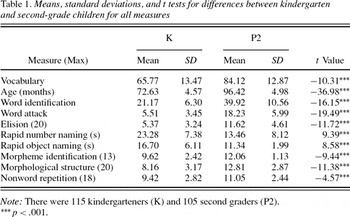
Means, standard deviations, and t tests for differences between kindergarten and second-grade children for all measures
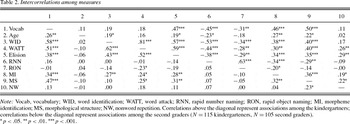
Intercorrelations among measures
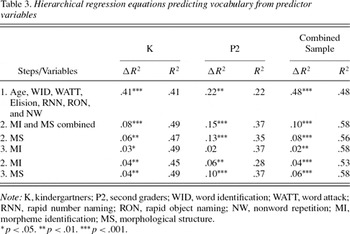
Hierarchical regression equations predicting vocabulary from predictor variables
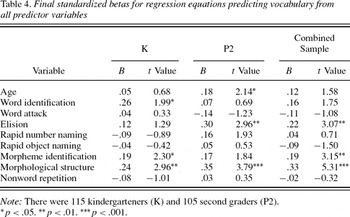
Final standardized betas for regression equations predicting vocabulary from all predictor variables
 You have
Access
- 219
- Cited by